wheel YAMAHA WR 250F 2004 User Guide
[x] Cancel search | Manufacturer: YAMAHA, Model Year: 2004, Model line: WR 250F, Model: YAMAHA WR 250F 2004Pages: 864, PDF Size: 22.07 MB
Page 94 of 864
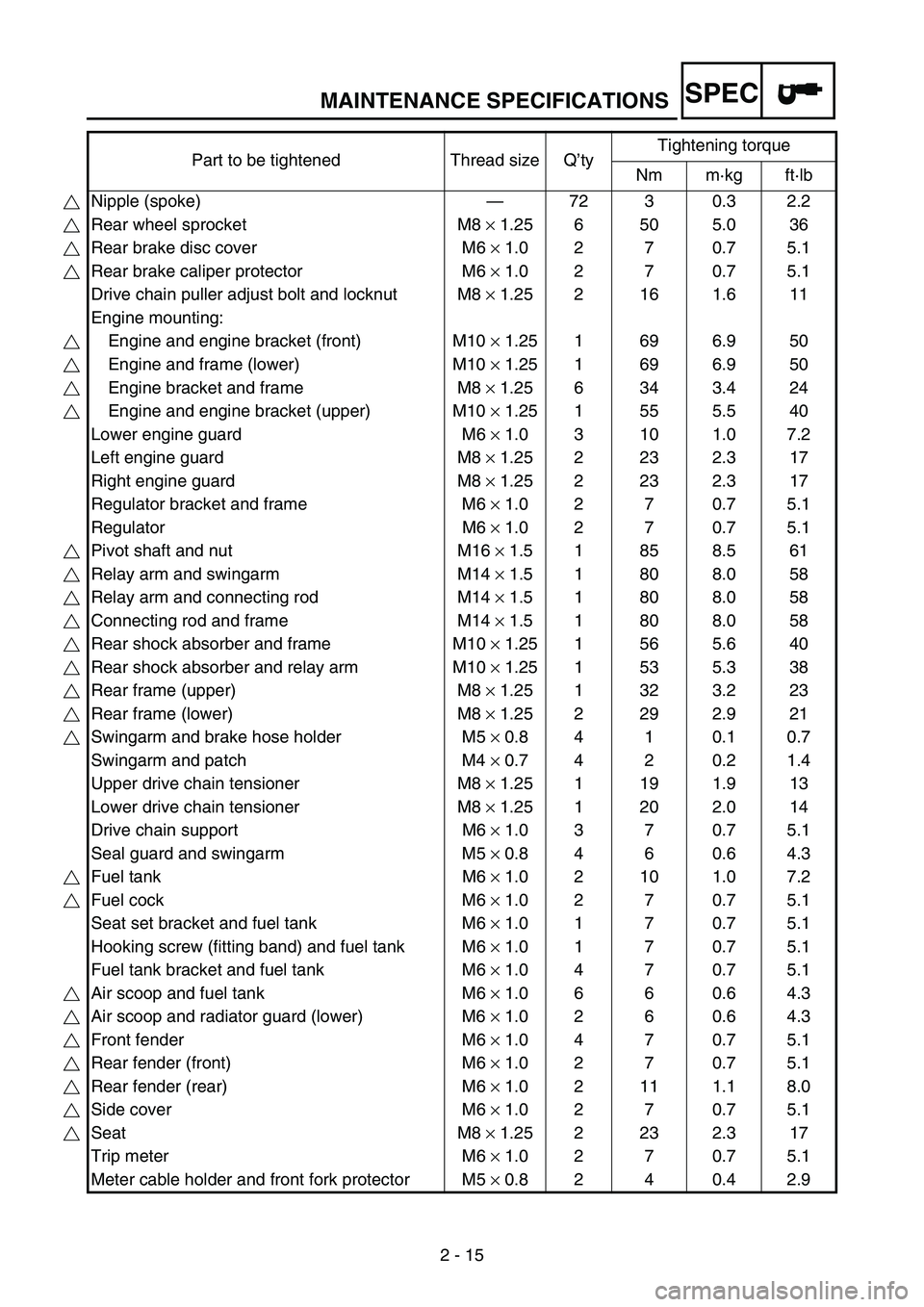
MAINTENANCE SPECIFICATIONS
2 - 15
SPEC
Part to be tightened Thread size Q’tyTightening torque
Nm m·kg ft·lb
Nipple (spoke)—72 3 0.3 2.2
Rear wheel sprocket M8 × 1.25 6 50 5.0 36
Rear brake disc cover M6 × 1.0 2 7 0.7 5.1
Rear brake caliper protector M6 × 1.0 2 7 0.7 5.1
Drive chain puller adjust bolt and locknut M8 × 1.25 2 16 1.6 11
Engine mounting:
Engine and engine bracket (front) M10 × 1.25 1 69 6.9 50
Engine and frame (lower) M10 × 1.25 1 69 6.9 50
Engine bracket and frame M8 × 1.25 6 34 3.4 24
Engine and engine bracket (upper) M10 × 1.25 1 55 5.5 40
Lower engine guard M6 × 1.0 3 10 1.0 7.2
Left engine guard M8 × 1.25 2 23 2.3 17
Right engine guard M8 × 1.25 2 23 2.3 17
Regulator bracket and frame M6 × 1.0 2 7 0.7 5.1
Regulator M6 × 1.0 2 7 0.7 5.1
Pivot shaft and nut M16 × 1.5 1 85 8.5 61
Relay arm and swingarm M14 × 1.5 1 80 8.0 58
Relay arm and connecting rod M14 × 1.5 1 80 8.0 58
Connecting rod and frame M14 × 1.5 1 80 8.0 58
Rear shock absorber and frame M10 × 1.25 1 56 5.6 40
Rear shock absorber and relay arm M10 × 1.25 1 53 5.3 38
Rear frame (upper) M8 × 1.25 1 32 3.2 23
Rear frame (lower) M8 × 1.25 2 29 2.9 21
Swingarm and brake hose holder M5 × 0.8 4 1 0.1 0.7
Swingarm and patch M4 × 0.7 4 2 0.2 1.4
Upper drive chain tensioner M8 × 1.25 1 19 1.9 13
Lower drive chain tensioner M8 × 1.25 1 20 2.0 14
Drive chain support M6 × 1.0 3 7 0.7 5.1
Seal guard and swingarm M5 × 0.8 4 6 0.6 4.3
Fuel tank M6 × 1.0 2 10 1.0 7.2
Fuel cock M6 × 1.0 2 7 0.7 5.1
Seat set bracket and fuel tank M6 × 1.0 1 7 0.7 5.1
Hooking screw (fitting band) and fuel tank M6 × 1.0 1 7 0.7 5.1
Fuel tank bracket and fuel tank M6 × 1.0 4 7 0.7 5.1
Air scoop and fuel tank M6 × 1.0 6 6 0.6 4.3
Air scoop and radiator guard (lower) M6 × 1.0 2 6 0.6 4.3
Front fender M6 × 1.0 4 7 0.7 5.1
Rear fender (front) M6 × 1.0 2 7 0.7 5.1
Rear fender (rear) M6 × 1.0 2 11 1.1 8.0
Side cover M6 × 1.0 2 7 0.7 5.1
Seat M8 × 1.25 2 23 2.3 17
Trip meter M6 × 1.0 2 7 0.7 5.1
Meter cable holder and front fork protector M5 × 0.8 2 4 0.4 2.9
Page 194 of 864
3 - 3
INSP
ADJ
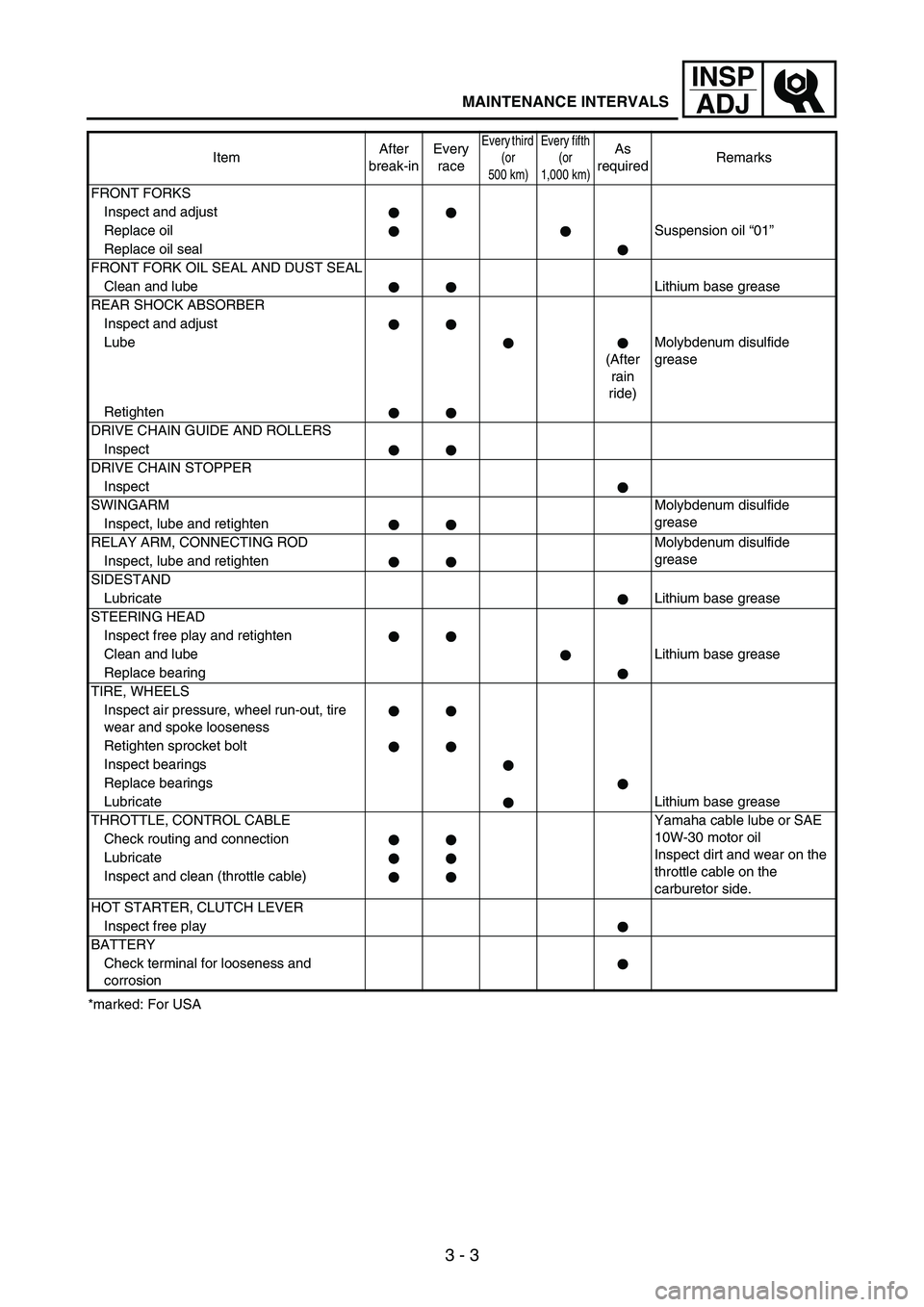
MAINTENANCE INTERVALS
*marked: For USAFRONT FORKS
Inspect and adjust
Replace oilSuspension oil “01”
Replace oil seal
FRONT FORK OIL SEAL AND DUST SEAL
Clean and lubeLithium base grease
REAR SHOCK ABSORBER
Inspect and adjust
Lube
(After
rain
ride)Molybdenum disulfide
grease
Retighten
DRIVE CHAIN GUIDE AND ROLLERS
Inspect
DRIVE CHAIN STOPPER
Inspect
SWINGARMMolybdenum disulfide
grease
Inspect, lube and retighten
RELAY ARM, CONNECTING ROD Molybdenum disulfide
grease
Inspect, lube and retighten
SIDESTAND
LubricateLithium base grease
STEERING HEAD
Inspect free play and retighten
Clean and lubeLithium base grease
Replace bearing
TIRE, WHEELS
Inspect air pressure, wheel run-out, tire
wear and spoke looseness
Retighten sprocket bolt
Inspect bearings
Replace bearings
LubricateLithium base grease
THROTTLE, CONTROL CABLE Yamaha cable lube or SAE
10W-30 motor oil
Inspect dirt and wear on the
throttle cable on the
carburetor side. Check routing and connection
Lubricate
Inspect and clean (throttle cable)
HOT STARTER, CLUTCH LEVER
Inspect free play
BATTERY
Check terminal for looseness and
corrosionItemAfter
break-inEvery
race
Every third
(or
500 km)Every fifth
(or
1,000 km)As
requiredRemarks
Page 207 of 864
3 - 16
INSP
ADJ
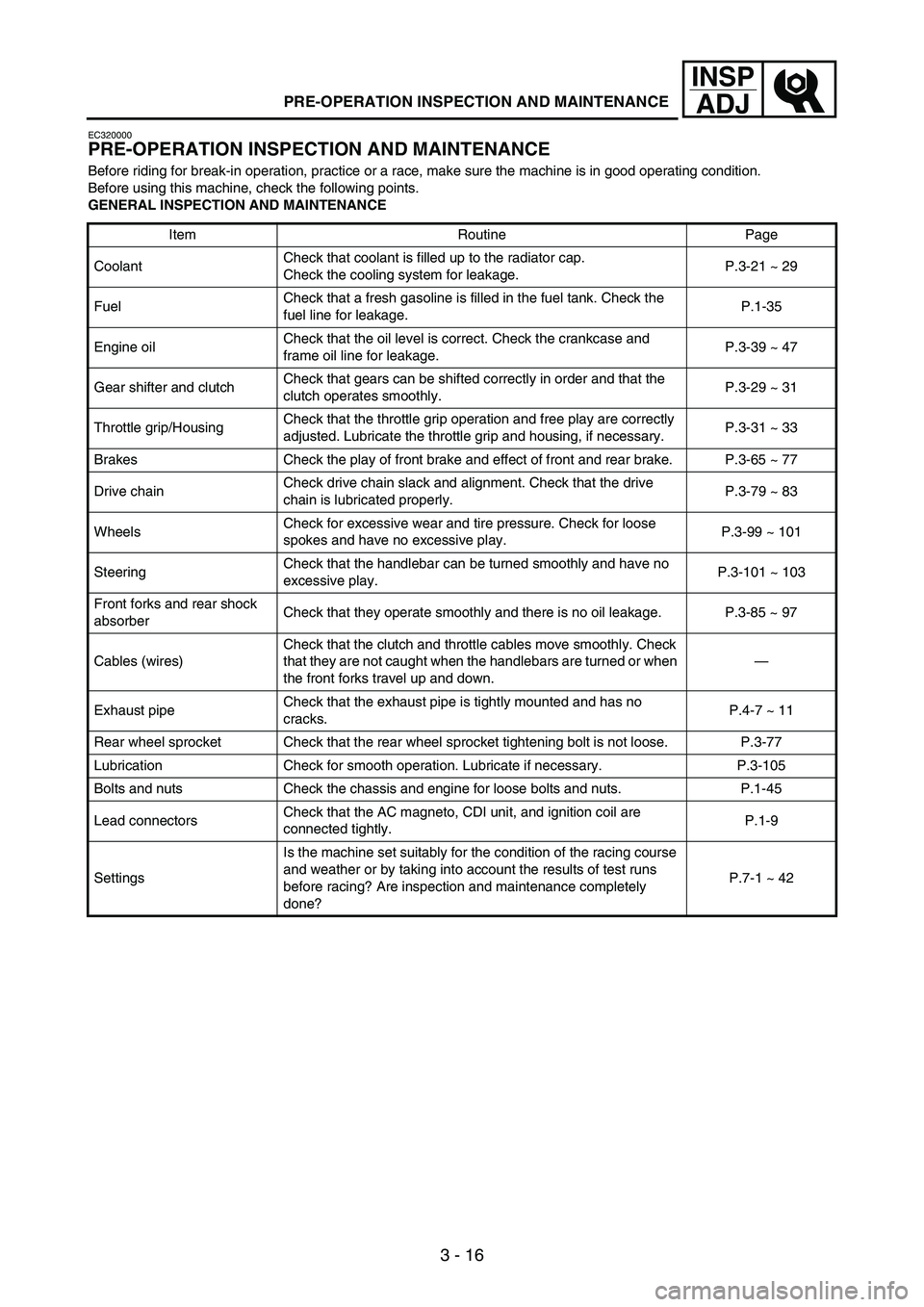
PRE-OPERATION INSPECTION AND MAINTENANCE
EC320000
PRE-OPERATION INSPECTION AND MAINTENANCE
Before riding for break-in operation, practice or a race, make sure the machine is in good operating condition.
Before using this machine, check the following points.
GENERAL INSPECTION AND MAINTENANCE
Item Routine Page
CoolantCheck that coolant is filled up to the radiator cap.
Check the cooling system for leakage.P.3-21 ~ 29
FuelCheck that a fresh gasoline is filled in the fuel tank. Check the
fuel line for leakage.P.1-35
Engine oilCheck that the oil level is correct. Check the crankcase and
frame oil line for leakage.P.3-39 ~ 47
Gear shifter and clutchCheck that gears can be shifted correctly in order and that the
clutch operates smoothly.P.3-29 ~ 31
Throttle grip/HousingCheck that the throttle grip operation and free play are correctly
adjusted. Lubricate the throttle grip and housing, if necessary.P.3-31 ~ 33
Brakes Check the play of front brake and effect of front and rear brake. P.3-65 ~ 77
Drive chainCheck drive chain slack and alignment. Check that the drive
chain is lubricated properly.P.3-79 ~ 83
WheelsCheck for excessive wear and tire pressure. Check for loose
spokes and have no excessive play.P.3-99 ~ 101
SteeringCheck that the handlebar can be turned smoothly and have no
excessive play.P.3-101 ~ 103
Front forks and rear shock
absorberCheck that they operate smoothly and there is no oil leakage. P.3-85 ~ 97
Cables (wires)Check that the clutch and throttle cables move smoothly. Check
that they are not caught when the handlebars are turned or when
the front forks travel up and down.—
Exhaust pipeCheck that the exhaust pipe is tightly mounted and has no
cracks.P.4-7 ~ 11
Rear wheel sprocket Check that the rear wheel sprocket tightening bolt is not loose. P.3-77
Lubrication Check for smooth operation. Lubricate if necessary. P.3-105
Bolts and nuts Check the chassis and engine for loose bolts and nuts. P.1-45
Lead connectorsCheck that the AC magneto, CDI unit, and ignition coil are
connected tightly.P.1-9
SettingsIs the machine set suitably for the condition of the racing course
and weather or by taking into account the results of test runs
before racing? Are inspection and maintenance completely
done?P.7-1 ~ 42
Page 264 of 864
3 - 73
INSP
ADJ
4. Check:
Brake lever operation
A softy or spongy feeling
→
Bleed brake system.
Refer to “BRAKE SYSTEM
AIR BLEEDING” section.
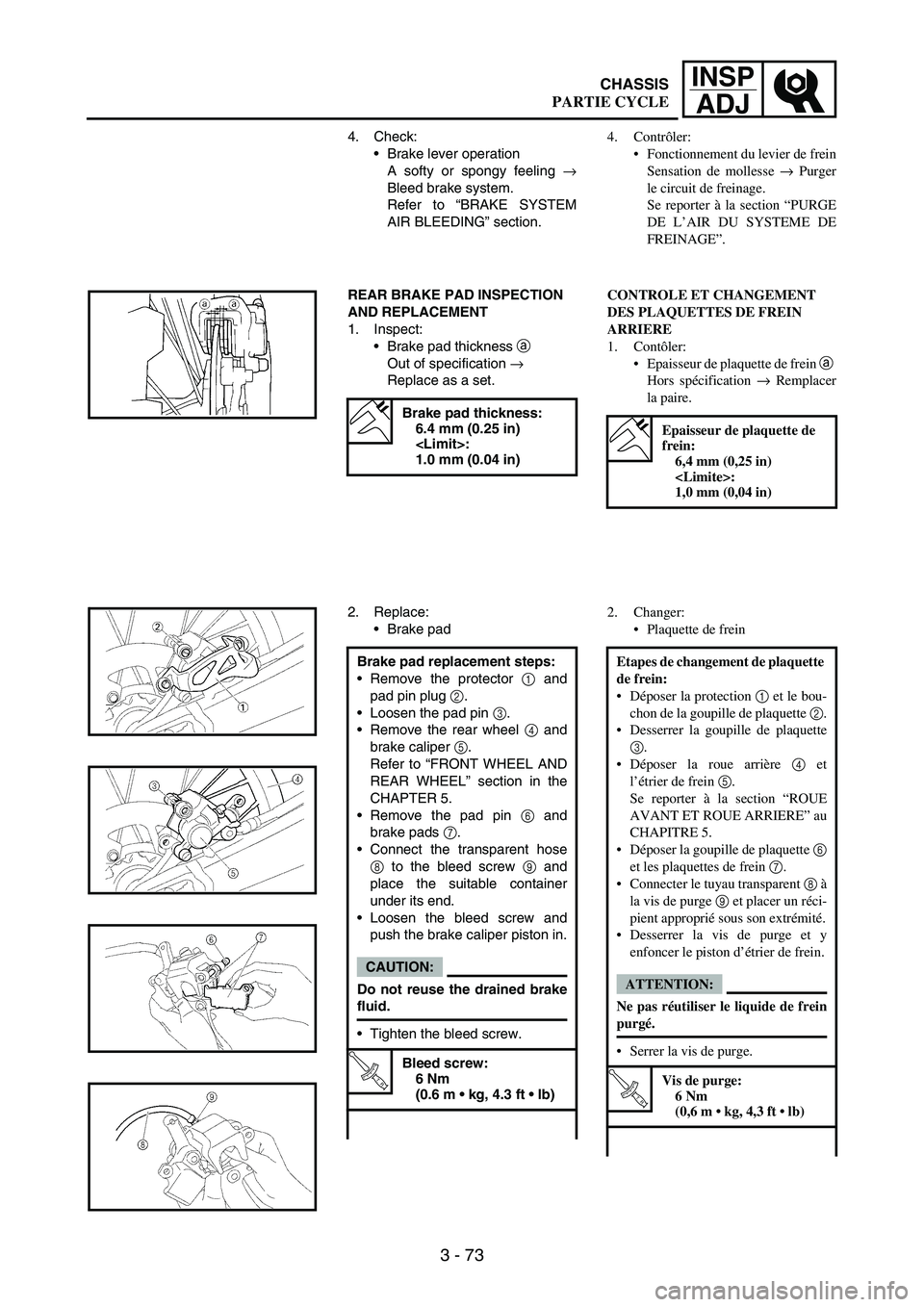
REAR BRAKE PAD INSPECTION
AND REPLACEMENT
1. Inspect:
Brake pad thickness
a
Out of specification
→
Replace as a set.
Brake pad thickness:
6.4 mm (0.25 in)
1.0 mm (0.04 in)
2. Replace:
Brake pad
Brake pad replacement steps:
Remove the protector
1 and
pad pin plug
2.
Loosen the pad pin
3.
Remove the rear wheel
4 and
brake caliper
5.
Refer to “FRONT WHEEL AND
REAR WHEEL” section in the
CHAPTER 5.
Remove the pad pin
6 and
brake pads
7.
Connect the transparent hose
8 to the bleed screw
9 and
place the suitable container
under its end.
Loosen the bleed screw and
push the brake caliper piston in.
CAUTION:
Do not reuse the drained brake
fluid.
Tighten the bleed screw.
T R..
Bleed screw:
6 Nm
(0.6 m kg, 4.3 ft lb)
4. Contrôler:
Fonctionnement du levier de frein
Sensation de mollesse → Purger
le circuit de freinage.
Se reporter à la section “PURGE
DE L’AIR DU SYSTEME DE
FREINAGE”.
CONTROLE ET CHANGEMENT
DES PLAQUETTES DE FREIN
ARRIERE
1. Contôler:
Epaisseur de plaquette de frein a
Hors spécification → Remplacer
la paire.
Epaisseur de plaquette de
frein:
6,4 mm (0,25 in)
1,0 mm (0,04 in)
2. Changer:
Plaquette de frein
Etapes de changement de plaquette
de frein:
Déposer la protection 1 et le bou-
chon de la goupille de plaquette 2.
Desserrer la goupille de plaquette
3.
Déposer la roue arrière 4 et
l’étrier de frein 5.
Se reporter à la section “ROUE
AVANT ET ROUE ARRIERE” au
CHAPITRE 5.
Déposer la goupille de plaquette 6
et les plaquettes de frein 7.
Connecter le tuyau transparent 8 à
la vis de purge 9 et placer un réci-
pient approprié sous son extrémité.
Desserrer la vis de purge et y
enfoncer le piston d’étrier de frein.
ATTENTION:
Ne pas réutiliser le liquide de frein
purgé.
Serrer la vis de purge.
T R..
Vis de purge:
6 Nm
(0,6 m kg, 4,3 ft lb)
CHASSIS
PARTIE CYCLE
Page 266 of 864
3 - 75
INSP
ADJ
3. Inspect:
Brake fluid level
Refer to “BRAKE FLUID
LEVEL INSPECTION” section.
4. Check:
Brake pedal operation
A softy or spongy feeling
→
Bleed brake system.
Refer to “BRAKE SYSTEM
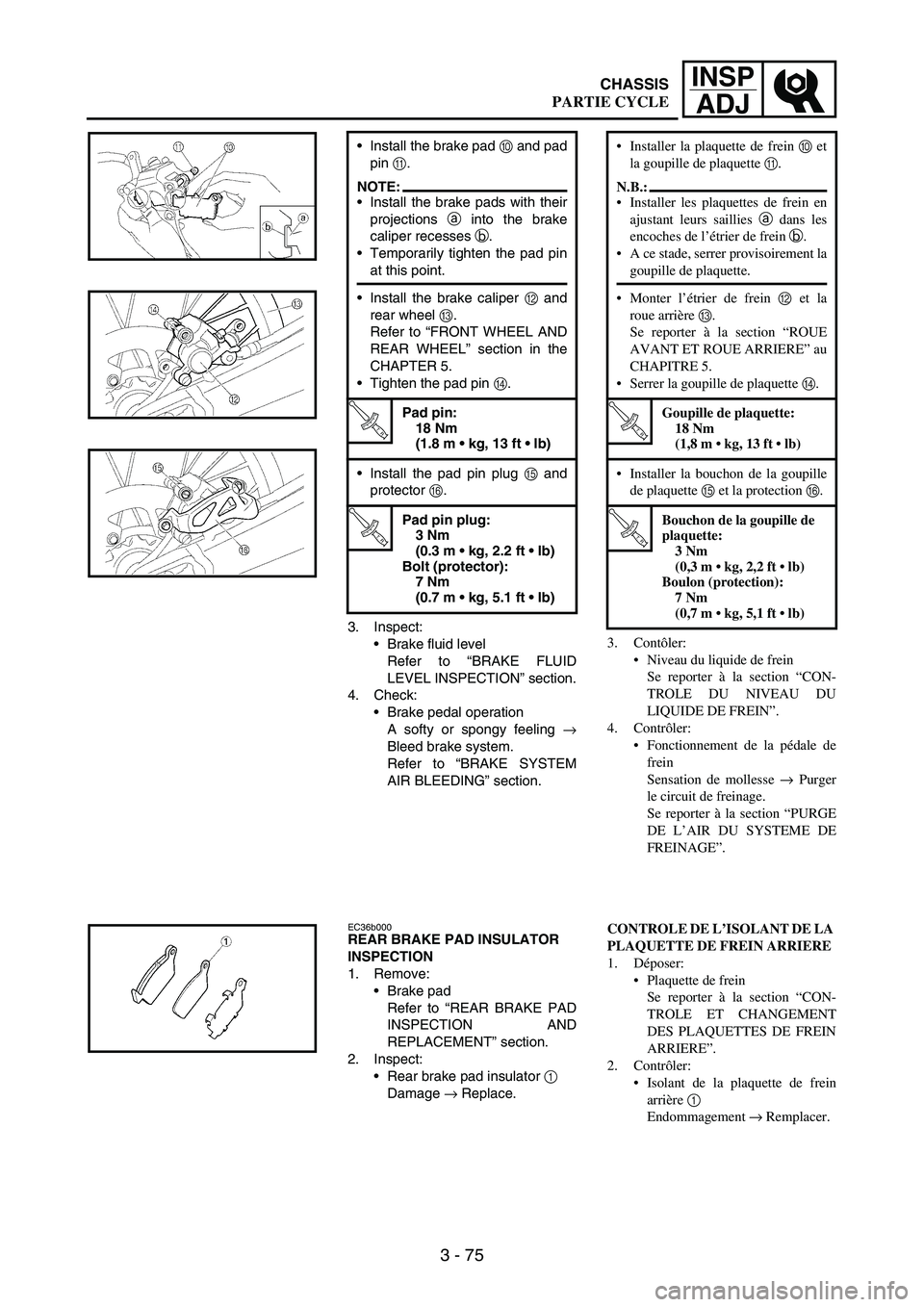
AIR BLEEDING” section. Install the brake pad
0 and pad
pin
A.
NOTE:Install the brake pads with their
projections
a into the brake
caliper recesses
b.
Temporarily tighten the pad pin
at this point.
Install the brake caliper
B and
rear wheel
C.
Refer to “FRONT WHEEL AND
REAR WHEEL” section in the
CHAPTER 5.
Tighten the pad pin
D.
T R..
Pad pin:
18 Nm
(1.8 m kg, 13 ft lb)
Install the pad pin plug
E and
protector
F.
T R..
Pad pin plug:
3 Nm
(0.3 m kg, 2.2 ft lb)
Bolt (protector):
7 Nm
(0.7 m kg, 5.1 ft lb)
EC36b000REAR BRAKE PAD INSULATOR
INSPECTION
1. Remove:
Brake pad
Refer to “REAR BRAKE PAD
INSPECTION AND
REPLACEMENT” section.
2. Inspect:
Rear brake pad insulator
1
Damage
→ Replace.
3. Contôler:
Niveau du liquide de frein
Se reporter à la section “CON-
TROLE DU NIVEAU DU
LIQUIDE DE FREIN”.
4. Contrôler:
Fonctionnement de la pédale de
frein
Sensation de mollesse → Purger
le circuit de freinage.
Se reporter à la section “PURGE
DE L’AIR DU SYSTEME DE
FREINAGE”. Installer la plaquette de frein 0 et
la goupille de plaquette A.
N.B.:
Installer les plaquettes de frein en
ajustant leurs saillies a dans les
encoches de l’étrier de frein b.
A ce stade, serrer provisoirement la
goupille de plaquette.
Monter l’étrier de frein B et la
roue arrière C.
Se reporter à la section “ROUE
AVANT ET ROUE ARRIERE” au
CHAPITRE 5.
Serrer la goupille de plaquette D.
T R..
Goupille de plaquette:
18 Nm
(1,8 m kg, 13 ft lb)
Installer la bouchon de la goupille
de plaquette E et la protection F.
T R..
Bouchon de la goupille de
plaquette:
3 Nm
(0,3 m kg, 2,2 ft lb)
Boulon (protection):
7 Nm
(0,7 m kg, 5,1 ft lb)
CONTROLE DE L’ISOLANT DE LA
PLAQUETTE DE FREIN ARRIERE
1. Déposer:
Plaquette de frein
Se reporter à la section “CON-
TROLE ET CHANGEMENT
DES PLAQUETTES DE FREIN
ARRIERE”.
2. Contrôler:
Isolant de la plaquette de frein
arrière 1
Endommagement → Remplacer.
CHASSIS
PARTIE CYCLE
Page 268 of 864
3 - 77
INSP
ADJ
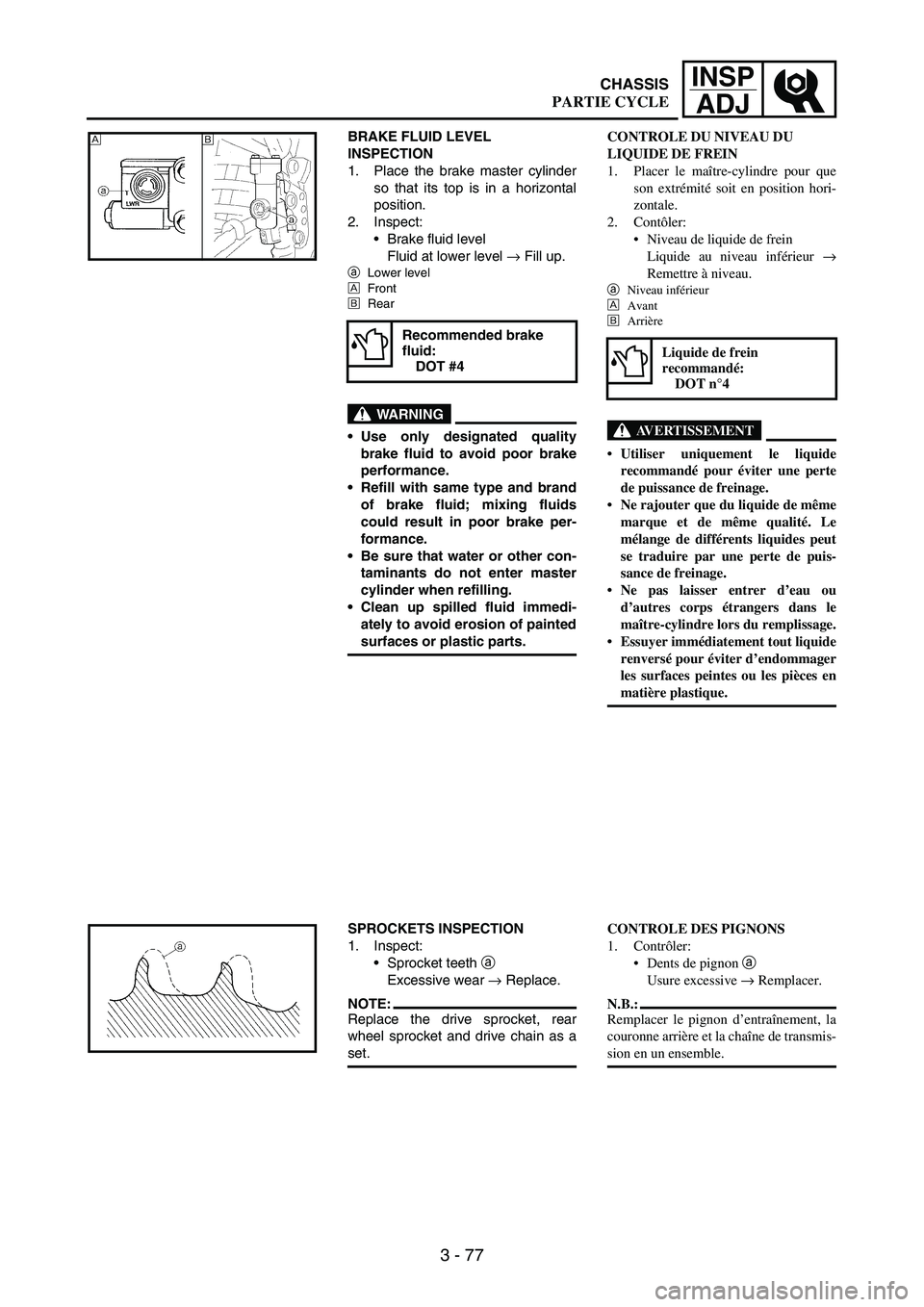
BRAKE FLUID LEVEL
INSPECTION
1. Place the brake master cylinder
so that its top is in a horizontal
position.
2. Inspect:
Brake fluid level
Fluid at lower level
→ Fill up.
aLower level
ÈFront
ÉRear
WARNING
Use only designated quality
brake fluid to avoid poor brake
performance.
Refill with same type and brand
of brake fluid; mixing fluids
could result in poor brake per-
formance.
Be sure that water or other con-
taminants do not enter master
cylinder when refilling.
Clean up spilled fluid immedi-
ately to avoid erosion of painted
surfaces or plastic parts.
Recommended brake
fluid:
DOT #4
ÈÉ
SPROCKETS INSPECTION
1. Inspect:
Sprocket teeth
a
Excessive wear
→ Replace.
NOTE:Replace the drive sprocket, rear
wheel sprocket and drive chain as a
set.
CONTROLE DU NIVEAU DU
LIQUIDE DE FREIN
1. Placer le maître-cylindre pour que
son extrémité soit en position hori-
zontale.
2. Contôler:
Niveau de liquide de frein
Liquide au niveau inférieur →
Remettre à niveau.
a
Niveau inférieur
È
Avant
É
Arrière
AVERTISSEMENT
Utiliser uniquement le liquide
recommandé pour éviter une perte
de puissance de freinage.
Ne rajouter que du liquide de même
marque et de même qualité. Le
mélange de différents liquides peut
se traduire par une perte de puis-
sance de freinage.
Ne pas laisser entrer d’eau ou
d’autres corps étrangers dans le
maître-cylindre lors du remplissage.
Essuyer immédiatement tout liquide
renversé pour éviter d’endommager
les surfaces peintes ou les pièces en
matière plastique.
Liquide de frein
recommandé:
DOT n°4
CONTROLE DES PIGNONS
1. Contrôler:
Dents de pignon
a
Usure excessive → Remplacer.
N.B.:
Remplacer le pignon d’entraînement, la
couronne arrière et la chaîne de transmis-
sion en un ensemble.
CHASSIS
PARTIE CYCLE
Page 272 of 864
3 - 81
INSP
ADJ
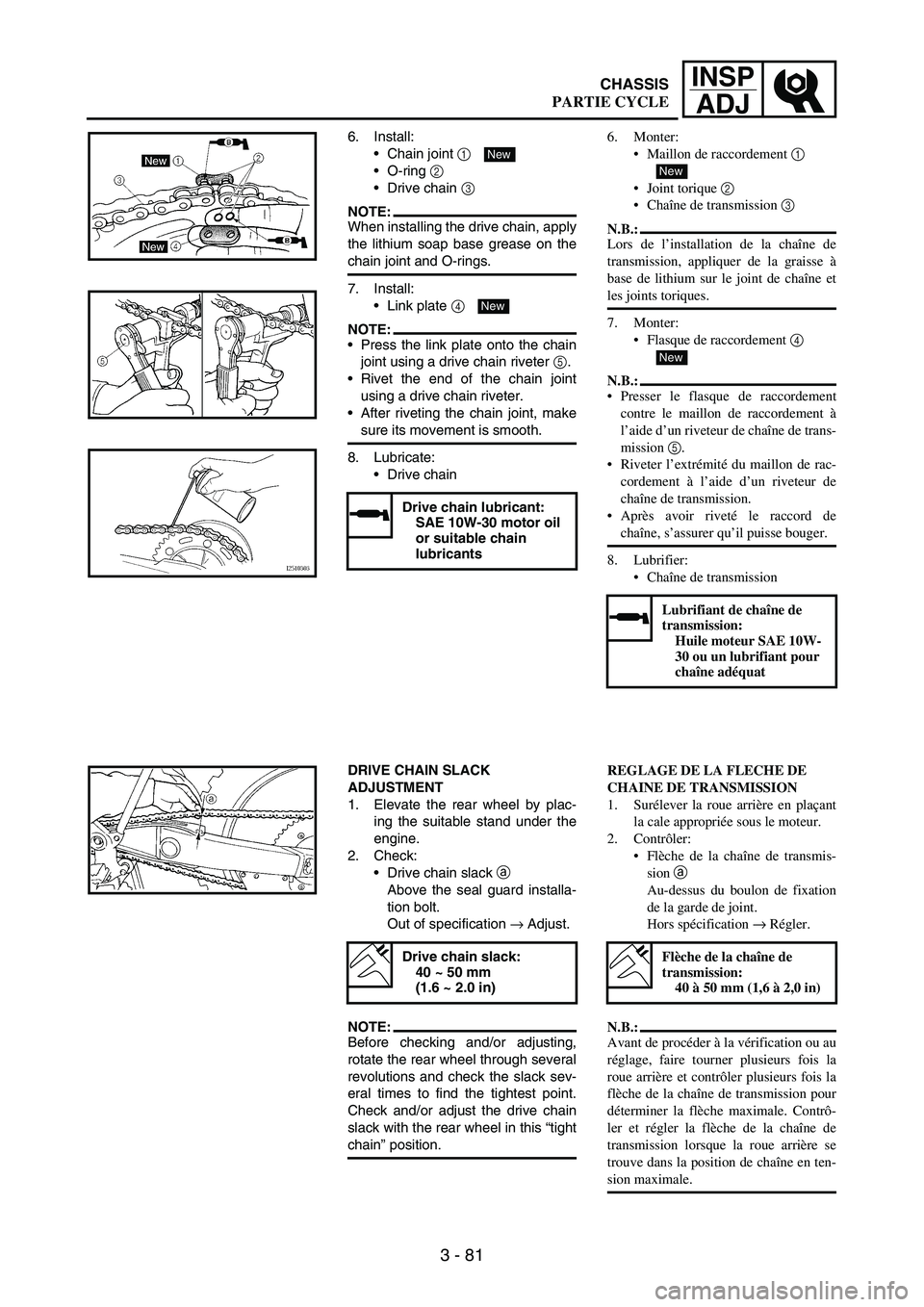
6. Install:
Chain joint
1
O-ring
2
Drive chain
3
NOTE:When installing the drive chain, apply
the lithium soap base grease on the
chain joint and O-rings.
7. Install:
Link plate
4
NOTE:Press the link plate onto the chain
joint using a drive chain riveter
5.
Rivet the end of the chain joint
using a drive chain riveter.
After riveting the chain joint, make
sure its movement is smooth.
8. Lubricate:
Drive chain
Drive chain lubricant:
SAE 10W-30 motor oil
or suitable chain
lubricants
New
New
DRIVE CHAIN SLACK
ADJUSTMENT
1. Elevate the rear wheel by plac-
ing the suitable stand under the
engine.
2. Check:
Drive chain slack
a
Above the seal guard installa-
tion bolt.
Out of specification
→ Adjust.
NOTE:Before checking and/or adjusting,
rotate the rear wheel through several
revolutions and check the slack sev-
eral times to find the tightest point.
Check and/or adjust the drive chain
slack with the rear wheel in this “tight
chain” position.
Drive chain slack:
40 ~ 50 mm
(1.6 ~ 2.0 in)
6. Monter:
Maillon de raccordement 1
Joint torique 2
Chaîne de transmission 3
N.B.:
Lors de l’installation de la chaîne de
transmission, appliquer de la graisse à
base de lithium sur le joint de chaîne et
les joints toriques.
7. Monter:
Flasque de raccordement 4
N.B.:
Presser le flasque de raccordement
contre le maillon de raccordement à
l’aide d’un riveteur de chaîne de trans-
mission 5.
Riveter l’extrémité du maillon de rac-
cordement à l’aide d’un riveteur de
chaîne de transmission.
Après avoir riveté le raccord de
chaîne, s’assurer qu’il puisse bouger.
8. Lubrifier:
Chaîne de transmission
Lubrifiant de chaîne de
transmission:
Huile moteur SAE 10W-
30 ou un lubrifiant pour
chaîne adéquat
New
New
REGLAGE DE LA FLECHE DE
CHAINE DE TRANSMISSION
1. Surélever la roue arrière en plaçant
la cale appropriée sous le moteur.
2. Contrôler:
Flèche de la chaîne de transmis-
sion a
Au-dessus du boulon de fixation
de la garde de joint.
Hors spécification → Régler.
N.B.:
Avant de procéder à la vérification ou au
réglage, faire tourner plusieurs fois la
roue arrière et contrôler plusieurs fois la
flèche de la chaîne de transmission pour
déterminer la flèche maximale. Contrô-
ler et régler la flèche de la chaîne de
transmission lorsque la roue arrière se
trouve dans la position de chaîne en ten-
sion maximale.
Flèche de la chaîne de
transmission:
40 à 50 mm (1,6 à 2,0 in)
CHASSIS
PARTIE CYCLE
Page 274 of 864
3 - 83
INSP
ADJ
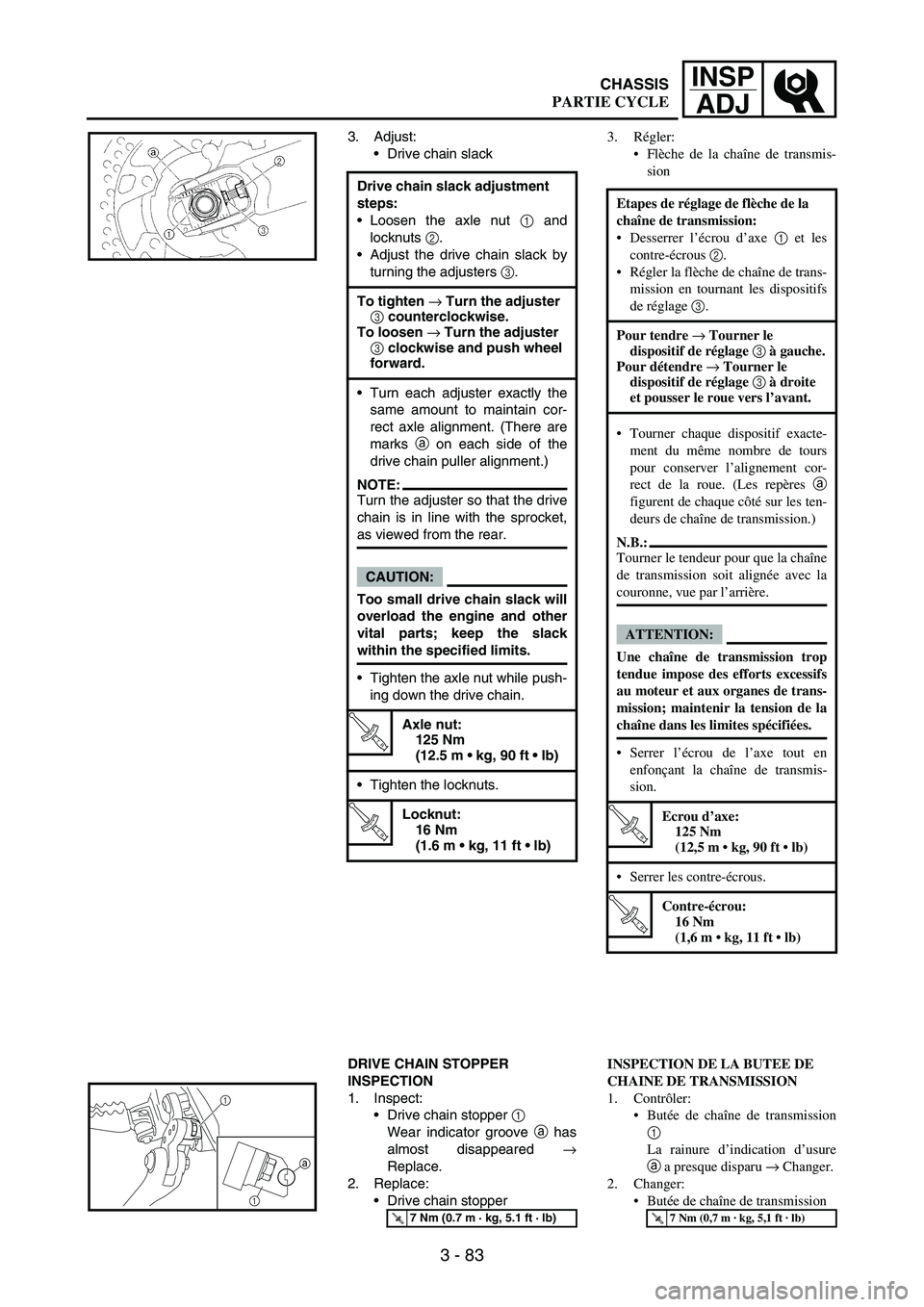
3. Adjust:
Drive chain slack
DRIVE CHAIN STOPPER
INSPECTION
1. Inspect:
Drive chain stopper
1
Wear indicator groove
a has
almost disappeared
→
Replace.
2. Replace:
Drive chain stopper Drive chain slack adjustment
steps:
Loosen the axle nut
1 and
locknuts
2.
Adjust the drive chain slack by
turning the adjusters
3.
To tighten → Turn the adjuster
3 counterclockwise.
To loosen → Turn the adjuster
3 clockwise and push wheel
forward.
Turn each adjuster exactly the
same amount to maintain cor-
rect axle alignment. (There are
marks
a on each side of the
drive chain puller alignment.)
NOTE:Turn the adjuster so that the drive
chain is in line with the sprocket,
as viewed from the rear.
CAUTION:
Too small drive chain slack will
overload the engine and other
vital parts; keep the slack
within the specified limits.
Tighten the axle nut while push-
ing down the drive chain.
T R..
Axle nut:
125 Nm
(12.5 m kg, 90 ft lb)
Tighten the locknuts.
T R..
Locknut:
16 Nm
(1.6 m kg, 11 ft lb)
T R..7 Nm (0.7 m · kg, 5.1 ft · lb)
1
1a
3. Régler:
Flèche de la chaîne de transmis-
sion
INSPECTION DE LA BUTEE DE
CHAINE DE TRANSMISSION
1. Contrôler:
Butée de chaîne de transmission
1
La rainure d’indication d’usure
a a presque disparu → Changer.
2. Changer:
Butée de chaîne de transmission Etapes de réglage de flèche de la
chaîne de transmission:
Desserrer l’écrou d’axe 1 et les
contre-écrous 2.
Régler la flèche de chaîne de trans-
mission en tournant les dispositifs
de réglage 3.
Pour tendre → Tourner le
dispositif de réglage 3 à gauche.
Pour détendre → Tourner le
dispositif de réglage 3 à droite
et pousser le roue vers l’avant.
Tourner chaque dispositif exacte-
ment du même nombre de tours
pour conserver l’alignement cor-
rect de la roue. (Les repères a
figurent de chaque côté sur les ten-
deurs de chaîne de transmission.)
N.B.:
Tourner le tendeur pour que la chaîne
de transmission soit alignée avec la
couronne, vue par l’arrière.
ATTENTION:
Une chaîne de transmission trop
tendue impose des efforts excessifs
au moteur et aux organes de trans-
mission; maintenir la tension de la
chaîne dans les limites spécifiées.
Serrer l’écrou de l’axe tout en
enfonçant la chaîne de transmis-
sion.
T R..
Ecrou d’axe:
125 Nm
(12,5 m kg, 90 ft lb)
Serrer les contre-écrous.
T R..
Contre-écrou:
16 Nm
(1,6 m kg, 11 ft lb)
T R..7 Nm (0,7 m · kg, 5,1 ft · lb)
CHASSIS
PARTIE CYCLE
Page 276 of 864
3 - 85
INSP
ADJ
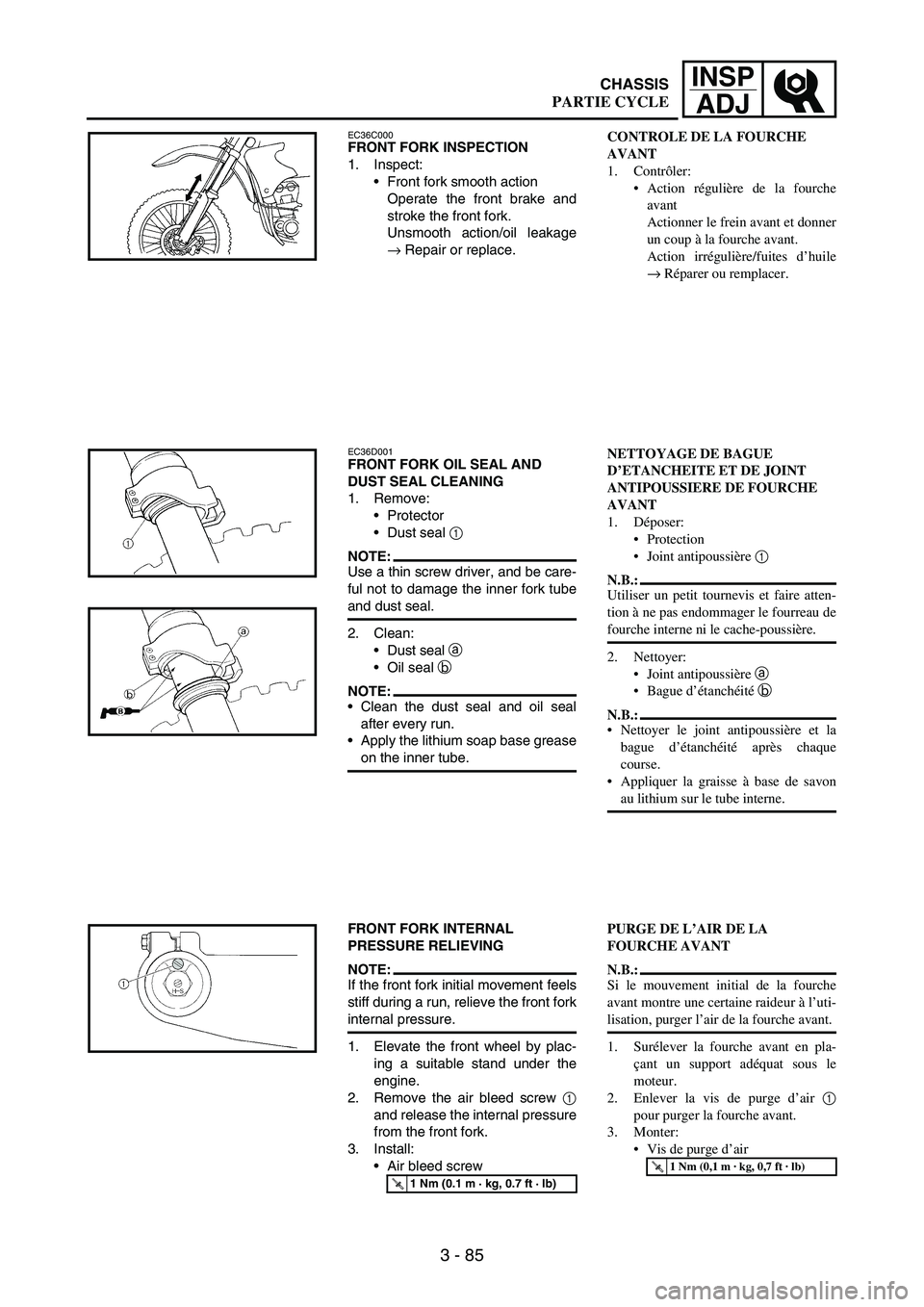
EC36C000FRONT FORK INSPECTION
1. Inspect:
Front fork smooth action
Operate the front brake and
stroke the front fork.
Unsmooth action/oil leakage
→ Repair or replace.
EC36D001FRONT FORK OIL SEAL AND
DUST SEAL CLEANING
1. Remove:
Protector
Dust seal
1
NOTE:Use a thin screw driver, and be care-
ful not to damage the inner fork tube
and dust seal.
2. Clean:
Dust seal
a
Oil seal
b
NOTE:Clean the dust seal and oil seal
after every run.
Apply the lithium soap base grease
on the inner tube.
FRONT FORK INTERNAL
PRESSURE RELIEVING
NOTE:If the front fork initial movement feels
stiff during a run, relieve the front fork
internal pressure.
1. Elevate the front wheel by plac-
ing a suitable stand under the
engine.
2. Remove the air bleed screw
1
and release the internal pressure
from the front fork.
3. Install:
Air bleed screw
T R..1 Nm (0.1 m · kg, 0.7 ft · lb)
CONTROLE DE LA FOURCHE
AVANT
1. Contrôler:
Action régulière de la fourche
avant
Actionner le frein avant et donner
un coup à la fourche avant.
Action irrégulière/fuites d’huile
→ Réparer ou remplacer.
NETTOYAGE DE BAGUE
D’ETANCHEITE ET DE JOINT
ANTIPOUSSIERE DE FOURCHE
AVANT
1. Déposer:
Protection
Joint antipoussière 1
N.B.:
Utiliser un petit tournevis et faire atten-
tion à ne pas endommager le fourreau de
fourche interne ni le cache-poussière.
2. Nettoyer:
Joint antipoussière a
Bague d’étanchéité b
N.B.:
Nettoyer le joint antipoussière et la
bague d’étanchéité après chaque
course.
Appliquer la graisse à base de savon
au lithium sur le tube interne.
PURGE DE L’AIR DE LA
FOURCHE AVANT
N.B.:
Si le mouvement initial de la fourche
avant montre une certaine raideur à l’uti-
lisation, purger l’air de la fourche avant.
1. Surélever la fourche avant en pla-
çant un support adéquat sous le
moteur.
2. Enlever la vis de purge d’air 1
pour purger la fourche avant.
3. Monter:
Vis de purge d’air
T R..1 Nm (0,1 m · kg, 0,7 ft · lb)
CHASSIS
PARTIE CYCLE
Page 282 of 864
3 - 91
INSP
ADJ
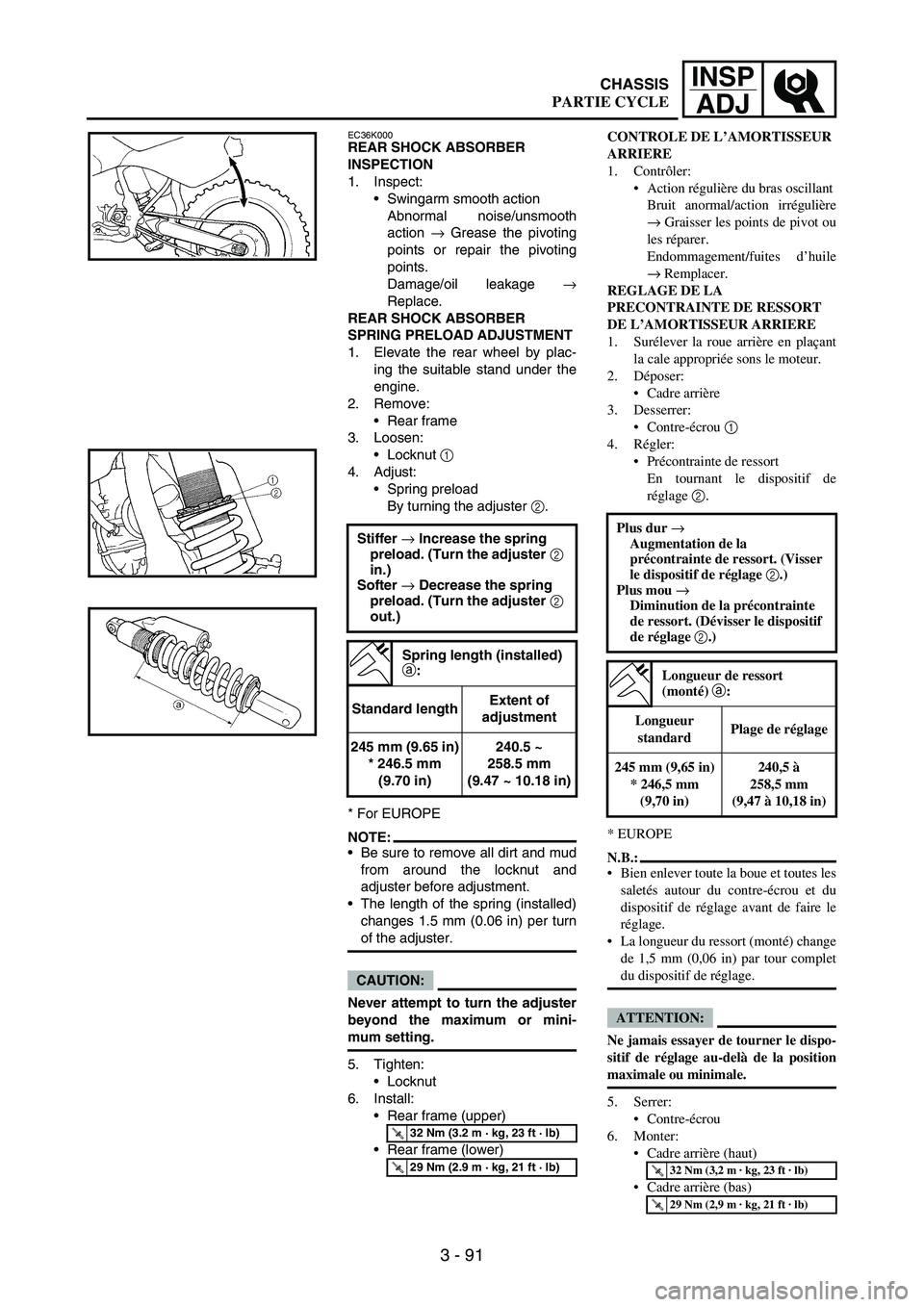
EC36K000REAR SHOCK ABSORBER
INSPECTION
1. Inspect:
Swingarm smooth action
Abnormal noise/unsmooth
action
→ Grease the pivoting
points or repair the pivoting
points.
Damage/oil leakage
→
Replace.
REAR SHOCK ABSORBER
SPRING PRELOAD ADJUSTMENT
1. Elevate the rear wheel by plac-
ing the suitable stand under the
engine.
2. Remove:
Rear frame
3. Loosen:
Locknut
1
4. Adjust:
Spring preload
By turning the adjuster
2.
* For EUROPE
NOTE:Be sure to remove all dirt and mud
from around the locknut and
adjuster before adjustment.
The length of the spring (installed)
changes 1.5 mm (0.06 in) per turn
of the adjuster.
CAUTION:
Never attempt to turn the adjuster
beyond the maximum or mini-
mum setting.
5. Tighten:
Locknut
6. Install:
Rear frame (upper)
Rear frame (lower) Stiffer → Increase the spring
preload. (Turn the adjuster 2
in.)
Softer → Decrease the spring
preload. (Turn the adjuster 2
out.)
Spring length (installed)
a:
Standard lengthExtent of
adjustment
245 mm (9.65 in)
* 246.5 mm
(9.70 in)240.5 ~
258.5 mm
(9.47 ~ 10.18 in)
T R..32 Nm (3.2 m · kg, 23 ft · lb)
T R..29 Nm (2.9 m · kg, 21 ft · lb)
CONTROLE DE L’AMORTISSEUR
ARRIERE
1. Contrôler:
Action régulière du bras oscillant
Bruit anormal/action irrégulière
→ Graisser les points de pivot ou
les réparer.
Endommagement/fuites d’huile
→ Remplacer.
REGLAGE DE LA
PRECONTRAINTE DE RESSORT
DE L’AMORTISSEUR ARRIERE
1. Surélever la roue arrière en plaçant
la cale appropriée sons le moteur.
2. Déposer:
Cadre arrière
3. Desserrer:
Contre-écrou 1
4. Régler:
Précontrainte de ressort
En tournant le dispositif de
réglage 2.
* EUROPE
N.B.:
Bien enlever toute la boue et toutes les
saletés autour du contre-écrou et du
dispositif de réglage avant de faire le
réglage.
La longueur du ressort (monté) change
de 1,5 mm (0,06 in) par tour complet
du dispositif de réglage.
ATTENTION:
Ne jamais essayer de tourner le dispo-
sitif de réglage au-delà de la position
maximale ou minimale.
5. Serrer:
Contre-écrou
6. Monter:
Cadre arrière (haut)
Cadre arrière (bas) Plus dur →
Augmentation de la
précontrainte de ressort. (Visser
le dispositif de réglage 2.)
Plus mou →
Diminution de la précontrainte
de ressort. (Dévisser le dispositif
de réglage 2.)
Longueur de ressort
(monté) a:
Longueur
standardPlage de réglage
245 mm (9,65 in)
* 246,5 mm
(9,70 in)240,5 à
258,5 mm
(9,47 à 10,18 in)
T R..32 Nm (3,2 m · kg, 23 ft · lb)
T R..29 Nm (2,9 m · kg, 21 ft · lb)
CHASSIS
PARTIE CYCLE