Starter YAMAHA WR 250F 2005 Owners Manual
[x] Cancel search | Manufacturer: YAMAHA, Model Year: 2005, Model line: WR 250F, Model: YAMAHA WR 250F 2005Pages: 864, PDF Size: 18.1 MB
Page 758 of 864
6 - 21
–+ELECELECTRIC STARTING SYSTEM
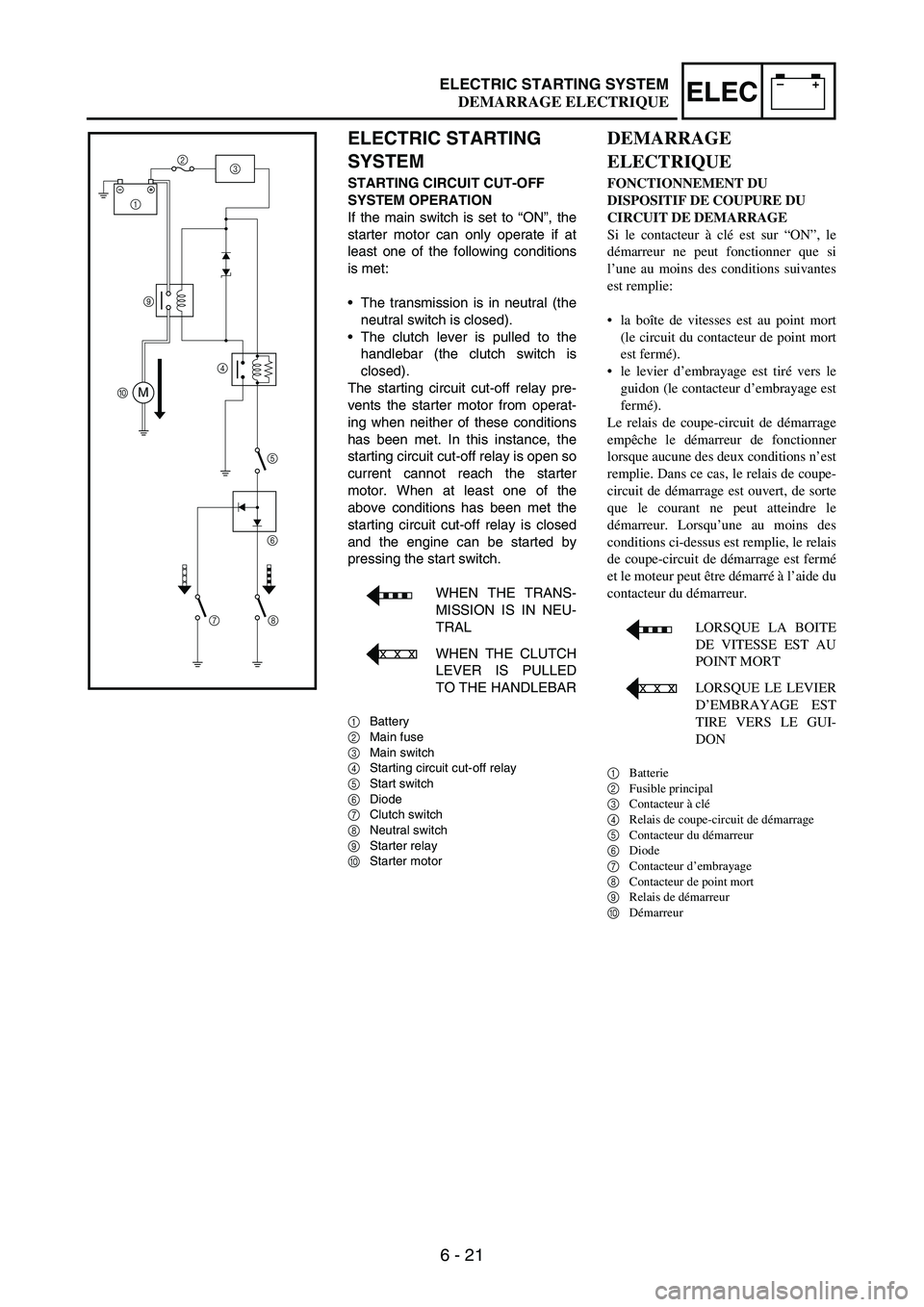
ELECTRIC STARTING
SYSTEM
STARTING CIRCUIT CUT-OFF
SYSTEM OPERATION
If the main switch is set to “ON”, the
starter motor can only operate if at
least one of the following conditions
is met:
The transmission is in neutral (the
neutral switch is closed).
The clutch lever is pulled to the
handlebar (the clutch switch is
closed).
The starting circuit cut-off relay pre-
vents the starter motor from operat-
ing when neither of these conditions
has been met. In this instance, the
starting circuit cut-off relay is open so
current cannot reach the starter
motor. When at least one of the
above conditions has been met the
starting circuit cut-off relay is closed
and the engine can be started by
pressing the start switch.
WHEN THE TRANS-
MISSION IS IN NEU-
TRAL
WHEN THE CLUTCH
LEVER IS PULLED
TO THE HANDLEBAR
1Battery
2Main fuse
3Main switch
4Starting circuit cut-off relay
5Start switch
6Diode
7Clutch switch
8Neutral switch
9Starter relay
0Starter motor
12
M
3
4
5
8 76 9
0
DEMARRAGE
ELECTRIQUE
FONCTIONNEMENT DU
DISPOSITIF DE COUPURE DU
CIRCUIT DE DEMARRAGE
Si le contacteur à clé est sur “ON”, le
démarreur ne peut fonctionner que si
l’une au moins des conditions suivantes
est remplie:
la boîte de vitesses est au point mort
(le circuit du contacteur de point mort
est fermé).
le levier d’embrayage est tiré vers le
guidon (le contacteur d’embrayage est
fermé).
Le relais de coupe-circuit de démarrage
empêche le démarreur de fonctionner
lorsque aucune des deux conditions n’est
remplie. Dans ce cas, le relais de coupe-
circuit de démarrage est ouvert, de sorte
que le courant ne peut atteindre le
démarreur. Lorsqu’une au moins des
conditions ci-dessus est remplie, le relais
de coupe-circuit de démarrage est fermé
et le moteur peut être démarré à l’aide du
contacteur du démarreur.
LORSQUE LA BOITE
DE VITESSE EST AU
POINT MORT
LORSQUE LE LEVIER
D’EMBRAYAGE EST
TIRE VERS LE GUI-
DON
1
Batterie
2
Fusible principal
3
Contacteur à clé
4
Relais de coupe-circuit de démarrage
5
Contacteur du démarreur
6
Diode
7
Contacteur d’embrayage
8
Contacteur de point mort
9
Relais de démarreur
0
Démarreur
DEMARRAGE ELECTRIQUE
Page 759 of 864
6 - 22
–+ELEC
E-STARTER
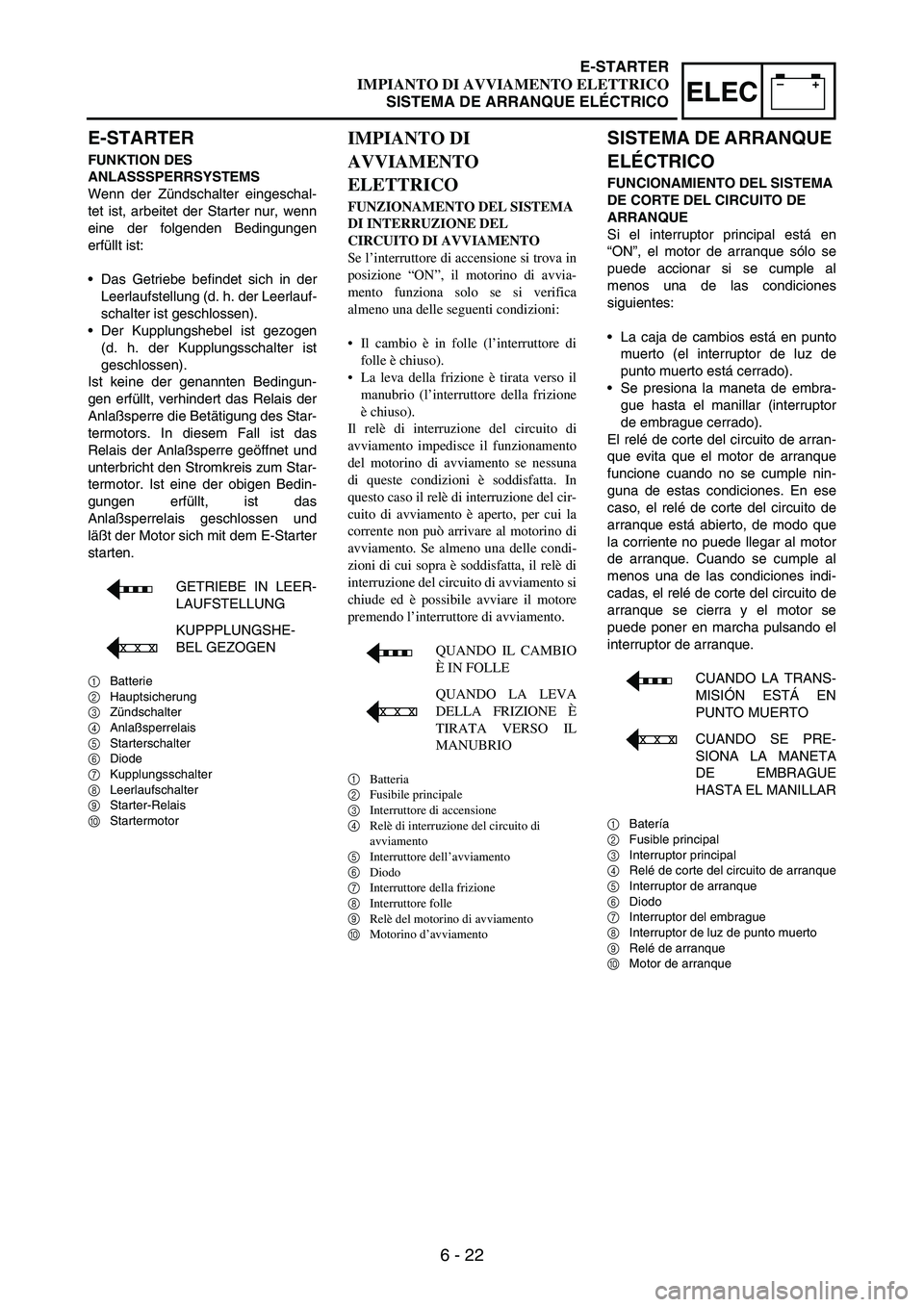
FUNKTION DES
ANLASSSPERRSYSTEMS
Wenn der Zündschalter eingeschal-
tet ist, arbeitet der Starter nur, wenn
eine der folgenden Bedingungen
erfüllt ist:
Das Getriebe befindet sich in der
Leerlaufstellung (d. h. der Leerlauf-
schalter ist geschlossen).
Der Kupplungshebel ist gezogen
(d. h. der Kupplungsschalter ist
geschlossen).
Ist keine der genannten Bedingun-
gen erfüllt, verhindert das Relais der
Anlaßsperre die Betätigung des Star-
termotors. In diesem Fall ist das
Relais der Anlaßsperre geöffnet und
unterbricht den Stromkreis zum Star-
termotor. Ist eine der obigen Bedin-
gungen erfüllt, ist das
Anlaßsperrelais geschlossen und
läßt der Motor sich mit dem E-Starter
starten.
GETRIEBE IN LEER-
LAUFSTELLUNG
KUPPPLUNGSHE-
BEL GEZOGEN
1Batterie
2Hauptsicherung
3Zündschalter
4Anlaßsperrelais
5Starterschalter
6Diode
7Kupplungsschalter
8Leerlaufschalter
9Starter-Relais
0Startermotor
IMPIANTO DI
AVVIAMENTO
ELETTRICO
FUNZIONAMENTO DEL SISTEMA
DI INTERRUZIONE DEL
CIRCUITO DI AVVIAMENTO
Se l’interruttore di accensione si trova in
posizione “ON”, il motorino di avvia-
mento funziona solo se si verifica
almeno una delle seguenti condizioni:
Il cambio è in folle (l’interruttore di
folle è chiuso).
La leva della frizione è tirata verso il
manubrio (l’interruttore della frizione
è chiuso).
Il relè di interruzione del circuito di
avviamento impedisce il funzionamento
del motorino di avviamento se nessuna
di queste condizioni è soddisfatta. In
questo caso il relè di interruzione del cir-
cuito di avviamento è aperto, per cui la
corrente non può arrivare al motorino di
avviamento. Se almeno una delle condi-
zioni di cui sopra è soddisfatta, il relè di
interruzione del circuito di avviamento si
chiude ed è possibile avviare il motore
premendo l’interruttore di avviamento.
QUANDO IL CAMBIO
È IN FOLLE
QUANDO LA LEVA
DELLA FRIZIONE È
TIRATA VERSO IL
MANUBRIO
1
Batteria
2
Fusibile principale
3
Interruttore di accensione
4
Relè di interruzione del circuito di
avviamento
5
Interruttore dell’avviamento
6
Diodo
7
Interruttore della frizione
8
Interruttore folle
9
Relè del motorino di avviamento
0
Motorino d’avviamento
SISTEMA DE ARRANQUE
ELÉCTRICO
FUNCIONAMIENTO DEL SISTEMA
DE CORTE DEL CIRCUITO DE
ARRANQUE
Si el interruptor principal está en
“ON”, el motor de arranque sólo se
puede accionar si se cumple al
menos una de las condiciones
siguientes:
La caja de cambios está en punto
muerto (el interruptor de luz de
punto muerto está cerrado).
Se presiona la maneta de embra-
gue hasta el manillar (interruptor
de embrague cerrado).
El relé de corte del circuito de arran-
que evita que el motor de arranque
funcione cuando no se cumple nin-
guna de estas condiciones. En ese
caso, el relé de corte del circuito de
arranque está abierto, de modo que
la corriente no puede llegar al motor
de arranque. Cuando se cumple al
menos una de las condiciones indi-
cadas, el relé de corte del circuito de
arranque se cierra y el motor se
puede poner en marcha pulsando el
interruptor de arranque.
CUANDO LA TRANS-
MISIÓN ESTÁ EN
PUNTO MUERTO
CUANDO SE PRE-
SIONA LA MANETA
DE EMBRAGUE
HASTA EL MANILLAR
1Batería
2Fusible principal
3Interruptor principal
4Relé de corte del circuito de arranque
5Interruptor de arranque
6Diodo
7Interruptor del embrague
8Interruptor de luz de punto muerto
9Relé de arranque
0Motor de arranque
E-STARTER
IMPIANTO DI AVVIAMENTO ELETTRICO
SISTEMA DE ARRANQUE ELÉCTRICO
Page 760 of 864
6 - 23
–+ELECELECTRIC STARTING SYSTEM
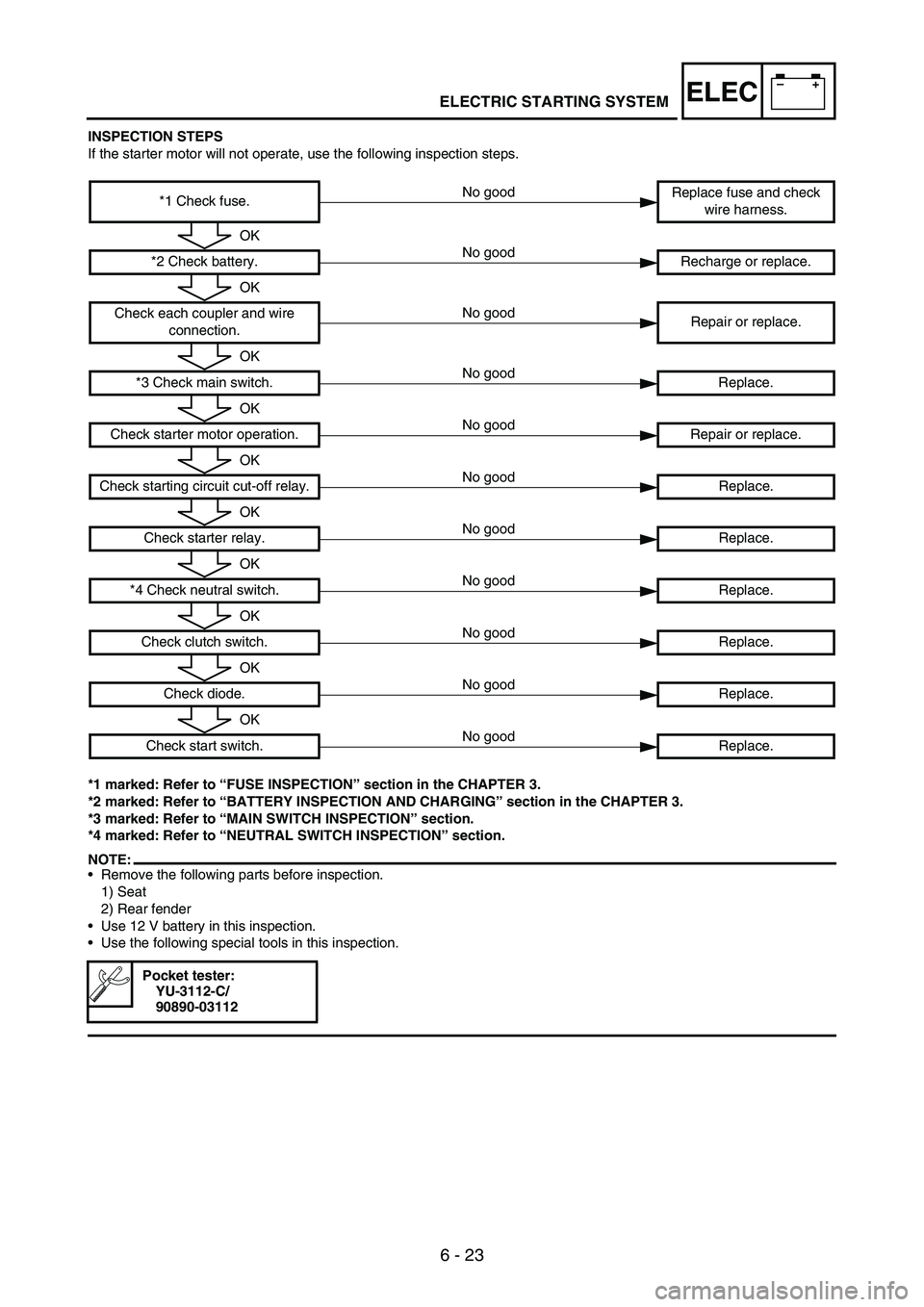
INSPECTION STEPS
If the starter motor will not operate, use the following inspection steps.
*1 marked: Refer to “FUSE INSPECTION” section in the CHAPTER 3.
*2 marked: Refer to “BATTERY INSPECTION AND CHARGING” section in the CHAPTER 3.
*3 marked: Refer to “MAIN SWITCH INSPECTION” section.
*4 marked: Refer to “NEUTRAL SWITCH INSPECTION” section.
NOTE:Remove the following parts before inspection.
1) Seat
2) Rear fender
Use 12 V battery in this inspection.
Use the following special tools in this inspection.
*1 Check fuse.Replace fuse and check
wire harness.
*2 Check battery. Recharge or replace.
Check each coupler and wire
connection.Repair or replace.
*3 Check main switch. Replace.
Check starter motor operation. Repair or replace.
Check starting circuit cut-off relay. Replace.
Check starter relay.Replace.
*4 Check neutral switch. Replace.
Check clutch switch.Replace.
Check diode.Replace.
Check start switch.Replace.
Pocket tester:
YU-3112-C/
90890-03112
No good
OK
No good
OK
No good
OK
No good
OK
No good
OK
No good
OK
No good
OK
No good
OK
No good
OK
No good
OK
No good
Page 762 of 864
6 - 25
–+ELEC
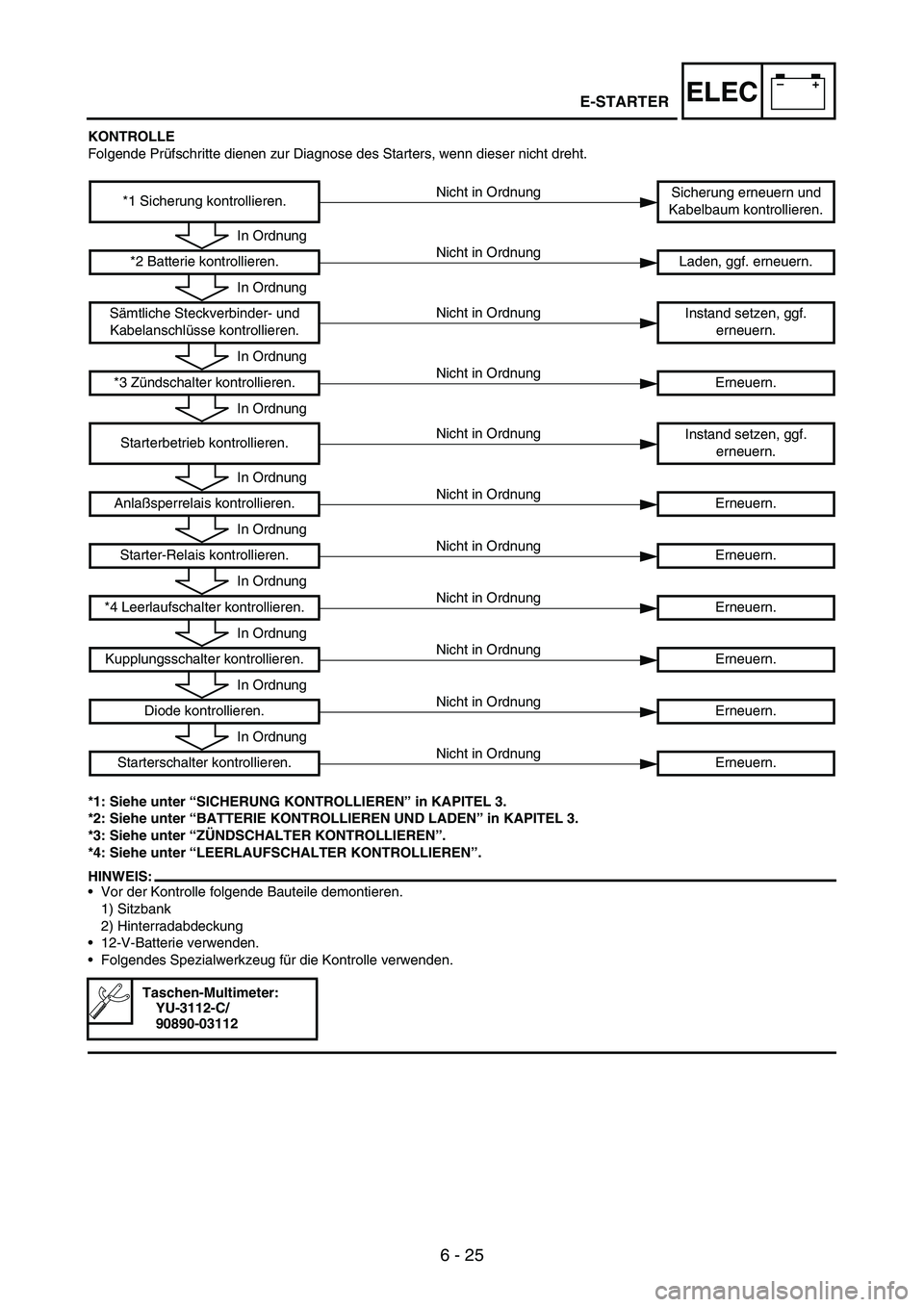
KONTROLLE
Folgende Prüfschritte dienen zur Diagnose des Starters, wenn dieser nicht dreht.
*1: Siehe unter “SICHERUNG KONTROLLIEREN” in KAPITEL 3.
*2: Siehe unter “BATTERIE KONTROLLIEREN UND LADEN” in KAPITEL 3.
*3: Siehe unter “ZÜNDSCHALTER KONTROLLIEREN”.
*4: Siehe unter “LEERLAUFSCHALTER KONTROLLIEREN”.
HINWEIS:
Vor der Kontrolle folgende Bauteile demontieren.
1) Sitzbank
2) Hinterradabdeckung
12-V-Batterie verwenden.
Folgendes Spezialwerkzeug für die Kontrolle verwenden.
*1 Sicherung kontrollieren.Sicherung erneuern und
Kabelbaum kontrollieren.
*2 Batterie kontrollieren. Laden, ggf. erneuern.
Sämtliche Steckverbinder- und
Kabelanschlüsse kontrollieren.Instand setzen, ggf.
erneuern.
*3 Zündschalter kontrollieren. Erneuern.
Starterbetrieb kontrollieren.Instand setzen, ggf.
erneuern.
Anlaßsperrelais kontrollieren. Erneuern.
Starter-Relais kontrollieren. Erneuern.
*4 Leerlaufschalter kontrollieren. Erneuern.
Kupplungsschalter kontrollieren. Erneuern.
Diode kontrollieren.Erneuern.
Starterschalter kontrollieren. Erneuern.
Taschen-Multimeter:
YU-3112-C/
90890-03112
Nicht in Ordnung
In Ordnung
Nicht in Ordnung
In Ordnung
Nicht in Ordnung
In Ordnung
Nicht in Ordnung
In Ordnung
Nicht in Ordnung
In Ordnung
Nicht in Ordnung
In Ordnung
Nicht in Ordnung
In Ordnung
Nicht in Ordnung
In Ordnung
Nicht in Ordnung
In Ordnung
Nicht in Ordnung
In Ordnung
Nicht in Ordnung
E-STARTER
Page 766 of 864
6 - 29
–+ELECELECTRIC STARTING SYSTEM
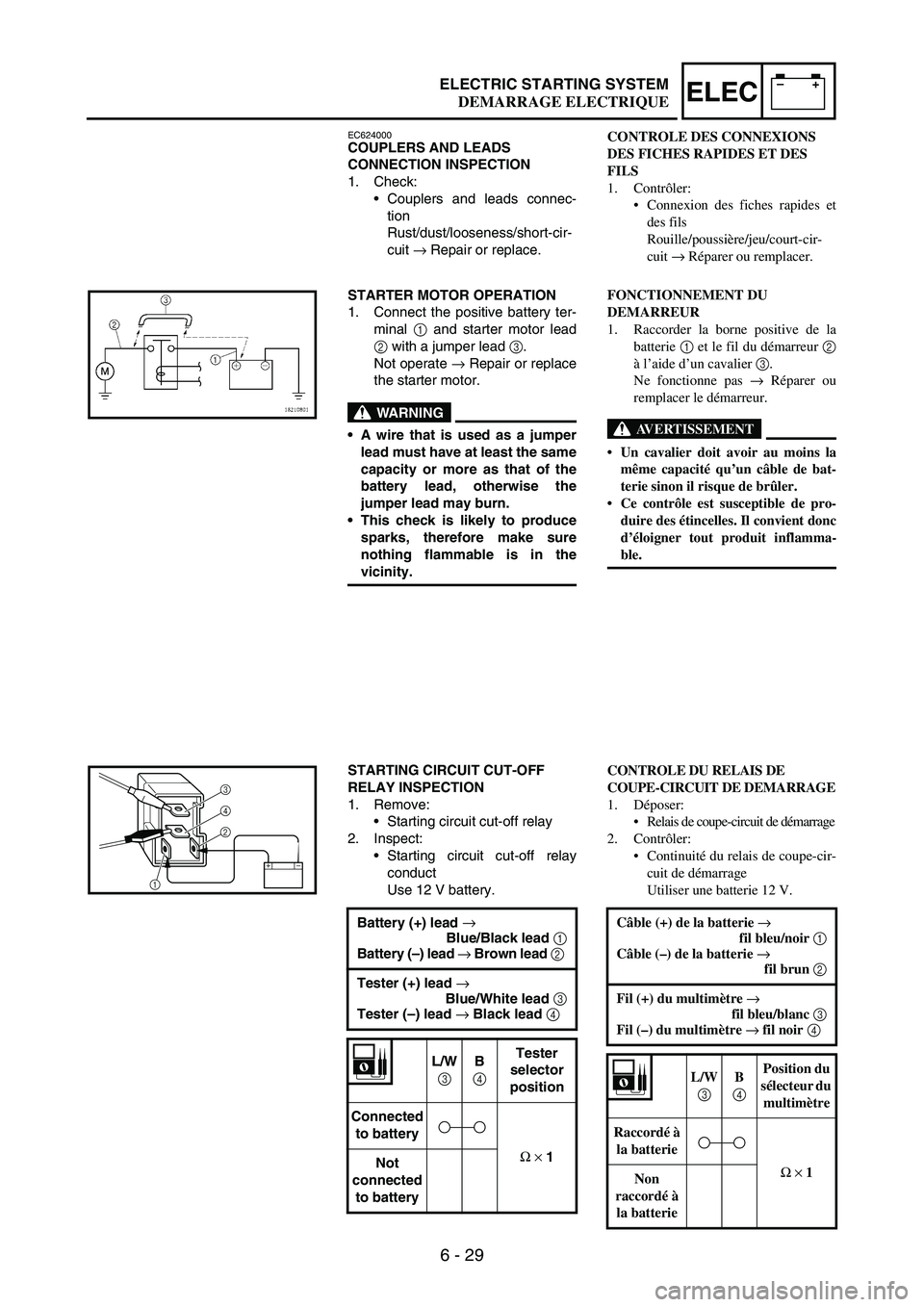
EC624000COUPLERS AND LEADS
CONNECTION INSPECTION
1. Check:
Couplers and leads connec-
tion
Rust/dust/looseness/short-cir-
cuit
→ Repair or replace.
STARTER MOTOR OPERATION
1. Connect the positive battery ter-
minal
1 and starter motor lead
2 with a jumper lead
3.
Not operate
→ Repair or replace
the starter motor.
WARNING
A wire that is used as a jumper
lead must have at least the same
capacity or more as that of the
battery lead, otherwise the
jumper lead may burn.
This check is likely to produce
sparks, therefore make sure
nothing flammable is in the
vicinity.
STARTING CIRCUIT CUT-OFF
RELAY INSPECTION
1. Remove:
Starting circuit cut-off relay
2. Inspect:
Starting circuit cut-off relay
conduct
Use 12 V battery.
Battery (+) lead →
Blue/Black lead 1
Battery (–) lead →
Brown lead 2
Tester (+) lead →
Blue/White lead 3
Tester (–) lead →
Black lead 4
L/W
3
B
4
Tester
selector
position
Connected
to battery
Ω
×
1
Not
connected
to battery
2 4
3
1
CONTROLE DES CONNEXIONS
DES FICHES RAPIDES ET DES
FILS
1. Contrôler:
Connexion des fiches rapides et
des fils
Rouille/poussière/jeu/court-cir-
cuit → Réparer ou remplacer.
FONCTIONNEMENT DU
DEMARREUR
1. Raccorder la borne positive de la
batterie 1 et le fil du démarreur 2
à l’aide d’un cavalier 3.
Ne fonctionne pas → Réparer ou
remplacer le démarreur.
AVERTISSEMENT
Un cavalier doit avoir au moins la
même capacité qu’un câble de bat-
terie sinon il risque de brûler.
Ce contrôle est susceptible de pro-
duire des étincelles. Il convient donc
d’éloigner tout produit inflamma-
ble.
CONTROLE DU RELAIS DE
COUPE-CIRCUIT DE DEMARRAGE
1. Déposer:
Relais de coupe-circuit de démarrage
2. Contrôler:
Continuité du relais de coupe-cir-
cuit de démarrage
Utiliser une batterie 12 V.
Câble (+) de la batterie →
fil bleu/noir 1
Câble (–) de la batterie →
fil brun 2
Fil (+) du multimètre →
fil bleu/blanc 3
Fil (–) du multimètre → fil noir 4
L/W
3 B
4 Position du
sélecteur du
multimètre
Raccordé à
la batterie
Ω × 1
Non
raccordé à
la batterie
DEMARRAGE ELECTRIQUE
Page 767 of 864
6 - 30
–+ELEC
STECKVERBINDER- UND
KABELANSCHLÜSSE
KONTROLLIEREN
1. Kontrollieren:
Steckverbinder- und Kabelan-
schlüsse
Rostig/staubig/locker/kurzge-
schlossen
→ Instand setzen,
ggf. erneuern.
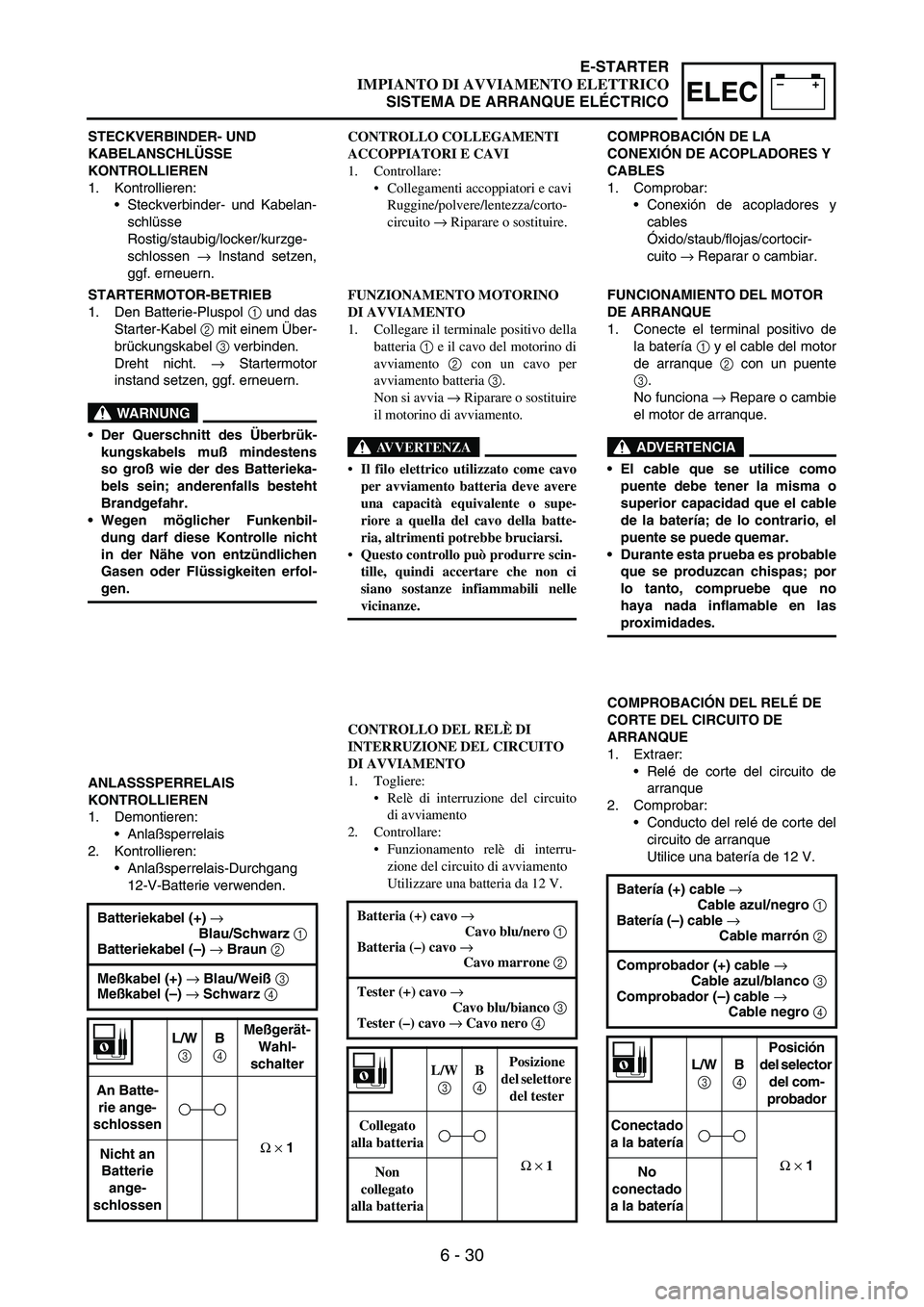
STARTERMOTOR-BETRIEB
1. Den Batterie-Pluspol
1 und das
Starter-Kabel
2 mit einem Über-
brückungskabel
3 verbinden.
Dreht nicht.
→ Startermotor
instand setzen, ggf. erneuern.
WARNUNG
Der Querschnitt des Überbrük-
kungskabels muß mindestens
so groß wie der des Batterieka-
bels sein; anderenfalls besteht
Brandgefahr.
Wegen möglicher Funkenbil-
dung darf diese Kontrolle nicht
in der Nähe von entzündlichen
Gasen oder Flüssigkeiten erfol-
gen.
ANLASSSPERRELAIS
KONTROLLIEREN
1. Demontieren:
Anlaßsperrelais
2. Kontrollieren:
Anlaßsperrelais-Durchgang
12-V-Batterie verwenden.
Batteriekabel (+) →
Blau/Schwarz 1
Batteriekabel (–) → Braun 2
Meßkabel (+) → Blau/Weiß 3
Meßkabel (–) → Schwarz 4
L/W
3 B
4 Meßgerät-
Wahl-
schalter
An Batte-
rie ange-
schlossen
Ω × 1
Nicht an
Batterie
ange-
schlossen
CONTROLLO COLLEGAMENTI
ACCOPPIATORI E CAVI
1. Controllare:
Collegamenti accoppiatori e cavi
Ruggine/polvere/lentezza/corto-
circuito → Riparare o sostituire.
FUNZIONAMENTO MOTORINO
DI AVVIAMENTO
1. Collegare il terminale positivo della
batteria 1 e il cavo del motorino di
avviamento 2 con un cavo per
avviamento batteria 3.
Non si avvia → Riparare o sostituire
il motorino di avviamento.
AVVERTENZA
Il filo elettrico utilizzato come cavo
per avviamento batteria deve avere
una capacità equivalente o supe-
riore a quella del cavo della batte-
ria, altrimenti potrebbe bruciarsi.
Questo controllo può produrre scin-
tille, quindi accertare che non ci
siano sostanze infiammabili nelle
vicinanze.
CONTROLLO DEL RELÈ DI
INTERRUZIONE DEL CIRCUITO
DI AVVIAMENTO
1. Togliere:
Relè di interruzione del circuito
di avviamento
2. Controllare:
Funzionamento relè di interru-
zione del circuito di avviamento
Utilizzare una batteria da 12 V.
Batteria (+) cavo →
Cavo blu/nero 1
Batteria (–) cavo →
Cavo marrone 2
Tester (+) cavo →
Cavo blu/bianco 3
Tester (–) cavo → Cavo nero 4
L/W
3 B
4 Posizione
del selettore
del tester
Collegato
alla batteria
Ω × 1
Non
collegato
alla batteria
COMPROBACIÓN DE LA
CONEXIÓN DE ACOPLADORES Y
CABLES
1. Comprobar:
Conexión de acopladores y
cables
Óxido/staub/flojas/cortocir-
cuito
→ Reparar o cambiar.
FUNCIONAMIENTO DEL MOTOR
DE ARRANQUE
1. Conecte el terminal positivo de
la batería
1 y el cable del motor
de arranque
2 con un puente
3.
No funciona
→ Repare o cambie
el motor de arranque.
ADVERTENCIA
El cable que se utilice como
puente debe tener la misma o
superior capacidad que el cable
de la batería; de lo contrario, el
puente se puede quemar.
Durante esta prueba es probable
que se produzcan chispas; por
lo tanto, compruebe que no
haya nada inflamable en las
proximidades.
COMPROBACIÓN DEL RELÉ DE
CORTE DEL CIRCUITO DE
ARRANQUE
1. Extraer:
Relé de corte del circuito de
arranque
2. Comprobar:
Conducto del relé de corte del
circuito de arranque
Utilice una batería de 12 V.
Batería (+) cable →
Cable azul/negro 1
Batería (–) cable →
Cable marrón 2
Comprobador (+) cable →
Cable azul/blanco 3
Comprobador (–) cable →
Cable negro 4
L/W
3 B
4 Posición
del selector
del com-
probador
Conectado
a la batería
Ω × 1
No
conectado
a la batería
E-STARTER
IMPIANTO DI AVVIAMENTO ELETTRICO
SISTEMA DE ARRANQUE ELÉCTRICO
Page 768 of 864
6 - 31
–+ELECELECTRIC STARTING SYSTEM
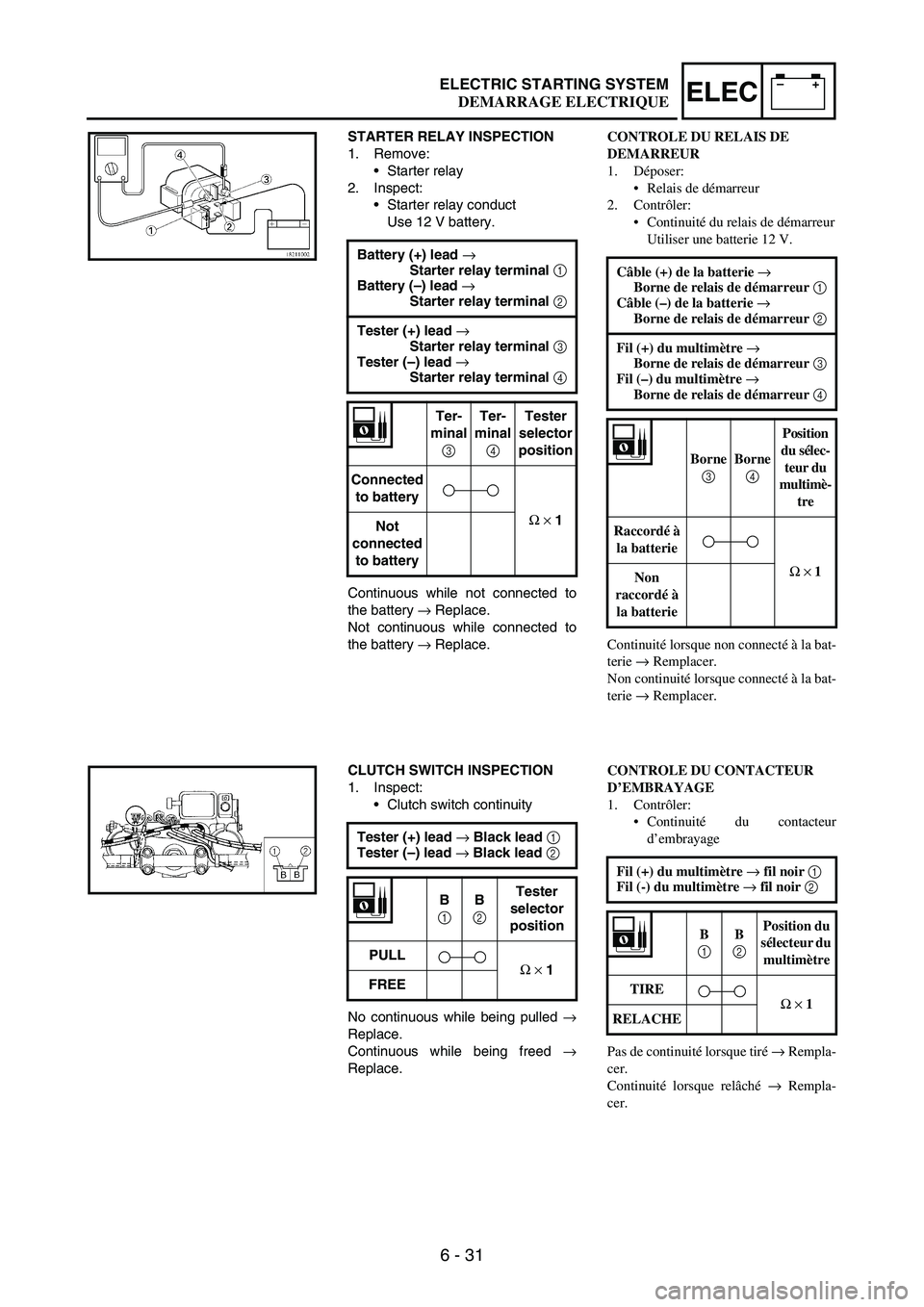
STARTER RELAY INSPECTION
1. Remove:
Starter relay
2. Inspect:
Starter relay conduct
Use 12 V battery.
Continuous while not connected to
the battery
→ Replace.
Not continuous while connected to
the battery
→ Replace. Battery (+) lead →
Starter relay terminal 1
Battery (–) lead →
Starter relay terminal 2
Tester (+) lead →
Starter relay terminal 3
Tester (–) lead →
Starter relay terminal 4
Ter-
minal
3
Ter-
minal
4
Tester
selector
position
Connected
to battery
Ω
×
1
Not
connected
to battery
CLUTCH SWITCH INSPECTION
1. Inspect:
Clutch switch continuity
No continuous while being pulled
→
Replace.
Continuous while being freed
→
Replace.Tester (+) lead →
Black lead 1
Tester (–) lead →
Black lead 2
B
1
B
2
Tester
selector
position
PULL
Ω
×
1
FREE
CONTROLE DU RELAIS DE
DEMARREUR
1. Déposer:
Relais de démarreur
2. Contrôler:
Continuité du relais de démarreur
Utiliser une batterie 12 V.
Continuité lorsque non connecté à la bat-
terie → Remplacer.
Non continuité lorsque connecté à la bat-
terie → Remplacer. Câble (+) de la batterie →
Borne de relais de démarreur 1
Câble (–) de la batterie →
Borne de relais de démarreur 2
Fil (+) du multimètre →
Borne de relais de démarreur 3
Fil (–) du multimètre →
Borne de relais de démarreur 4
Borne
3 Borne
4 Position
du sélec-
teur du
multimè-
tre
Raccordé à
la batterie
Ω × 1
Non
raccordé à
la batterie
CONTROLE DU CONTACTEUR
D’EMBRAYAGE
1. Contrôler:
Continuité du contacteur
d’embrayage
Pas de continuité lorsque tiré → Rempla-
cer.
Continuité lorsque relâché → Rempla-
cer.Fil (+) du multimètre → fil noir 1
Fil (-) du multimètre → fil noir 2
B
1 B
2 Position du
sélecteur du
multimètre
TIRE
Ω × 1
RELACHE
DEMARRAGE ELECTRIQUE
Page 769 of 864
6 - 32
–+ELEC
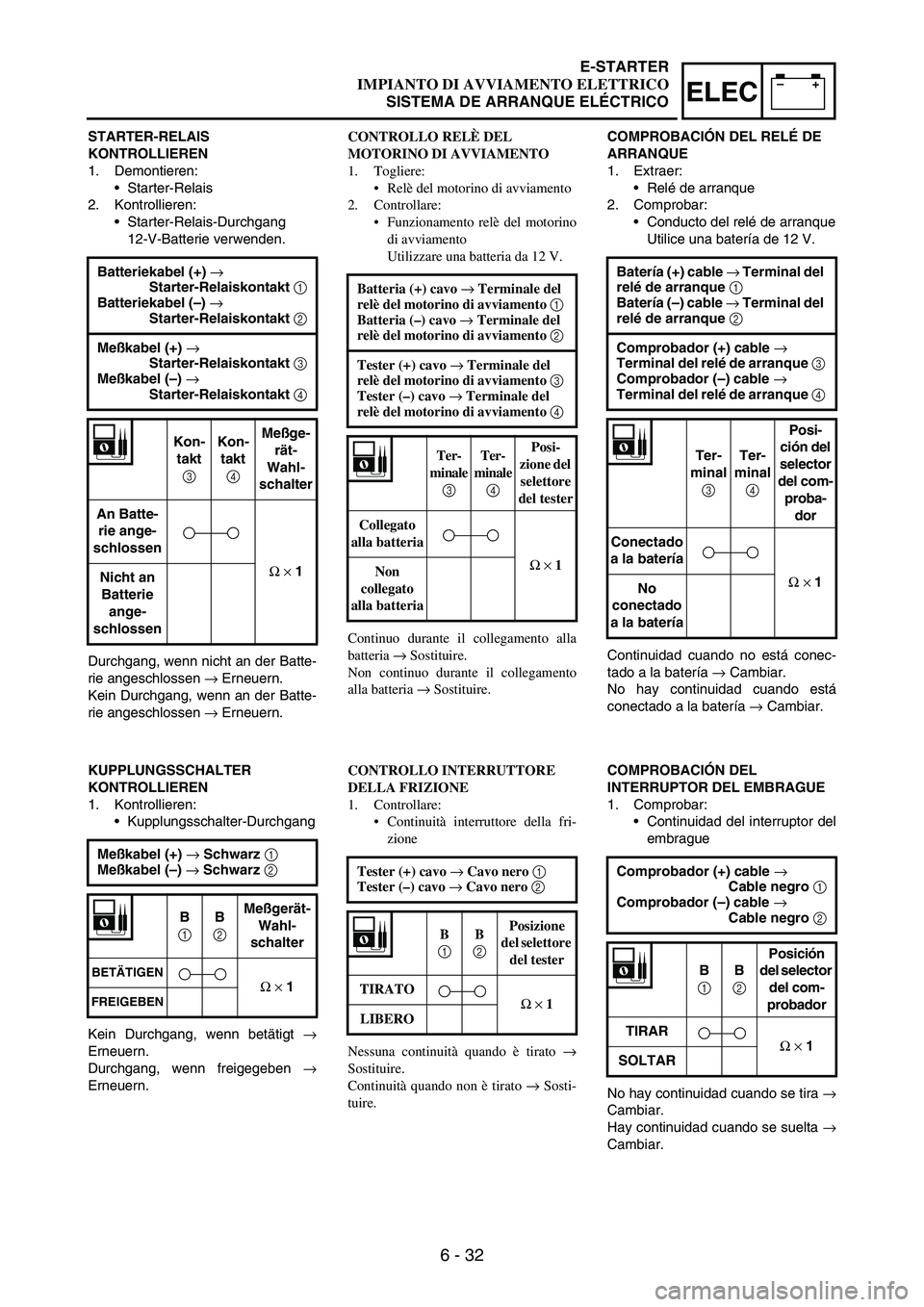
STARTER-RELAIS
KONTROLLIEREN
1. Demontieren:
Starter-Relais
2. Kontrollieren:
Starter-Relais-Durchgang
12-V-Batterie verwenden.
Durchgang, wenn nicht an der Batte-
rie angeschlossen
→ Erneuern.
Kein Durchgang, wenn an der Batte-
rie angeschlossen
→ Erneuern. Batteriekabel (+) →
Starter-Relaiskontakt 1
Batteriekabel (–) →
Starter-Relaiskontakt 2
Meßkabel (+) →
Starter-Relaiskontakt 3
Meßkabel (–) →
Starter-Relaiskontakt 4
Kon-
takt
3 Kon-
takt
4 Meßge-
rät-
Wahl-
schalter
An Batte-
rie ange-
schlossen
Ω × 1
Nicht an
Batterie
ange-
schlossen
KUPPLUNGSSCHALTER
KONTROLLIEREN
1. Kontrollieren:
Kupplungsschalter-Durchgang
Kein Durchgang, wenn betätigt
→
Erneuern.
Durchgang, wenn freigegeben
→
Erneuern.Meßkabel (+) → Schwarz 1
Meßkabel (–) → Schwarz 2
B
1 B
2 Meßgerät-
Wahl-
schalter
BETÄTIGENΩ × 1FREIGEBEN
CONTROLLO RELÈ DEL
MOTORINO DI AVVIAMENTO
1. Togliere:
Relè del motorino di avviamento
2. Controllare:
Funzionamento relè del motorino
di avviamento
Utilizzare una batteria da 12 V.
Continuo durante il collegamento alla
batteria → Sostituire.
Non continuo durante il collegamento
alla batteria → Sostituire. Batteria (+) cavo → Terminale del
relè del motorino di avviamento 1
Batteria (–) cavo → Terminale del
relè del motorino di avviamento 2
Tester (+) cavo → Terminale del
relè del motorino di avviamento 3
Tester (–) cavo → Terminale del
relè del motorino di avviamento 4
Ter-
minale
3 Ter-
minale
4 Posi-
zione del
selettore
del tester
Collegato
alla batteria
Ω × 1
Non
collegato
alla batteria
CONTROLLO INTERRUTTORE
DELLA FRIZIONE
1. Controllare:
Continuità interruttore della fri-
zione
Nessuna continuità quando è tirato →
Sostituire.
Continuità quando non è tirato → Sosti-
tuire.Tester (+) cavo → Cavo nero 1
Tester (–) cavo → Cavo nero 2
B
1 B
2 Posizione
del selettore
del tester
TIRATO
Ω × 1
LIBERO
COMPROBACIÓN DEL RELÉ DE
ARRANQUE
1. Extraer:
Relé de arranque
2. Comprobar:
Conducto del relé de arranque
Utilice una batería de 12 V.
Continuidad cuando no está conec-
tado a la batería
→ Cambiar.
No hay continuidad cuando está
conectado a la batería
→ Cambiar. Batería (+) cable → Terminal del
relé de arranque 1
Batería (–) cable → Terminal del
relé de arranque 2
Comprobador (+) cable →
Terminal del relé de arranque 3
Comprobador (–) cable →
Terminal del relé de arranque 4
Ter-
minal
3 Ter-
minal
4 Posi-
ción del
selector
del com-
proba-
dor
Conectado
a la batería
Ω × 1
No
conectado
a la batería
COMPROBACIÓN DEL
INTERRUPTOR DEL EMBRAGUE
1. Comprobar:
Continuidad del interruptor del
embrague
No hay continuidad cuando se tira
→
Cambiar.
Hay continuidad cuando se suelta
→
Cambiar.Comprobador (+) cable →
Cable negro 1
Comprobador (–) cable →
Cable negro 2
B
1 B
2 Posición
del selector
del com-
probador
TIRAR
Ω × 1
SOLTAR
E-STARTER
IMPIANTO DI AVVIAMENTO ELETTRICO
SISTEMA DE ARRANQUE ELÉCTRICO
Page 771 of 864
6 - 34
–+ELEC
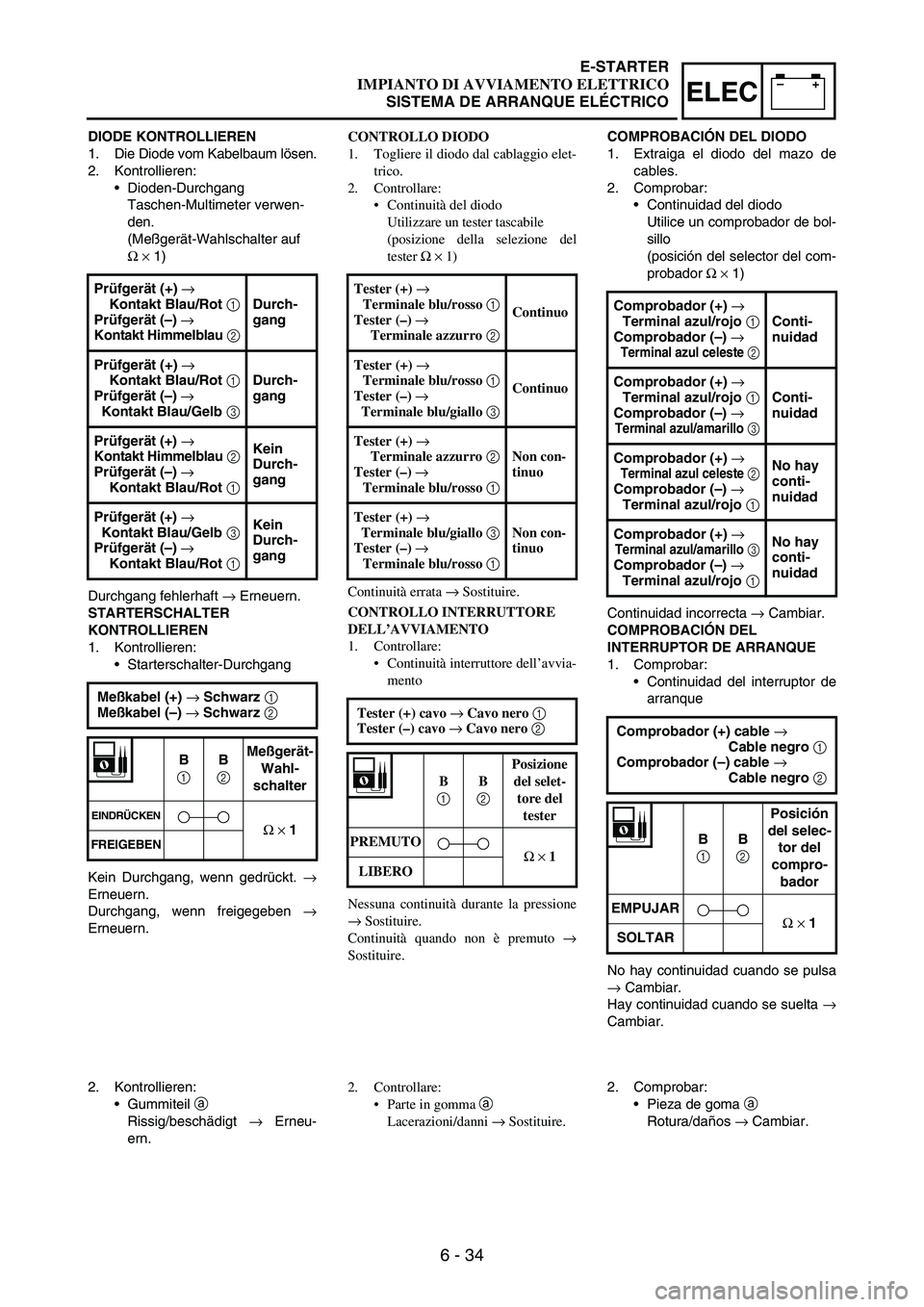
DIODE KONTROLLIEREN
1. Die Diode vom Kabelbaum lösen.
2. Kontrollieren:
Dioden-Durchgang
Taschen-Multimeter verwen-
den.
(Meßgerät-Wahlschalter auf
Ω×1)
Durchgang fehlerhaft
→ Erneuern.
STARTERSCHALTER
KONTROLLIEREN
1. Kontrollieren:
Starterschalter-Durchgang
Kein Durchgang, wenn gedrückt.
→
Erneuern.
Durchgang, wenn freigegeben
→
Erneuern.Prüfgerät (+) →
Kontakt Blau/Rot 1
Prüfgerät (–) →
Kontakt Himmelblau2
Durch-
gang
Prüfgerät (+) →
Kontakt Blau/Rot 1
Prüfgerät (–) →
Kontakt Blau/Gelb 3Durch-
gang
Prüfgerät (+) →
Kontakt Himmelblau2
Prüfgerät (–) →
Kontakt Blau/Rot 1Kein
Durch-
gang
Prüfgerät (+) →
Kontakt Blau/Gelb 3
Prüfgerät (–) →
Kontakt Blau/Rot 1Kein
Durch-
gang
Meßkabel (+) → Schwarz 1
Meßkabel (–) → Schwarz 2
B
1 B
2 Meßgerät-
Wahl-
schalter
EINDRÜCKENΩ × 1FREIGEBEN
2. Kontrollieren:
Gummiteil
a
Rissig/beschädigt
→ Erneu-
ern.CONTROLLO DIODO
1. Togliere il diodo dal cablaggio elet-
trico.
2. Controllare:
Continuità del diodo
Utilizzare un tester tascabile
(posizione della selezione del
tester Ω × 1)
Continuità errata → Sostituire. Tester (+) →
Terminale blu/rosso 1
Tester (–) →
Terminale azzurro 2Continuo
Tester (+) →
Terminale blu/rosso 1
Tester (–) →
Terminale blu/giallo 3Continuo
Tester (+) →
Terminale azzurro 2
Tester (–) →
Terminale blu/rosso 1Non con-
tinuo
Tester (+) →
Terminale blu/giallo 3
Tester (–) →
Terminale blu/rosso 1Non con-
tinuo
CONTROLLO INTERRUTTORE
DELL’AVVIAMENTO
1. Controllare:
Continuità interruttore dell’avvia-
mento
Nessuna continuità durante la pressione
→ Sostituire.
Continuità quando non è premuto →
Sostituire.Tester (+) cavo → Cavo nero 1
Tester (–) cavo → Cavo nero 2
B
1 B
2 Posizione
del selet-
tore del
tester
PREMUTO
Ω × 1
LIBERO
2. Controllare:
Parte in gomma a
Lacerazioni/danni → Sostituire.COMPROBACIÓN DEL DIODO
1. Extraiga el diodo del mazo de
cables.
2. Comprobar:
Continuidad del diodo
Utilice un comprobador de bol-
sillo
(posición del selector del com-
probador
Ω
× 1)
Continuidad incorrecta
→ Cambiar.
COMPROBACIÓN DEL
INTERRUPTOR DE ARRANQUE
1. Comprobar:
Continuidad del interruptor de
arranque
No hay continuidad cuando se pulsa
→ Cambiar.
Hay continuidad cuando se suelta
→
Cambiar.Comprobador (+) →
Terminal azul/rojo 1
Comprobador (–) →
Terminal azul celeste2
Conti-
nuidad
Comprobador (+) →
Terminal azul/rojo 1
Comprobador (–) →
Terminal azul/amarillo 3
Conti-
nuidad
Comprobador (+) →
Terminal azul celeste2Comprobador (–) →
Terminal azul/rojo 1No hay
conti-
nuidad
Comprobador (+) →
Terminal azul/amarillo 3
Comprobador (–) →
Terminal azul/rojo 1No hay
conti-
nuidad
Comprobador (+) cable →
Cable negro 1
Comprobador (–) cable →
Cable negro 2
B
1 B
2 Posición
del selec-
tor del
compro-
bador
EMPUJAR
Ω × 1
SOLTAR
2. Comprobar:
Pieza de goma
a
Rotura/daños
→ Cambiar.
E-STARTER
IMPIANTO DI AVVIAMENTO ELETTRICO
SISTEMA DE ARRANQUE ELÉCTRICO
Page 772 of 864
6 - 35
–+ELECELECTRIC STARTING SYSTEM
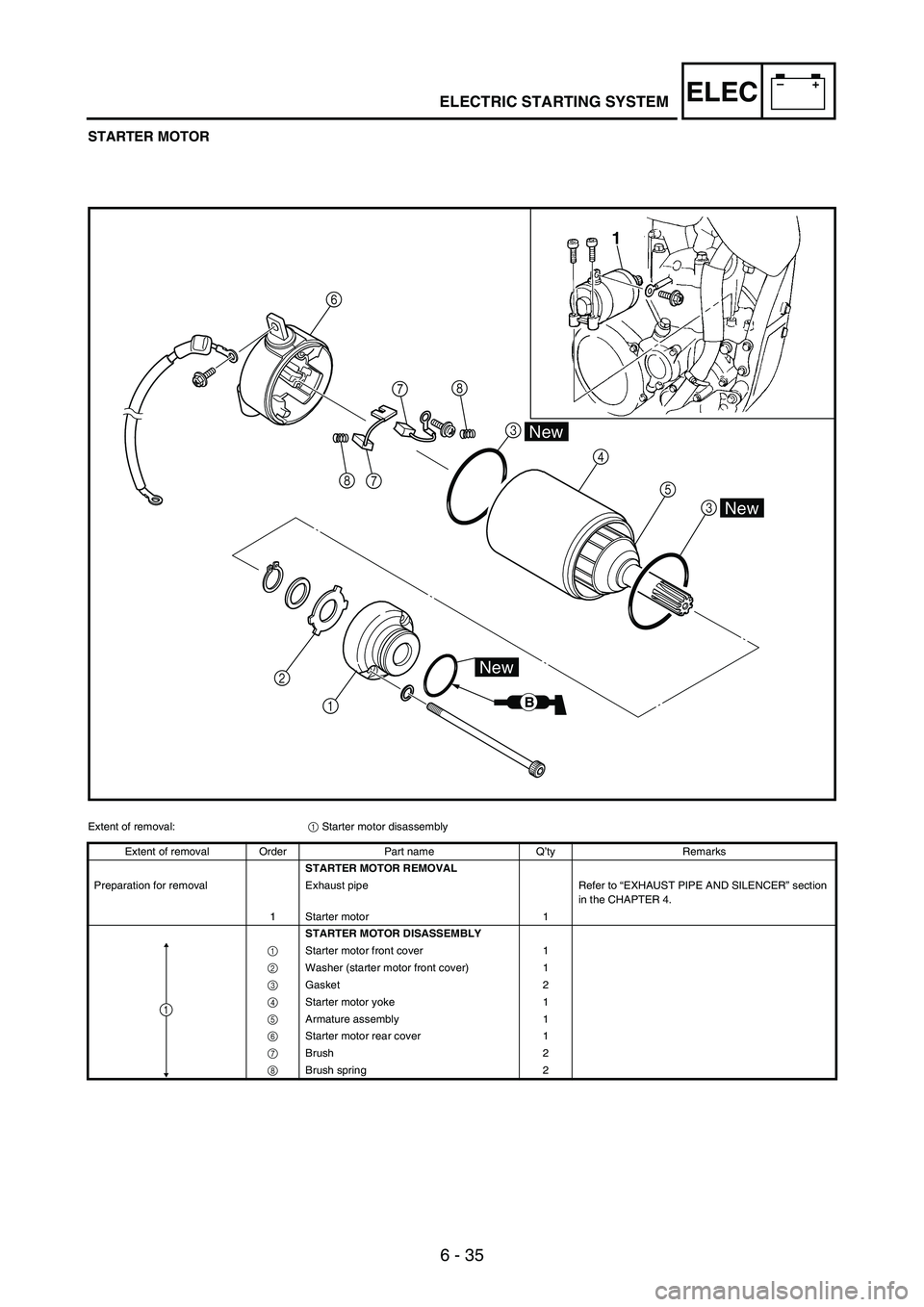
STARTER MOTOR
78
7 84
5
3
2
1
New
B
New
New
1
3 6
Extent of removal:
1 Starter motor disassembly
Extent of removal Order Part name Q’ty Remarks
STARTER MOTOR REMOVAL
Preparation for removal Exhaust pipe Refer to “EXHAUST PIPE AND SILENCER” section
in the CHAPTER 4.
1 Starter motor 1
STARTER MOTOR DISASSEMBLY
1 Starter motor front cover 1
2 Washer (starter motor front cover) 1
3 Gasket 2
4 Starter motor yoke 1
5 Armature assembly 1
6 Starter motor rear cover 1
7 Brush 2
8 Brush spring 2
1