radiator YAMAHA WR 250F 2005 Owner's Manual
[x] Cancel search | Manufacturer: YAMAHA, Model Year: 2005, Model line: WR 250F, Model: YAMAHA WR 250F 2005Pages: 864, PDF Size: 18.1 MB
Page 193 of 864
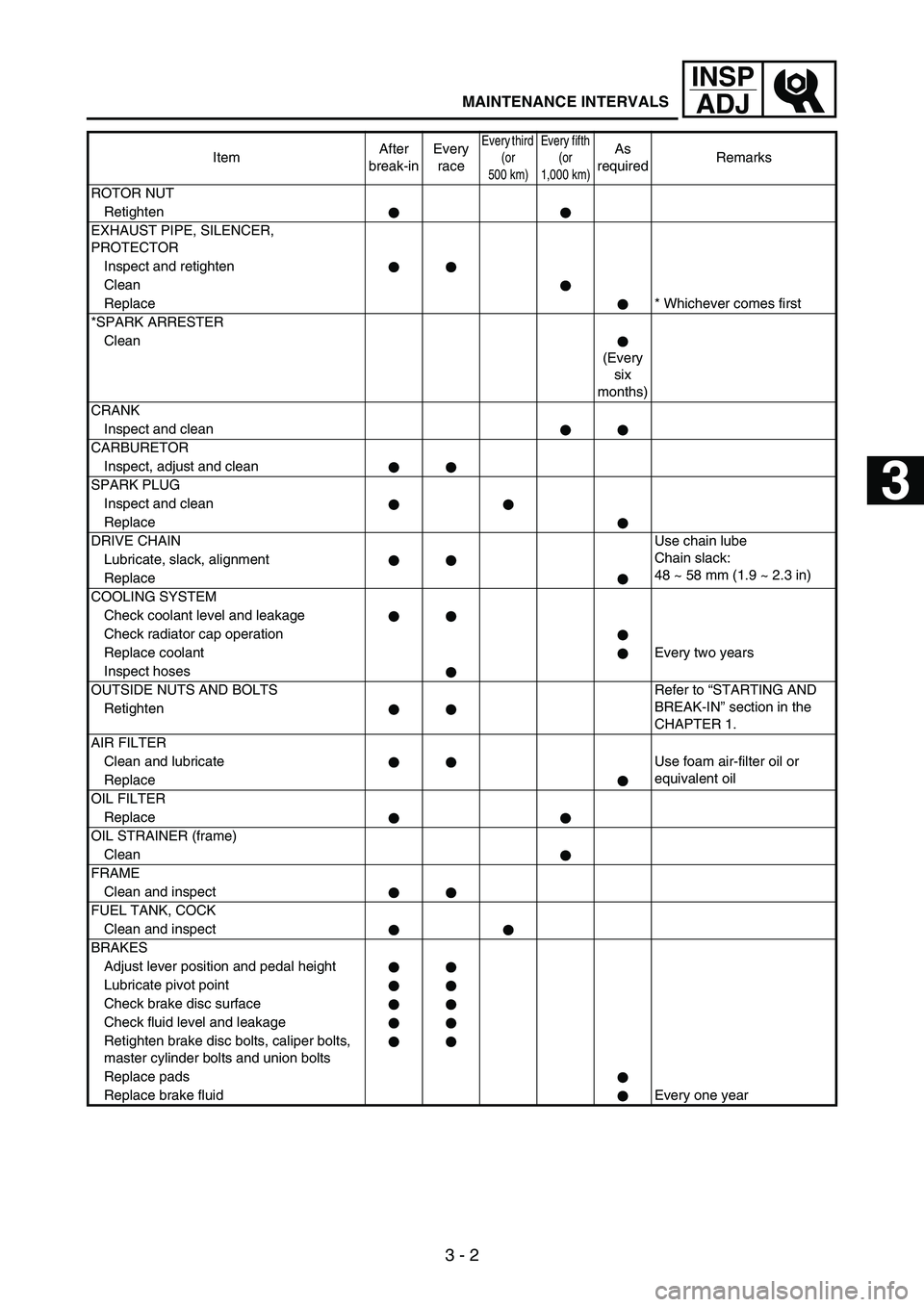
3 - 2
INSP
ADJ
MAINTENANCE INTERVALS
ROTOR NUT
Retighten
EXHAUST PIPE, SILENCER,
PROTECTOR
Inspect and retighten
Clean
Replace* Whichever comes first
*SPARK ARRESTER
Clean
(Every
six
months)
CRANK
Inspect and clean
CARBURETOR
Inspect, adjust and clean
SPARK PLUG
Inspect and clean
Replace
DRIVE CHAINUse chain lube
Chain slack:
48 ~ 58 mm (1.9 ~ 2.3 in) Lubricate, slack, alignment
Replace
COOLING SYSTEM
Check coolant level and leakage
Check radiator cap operation
Replace coolantEvery two years
Inspect hoses
OUTSIDE NUTS AND BOLTS Refer to “STARTING AND
BREAK-IN” section in the
CHAPTER 1. Retighten
AIR FILTER
Clean and lubricate Use foam air-filter oil or
equivalent oil
Replace
OIL FILTER
Replace
OIL STRAINER (frame)
Clean
FRAME
Clean and inspect
FUEL TANK, COCK
Clean and inspect
BRAKES
Adjust lever position and pedal height
Lubricate pivot point
Check brake disc surface
Check fluid level and leakage
Retighten brake disc bolts, caliper bolts,
master cylinder bolts and union bolts
Replace pads
Replace brake fluid Every one yearItemAfter
break-inEvery
race
Every third
(or
500 km)Every fifth
(or
1,000 km)As
requiredRemarks
1
2
3
4
5
6
7
Page 202 of 864
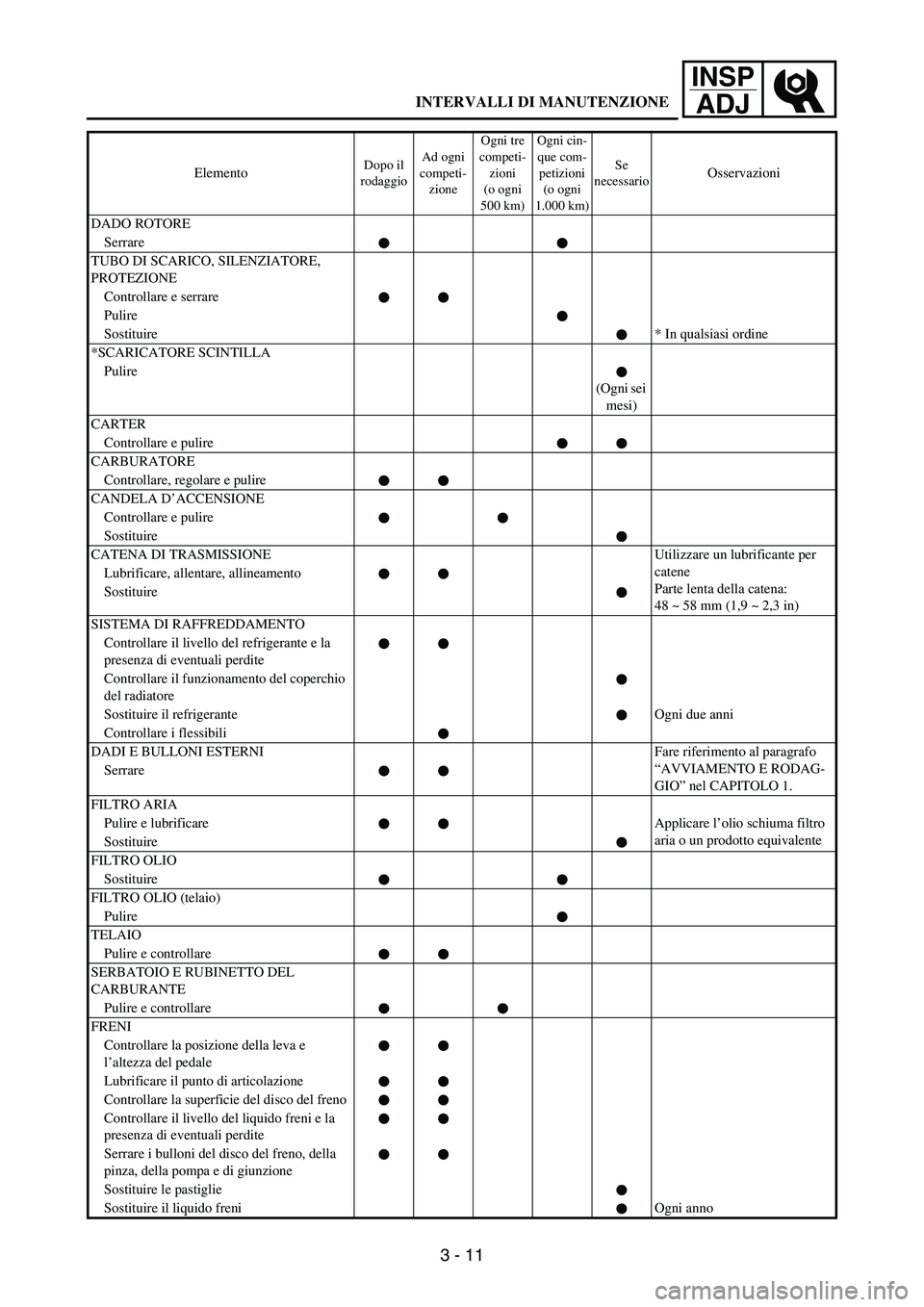
3 - 11
INSP
ADJ
DADO ROTORE
Serrare
TUBO DI SCARICO, SILENZIATORE,
PROTEZIONE
Controllare e serrare
Pulire
Sostituire* In qualsiasi ordine
*SCARICATORE SCINTILLA
Pulire
(Ogni sei
mesi)
CARTER
Controllare e pulire
CARBURATORE
Controllare, regolare e pulire
CANDELA D’ACCENSIONE
Controllare e pulire
Sostituire
CATENA DI TRASMISSIONE Utilizzare un lubrificante per
catene
Parte lenta della catena:
48 ~ 58 mm (1,9 ~ 2,3 in) Lubrificare, allentare, allineamento
Sostituire
SISTEMA DI RAFFREDDAMENTO
Controllare il livello del refrigerante e la
presenza di eventuali perdite
Controllare il funzionamento del coperchio
del radiatore
Sostituire il refrigerante Ogni due anni
Controllare i flessibili
DADI E BULLONI ESTERNI Fare riferimento al paragrafo
“AVVIAMENTO E RODAG-
GIO” nel CAPITOLO 1. Serrare
FILTRO ARIA
Pulire e lubrificare Applicare l’olio schiuma filtro
aria o un prodotto equivalente
Sostituire
FILTRO OLIO
Sostituire
FILTRO OLIO (telaio)
Pulire
TELAIO
Pulire e controllare
SERBATOIO E RUBINETTO DEL
CARBURANTE
Pulire e controllare
FRENI
Controllare la posizione della leva e
l’altezza del pedale
Lubrificare il punto di articolazione
Controllare la superficie del disco del freno
Controllare il livello del liquido freni e la
presenza di eventuali perdite
Serrare i bulloni del disco del freno, della
pinza, della pompa e di giunzione
Sostituire le pastiglie
Sostituire il liquido freni Ogni annoElemento
Dopo il
rodaggioAd ogni
competi-
zioneOgni tre
competi-
zioni
(o ogni
500 km)Ogni cin-
que com-
petizioni
(o ogni
1.000 km)Se
necessarioOsservazioni
INTERVALLI DI MANUTENZIONE
Page 207 of 864
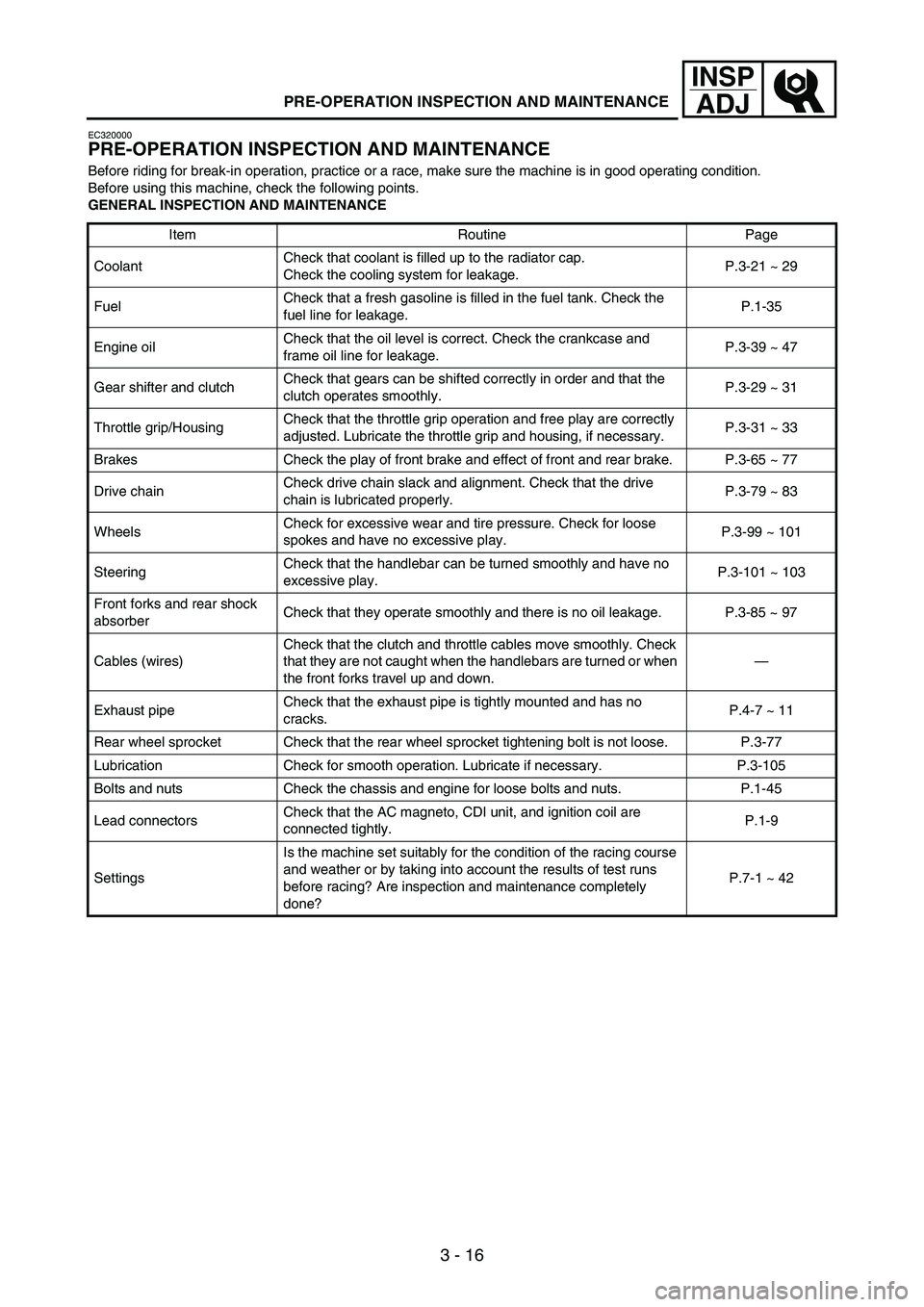
3 - 16
INSP
ADJ
PRE-OPERATION INSPECTION AND MAINTENANCE
EC320000
PRE-OPERATION INSPECTION AND MAINTENANCE
Before riding for break-in operation, practice or a race, make sure the machine is in good operating condition.
Before using this machine, check the following points.
GENERAL INSPECTION AND MAINTENANCE
Item Routine Page
CoolantCheck that coolant is filled up to the radiator cap.
Check the cooling system for leakage.P.3-21 ~ 29
FuelCheck that a fresh gasoline is filled in the fuel tank. Check the
fuel line for leakage.P.1-35
Engine oilCheck that the oil level is correct. Check the crankcase and
frame oil line for leakage.P.3-39 ~ 47
Gear shifter and clutchCheck that gears can be shifted correctly in order and that the
clutch operates smoothly.P.3-29 ~ 31
Throttle grip/HousingCheck that the throttle grip operation and free play are correctly
adjusted. Lubricate the throttle grip and housing, if necessary.P.3-31 ~ 33
Brakes Check the play of front brake and effect of front and rear brake. P.3-65 ~ 77
Drive chainCheck drive chain slack and alignment. Check that the drive
chain is lubricated properly.P.3-79 ~ 83
WheelsCheck for excessive wear and tire pressure. Check for loose
spokes and have no excessive play.P.3-99 ~ 101
SteeringCheck that the handlebar can be turned smoothly and have no
excessive play.P.3-101 ~ 103
Front forks and rear shock
absorberCheck that they operate smoothly and there is no oil leakage. P.3-85 ~ 97
Cables (wires)Check that the clutch and throttle cables move smoothly. Check
that they are not caught when the handlebars are turned or when
the front forks travel up and down.—
Exhaust pipeCheck that the exhaust pipe is tightly mounted and has no
cracks.P.4-7 ~ 11
Rear wheel sprocket Check that the rear wheel sprocket tightening bolt is not loose. P.3-77
Lubrication Check for smooth operation. Lubricate if necessary. P.3-105
Bolts and nuts Check the chassis and engine for loose bolts and nuts. P.1-45
Lead connectorsCheck that the AC magneto, CDI unit, and ignition coil are
connected tightly.P.1-9
SettingsIs the machine set suitably for the condition of the racing course
and weather or by taking into account the results of test runs
before racing? Are inspection and maintenance completely
done?P.7-1 ~ 42
Page 210 of 864
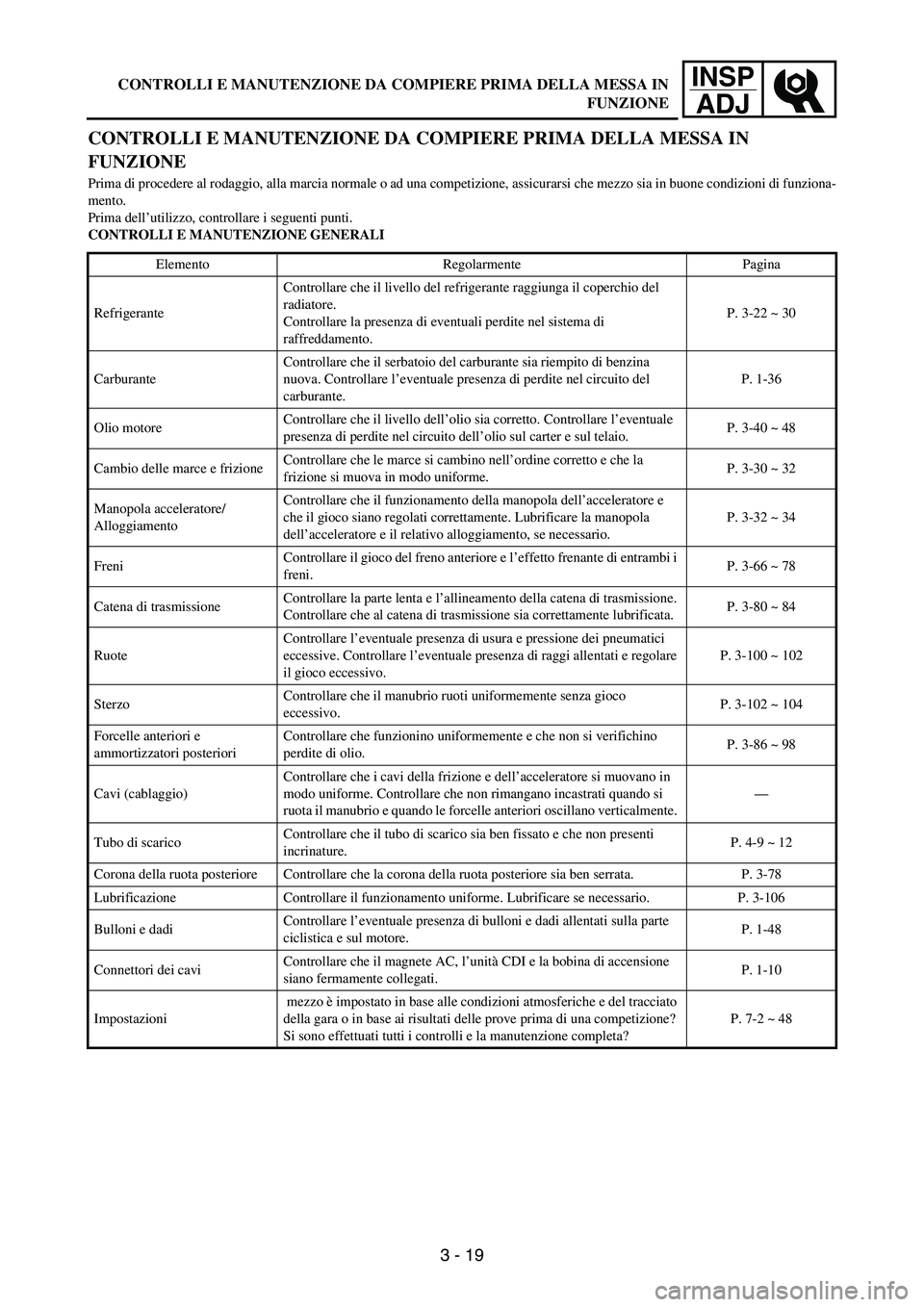
3 - 19
INSP
ADJ
CONTROLLI E MANUTENZIONE DA COMPIERE PRIMA DELLA MESSA IN
FUNZIONE
Prima di procedere al rodaggio, alla marcia normale o ad una competizione, assicurarsi che mezzo sia in buone condizioni di funziona-
mento.
Prima dell’utilizzo, controllare i seguenti punti.
CONTROLLI E MANUTENZIONE GENERALI
Elemento Regolarmente Pagina
RefrigeranteControllare che il livello del refrigerante raggiunga il coperchio del
radiatore.
Controllare la presenza di eventuali perdite nel sistema di
raffreddamento.P. 3-22 ~ 30
CarburanteControllare che il serbatoio del carburante sia riempito di benzina
nuova. Controllare l’eventuale presenza di perdite nel circuito del
carburante.P. 1-36
Olio motoreControllare che il livello dell’olio sia corretto. Controllare l’eventuale
presenza di perdite nel circuito dell’olio sul carter e sul telaio. P. 3-40 ~ 48
Cambio delle marce e frizioneControllare che le marce si cambino nell’ordine corretto e che la
frizione si muova in modo uniforme. P. 3-30 ~ 32
Manopola acceleratore/
AlloggiamentoControllare che il funzionamento della manopola dell’acceleratore e
che il gioco siano regolati correttamente. Lubrificare la manopola
dell’acceleratore e il relativo alloggiamento, se necessario. P. 3-32 ~ 34
FreniControllare il gioco del freno anteriore e l’effetto frenante di entrambi i
freni. P. 3-66 ~ 78
Catena di trasmissioneControllare la parte lenta e l’allineamento della catena di trasmissione.
Controllare che al catena di trasmissione sia correttamente lubrificata. P. 3-80 ~ 84
RuoteControllare l’eventuale presenza di usura e pressione dei pneumatici
eccessive. Controllare l’eventuale presenza di raggi allentati e regolare
il gioco eccessivo. P. 3-100 ~ 102
SterzoControllare che il manubrio ruoti uniformemente senza gioco
eccessivo. P. 3-102 ~ 104
Forcelle anteriori e
ammortizzatori posterioriControllare che funzionino uniformemente e che non si verifichino
perdite di olio.P. 3-86 ~ 98
Cavi (cablaggio)Controllare che i cavi della frizione e dell’acceleratore si muovano in
modo uniforme. Controllare che non rimangano incastrati quando si
ruota il manubrio e quando le forcelle anteriori oscillano verticalmente. —
Tubo di scaricoControllare che il tubo di scarico sia ben fissato e che non presenti
incrinature.P. 4-9 ~ 12
Corona della ruota posteriore Controllare che la corona della ruota posteriore sia ben serrata. P. 3-78
Lubrificazione Controllare il funzionamento uniforme. Lubrificare se necessario. P. 3-106
Bulloni e dadiControllare l’eventuale presenza di bulloni e dadi allentati sulla parte
ciclistica e sul motore. P. 1-48
Connettori dei caviControllare che il magnete AC, l’unità CDI e la bobina di accensione
siano fermamente collegati.P. 1-10
Impostazioni mezzo è impostato in base alle condizioni atmosferiche e del tracciato
della gara o in base ai risultati delle prove prima di una competizione?
Si sono effettuati tutti i controlli e la manutenzione completa?P. 7-2 ~ 48
CONTROLLI E MANUTENZIONE DA COMPIERE PRIMA DELLA MESSA IN
FUNZIONE
Page 212 of 864
3 - 21
INSP
ADJ
EC350000
ENGINE
COOLANT LEVEL INSPECTION
WARNING
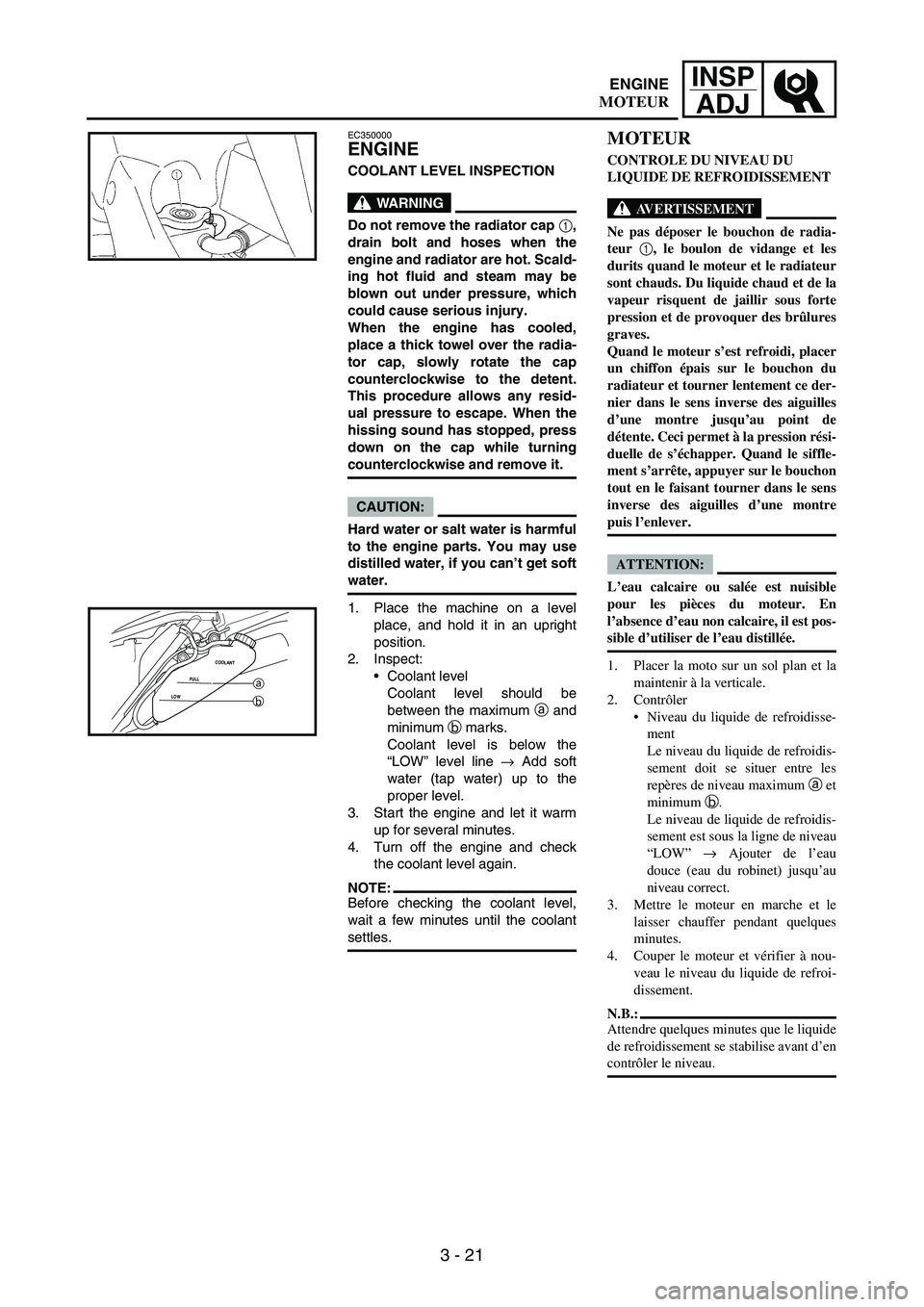
Do not remove the radiator cap 1,
drain bolt and hoses when the
engine and radiator are hot. Scald-
ing hot fluid and steam may be
blown out under pressure, which
could cause serious injury.
When the engine has cooled,
place a thick towel over the radia-
tor cap, slowly rotate the cap
counterclockwise to the detent.
This procedure allows any resid-
ual pressure to escape. When the
hissing sound has stopped, press
down on the cap while turning
counterclockwise and remove it.
CAUTION:
Hard water or salt water is harmful
to the engine parts. You may use
distilled water, if you can’t get soft
water.
1. Place the machine on a level
place, and hold it in an upright
position.
2. Inspect:
Coolant level
Coolant level should be
between the maximum
a and
minimum
b marks.
Coolant level is below the
“LOW” level line
→ Add soft
water (tap water) up to the
proper level.
3. Start the engine and let it warm
up for several minutes.
4. Turn off the engine and check
the coolant level again.
NOTE:Before checking the coolant level,
wait a few minutes until the coolant
settles.
LOWFULLCOOLANTa
b
MOTEUR
CONTROLE DU NIVEAU DU
LIQUIDE DE REFROIDISSEMENT
AVERTISSEMENT
Ne pas déposer le bouchon de radia-
teur 1
, le boulon de vidange et les
durits quand le moteur et le radiateur
sont chauds. Du liquide chaud et de la
vapeur risquent de jaillir sous forte
pression et de provoquer des brûlures
graves.
Quand le moteur s’est refroidi, placer
un chiffon épais sur le bouchon du
radiateur et tourner lentement ce der-
nier dans le sens inverse des aiguilles
d’une montre jusqu’au point de
détente. Ceci permet à la pression rési-
duelle de s’échapper. Quand le siffle-
ment s’arrête, appuyer sur le bouchon
tout en le faisant tourner dans le sens
inverse des aiguilles d’une montre
puis l’enlever.
ATTENTION:
L’eau calcaire ou salée est nuisible
pour les pièces du moteur. En
l’absence d’eau non calcaire, il est pos-
sible d’utiliser de l’eau distillée.
1. Placer la moto sur un sol plan et la
maintenir à la verticale.
2. Contrôler
Niveau du liquide de refroidisse-
ment
Le niveau du liquide de refroidis-
sement doit se situer entre les
repères de niveau maximum a et
minimum b.
Le niveau de liquide de refroidis-
sement est sous la ligne de niveau
“LOW” → Ajouter de l’eau
douce (eau du robinet) jusqu’au
niveau correct.
3. Mettre le moteur en marche et le
laisser chauffer pendant quelques
minutes.
4. Couper le moteur et vérifier à nou-
veau le niveau du liquide de refroi-
dissement.
N.B.:
Attendre quelques minutes que le liquide
de refroidissement se stabilise avant d’en
contrôler le niveau.
ENGINE
MOTEUR
Page 213 of 864
INSP
ADJ
3 - 22
MOTOR
KÜHLFLÜSSIGKEITSSTAND
KONTROLLIEREN
WARNUNG
Der Kühlerverschlußdeckel 1, die
Ablaßschraube und die Schläuche
dürfen niemals bei heißem Motor
abgenommen werden. Austreten-
der Dampf und heiße Kühlflüssig-
keit können ernsthafte Verbrühun-
gen verursachen.
Den Kühlerverschlußdeckel erst
nach Abkühlen des Motors öffnen.
Dazu einen dicken Lappen über
den Kühlerverschlußdeckel legen
und dann den Deckel langsam im
Gegenuhrzeigersinn bis zum
Anschlag drehen Dadurch kann
der restliche Druck entweichen.
Erst wenn kein Zischen mehr zu
vernehmen ist, den Verschlußdek-
kel eindrücken und im Gegenuhr-
zeigersinn abschrauben.
ACHTUNG:
Hartes Wasser oder Salzwasser
sind für den Motor schädlich. Ver-
wenden Sie destilliertes Wasser
wenn kein weiches Wasser vor-
handen ist.
1. Das Motorrad auf einem ebenen
Untergrund abstellen und in
gerader Stellung halten.
2. Kontrollieren:
Kühlflüssigkeitsstand
Der Kühlflüssigkeitsstand
sollte sich zwischen den Maxi-
mal- und Minimalstand-Mar-
kierungen
a und
b befinden.
Kühlflüssigkeitsstand unter-
halb der Markierung “LOW”
→
Weiches Wasser (Leitungs-
wasser) bis zum vorgeschrie-
benen Stand auffüllen.
3. Den Motor anlassen und einige
Minuten lang betreiben.
4. Den Motor abstellen und den
Kühlflüssigkeitsstand erneut
kontrollieren.
HINWEIS:
Vor der Kontrolle des Kühlflüssig-
keitsstandes einige Minuten warten,
bis sich die Flüssigkeit gesetzt hat.
MOTORE
CONTROLLO DEL LIVELLO DEL
REFRIGERANTE
AVVERTENZA
Non rimuovere il coperchio del radia-
tore 1
, tappo di scarico e i flessibili
quando il motore e il radiatore sono
caldi. Si potrebbe verificare la fuoriu-
scita di liquido bollente e vapore sotto
pressione, con conseguenti gravi infor-
tuni.
Quando il motore si è raffreddato, col-
locare un asciugamano spesso sul
coperchio del radiatore e ruotare len-
tamente il coperchio in senso antiora-
rio fino al fermo. Questa procedura
consente la fuoriuscita della pressione
residua. Quando non si sente più il
sibilo caratteristico, rimuovere il
coperchio e premendo e svitando in
senso antiorario.
ATTENZIONE:
L’acqua dura o salata danneggia i
componenti del motore. Utilizzare
acqua distillata, in caso di impossibi-
lità di reperimento di acqua dolce.
1. Collocare il mezzo su una superficie
piana in posizione verticale.
2. Controllare:
Livello refrigerante
Il livello del refrigerante deve
essere compreso tra i contrasse-
gni del massimo a e del minimo
b.
Il livello del refrigerante è al di
sotto della linea di livello “LOW”
→ Aggiungere acqua dolce
(acqua del rubinetto) fino al
livello corretto.
3. Avviare il motore e farlo riscaldare
per alcuni minuti.
4. Spegnere il motore e controllare
nuovamente il livello del refrige-
rante.
NOTA:
Prima di controllare il livello, attendere
alcuni minuti finché il refrigerante non si
deposita.
MOTOR
COMPROBACIÓN DEL NIVEL DE
REFRIGERANTE
ADVERTENCIA
No quite el tapón del radiador 1,
el tornillo de vaciado y los tubos
cuando el motor y el radiador
estén calientes. Puede salir un
chorro a presión de líquido y
vapor calientes y provocar graves
lesiones.
Cuando el motor se haya enfriado,
coloque una toalla fina sobre el
tapón del radiador y gire lenta-
mente el tapón en el sentido con-
trario al de las agujas del reloj
hasta el tope. Con esta operación
se libera la presión residual.
Cuando deje de oírse el silbido,
presione el tapón hacia abajo
mientras lo gira en el sentido con-
trario al de las agujas del reloj y
luego extráigalo.
ATENCION:
El agua dura o el agua salada
resultan perjudiciales para los
componentes del motor. Puede
utilizar agua destilada si no dis-
pone de agua blanda.
1. Sitúe la máquina sobre una
superficie horizontal y mantén-
gala en posición vertical.
2. Comprobar:
Nivel de refrigerante
El nivel de refrigerante debe
encontrarse entre la marca de
nivel máximo
a y la marca de
nivel mínimo
b.
Nivel de refrigerante por
debajo de la línea “LOW”
→
Añadir agua blanda (agua del
grifo) hasta el nivel correcto.
3. Arranque el motor y déjelo
calentar unos minutos.
4. Pare el motor y vuelva a com-
probar el nivel de refrigerante.
NOTA:
Antes de comprobar el nivel de refri-
gerante, espere unos minutos para
que se asiente.
MOTOR
MOTORE
MOTOR
Page 214 of 864
3 - 23
INSP
ADJ
COOLANT REPLACEMENT
WARNING
Do not remove the radiator cap
when the engine is hot.
CAUTION:
Take care so that coolant does not
splash on painted surfaces. If it
splashes, wash it away with water.
1. Place a container under the
engine.
2. Remove:
Seat
Refer to “SEAT, FUEL TANK
AND SIDE COVERS” section
in the CHAPTER 4.
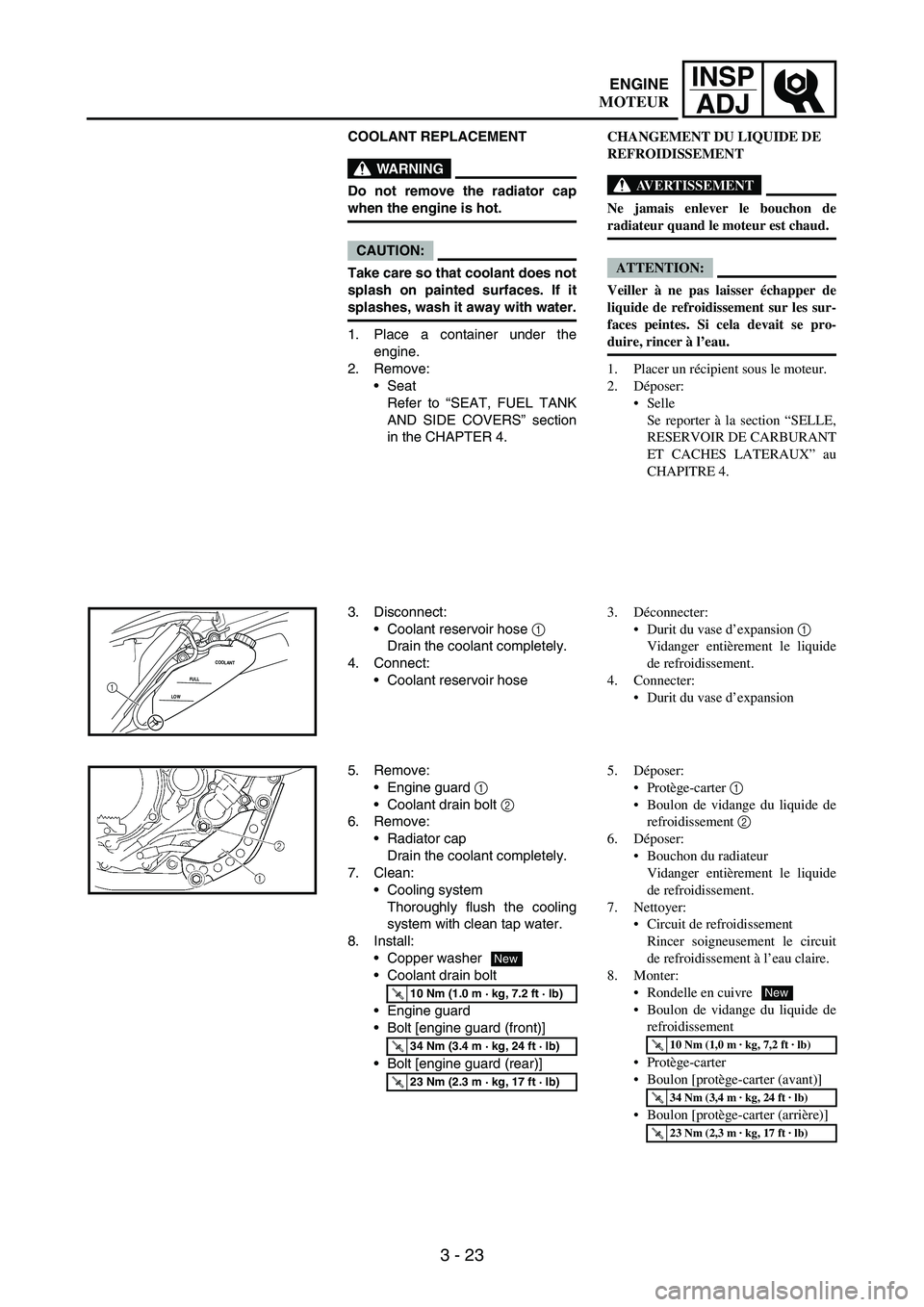
3. Disconnect:
Coolant reservoir hose
1
Drain the coolant completely.
4. Connect:
Coolant reservoir hose
LOWFULLCOOLANT1
5. Remove:
Engine guard
1
Coolant drain bolt
2
6. Remove:
Radiator cap
Drain the coolant completely.
7. Clean:
Cooling system
Thoroughly flush the cooling
system with clean tap water.
8. Install:
Copper washer
Coolant drain bolt
Engine guard
Bolt [engine guard (front)]
Bolt [engine guard (rear)]
T R..10 Nm (1.0 m · kg, 7.2 ft · lb)
T R..34 Nm (3.4 m · kg, 24 ft · lb)
T R..23 Nm (2.3 m · kg, 17 ft · lb)
New
CHANGEMENT DU LIQUIDE DE
REFROIDISSEMENT
AVERTISSEMENT
Ne jamais enlever le bouchon de
radiateur quand le moteur est chaud.
ATTENTION:
Veiller à ne pas laisser échapper de
liquide de refroidissement sur les sur-
faces peintes. Si cela devait se pro-
duire, rincer à l’eau.
1. Placer un récipient sous le moteur.
2. Déposer:
Selle
Se reporter à la section “SELLE,
RESERVOIR DE CARBURANT
ET CACHES LATERAUX” au
CHAPITRE 4.
3. Déconnecter:
Durit du vase d’expansion 1
Vidanger entièrement le liquide
de refroidissement.
4. Connecter:
Durit du vase d’expansion
5. Déposer:
Protège-carter 1
Boulon de vidange du liquide de
refroidissement 2
6. Déposer:
Bouchon du radiateur
Vidanger entièrement le liquide
de refroidissement.
7. Nettoyer:
Circuit de refroidissement
Rincer soigneusement le circuit
de refroidissement à l’eau claire.
8. Monter:
Rondelle en cuivre
Boulon de vidange du liquide de
refroidissement
Protège-carter
Boulon [protège-carter (avant)]
Boulon [protège-carter (arrière)]
T R..10 Nm (1,0 m · kg, 7,2 ft · lb)
T R..34 Nm (3,4 m · kg, 24 ft · lb)
T R..23 Nm (2,3 m · kg, 17 ft · lb)
New
ENGINE
MOTEUR
Page 215 of 864
INSP
ADJ
3 - 24
KÜHLFLÜSSIGKEIT WECHSELN
WARNUNG
Der Kühlerverschlußdeckel darf
niemals bei heißem Motor abge-
nommen werden.
ACHTUNG:
Keine Kühlflüssigkeit an lackierte
Flächen lassen. Spritzer sofort mit
Wasser abwaschen.
1. Ein Auffanggefäß unter den
Motor stellen.
2. Demontieren:
Sitzbank
Siehe unter “SITZBANK,
KRAFTSTOFFTANK UND
SEITENABDEKKUNGEN” in
KAPITEL 4.
3. Lösen:
Ausgleichsbehälter-Schlauch
1
Die Kühlflüssigkeit vollständig
ablaufen lassen.
4. Anschließen:
Ausgleichsbehälter-Schlauch
5. Demontieren:
Motorschutz
1
Kühlflüssigkeits-Ablaß-
schraube
2
6. Demontieren:
Kühlerverschlußdeckel
Die Kühlflüssigkeit vollständig
ablaufen lassen.
7. Reinigen:
Kühlsystem
Das Kühlsystem gründlich mit
sauberem Leitungswasser
spülen.
8. Montieren:
Kupferscheibe
Kühlflüssigkeits-Ablaß-
schraube
Motorschutz
Motorschutz-Schraube (vorn)
Motorschutz-Schraube
(hinten)
T R..10 Nm (1,0 m · kg, 7,2 ft · lb)
T R..34 Nm (3,4 m · kg, 24 ft · lb)
T R..23 Nm (2,3 m · kg, 17 ft · lb)
New
SOSTITUZIONE DEL
REFRIGERANTE
AVVERTENZA
Non togliere il coperchio del radiatore
a motore caldo.
ATTENZIONE:
Prestare attenzione a non rovesciare il
refrigerante su superfici verniciate. Se
si rovescia, lavarlo con acqua.
1. Collocare un recipiente sotto il
motore.
2. Togliere:
Sella
Fare riferimento al paragrafo
“SELLA, SERBATOIO CAR-
BURANTE E FIANCHETTI” nel
CAPITOLO 4.
3. Scollegare:
Flessibile del serbatoio del refri-
gerante 1
Scaricare completamente il refri-
gerante.
4. Collegare:
Flessibile del serbatoio del refri-
gerante
5. Togliere:
Riparo motore 1
Bullone di scarico refrigerante 2
6. Togliere:
Coperchio del radiatore
Scaricare completamente il refri-
gerante.
7. Pulire:
Sistema di raffreddamento
Sciacquare accuratamente il
sistema di raffreddamento con
acqua del rubinetto pulita.
8. Installare:
Rondella di rame
Bullone di scarico refrigerante
Riparo motore
Bullone
[riparo motore (anteriore)]
Bullone
[riparo motore (posteriore)]
T R..10 Nm (1,0 m · kg, 7,2 ft · lb)
T R..34 Nm (3,4 m · kg, 24 ft · lb)
T R..23 Nm (2,3 m · kg, 17 ft · lb)
New
CAMBIO DEL REFRIGERANTE
ADVERTENCIA
No quite el tapón del radiador
cuando el motor esté caliente.
ATENCION:
Evite que se vierta refrigerante
sobre las superficies pintadas. Si
se vierte, lávelo con agua.
1. Coloque un recipiente debajo del
motor.
2. Extraer:
Sillín
Consulte el apartado “SILLÍN,
DEPÓSITO DE COMBUSTI-
BLE Y CUBIERTAS LATERA-
LES” del CAPÍTULO 4.
3. Desconectar:
Tubo del depósito de refrige-
rante
1
Vacíe completamente el refri-
gerante.
4. Conectar:
Tubo del depósito de refrige-
rante
5. Extraer:
Protección del motor
1
Tornillo de vaciado del refrige-
rante
2
6. Extraer:
Tapón del radiador
Vacíe completamente el refri-
gerante.
7. Limpiar:
Sistema de refrigeración
Lave a fondo el sistema de
refrigeración con agua del
grifo limpia.
8. Instalar:
Arandela de cobre
Tornillo de vaciado del refrige-
rante
Protector del motor
Tornillo
[protector del motor (delante)]
Tornillo
[protector del motor (trasero)]
T R..10 Nm (1,0 m · kg, 7,2 ft · lb)
T R..34 Nm (3,4 m · kg, 24 ft · lb)
T R..23 Nm (2,3 m · kg, 17 ft · lb)
New
MOTOR
MOTORE
MOTOR
Page 216 of 864
3 - 25
INSP
ADJ
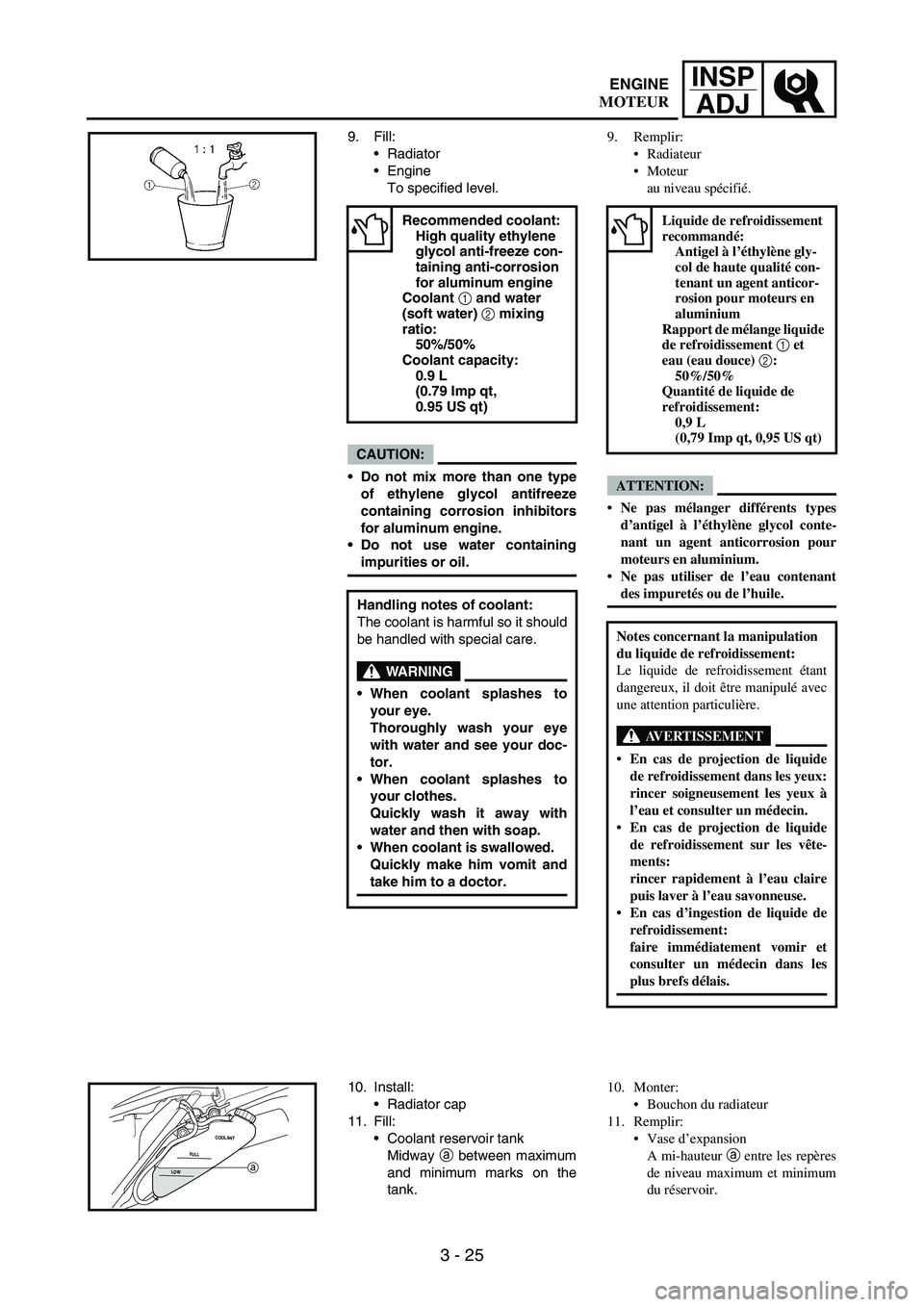
9. Fill:
Radiator
Engine
To specified level.
CAUTION:
Do not mix more than one type
of ethylene glycol antifreeze
containing corrosion inhibitors
for aluminum engine.
Do not use water containing
impurities or oil.
Recommended coolant:
High quality ethylene
glycol anti-freeze con-
taining anti-corrosion
for aluminum engine
Coolant 1 and water
(soft water) 2 mixing
ratio:
50%/50%
Coolant capacity:
0.9 L
(0.79 Imp qt,
0.95 US qt)
Handling notes of coolant:
The coolant is harmful so it should
be handled with special care.
WARNING
When coolant splashes to
your eye.
Thoroughly wash your eye
with water and see your doc-
tor.
When coolant splashes to
your clothes.
Quickly wash it away with
water and then with soap.
When coolant is swallowed.
Quickly make him vomit and
take him to a doctor.
10. Install:
Radiator cap
11. Fill:
Coolant reservoir tank
Midway
a between maximum
and minimum marks on the
tank.
LOWFULLCOOLANTa
9. Remplir:
Radiateur
Moteur
au niveau spécifié.
ATTENTION:
Ne pas mélanger différents types
d’antigel à l’éthylène glycol conte-
nant un agent anticorrosion pour
moteurs en aluminium.
Ne pas utiliser de l’eau contenant
des impuretés ou de l’huile.
Liquide de refroidissement
recommandé:
Antigel à l’éthylène gly-
col de haute qualité con-
tenant un agent anticor-
rosion pour moteurs en
aluminium
Rapport de mélange liquide
de refroidissement 1 et
eau (eau douce) 2:
50%/50%
Quantité de liquide de
refroidissement:
0,9 L
(0,79 Imp qt, 0,95 US qt)
Notes concernant la manipulation
du liquide de refroidissement:
Le liquide de refroidissement étant
dangereux, il doit être manipulé avec
une attention particulière.
AVERTISSEMENT
En cas de projection de liquide
de refroidissement dans les yeux:
rincer soigneusement les yeux à
l’eau et consulter un médecin.
En cas de projection de liquide
de refroidissement sur les vête-
ments:
rincer rapidement à l’eau claire
puis laver à l’eau savonneuse.
En cas d’ingestion de liquide de
refroidissement:
faire immédiatement vomir et
consulter un médecin dans les
plus brefs délais.
10. Monter:
Bouchon du radiateur
11. Remplir:
Vase d’expansion
A mi-hauteur a entre les repères
de niveau maximum et minimum
du réservoir.
ENGINE
MOTEUR
Page 217 of 864
INSP
ADJ
3 - 26
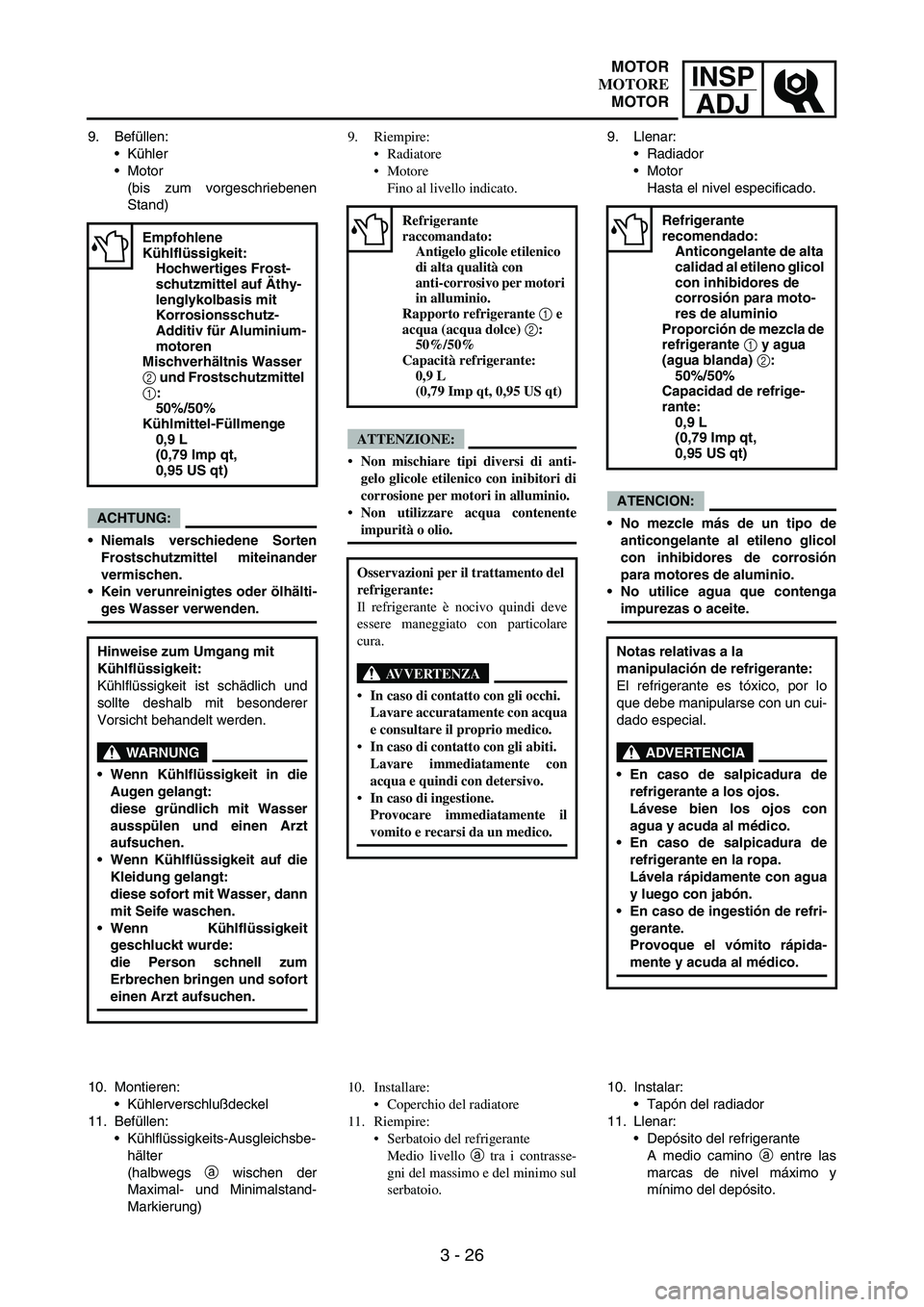
9. Befüllen:
Kühler
Motor
(bis zum vorgeschriebenen
Stand)
ACHTUNG:
Niemals verschiedene Sorten
Frostschutzmittel miteinander
vermischen.
Kein verunreinigtes oder ölhälti-
ges Wasser verwenden.
Empfohlene
Kühlflüssigkeit:
Hochwertiges Frost-
schutzmittel auf Äthy-
lenglykolbasis mit
Korrosionsschutz-
Additiv für Aluminium-
motoren
Mischverhältnis Wasser
2 und Frostschutzmittel
1:
50%/50%
Kühlmittel-Füllmenge
0,9 L
(0,79 Imp qt,
0,95 US qt)
Hinweise zum Umgang mit
Kühlflüssigkeit:
Kühlflüssigkeit ist schädlich und
sollte deshalb mit besonderer
Vorsicht behandelt werden.
WARNUNG
Wenn Kühlflüssigkeit in die
Augen gelangt:
diese gründlich mit Wasser
ausspülen und einen Arzt
aufsuchen.
Wenn Kühlflüssigkeit auf die
Kleidung gelangt:
diese sofort mit Wasser, dann
mit Seife waschen.
Wenn Kühlflüssigkeit
geschluckt wurde:
die Person schnell zum
Erbrechen bringen und sofort
einen Arzt aufsuchen.
10. Montieren:
Kühlerverschlußdeckel
11. Befüllen:
Kühlflüssigkeits-Ausgleichsbe-
hälter
(halbwegs
a wischen der
Maximal- und Minimalstand-
Markierung)9. Riempire:
Radiatore
Motore
Fino al livello indicato.
ATTENZIONE:
Non mischiare tipi diversi di anti-
gelo glicole etilenico con inibitori di
corrosione per motori in alluminio.
Non utilizzare acqua contenente
impurità o olio.
Refrigerante
raccomandato:
Antigelo glicole etilenico
di alta qualità con
anti-corrosivo per motori
in alluminio.
Rapporto refrigerante 1 e
acqua (acqua dolce) 2:
50%/50%
Capacità refrigerante:
0,9 L
(0,79 Imp qt, 0,95 US qt)
Osservazioni per il trattamento del
refrigerante:
Il refrigerante è nocivo quindi deve
essere maneggiato con particolare
cura.
AVVERTENZA
In caso di contatto con gli occhi.
Lavare accuratamente con acqua
e consultare il proprio medico.
In caso di contatto con gli abiti.
Lavare immediatamente con
acqua e quindi con detersivo.
In caso di ingestione.
Provocare immediatamente il
vomito e recarsi da un medico.
10. Installare:
Coperchio del radiatore
11. Riempire:
Serbatoio del refrigerante
Medio livello a tra i contrasse-
gni del massimo e del minimo sul
serbatoio. 9. Llenar:
Radiador
Motor
Hasta el nivel especificado.
ATENCION:
No mezcle más de un tipo de
anticongelante al etileno glicol
con inhibidores de corrosión
para motores de aluminio.
No utilice agua que contenga
impurezas o aceite.
Refrigerante
recomendado:
Anticongelante de alta
calidad al etileno glicol
con inhibidores de
corrosión para moto-
res de aluminio
Proporción de mezcla de
refrigerante 1 y agua
(agua blanda) 2:
50%/50%
Capacidad de refrige-
rante:
0,9 L
(0,79 Imp qt,
0,95 US qt)
Notas relativas a la
manipulación de refrigerante:
El refrigerante es tóxico, por lo
que debe manipularse con un cui-
dado especial.
ADVERTENCIA
En caso de salpicadura de
refrigerante a los ojos.
Lávese bien los ojos con
agua y acuda al médico.
En caso de salpicadura de
refrigerante en la ropa.
Lávela rápidamente con agua
y luego con jabón.
En caso de ingestión de refri-
gerante.
Provoque el vómito rápida-
mente y acuda al médico.
10. Instalar:
Tapón del radiador
11. Llenar:
Depósito del refrigerante
A medio camino
a entre las
marcas de nivel máximo y
mínimo del depósito.
MOTOR
MOTORE
MOTOR