fuel YAMAHA WR 250F 2006 Notices Demploi (in French)
[x] Cancel search | Manufacturer: YAMAHA, Model Year: 2006, Model line: WR 250F, Model: YAMAHA WR 250F 2006Pages: 900, PDF Size: 23.77 MB
Page 420 of 900
4 - 79
ENGCYLINDER HEAD
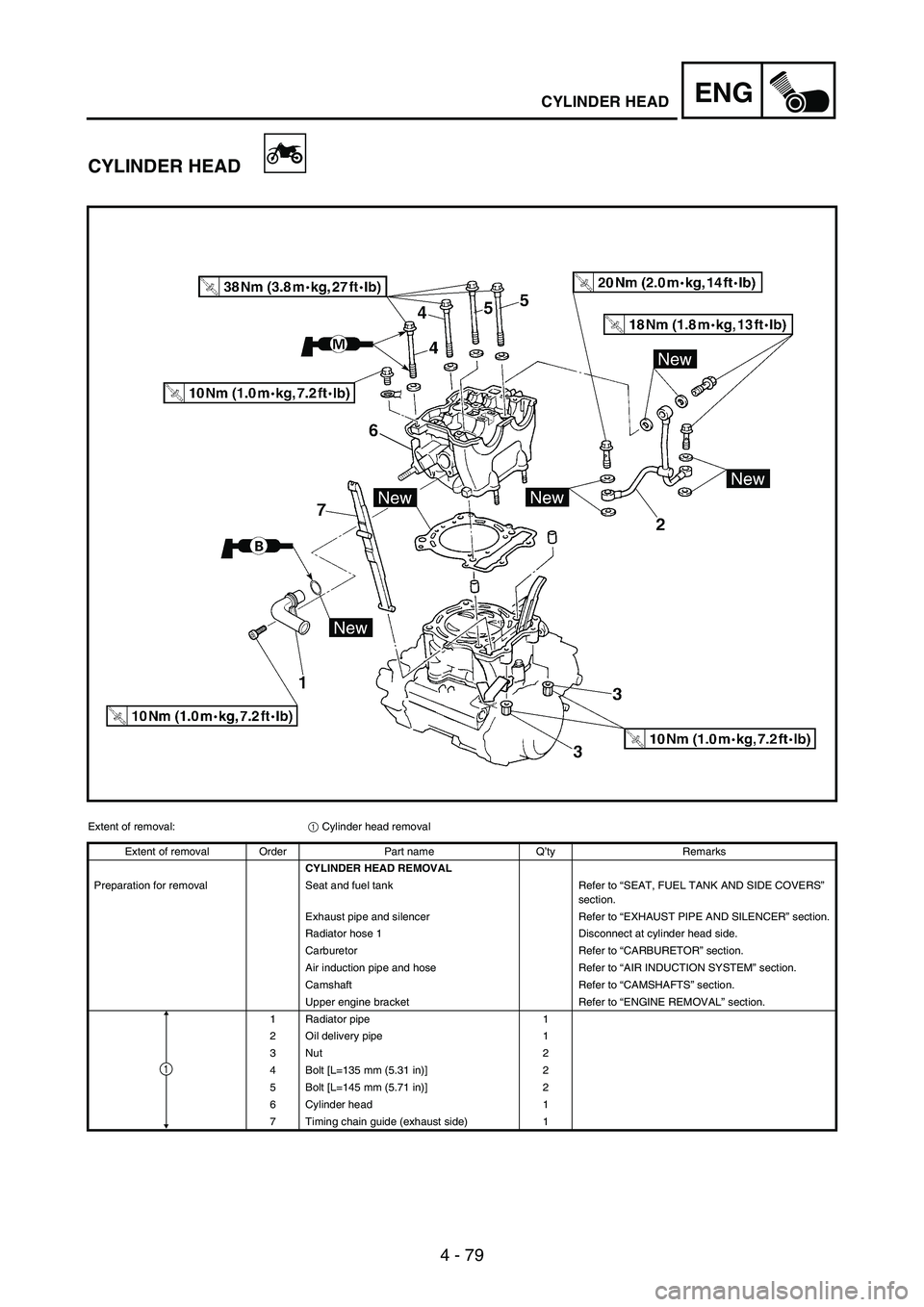
CYLINDER HEAD
Extent of removal:
1 Cylinder head removal
Extent of removal Order Part name Q’ty Remarks
CYLINDER HEAD REMOVAL
Preparation for removal Seat and fuel tank Refer to “SEAT, FUEL TANK AND SIDE COVERS”
section.
Exhaust pipe and silencer Refer to “EXHAUST PIPE AND SILENCER” section.
Radiator hose 1 Disconnect at cylinder head side.
Carburetor Refer to “CARBURETOR” section.
Air induction pipe and hose Refer to “AIR INDUCTION SYSTEM” section.
Camshaft Refer to “CAMSHAFTS” section.
Upper engine bracket Refer to “ENGINE REMOVAL” section.
1 Radiator pipe 1
2 Oil delivery pipe 1
3Nut 2
4 Bolt [L=135 mm (5.31 in)] 2
5 Bolt [L=145 mm (5.71 in)] 2
6 Cylinder head 1
7 Timing chain guide (exhaust side) 1
1
Page 534 of 900
4 - 193
ENGAC MAGNETO AND STARTER CLUTCH
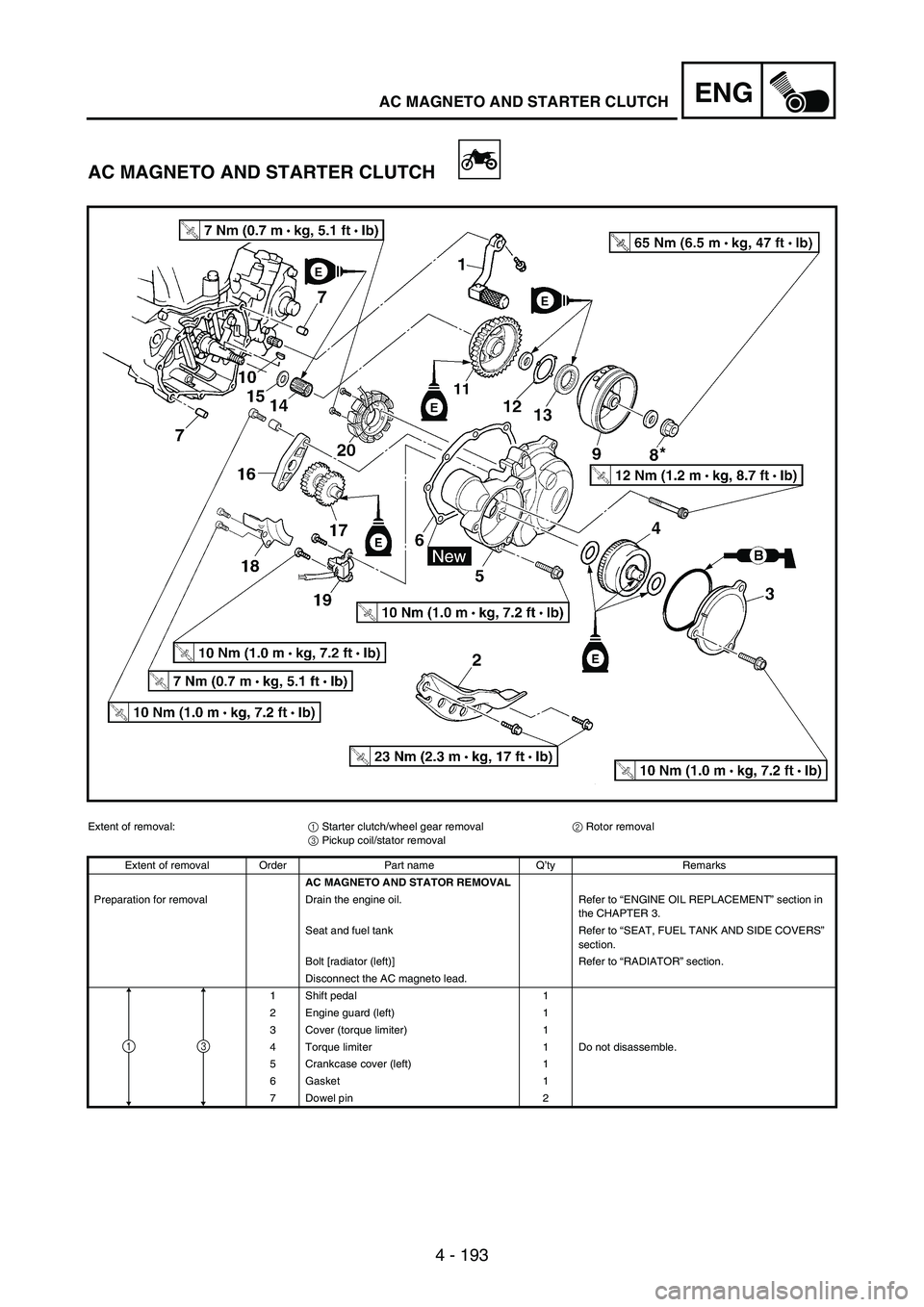
AC MAGNETO AND STARTER CLUTCH
Extent of removal:
1 Starter clutch/wheel gear removal
2 Rotor removal
3 Pickup coil/stator removal
Extent of removal Order Part name Q’ty Remarks
AC MAGNETO AND STATOR REMOVAL
Preparation for removal Drain the engine oil. Refer to “ENGINE OIL REPLACEMENT” section in
the CHAPTER 3.
Seat and fuel tank Refer to “SEAT, FUEL TANK AND SIDE COVERS”
section.
Bolt [radiator (left)] Refer to “RADIATOR” section.
Disconnect the AC magneto lead.
1 Shift pedal 1
2 Engine guard (left) 1
3 Cover (torque limiter) 1
4 Torque limiter 1 Do not disassemble.
5 Crankcase cover (left) 1
6 Gasket 1
7 Dowel pin 2
31
Page 556 of 900
4 - 215
ENGENGINE REMOVAL
EC4M0000
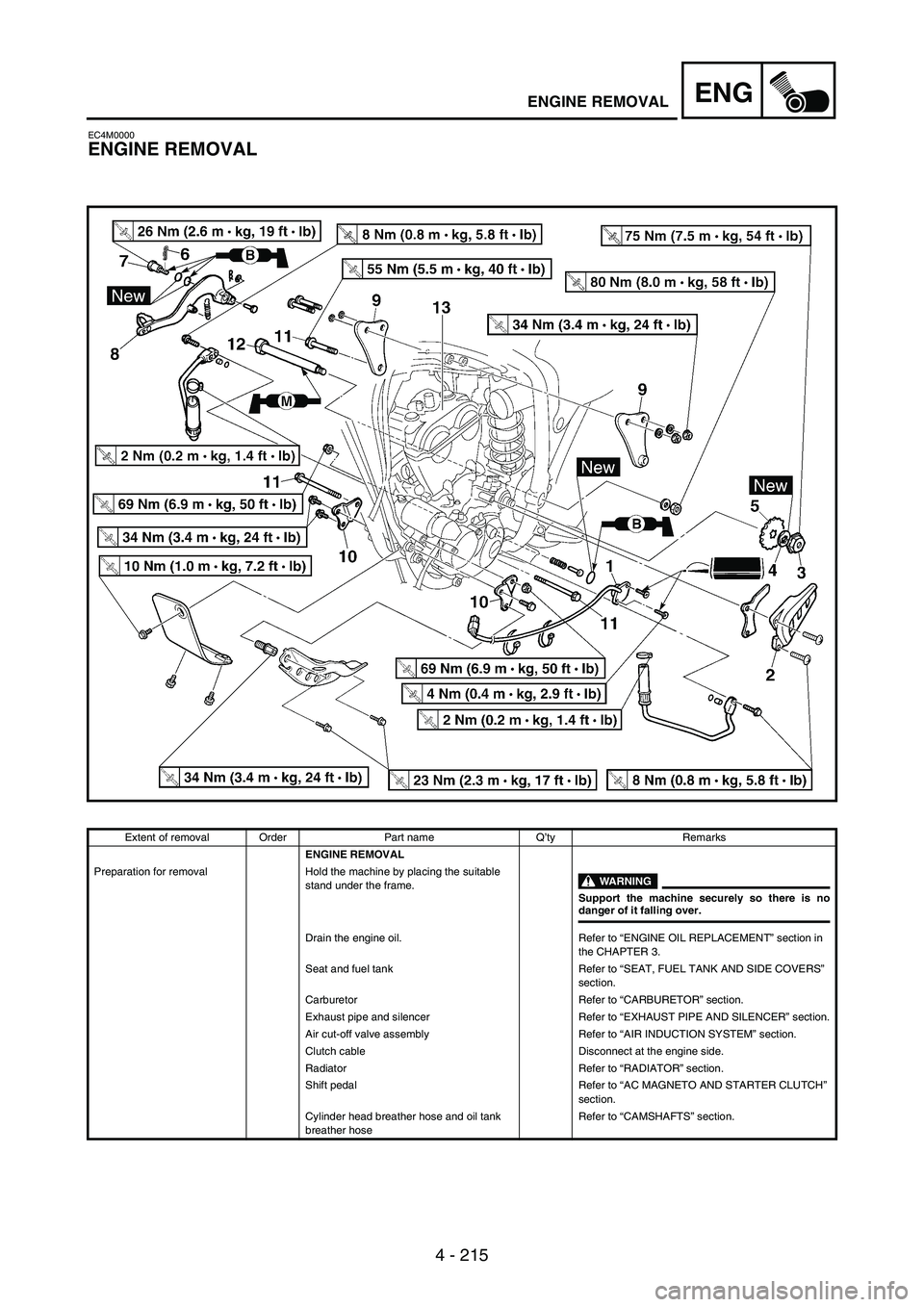
ENGINE REMOVAL
Extent of removal Order Part name Q’ty Remarks
ENGINE REMOVAL
Preparation for removal Hold the machine by placing the suitable
stand under the frame.
WARNING
Support the machine securely so there is nodanger of it falling over.
Drain the engine oil. Refer to “ENGINE OIL REPLACEMENT” section in
the CHAPTER 3.
Seat and fuel tank Refer to “SEAT, FUEL TANK AND SIDE COVERS”
section.
Carburetor Refer to “CARBURETOR” section.
Exhaust pipe and silencer Refer to “EXHAUST PIPE AND SILENCER” section.
Air cut-off valve assembly Refer to “AIR INDUCTION SYSTEM” section.
Clutch cable Disconnect at the engine side.
Radiator Refer to “RADIATOR” section.
Shift pedal Refer to “AC MAGNETO AND STARTER CLUTCH”
section.
Cylinder head breather hose and oil tank
breather hoseRefer to “CAMSHAFTS” section.
Page 746 of 900
5 - 141
CHASREAR SHOCK ABSORBER
EC580000
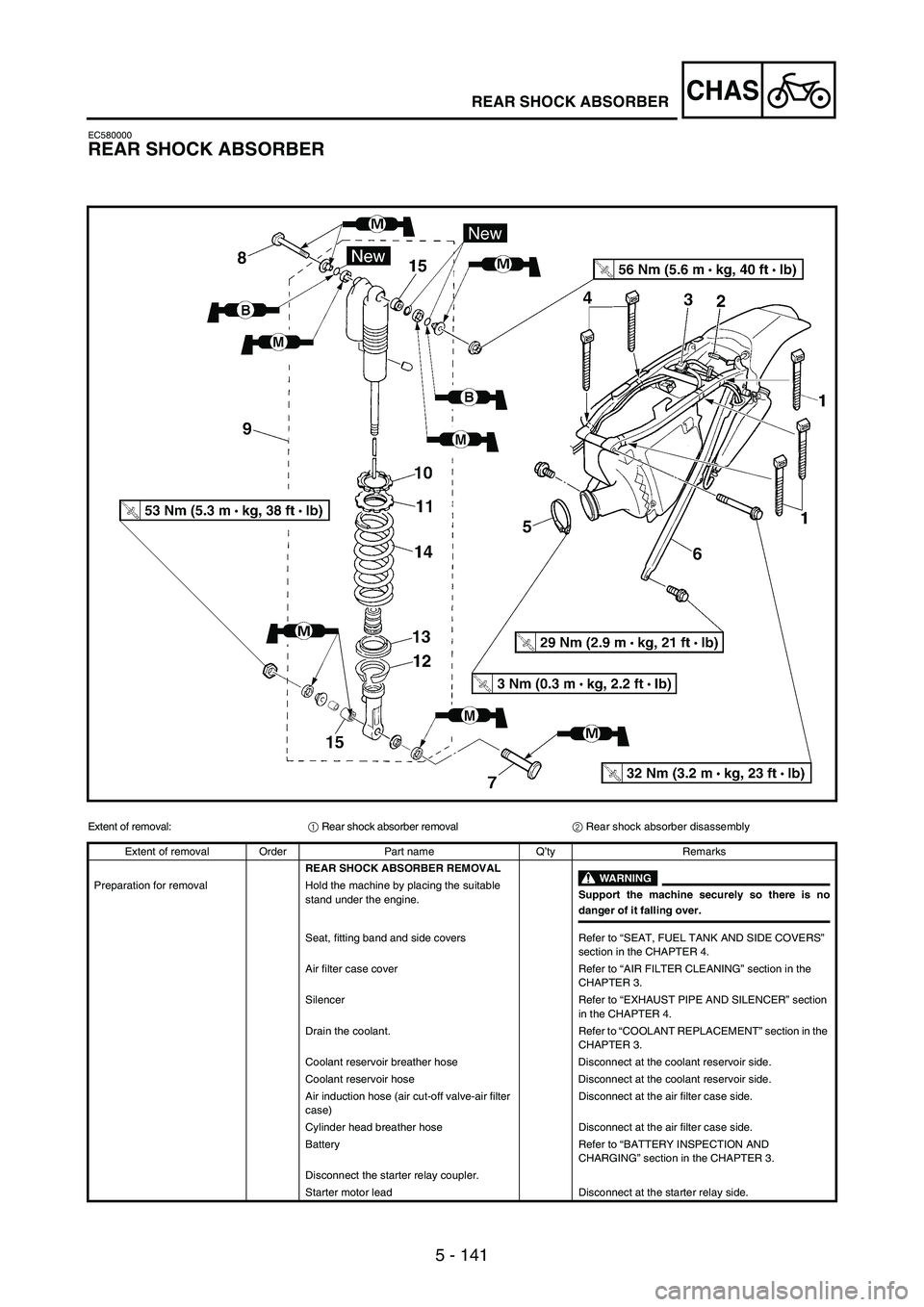
REAR SHOCK ABSORBER
Extent of removal:
1 Rear shock absorber removal
2 Rear shock absorber disassembly
Extent of removal Order Part name Q’ty Remarks
REAR SHOCK ABSORBER REMOVAL
WARNING
Support the machine securely so there is nodanger of it falling over. Preparation for removal Hold the machine by placing the suitable
stand under the engine.
Seat, fitting band and side covers Refer to “SEAT, FUEL TANK AND SIDE COVERS”
section in the CHAPTER 4.
Air filter case cover Refer to “AIR FILTER CLEANING” section in the
CHAPTER 3.
Silencer Refer to “EXHAUST PIPE AND SILENCER” section
in the CHAPTER 4.
Drain the coolant. Refer to “COOLANT REPLACEMENT” section in the
CHAPTER 3.
Coolant reservoir breather hose Disconnect at the coolant reservoir side.
Coolant reservoir hose Disconnect at the coolant reservoir side.
Air induction hose (air cut-off valve-air filter
case)Disconnect at the air filter case side.
Cylinder head breather hose Disconnect at the air filter case side.
Battery Refer to “BATTERY INSPECTION AND
CHARGING” section in the CHAPTER 3.
Disconnect the starter relay coupler.
Starter motor lead Disconnect at the starter relay side.
Page 771 of 900
6 - 8
–+ELECIGNITION SYSTEM
EC620000
IGNITION SYSTEM
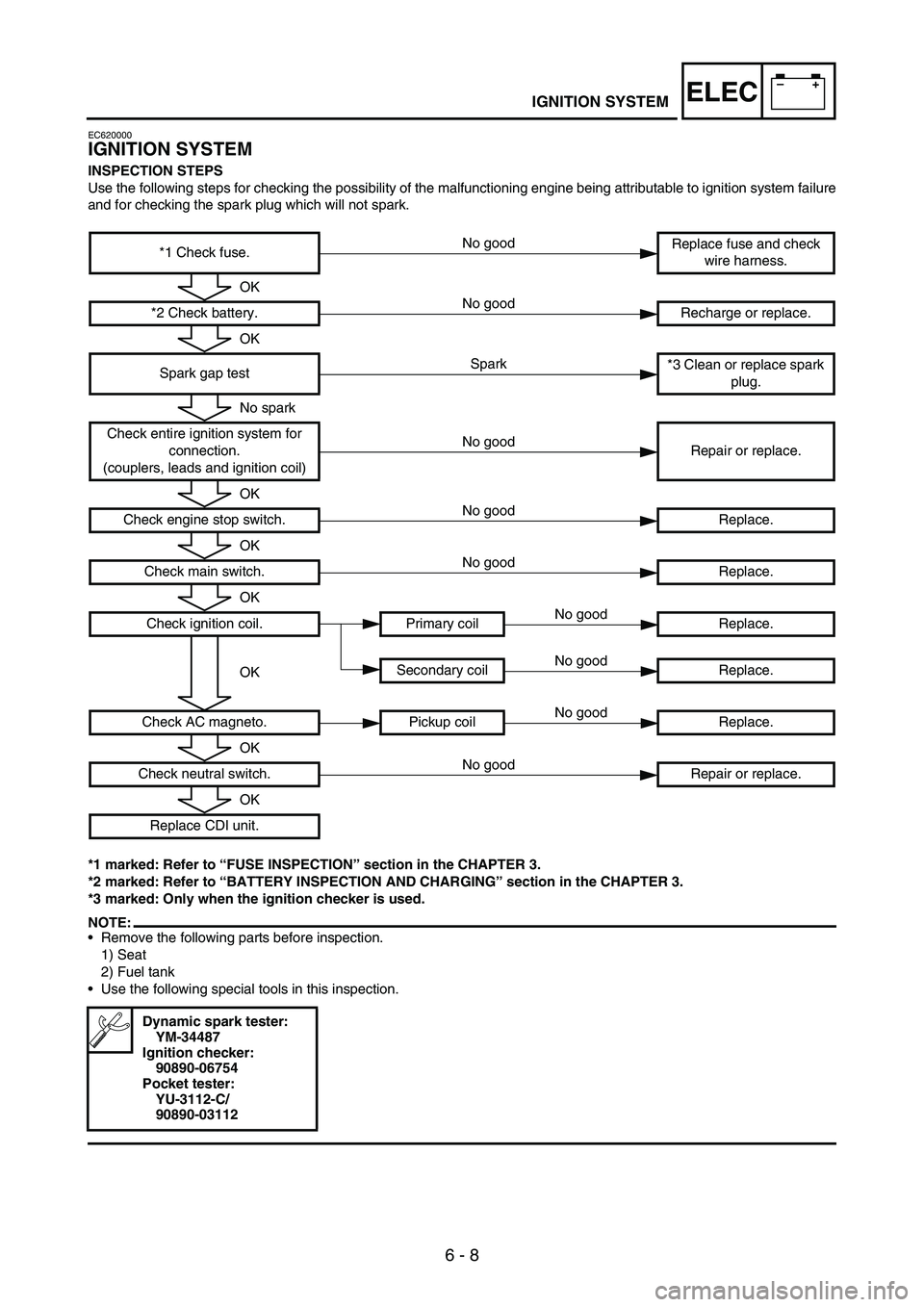
INSPECTION STEPS
Use the following steps for checking the possibility of the malfunctioning engine being attributable to ignition system failure
and for checking the spark plug which will not spark.
*1 marked: Refer to “FUSE INSPECTION” section in the CHAPTER 3.
*2 marked: Refer to “BATTERY INSPECTION AND CHARGING” section in the CHAPTER 3.
*3 marked: Only when the ignition checker is used.
NOTE:•Remove the following parts before inspection.
1) Seat
2) Fuel tank
•Use the following special tools in this inspection.
*1 Check fuse.Replace fuse and check
wire harness.
*2 Check battery. Recharge or replace.
Spark gap test*3 Clean or replace spark
plug.
Check entire ignition system for
connection.
(couplers, leads and ignition coil)Repair or replace.
Check engine stop switch. Replace.
Check main switch.Replace.
Check ignition coil. Primary coil Replace.
Secondary coil Replace.
Check AC magneto. Pickup coil Replace.
Check neutral switch. Repair or replace.
Replace CDI unit.
Dynamic spark tester:
YM-34487
Ignition checker:
90890-06754
Pocket tester:
YU-3112-C/
90890-03112
No good
OK
No good
OK
Spark
No spark
No good
OK
No good
OK
No good
OK
No good
OKNo good
No good
OK
No good
OK
Page 808 of 900
6 - 45
–+ELECCHARGING SYSTEM
EC680000
CHARGING SYSTEM
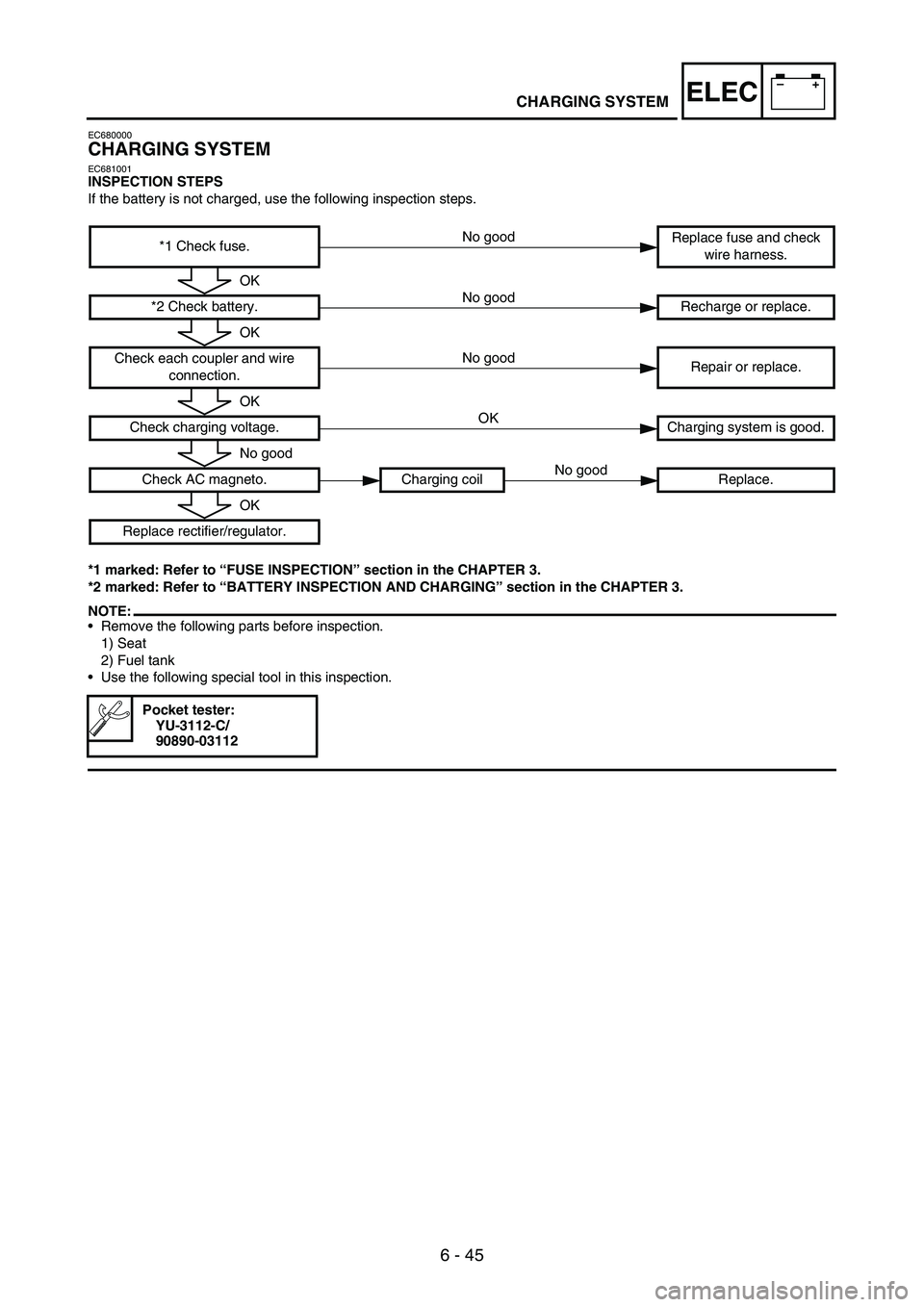
EC681001INSPECTION STEPS
If the battery is not charged, use the following inspection steps.
*1 marked: Refer to “FUSE INSPECTION” section in the CHAPTER 3.
*2 marked: Refer to “BATTERY INSPECTION AND CHARGING” section in the CHAPTER 3.
NOTE:•Remove the following parts before inspection.
1) Seat
2) Fuel tank
•Use the following special tool in this inspection.
*1 Check fuse.Replace fuse and check
wire harness.
*2 Check battery. Recharge or replace.
Check each coupler and wire
connection.Repair or replace.
Check charging voltage. Charging system is good.
Check AC magneto. Charging coil Replace.
Replace rectifier/regulator.
Pocket tester:
YU-3112-C/
90890-03112
No good
OK
No good
OK
No good
OK
OK
No good
No good
OK
Page 830 of 900
6 - 67
–+ELECLIGHTING SYSTEM
LIGHTING SYSTEM
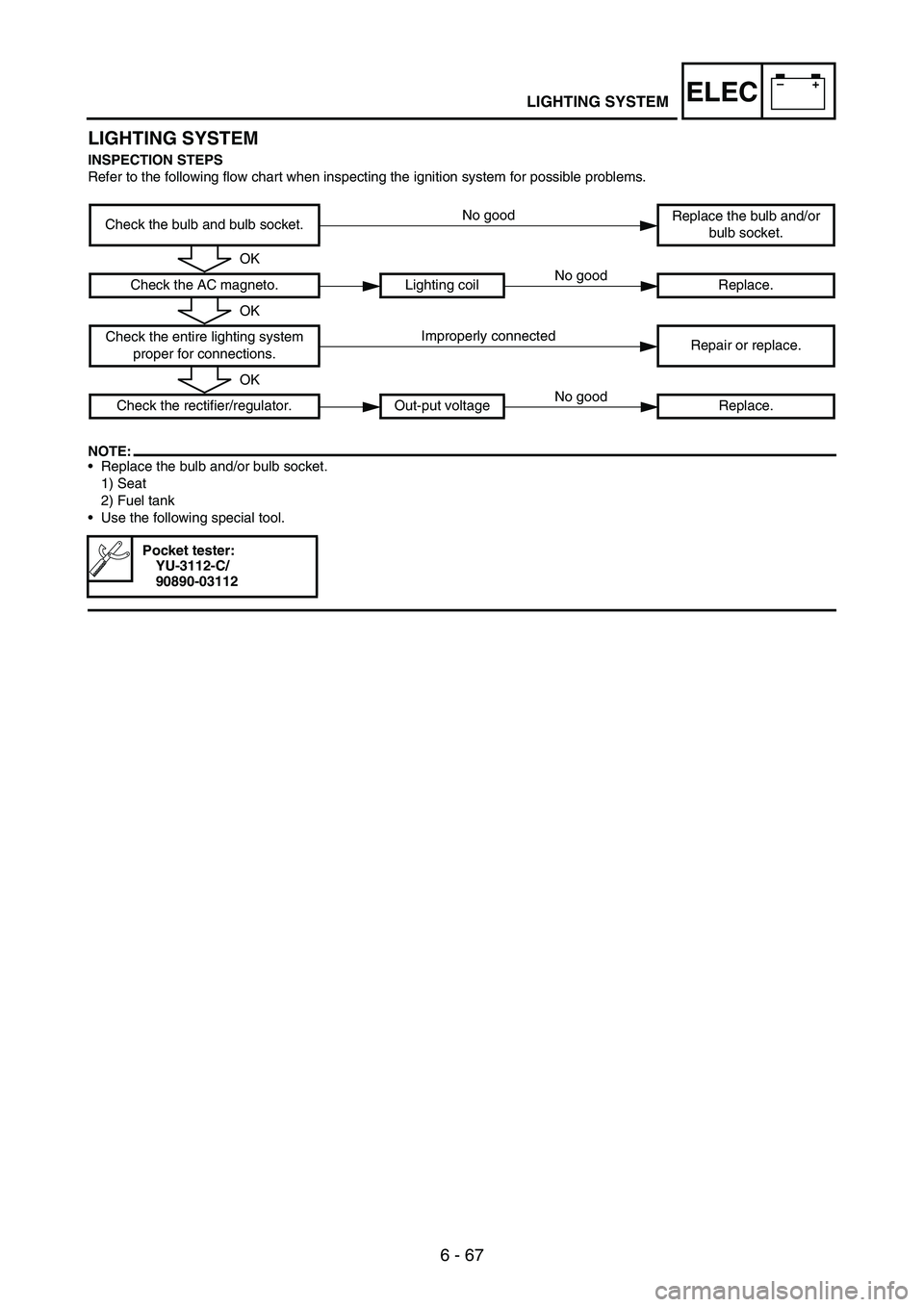
INSPECTION STEPS
Refer to the following flow chart when inspecting the ignition system for possible problems.
NOTE:•Replace the bulb and/or bulb socket.
1) Seat
2) Fuel tank
•Use the following special tool.
Check the bulb and bulb socket.Replace the bulb and/or
bulb socket.
Check the AC magneto. Lighting coil Replace.
Check the entire lighting system
proper for connections.Repair or replace.
Check the rectifier/regulator. Out-put voltage Replace.
Pocket tester:
YU-3112-C/
90890-03112
No good
OK
No good
OK
Improperly connected
OK
No good
Page 850 of 900
7 - 1
TUNSETTING
EC700000
TUNING
EC710000
ENGINE
Carburetor setting
•The air/fuel mixture will vary
depending on atmospheric condi-
tions. Therefore, it is necessary to
take into consideration the air
pressure, ambient temperature,
humidity, etc., when adjusting the
carburetor.
•Perform a test run to check for
proper engine performance (e.g.,
throttle response) and spark plug(-
s) discoloration or fouling. Use
these readings to determine the
best possible carburetor setting.
NOTE:It is recommended to keep a record
of all carburetor settings and external
conditions (e.g., atmospheric condi-
tions, track/surface conditions, lap
times) to make future carburetor set-
ting easier.
WARNING
The carburetor is a part of the
fuel line. Therefore, be sure to
install it in a well-ventilated area,
away from flammable objects
and any sources of fire.
Never look into the carburetor
intake. Flames may shoot out
from the pipe if the engine back-
fires while it is being started.
Gasoline may be discharged
from the accelerator pump noz-
zle when the carburetor has
been removed.
MISE AU POINT
MOTEUR
Réglage du carburateur
Le mélange air/carburant varie en
fonction des conditions atmosphéri-
ques. Il est donc nécessaire de tenir
compte de la pression de l’air, de la
température ambiante, de l’humidité,
etc., pour le réglage du carburateur.
Effectuer un essai de conduite pour
contrôler les performances du moteur
(par ex. la réponse du moteur) et l’état
des bougies (décoloration ou encrasse-
ment). Utiliser les valeurs obtenues
pour effectuer le meilleur réglage pos-
sible du carburateur.
N.B.:
Il est recommandé de conserver un enre-
gistrement de tous les réglages du carbu-
rateur et des conditions extérieures
(conditions atmosphériques, conditions
de la piste/de la surface, temps intermé-
diaire) pour faciliter les réglages ulté-
rieurs du carburateur.
AVERTISSEMENT
Le carburateur fait partie du circuit
d’alimentation en carburant. Par
conséquent, veiller à effectuer le
montage dans un endroit bien aéré,
à l’écart de tout objet inflammable
ou de toute source d’incendie.
Ne jamais regarder dans l’admis-
sion du carburateur. Des flammes
peuvent surgir du tuyau en cas de
retour de flamme du moteur au
démarrage. De l’essence peut
s’écouler de l’injecteur de la pompe
de reprise lorsque le carburateur a
été déposé.
REGLAGE
Page 852 of 900

7 - 3
TUNSETTING
CAUTION:
The carburetor is extremely sen-
sitive to foreign matter (dirt,
sand, water, etc.). During instal-
lation, do not allow foreign mat-
ter to get into the carburetor.
Always handle the carburetor
and its components carefully.
Even slight scratches, bends or
damage to carburetor parts may
prevent the carburetor from
functioning correctly. Carefully
perform all servicing with the
appropriate tools and without
applying excessive force.
When the engine is stopped or
when riding at no load, do not
open and close the throttle
unnecessarily. Otherwise, too
much fuel may be discharged,
starting may become difficult or
the engine may not run well.
After installing the carburetor,
check that the throttle operates
correctly and opens and closes
smoothly.
Atmospheric conditions and
carburetor settings
The air density (i.e., concentration
of oxygen in the air) determines
the richness or leanness of the air/
fuel mixture. Therefore, refer to the
above table for mixture settings.
That is:
•Higher temperature expands the
air with its resultant reduced den-
sity.
•Higher humidity reduces the
amount of oxygen in the air by so
much of the water vapor in the
same air.
•Lower atmospheric pressure (at a
high altitude) reduces the density
of the air.
Air temp. HumidityAir
pressure
(altitude)Mixture Setting
High High Low (high) Richer Leaner
Low Low High (low) Leaner Richer
ATTENTION:
Le carburateur est extrêmement
sensible aux corps étrangers (pous-
sière, sable, eau, etc.). Pendant le
montage, veiller à ce qu’aucun
corps étranger ne puisse pénétrer
dans le carburateur.
Toujours manipuler le carburateur
et ses composants avec prudence.
Tout endommagement (rayures
même légères, courbures, etc.) peut
empêcher le carburateur de fonc-
tionner correctement. Effectuer soi-
gneusement tout entretien à l’aide
des outils adéquats et sans forcer.
Lorsque le moteur est arrêté, ou
tourne sans charge, ne pas ouvrir et
fermer inutilement les gaz. Cela ris-
querait d’amener trop de carburant
et de rendre le démarrage difficile
ou d’altérer le fonctionnement du
moteur.
Après avoir monté le carburateur,
contrôler que le papillon fonctionne
correctement et s’ouvre et se ferme
sans problème.
Conditions atmosphériques et réglages
du carburateur
La densité de l’air (c.-à-d. la concen-
tration d’oxygène dans l’air) déter-
mine la richesse ou la pauvreté du
mélange air/carburant. Il convient dès
lors de se conformer au tableau ci-des-
sus pour la composition du mélange.
Tenir compte des trois facteurs suivants:
La température de l’air: la densité de
l’air diminue au fur et à mesure que
l’air se dilate sous l’effet des tempéra-
tures élevées.
Le taux d’humidité de l’air: le taux
d’oxygène diminue au fur et à mesure
que le taux d’humidité augmente.
Pression atmosphérique (altitude): la
densité diminue au fur et à mesure que
la pression atmosphérique descend
(altitude élevée).
Temp.
de l’airHumiditéPression
d’air
(altitude)MélangeRégla-
ges
Haute HauteBasse
(élevée)Plus
richePlus
pauvre
Basse BasseHaute
(basse)Plus
pauvrePlus
riche
REGLAGE
Page 854 of 900
7 - 5
TUNSETTING
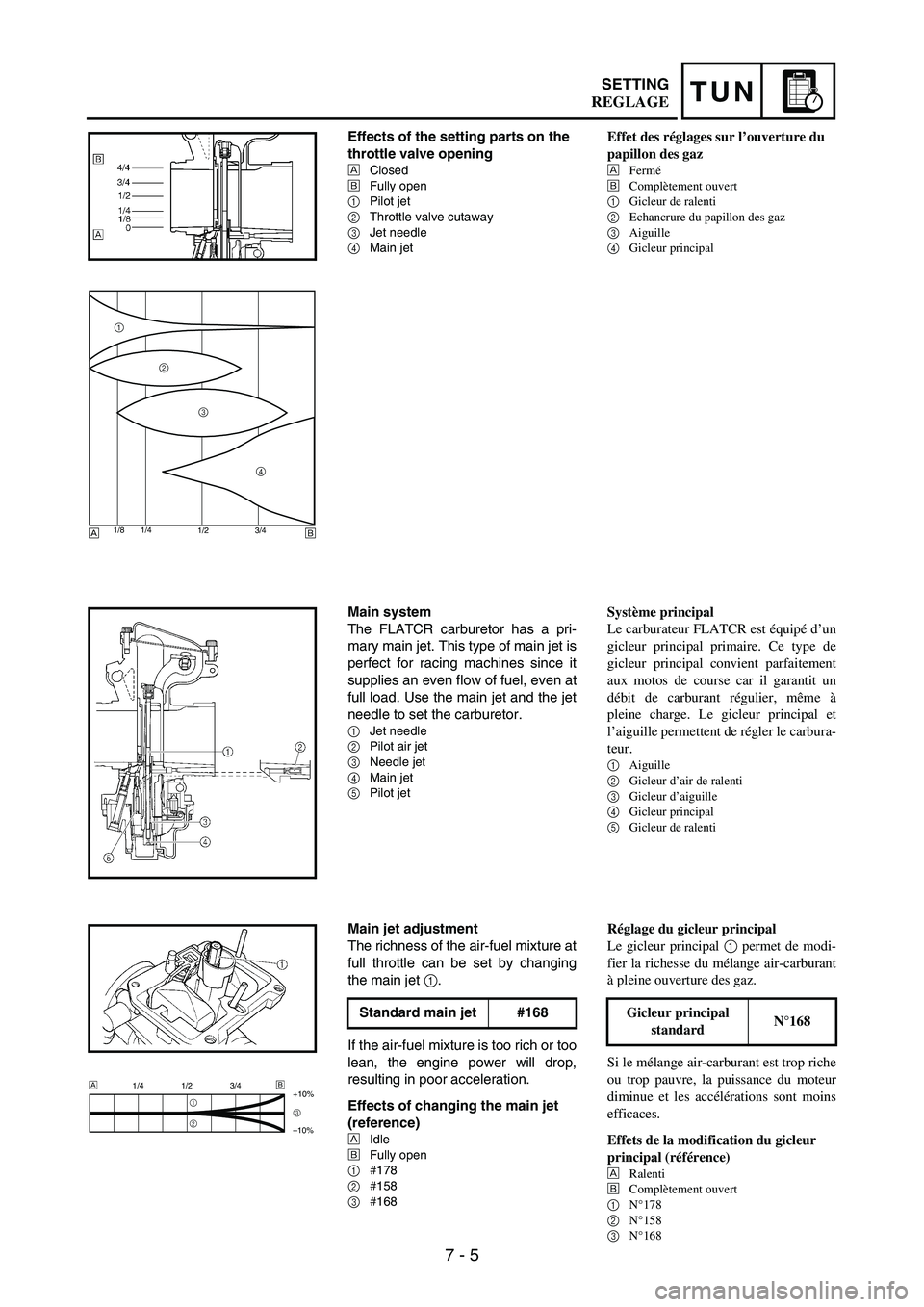
Effects of the setting parts on the
throttle valve opening
ÈClosed
ÉFully open
1Pilot jet
2Throttle valve cutaway
3Jet needle
4Main jet
1/2 3/4 1/4 1/8
1
2
3
4
ÈÉ
Main system
The FLATCR carburetor has a pri-
mary main jet. This type of main jet is
perfect for racing machines since it
supplies an even flow of fuel, even at
full load. Use the main jet and the jet
needle to set the carburetor.
1Jet needle
2Pilot air jet
3Needle jet
4Main jet
5Pilot jet
Main jet adjustment
The richness of the air-fuel mixture at
full throttle can be set by changing
the main jet 1
.
If the air-fuel mixture is too rich or too
lean, the engine power will drop,
resulting in poor acceleration.
Effects of changing the main jet
(reference)
ÈIdle
ÉFully open
1#178
2#158
3#168
Standard main jet #168
1/4 1/2 3/4
+10%
3
–10%
1
2
ÈÉ
Effet des réglages sur l’ouverture du
papillon des gaz
ÈFermé
ÉComplètement ouvert
1Gicleur de ralenti
2Echancrure du papillon des gaz
3Aiguille
4Gicleur principal
Système principal
Le carburateur FLATCR est équipé d’un
gicleur principal primaire. Ce type de
gicleur principal convient parfaitement
aux motos de course car il garantit un
débit de carburant régulier, même à
pleine charge. Le gicleur principal et
l’aiguille permettent de régler le carbura-
teur.
1Aiguille
2Gicleur d’air de ralenti
3Gicleur d’aiguille
4Gicleur principal
5Gicleur de ralenti
Réglage du gicleur principal
Le gicleur principal
1 permet de modi-
fier la richesse du mélange air-carburant
à pleine ouverture des gaz.
Si le mélange air-carburant est trop riche
ou trop pauvre, la puissance du moteur
diminue et les accélérations sont moins
efficaces.
Effets de la modification du gicleur
principal (référence)
ÈRalenti
ÉComplètement ouvert
1N°178
2N°158
3N°168
Gicleur principal
standardN°168
REGLAGE