length YAMAHA WR 250F 2007 User Guide
[x] Cancel search | Manufacturer: YAMAHA, Model Year: 2007, Model line: WR 250F, Model: YAMAHA WR 250F 2007Pages: 912, PDF Size: 23.95 MB
Page 314 of 912
3 - 103
INSP
ADJ
EC36K000REAR SHOCK ABSORBER
INSPECTION
1. Inspect:
Swingarm smooth action
Abnormal noise/unsmooth
action
→ Grease the pivoting
points or repair the pivoting
points.
Damage/oil leakage
→
Replace.
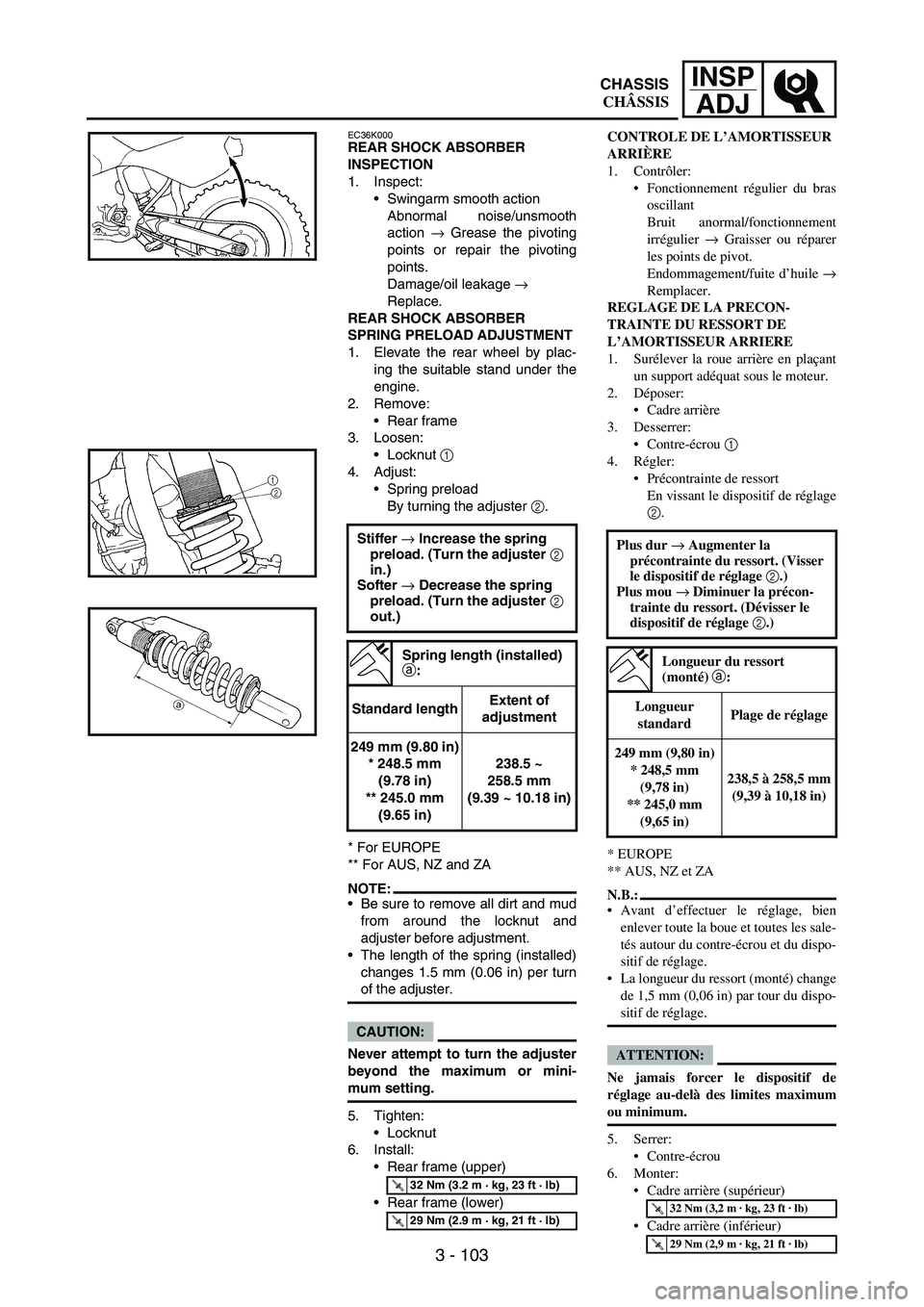
REAR SHOCK ABSORBER
SPRING PRELOAD ADJUSTMENT
1. Elevate the rear wheel by plac-
ing the suitable stand under the
engine.
2. Remove:
Rear frame
3. Loosen:
Locknut
1
4. Adjust:
Spring preload
By turning the adjuster
2.
* For EUROPE
** For AUS, NZ and ZA
NOTE:Be sure to remove all dirt and mud
from around the locknut and
adjuster before adjustment.
The length of the spring (installed)
changes 1.5 mm (0.06 in) per turn
of the adjuster.
CAUTION:
Never attempt to turn the adjuster
beyond the maximum or mini-
mum setting.
5. Tighten:
Locknut
6. Install:
Rear frame (upper)
Rear frame (lower) Stiffer → Increase the spring
preload. (Turn the adjuster 2
in.)
Softer → Decrease the spring
preload. (Turn the adjuster 2
out.)
Spring length (installed)
a:
Standard lengthExtent of
adjustment
249 mm (9.80 in)
* 248.5 mm
(9.78 in)
** 245.0 mm
(9.65 in)238.5 ~
258.5 mm
(9.39 ~ 10.18 in)
T R..32 Nm (3.2 m · kg, 23 ft · lb)
T R..29 Nm (2.9 m · kg, 21 ft · lb)
CONTROLE DE L’AMORTISSEUR
ARRIÈRE
1. Contrôler:
Fonctionnement régulier du bras
oscillant
Bruit anormal/fonctionnement
irrégulier → Graisser ou réparer
les points de pivot.
Endommagement/fuite d’huile →
Remplacer.
REGLAGE DE LA PRECON-
TRAINTE DU RESSORT DE
L’AMORTISSEUR ARRIERE
1. Surélever la roue arrière en plaçant
un support adéquat sous le moteur.
2. Déposer:
Cadre arrière
3. Desserrer:
Contre-écrou 1
4. Régler:
Précontrainte de ressort
En vissant le dispositif de réglage
2.
* EUROPE
** AUS, NZ et ZA
N.B.:
Avant d’effectuer le réglage, bien
enlever toute la boue et toutes les sale-
tés autour du contre-écrou et du dispo-
sitif de réglage.
La longueur du ressort (monté) change
de 1,5 mm (0,06 in) par tour du dispo-
sitif de réglage.
ATTENTION:
Ne jamais forcer le dispositif de
réglage au-delà des limites maximum
ou minimum.
5. Serrer:
Contre-écrou
6. Monter:
Cadre arrière (supérieur)
Cadre arrière (inférieur) Plus dur → Augmenter la
précontrainte du ressort. (Visser
le dispositif de réglage 2.)
Plus mou → Diminuer la précon-
trainte du ressort. (Dévisser le
dispositif de réglage 2.)
Longueur du ressort
(monté) a:
Longueur
standardPlage de réglage
249 mm (9,80 in)
* 248,5 mm
(9,78 in)
** 245,0 mm
(9,65 in)238,5 à 258,5 mm
(9,39 à 10,18 in)
T R..32 Nm (3,2 m · kg, 23 ft · lb)
T R..29 Nm (2,9 m · kg, 21 ft · lb)
CHASSIS
CHÂSSIS
Page 392 of 912
4 - 33
TUNSETTING
EC72B000Rear suspension setting
The rear suspension setting should
be made depending on the rider’s
feeling of an actual run and the cir-
cuit conditions.
The rear suspension setting includes
the following two factors:
1. Setting of spring preload
Change the set length of the
spring.
Change the spring.
2. Setting of damping force
Change the rebound damping.
Change the compression
damping.
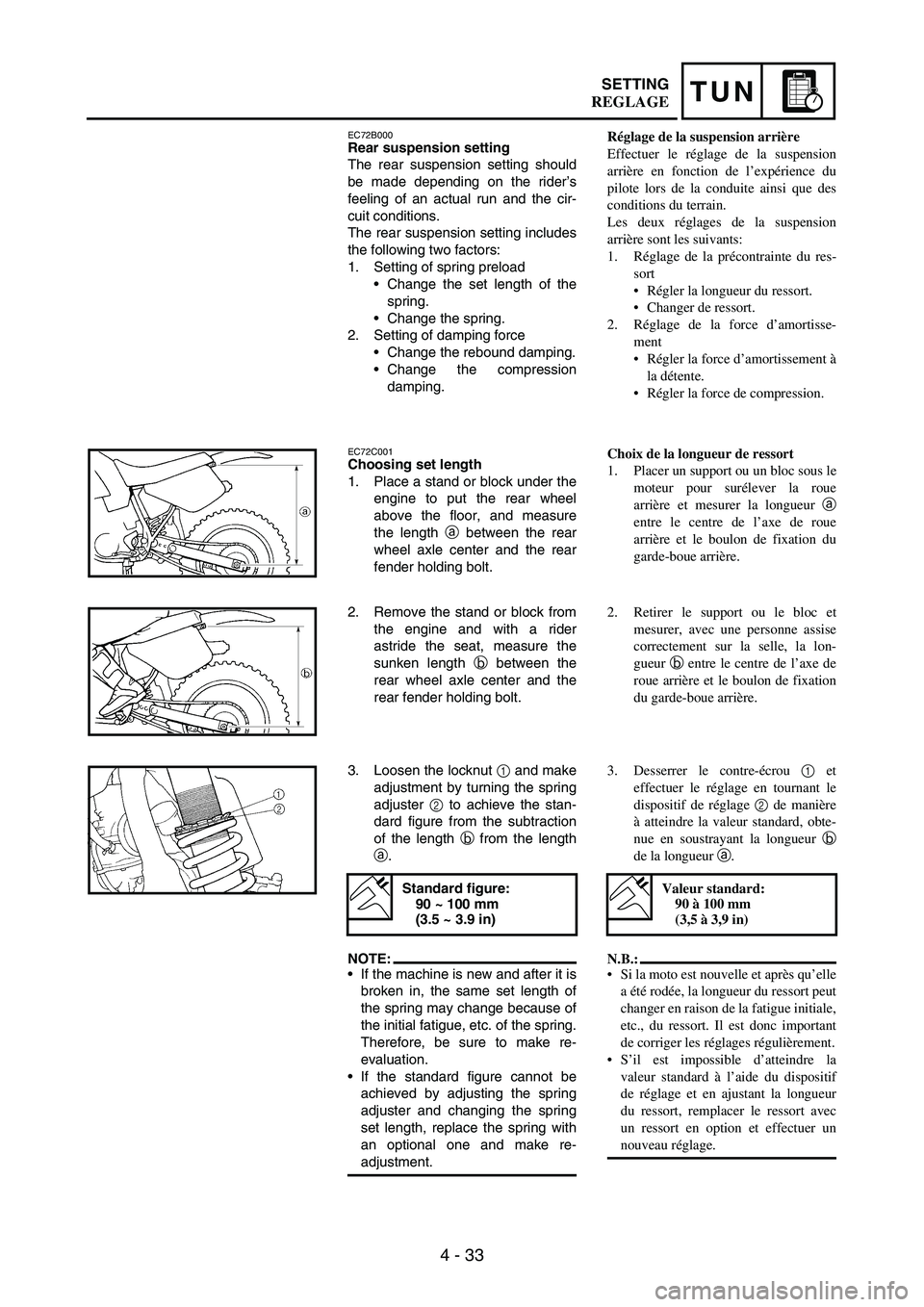
EC72C001Choosing set length
1. Place a stand or block under the
engine to put the rear wheel
above the floor, and measure
the length
a between the rear
wheel axle center and the rear
fender holding bolt.
2. Remove the stand or block from
the engine and with a rider
astride the seat, measure the
sunken length
b between the
rear wheel axle center and the
rear fender holding bolt.
3. Loosen the locknut
1 and make
adjustment by turning the spring
adjuster
2 to achieve the stan-
dard figure from the subtraction
of the length
b from the length
a.
NOTE:If the machine is new and after it is
broken in, the same set length of
the spring may change because of
the initial fatigue, etc. of the spring.
Therefore, be sure to make re-
evaluation.
If the standard figure cannot be
achieved by adjusting the spring
adjuster and changing the spring
set length, replace the spring with
an optional one and make re-
adjustment.
Standard figure:
90 ~ 100 mm
(3.5 ~ 3.9 in)
Réglage de la suspension arrière
Effectuer le réglage de la suspension
arrière en fonction de l’expérience du
pilote lors de la conduite ainsi que des
conditions du terrain.
Les deux réglages de la suspension
arrière sont les suivants:
1. Réglage de la précontrainte du res-
sort
Régler la longueur du ressort.
Changer de ressort.
2. Réglage de la force d’amortisse-
ment
Régler la force d’amortissement à
la détente.
Régler la force de compression.
Choix de la longueur de ressort
1. Placer un support ou un bloc sous le
moteur pour surélever la roue
arrière et mesurer la longueur a
entre le centre de l’axe de roue
arrière et le boulon de fixation du
garde-boue arrière.
2. Retirer le support ou le bloc et
mesurer, avec une personne assise
correctement sur la selle, la lon-
gueur b entre le centre de l’axe de
roue arrière et le boulon de fixation
du garde-boue arrière.
3. Desserrer le contre-écrou 1 et
effectuer le réglage en tournant le
dispositif de réglage 2 de manière
à atteindre la valeur standard, obte-
nue en soustrayant la longueur b
de la longueur a.
N.B.:
Si la moto est nouvelle et après qu’elle
a été rodée, la longueur du ressort peut
changer en raison de la fatigue initiale,
etc., du ressort. Il est donc important
de corriger les réglages régulièrement.
S’il est impossible d’atteindre la
valeur standard à l’aide du dispositif
de réglage et en ajustant la longueur
du ressort, remplacer le ressort avec
un ressort en option et effectuer un
nouveau réglage.
Valeur standard:
90 à 100 mm
(3,5 à 3,9 in)
REGLAGE
Page 394 of 912
![YAMAHA WR 250F 2007 User Guide 4 - 35
TUNSETTING
Setting of spring after
replacement
After replacement, be sure to adjust
the spring to the set length [sunken
length 90 ~ 100 mm (3.5 ~ 3.9 in)]
and set it.
1. Use of soft spring
S](/img/51/52333/w960_52333-393.png "YAMAHA WR 250F 2007 User Guide 4 - 35
TUNSETTING
Setting of spring after
replacement
After replacement, be sure to adjust
the spring to the set length [sunken
length 90 ~ 100 mm (3.5 ~ 3.9 in)]
and set it.
1. Use of soft spring
S")
4 - 35
TUNSETTING
Setting of spring after
replacement
After replacement, be sure to adjust
the spring to the set length [sunken
length 90 ~ 100 mm (3.5 ~ 3.9 in)]
and set it.
1. Use of soft spring
Set the soft spring for less
rebound damping to compen-
sate for its less spring load.
Run with the rebound damping
adjuster one or two clicks on
the softer side and readjust it
to suit your preference.
2. Use of stiff spring
Set the soft spring for more
rebound damping to compen-
sate for its greater spring load.
Run with the rebound damping
adjuster one or two clicks on
the stiffer side and readjust it
to suit your preference.
*Adjusting the rebound damp-
ing will be followed more or
less by a change in the com-
pression damping. For correc-
tion, turn the low compression
damping adjuster on the softer
side.
CAUTION:
When using a rear shock absorber
other than currently installed, use
the one whose overall length a
does not exceed the standard as it
may result in faulty performance.
Never use one whose overall
length is greater than standard.
Length a
of standard
shock:
488.5 mm (19.23 in)
Réglage du ressort après
remplacement
Après avoir remplacé le ressort, veiller à
l’ajuster à la longueur recommandée
[profondeur 90 à 100 mm (3,5 à 3,9 in)]
et à le régler.
1. Ressort mou
Régler le ressort mou de manière
que la force d’amortissement à la
détente soit moindre afin de com-
penser son manque de raideur.
Après avoir, à l’aide du dispositif
de réglage, diminué la force
d’amortissement à la détente d’un
ou deux déclics, rouler avec la
moto puis effectuer un nouveau
réglage en fonction des préféren-
ces personnelles.
2. Ressort dur
Régler le ressort de manière à
augmenter la force d’amortisse-
ment à la détente afin de compen-
ser la plus grande raideur du
ressort. Après avoir, à l’aide du
dispositif de réglage, augmenté la
force d’amortissement à la
détente d’un ou deux déclics, rou-
ler avec la moto puis effectuer un
nouveau réglage en fonction des
préférences personnelles.
*Un réglage de la force d’amortis-
sement à la détente entraîne un
changement de la force de com-
pression. Pour corriger, dévisser
le dispositif de réglage de la force
de compression.
ATTENTION:
Lors du remplacement de l’amortis-
seur arrière, veiller à monter un
amortisseur dont la longueur totale a
ne dépasse pas la longueur standard
sous peine d’altérer les performances.
Ne jamais monter un amortisseur
dont la longueur totale est supérieure
à la longueur standard.
Longueur a de
l’amortisseur standard:
488,5 mm (19,23 in)
REGLAGE
Page 396 of 912
4 - 37
TUNSETTING
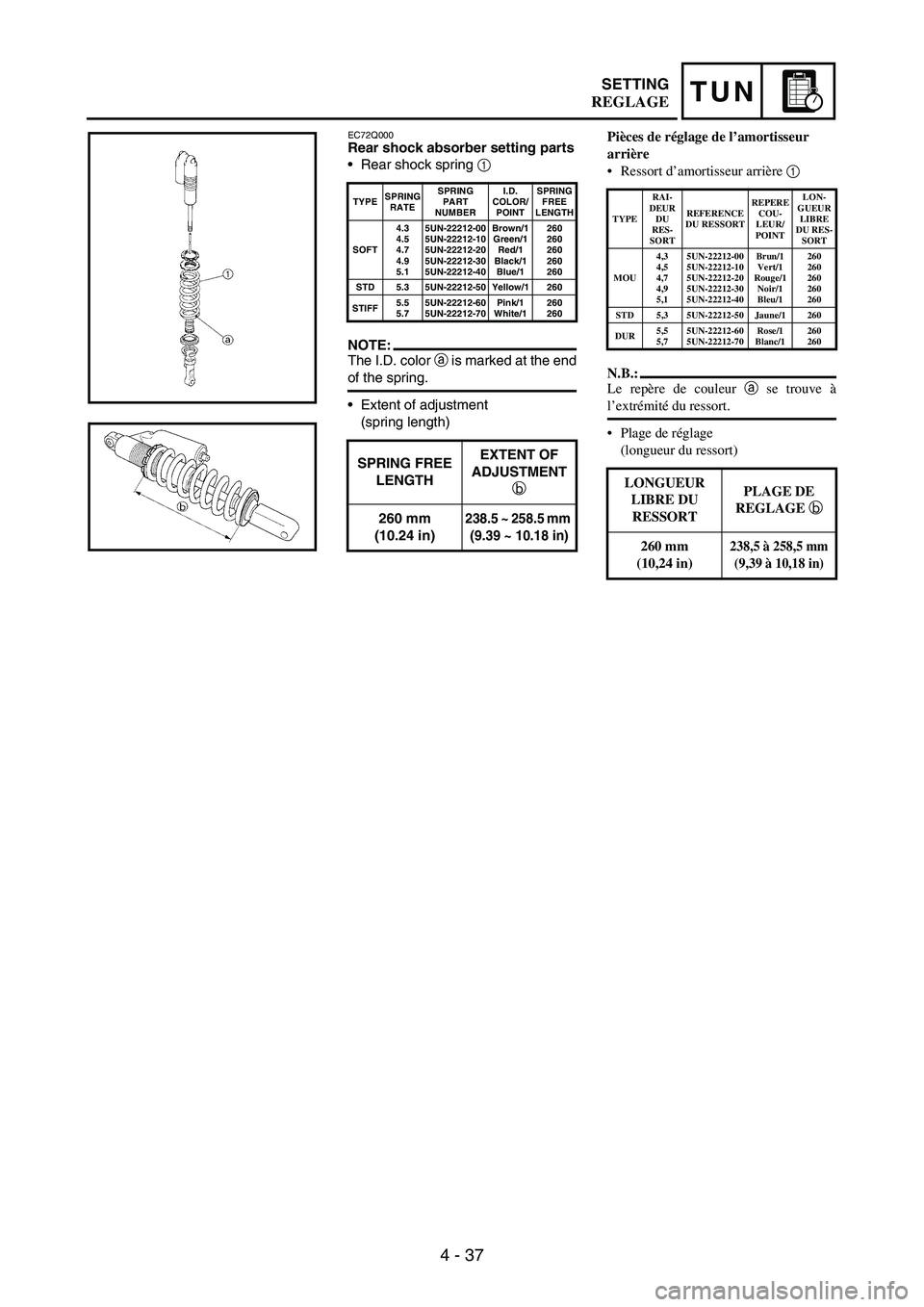
EC72Q000Rear shock absorber setting parts
Rear shock spring
1
NOTE:The I.D. color
a is marked at the end
of the spring.
Extent of adjustment
(spring length)
TYPESPRING
RATESPRING
PART
NUMBERI.D.
COLOR/
POINTSPRING
FREE
LENGTH
SOFT4.3
4.5
4.7
4.9
5.15UN-22212-00
5UN-22212-10
5UN-22212-20
5UN-22212-30
5UN-22212-40Brown/1
Green/1
Red/1
Black/1
Blue/1260
260
260
260
260
STD 5.3 5UN-22212-50 Yellow/1 260
STIFF5.5
5.75UN-22212-60
5UN-22212-70Pink/1
White/1260
260
SPRING FREE
LENGTHEXTENT OF
ADJUSTMENT
b
260 mm
(10.24 in)
238.5 ~ 258.5 mm
(9.39 ~ 10.18 in)
Pièces de réglage de l’amortisseur
arrière
Ressort d’amortisseur arrière 1
N.B.:
Le repère de couleur a se trouve à
l’extrémité du ressort.
Plage de réglage
(longueur du ressort)
TYPERAI-
DEUR
DU
RES-
SORTREFERENCE
DU RESSORTREPERE
COU-
LEUR/
POINTLON-
GUEUR
LIBRE
DU RES-
SORT
MOU4,3
4,5
4,7
4,9
5,15UN-22212-00
5UN-22212-10
5UN-22212-20
5UN-22212-30
5UN-22212-40Brun/1
Vert/1
Rouge/1
Noir/1
Bleu/1260
260
260
260
260
STD 5,3 5UN-22212-50 Jaune/1 260
DUR5,5
5,75UN-22212-60
5UN-22212-70Rose/1
Blanc/1260
260
LONGUEUR
LIBRE DU
RESSORT PLAGE DE
REGLAGE b
260 mm
(10,24 in)
238,5 à 258,5 mm
(9,39 à 10,18 in)
REGLAGE
Page 398 of 912
4 - 39
TUNSETTING
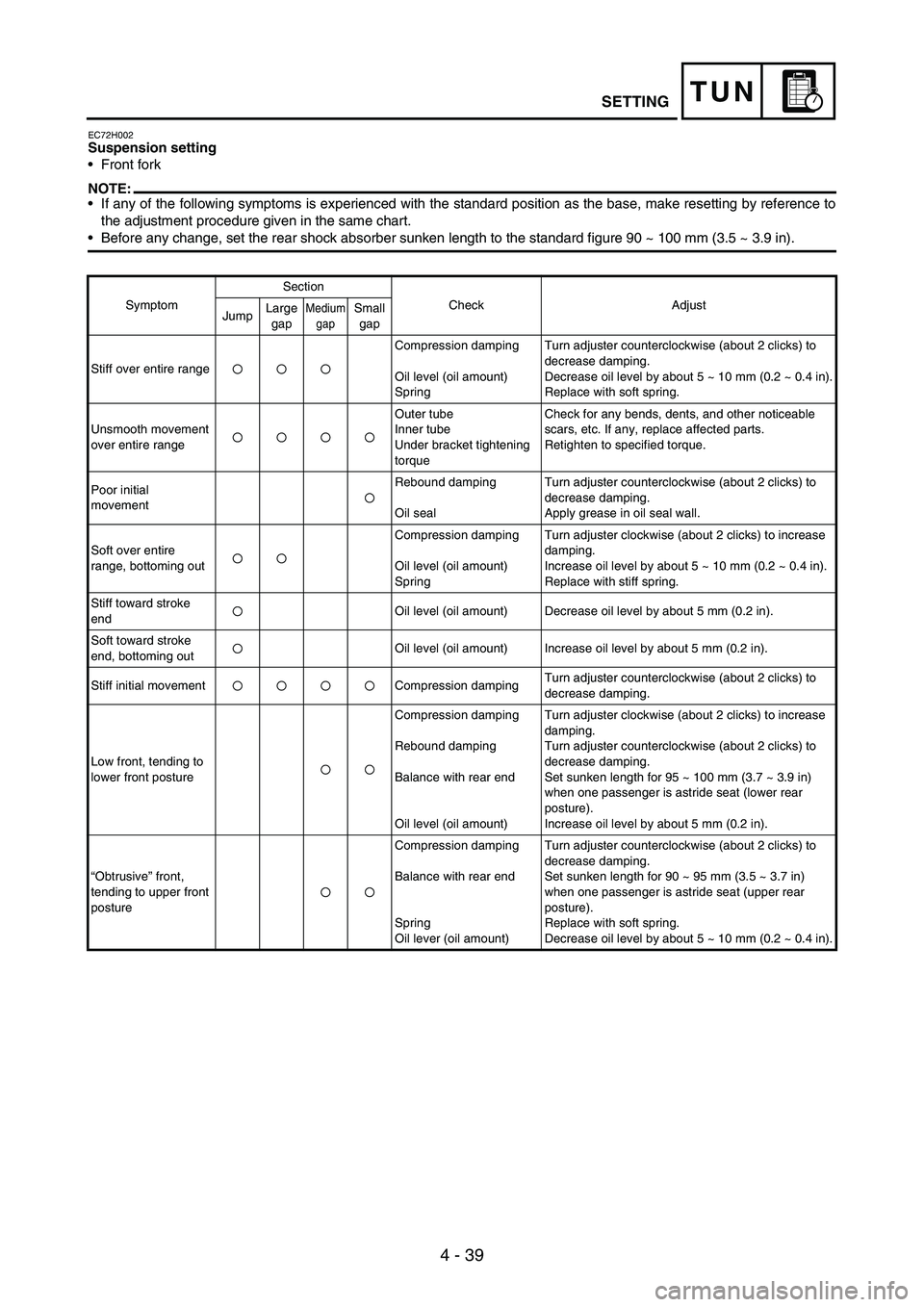
EC72H002Suspension setting
Front fork
NOTE:If any of the following symptoms is experienced with the standard position as the base, make resetting by reference to
the adjustment procedure given in the same chart.
Before any change, set the rear shock absorber sunken length to the standard figure 90 ~ 100 mm (3.5 ~ 3.9 in).
SymptomSection
Check Adjust
JumpLarge
gapMedium
gapSmall
gap
Stiff over entire rangeCompression damping
Oil level (oil amount)
SpringTurn adjuster counterclockwise (about 2 clicks) to
decrease damping.
Decrease oil level by about 5 ~ 10 mm (0.2 ~ 0.4 in).
Replace with soft spring.
Unsmooth movement
over entire rangeOuter tube
Inner tube
Under bracket tightening
torqueCheck for any bends, dents, and other noticeable
scars, etc. If any, replace affected parts.
Retighten to specified torque.
Poor initial
movementRebound damping
Oil sealTurn adjuster counterclockwise (about 2 clicks) to
decrease damping.
Apply grease in oil seal wall.
Soft over entire
range, bottoming outCompression damping
Oil level (oil amount)
SpringTurn adjuster clockwise (about 2 clicks) to increase
damping.
Increase oil level by about 5 ~ 10 mm (0.2 ~ 0.4 in).
Replace with stiff spring.
Stiff toward stroke
endOil level (oil amount) Decrease oil level by about 5 mm (0.2 in).
Soft toward stroke
end, bottoming outOil level (oil amount) Increase oil level by about 5 mm (0.2 in).
Stiff initial movement Compression dampingTurn adjuster counterclockwise (about 2 clicks) to
decrease damping.
Low front, tending to
lower front postureCompression damping
Rebound damping
Balance with rear end
Oil level (oil amount)Turn adjuster clockwise (about 2 clicks) to increase
damping.
Turn adjuster counterclockwise (about 2 clicks) to
decrease damping.
Set sunken length for 95 ~ 100 mm (3.7 ~ 3.9 in)
when one passenger is astride seat (lower rear
posture).
Increase oil level by about 5 mm (0.2 in).
“Obtrusive” front,
tending to upper front
postureCompression damping
Balance with rear end
Spring
Oil lever (oil amount)Turn adjuster counterclockwise (about 2 clicks) to
decrease damping.
Set sunken length for 90 ~ 95 mm (3.5 ~ 3.7 in)
when one passenger is astride seat (upper rear
posture).
Replace with soft spring.
Decrease oil level by about 5 ~ 10 mm (0.2 ~ 0.4 in).
Page 399 of 912
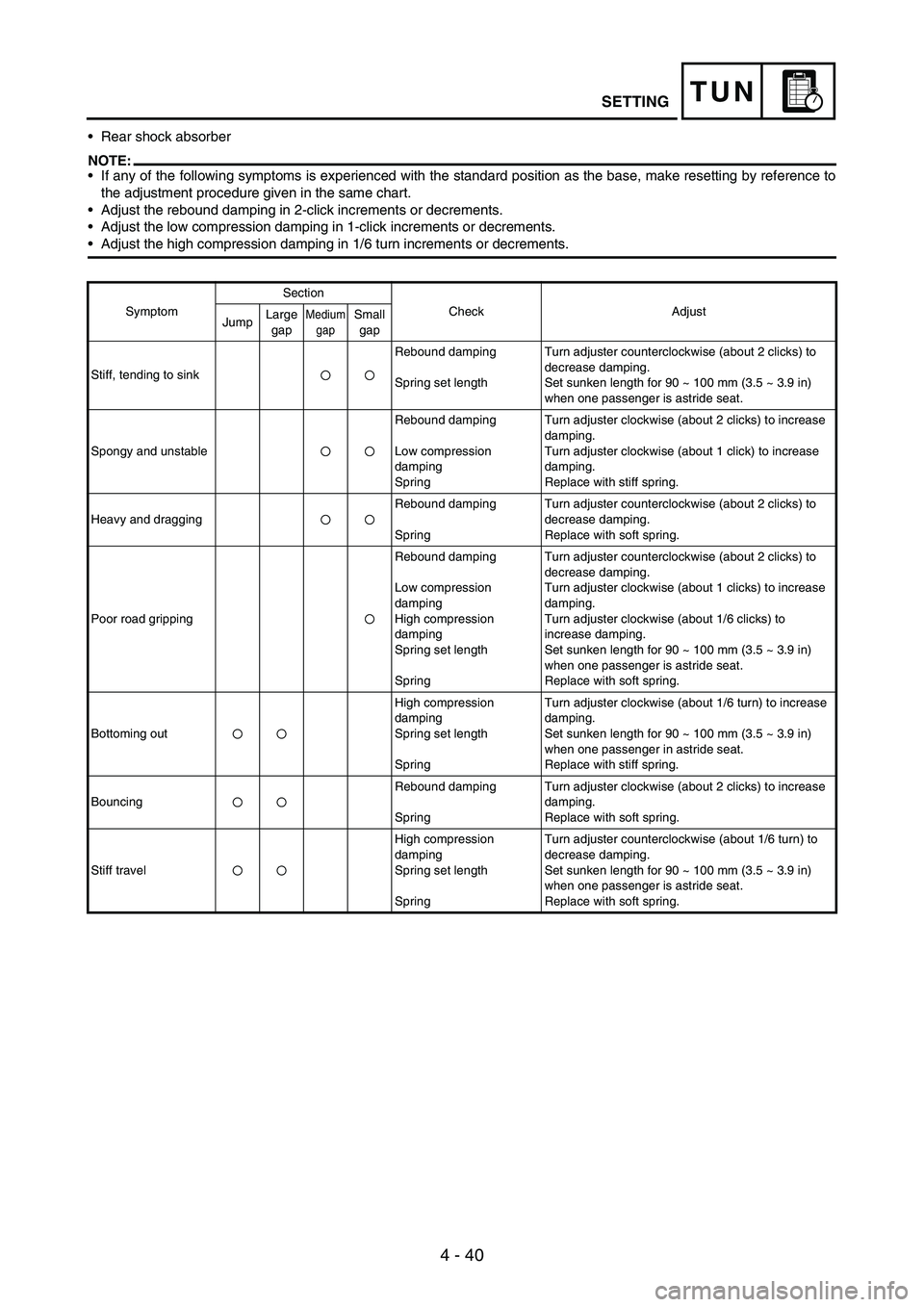
4 - 40
TUNSETTING
Rear shock absorber
NOTE:If any of the following symptoms is experienced with the standard position as the base, make resetting by reference to
the adjustment procedure given in the same chart.
Adjust the rebound damping in 2-click increments or decrements.
Adjust the low compression damping in 1-click increments or decrements.
Adjust the high compression damping in 1/6 turn increments or decrements.
SymptomSection
Check Adjust
JumpLarge
gapMedium
gapSmall
gap
Stiff, tending to sinkRebound damping
Spring set lengthTurn adjuster counterclockwise (about 2 clicks) to
decrease damping.
Set sunken length for 90 ~ 100 mm (3.5 ~ 3.9 in)
when one passenger is astride seat.
Spongy and unstableRebound damping
Low compression
damping
SpringTurn adjuster clockwise (about 2 clicks) to increase
damping.
Turn adjuster clockwise (about 1 click) to increase
damping.
Replace with stiff spring.
Heavy and draggingRebound damping
SpringTurn adjuster counterclockwise (about 2 clicks) to
decrease damping.
Replace with soft spring.
Poor road grippingRebound damping
Low compression
damping
High compression
damping
Spring set length
SpringTurn adjuster counterclockwise (about 2 clicks) to
decrease damping.
Turn adjuster clockwise (about 1 clicks) to increase
damping.
Turn adjuster clockwise (about 1/6 clicks) to
increase damping.
Set sunken length for 90 ~ 100 mm (3.5 ~ 3.9 in)
when one passenger is astride seat.
Replace with soft spring.
Bottoming outHigh compression
damping
Spring set length
SpringTurn adjuster clockwise (about 1/6 turn) to increase
damping.
Set sunken length for 90 ~ 100 mm (3.5 ~ 3.9 in)
when one passenger in astride seat.
Replace with stiff spring.
BouncingRebound damping
SpringTurn adjuster clockwise (about 2 clicks) to increase
damping.
Replace with soft spring.
Stiff travelHigh compression
damping
Spring set length
SpringTurn adjuster counterclockwise (about 1/6 turn) to
decrease damping.
Set sunken length for 90 ~ 100 mm (3.5 ~ 3.9 in)
when one passenger is astride seat.
Replace with soft spring.
Page 462 of 912
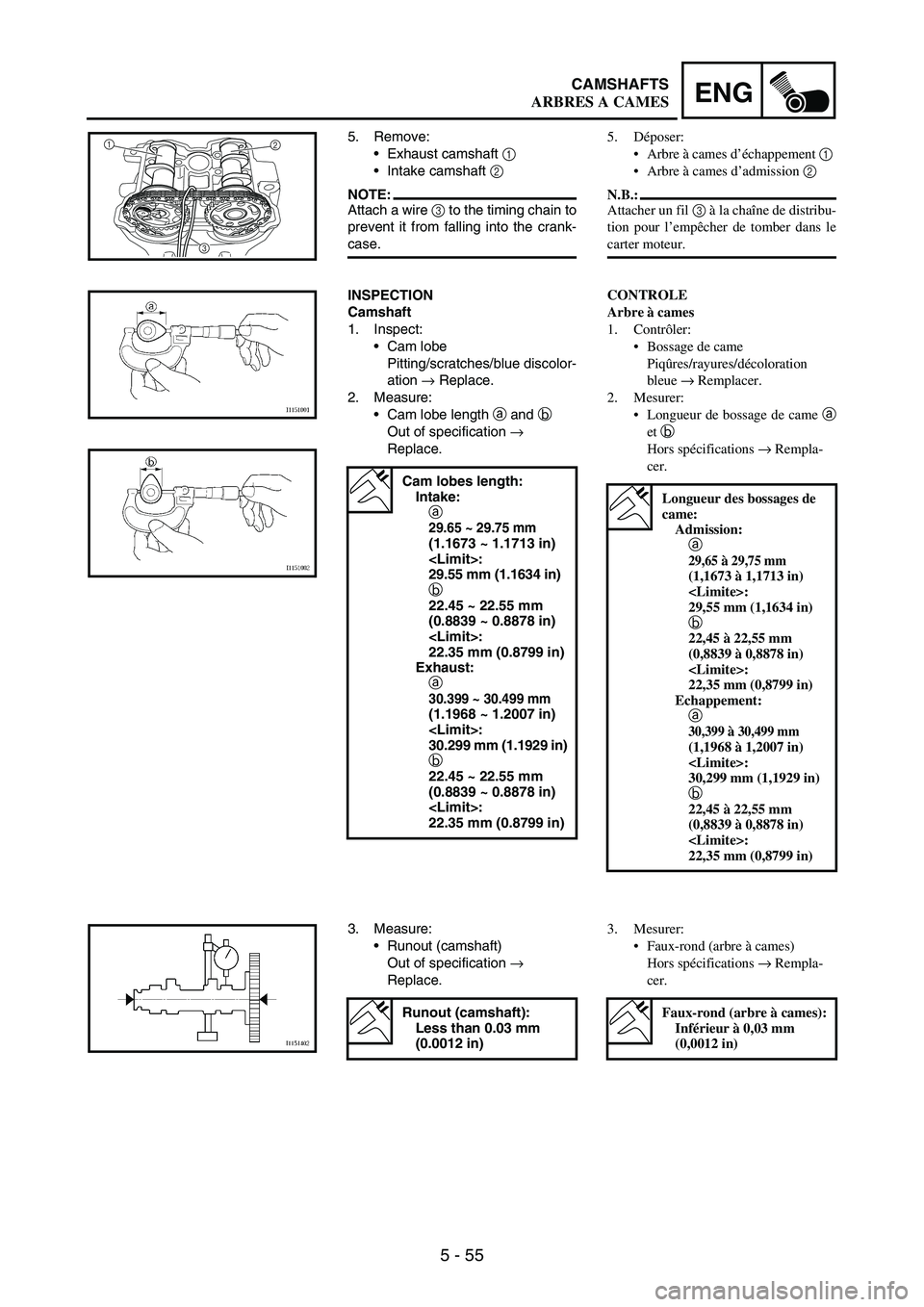
5 - 55
ENGCAMSHAFTS
5. Remove:
Exhaust camshaft
1
Intake camshaft
2
NOTE:Attach a wire
3 to the timing chain to
prevent it from falling into the crank-
case.
1
2
3
INSPECTION
Camshaft
1. Inspect:
Cam lobe
Pitting/scratches/blue discolor-
ation
→ Replace.
2. Measure:
Cam lobe length
a and b
Out of specification →
Replace.
Cam lobes length:
Intake:
a
29.65 ~ 29.75 mm
(1.1673 ~ 1.1713 in)
29.55 mm (1.1634 in)
b
22.45 ~ 22.55 mm
(0.8839 ~ 0.8878 in)
22.35 mm (0.8799 in)
Exhaust:
a
30.399 ~ 30.499 mm
(1.1968 ~ 1.2007 in)
30.299 mm (1.1929 in)
b
22.45 ~ 22.55 mm
(0.8839 ~ 0.8878 in)
22.35 mm (0.8799 in)
3. Measure:
Runout (camshaft)
Out of specification →
Replace.
Runout (camshaft):
Less than 0.03 mm
(0.0012 in)
5. Déposer:
Arbre à cames d’échappement 1
Arbre à cames d’admission 2
N.B.:
Attacher un fil 3 à la chaîne de distribu-
tion pour l’empêcher de tomber dans le
carter moteur.
CONTROLE
Arbre à cames
1. Contrôler:
Bossage de came
Piqûres/rayures/décoloration
bleue → Remplacer.
2. Mesurer:
Longueur de bossage de came a
et b
Hors spécifications → Rempla-
cer.
Longueur des bossages de
came:
Admission:
a
29,65 à 29,75 mm
(1,1673 à 1,1713 in)
29,55 mm (1,1634 in)
b
22,45 à 22,55 mm
(0,8839 à 0,8878 in)
22,35 mm (0,8799 in)
Echappement:
a
30,399 à 30,499 mm
(1,1968 à 1,2007 in)
30,299 mm (1,1929 in)
b
22,45 à 22,55 mm
(0,8839 à 0,8878 in)
22,35 mm (0,8799 in)
3. Mesurer:
Faux-rond (arbre à cames)
Hors spécifications → Rempla-
cer.
Faux-rond (arbre à cames):
Inférieur à 0,03 mm
(0,0012 in)
ARBRES A CAMES
Page 496 of 912
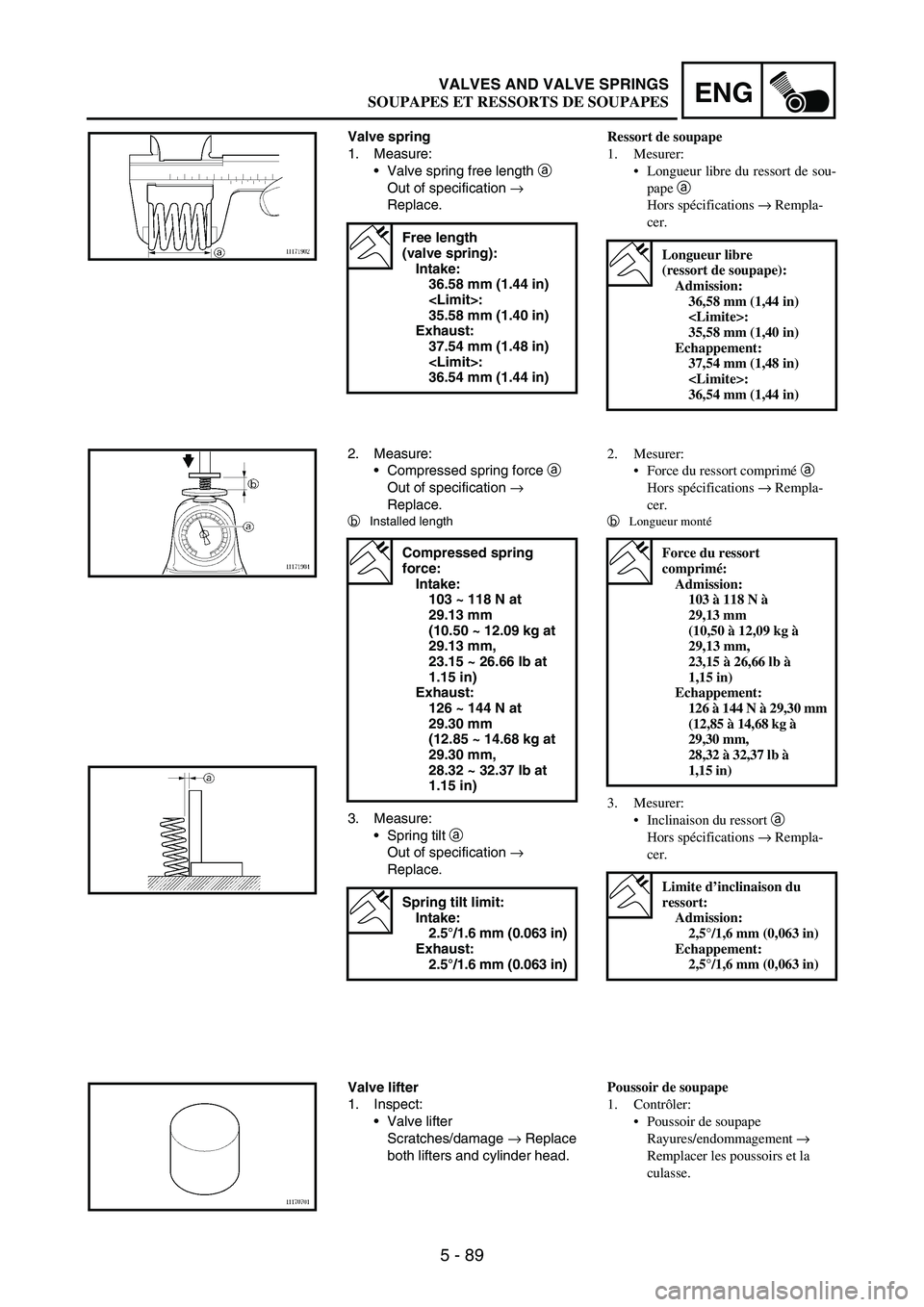
5 - 89
ENGVALVES AND VALVE SPRINGS
Valve spring
1. Measure:
Valve spring free length
a
Out of specification
→
Replace.
Free length
(valve spring):
Intake:
36.58 mm (1.44 in)
35.58 mm (1.40 in)
Exhaust:
37.54 mm (1.48 in)
36.54 mm (1.44 in)
2. Measure:
Compressed spring force
a
Out of specification
→
Replace.
b
Installed length
3. Measure:
Spring tilt
a
Out of specification
→
Replace.
Compressed spring
force:
Intake:
103 ~ 118 N at
29.13 mm
(10.50 ~ 12.09 kg at
29.13 mm,
23.15 ~ 26.66 lb at
1.15 in)
Exhaust:
126 ~ 144 N at
29.30 mm
(12.85 ~ 14.68 kg at
29.30 mm,
28.32 ~ 32.37 lb at
1.15 in)
Spring tilt limit:
Intake:
2.5°/1.6 mm (0.063 in)
Exhaust:
2.5°/1.6 mm (0.063 in)
Valve lifter
1. Inspect:
Valve lifter
Scratches/damage
→ Replace
both lifters and cylinder head.
Ressort de soupape
1. Mesurer:
Longueur libre du ressort de sou-
pape a
Hors spécifications → Rempla-
cer.
Longueur libre
(ressort de soupape):
Admission:
36,58 mm (1,44 in)
35,58 mm (1,40 in)
Echappement:
37,54 mm (1,48 in)
36,54 mm (1,44 in)
2. Mesurer:
Force du ressort comprimé a
Hors spécifications → Rempla-
cer.
b
Longueur monté
3. Mesurer:
Inclinaison du ressort a
Hors spécifications → Rempla-
cer.
Force du ressort
comprimé:
Admission:
103 à 118 N à
29,13 mm
(10,50 à 12,09 kg à
29,13 mm,
23,15 à 26,66 lb à
1,15 in)
Echappement:
126 à 144 N à 29,30 mm
(12,85 à 14,68 kg à
29,30 mm,
28,32 à 32,37 lb à
1,15 in)
Limite d’inclinaison du
ressort:
Admission:
2,5°/1,6 mm (0,063 in)
Echappement:
2,5°/1,6 mm (0,063 in)
Poussoir de soupape
1. Contrôler:
Poussoir de soupape
Rayures/endommagement →
Remplacer les poussoirs et la
culasse.
SOUPAPES ET RESSORTS DE SOUPAPES
Page 526 of 912
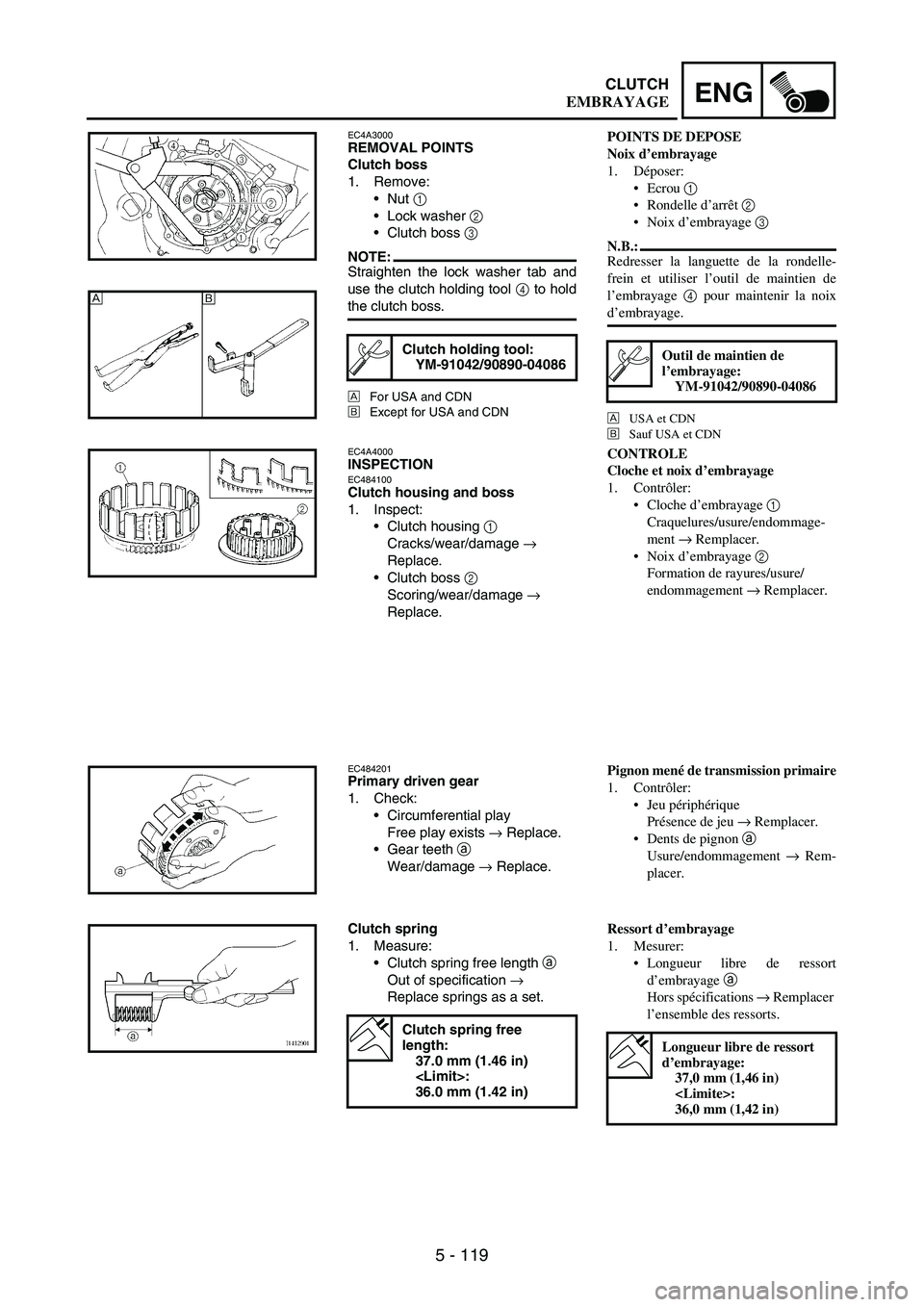
5 - 119
ENGCLUTCH
EC4A3000REMOVAL POINTS
Clutch boss
1. Remove:
Nut
1
Lock washer
2
Clutch boss
3
NOTE:Straighten the lock washer tab and
use the clutch holding tool
4 to hold
the clutch boss.
ÈFor USA and CDN
ÉExcept for USA and CDN
Clutch holding tool:
YM-91042/90890-04086
ÈÉ
EC4A4000INSPECTIONEC484100Clutch housing and boss
1. Inspect:
Clutch housing
1
Cracks/wear/damage
→
Replace.
Clutch boss
2
Scoring/wear/damage
→
Replace.
EC484201Primary driven gear
1. Check:
Circumferential play
Free play exists
→ Replace.
Gear teeth
a
Wear/damage
→ Replace.
Clutch spring
1. Measure:
Clutch spring free length
a
Out of specification
→
Replace springs as a set.
Clutch spring free
length:
37.0 mm (1.46 in)
36.0 mm (1.42 in)
POINTS DE DEPOSE
Noix d’embrayage
1. Déposer:
Ecrou 1
Rondelle d’arrêt 2
Noix d’embrayage 3
N.B.:
Redresser la languette de la rondelle-
frein et utiliser l’outil de maintien de
l’embrayage 4 pour maintenir la noix
d’embrayage.
È
USA et CDN
É
Sauf USA et CDN
Outil de maintien de
l’embrayage:
YM-91042/90890-04086
CONTROLE
Cloche et noix d’embrayage
1. Contrôler:
Cloche d’embrayage 1
Craquelures/usure/endommage-
ment → Remplacer.
Noix d’embrayage 2
Formation de rayures/usure/
endommagement → Remplacer.
Pignon mené de transmission primaire
1. Contrôler:
Jeu périphérique
Présence de jeu → Remplacer.
Dents de pignon
a
Usure/endommagement → Rem-
placer.
Ressort d’embrayage
1. Mesurer:
Longueur libre de ressort
d’embrayage
a
Hors spécifications → Remplacer
l’ensemble des ressorts.
Longueur libre de ressort
d’embrayage:
37,0 mm (1,46 in)
36,0 mm (1,42 in)
EMBRAYAGE
Page 736 of 912
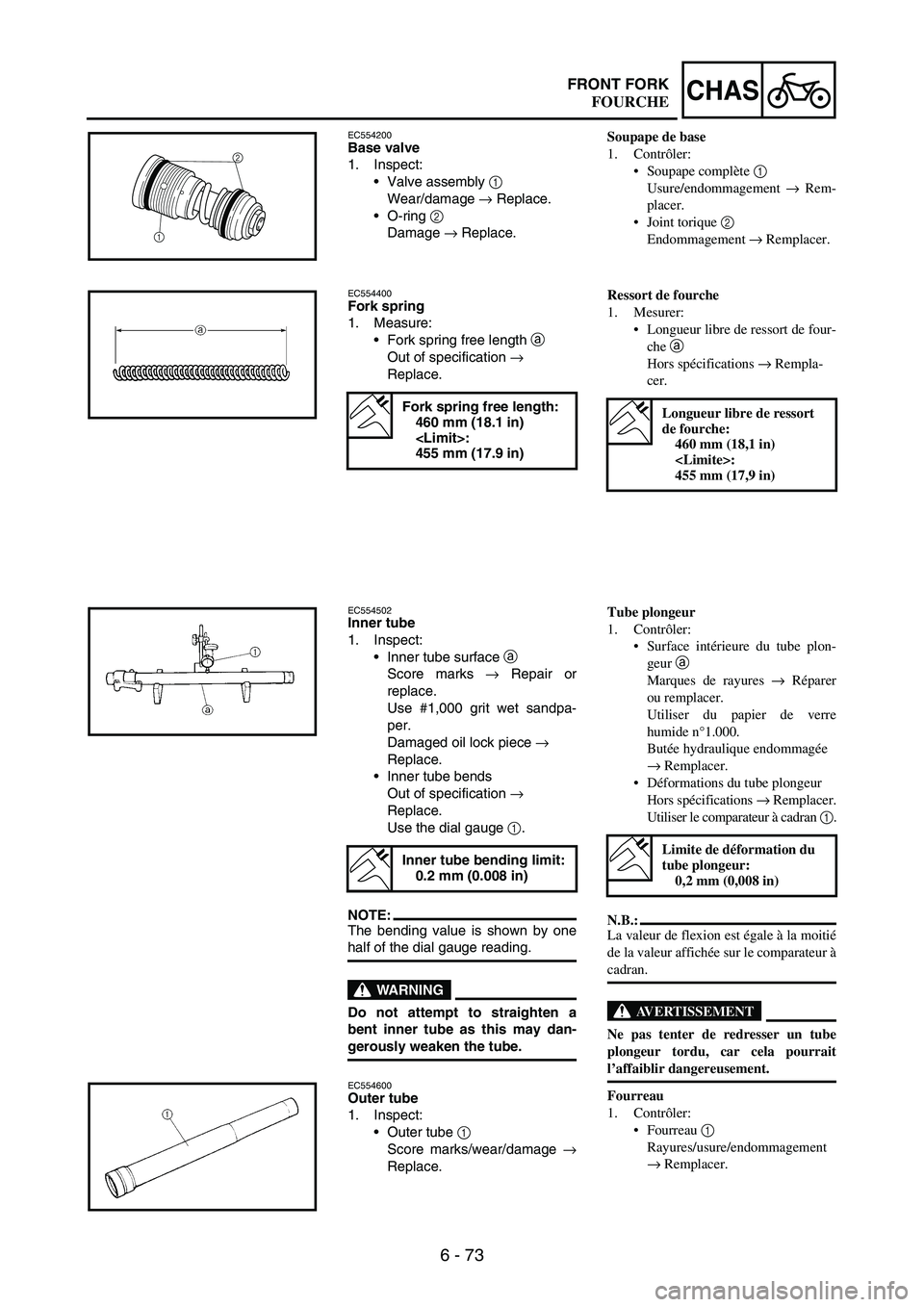
6 - 73
CHASFRONT FORK
EC554200Base valve
1. Inspect:
Valve assembly
1
Wear/damage
→ Replace.
O-ring
2
Damage
→ Replace.2
1
EC554400Fork spring
1. Measure:
Fork spring free length
a
Out of specification →
Replace.
Fork spring free length:
460 mm (18.1 in)
455 mm (17.9 in)
EC554502Inner tube
1. Inspect:
Inner tube surface a
Score marks → Repair or
replace.
Use #1,000 grit wet sandpa-
per.
Damaged oil lock piece →
Replace.
Inner tube bends
Out of specification →
Replace.
Use the dial gauge 1.
NOTE:The bending value is shown by one
half of the dial gauge reading.
WARNING
Do not attempt to straighten a
bent inner tube as this may dan-
gerously weaken the tube.
Inner tube bending limit:
0.2 mm (0.008 in)
EC554600Outer tube
1. Inspect:
Outer tube 1
Score marks/wear/damage →
Replace.
Soupape de base
1. Contrôler:
Soupape complète 1
Usure/endommagement → Rem-
placer.
Joint torique 2
Endommagement → Remplacer.
Ressort de fourche
1. Mesurer:
Longueur libre de ressort de four-
che a
Hors spécifications → Rempla-
cer.
Longueur libre de ressort
de fourche:
460 mm (18,1 in)
455 mm (17,9 in)
Tube plongeur
1. Contrôler:
Surface intérieure du tube plon-
geur a
Marques de rayures → Réparer
ou remplacer.
Utiliser du papier de verre
humide n°1.000.
Butée hydraulique endommagée
→ Remplacer.
Déformations du tube plongeur
Hors spécifications → Remplacer.
Utiliser le comparateur à cadran 1.
N.B.:
La valeur de flexion est égale à la moitié
de la valeur affichée sur le comparateur à
cadran.
AVERTISSEMENT
Ne pas tenter de redresser un tube
plongeur tordu, car cela pourrait
l’affaiblir dangereusement.
Fourreau
1. Contrôler:
Fourreau 1
Rayures/usure/endommagement
→ Remplacer.
Limite de déformation du
tube plongeur:
0,2 mm (0,008 in)
FOURCHE