fuel YAMAHA WR 250F 2013 User Guide
[x] Cancel search | Manufacturer: YAMAHA, Model Year: 2013, Model line: WR 250F, Model: YAMAHA WR 250F 2013Pages: 232, PDF Size: 13.36 MB
Page 33 of 232
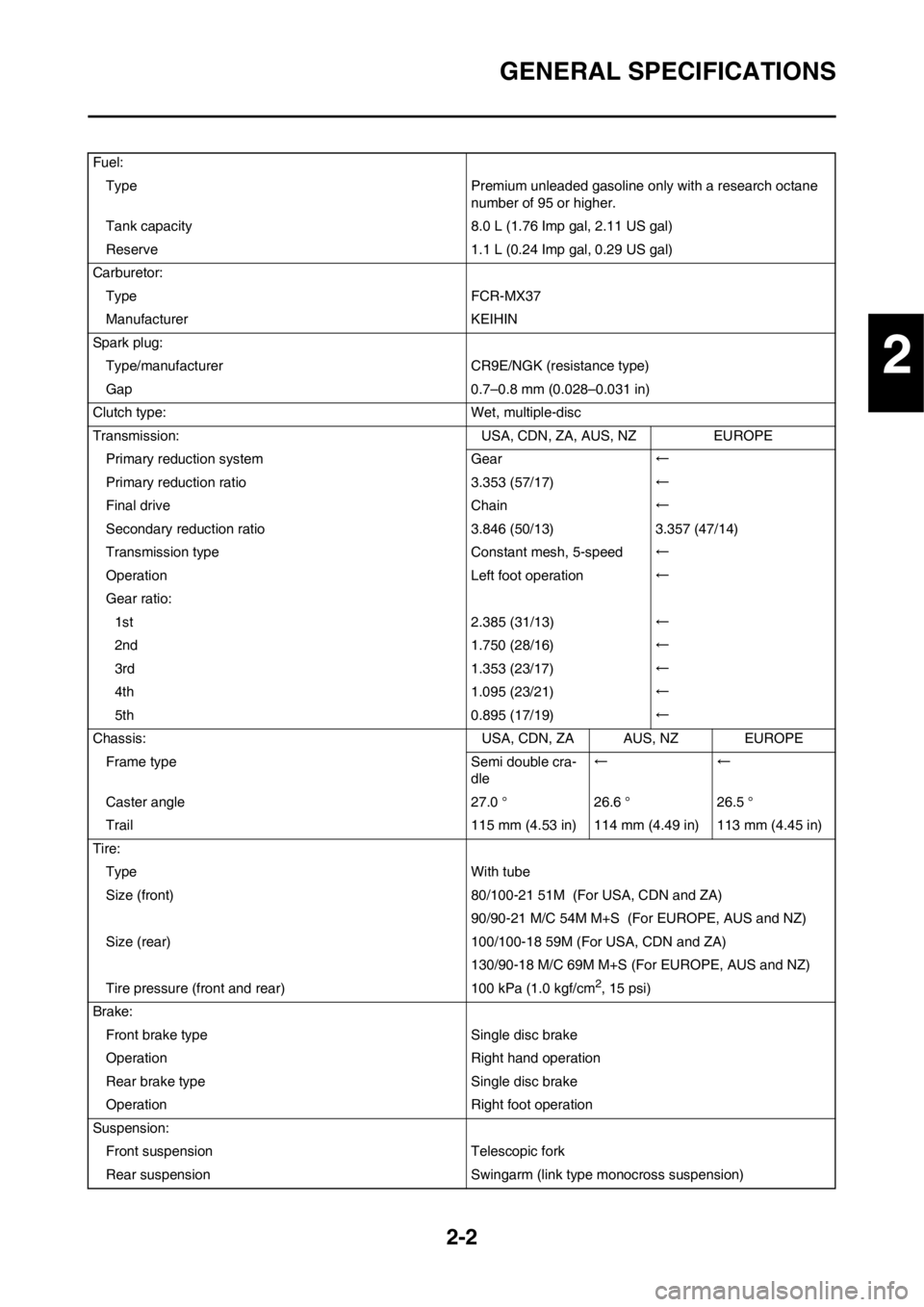
2-2
GENERAL SPECIFICATIONS
Fuel:
Type Premium unleaded gasoline only with a research octane
number of 95 or higher.
Tank capacity 8.0 L (1.76 Imp gal, 2.11 US gal)
Reserve 1.1 L (0.24 Imp gal, 0.29 US gal)
Carburetor:
Type FCR-MX37
Manufacturer KEIHIN
Spark plug:
Type/manufacturer CR9E/NGK (resistance type)
Gap 0.7–0.8 mm (0.028–0.031 in)
Clutch type: Wet, multiple-disc
Transmission: USA, CDN, ZA, AUS, NZ EUROPE
Primary reduction system Gear←
Primary reduction ratio 3.353 (57/17)←
Final drive Chain←
Secondary reduction ratio 3.846 (50/13) 3.357 (47/14)
Transmission type Constant mesh, 5-speed←
Operation Left foot operation←
Gear ratio:
1st 2.385 (31/13)←
2nd 1.750 (28/16)←
3rd 1.353 (23/17)←
4th 1.095 (23/21)←
5th 0.895 (17/19)←
Chassis: USA, CDN, ZA AUS, NZ EUROPE
Frame type Semi double cra-
dle←←
Caster angle 27.0 ° 26.6 ° 26.5 °
Trail 115 mm (4.53 in) 114 mm (4.49 in) 113 mm (4.45 in)
Tire:
Type With tube
Size (front) 80/100-21 51M (For USA, CDN and ZA)
90/90-21 M/C 54M M+S (For EUROPE, AUS and NZ)
Size (rear) 100/100-18 59M (For USA, CDN and ZA)
130/90-18 M/C 69M M+S (For EUROPE, AUS and NZ)
Tire pressure (front and rear) 100 kPa (1.0 kgf/cm
2, 15 psi)
Brake:
Front brake type Single disc brake
Operation Right hand operation
Rear brake type Single disc brake
Operation Right foot operation
Suspension:
Front suspension Telescopic fork
Rear suspension Swingarm (link type monocross suspension)
2
Page 46 of 232

2-15
TIGHTENING TORQUES
△Brake pedal M8 1 26 Nm (2.6 m•kg, 19 ft•lb)
△Rear brake master cylinder M6 2 10 Nm (1.0 m•kg, 7.2 ft•lb)
Rear brake master cylinder cap M4 2 2 Nm (0.2 m•kg, 1.4 ft•lb)
△
Rear brake hose union bolt M10 2 30 Nm (3.0 m•kg, 22 ft•lb)Copper
washer
△Rear wheel axle and axle nut M20 1 125 Nm (12.5 m•kg, 90 ft•lb)
△Nipple (spoke) — 72 3 Nm (0.3 m•kg, 2.2 ft•lb)
△Rear wheel sprocket M8 6 50 Nm (5.0 m•kg, 36 ft•lb)
△Rear brake disc cover M6 2 10 Nm (1.0 m•kg, 7.2 ft•lb)
△Rear brake caliper protector M6 2 7 Nm (0.7 m•kg, 5.1 ft•lb)
Drive chain puller adjust bolt and locknut M8 2 19 Nm (1.9 m•kg, 13 ft•lb)
Engine mounting:
△Engine and engine bracket (front) M10 1 53 Nm (5.3 m•kg, 38 ft•lb)
△Engine and frame (lower) M10 1 53 Nm (5.3 m•kg, 38 ft•lb)
△Upper engine bracket and frame M8 4 34 Nm (3.4 m•kg, 24 ft•lb)
△Lower engine bracket and frame M8 4 34 Nm (3.4 m•kg, 24 ft•lb)
△Engine and engine bracket (upper) M10 1 55 Nm (5.5 m•kg, 40 ft•lb)
△Engine guard M6 3 7 Nm (0.7 m•kg, 5.1 ft•lb)
Regulator M6 2 7 Nm (0.7 m•kg, 5.1 ft•lb)
△Pivot shaft and nut M16 1 85 Nm (8.5 m•kg, 61 ft•lb)
△Relay arm and swingarm M14 1 70 Nm (7.0 m•kg, 50 ft•lb)
△Relay arm and connecting rod M14 1 80 Nm (8.0 m•kg, 58 ft•lb)
△Connecting rod and frame M14 1 80 Nm (8.0 m•kg, 58 ft•lb)
△Rear shock absorber and frame M10 1 56 Nm (5.6 m•kg, 40 ft•lb)
△Rear shock absorber and relay arm M10 1 53 Nm (5.3 m•kg, 38 ft•lb)
△Rear frame (upper) M8 1 38 Nm (3.8 m•kg, 27 ft•lb)
△Rear frame (lower) M8 2 32 Nm (3.2 m•kg, 23 ft•lb)
△Swingarm and brake hose holder M54 3 Nm (0.3 m•kg, 2.2 ft•lb)
Swingarm and patch M4 4 2 Nm (0.2 m•kg, 1.4 ft•lb)
Upper drive chain tensioner M8 1 16 Nm (1.6 m•kg, 11 ft•lb)
Lower drive chain tensioner M8 1 16 Nm (1.6 m•kg, 11 ft•lb)
Drive chain support M6 3 7 Nm (0.7 m•kg, 5.1 ft•lb)
Seal guard and swingarm M5 4 6 Nm (0.6 m•kg, 4.3 ft•lb)
△Fuel tank M6 2 9 Nm (0.9 m•kg, 6.5 ft•lb)
△Fuel cock M6 2 4 Nm (0.4 m•kg, 2.9 ft•lb)
Seat set bracket and fuel tankM6 1 7 Nm (0.7 m•kg, 5.1 ft•lb)
Fuel tank bracket and fuel tank M6 4 7 Nm (0.7 m•kg, 5.1 ft•lb)
△Air scoop and fuel tank M6 6 7 Nm (0.7 m•kg, 5.1 ft•lb)
△Air scoop and radiator guard (lower) M6 2 6 Nm (0.6 m•kg, 4.3 ft•lb)
△Front fender M6 4 7 Nm (0.7 m•kg, 5.1 ft•lb)
△Rear fender (front) M6 2 7 Nm (0.7 m•kg, 5.1 ft•lb)
△Rear fender (rear) M6 2 11 Nm (1.1 m•kg, 8.0 ft•lb)
△Side cover M6 2 7 Nm (0.7 m•kg, 5.1 ft•lb)
Seat M8 2 22 Nm (2.2 m•kg, 16 ft•lb)ItemThread
sizeQ'ty Tightening torque Remarks
Page 52 of 232

2-21
CABLE ROUTING DIAGRAM
CABLE ROUTING DIAGRAM
1. Fuel tank breather hose
2. Clamp
3. Diode
4. Hot starter cable
5. Wire harness
6. Hump (frame)
7. Cylinder head breather hose
8. Throttle position sensor lead
9. Neutral switch lead10. Oil hose
11. Clutch cable
12. Starter motor lead
13. Cable guide
14. Negative battery lead
15. AC magneto lead
16. Brake hose
17. Rectifier/regulator lead
18. Carburetor breather hose19. Carburetor overflow hose
20. Catch tank breather hose
21. Hot starter cable protector
22. Rubber cap
Page 53 of 232

2-22
CABLE ROUTING DIAGRAM
A. Insert the end of the fuel tank
breather hose into the hole in
the steering stem.
B. Fasten the throttle cable, hot
starter cable and rectifier/regula-
tor lead onto the frame. Locate
the clamp under the throttle ca-
ble on the right side of the frame,
and face its ends, as well as the
tie ends, downward.
C. Fasten the diode (at the mark-
ing), throttle cable and hot start-
er cable onto the frame. Locate
the clamp end facing toward the
lower right of the frame and with
the tie end facing downward.
D. Fasten the wire harness, throttle
position sensor lead, starter mo-
tor lead and negative battery
lead onto the frame. Pass the
clamp through the hole in the
stay (air cut-off valve). Locate
the clamp end facing toward the
lower side of the frame and cut
off the tie end.
E. Pass the carburetor breather
hoses, carburetor overflow hose
and catch tank breather hose
between the connecting rod and
cross tube (frame).
F. Fasten the neutral switch lead
and oil hose together with the
plastic locking ties and cut off
the tie ends.
G. Fasten the neutral switch lead
and AC magneto lead onto the
frame. Locate the clamp end
facing toward the outside of the
frame and tie end facing toward
the rear of the frame.
H. Pass the clutch cable through
the cable guide.
I. Fasten the starter motor lead,
AC magneto lead and neutral
switch lead onto the frame. Lo-
cate the clamp end facing to-
ward the rear of the frame and
cut off the tie end.
J. Fasten the clutch cable, starter
motor lead, negative battery
lead, AC magneto lead and neu-
tral switch lead onto the frame.
Locate the clamp end facing to-
ward the rear of the frame and
cut off the tie end.
K. Pass the neutral switch lead and
AC magneto lead on the inside
of the wire harness.
L. Fasten the clutch cable, AC
magneto lead and neutral switch
lead onto the frame. Locate the
clamp end near the clutch cable
and cut off the tie end.M. Pass the clutch cable and wire
harness through the cable
guide.
N. Locate the couplers in the frame
recess.
O. Pass the carburetor breather
hoses, carburetor overflow hose
and catch tank breather hose so
that the hoses do not contact the
rear shock absorber.
P. Secure the coupler by pushing it
into the hole in the headlight
unit.
Q. Fasten the throttle position sen-
sor lead and the hot starter ca-
ble.
R. Locate the clamp between the
hot starter cable protector and
rubber cap.
Page 60 of 232
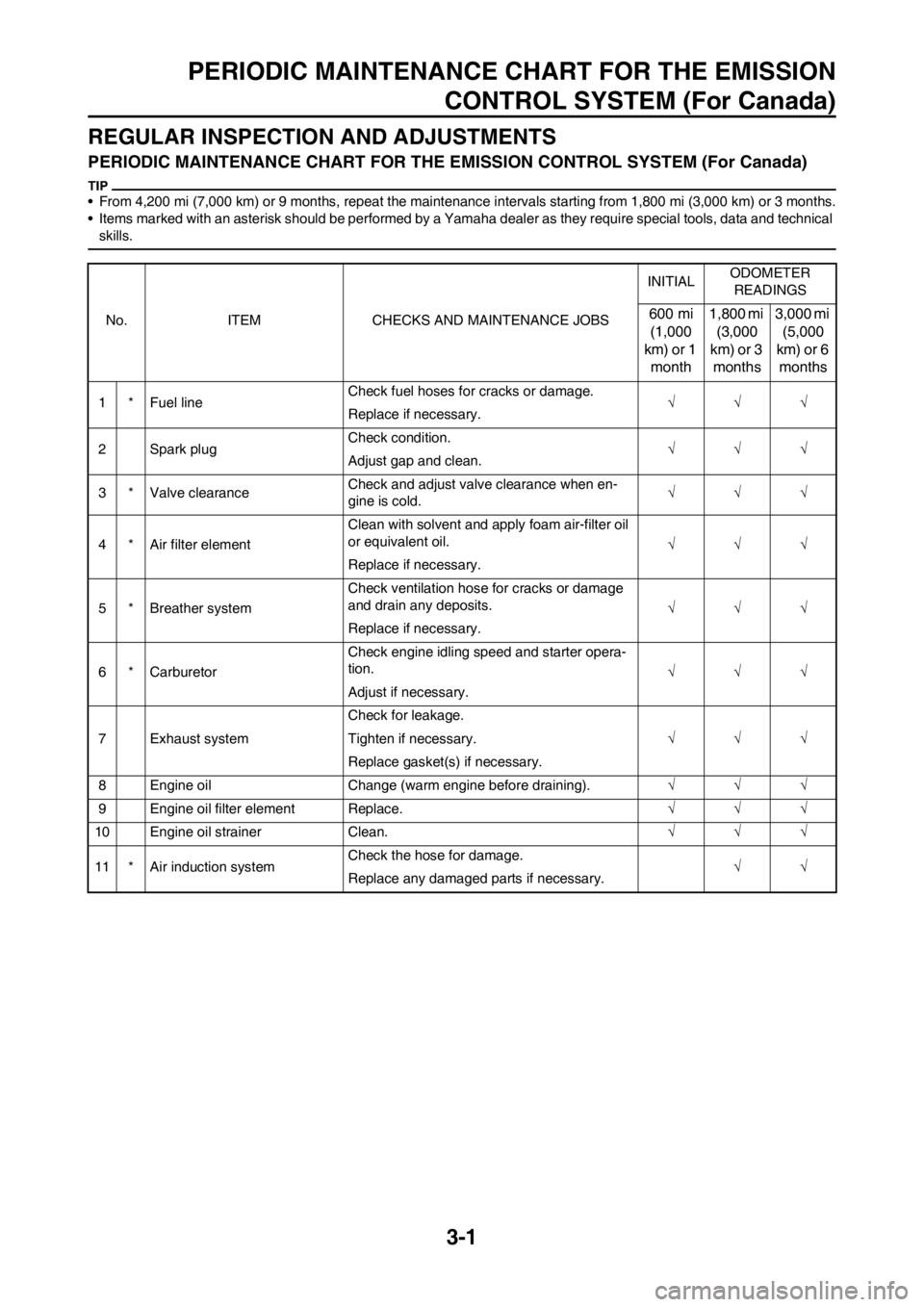
3-1
PERIODIC MAINTENANCE CHART FOR THE EMISSION
CONTROL SYSTEM (For Canada)
REGULAR INSPECTION AND ADJUSTMENTS
PERIODIC MAINTENANCE CHART FOR THE EMISSION CONTROL SYSTEM (For Canada)
• From 4,200 mi (7,000 km) or 9 months, repeat the maintenance intervals starting from 1,800 mi (3,000 km) or 3 months.
• Items marked with an asterisk should be performed by a Yamaha dealer as they require special tools, data and technical
skills.
No. ITEM CHECKS AND MAINTENANCE JOBSINITIALODOMETER
READINGS600 mi
(1,000
km) or 1
month1,800 mi
(3,000
km) or 3
months3,000 mi
(5,000
km) or 6
months
1 * Fuel lineCheck fuel hoses for cracks or damage.
Replace if necessary.
2 Spark plugCheck condition.
Adjust gap and clean.
3 * Valve clearanceCheck and adjust valve clearance when en-
gine is cold.
4 * Air filter elementClean with solvent and apply foam air-filter oil
or equivalent oil.
Replace if necessary.
5 * Breather systemCheck ventilation hose for cracks or damage
and drain any deposits.
Replace if necessary.
6 * CarburetorCheck engine idling speed and starter opera-
tion.
Adjust if necessary.
7 Exhaust systemCheck for leakage.
Tighten if necessary.
Replace gasket(s) if necessary.
8 Engine oil Change (warm engine before draining).
9 Engine oil filter element Replace.
10 Engine oil strainer Clean.
11 * Air induction systemCheck the hose for damage.
Replace any damaged parts if necessary.
Page 64 of 232

3-5
MAINTENANCE INTERVALS FOR COMPETITION USE
CRANK
Inspect and clean●●
CARBURETOR
Inspect, adjust and clean●●
AIR INDUCTION SYSTEM
Inspect and clean●● ●●
SPARK PLUG
Inspect and clean●●
Replace●
DRIVE CHAIN Use chain lube.
Lubricate, slack, alignment●●Chain slack: 48–58 mm (1.9–2.3 in)
Replace●
COOLING SYSTEM
Check coolant level and leakage●●
Check radiator cap operation●
Replace coolant●Every two years
Inspect hoses●
OUTSIDE NUTS AND BOLTS
Retighten●●Refer to "STARTING AND BREAK-
IN" section in the CHAPTER 1.
AIR FILTER
Clean and lubricate●●Use foam air-filter oil or equivalent oil.
Replace●
OIL FILTER
Replace●●
ENGINE GUARD
Replace●Breakage
FRAME
Clean and inspect●●
FUEL TANK, COCK
Clean and inspect●●
BRAKES
Adjust lever position and pedal
height●●
Lubricate pivot point●●
Check brake disc surface●●
Check fluid level and leakage●●
Retighten brake disc bolts, cali-
per bolts, master cylinder bolts
and union bolts●●
Replace pads●
Replace brake fluid●Every one year ItemAfter
break-
inEvery
race
Every
third
(or 500
km)Every
fifth (or
1,000
km)
As re-
quiredRemarks
Page 66 of 232

3-7
PRE-OPERATION INSPECTION AND MAINTENANCE
PRE-OPERATION INSPECTION AND MAINTENANCE
Before riding for break-in operation or practice, make sure the machine is in good operating condition.
Before using this machine, check the following points.
GENERAL INSPECTION AND MAINTENANCE
Item Routine Page
CoolantCheck that coolant is filled up to the radiator cap. Check the cool-
ing system for leakage.P.3-11 – 12
FuelCheck that a fresh gasoline is filled in the fuel tank. Check the fuel
line for leakage.P.1-18
Engine oilCheck that the oil level is correct. Check the crankcase and oil
line for leakage.P.3-14 – 15
Gear shifter and clutchCheck that gears can be shifted correctly in order and that the
clutch operates smoothly.P.3-12 – 13
Throttle grip/HousingCheck that the throttle grip operation and free play are correctly
adjusted. Lubricate the throttle grip and housing, if necessary.P.3-13
Brakes Check the play of front brake and effect of front and rear brake. P.3-19 – 22
Drive chainCheck drive chain slack and alignment. Check that the drive chain
is lubricated properly.P.3-22 – 23
WheelsCheck for excessive wear and tire pressure. Check for loose
spokes and have no excessive play.P.3-26 – 27
SteeringCheck that the handlebar can be turned smoothly and have no ex-
cessive play.P.3-27
Front forks and rear shock
absorberCheck that they operate smoothly and there is no oil leakage.
P.3-23 – 26
Cables (wires)Check that the clutch and throttle cables move smoothly. Check
that they are not caught when the handlebars are turned or when
the front forks travel up and down.—
Exhaust pipe Check that the exhaust pipe is tightly mounted and has no cracks. P.3-10 – 11
Rear wheel sprocket Check that the rear wheel sprocket tightening bolt is not loose. P.3-22
Lubrication Check for smooth operation. Lubricate if necessary. P.3-28
Bolts and nuts Check the chassis and engine for loose bolts and nuts. P.1-20
Lead connectorsCheck that the AC magneto, CDI unit, and ignition coil are con-
nected tightly.P.1-7
SettingsIs the machine set suitably for the condition of the course and
weather or by taking into account the results of test runs before
riding? Are inspection and maintenance completely done?P.4-1 – 10
Page 67 of 232
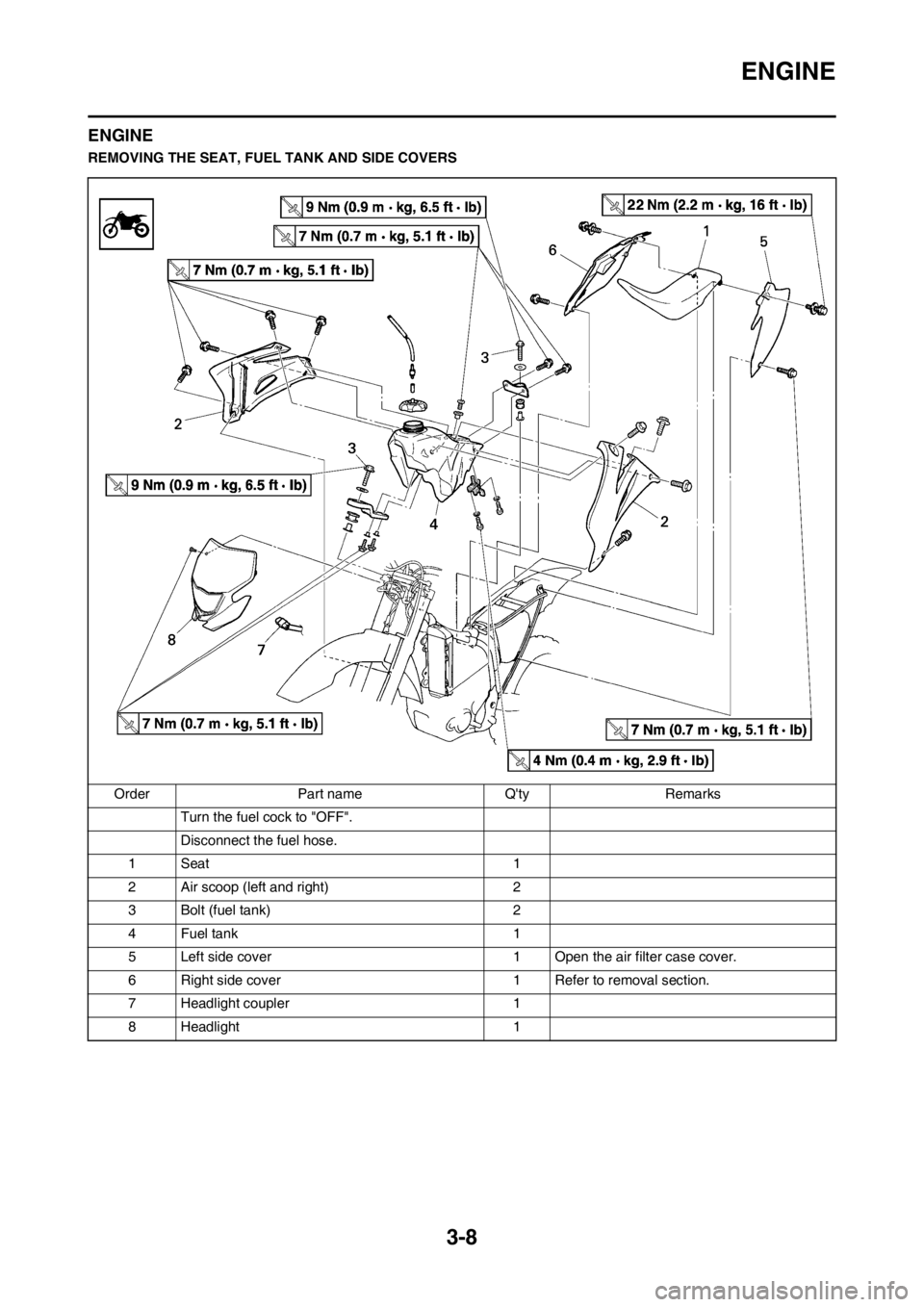
3-8
ENGINE
ENGINE
REMOVING THE SEAT, FUEL TANK AND SIDE COVERS
Order Part name Q'ty Remarks
Turn the fuel cock to "OFF".
Disconnect the fuel hose.
1Seat 1
2 Air scoop (left and right) 2
3 Bolt (fuel tank) 2
4 Fuel tank 1
5 Left side cover 1 Open the air filter case cover.
6 Right side cover 1 Refer to removal section.
7 Headlight coupler 1
8 Headlight 1
Page 69 of 232
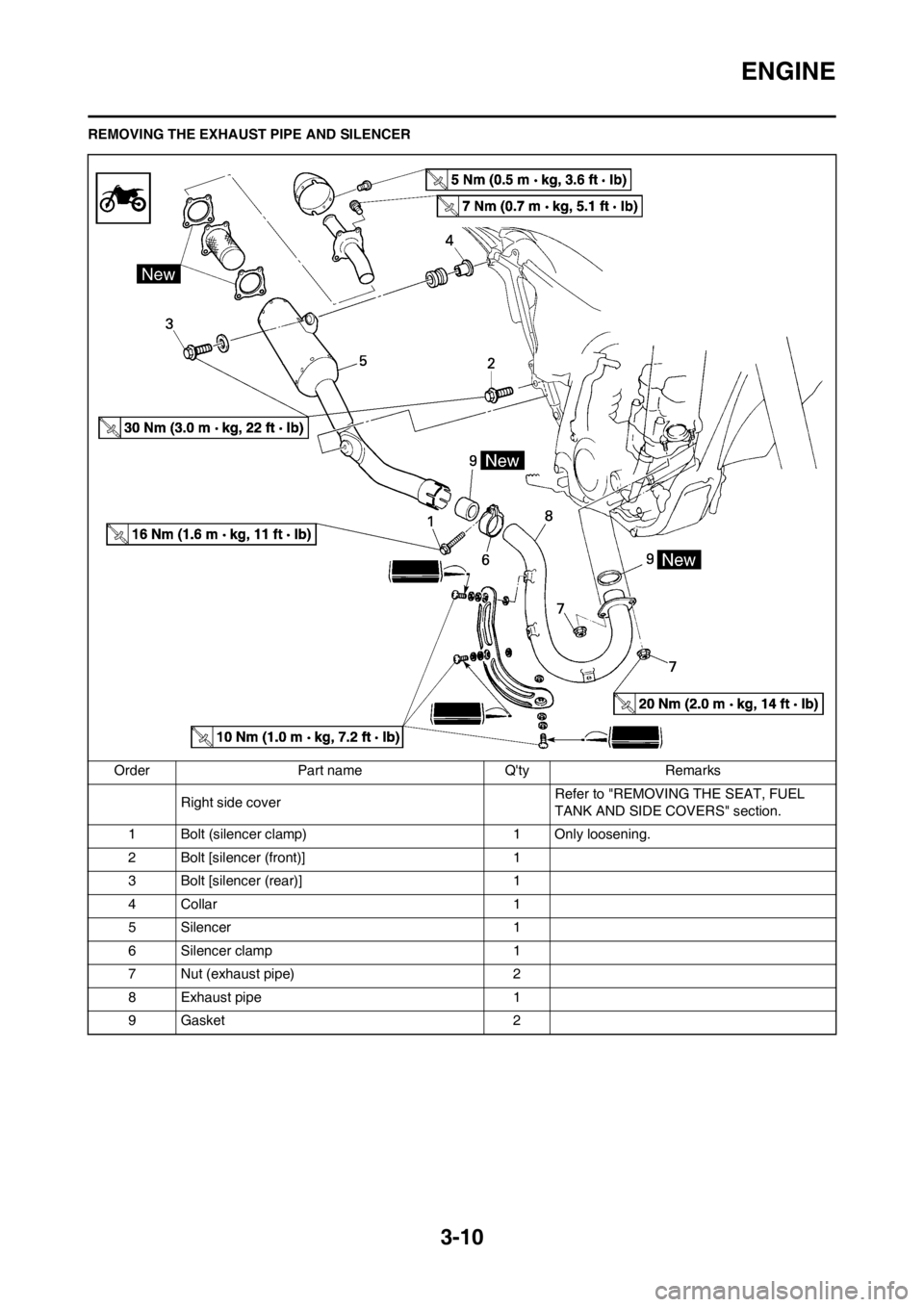
3-10
ENGINE
REMOVING THE EXHAUST PIPE AND SILENCER
Order Part name Q'ty Remarks
Right side coverRefer to "REMOVING THE SEAT, FUEL
TANK AND SIDE COVERS" section.
1 Bolt (silencer clamp) 1 Only loosening.
2 Bolt [silencer (front)] 1
3 Bolt [silencer (rear)] 1
4 Collar 1
5 Silencer 1
6 Silencer clamp 1
7 Nut (exhaust pipe) 2
8 Exhaust pipe 1
9 Gasket 2
Page 75 of 232
3-16
ENGINE
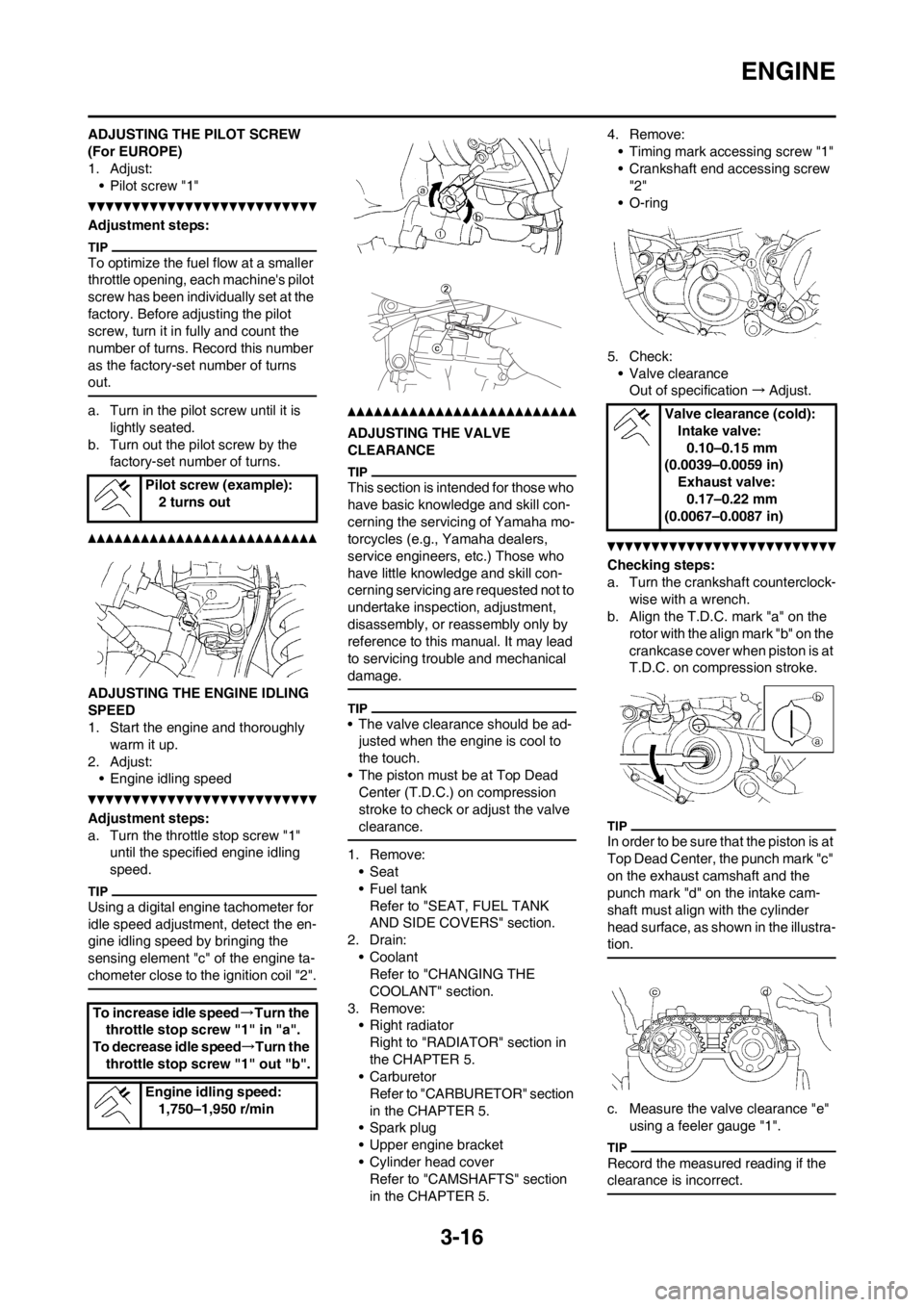
ADJUSTING THE PILOT SCREW
(For EUROPE)
1. Adjust:
• Pilot screw "1"
Adjustment steps:
To optimize the fuel flow at a smaller
throttle opening, each machine's pilot
screw has been individually set at the
factory. Before adjusting the pilot
screw, turn it in fully and count the
number of turns. Record this number
as the factory-set number of turns
out.
a. Turn in the pilot screw until it is
lightly seated.
b. Turn out the pilot screw by the
factory-set number of turns.
ADJUSTING THE ENGINE IDLING
SPEED
1. Start the engine and thoroughly
warm it up.
2. Adjust:
• Engine idling speed
Adjustment steps:
a. Turn the throttle stop screw "1"
until the specified engine idling
speed.
Using a digital engine tachometer for
idle speed adjustment, detect the en-
gine idling speed by bringing the
sensing element "c" of the engine ta-
chometer close to the ignition coil "2".
ADJUSTING THE VALVE
CLEARANCE
This section is intended for those who
have basic knowledge and skill con-
cerning the servicing of Yamaha mo-
torcycles (e.g., Yamaha dealers,
service engineers, etc.) Those who
have little knowledge and skill con-
cerning servicing are requested not to
undertake inspection, adjustment,
disassembly, or reassembly only by
reference to this manual. It may lead
to servicing trouble and mechanical
damage.
• The valve clearance should be ad-
justed when the engine is cool to
the touch.
• The piston must be at Top Dead
Center (T.D.C.) on compression
stroke to check or adjust the valve
clearance.
1. Remove:
•Seat
•Fuel tank
Refer to "SEAT, FUEL TANK
AND SIDE COVERS" section.
2. Drain:
• Coolant
Refer to "CHANGING THE
COOLANT" section.
3. Remove:
• Right radiator
Right to "RADIATOR" section in
the CHAPTER 5.
• Carburetor
Refer to "CARBURETOR" section
in the CHAPTER 5.
• Spark plug
• Upper engine bracket
• Cylinder head cover
Refer to "CAMSHAFTS" section
in the CHAPTER 5.4. Remove:
• Timing mark accessing screw "1"
• Crankshaft end accessing screw
"2"
• O-ring
5. Check:
• Valve clearance
Out of specification→Adjust.
Checking steps:
a. Turn the crankshaft counterclock-
wise with a wrench.
b. Align the T.D.C. mark "a" on the
rotor with the align mark "b" on the
crankcase cover when piston is at
T.D.C. on compression stroke.
In order to be sure that the piston is at
Top Dead Center, the punch mark "c"
on the exhaust camshaft and the
punch mark "d" on the intake cam-
shaft must align with the cylinder
head surface, as shown in the illustra-
tion.
c. Measure the valve clearance "e"
using a feeler gauge "1".
Record the measured reading if the
clearance is incorrect.
Pilot screw (example):
2 turns out
To increase idle speed→Turn the
throttle stop screw "1" in "a".
To decrease idle speed→Turn the
throttle stop screw "1" out "b".
Engine idling speed:
1,750–1,950 r/min
Valve clearance (cold):
Intake valve:
0.10–0.15 mm
(0.0039–0.0059 in)
Exhaust valve:
0.17–0.22 mm
(0.0067–0.0087 in)