radiator cap YAMAHA WR 250F 2017 User Guide
[x] Cancel search | Manufacturer: YAMAHA, Model Year: 2017, Model line: WR 250F, Model: YAMAHA WR 250F 2017Pages: 432, PDF Size: 14.14 MB
Page 111 of 432
ENGINE
3-11
5. Install:
• Copper washer
• Coolant drain bolt
6. Pour coolant.
EWA
WARNING
• If coolant splashes in your eyes, thorough-
ly wash them with water and consult a
doctor.
• If coolant splashes on your clothes, quick-
ly wash it away with water and then with
soap and water.
• If coolant is swallowed, induce vomiting
and get immediate medical attention.
ECA
NOTICE
• Adding water instead of coolant lowers the
antifreeze content of the coolant. If water
is used instead of coolant check, and if
necessary, correct the antifreeze concen-
tration of the coolant.
• Use only distilled water. However, if dis-
tilled water is not available, soft water may
be used.
• If coolant comes into contact with painted
surfaces, immediately wash them with wa-
ter.
• Do not mix different types of antifreeze.
7. Install:
• Radiator cap
8. Start the engine, warm this up for 3 minutes,
stop it, and then wait for it to cool down.
9. Check:
• Coolant level
Refer to “CHECKING THE COOLANT LEV-
EL” on page 3-10.
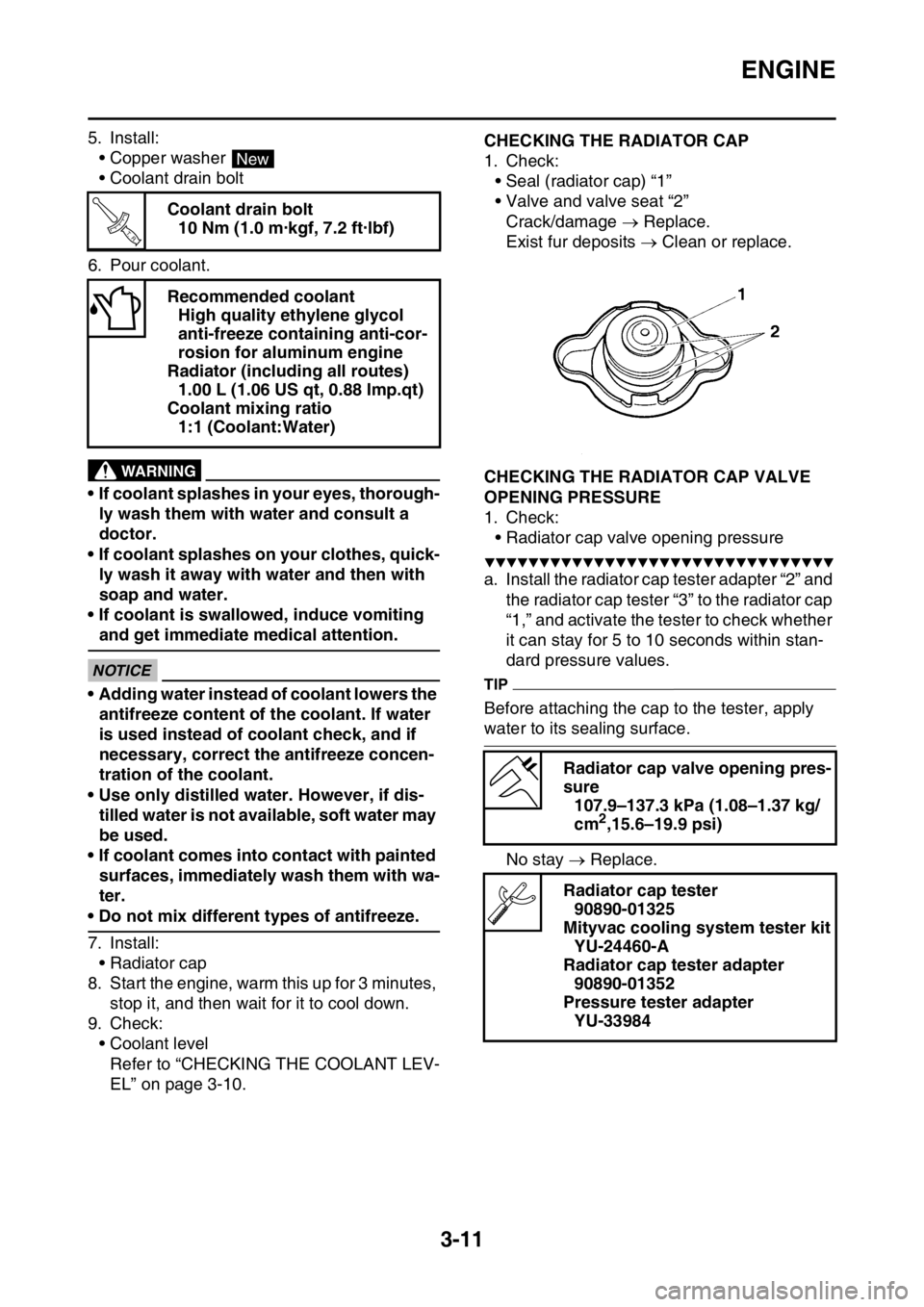
EAS2GBB085CHECKING THE RADIATOR CAP
1. Check:
• Seal (radiator cap) “1”
• Valve and valve seat “2”
Crack/damage Replace.
Exist fur deposits Clean or replace.
EAS2GBB086CHECKING THE RADIATOR CAP VALVE
OPENING PRESSURE
1. Check:
• Radiator cap valve opening pressure
▼▼▼▼▼▼▼▼▼▼▼▼▼▼▼▼▼▼▼▼▼▼▼▼▼▼▼▼▼▼▼▼
a. Install the radiator cap tester adapter “2” and
the radiator cap tester “3” to the radiator cap
“1,” and activate the tester to check whether
it can stay for 5 to 10 seconds within stan-
dard pressure values.
TIP
Before attaching the cap to the tester, apply
water to its sealing surface.
No stay Replace. Coolant drain bolt
10 Nm (1.0 m·kgf, 7.2 ft·lbf)
Recommended coolant
High quality ethylene glycol
anti-freeze containing anti-cor-
rosion for aluminum engine
Radiator (including all routes)
1.00 L (1.06 US qt, 0.88 Imp.qt)
Coolant mixing ratio
1:1 (Coolant:Water)
New
T R..
Radiator cap valve opening pres-
sure
107.9–137.3 kPa (1.08–1.37 kg/
cm
2,15.6–19.9 psi)
Radiator cap tester
90890-01325
Mityvac cooling system tester kit
YU-24460-A
Radiator cap tester adapter
90890-01352
Pressure tester adapter
YU-33984
Page 112 of 432
ENGINE
3-12
▲▲▲▲▲▲▲▲▲▲▲▲▲▲▲▲▲▲▲▲▲▲▲▲▲▲▲▲▲▲▲▲
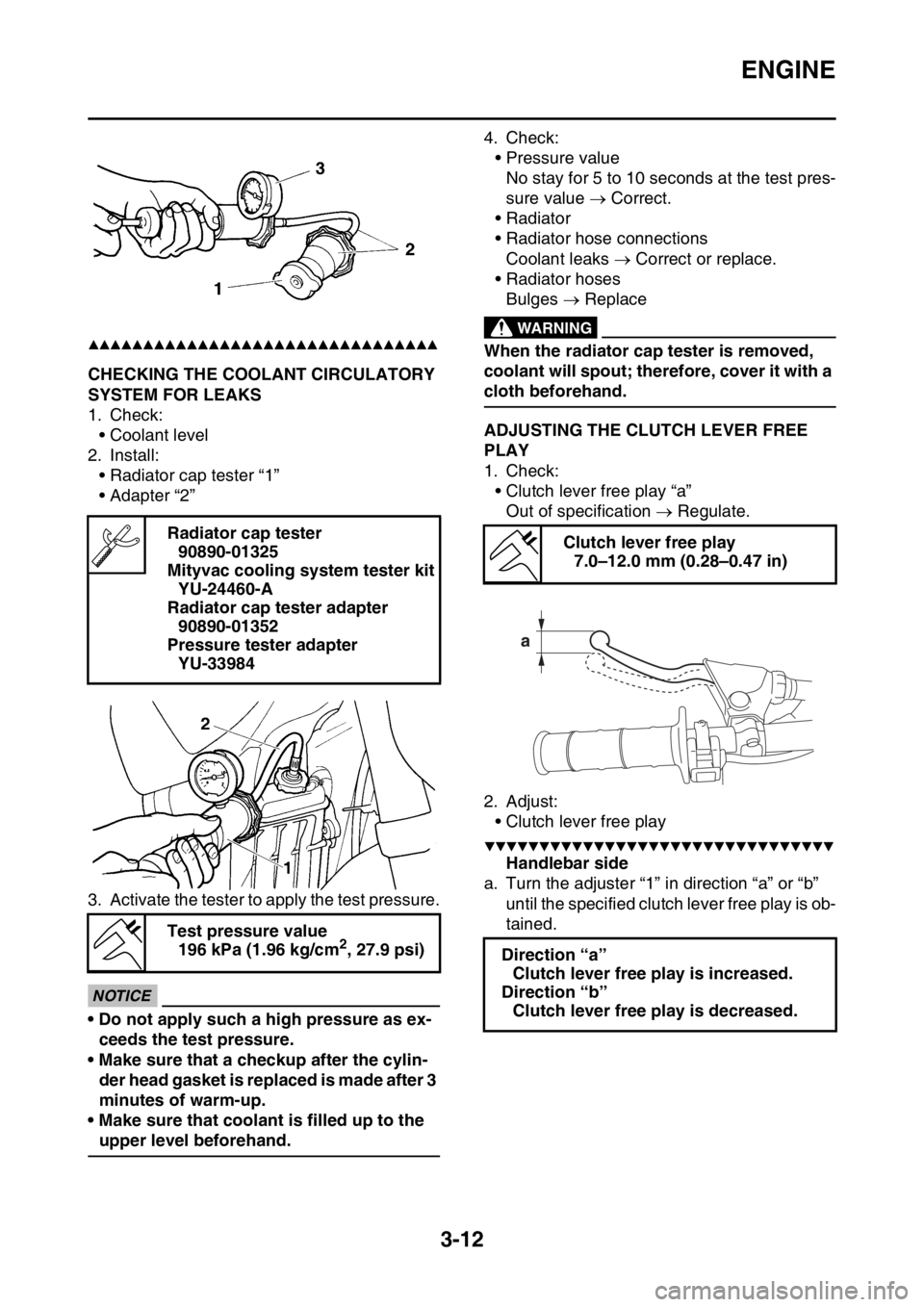
EAS2GBB087CHECKING THE COOLANT CIRCULATORY
SYSTEM FOR LEAKS
1. Check:
• Coolant level
2. Install:
• Radiator cap tester “1”
• Adapter “2”
3. Activate the tester to apply the test pressure.
ECA
NOTICE
• Do not apply such a high pressure as ex-
ceeds the test pressure.
• Make sure that a checkup after the cylin-
der head gasket is replaced is made after 3
minutes of warm-up.
• Make sure that coolant is filled up to the
upper level beforehand.4. Check:
• Pressure value
No stay for 5 to 10 seconds at the test pres-
sure value Correct.
• Radiator
• Radiator hose connections
Coolant leaks Correct or replace.
• Radiator hoses
Bulges Replace
EWA
WARNING
When the radiator cap tester is removed,
coolant will spout; therefore, cover it with a
cloth beforehand.
EAS2GBB088ADJUSTING THE CLUTCH LEVER FREE
PLAY
1. Check:
• Clutch lever free play “a”
Out of specification Regulate.
2. Adjust:
• Clutch lever free play
▼▼▼▼▼▼▼▼▼▼▼▼▼▼▼▼▼▼▼▼▼▼▼▼▼▼▼▼▼▼▼▼
Handlebar side
a. Turn the adjuster “1” in direction “a” or “b”
until the specified clutch lever free play is ob-
tained. Radiator cap tester
90890-01325
Mityvac cooling system tester kit
YU-24460-A
Radiator cap tester adapter
90890-01352
Pressure tester adapter
YU-33984
Test pressure value
196 kPa (1.96 kg/cm
2, 27.9 psi)
Clutch lever free play
7.0–12.0 mm (0.28–0.47 in)
Direction “a”
Clutch lever free play is increased.
Direction “b”
Clutch lever free play is decreased.
Page 318 of 432
RADIATOR
7-3
EAS2GBB330HANDLING NOTEEWA
WARNING
If coolant seems hot, do not remove the ra-
diator cap.
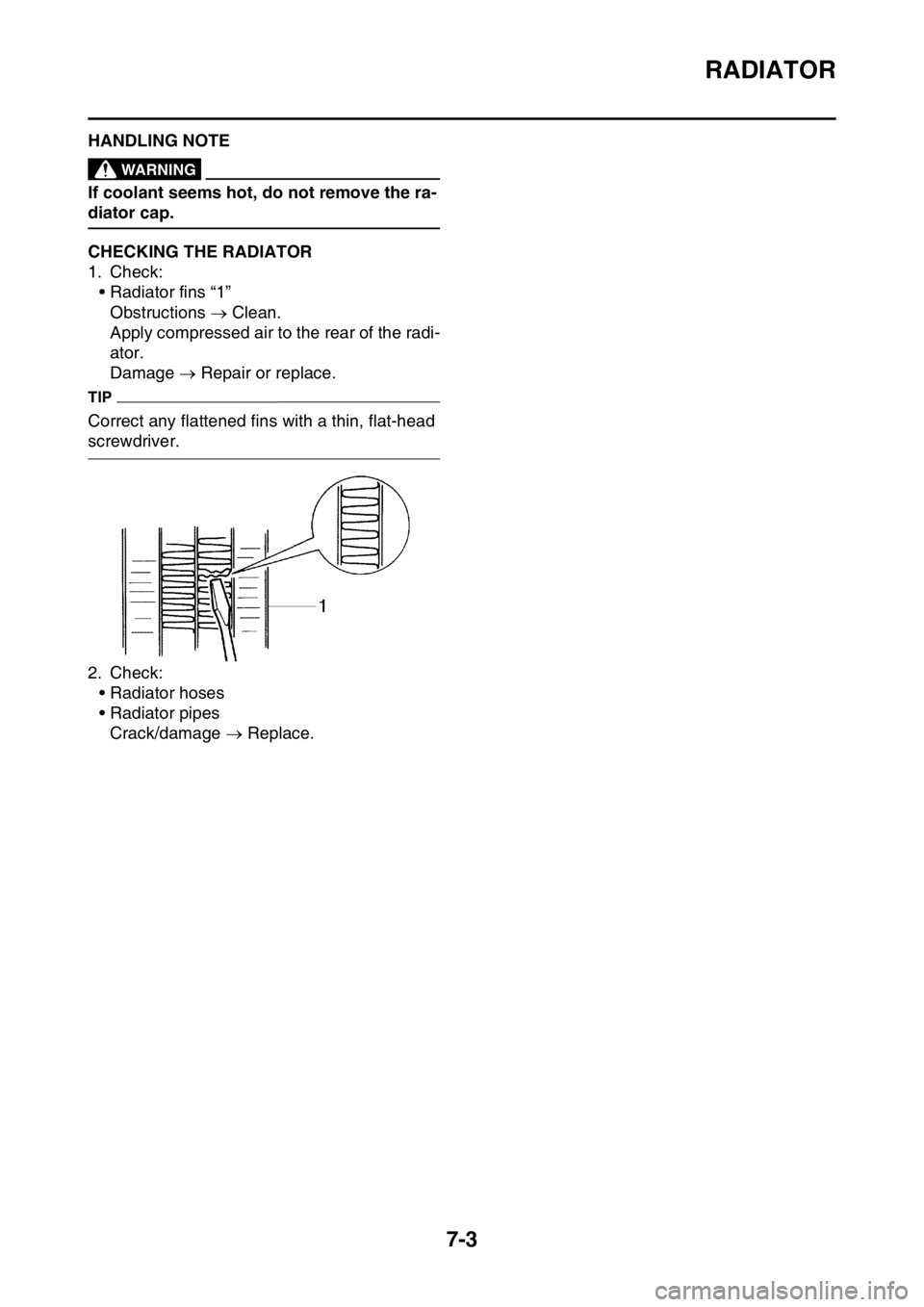
EAS2GBB331CHECKING THE RADIATOR
1. Check:
• Radiator fins “1”
Obstructions Clean.
Apply compressed air to the rear of the radi-
ator.
Damage Repair or replace.
TIP
Correct any flattened fins with a thin, flat-head
screwdriver.
2. Check:
• Radiator hoses
• Radiator pipes
Crack/damage Replace.
Page 336 of 432

ELECTRICAL COMPONENTS....................................................................... 9-60
CHECKING THE SWITCHES .................................................................. 9-64
CHECKING THE BULBS AND BULB SOCKETS .................................... 9-67
CHECKING THE FUSES ......................................................................... 9-68
CHECKING AND CHARGING THE BATTERY ........................................ 9-69
CHECKING THE RELAYS ....................................................................... 9-72
CHECKING THE DIODE .......................................................................... 9-73
CHECKING THE IGNITION SPARK GAP................................................ 9-73
CHECKING THE SPARK PLUG CAP ...................................................... 9-74
CHECKING THE IGNITION COIL ............................................................ 9-74
CHECKING THE CRANKSHAFT POSITION SENSOR........................... 9-75
CHECKING THE LEAN ANGLE SENSOR............................................... 9-75
CHECKING THE STARTER MOTOR OPERATION ................................ 9-76
CHECKING THE STATOR COIL ............................................................. 9-76
CHECKING THE RECTIFIER/REGULATOR ........................................... 9-76
CHECKING THE SPEED SENSOR ......................................................... 9-77
CHECKING THE FUEL SENDER ............................................................ 9-77
CHECKING THE RESISTER ................................................................... 9-78
CHECKING THE RADIATOR FAN MOTOR ............................................ 9-78
CHECKING THE COOLANT TEMPERATURE SENSOR........................ 9-78
CHECKING THE THROTTLE POSITION SENSOR ................................ 9-79
CHECKING THE THROTTLE POSITION SENSOR INPUT VOLTAGE .. 9-80
CHECKING THE INTAKE AIR PRESSURE SENSOR ............................ 9-80
CHECKING THE INTAKE AIR TEMPERATURE SENSOR ..................... 9-80
CHECKING THE FUEL INJECTOR ......................................................... 9-81
Page 409 of 432
ELECTRICAL COMPONENTS
9-73
Radiator fan motor relay
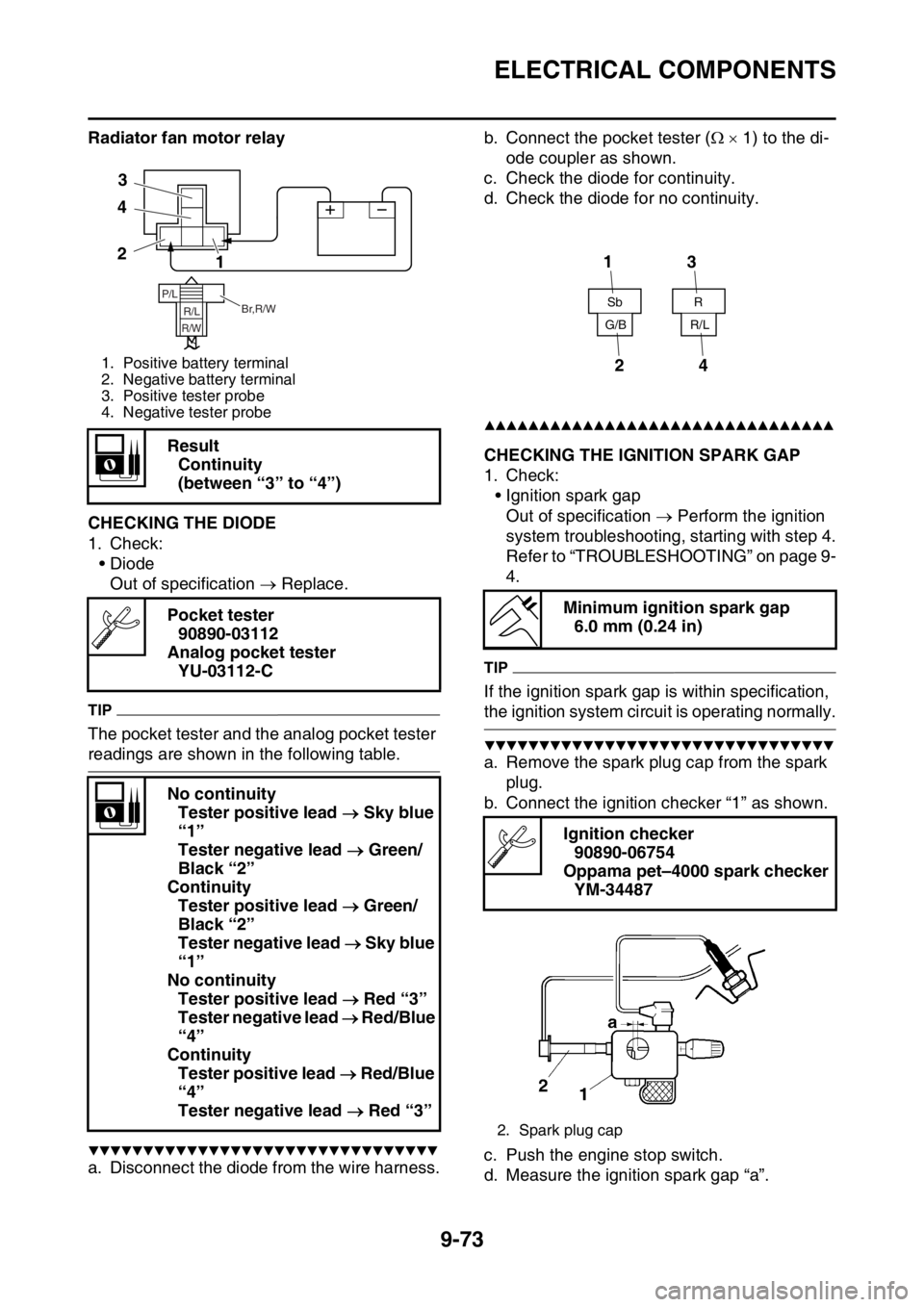
EAS2GBB387CHECKING THE DIODE
1. Check:
•Diode
Out of specification Replace.
TIP
The pocket tester and the analog pocket tester
readings are shown in the following table.
▼▼▼▼▼▼▼▼▼▼▼▼▼▼▼▼▼▼▼▼▼▼▼▼▼▼▼▼▼▼▼▼
a. Disconnect the diode from the wire harness.b. Connect the pocket tester ( 1) to the di-
ode coupler as shown.
c. Check the diode for continuity.
d. Check the diode for no continuity.
▲▲▲▲▲▲▲▲▲▲▲▲▲▲▲▲▲▲▲▲▲▲▲▲▲▲▲▲▲▲▲▲
EAS2GBB388CHECKING THE IGNITION SPARK GAP
1. Check:
• Ignition spark gap
Out of specification Perform the ignition
system troubleshooting, starting with step 4.
Refer to “TROUBLESHOOTING” on page 9-
4.
TIP
If the ignition spark gap is within specification,
the ignition system circuit is operating normally.
▼▼▼▼▼▼▼▼▼▼▼▼▼▼▼▼▼▼▼▼▼▼▼▼▼▼▼▼▼▼▼▼
a. Remove the spark plug cap from the spark
plug.
b. Connect the ignition checker “1” as shown.
c. Push the engine stop switch.
d. Measure the ignition spark gap “a”.
1. Positive battery terminal
2. Negative battery terminal
3. Positive tester probe
4. Negative tester probe
Result
Continuity
(between “3” to “4”)
Pocket tester
90890-03112
Analog pocket tester
YU-03112-C
No continuity
Tester positive lead Sky blue
“1”
Tester negative lead Green/
Black “2”
Continuity
Tester positive lead Green/
Black “2”
Tester negative lead Sky blue
“1”
No continuity
Tester positive lead Red “3”
Tester negative lead Red/Blue
“4”
Continuity
Tester positive lead Red/Blue
“4”
Tester negative lead Red “3”
1 23
4
P/L
R/L
R/W
Br,R/W
Minimum ignition spark gap
6.0 mm (0.24 in)
Ignition checker
90890-06754
Oppama pet–4000 spark checker
YM-34487
2. Spark plug cap
2
1
4
3
R Sb
G/B R/L
Page 422 of 432
TROUBLESHOOTING
10-3
Cooling system
1. Coolant
• Low coolant level
2. Radiator
• Damaged or leaking radiator
• Faulty radiator cap
• Bent or damaged radiator fin
3. Water pump
• Damaged or faulty water pump
• Damaged hose
• Improperly connected hose
• Damaged pipe
• Improperly connected pipe
Fuel system
1. Throttle body
• Damaged or loose throttle body joint
2. Air filter
• Clogged air filter element
Chassis
1. Brake(s)
• Dragging brake
Electrical system
1. Spark plug
• Incorrect spark plug gap
• Incorrect spark plug heat range
2. Ignition system
• Faulty ECU
• Faulty coolant temperature sensor
EAS2GBB416OVERCOOLING
Cooling system
1. Coolant temperature sensor
• Faulty coolant temperature sensor
EAS2GBB417POOR BRAKING PERFORMANCE
Chassis
1. Brake(s)
• Worn brake pad
• Worn brake disc
• Air in hydraulic brake system
• Leaking brake fluid
• Defective master cylinder kit
• Faulty brake caliper kit
• Faulty brake caliper seal
• Loose union bolt
• Damaged brake hose
• Oil or grease on the brake disc
• Oil or grease on the brake pad
• Incorrect brake fluid level
EAS2GBB418FRONT FORK OIL LEAKING
Chassis
1. Front fork
• Bent, damaged, or rusty inner tube
• Cracked or damaged outer tube
• Improperly installed oil seal
• Damaged oil seal lip
• Incorrect oil level (high)
• Loose damper rod assembly bolt
• Damaged damper rod assembly bolt copper
washer
• Cracked or damaged cap bolt O-ring
EAS2GBB419FAULTY FRONT FORK LEGS
Chassis
1. Front fork
• Bent or damaged inner tube
• Bent or damaged outer tube
• Broken fork spring
• Bent or damaged damper rod
• Incorrect oil viscosity
• Incorrect oil level
EAS2GBB420UNSTABLE HANDLING
Chassis
1. Handlebar
• Bent or improperly installed handlebar
2. Steering head components
• Improperly installed upper bracket
• Improperly installed lower bracket
(improperly tightened ring nut)
• Bent steering stem
• Damaged ball bearing or bearing race
3. Front fork leg (s)
• Uneven oil levels (both front fork legs)
• Unevenly tensioned fork spring (both front
fork legs)
• Broken fork spring
• Bent or damaged inner tube
• Bent or damaged outer tube
4. Swingarm
• Worn bearing or bushing
• Bent or damaged swingarm
5. Rear shock absorber assembly (-ies)
• Faulty rear shock absorber spring
• Leaking oil or gas
6. Tire (s)
• Uneven tire pressures (front and rear)
• Incorrect tire pressure
• Uneven tire wear