suspension YAMAHA WR 250F 2017 User Guide
[x] Cancel search | Manufacturer: YAMAHA, Model Year: 2017, Model line: WR 250F, Model: YAMAHA WR 250F 2017Pages: 432, PDF Size: 14.14 MB
Page 143 of 432

4
TUNING
CHASSIS.......................................................................................................... 4-1
SELECTION OF THE SECONDARY REDUCTION RATIO
(SPROCKET) ............................................................................................ 4-1
DRIVE AND REAR WHEEL SPROCKETS SETTING PARTS .................. 4-1
TIRE PRESSURE....................................................................................... 4-1
FRONT FORK SETTING............................................................................ 4-2
CHANGE IN AMOUNT AND CHARACTERISTICS OF FORK OIL............ 4-2
SETTING OF SPRING AFTER REPLACEMENT ...................................... 4-2
FRONT FORK SETTING PARTS............................................................... 4-3
REAR SUSPENSION SETTING ................................................................ 4-3
CHOOSING SET LENGTH ........................................................................ 4-3
SETTING OF SPRING AFTER REPLACEMENT ...................................... 4-4
REAR SHOCK ABSORBER SETTING PARTS ......................................... 4-4
SUSPENSION SETTING (FRONT FORK)................................................. 4-6
SUSPENSION SETTING (REAR SHOCK ABSORBER) ........................... 4-7
Page 145 of 432
CHASSIS
4-2
• Under a stony or a hard road condition, the
tire pressure should be higher to prevent a flat
tire.
EAS2GBB140FRONT FORK SETTING
The front fork setting should be made depend-
ing on the rider’s feeling of an actual run and
the circuit conditions.
The front fork setting includes the following
three factors:
1. Setting of air spring characteristics
• Change the fork oil amount.
2. Setting of spring preload
• Change the spring.
3. Setting of damping force
• Change the compression damping force.
• Change the rebound damping force.
The spring acts on the load and the damping
force acts on the cushion travel speed.
EAS2GBB141CHANGE IN AMOUNT AND CHARACTERIS-
TICS OF FORK OIL
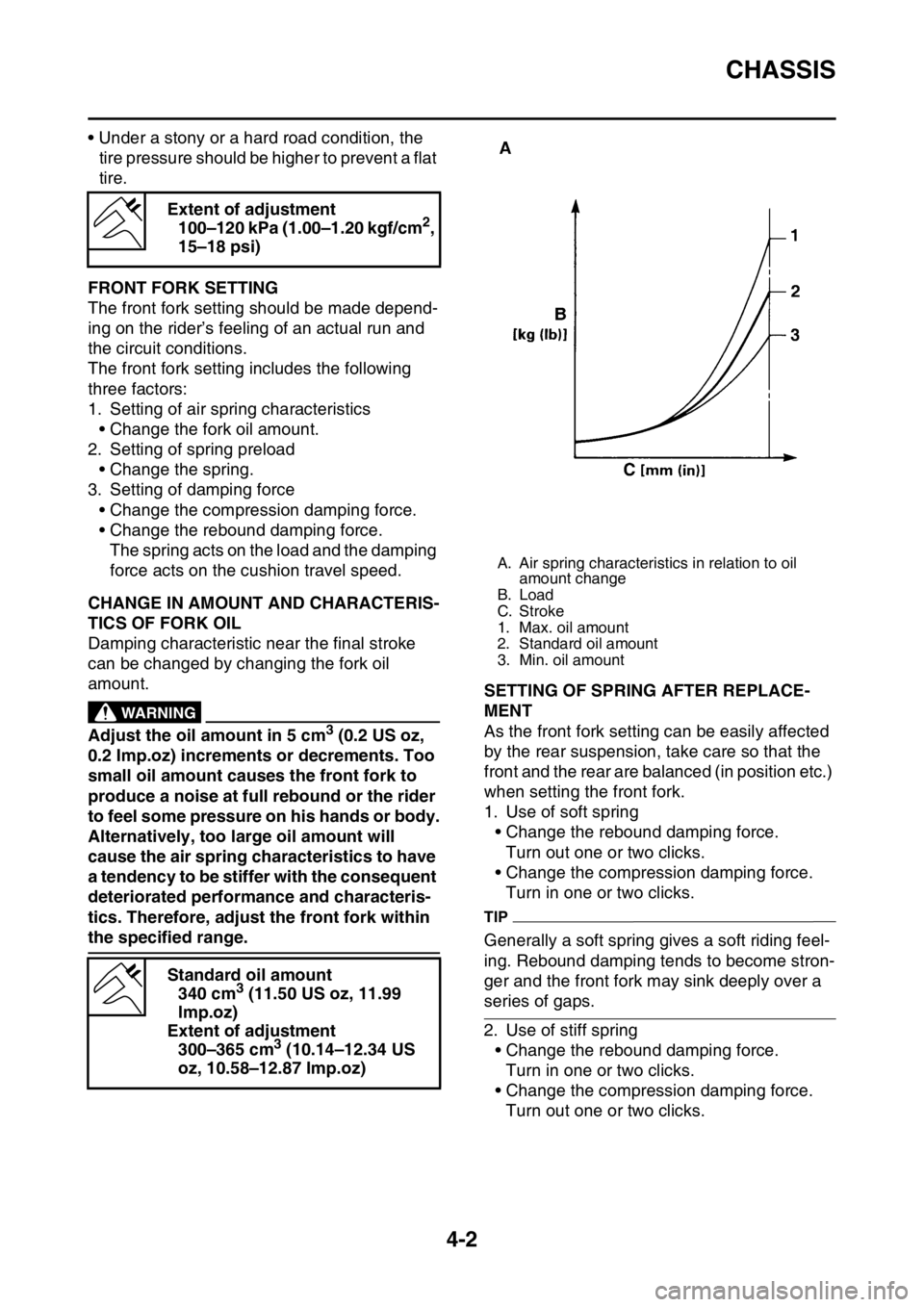
Damping characteristic near the final stroke
can be changed by changing the fork oil
amount.
EWA
WARNING
Adjust the oil amount in 5 cm3 (0.2 US oz,
0.2 Imp.oz) increments or decrements. Too
small oil amount causes the front fork to
produce a noise at full rebound or the rider
to feel some pressure on his hands or body.
Alternatively, too large oil amount will
cause the air spring characteristics to have
a tendency to be stiffer with the consequent
deteriorated performance and characteris-
tics. Therefore, adjust the front fork within
the specified range.
EAS2GBB142SETTING OF SPRING AFTER REPLACE-
MENT
As the front fork setting can be easily affected
by the rear suspension, take care so that the
front and the rear are balanced (in position etc.)
when setting the front fork.
1. Use of soft spring
• Change the rebound damping force.
Turn out one or two clicks.
• Change the compression damping force.
Turn in one or two clicks.
TIP
Generally a soft spring gives a soft riding feel-
ing. Rebound damping tends to become stron-
ger and the front fork may sink deeply over a
series of gaps.
2. Use of stiff spring
• Change the rebound damping force.
Turn in one or two clicks.
• Change the compression damping force.
Turn out one or two clicks. Extent of adjustment
100–120 kPa (1.00–1.20 kgf/cm
2,
15–18 psi)
Standard oil amount
340 cm
3 (11.50 US oz, 11.99
lmp.oz)
Extent of adjustment
300–365 cm
3 (10.14–12.34 US
oz, 10.58–12.87 Imp.oz)
A. Air spring characteristics in relation to oil
amount change
B. Load
C. Stroke
1. Max. oil amount
2. Standard oil amount
3. Min. oil amount
Page 146 of 432
CHASSIS
4-3
TIP
Generally a stiff spring gives a stiff riding feel-
ing. Rebound damping tends to become weak-
er, resulting in lack of a sense of contact with
the road surface or in a vibrating handlebar.
EAS2GBB143FRONT FORK SETTING PARTS
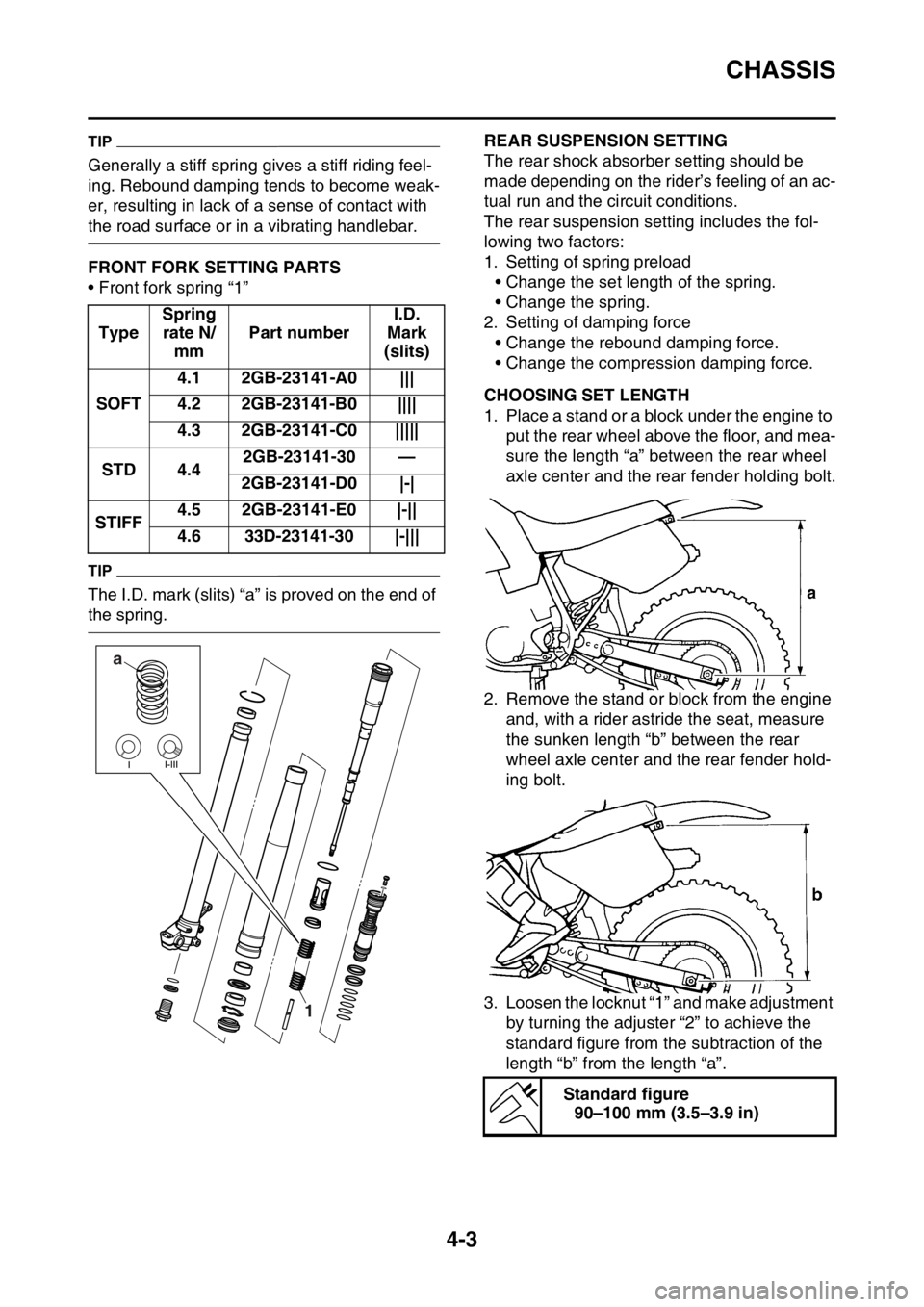
• Front fork spring “1”
TIP
The I.D. mark (slits) “a” is proved on the end of
the spring.
EAS2GBB144REAR SUSPENSION SETTING
The rear shock absorber setting should be
made depending on the rider’s feeling of an ac-
tual run and the circuit conditions.
The rear suspension setting includes the fol-
lowing two factors:
1. Setting of spring preload
• Change the set length of the spring.
• Change the spring.
2. Setting of damping force
• Change the rebound damping force.
• Change the compression damping force.
EAS2GBB145CHOOSING SET LENGTH
1. Place a stand or a block under the engine to
put the rear wheel above the floor, and mea-
sure the length “a” between the rear wheel
axle center and the rear fender holding bolt.
2. Remove the stand or block from the engine
and, with a rider astride the seat, measure
the sunken length “b” between the rear
wheel axle center and the rear fender hold-
ing bolt.
3. Loosen the locknut “1” and make adjustment
by turning the adjuster “2” to achieve the
standard figure from the subtraction of the
length “b” from the length “a”. TypeSpring
rate N/
mmPart numberI.D.
Mark
(slits)
SOFT4.1 2GB-23141-A0 |||
4.2 2GB-23141-B0 ||||
4.3 2GB-23141-C0 |||||
STD 4.42GB-23141-30 —
2GB-23141-D0 |-|
STIFF4.5 2GB-23141-E0 |-||
4.6 33D-23141-30 |-|||
a
1
Standard figure
90–100 mm (3.5–3.9 in)
Page 149 of 432
CHASSIS
4-6
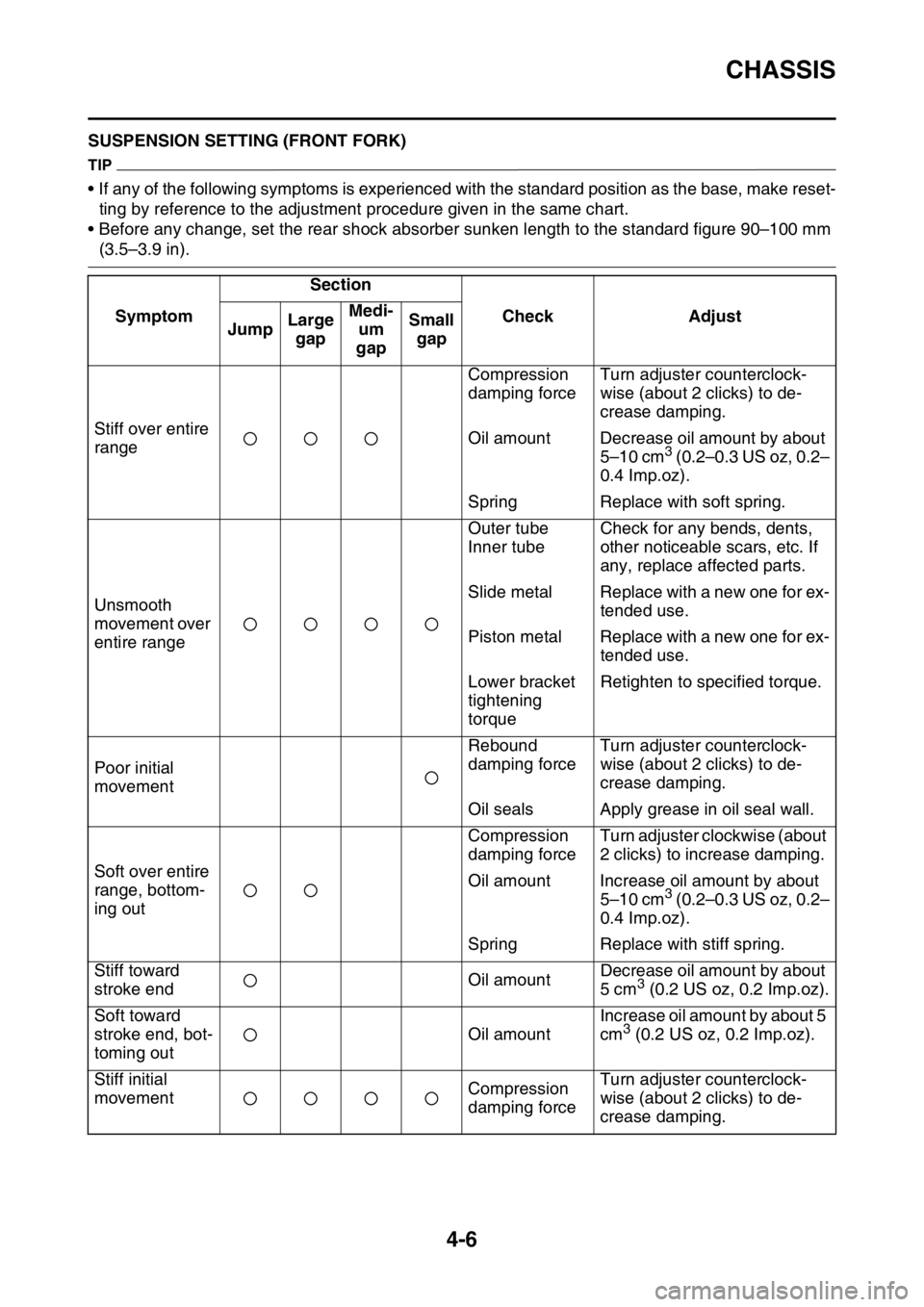
EAS2GBB148SUSPENSION SETTING (FRONT FORK)
TIP
• If any of the following symptoms is experienced with the standard position as the base, make reset-
ting by reference to the adjustment procedure given in the same chart.
• Before any change, set the rear shock absorber sunken length to the standard figure 90–100 mm
(3.5–3.9 in).
SymptomSection
Check Adjust
JumpLarge
gapMedi-
um
gapSmall
gap
Stiff over entire
rangeCompression
damping forceTurn adjuster counterclock-
wise (about 2 clicks) to de-
crease damping.
Oil amount Decrease oil amount by about
5–10 cm
3 (0.2–0.3 US oz, 0.2–
0.4 Imp.oz).
Spring Replace with soft spring.
Unsmooth
movement over
entire rangeOuter tube
Inner tubeCheck for any bends, dents,
other noticeable scars, etc. If
any, replace affected parts.
Slide metal Replace with a new one for ex-
tended use.
Piston metal Replace with a new one for ex-
tended use.
Lower bracket
tightening
torqueRetighten to specified torque.
Poor initial
movementRebound
damping forceTurn adjuster counterclock-
wise (about 2 clicks) to de-
crease damping.
Oil seals Apply grease in oil seal wall.
Soft over entire
range, bottom-
ing outCompression
damping forceTurn adjuster clockwise (about
2 clicks) to increase damping.
Oil amount Increase oil amount by about
5–10 cm
3 (0.2–0.3 US oz, 0.2–
0.4 Imp.oz).
Spring Replace with stiff spring.
Stiff toward
stroke endOil amountDecrease oil amount by about
5 cm
3 (0.2 US oz, 0.2 Imp.oz).
Soft toward
stroke end, bot-
toming outOil amountIncrease oil amount by about 5
cm
3 (0.2 US oz, 0.2 Imp.oz).
Stiff initial
movementCompression
damping forceTurn adjuster counterclock-
wise (about 2 clicks) to de-
crease damping.
Page 150 of 432
CHASSIS
4-7
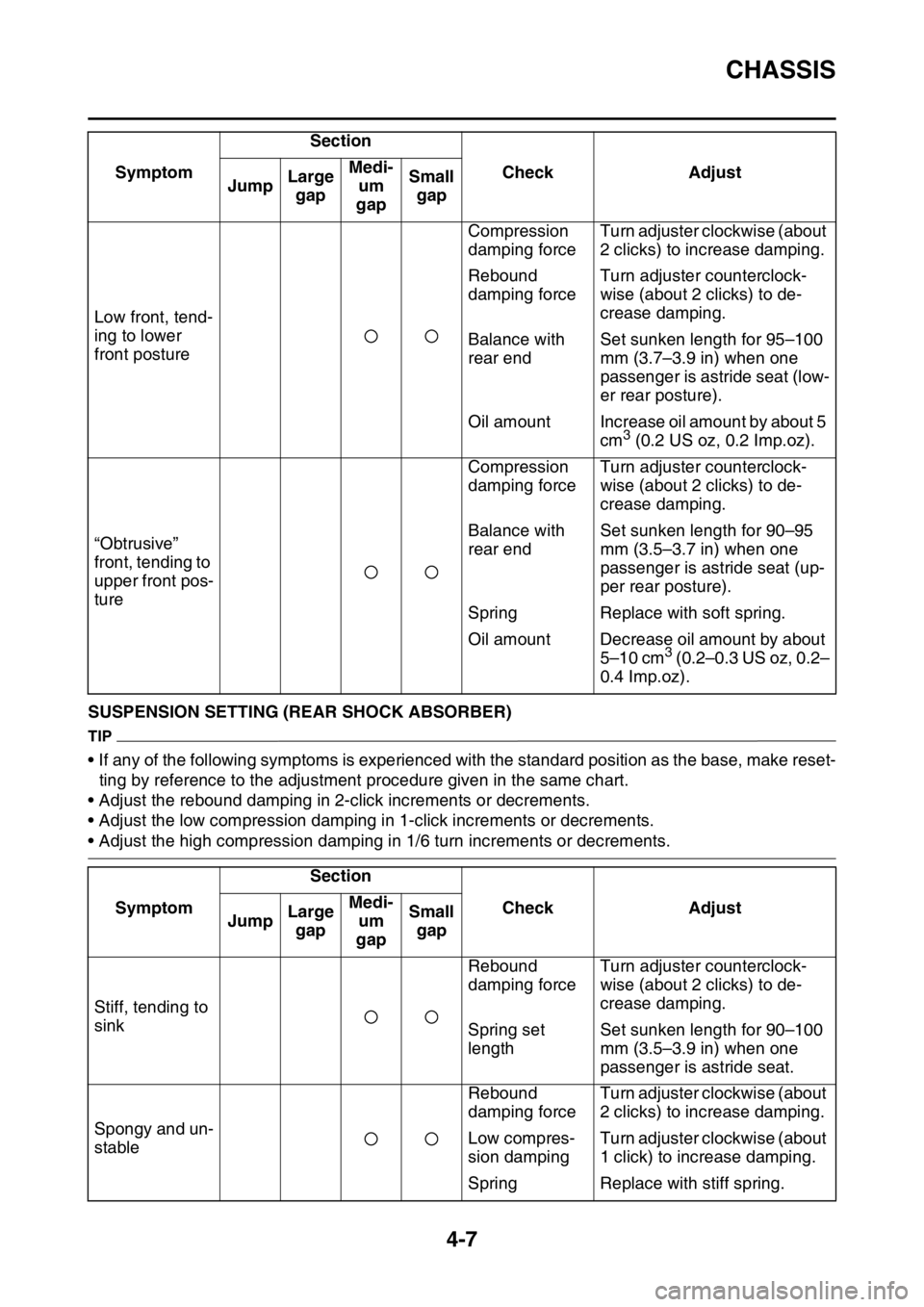
EAS2GBB149SUSPENSION SETTING (REAR SHOCK ABSORBER)
TIP
• If any of the following symptoms is experienced with the standard position as the base, make reset-
ting by reference to the adjustment procedure given in the same chart.
• Adjust the rebound damping in 2-click increments or decrements.
• Adjust the low compression damping in 1-click increments or decrements.
• Adjust the high compression damping in 1/6 turn increments or decrements. Low front, tend-
ing to lower
front postureCompression
damping forceTurn adjuster clockwise (about
2 clicks) to increase damping.
Rebound
damping forceTurn adjuster counterclock-
wise (about 2 clicks) to de-
crease damping.
Balance with
rear endSet sunken length for 95–100
mm (3.7–3.9 in) when one
passenger is astride seat (low-
er rear posture).
Oil amount Increase oil amount by about 5
cm
3 (0.2 US oz, 0.2 Imp.oz).
“Obtrusive”
front, tending to
upper front pos-
tureCompression
damping forceTurn adjuster counterclock-
wise (about 2 clicks) to de-
crease damping.
Balance with
rear endSet sunken length for 90–95
mm (3.5–3.7 in) when one
passenger is astride seat (up-
per rear posture).
Spring Replace with soft spring.
Oil amount Decrease oil amount by about
5–10 cm
3 (0.2–0.3 US oz, 0.2–
0.4 Imp.oz).
SymptomSection
Check Adjust
JumpLarge
gapMedi-
um
gapSmall
gap
Stiff, tending to
sinkRebound
damping forceTurn adjuster counterclock-
wise (about 2 clicks) to de-
crease damping.
Spring set
lengthSet sunken length for 90–100
mm (3.5–3.9 in) when one
passenger is astride seat.
Spongy and un-
stableRebound
damping forceTurn adjuster clockwise (about
2 clicks) to increase damping.
Low compres-
sion dampingTurn adjuster clockwise (about
1 click) to increase damping.
Spring Replace with stiff spring. SymptomSection
Check Adjust
JumpLarge
gapMedi-
um
gapSmall
gap
Page 198 of 432
FRONT FORK
5-44
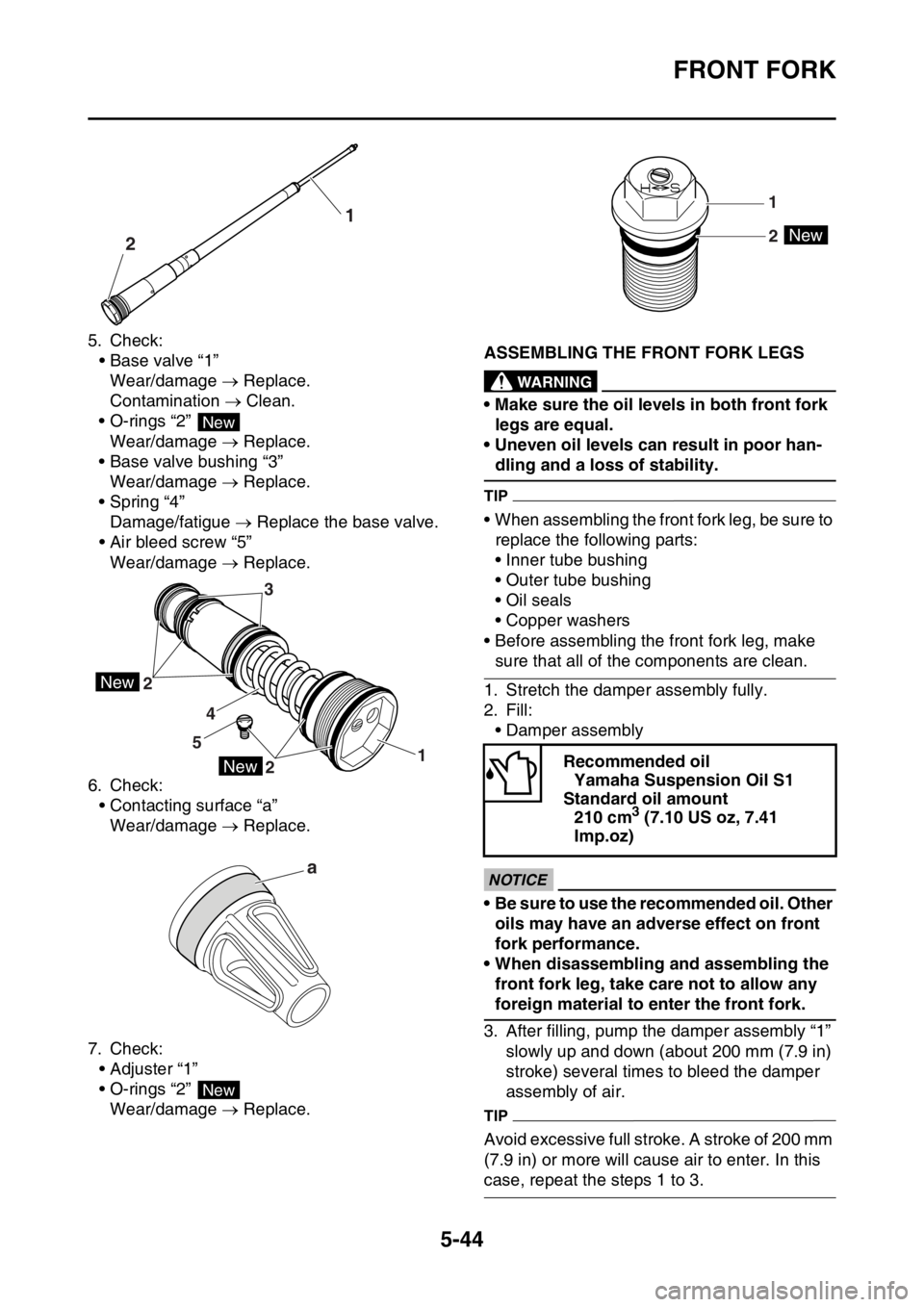
5. Check:
• Base valve “1”
Wear/damage Replace.
Contamination Clean.
• O-rings “2”
Wear/damage Replace.
• Base valve bushing “3”
Wear/damage Replace.
• Spring “4”
Damage/fatigue Replace the base valve.
• Air bleed screw “5”
Wear/damage Replace.
6. Check:
• Contacting surface “a”
Wear/damage Replace.
7. Check:
• Adjuster “1”
• O-rings “2”
Wear/damage Replace.EAS2GBB201ASSEMBLING THE FRONT FORK LEGSEWA
WARNING
• Make sure the oil levels in both front fork
legs are equal.
• Uneven oil levels can result in poor han-
dling and a loss of stability.
TIP
• When assembling the front fork leg, be sure to
replace the following parts:
• Inner tube bushing
• Outer tube bushing
• Oil seals
• Copper washers
• Before assembling the front fork leg, make
sure that all of the components are clean.
1. Stretch the damper assembly fully.
2. Fill:
• Damper assembly
ECA
NOTICE
• Be sure to use the recommended oil. Other
oils may have an adverse effect on front
fork performance.
• When disassembling and assembling the
front fork leg, take care not to allow any
foreign material to enter the front fork.
3. After filling, pump the damper assembly “1”
slowly up and down (about 200 mm (7.9 in)
stroke) several times to bleed the damper
assembly of air.
TIP
Avoid excessive full stroke. A stroke of 200 mm
(7.9 in) or more will cause air to enter. In this
case, repeat the steps 1 to 3.
21
New
New
New
2
21 543
a
New
Recommended oil
Yamaha Suspension Oil S1
Standard oil amount
210 cm
3 (7.10 US oz, 7.41
Imp.oz)
New
1
2
Page 204 of 432
FRONT FORK
5-50
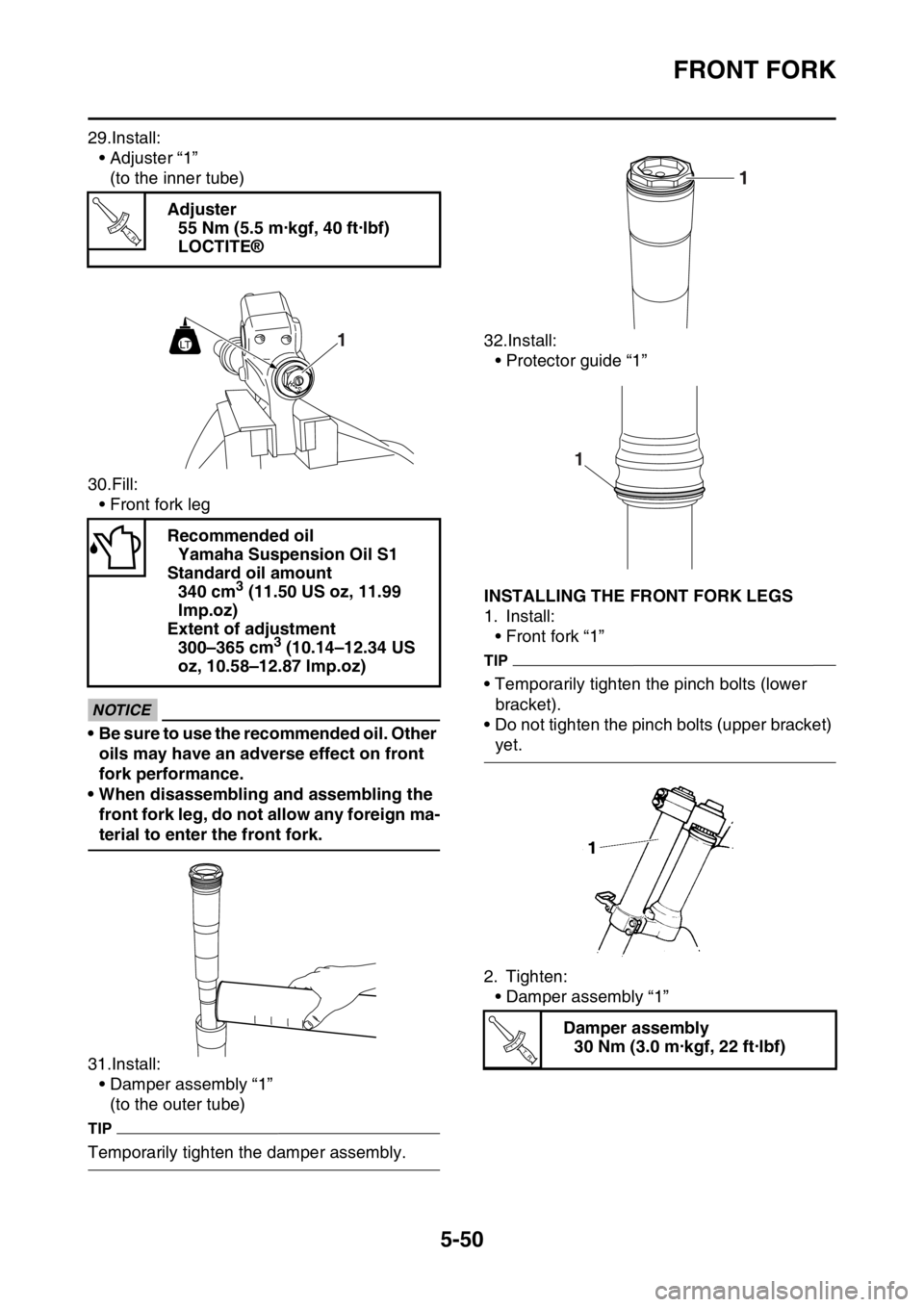
29.Install:
• Adjuster “1”
(to the inner tube)
30.Fill:
• Front fork leg
ECA
NOTICE
• Be sure to use the recommended oil. Other
oils may have an adverse effect on front
fork performance.
• When disassembling and assembling the
front fork leg, do not allow any foreign ma-
terial to enter the front fork.
31.Install:
• Damper assembly “1”
(to the outer tube)
TIP
Temporarily tighten the damper assembly.32.Install:
• Protector guide “1”
EAS2GBB202INSTALLING THE FRONT FORK LEGS
1. Install:
• Front fork “1”
TIP
• Temporarily tighten the pinch bolts (lower
bracket).
• Do not tighten the pinch bolts (upper bracket)
yet.
2. Tighten:
• Damper assembly “1” Adjuster
55 Nm (5.5 m·kgf, 40 ft·lbf)
LOCTITE®
Recommended oil
Yamaha Suspension Oil S1
Standard oil amount
340 cm
3 (11.50 US oz, 11.99
lmp.oz)
Extent of adjustment
300–365 cm
3 (10.14–12.34 US
oz, 10.58–12.87 lmp.oz)
T R..
1LT
Damper assembly
30 Nm (3.0 m·kgf, 22 ft·lbf)
1
T R..