wheel YAMAHA WR 250F 2017 Owner's Manual
[x] Cancel search | Manufacturer: YAMAHA, Model Year: 2017, Model line: WR 250F, Model: YAMAHA WR 250F 2017Pages: 432, PDF Size: 14.14 MB
Page 130 of 432
CHASSIS
3-30
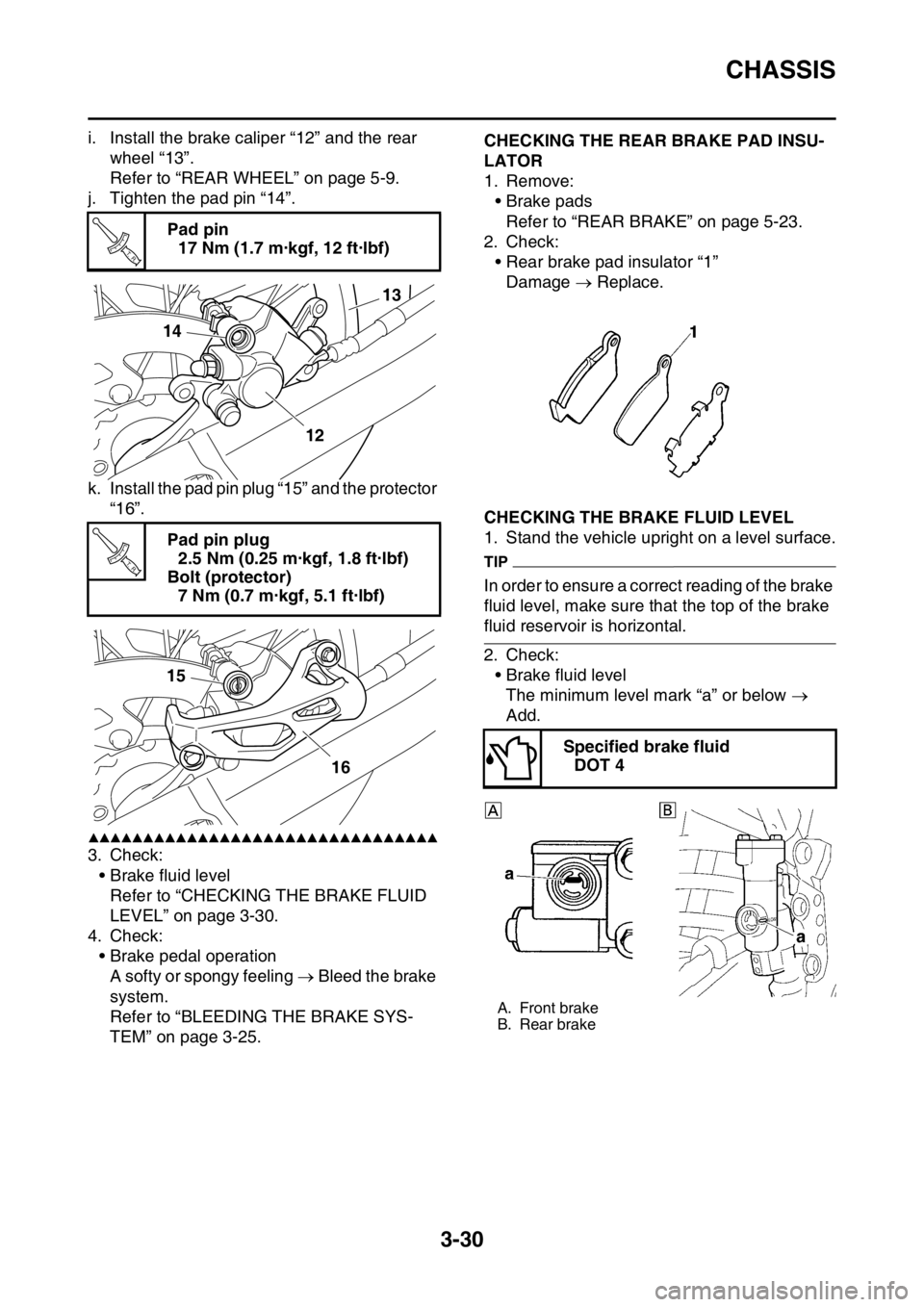
i. Install the brake caliper “12” and the rear
wheel “13”.
Refer to “REAR WHEEL” on page 5-9.
j. Tighten the pad pin “14”.
k. Install the pad pin plug “15” and the protector
“16”.
▲▲▲▲▲▲▲▲▲▲▲▲▲▲▲▲▲▲▲▲▲▲▲▲▲▲▲▲▲▲▲▲
3. Check:
• Brake fluid level
Refer to “CHECKING THE BRAKE FLUID
LEVEL” on page 3-30.
4. Check:
• Brake pedal operation
A softy or spongy feeling Bleed the brake
system.
Refer to “BLEEDING THE BRAKE SYS-
TEM” on page 3-25.
EAS2GBB108CHECKING THE REAR BRAKE PAD INSU-
LATOR
1. Remove:
• Brake pads
Refer to “REAR BRAKE” on page 5-23.
2. Check:
• Rear brake pad insulator “1”
Damage Replace.
EAS2GBB109CHECKING THE BRAKE FLUID LEVEL
1. Stand the vehicle upright on a level surface.
TIP
In order to ensure a correct reading of the brake
fluid level, make sure that the top of the brake
fluid reservoir is horizontal.
2. Check:
• Brake fluid level
The minimum level mark “a” or below
Add. Pad pin
17 Nm (1.7 m·kgf, 12 ft·lbf)
Pad pin plug
2.5 Nm (0.25 m·kgf, 1.8 ft·lbf)
Bolt (protector)
7 Nm (0.7 m·kgf, 5.1 ft·lbf)
T R..
13
14
12
T R..
15
16
Specified brake fluid
DOT 4
A. Front brake
B. Rear brake
Page 131 of 432
CHASSIS
3-31
EWA
WARNING
• Use only the designated brake fluid. Other
brake fluids may cause the rubber seals to
deteriorate, causing leakage and poor
brake performance.
• Refill with the same type of brake fluid that
is already in the system. Mixing brake flu-
ids may result in a harmful chemical reac-
tion, leading to poor brake performance.
• When refilling, be careful that water does
not enter the brake fluid reservoir. Water
will significantly lower the boiling point of
the brake fluid and could cause vapor
lock.
ECA
NOTICE
Brake fluid may damage painted surfaces
and plastic parts. Therefore, always clean
up any spilt brake fluid immediately.
EAS2GBB110ADJUSTING THE DRIVE CHAIN SLACKECA
NOTICE
A drive chain that is too tight will overload
the engine and other vital parts, and one
that is too loose can skip and damage the
swingarm or cause an accident. Therefore,
keep the drive chain slack within the speci-
fied limits.
1. Use a suitable stand to raise the rear wheel
off the ground.
EWA
WARNING
Securely support the vehicle so that there is
no danger of it falling over.
2. Shift the transmission into the neutral posi-
tion.
3. Pull the drive chain up above the drive chain
guide installation bolt with a force of about
50 N (5.0 kgf, 36 lbf).
4. Check:
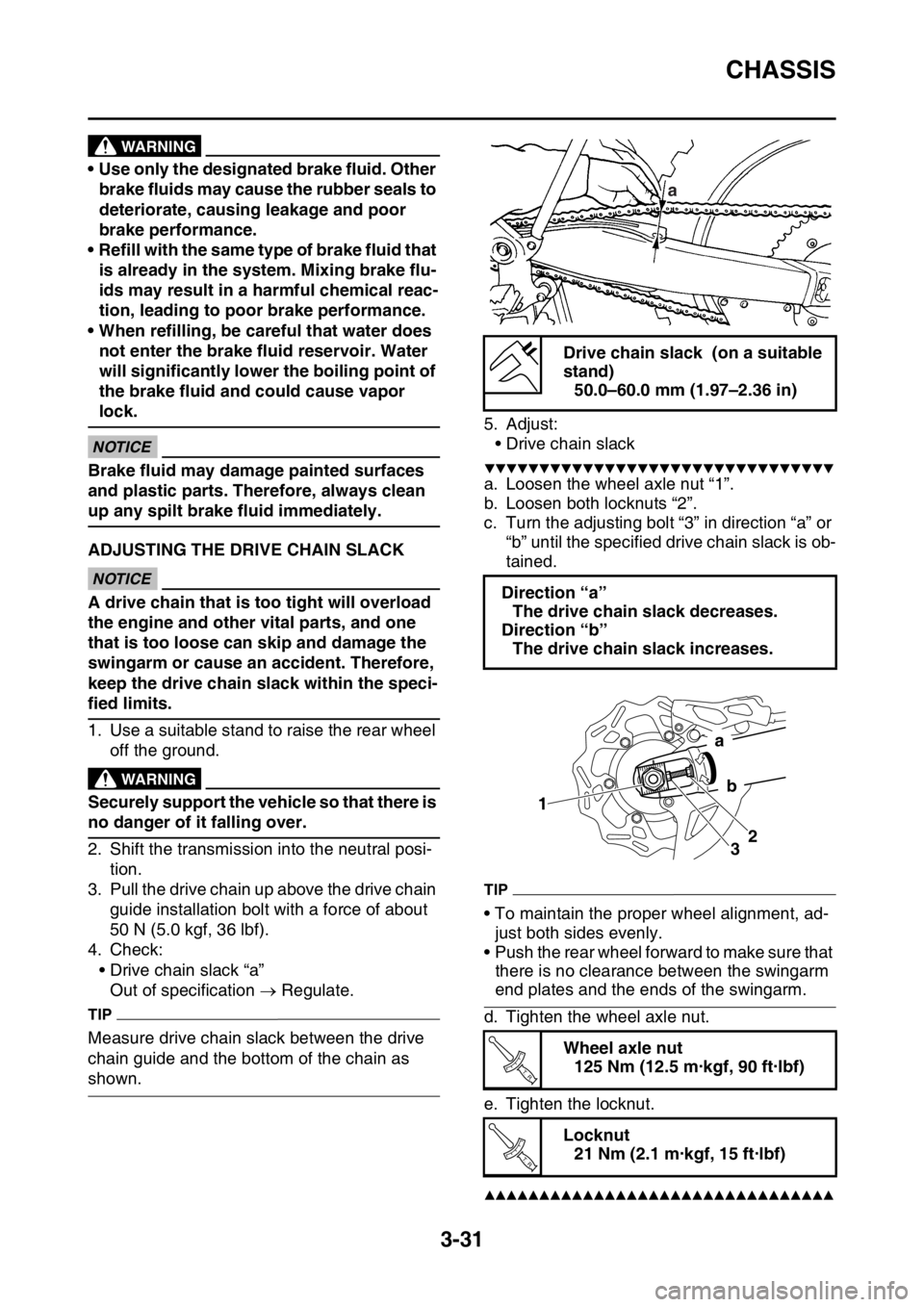
• Drive chain slack “a”
Out of specification Regulate.
TIP
Measure drive chain slack between the drive
chain guide and the bottom of the chain as
shown.5. Adjust:
• Drive chain slack
▼▼▼▼▼▼▼▼▼▼▼▼▼▼▼▼▼▼▼▼▼▼▼▼▼▼▼▼▼▼▼▼
a. Loosen the wheel axle nut “1”.
b. Loosen both locknuts “2”.
c. Turn the adjusting bolt “3” in direction “a” or
“b” until the specified drive chain slack is ob-
tained.
TIP
• To maintain the proper wheel alignment, ad-
just both sides evenly.
• Push the rear wheel forward to make sure that
there is no clearance between the swingarm
end plates and the ends of the swingarm.
d. Tighten the wheel axle nut.
e. Tighten the locknut.
▲▲▲▲▲▲▲▲▲▲▲▲▲▲▲▲▲▲▲▲▲▲▲▲▲▲▲▲▲▲▲▲
Drive chain slack (on a suitable
stand)
50.0–60.0 mm (1.97–2.36 in)
Direction “a”
The drive chain slack decreases.
Direction “b”
The drive chain slack increases.
Wheel axle nut
125 Nm (12.5 m·kgf, 90 ft·lbf)
Locknut
21 Nm (2.1 m·kgf, 15 ft·lbf)
a
1
32
a
b
T R..
T R..
Page 132 of 432
CHASSIS
3-32
EAS2GBB111CHECKING THE FRONT FORK LEGS
1. Stand the vehicle upright on a level surface.
EWA
WARNING
Securely support the vehicle so that there is
no danger of it falling over.
2. Check:
• Inner tube
Damage/scratches Replace.
• Front fork leg (s)
Oil leaks between inner tube and outer tube
Replace the oil seal.
3. Hold the vehicle upright and apply the front
brake.
4. Check:
• Front fork operation
Push down hard on the handlebar several
times and check if the front fork rebounds
smoothly.
Unsmooth operation Correct or replace.
Refer to “FRONT FORK” on page 5-40.
EAS2GBB112CHECKING THE FRONT FORK PROTEC-
TOR GUIDE
1. Check:
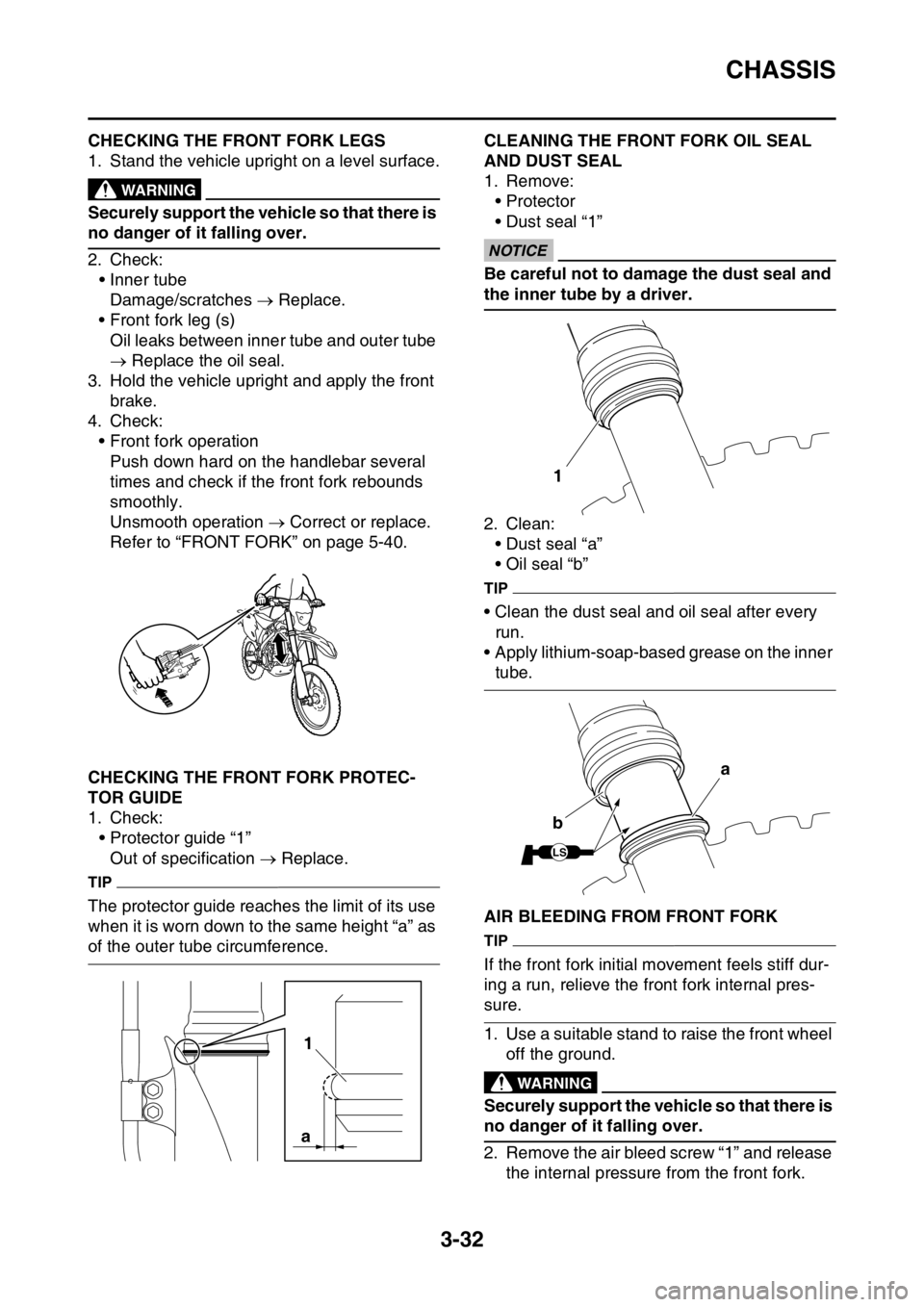
• Protector guide “1”
Out of specification Replace.
TIP
The protector guide reaches the limit of its use
when it is worn down to the same height “a” as
of the outer tube circumference.
EAS2GBB113CLEANING THE FRONT FORK OIL SEAL
AND DUST SEAL
1. Remove:
•Protector
• Dust seal “1”
ECA
NOTICE
Be careful not to damage the dust seal and
the inner tube by a driver.
2. Clean:
• Dust seal “a”
• Oil seal “b”
TIP
• Clean the dust seal and oil seal after every
run.
• Apply lithium-soap-based grease on the inner
tube.
EAS2GBB114AIR BLEEDING FROM FRONT FORK
TIP
If the front fork initial movement feels stiff dur-
ing a run, relieve the front fork internal pres-
sure.
1. Use a suitable stand to raise the front wheel
off the ground.
EWA
WARNING
Securely support the vehicle so that there is
no danger of it falling over.
2. Remove the air bleed screw “1” and release
the internal pressure from the front fork.
1
a
1
LS
a
b
Page 134 of 432
CHASSIS
3-34
EAS2GBB116CHECKING THE SWINGARM OPERATION
1. Check:
• Swingarm smooth action
• Swingarm free play
Refer to “SWINGARM” on page 5-65.
EAS2GBB117CHECKING THE REAR SUSPENSION
1. Stand the vehicle upright on a level surface.
EWA
WARNING
Securely support the vehicle so that there is
no danger of it falling over.
2. Check:
• Rear shock absorber assembly
Gas leaks/oil leaks Replace the rear
shock absorber assembly.
Refer to “REAR SHOCK ABSORBER AS-
SEMBLY” on page 5-58.
3. Check:
• Rear shock absorber assembly smooth ac-
tion
• Rear suspension link smooth action
Sit astride the seat and shake your body up
and down several times to check whether
the rear shock absorber assembly operates
smoothly.
Unsmooth operation Correct or replace.
Refer to “REAR SHOCK ABSORBER AS-
SEMBLY” on page 5-58.
EAS2GBB118ADJUSTING THE REAR SHOCK ABSORB-
ER ASSEMBLY
Use a suitable stand to raise the rear wheel off
the ground.
EWA
WARNING
Securely support the vehicle so that there is
no danger of it falling over.
Spring preload
ECA
NOTICE
Do not turn the adjuster forcibly beyond its
adjusting range.1. Remove:
• Rear frame
Refer to “REAR SHOCK ABSORBER AS-
SEMBLY” on page 5-58.
2. Adjust:
• Spring preload
▼▼▼▼▼▼▼▼▼▼▼▼▼▼▼▼▼▼▼▼▼▼▼▼▼▼▼▼▼▼▼▼
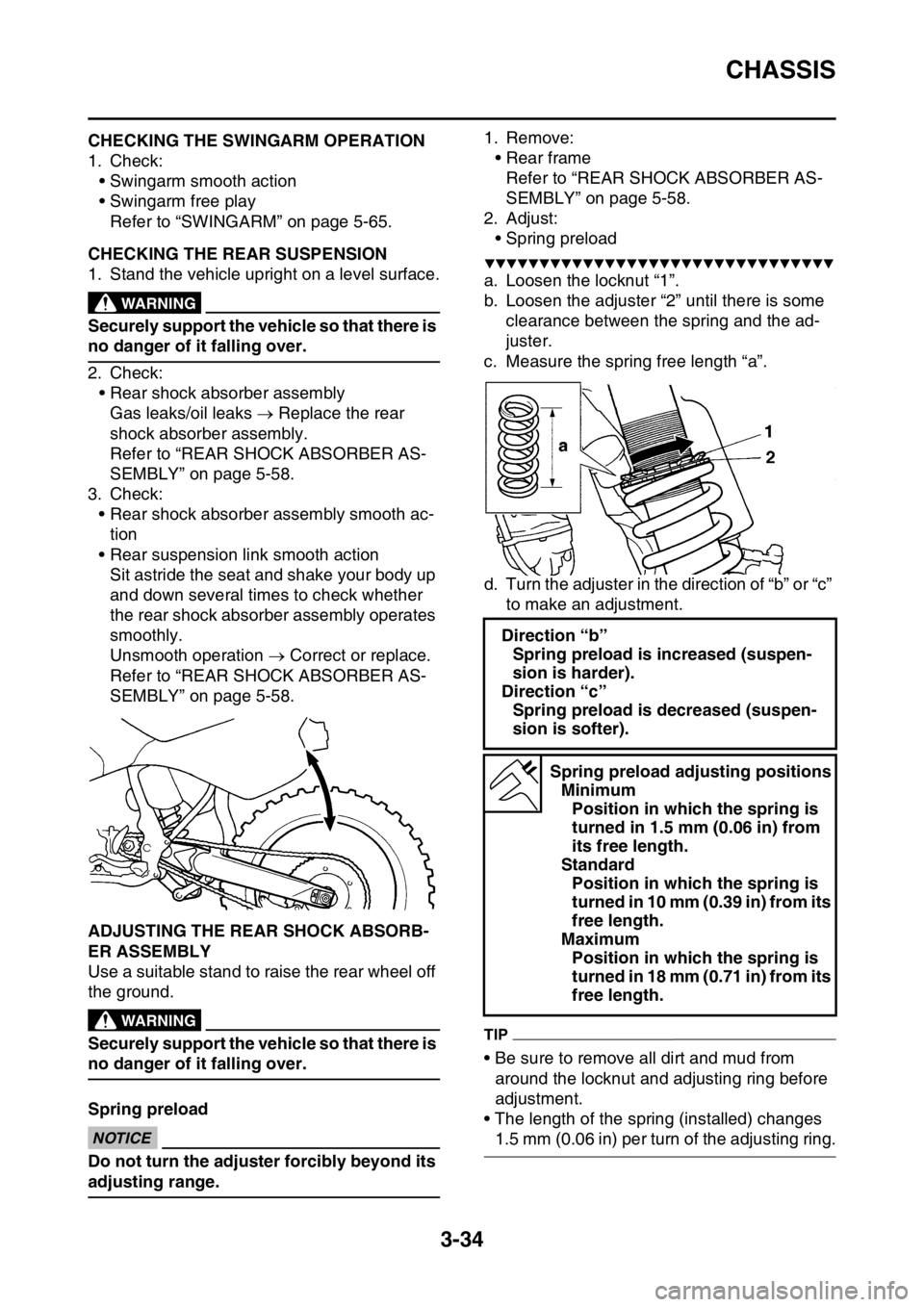
a. Loosen the locknut “1”.
b. Loosen the adjuster “2” until there is some
clearance between the spring and the ad-
juster.
c. Measure the spring free length “a”.
d. Turn the adjuster in the direction of “b” or “c”
to make an adjustment.
TIP
• Be sure to remove all dirt and mud from
around the locknut and adjusting ring before
adjustment.
• The length of the spring (installed) changes
1.5 mm (0.06 in) per turn of the adjusting ring.
Direction “b”
Spring preload is increased (suspen-
sion is harder).
Direction “c”
Spring preload is decreased (suspen-
sion is softer).
Spring preload adjusting positions
Minimum
Position in which the spring is
turned in 1.5 mm (0.06 in) from
its free length.
Standard
Position in which the spring is
turned in 10 mm (0.39 in) from its
free length.
Maximum
Position in which the spring is
turned in 18 mm (0.71 in) from its
free length.
Page 137 of 432
CHASSIS
3-37
TIP
• Do not give a half turn (180 °) or more for one
tightening.
• Make sure that tightening after a break-in is
done until the initial looseness in nipples dis-
appears.
• Make sure that tightening is done in stages,
not at a time.
EAS2GBB121CHECKING THE WHEELS
1. Check:
• Wheel(s)
Damage/out-of-round Replace.
EWA
WARNING
Never attempt to make any repairs to the
wheel.
TIP
After replacing a tire or a wheel, always bal-
ance the wheel.
EAS2GBB122CHECKING THE WHEEL BEARINGS
1. Check:
• Wheel bearings
Refer to “CHECKING THE FRONT WHEEL”
on page 5-5 and “CHECKING THE REAR
WHEEL” on page 5-10.
EAS2GBB123CHECKING AND ADJUSTING THE STEER-
ING HEAD
1. Use a suitable stand to raise the front wheel
off the ground.
EWA
WARNING
Securely support the vehicle so that there is
no danger of it falling over.
2. Check:
• Steering head
Grasp the bottom of the front fork legs and
gently rock the front fork.
Blinding/looseness Adjust the steering
head.
3. Remove:
• Handlebar
Refer to “HANDLEBAR” on page 5-33.
• Upper bracket
Refer to “STEERING HEAD” on page 5-53.
4. Adjust:
• Steering head
▼▼▼▼▼▼▼▼▼▼▼▼▼▼▼▼▼▼▼▼▼▼▼▼▼▼▼▼▼▼▼▼
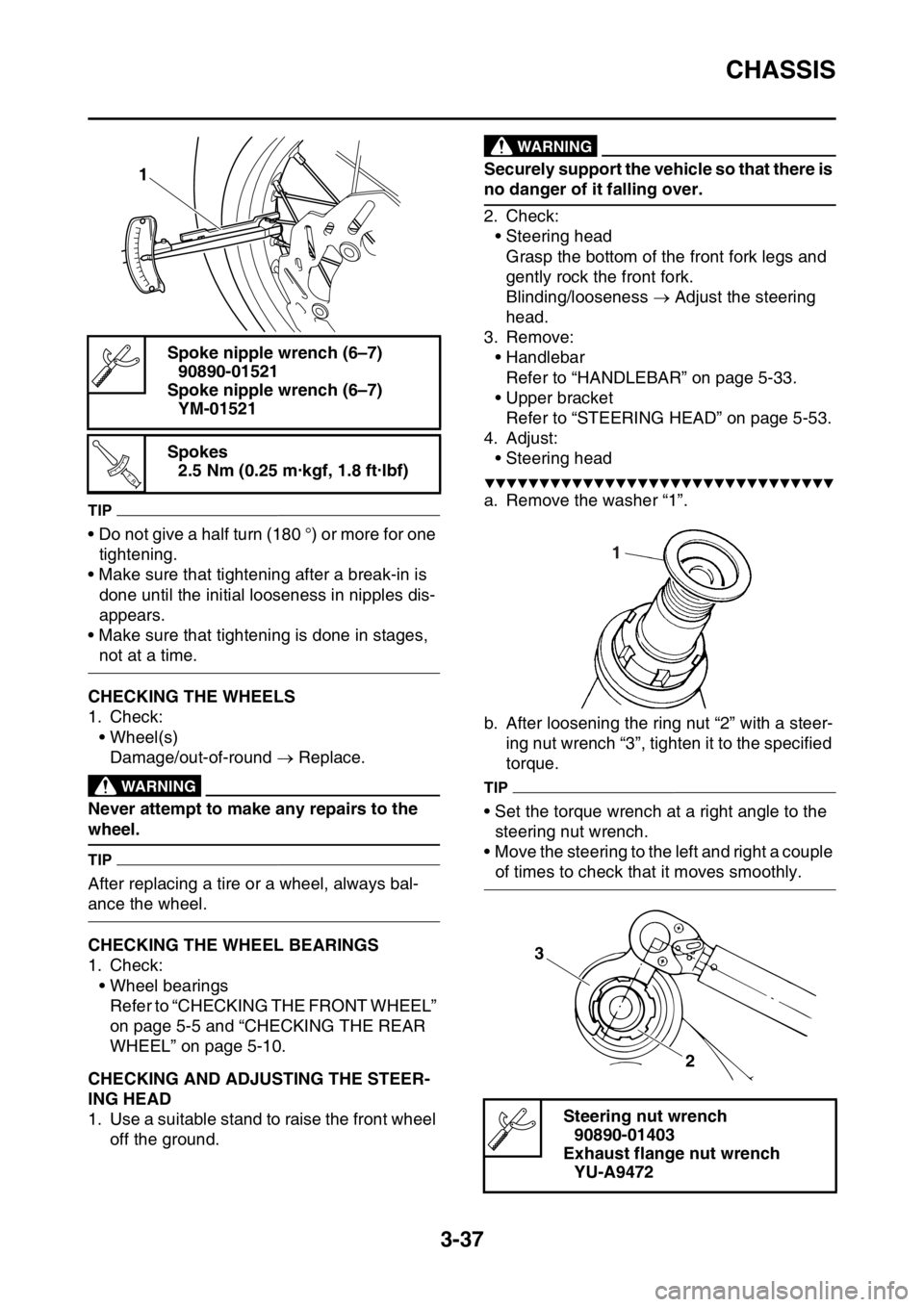
a. Remove the washer “1”.
b. After loosening the ring nut “2” with a steer-
ing nut wrench “3”, tighten it to the specified
torque.
TIP
• Set the torque wrench at a right angle to the
steering nut wrench.
• Move the steering to the left and right a couple
of times to check that it moves smoothly. Spoke nipple wrench (6–7)
90890-01521
Spoke nipple wrench (6–7)
YM-01521
Spokes
2.5 Nm (0.25 m·kgf, 1.8 ft·lbf)
1
T R..
Steering nut wrench
90890-01403
Exhaust flange nut wrench
YU-A9472
1
3
2
Page 143 of 432

4
TUNING
CHASSIS.......................................................................................................... 4-1
SELECTION OF THE SECONDARY REDUCTION RATIO
(SPROCKET) ............................................................................................ 4-1
DRIVE AND REAR WHEEL SPROCKETS SETTING PARTS .................. 4-1
TIRE PRESSURE....................................................................................... 4-1
FRONT FORK SETTING............................................................................ 4-2
CHANGE IN AMOUNT AND CHARACTERISTICS OF FORK OIL............ 4-2
SETTING OF SPRING AFTER REPLACEMENT ...................................... 4-2
FRONT FORK SETTING PARTS............................................................... 4-3
REAR SUSPENSION SETTING ................................................................ 4-3
CHOOSING SET LENGTH ........................................................................ 4-3
SETTING OF SPRING AFTER REPLACEMENT ...................................... 4-4
REAR SHOCK ABSORBER SETTING PARTS ......................................... 4-4
SUSPENSION SETTING (FRONT FORK)................................................. 4-6
SUSPENSION SETTING (REAR SHOCK ABSORBER) ........................... 4-7
Page 144 of 432
CHASSIS
4-1
EAS2GBB136
CHASSIS
EAS2GBB137SELECTION OF THE SECONDARY REDUC-
TION RATIO (SPROCKET)
• It is generally said that the secondary gear ra-
tio should be reduced for a longer straight por-
tion of a speed course and should be
increased for a course with many corners. Ac-
tually, however, as the speed depends on the
ground condition of the day of the race, be
sure to run through the circuit to set the ma-
chine suitable for the entire course.
• In actuality, it is very difficult to achieve set-
tings suitable for the entire course and some
settings may be sacrificed. Thus, the settings
should be matched to the portion of the
course that has the greatest effect on the race
result. In such a case, run through the entire
course while making notes of lap times to find
the best balance; then, determine the second-
ary reduction ratio.
• If a course has a long straight portion where a
machine can run at maximum speed, the ma-
chine is generally set such that it can develop
its maximum revolutions toward the end of the
straight line, with care taken to avoid the en-
gine over-revving.
TIP
Riding technique varies from rider to rider and
the performance of a machine also vary from
machine to machine. Therefore, do not imitate
other rider’s settings from the beginning but
choose your own setting according to the level
of your riding technique.
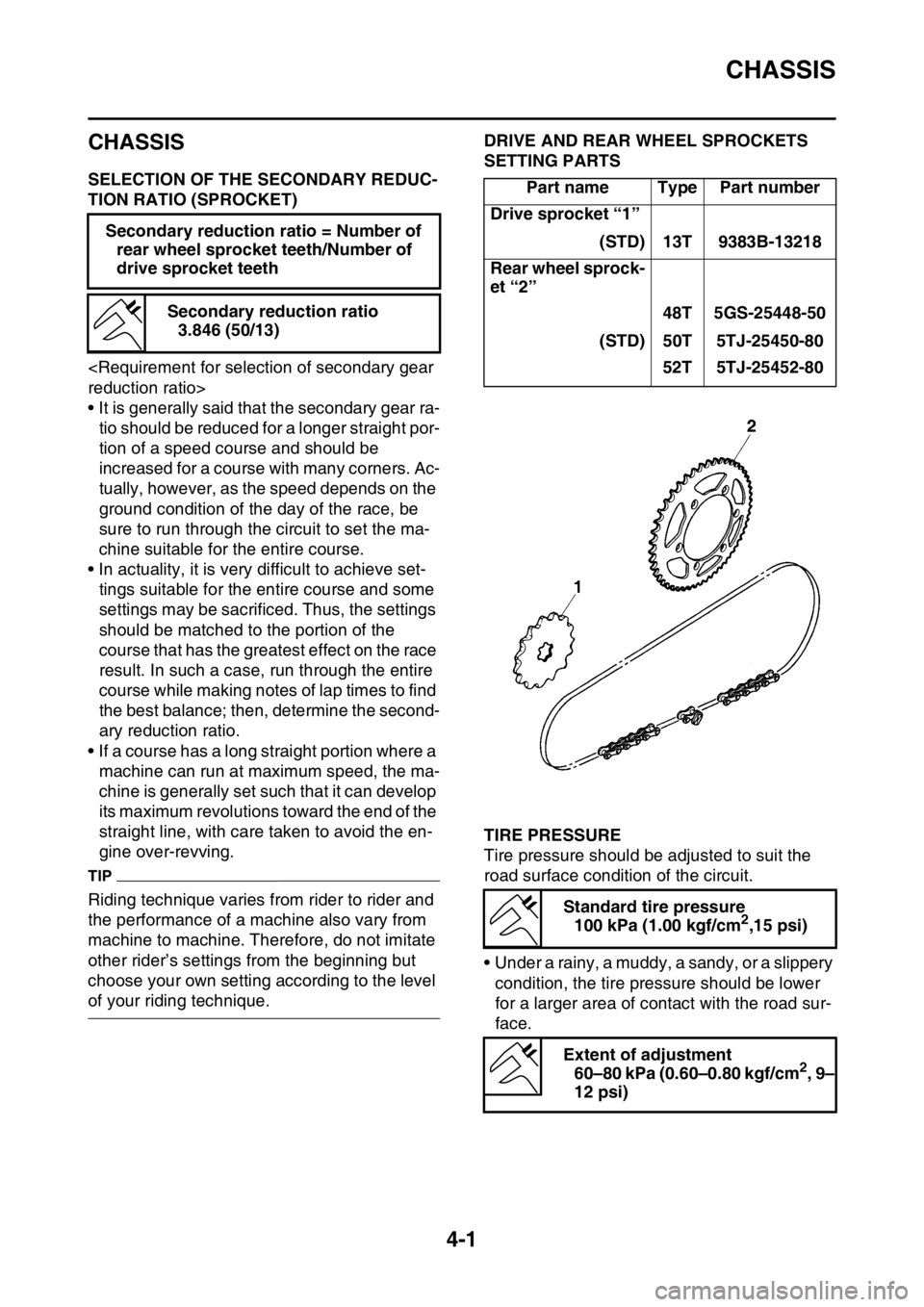
EAS2GBB138DRIVE AND REAR WHEEL SPROCKETS
SETTING PARTS
EAS2GBB139TIRE PRESSURE
Tire pressure should be adjusted to suit the
road surface condition of the circuit.
• Under a rainy, a muddy, a sandy, or a slippery
condition, the tire pressure should be lower
for a larger area of contact with the road sur-
face. Secondary reduction ratio = Number of
rear wheel sprocket teeth/Number of
drive sprocket teeth
Secondary reduction ratio
3.846 (50/13)
Part name Type Part number
Drive sprocket “1”
(STD) 13T 9383B-13218
Rear wheel sprock-
et “2”
48T 5GS-25448-50
(STD) 50T 5TJ-25450-80
52T 5TJ-25452-80
Standard tire pressure
100 kPa (1.00 kgf/cm
2,15 psi)
Extent of adjustment
60–80 kPa (0.60–0.80 kgf/cm
2, 9–
12 psi)
Page 146 of 432
CHASSIS
4-3
TIP
Generally a stiff spring gives a stiff riding feel-
ing. Rebound damping tends to become weak-
er, resulting in lack of a sense of contact with
the road surface or in a vibrating handlebar.
EAS2GBB143FRONT FORK SETTING PARTS
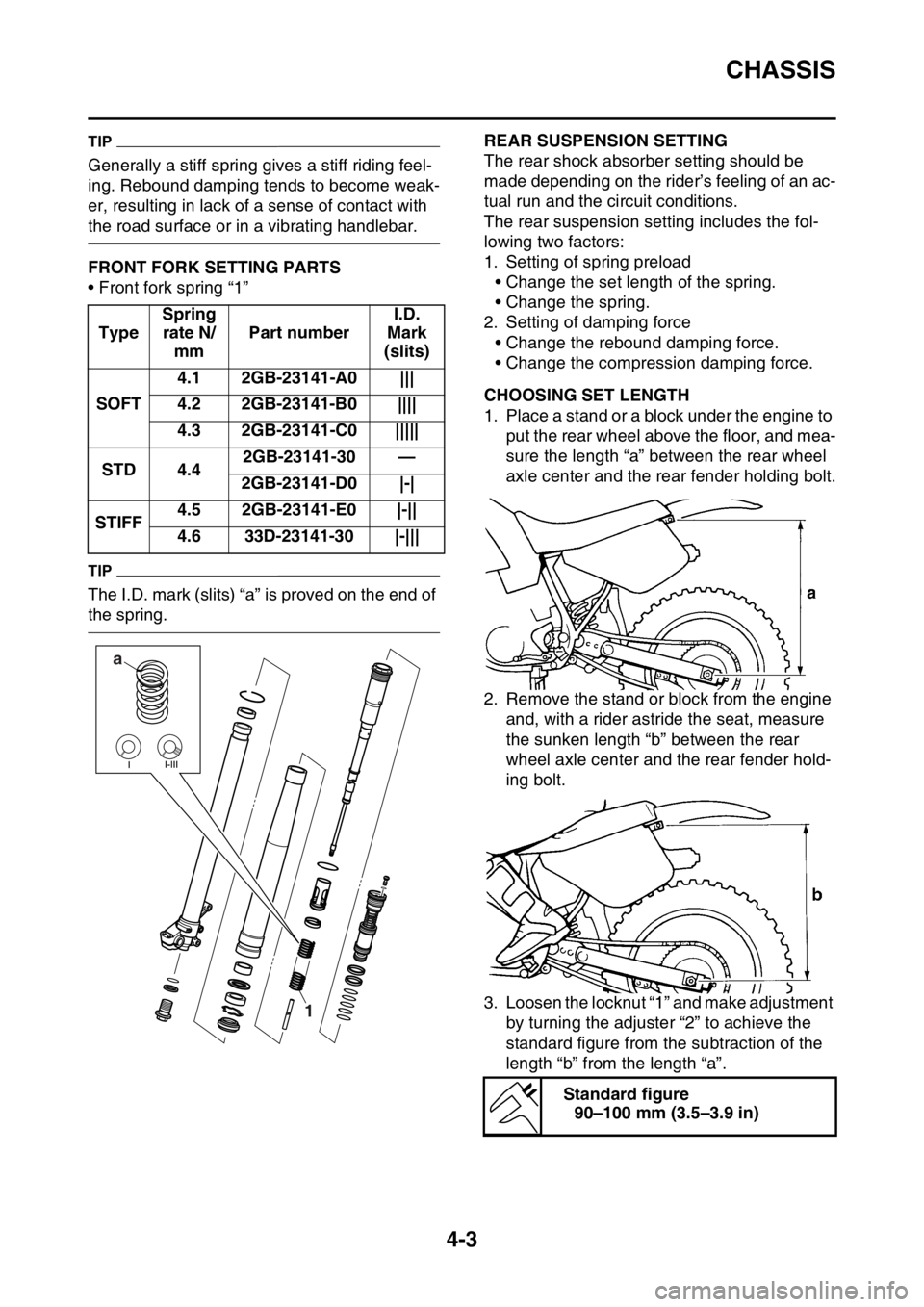
• Front fork spring “1”
TIP
The I.D. mark (slits) “a” is proved on the end of
the spring.
EAS2GBB144REAR SUSPENSION SETTING
The rear shock absorber setting should be
made depending on the rider’s feeling of an ac-
tual run and the circuit conditions.
The rear suspension setting includes the fol-
lowing two factors:
1. Setting of spring preload
• Change the set length of the spring.
• Change the spring.
2. Setting of damping force
• Change the rebound damping force.
• Change the compression damping force.
EAS2GBB145CHOOSING SET LENGTH
1. Place a stand or a block under the engine to
put the rear wheel above the floor, and mea-
sure the length “a” between the rear wheel
axle center and the rear fender holding bolt.
2. Remove the stand or block from the engine
and, with a rider astride the seat, measure
the sunken length “b” between the rear
wheel axle center and the rear fender hold-
ing bolt.
3. Loosen the locknut “1” and make adjustment
by turning the adjuster “2” to achieve the
standard figure from the subtraction of the
length “b” from the length “a”. TypeSpring
rate N/
mmPart numberI.D.
Mark
(slits)
SOFT4.1 2GB-23141-A0 |||
4.2 2GB-23141-B0 ||||
4.3 2GB-23141-C0 |||||
STD 4.42GB-23141-30 —
2GB-23141-D0 |-|
STIFF4.5 2GB-23141-E0 |-||
4.6 33D-23141-30 |-|||
a
1
Standard figure
90–100 mm (3.5–3.9 in)
Page 153 of 432

5
CHASSIS
GENERAL CHASSIS........................................................................................ 5-1
REMOVING THE LEFT SIDE COVER ....................................................... 5-3
REMOVING THE SEAT ............................................................................. 5-3
FRONT WHEEL................................................................................................ 5-4
REMOVING THE FRONT WHEEL............................................................. 5-5
CHECKING THE FRONT WHEEL ............................................................. 5-5
DISASSEMBLING THE FRONT WHEEL ................................................... 5-6
ASSEMBLING THE FRONT WHEEL ......................................................... 5-6
INSTALLING THE FRONT WHEEL ........................................................... 5-7
REAR WHEEL.................................................................................................. 5-9
REMOVING THE REAR WHEEL ............................................................. 5-10
CHECKING THE REAR WHEEL.............................................................. 5-10
DISASSEMBLING THE REAR WHEEL ................................................... 5-10
CHECKING AND REPLACING THE REAR WHEEL SPROCKET .......... 5-10
ASSEMBLING THE REAR WHEEL ......................................................... 5-11
INSTALLING THE REAR WHEEL............................................................ 5-11
FRONT BRAKE.............................................................................................. 5-13
INTRODUCTION ...................................................................................... 5-17
CHECKING THE FRONT BRAKE DISC .................................................. 5-17
REMOVING THE FRONT BRAKE CALIPER ........................................... 5-17
DISASSEMBLING THE FRONT BRAKE CALIPER................................. 5-17
CHECKING THE FRONT BRAKE CALIPER ........................................... 5-18
ASSEMBLING THE FRONT BRAKE CALIPER ....................................... 5-18
INSTALLING THE BRAKE CALIPER PISTON ........................................ 5-18
INSTALLING THE FRONT BRAKE CALIPER ......................................... 5-19
REMOVING THE FRONT BRAKE MASTER CYLINDER ........................ 5-20
CHECKING THE FRONT BRAKE MASTER CYLINDER......................... 5-20
ASSEMBLING THE FRONT BRAKE MASTER CYLINDER .................... 5-20
INSTALLING THE FRONT BRAKE MASTER CYLINDER....................... 5-21
REAR BRAKE................................................................................................ 5-23
INTRODUCTION ...................................................................................... 5-27
CHECKING THE REAR BRAKE DISC..................................................... 5-27
REMOVING THE REAR BRAKE CALIPER ............................................. 5-28
DISASSEMBLING THE REAR BRAKE CALIPER ................................... 5-28
CHECKING THE REAR BRAKE CALIPER .............................................. 5-28
ASSEMBLING THE REAR BRAKE CALIPER ......................................... 5-28
INSTALLING THE BRAKE CALIPER PISTON ........................................ 5-29
INSTALLING THE REAR BRAKE CALIPER ............................................ 5-29
REMOVING THE REAR BRAKE MASTER CYLINDER .......................... 5-30
CHECKING THE REAR BRAKE MASTER CYLINDER ........................... 5-30
ASSEMBLING THE REAR BRAKE MASTER CYLINDER....................... 5-31
INSTALLING THE REAR BRAKE MASTER CYLINDER ......................... 5-31
Page 154 of 432

HANDLEBAR................................................................................................. 5-33
REMOVING THE HANDLEBAR............................................................... 5-35
CHECKING THE HANDLEBAR ............................................................... 5-35
INSTALLING THE HANDLEBAR ............................................................. 5-35
FRONT FORK................................................................................................. 5-40
REMOVING THE FRONT FORK LEGS ................................................... 5-42
DISASSEMBLING THE FRONT FORK LEGS ......................................... 5-42
CHECKING THE FRONT FORK LEGS ................................................... 5-43
ASSEMBLING THE FRONT FORK LEGS ............................................... 5-44
INSTALLING THE FRONT FORK LEGS ................................................. 5-50
STEERING HEAD........................................................................................... 5-53
REMOVING THE LOWER BRACKET...................................................... 5-55
CHECKING THE STEERING HEAD ........................................................ 5-55
INSTALLING THE STEERING HEAD ...................................................... 5-55
REAR SHOCK ABSORBER ASSEMBLY..................................................... 5-58
HANDLING THE REAR SHOCK ABSORBER ......................................... 5-61
DISPOSING OF A REAR SHOCK ABSORBER ...................................... 5-61
REMOVING THE REAR SHOCK ABSORBER ASSEMBLY.................... 5-61
REMOVING THE BEARING..................................................................... 5-61
CHECKING THE REAR SHOCK ABSORBER ASSEMBLY .................... 5-62
CHECKING THE CONNECTING ARM AND RELAY ARM ...................... 5-62
INSTALLING THE RELAY ARM............................................................... 5-62
INSTALLING THE REAR SHOCK ABSORBER ASSEMBLY .................. 5-63
SWINGARM.................................................................................................... 5-65
REMOVING THE SWINGARM................................................................. 5-66
REMOVING THE BEARING..................................................................... 5-66
CHECKING THE SWINGARM ................................................................. 5-66
INSTALLING THE SWINGARM ............................................................... 5-67
CHAIN DRIVE................................................................................................. 5-68
REMOVING THE DRIVE CHAIN.............................................................. 5-69
CHECKING THE DRIVE CHAIN .............................................................. 5-69
CHECKING THE DRIVE SPROCKET...................................................... 5-70
CHECKING THE REAR WHEEL SPROCKET ......................................... 5-70
INSTALLING THE DRIVE CHAIN ............................................................ 5-70