brake YAMAHA WR 250F 2017 Owner's Guide
[x] Cancel search | Manufacturer: YAMAHA, Model Year: 2017, Model line: WR 250F, Model: YAMAHA WR 250F 2017Pages: 432, PDF Size: 14.14 MB
Page 130 of 432
CHASSIS
3-30
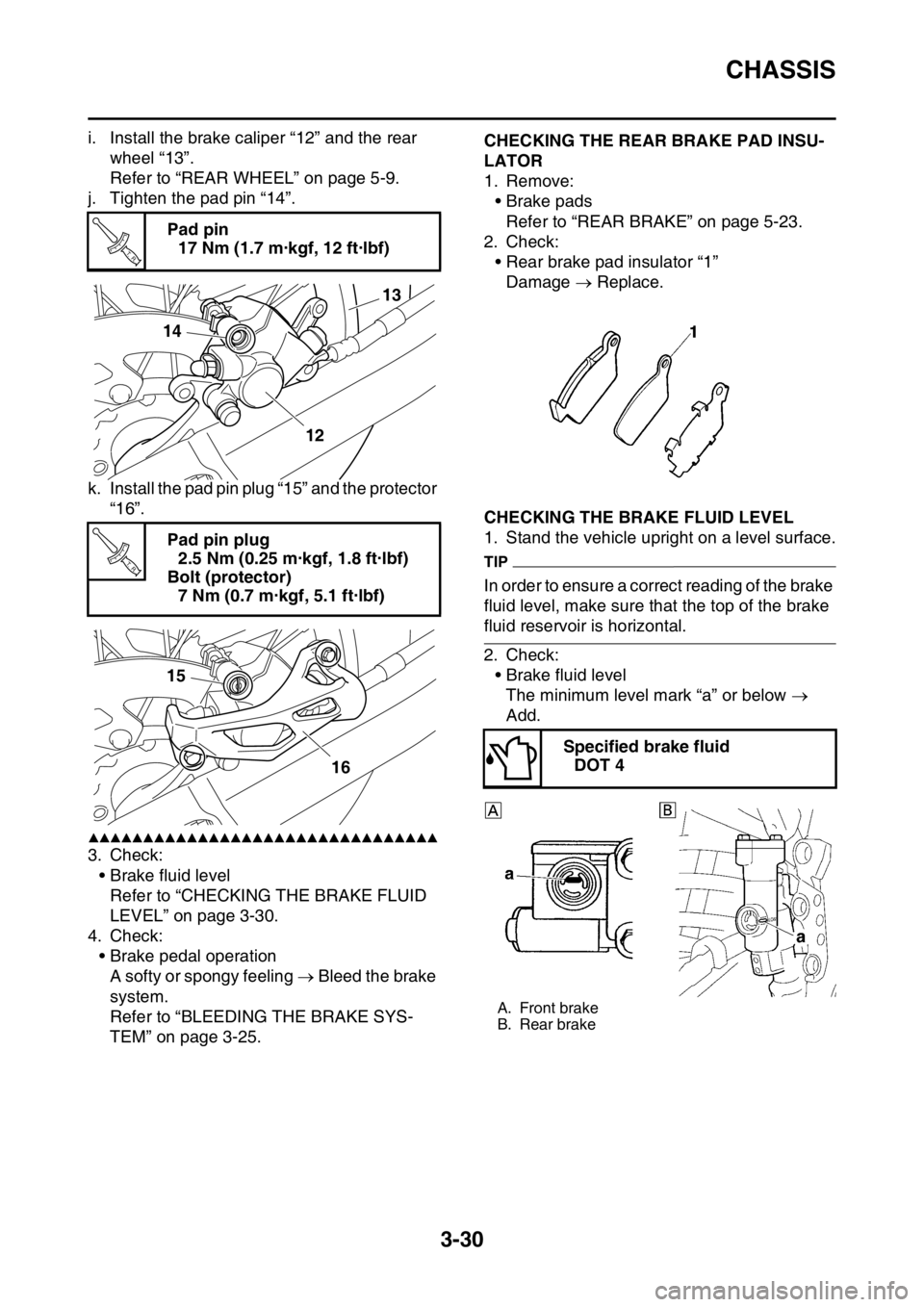
i. Install the brake caliper “12” and the rear
wheel “13”.
Refer to “REAR WHEEL” on page 5-9.
j. Tighten the pad pin “14”.
k. Install the pad pin plug “15” and the protector
“16”.
▲▲▲▲▲▲▲▲▲▲▲▲▲▲▲▲▲▲▲▲▲▲▲▲▲▲▲▲▲▲▲▲
3. Check:
• Brake fluid level
Refer to “CHECKING THE BRAKE FLUID
LEVEL” on page 3-30.
4. Check:
• Brake pedal operation
A softy or spongy feeling Bleed the brake
system.
Refer to “BLEEDING THE BRAKE SYS-
TEM” on page 3-25.
EAS2GBB108CHECKING THE REAR BRAKE PAD INSU-
LATOR
1. Remove:
• Brake pads
Refer to “REAR BRAKE” on page 5-23.
2. Check:
• Rear brake pad insulator “1”
Damage Replace.
EAS2GBB109CHECKING THE BRAKE FLUID LEVEL
1. Stand the vehicle upright on a level surface.
TIP
In order to ensure a correct reading of the brake
fluid level, make sure that the top of the brake
fluid reservoir is horizontal.
2. Check:
• Brake fluid level
The minimum level mark “a” or below
Add. Pad pin
17 Nm (1.7 m·kgf, 12 ft·lbf)
Pad pin plug
2.5 Nm (0.25 m·kgf, 1.8 ft·lbf)
Bolt (protector)
7 Nm (0.7 m·kgf, 5.1 ft·lbf)
T R..
13
14
12
T R..
15
16
Specified brake fluid
DOT 4
A. Front brake
B. Rear brake
Page 131 of 432
CHASSIS
3-31
EWA
WARNING
• Use only the designated brake fluid. Other
brake fluids may cause the rubber seals to
deteriorate, causing leakage and poor
brake performance.
• Refill with the same type of brake fluid that
is already in the system. Mixing brake flu-
ids may result in a harmful chemical reac-
tion, leading to poor brake performance.
• When refilling, be careful that water does
not enter the brake fluid reservoir. Water
will significantly lower the boiling point of
the brake fluid and could cause vapor
lock.
ECA
NOTICE
Brake fluid may damage painted surfaces
and plastic parts. Therefore, always clean
up any spilt brake fluid immediately.
EAS2GBB110ADJUSTING THE DRIVE CHAIN SLACKECA
NOTICE
A drive chain that is too tight will overload
the engine and other vital parts, and one
that is too loose can skip and damage the
swingarm or cause an accident. Therefore,
keep the drive chain slack within the speci-
fied limits.
1. Use a suitable stand to raise the rear wheel
off the ground.
EWA
WARNING
Securely support the vehicle so that there is
no danger of it falling over.
2. Shift the transmission into the neutral posi-
tion.
3. Pull the drive chain up above the drive chain
guide installation bolt with a force of about
50 N (5.0 kgf, 36 lbf).
4. Check:
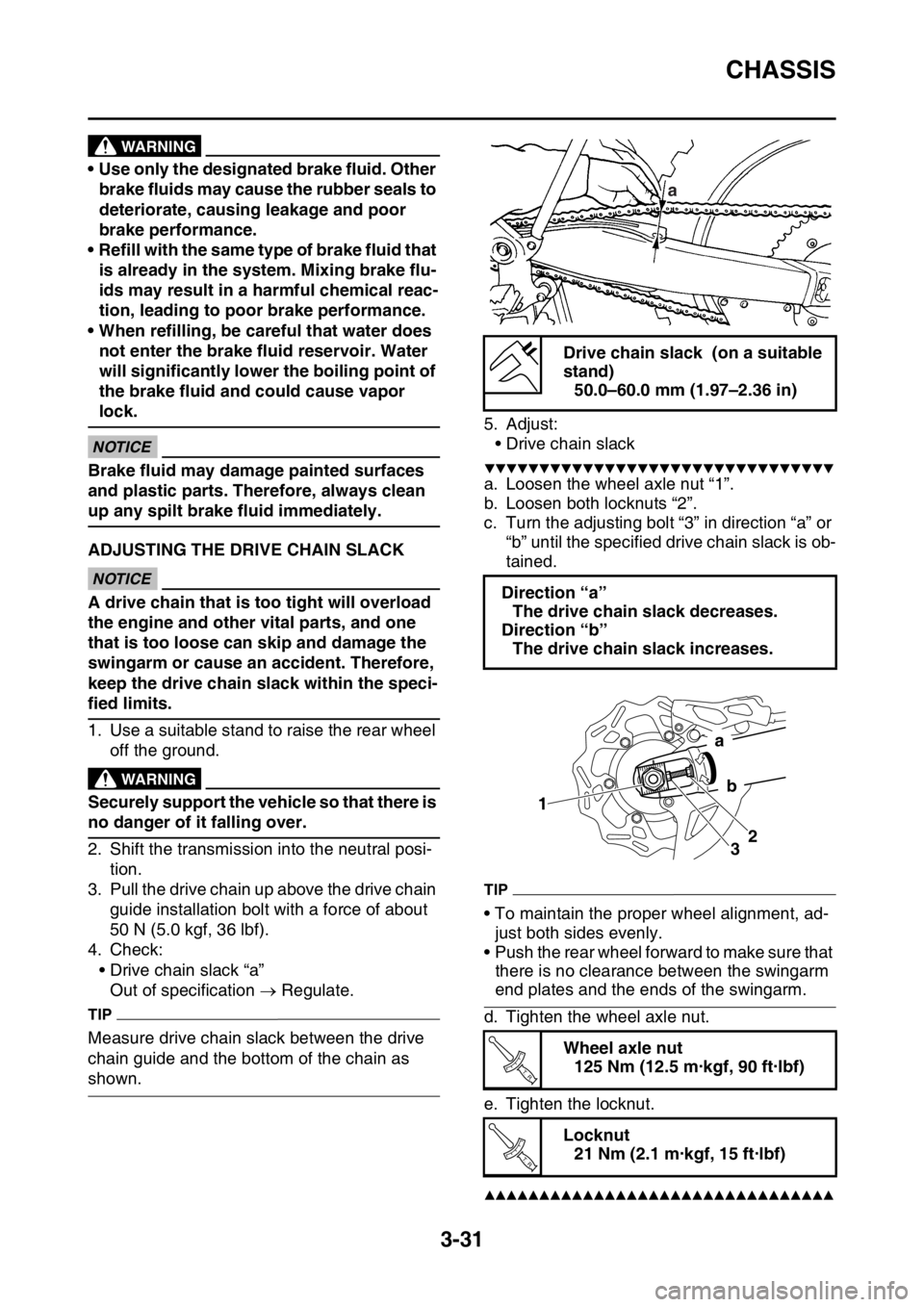
• Drive chain slack “a”
Out of specification Regulate.
TIP
Measure drive chain slack between the drive
chain guide and the bottom of the chain as
shown.5. Adjust:
• Drive chain slack
▼▼▼▼▼▼▼▼▼▼▼▼▼▼▼▼▼▼▼▼▼▼▼▼▼▼▼▼▼▼▼▼
a. Loosen the wheel axle nut “1”.
b. Loosen both locknuts “2”.
c. Turn the adjusting bolt “3” in direction “a” or
“b” until the specified drive chain slack is ob-
tained.
TIP
• To maintain the proper wheel alignment, ad-
just both sides evenly.
• Push the rear wheel forward to make sure that
there is no clearance between the swingarm
end plates and the ends of the swingarm.
d. Tighten the wheel axle nut.
e. Tighten the locknut.
▲▲▲▲▲▲▲▲▲▲▲▲▲▲▲▲▲▲▲▲▲▲▲▲▲▲▲▲▲▲▲▲
Drive chain slack (on a suitable
stand)
50.0–60.0 mm (1.97–2.36 in)
Direction “a”
The drive chain slack decreases.
Direction “b”
The drive chain slack increases.
Wheel axle nut
125 Nm (12.5 m·kgf, 90 ft·lbf)
Locknut
21 Nm (2.1 m·kgf, 15 ft·lbf)
a
1
32
a
b
T R..
T R..
Page 132 of 432
CHASSIS
3-32
EAS2GBB111CHECKING THE FRONT FORK LEGS
1. Stand the vehicle upright on a level surface.
EWA
WARNING
Securely support the vehicle so that there is
no danger of it falling over.
2. Check:
• Inner tube
Damage/scratches Replace.
• Front fork leg (s)
Oil leaks between inner tube and outer tube
Replace the oil seal.
3. Hold the vehicle upright and apply the front
brake.
4. Check:
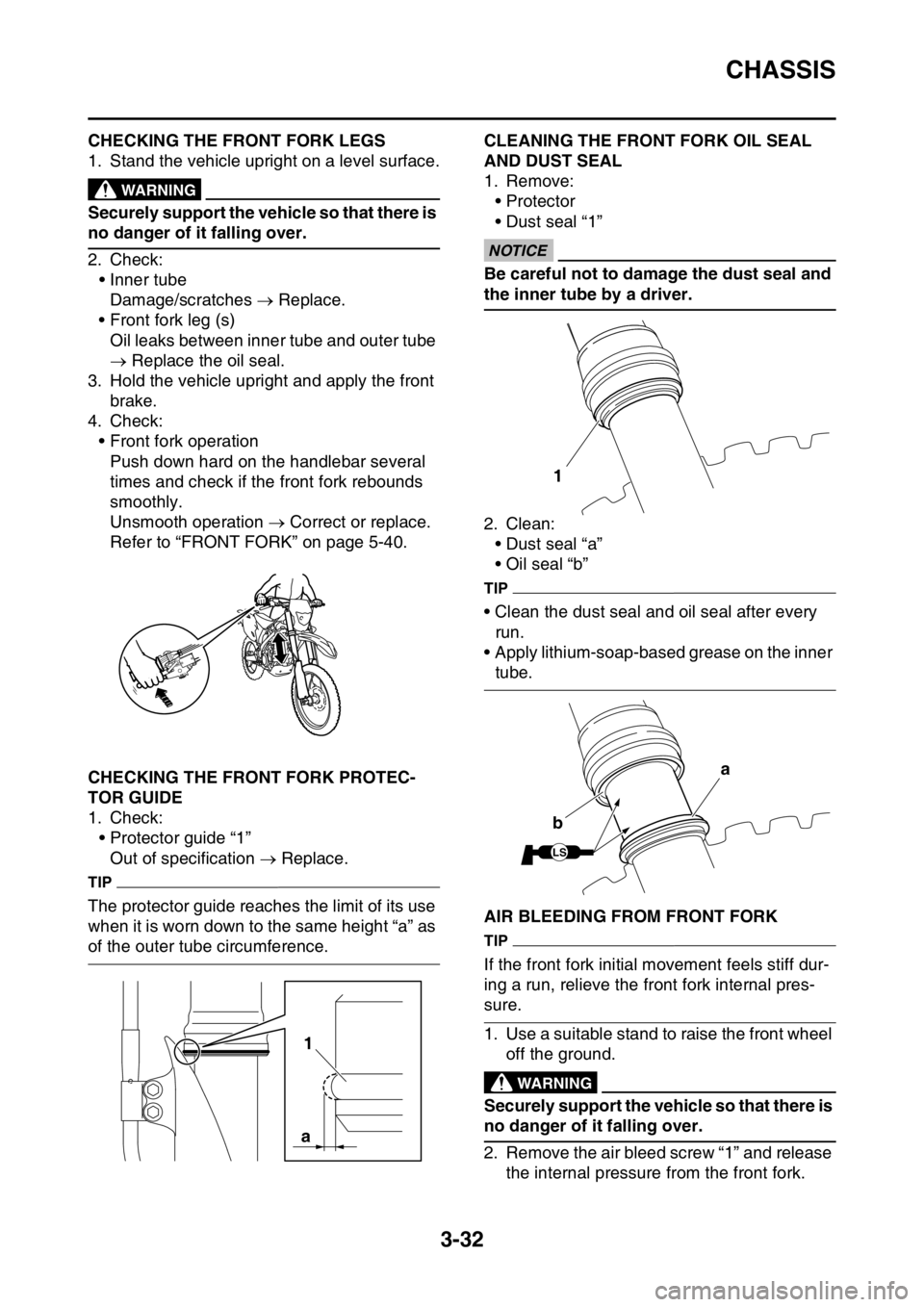
• Front fork operation
Push down hard on the handlebar several
times and check if the front fork rebounds
smoothly.
Unsmooth operation Correct or replace.
Refer to “FRONT FORK” on page 5-40.
EAS2GBB112CHECKING THE FRONT FORK PROTEC-
TOR GUIDE
1. Check:
• Protector guide “1”
Out of specification Replace.
TIP
The protector guide reaches the limit of its use
when it is worn down to the same height “a” as
of the outer tube circumference.
EAS2GBB113CLEANING THE FRONT FORK OIL SEAL
AND DUST SEAL
1. Remove:
•Protector
• Dust seal “1”
ECA
NOTICE
Be careful not to damage the dust seal and
the inner tube by a driver.
2. Clean:
• Dust seal “a”
• Oil seal “b”
TIP
• Clean the dust seal and oil seal after every
run.
• Apply lithium-soap-based grease on the inner
tube.
EAS2GBB114AIR BLEEDING FROM FRONT FORK
TIP
If the front fork initial movement feels stiff dur-
ing a run, relieve the front fork internal pres-
sure.
1. Use a suitable stand to raise the front wheel
off the ground.
EWA
WARNING
Securely support the vehicle so that there is
no danger of it falling over.
2. Remove the air bleed screw “1” and release
the internal pressure from the front fork.
1
a
1
LS
a
b
Page 138 of 432
CHASSIS
3-38
c. Turn the front fork to the right and left a few
times, and make sure that the steering ro-
tates smoothly. If it does not turn smoothly,
remove the lower bracket and check the up-
per and lower bearings.
Refer to “STEERING HEAD” on page 5-53.
d. Loosen the ring nut fully turn and then tight-
en it to specification with a steering nut
wrench.
EWA
WARNING
Do not overtighten the lower ring nut.
e. Check the steering head for looseness or
binding by turning the front fork all the way in
both directions. If any binding is felt, remove
the lower bracket and check the upper and
lower bearings.
Refer to “STEERING HEAD” on page 5-53.
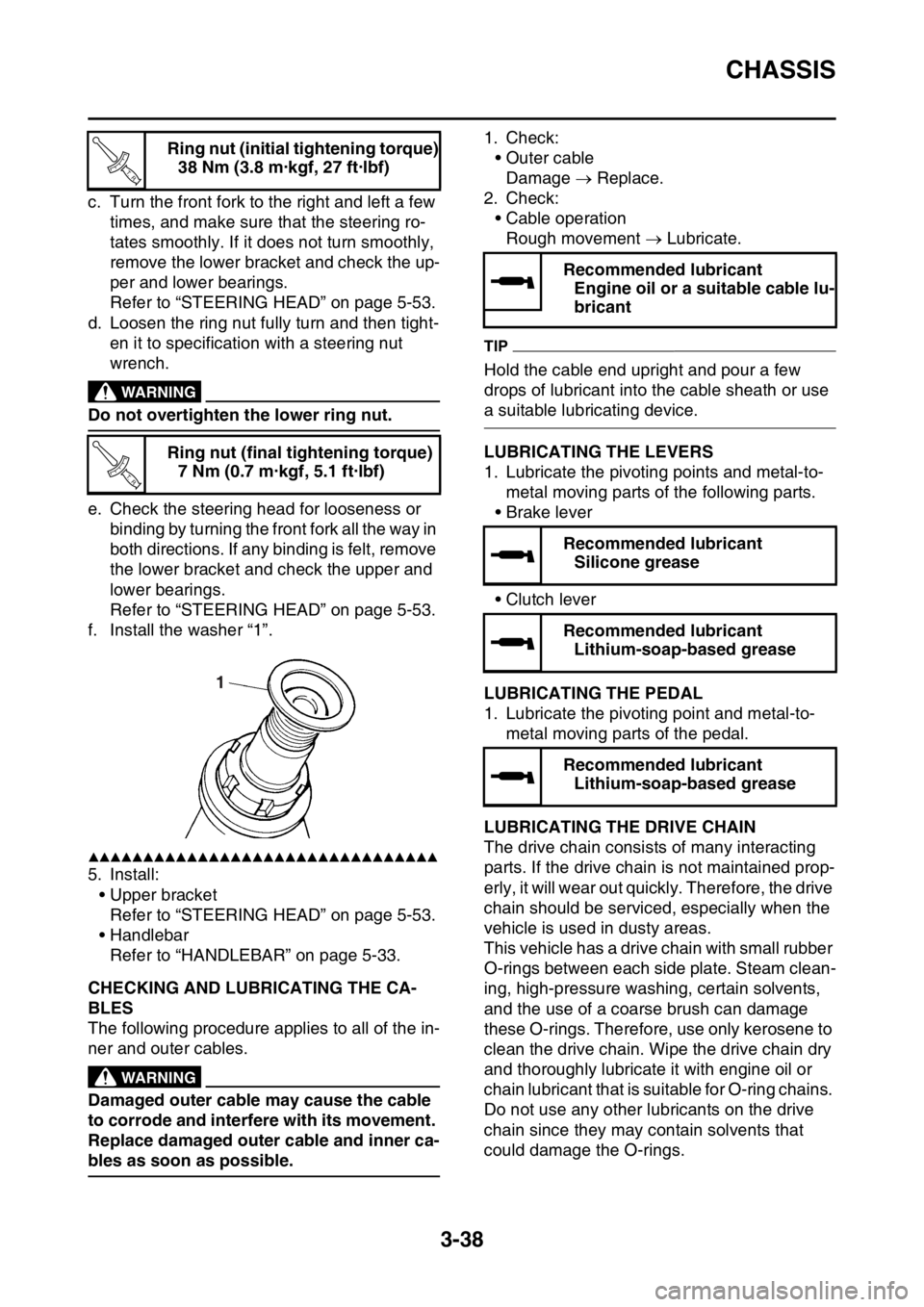
f. Install the washer “1”.
▲▲▲▲▲▲▲▲▲▲▲▲▲▲▲▲▲▲▲▲▲▲▲▲▲▲▲▲▲▲▲▲
5. Install:
• Upper bracket
Refer to “STEERING HEAD” on page 5-53.
• Handlebar
Refer to “HANDLEBAR” on page 5-33.
EAS2GBB124CHECKING AND LUBRICATING THE CA-
BLES
The following procedure applies to all of the in-
ner and outer cables.
EWA
WARNING
Damaged outer cable may cause the cable
to corrode and interfere with its movement.
Replace damaged outer cable and inner ca-
bles as soon as possible.1. Check:
• Outer cable
Damage Replace.
2. Check:
• Cable operation
Rough movement Lubricate.
TIP
Hold the cable end upright and pour a few
drops of lubricant into the cable sheath or use
a suitable lubricating device.
EAS2GBB125LUBRICATING THE LEVERS
1. Lubricate the pivoting points and metal-to-
metal moving parts of the following parts.
•Brake lever
• Clutch lever
EAS2GBB126LUBRICATING THE PEDAL
1. Lubricate the pivoting point and metal-to-
metal moving parts of the pedal.
EAS2GBB127LUBRICATING THE DRIVE CHAIN
The drive chain consists of many interacting
parts. If the drive chain is not maintained prop-
erly, it will wear out quickly. Therefore, the drive
chain should be serviced, especially when the
vehicle is used in dusty areas.
This vehicle has a drive chain with small rubber
O-rings between each side plate. Steam clean-
ing, high-pressure washing, certain solvents,
and the use of a coarse brush can damage
these O-rings. Therefore, use only kerosene to
clean the drive chain. Wipe the drive chain dry
and thoroughly lubricate it with engine oil or
chain lubricant that is suitable for O-ring chains.
Do not use any other lubricants on the drive
chain since they may contain solvents that
could damage the O-rings. Ring nut (initial tightening torque)
38 Nm (3.8 m·kgf, 27 ft·lbf)
Ring nut (final tightening torque)
7 Nm (0.7 m·kgf, 5.1 ft·lbf)
T R..
T R..
1
Recommended lubricant
Engine oil or a suitable cable lu-
bricant
Recommended lubricant
Silicone grease
Recommended lubricant
Lithium-soap-based grease
Recommended lubricant
Lithium-soap-based grease
Page 153 of 432
5
CHASSIS
GENERAL CHASSIS........................................................................................ 5-1
REMOVING THE LEFT SIDE COVER ....................................................... 5-3
REMOVING THE SEAT ............................................................................. 5-3
FRONT WHEEL................................................................................................ 5-4
REMOVING THE FRONT WHEEL............................................................. 5-5
CHECKING THE FRONT WHEEL ............................................................. 5-5
DISASSEMBLING THE FRONT WHEEL ................................................... 5-6
ASSEMBLING THE FRONT WHEEL ......................................................... 5-6
INSTALLING THE FRONT WHEEL ........................................................... 5-7
REAR WHEEL.................................................................................................. 5-9
REMOVING THE REAR WHEEL ............................................................. 5-10
CHECKING THE REAR WHEEL.............................................................. 5-10
DISASSEMBLING THE REAR WHEEL ................................................... 5-10
CHECKING AND REPLACING THE REAR WHEEL SPROCKET .......... 5-10
ASSEMBLING THE REAR WHEEL ......................................................... 5-11
INSTALLING THE REAR WHEEL............................................................ 5-11
FRONT BRAKE.............................................................................................. 5-13
INTRODUCTION ...................................................................................... 5-17
CHECKING THE FRONT BRAKE DISC .................................................. 5-17
REMOVING THE FRONT BRAKE CALIPER ........................................... 5-17
DISASSEMBLING THE FRONT BRAKE CALIPER................................. 5-17
CHECKING THE FRONT BRAKE CALIPER ........................................... 5-18
ASSEMBLING THE FRONT BRAKE CALIPER ....................................... 5-18
INSTALLING THE BRAKE CALIPER PISTON ........................................ 5-18
INSTALLING THE FRONT BRAKE CALIPER ......................................... 5-19
REMOVING THE FRONT BRAKE MASTER CYLINDER ........................ 5-20
CHECKING THE FRONT BRAKE MASTER CYLINDER......................... 5-20
ASSEMBLING THE FRONT BRAKE MASTER CYLINDER .................... 5-20
INSTALLING THE FRONT BRAKE MASTER CYLINDER....................... 5-21
REAR BRAKE................................................................................................ 5-23
INTRODUCTION ...................................................................................... 5-27
CHECKING THE REAR BRAKE DISC..................................................... 5-27
REMOVING THE REAR BRAKE CALIPER ............................................. 5-28
DISASSEMBLING THE REAR BRAKE CALIPER ................................... 5-28
CHECKING THE REAR BRAKE CALIPER .............................................. 5-28
ASSEMBLING THE REAR BRAKE CALIPER ......................................... 5-28
INSTALLING THE BRAKE CALIPER PISTON ........................................ 5-29
INSTALLING THE REAR BRAKE CALIPER ............................................ 5-29
REMOVING THE REAR BRAKE MASTER CYLINDER .......................... 5-30
CHECKING THE REAR BRAKE MASTER CYLINDER ........................... 5-30
ASSEMBLING THE REAR BRAKE MASTER CYLINDER....................... 5-31
INSTALLING THE REAR BRAKE MASTER CYLINDER ......................... 5-31
Page 158 of 432
FRONT WHEEL
5-4
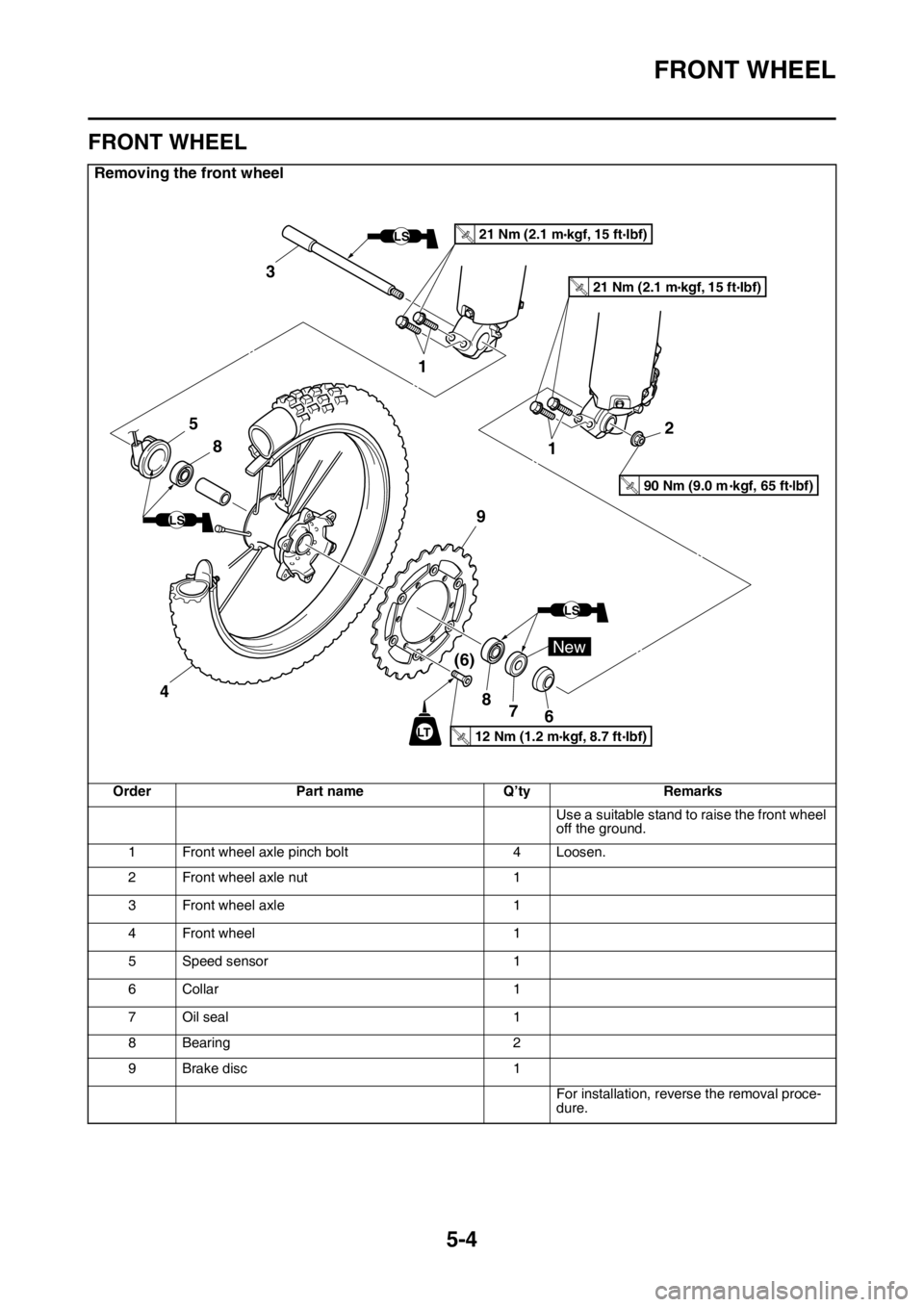
EAS2GBB154
FRONT WHEEL
Removing the front wheel
Order Part name Q’ty Remarks
Use a suitable stand to raise the front wheel
off the ground.
1 Front wheel axle pinch bolt 4 Loosen.
2 Front wheel axle nut 1
3 Front wheel axle 1
4 Front wheel 1
5 Speed sensor 1
6Collar 1
7 Oil seal 1
8 Bearing 2
9 Brake disc 1
For installation, reverse the removal proce-
dure.
12 Nm (1.2 m kgf, 8.7 ft Ibf)T.R.
New
LT
LS
LS
LS
8
7 8
(6)
9
12
1 3
21 Nm (2.1 m kgf, 15 ft Ibf)T.R.
21 Nm (2.1 m kgf, 15 ft Ibf)T.R.
4
90 Nm (9.0 m kgf, 65 ft lbf)T.R.
5
6
Page 160 of 432
FRONT WHEEL
5-6
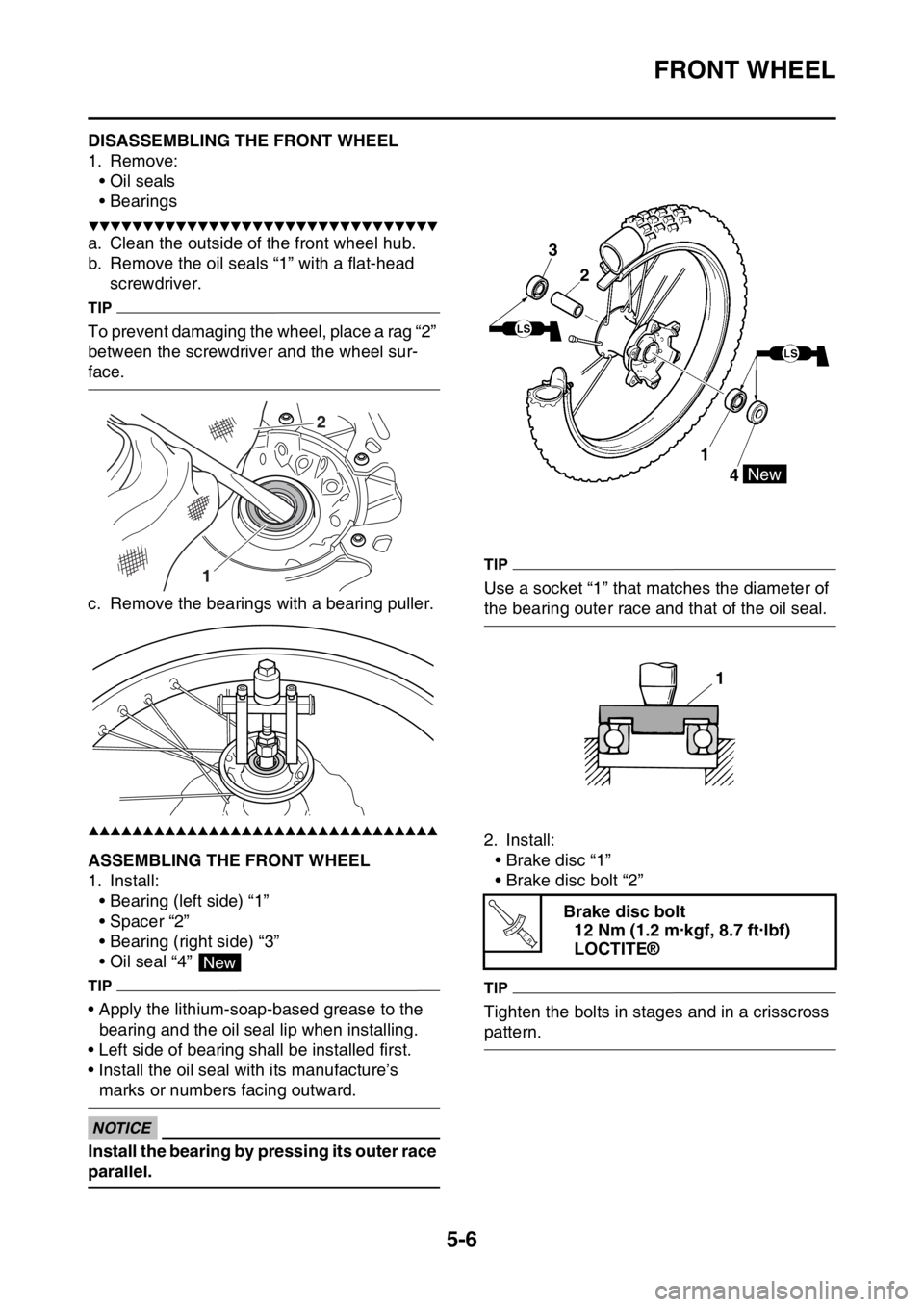
EAS2GBB157DISASSEMBLING THE FRONT WHEEL
1. Remove:
• Oil seals
• Bearings
▼▼▼▼▼▼▼▼▼▼▼▼▼▼▼▼▼▼▼▼▼▼▼▼▼▼▼▼▼▼▼▼
a. Clean the outside of the front wheel hub.
b. Remove the oil seals “1” with a flat-head
screwdriver.
TIP
To prevent damaging the wheel, place a rag “2”
between the screwdriver and the wheel sur-
face.
c. Remove the bearings with a bearing puller.
▲▲▲▲▲▲▲▲▲▲▲▲▲▲▲▲▲▲▲▲▲▲▲▲▲▲▲▲▲▲▲▲
EAS2GBB158ASSEMBLING THE FRONT WHEEL
1. Install:
• Bearing (left side) “1”
• Spacer “2”
• Bearing (right side) “3”
• Oil seal “4”
TIP
• Apply the lithium-soap-based grease to the
bearing and the oil seal lip when installing.
• Left side of bearing shall be installed first.
• Install the oil seal with its manufacture’s
marks or numbers facing outward.
ECA
NOTICE
Install the bearing by pressing its outer race
parallel.
TIP
Use a socket “1” that matches the diameter of
the bearing outer race and that of the oil seal.
2. Install:
• Brake disc “1”
• Brake disc bolt “2”
TIP
Tighten the bolts in stages and in a crisscross
pattern.
12
New
Brake disc bolt
12 Nm (1.2 m·kgf, 8.7 ft·lbf)
LOCTITE®
3
2
1
4
New
1
T R..
Page 161 of 432
FRONT WHEEL
5-7
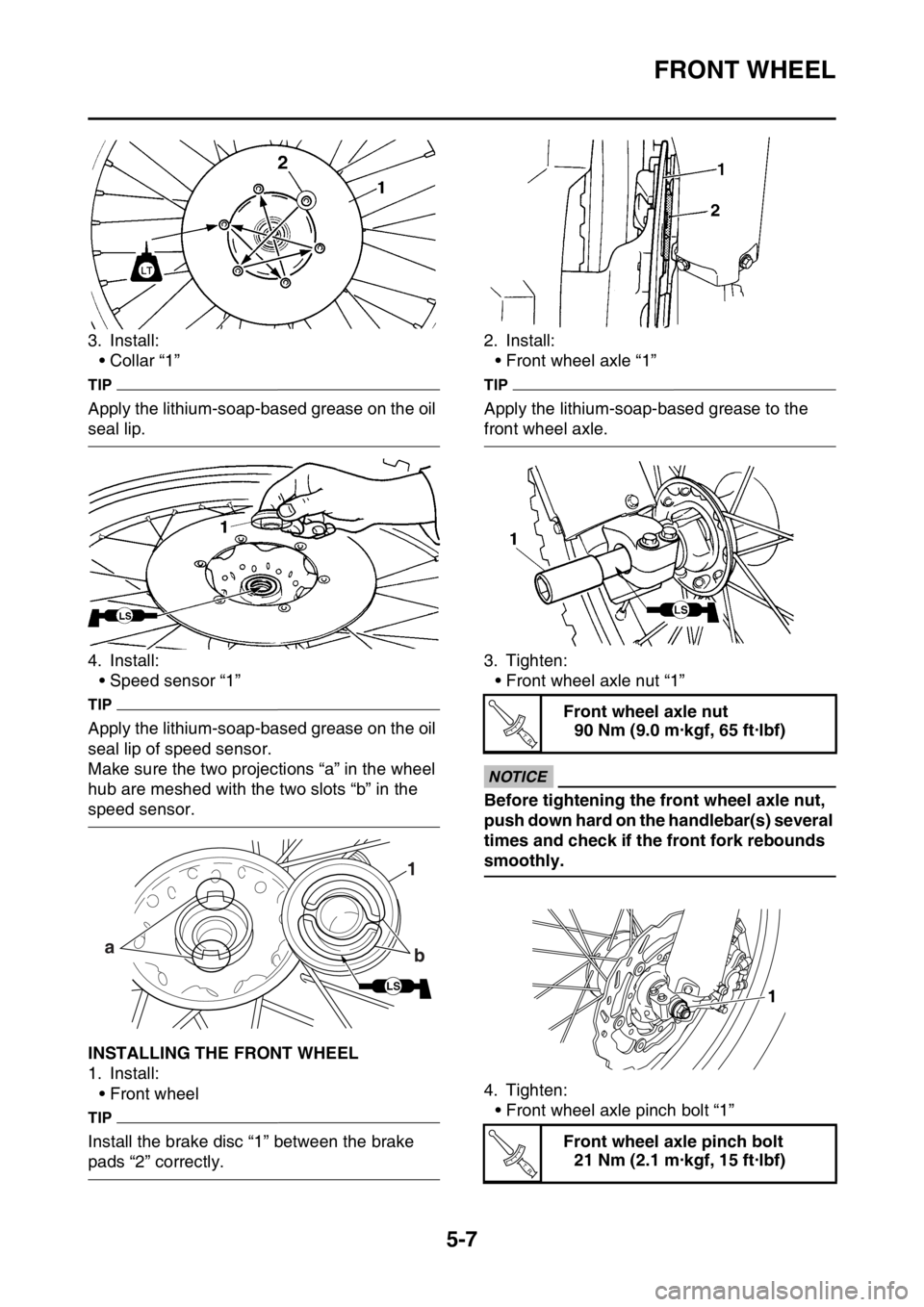
3. Install:
• Collar “1”
TIP
Apply the lithium-soap-based grease on the oil
seal lip.
4. Install:
• Speed sensor “1”
TIP
Apply the lithium-soap-based grease on the oil
seal lip of speed sensor.
Make sure the two projections “a” in the wheel
hub are meshed with the two slots “b” in the
speed sensor.
EAS2GBB159INSTALLING THE FRONT WHEEL
1. Install:
• Front wheel
TIP
Install the brake disc “1” between the brake
pads “2” correctly.2. Install:
• Front wheel axle “1”
TIP
Apply the lithium-soap-based grease to the
front wheel axle.
3. Tighten:
• Front wheel axle nut “1”
ECA
NOTICE
Before tightening the front wheel axle nut,
push down hard on the handlebar(s) several
times and check if the front fork rebounds
smoothly.
4. Tighten:
• Front wheel axle pinch bolt “1”1
a
b
LS
Front wheel axle nut
90 Nm (9.0 m·kgf, 65 ft·lbf)
Front wheel axle pinch bolt
21 Nm (2.1 m·kgf, 15 ft·lbf)
T R..
1
T R..
Page 163 of 432
REAR WHEEL
5-9
EAS2GBB160
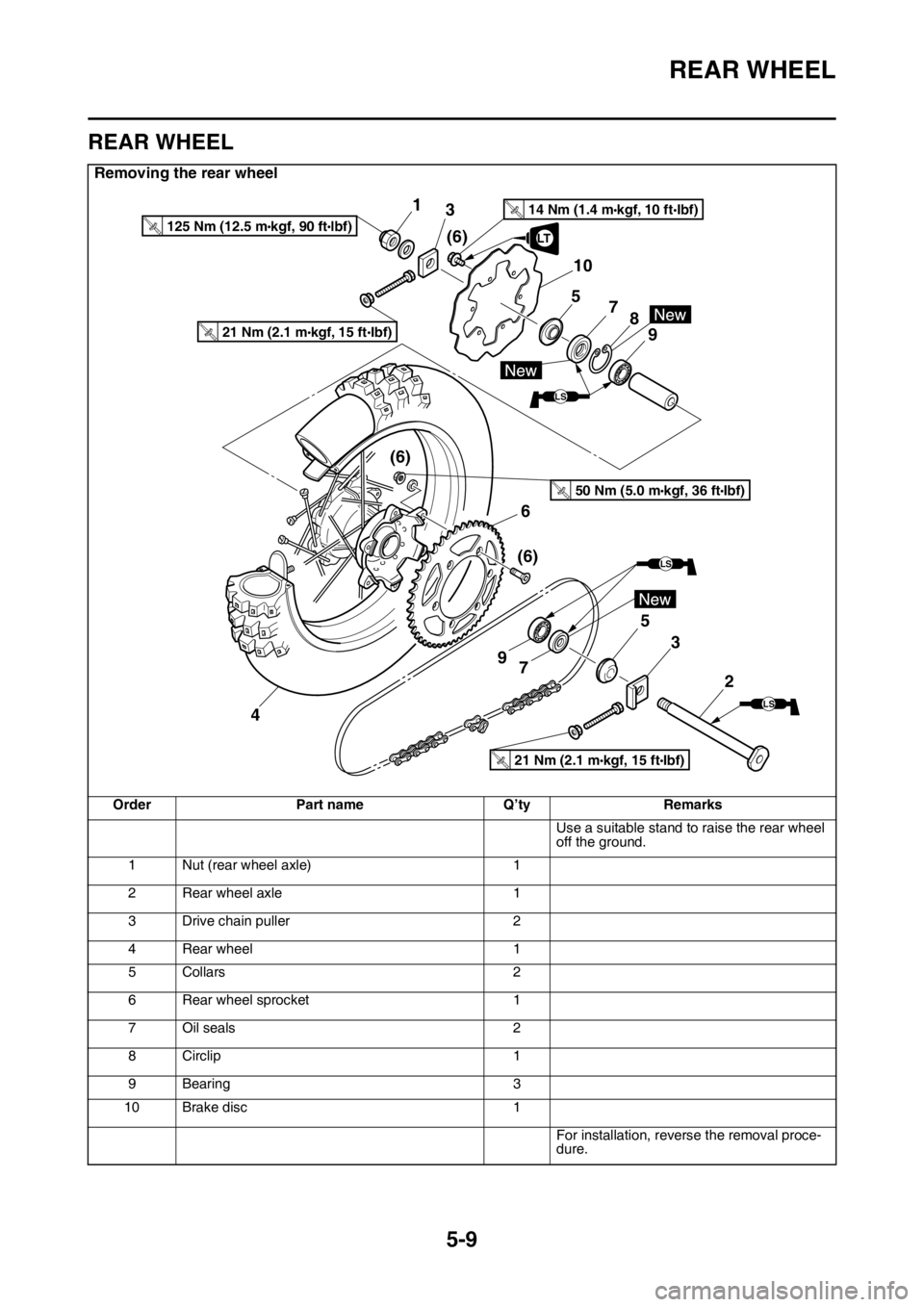
REAR WHEEL
Removing the rear wheel
Order Part name Q’ty Remarks
Use a suitable stand to raise the rear wheel
off the ground.
1 Nut (rear wheel axle) 1
2 Rear wheel axle 1
3 Drive chain puller 2
4 Rear wheel 1
5Collars 2
6 Rear wheel sprocket 1
7Oil seals 2
8 Circlip 1
9 Bearing 3
10 Brake disc 1
For installation, reverse the removal proce-
dure.
(6)
21 Nm (2.1 m kgf, 15 ft Ibf)T.R.
2 5
7 9
LS
LS(6)
46
1
(6) 3
LS
8
9 10
7 5
LT
14 Nm (1.4 m kgf, 10 ft Ibf)T.R.
3
21 Nm (2.1 m kgf, 15 ft Ibf)T.R.
50 Nm (5.0 m kgf, 36 ft Ibf)T.R.
125 Nm (12.5 m kgf, 90 ft lbf)T.R.
Page 164 of 432
REAR WHEEL
5-10
EAS2GBB161REMOVING THE REAR WHEEL
1. Use a suitable stand to raise the rear wheel
off the ground.
EWA
WARNING
Securely support the vehicle so that there is
no danger of it falling over.
2. Remove:
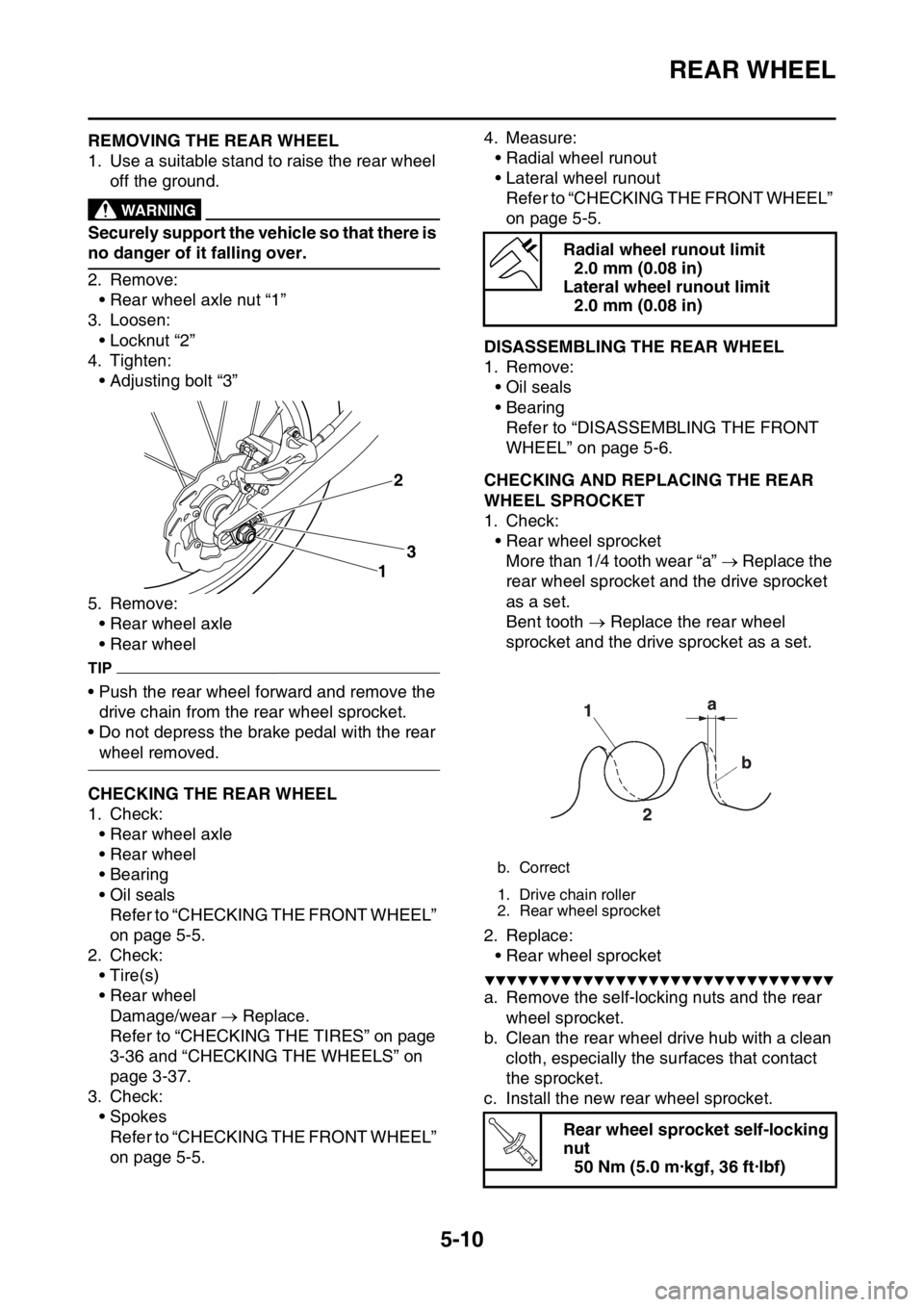
• Rear wheel axle nut “1”
3. Loosen:
• Locknut “2”
4. Tighten:
• Adjusting bolt “3”
5. Remove:
• Rear wheel axle
• Rear wheel
TIP
• Push the rear wheel forward and remove the
drive chain from the rear wheel sprocket.
• Do not depress the brake pedal with the rear
wheel removed.
EAS2GBB162CHECKING THE REAR WHEEL
1. Check:
• Rear wheel axle
• Rear wheel
• Bearing
• Oil seals
Refer to “CHECKING THE FRONT WHEEL”
on page 5-5.
2. Check:
•Tire(s)
• Rear wheel
Damage/wear Replace.
Refer to “CHECKING THE TIRES” on page
3-36 and “CHECKING THE WHEELS” on
page 3-37.
3. Check:
• Spokes
Refer to “CHECKING THE FRONT WHEEL”
on page 5-5.4. Measure:
• Radial wheel runout
• Lateral wheel runout
Refer to “CHECKING THE FRONT WHEEL”
on page 5-5.
EAS2GBB163DISASSEMBLING THE REAR WHEEL
1. Remove:
• Oil seals
• Bearing
Refer to “DISASSEMBLING THE FRONT
WHEEL” on page 5-6.
EAS2GBB164CHECKING AND REPLACING THE REAR
WHEEL SPROCKET
1. Check:
• Rear wheel sprocket
More than 1/4 tooth wear “a” Replace the
rear wheel sprocket and the drive sprocket
as a set.
Bent tooth Replace the rear wheel
sprocket and the drive sprocket as a set.
2. Replace:
• Rear wheel sprocket
▼▼▼▼▼▼▼▼▼▼▼▼▼▼▼▼▼▼▼▼▼▼▼▼▼▼▼▼▼▼▼▼
a. Remove the self-locking nuts and the rear
wheel sprocket.
b. Clean the rear wheel drive hub with a clean
cloth, especially the surfaces that contact
the sprocket.
c. Install the new rear wheel sprocket.
3
12
Radial wheel runout limit
2.0 mm (0.08 in)
Lateral wheel runout limit
2.0 mm (0.08 in)
b. Correct
1. Drive chain roller
2. Rear wheel sprocket
Rear wheel sprocket self-locking
nut
50 Nm (5.0 m·kgf, 36 ft·lbf)
T R..