battery YAMAHA WR 450F 2006 Notices Demploi (in French)
[x] Cancel search | Manufacturer: YAMAHA, Model Year: 2006, Model line: WR 450F, Model: YAMAHA WR 450F 2006Pages: 786, PDF Size: 22.49 MB
Page 300 of 786
3 - 52
INSP
ADJ
BATTERY INSPECTION AND CHARGING
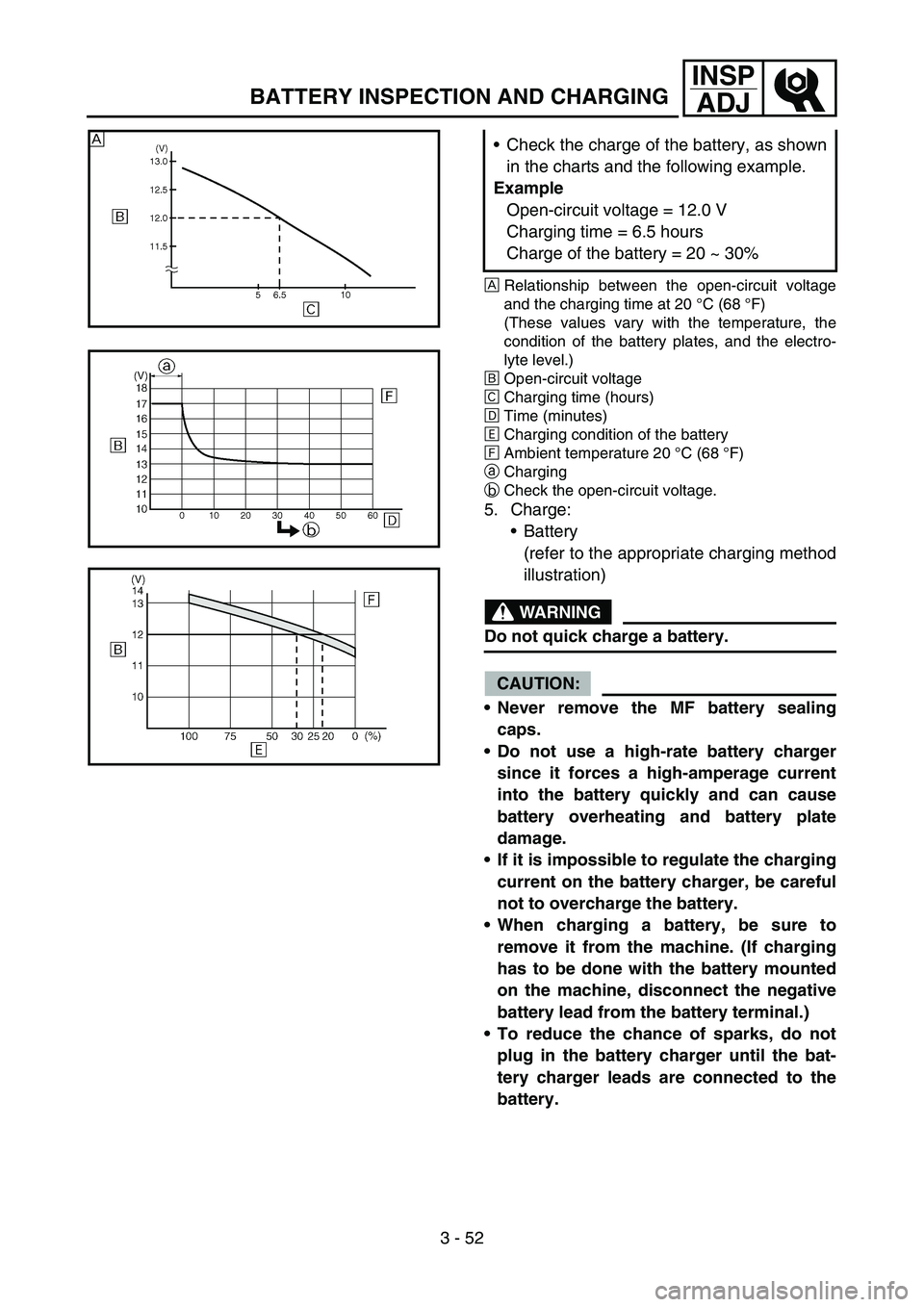
ÈRelationship between the open-circuit voltage
and the charging time at 20 °C (68 °F)
(These values vary with the temperature, the
condition of the battery plates, and the electro-
lyte level.)
ÉOpen-circuit voltage
ÊCharging time (hours)
ËTime (minutes)
ÌCharging condition of the battery
ÍAmbient temperature 20 °C (68 °F)
aCharging
bCheck the open-circuit voltage.
5. Charge:
Battery
(refer to the appropriate charging method
illustration)
WARNING
Do not quick charge a battery.
CAUTION:
Never remove the MF battery sealing
caps.
Do not use a high-rate battery charger
since it forces a high-amperage current
into the battery quickly and can cause
battery overheating and battery plate
damage.
If it is impossible to regulate the charging
current on the battery charger, be careful
not to overcharge the battery.
When charging a battery, be sure to
remove it from the machine. (If charging
has to be done with the battery mounted
on the machine, disconnect the negative
battery lead from the battery terminal.)
To reduce the chance of sparks, do not
plug in the battery charger until the bat-
tery charger leads are connected to the
battery. Check the charge of the battery, as shown
in the charts and the following example.
Example
Open-circuit voltage = 12.0 V
Charging time = 6.5 hours
Charge of the battery = 20 ~ 30%
È
Page 302 of 786
3 - 53
INSP
ADJ
BATTERY INSPECTION AND CHARGING
Before removing the battery charger lead
clips from the battery terminals, be sure
to turn off the battery charger.
Make sure the battery charger lead clips
are in full contact with the battery termi-
nal and that they are not shorted. A cor-
roded battery charger lead clip may
generate heat in the contact area and a
weak clip spring may cause sparks.
If the battery becomes hot to the touch at
any time during the charging process,
disconnect the battery charger and let the
battery cool before reconnecting it. Hot
batteries can explode!
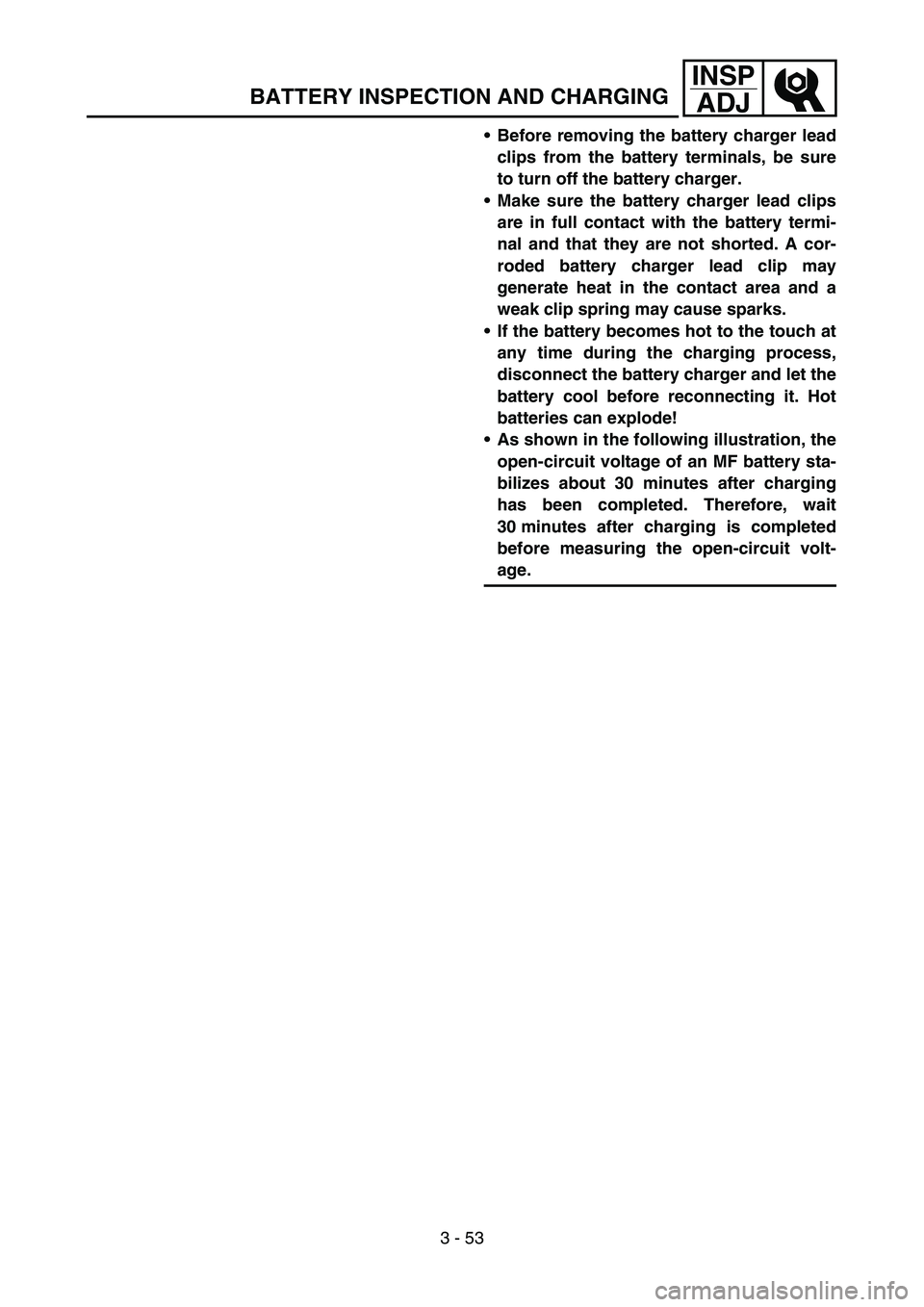
As shown in the following illustration, the
open-circuit voltage of an MF battery sta-
bilizes about 30 minutes after charging
has been completed. Therefore, wait
30 minutes after charging is completed
before measuring the open-circuit volt-
age.
Page 304 of 786
3 - 54
INSP
ADJ
BATTERY INSPECTION AND CHARGING
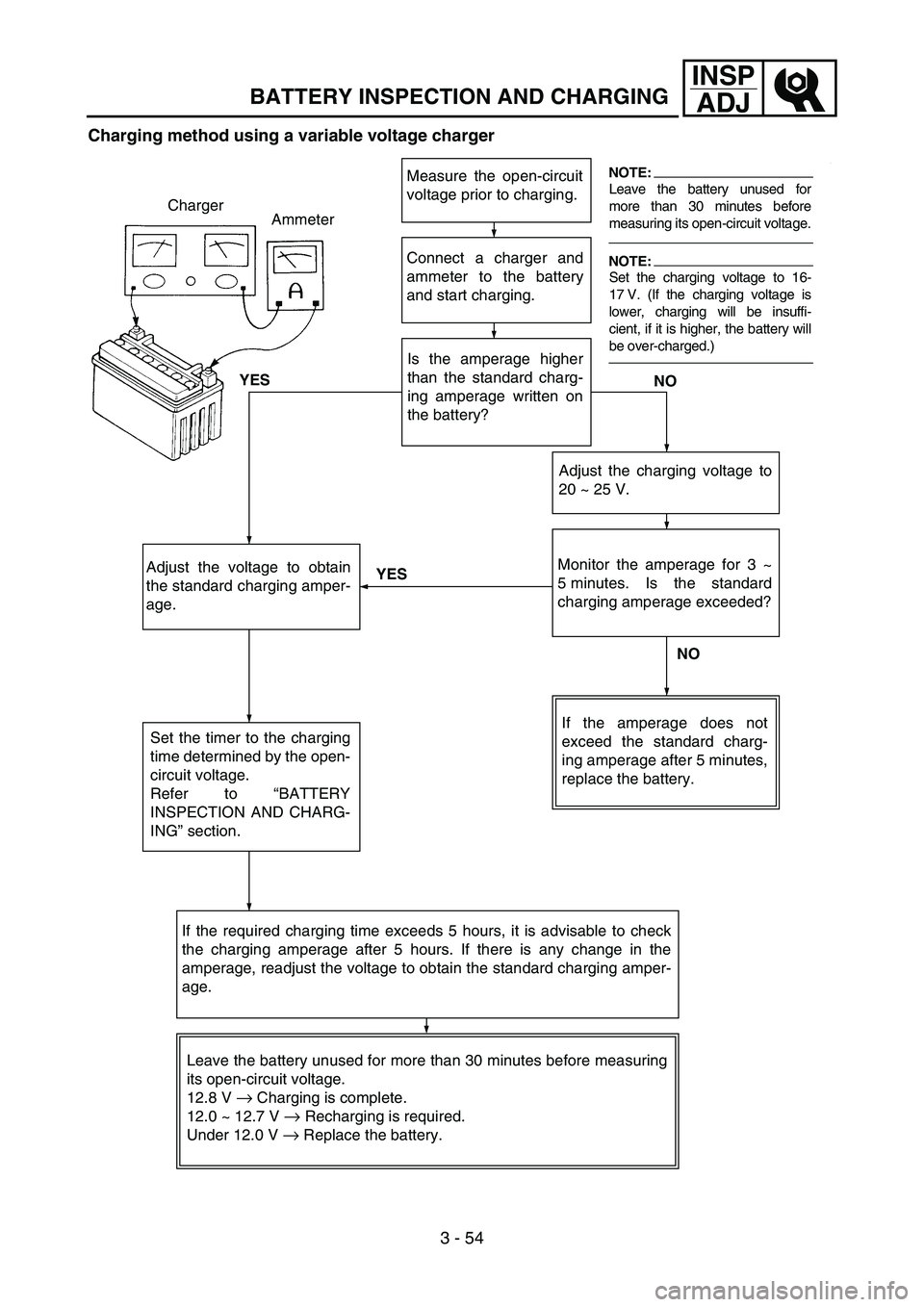
Charging method using a variable voltage charger
Connect a charger and
ammeter to the battery
and start charging.
Is the amperage higher
than the standard charg-
ing amperage written on
the battery?NO YES Charger
Ammeter
Adjust the voltage to obtain
the standard charging amper-
age.
Set the timer to the charging
time determined by the open-
circuit voltage.
Refer to “BATTERY
INSPECTION AND CHARG-
ING” section.Adjust the charging voltage to
20 ~ 25 V.
Monitor the amperage for 3 ~
5 minutes. Is the standard
charging amperage exceeded?
NO YES
If the amperage does not
exceed the standard charg-
ing amperage after 5 minutes,
replace the battery.
If the required charging time exceeds 5 hours, it is advisable to check
the charging amperage after 5 hours. If there is any change in the
amperage, readjust the voltage to obtain the standard charging amper-
age.
Leave the battery unused for more than 30 minutes before measuring
its open-circuit voltage.
12.8 V
→ Charging is complete.
12.0 ~ 12.7 V
→ Recharging is required.
Under 12.0 V
→ Replace the battery.
Leave the battery unused for
more than 30 minutes before
measuring its open-circuit voltage.
Set the charging voltage to 16-
17 V. (If the charging voltage is
lower, charging will be insuffi-
cient, if it is higher, the battery will
be over-charged.) NOTE:
NOTE:
Measure the open-circuit
voltage prior to charging.
Page 305 of 786
3 - 55
INSP
ADJ
BATTERY INSPECTION AND CHARGING
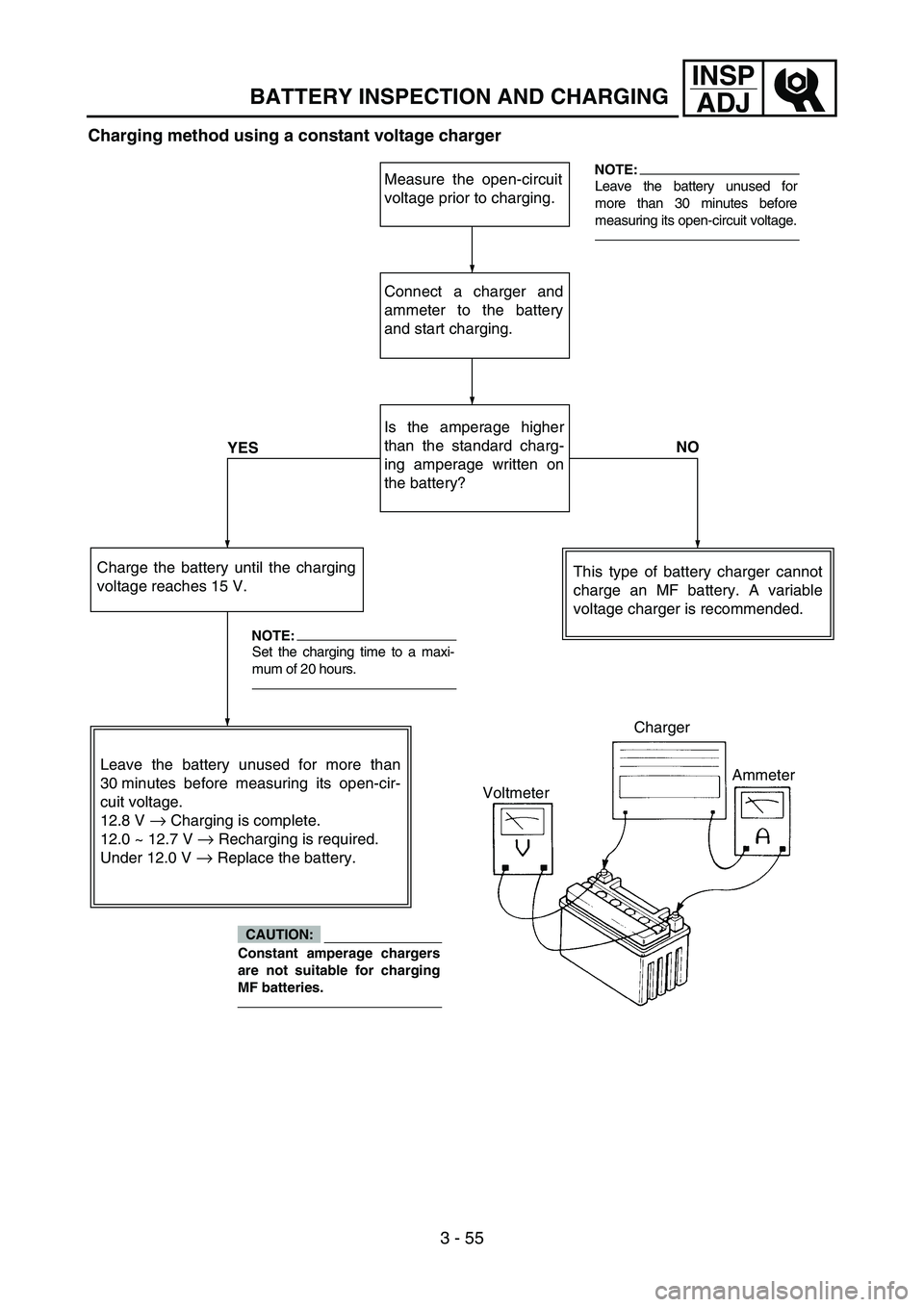
Charging method using a constant voltage charger
Measure the open-circuit
voltage prior to charging.
Connect a charger and
ammeter to the battery
and start charging.
NO
YESIs the amperage higher
than the standard charg-
ing amperage written on
the battery?
Charge the battery until the charging
voltage reaches 15 V.
Leave the battery unused for more than
30 minutes before measuring its open-cir-
cuit voltage.
12.8 V
→ Charging is complete.
12.0 ~ 12.7 V
→ Recharging is required.
Under 12.0 V
→ Replace the battery.This type of battery charger cannot
charge an MF battery. A variable
voltage charger is recommended.
Leave the battery unused for
more than 30 minutes before
measuring its open-circuit voltage. NOTE:
Set the charging time to a maxi-
mum of 20 hours. NOTE:
Constant amperage chargers
are not suitable for charging
MF batteries.
CAUTION:
Charger
Ammeter
Voltmeter
Page 312 of 786
3 - 56
INSP
ADJ
FUSE INSPECTION
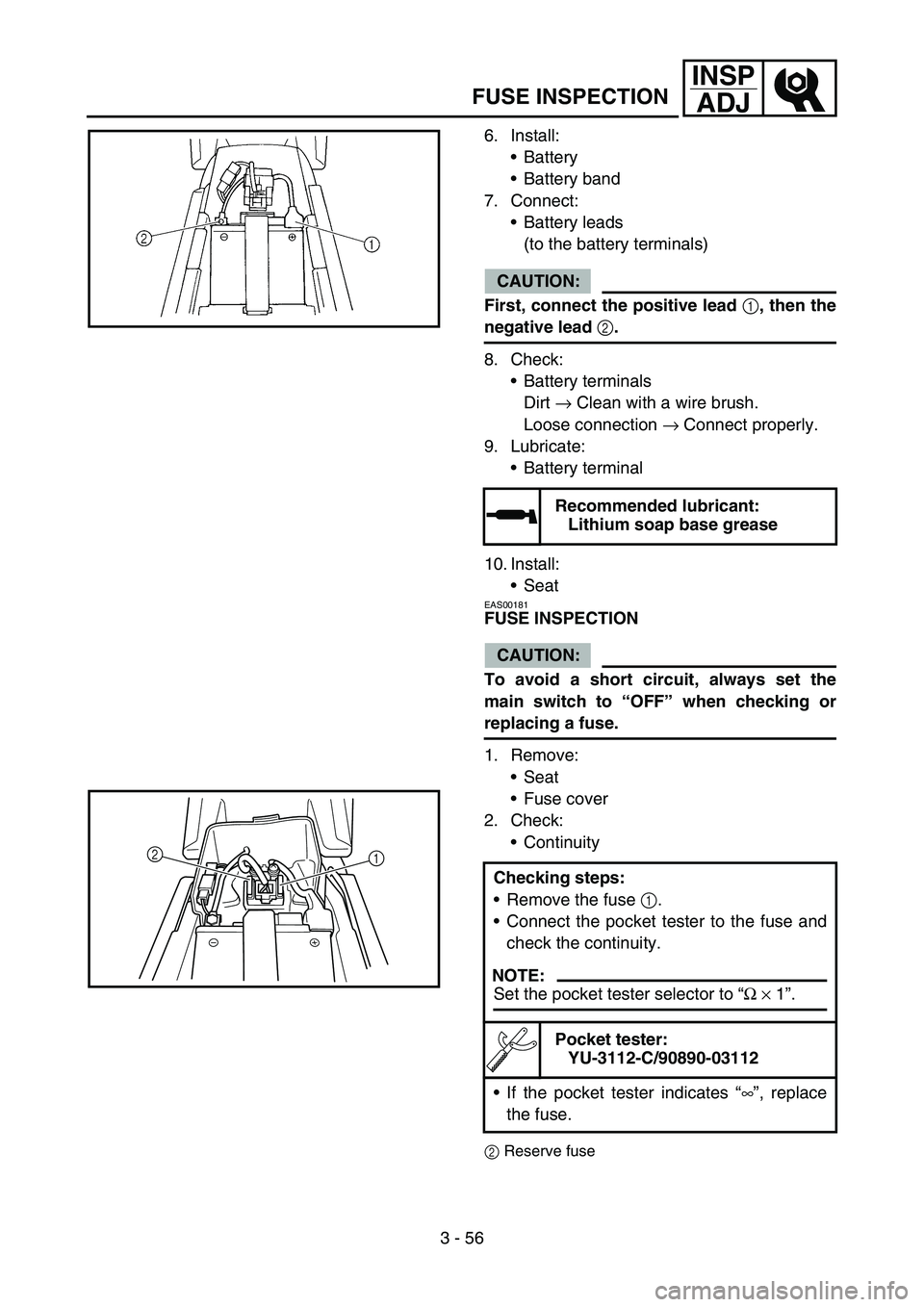
6. Install:
Battery
Battery band
7. Connect:
Battery leads
(to the battery terminals)
CAUTION:
First, connect the positive lead
1, then the
negative lead
2.
8. Check:
Battery terminals
Dirt → Clean with a wire brush.
Loose connection → Connect properly.
9. Lubricate:
Battery terminal
10. Install:
Seat
EAS00181
FUSE INSPECTION
CAUTION:
To avoid a short circuit, always set the
main switch to “OFF” when checking or
replacing a fuse.
1. Remove:
Seat
Fuse cover
2. Check:
Continuity
2Reserve fuse
Recommended lubricant:
Lithium soap base grease
Checking steps:
Remove the fuse 1.
Connect the pocket tester to the fuse and
check the continuity.
NOTE:
Set the pocket tester selector to “Ω × 1”.
Pocket tester:
YU-3112-C/90890-03112
If the pocket tester indicates “∞”, replace
the fuse.
2
1
Page 490 of 786
4 - 87
ENGENGINE REMOVAL
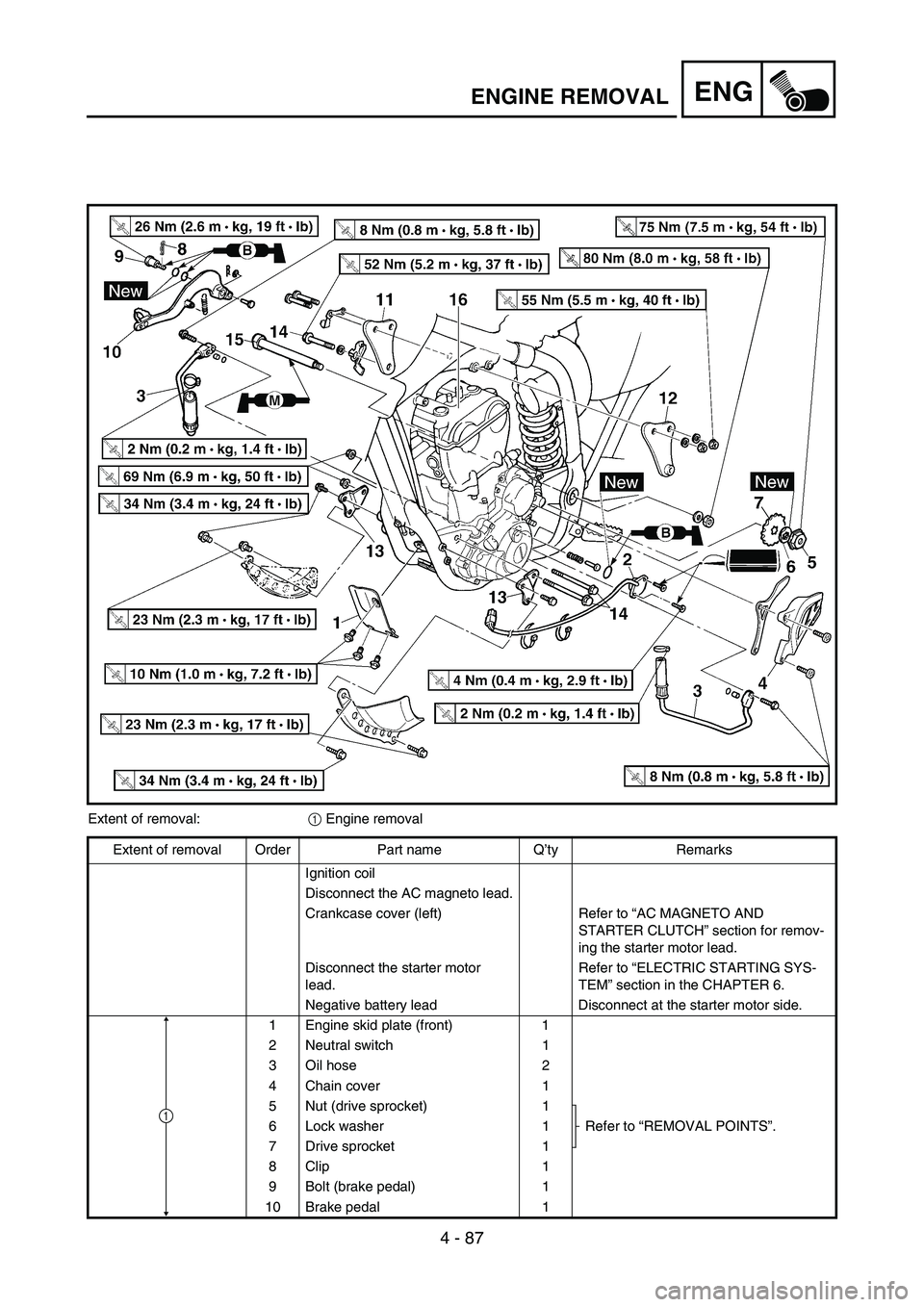
Extent of removal:
1 Engine removal
Extent of removal Order Part name Q’ty Remarks
Ignition coil
Disconnect the AC magneto lead.
Crankcase cover (left) Refer to “AC MAGNETO AND
STARTER CLUTCH” section for remov-
ing the starter motor lead.
Disconnect the starter motor
lead.Refer to “ELECTRIC STARTING SYS-
TEM” section in the CHAPTER 6.
Negative battery lead Disconnect at the starter motor side.
1 Engine skid plate (front) 1
2 Neutral switch 1
3 Oil hose 2
4 Chain cover 1
5 Nut (drive sprocket) 1
Refer to “REMOVAL POINTS”. 6 Lock washer 1
7 Drive sprocket 1
8Clip 1
9 Bolt (brake pedal) 1
10 Brake pedal 1
1
Page 650 of 786

5 - 62
CHASREAR SHOCK ABSORBER
Extent of removal Order Part name Q’ty Remarks
Cylinder head breather hose Disconnect at the air filter case side.
Battery Refer to “BATTERY INSPECTION AND
CHARGING” section in the CHAPTER 3.
Disconnect the starter relay cou-
pler.
Starter motor lead Disconnect at the starter relay side.
1 Locking tie 3
2 Taillight coupler 1
3 Starting circuit cut-off relay cou-
pler1
4 Plastic band 2
5 Clamp (air filter joint) 1 Only loosening.
6Rear frame 1
7 Bolt (rear shock absorber-relay
arm)1 Hold the swingarm.
8 Bolt (rear shock absorber-frame) 1
21
Page 666 of 786

6 - 1
–+ELECELECTRICAL COMPONENTS AND WIRING DIAGRAM
EC600000
ELECTRICAL
EC610000
ELECTRICAL COMPONENTS AND WIRING DIAGRAM
EC611000
ELECTRICAL COMPONENTS
1Headlight
2Multi-function display
3“ENGINE STOP” but-
ton
4Clutch switch
5Diode
6Starter relay diode
7TPS (throttle posi-
tion sensor)
8Starter relay
9Fuse
0Starting circuit cut-off
relayATaillight
BNeutral switch
CStarter motor
DAC magneto
ERectifier/regulator
FIgnition coil
GSpark plug
HStart switch
IMain switch
JCDI unit
KSpeed sensor
LBatteryCOLOR CODE
B ...................... Black
Br ..................... Brown
Ch .................... Chocolate
Dg .................... Dark green
Gy .................... Gray
L....................... Blue
O ...................... Orange
R ...................... Red
Sb .................... Sky blue
W ..................... White
EC612000
WIRING DIAGRAM
FGH
I
J
K
L
1 234
56
789
0A
B C
D E
B/L
W
W
R
BR/BBr
R
BR/BBr
R
Y
Y
L/R/BBB
SbL/W
L/YBBB
WY
RY
R
LY
B
YLB/L
B
B
ON
OFF
10A
BB
OFF
START
R-BrL/W
B
BrL/W
BrL/W
L/B
-Y
Y
B
LY
B
L/WSb
B/WBBB
W/R/W
R/
BGyBrL/W
ON
STOP
O
LSbB/L
W RBrB/W
L
/
BGyWR
/B
B O
L/YSbL/R
R W
Y W
Y W
Y
L B
B
B
RRR/B
B Br B
B B B B
L/W
R
R
R R B
R
BrBr
L/W L/
W
Br B
L/B
L/B
L/R
Br
R/B
L/B L
/W
B/W
WW
/RW
RO
L
Y
ELO
B
L
Y
B/LSb*1
Sb
*2B/W
B
B
L/R L/Y L/Y
B
SbSbL/W
B
Gy
SbBB/LYO
L
*2
O B
L YL/W
B/L
*1
D
E
CI
6
H4 5
B3J
K
2FG
7
8L9
1A
*2
*1
W
B
R/W
Ch
Dg
Y
B BrRW
WRB/W
SIGNAL
+
Backup
SLCT1
SLCT2
RST
GND
BrR/WB
B
R/WBr
WRB/W
R B
W
ChDgYB
B/WWRB/WWR
0
R
W
W W
L/WB/L
Y B
RB
B
L
L
*1: For USA
*2: Except for USA
Y ...................... Yellow
B/L ................... Black/Blue
B/W .................. Black/White
L/B ................... Blue/Black
L/R ................... Blue/Red
L/Y ................... Blue/Yellow
L/W .................. Blue/White
R/B................... Red/Black
R/W.................. Red/White
Page 672 of 786
–+ELEC
6 - 3
IGNITION SYSTEM
EC620000
IGNITION SYSTEM
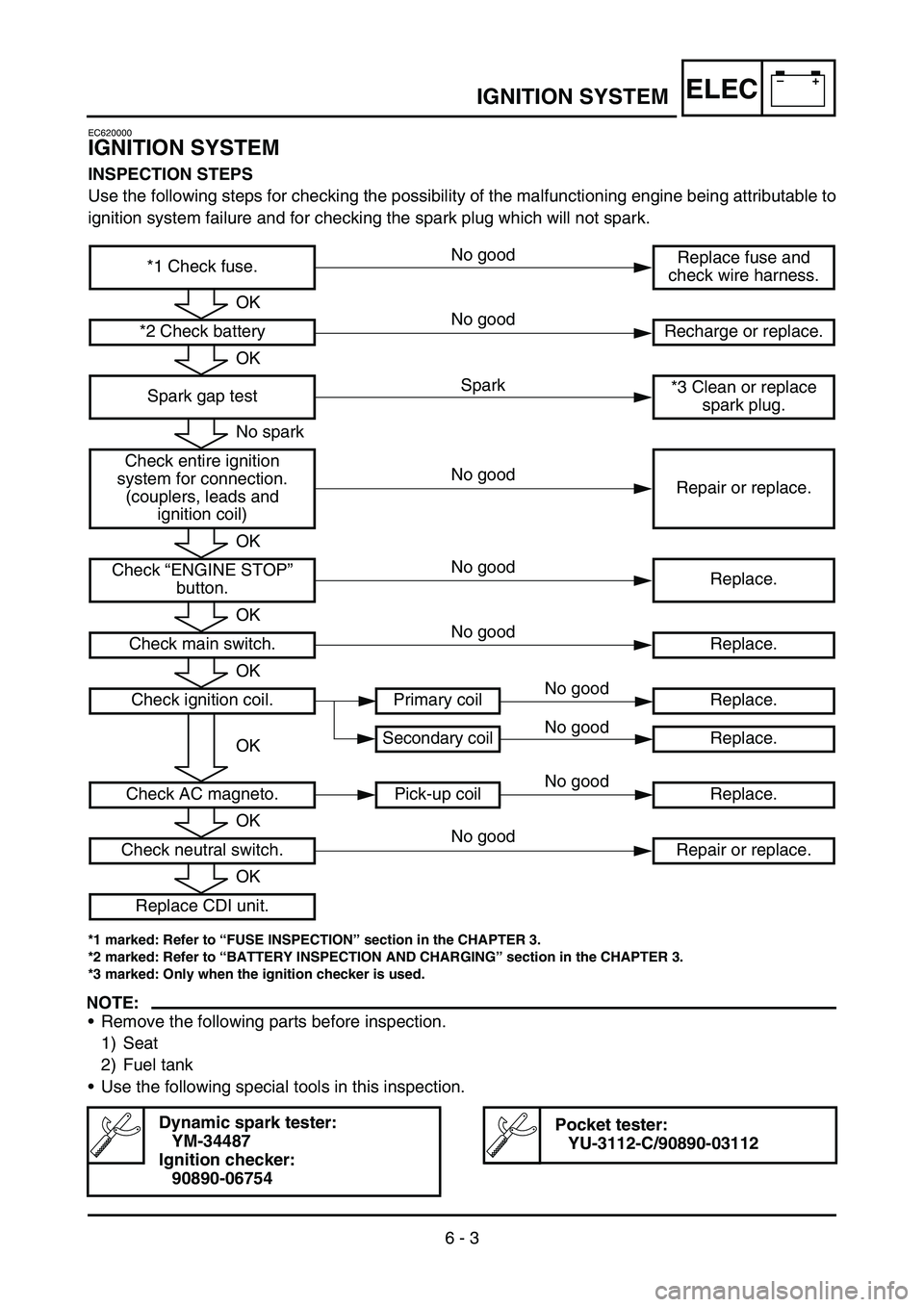
INSPECTION STEPS
Use the following steps for checking the possibility of the malfunctioning engine being attributable to
ignition system failure and for checking the spark plug which will not spark.
*1 marked: Refer to “FUSE INSPECTION” section in the CHAPTER 3.
*2 marked: Refer to “BATTERY INSPECTION AND CHARGING” section in the CHAPTER 3.
*3 marked: Only when the ignition checker is used.
NOTE:
•Remove the following parts before inspection.
1) Seat
2) Fuel tank
•Use the following special tools in this inspection.
Dynamic spark tester:
YM-34487
Ignition checker:
90890-06754Pocket tester:
YU-3112-C/90890-03112
*1 Check fuse.Replace fuse and
check wire harness.
*2 Check battery Recharge or replace.
Spark gap test*3 Clean or replace
spark plug.
Check entire ignition
system for connection.
(couplers, leads and
ignition coil)Repair or replace.
Check “ENGINE STOP”
button.Replace.
Check main switch. Replace.
Check ignition coil. Primary coil Replace.
Secondary coil Replace.
Check AC magneto. Pick-up coil Replace.
Check neutral switch. Repair or replace.
Replace CDI unit.
OK
OK
No spark
OK
OK
OK
OK
OK
OK
Spark No good
No good
No good
No good
No good No good
No good
No good
No good
Page 678 of 786
6 - 5
–+ELECIGNITION SYSTEM
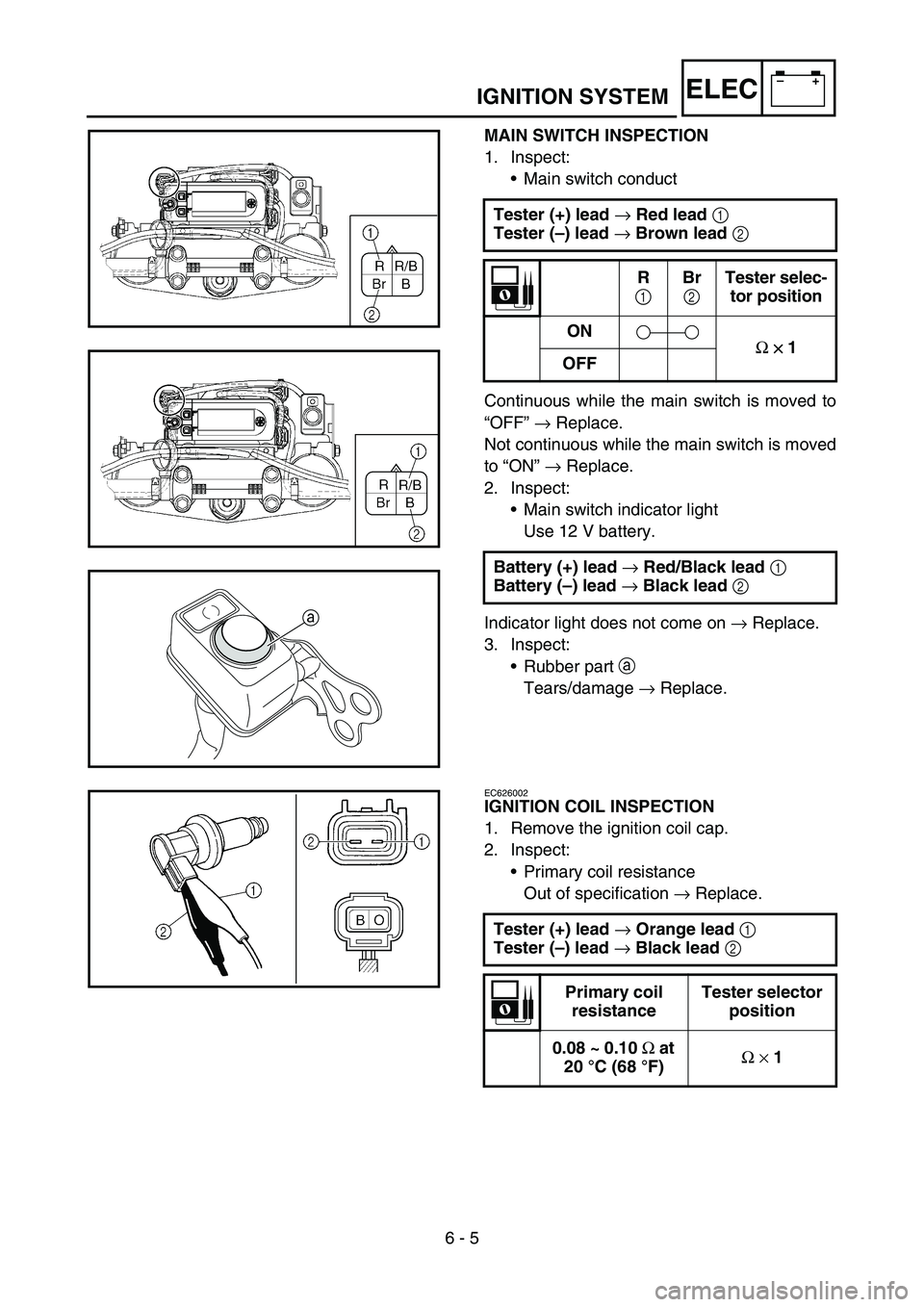
MAIN SWITCH INSPECTION
1. Inspect:
•Main switch conduct
Continuous while the main switch is moved to
“OFF” → Replace.
Not continuous while the main switch is moved
to “ON” → Replace.
2. Inspect:
•Main switch indicator light
Use 12 V battery.
Indicator light does not come on → Replace.
3. Inspect:
•Rubber part a
Tears/damage → Replace. Tester (+) lead
→ Red lead
1
Tester (–) lead
→ Brown lead
2
R
1 Br
2 Tester selec-
tor position
ON
Ω
×
×× × 1
OFF
Battery (+) lead
→ Red/Black lead
1
Battery (–) lead
→ Black lead
2
a
EC626002
IGNITION COIL INSPECTION
1. Remove the ignition coil cap.
2. Inspect:
•Primary coil resistance
Out of specification → Replace.
Tester (+) lead
→ Orange lead
1
Tester (–) lead
→ Black lead
2
Primary coil
resistanceTester selector
position
0.08 ~ 0.10
Ω at
20 °C (68 °F)Ω
× 1