lock YAMAHA WR 450F 2006 Owners Manual
[x] Cancel search | Manufacturer: YAMAHA, Model Year: 2006, Model line: WR 450F, Model: YAMAHA WR 450F 2006Pages: 786, PDF Size: 22.49 MB
Page 715 of 786

–+ELEC
HANDHABUNGSHINWEISE
ACHTUNG:
Die Drosselklappensensor-Schrau-
ben 1 dürfen nicht gelockert wer-
den, außer wenn der
Drosselklappensensor zu erneuern
ist.
STECKVERBINDER- UND KABEL-
ANSCHLÜSSE KONTROLLIEREN
1. Kontrollieren:
Steckverbinder- und Kabelan-
schlüsse
Rostig/staubig/locker/kurzge-
schlossen → Instand setzen,
ggf. erneuern.
DROSSELKLAPPENSENSOR-
SPULE KONTROLLIEREN
1. Kontrollieren:
Drosselklappensensor-Spule
Nicht nach Vorgabe → Erneu-
ern.
2. Lockern:
Leerlaufeinstellschraube 1
HINWEIS:
Die Leerlaufeinstellschraube heraus-
drehen, bis die Drosselklappenwelle
sich in der völlig geschlossenen Stel-
lung befindet.Messkabel (+) → Blau 1
Messkabel (–) → Schwarz 2
Drosselklap-
pensensor-Spu-
lenwiderstandMessgerät-
Wahlschalter
4–6 kΩ bei
20 °C (68 °F)kΩ × 1
REMARQUES CONCERNANT LA
MANIPULATION
ATTENTION:
Ne pas desserrer les vis {TPS (capteur
de position de papillon des gaz)} 1
sauf en cas de remplacement du TPS
(capteur de position de papillon des
gaz) en raison d’une panne, car cela
provoquerait une baisse des perfor-
mances du moteur.
CONTROLE DES CONNEXIONS
DES FICHES RAPIDES ET DES
FILS
1. Contrôler:
Connexion des fiches rapides et
des fils
Rouille/poussière/jeu/court-cir-
cuit → Réparer ou remplacer.
CONTROLE DE LA BOBINE DU
TPS
1. Contrôler:
Résistance de la bobine du TPS
Hors spécifications → Rempla-
cer.
2. Desserrer:
Vis de butée de papillon des gaz
1
N.B.:
Dévisser la vis de butée de papillon des
gaz jusqu’à ce que l’axe de papillon soit
en position complètement fermée. Fil (+) du multimètre → fil bleu 1
Fil (–) du multimètre → fil noir 2
Résistance de
la bobine du
TPSPosition du
sélecteur du
multimètre
4 à 6 kΩ à
20 °C (68 °F)kΩ × 1
NOTA RELATIVA A LA
MANIPULACIÓN
ATENCION:
No afloje los tornillos {TPS (sensor de
posición del acelerador)} 1 salvo para
cambiar el TPS (sensor de posición del
acelerador) debido a un fallo, ya que
provocará una disminución de las
prestaciones del motor.
COMPROBACIÓN DE LA
CONEXIÓN DE ACOPLADORES Y
CABLES
1. Comprobar:
Conexión de acopladores y cables
Óxido/polvo/flojas/cortocircuito
→ Reparar o cambiar.
COMPROBACIÓN DE LA BOBINA
DEL TPS
1. Comprobar:
Resistencia de la bobina del TPS
Fuera del valor especificado →
Cambiar.
2. Aflojar:
Tornillo de tope del acelerador 1
NOTA:
Gire el tornillo de tope del acelerador
hasta que el eje del acelerador esté en
posición completamente cerrada. Cable (+) del comprobador →
Cable azul 1
Cable (–) del comprobador →
Cable negro 2
Resistencia de
la bobina del
TPSPosición del
selector del
comprobador
4 ~ 6 kΩ a
20 °C (68 °F)kΩ × 1
SYSTEME TPS (CAPTEUR DE POSITION DE PAPILLON DES GAZ)
DROSSELKLAPPENSENSOR
SISTEMA TPS (SENSOR DE POSICIÓN DEL ACELERADOR)
6 - 20
Page 717 of 786

–+ELEC
3. Kontrollieren:
Drosselklappensensor-Wider-
stand
Darauf achten, dass der
Widerstand allmählich
ansteigt, während der Gas-
drehgriff geöffnet wird.
Nicht nach Vorgabe → Erneu-
ern.
Messkabel (+) → Gelb 1
Messkabel (–) → Schwarz 2
Drosselklappen-
sensor-Wider-
standMessge-
rät-Wahl-
schalter
Ganz
geschlos-
senGanz
geöffnet
kΩ × 10–2 k
Ω
bei 20 °C
(68°F)4–6 k
Ω
bei 20 °C
(68°F)
DROSSELKLAPPENSENSOR
ERNEUERN UND EINSTELLEN
1. Demontieren:
Drosselklappensensor-Steck-
verbinder
Schraube (Drosselklappen-
sensor) 1
Drosselklappensensor 2
HINWEIS:
Die Drosselklappensensor-Schrau-
ben mit einem T25-Einsatz lockern.
2. Erneuern:
Drosselklappensensor
3. Montieren:
Drosselklappensensor 1
Drosselklappensensor-
Schraube 2
Drosselklappensensor-Steck-
verbinder
HINWEIS:
Die Haltenase b am Vergaser
muss in der Nut a im Drosselklap-
pensensor sitzen.
Die Drosselklappensensor-Schrau-
ben provisorisch festziehen. 3. Contrôler:
Résistance variable de la bobine
du TPS
Vérifier que la résistance aug-
mente lorsque l’on déplace la poi-
gnée des gaz de la position
complètement fermée à la posi-
tion complètement ouverte.
Hors spécifications → Rempla-
cer.
Fil (+) du multimètre → fil jaune 1
Fil (–) du multimètre → fil noir 2
Résistance variable
de la bobine du
TPSPosition du
sélecteur du
multimètre
Complè-
tement
ferméComplè-
tement
ouvert
kΩ × 10 à 2 kΩ
à 20 °C
(68°F)4 à 6 kΩ
à 20 °C
(68°F)
REMPLACEMENT ET REGLAGE
DU TPS
1. Déposer:
Fiche rapide du TPS
Vis (TPS) 1
TPS 2
N.B.:
Desserrer les vis (TPS) à l’aide de la
mèche T25.
2. Remplacer:
TPS
3. Monter:
TPS 1
Vis (TPS) 2
Fiche rapide du TPS
N.B.:
Aligner la fente a du TPS avec la
saillie b du carburateur.
Serrer provisoirement les vis (TPS).3. Comprobar:
Resistencia variable de la bobina
del TPS
Compruebe si la resistencia
aumenta a medida que el puño del
acelerador se desplaza desde la
posición completamente cerrada a
la posición completamente
abierta.
Fuera del valor especificado →
Cambiar.
Cable (+) del comprobador →
Cable amarillo 1
Cable (–) del comprobador →
Cable negro 2
Resistencia varia-
ble de la bobina del
TPSPosición del
selector del
comprobador
Comple-
tamente
cerradoComple-
tamente
abierto
kΩ × 10 ~ 2 k
Ω
a 20 °C
(68°F)4 ~ 6 k
Ω
a 20 °C
(68°F)
CAMBIO Y AJUSTE DEL TPS
1. Extraer:
Acoplador del TPS
Tornillo (TPS) 1
TPS 2
NOTA:
Afloje los tornillos (TPS) con la punta
T25.
2. Cambiar:
TPS
3. Instalar:
TPS 1
Tornillo (TPS) 2
Acoplador del TPS
NOTA:
Alinee la ranura a del TPS con el
saliente b del carburador.
Apriete provisionalmente los tornillos
(TPS).
SYSTEME TPS (CAPTEUR DE POSITION DE PAPILLON DES GAZ)
DROSSELKLAPPENSENSOR
SISTEMA TPS (SENSOR DE POSICIÓN DEL ACELERADOR)
6 - 21
Page 733 of 786
–+ELEC
STECKVERBINDER- UND
KABELANSCHLÜSSE
KONTROLLIEREN
1. Kontrollieren:
Steckverbinder- und Kabelan-
schlüsse
Rostig/staubig/locker/kurzge-
schlossen → Instand setzen,
ggf. erneuern.
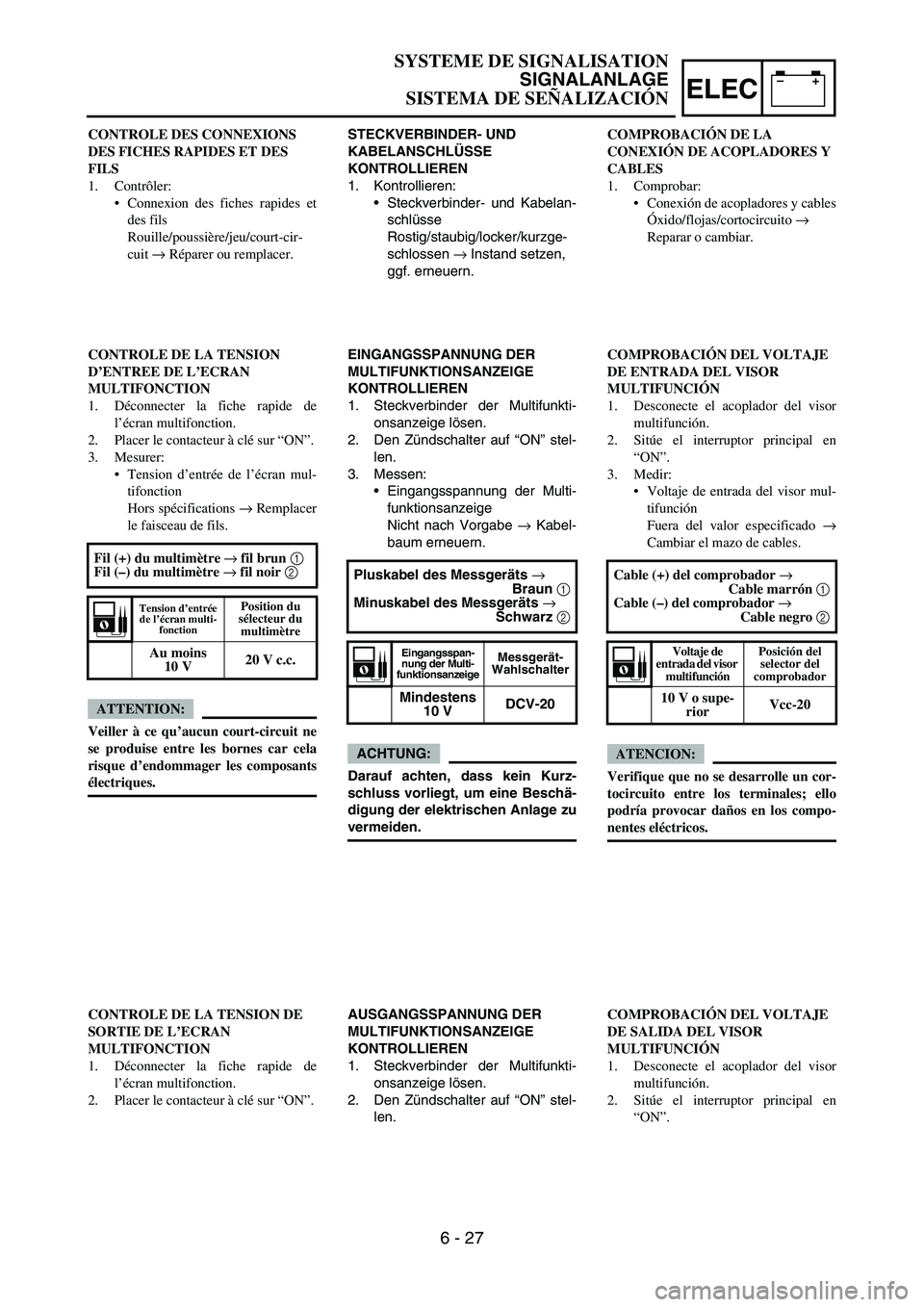
EINGANGSSPANNUNG DER
MULTIFUNKTIONSANZEIGE
KONTROLLIEREN
1. Steckverbinder der Multifunkti-
onsanzeige lösen.
2. Den Zündschalter auf “ON” stel-
len.
3. Messen:
Eingangsspannung der Multi-
funktionsanzeige
Nicht nach Vorgabe → Kabel-
baum erneuern.
ACHTUNG:
Darauf achten, dass kein Kurz-
schluss vorliegt, um eine Beschä-
digung der elektrischen Anlage zu
vermeiden.Pluskabel des Messgeräts →
Braun 1
Minuskabel des Messgeräts →
Schwarz 2
Eingangsspan-
nung der Multi-
funktionsanzeigeMessgerät-
Wahlschalter
Mindestens
10 VDCV-20
AUSGANGSSPANNUNG DER
MULTIFUNKTIONSANZEIGE
KONTROLLIEREN
1. Steckverbinder der Multifunkti-
onsanzeige lösen.
2. Den Zündschalter auf “ON” stel-
len. CONTROLE DES CONNEXIONS
DES FICHES RAPIDES ET DES
FILS
1. Contrôler:
Connexion des fiches rapides et
des fils
Rouille/poussière/jeu/court-cir-
cuit → Réparer ou remplacer.
CONTROLE DE LA TENSION
D’ENTREE DE L’ECRAN
MULTIFONCTION
1. Déconnecter la fiche rapide de
l’écran multifonction.
2. Placer le contacteur à clé sur “ON”.
3. Mesurer:
Tension d’entrée de l’écran mul-
tifonction
Hors spécifications → Remplacer
le faisceau de fils.
ATTENTION:
Veiller à ce qu’aucun court-circuit ne
se produise entre les bornes car cela
risque d’endommager les composants
électriques.Fil (+) du multimètre → fil brun 1
Fil (–) du multimètre → fil noir 2
Tension d’entrée
de l’écran multi-
fonctionPosition du
sélecteur du
multimètre
Au moins
10 V20 V c.c.
CONTROLE DE LA TENSION DE
SORTIE DE L’ECRAN
MULTIFONCTION
1. Déconnecter la fiche rapide de
l’écran multifonction.
2. Placer le contacteur à clé sur “ON”.COMPROBACIÓN DE LA
CONEXIÓN DE ACOPLADORES Y
CABLES
1. Comprobar:
Conexión de acopladores y cables
Óxido/flojas/cortocircuito →
Reparar o cambiar.
COMPROBACIÓN DEL VOLTAJE
DE ENTRADA DEL VISOR
MULTIFUNCIÓN
1. Desconecte el acoplador del visor
multifunción.
2. Sitúe el interruptor principal en
“ON”.
3. Medir:
Voltaje de entrada del visor mul-
tifunción
Fuera del valor especificado →
Cambiar el mazo de cables.
ATENCION:
Verifique que no se desarrolle un cor-
tocircuito entre los terminales; ello
podría provocar daños en los compo-
nentes eléctricos. Cable (+) del comprobador →
Cable marrón 1
Cable (–) del comprobador →
Cable negro 2
Voltaje de
entrada del visor
multifunciónPosición del
selector del
comprobador
10 V o supe-
riorVcc-20
COMPROBACIÓN DEL VOLTAJE
DE SALIDA DEL VISOR
MULTIFUNCIÓN
1. Desconecte el acoplador del visor
multifunción.
2. Sitúe el interruptor principal en
“ON”.
SYSTEME DE SIGNALISATION
SIGNALANLAGE
SISTEMA DE SEÑALIZACIÓN
6 - 27
Page 760 of 786
7 - 11
TUNSETTING
EC722011
Front fork setting
The front fork setting should be made depend-
ing on the rider’s feeling of an actual run and
the circuit conditions.
The front fork setting includes the following
three factors:
1. Setting of air spring characteristics
•Change the fork oil level.
2. Setting of spring preload
•Change the spring.
•Install the adjustment washer.
3. Setting of damping force
•Change the compression damping.
•Change the rebound damping.
The spring acts on the load and the
damping force acts on the cushion travel
speed.
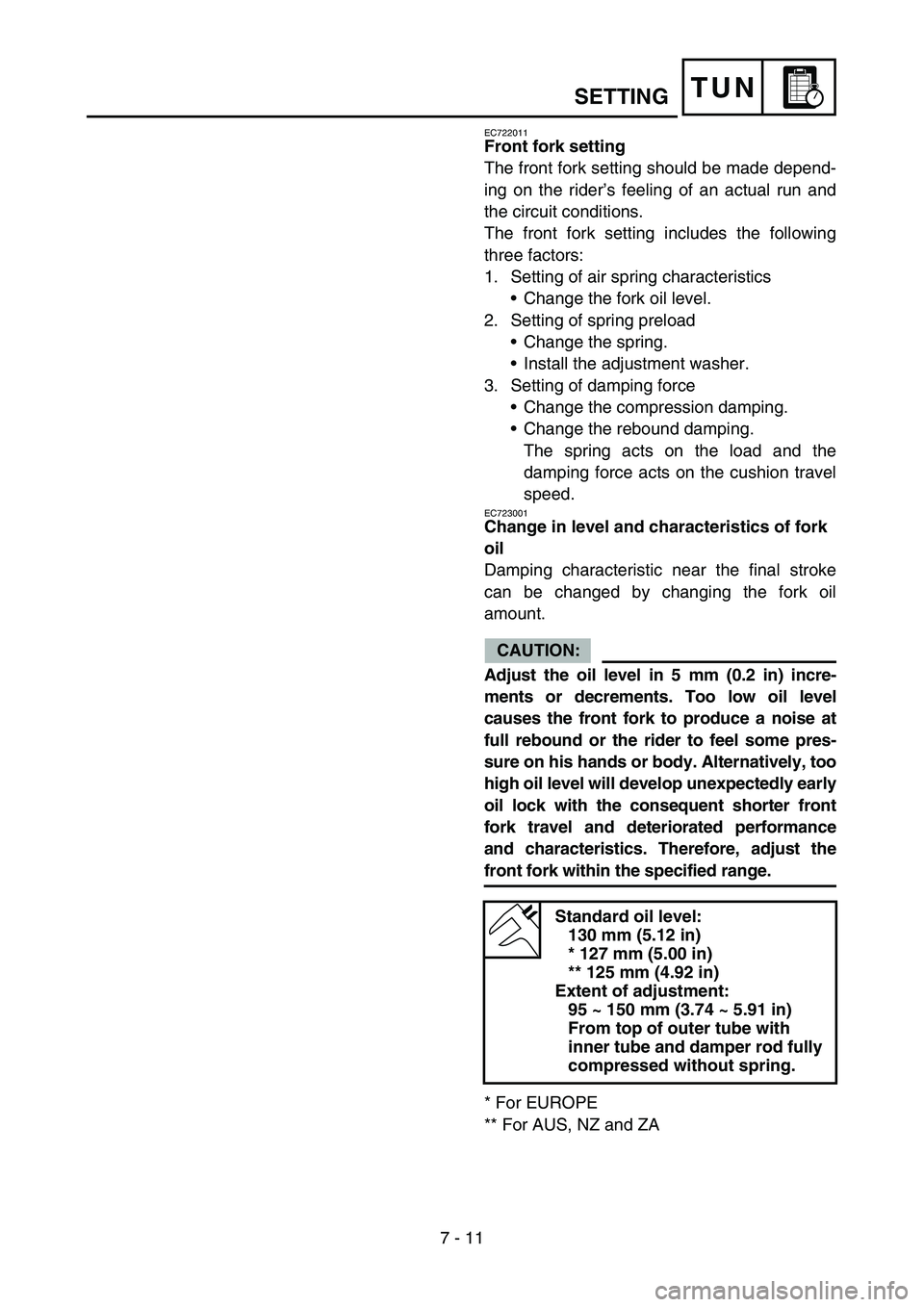
EC723001
Change in level and characteristics of fork
oil
Damping characteristic near the final stroke
can be changed by changing the fork oil
amount.
CAUTION:
Adjust the oil level in 5 mm (0.2 in) incre-
ments or decrements. Too low oil level
causes the front fork to produce a noise at
full rebound or the rider to feel some pres-
sure on his hands or body. Alternatively, too
high oil level will develop unexpectedly early
oil lock with the consequent shorter front
fork travel and deteriorated performance
and characteristics. Therefore, adjust the
front fork within the specified range.
* For EUROPE
** For AUS, NZ and ZA
Standard oil level:
130 mm (5.12 in)
* 127 mm (5.00 in)
** 125 mm (4.92 in)
Extent of adjustment:
95 ~ 150 mm (3.74 ~ 5.91 in)
From top of outer tube with
inner tube and damper rod fully
compressed without spring.
Page 768 of 786
7 - 15
TUN
EC72B000
Rear suspension setting
The rear suspension setting should be made
depending on the rider’s feeling of an actual
run and the circuit conditions.
The rear suspension setting includes the fol-
lowing two factors:
1. Setting of spring preload
•Change the set length of the spring.
•Change the spring.
2. Setting of damping force
•Change the rebound damping.
•Change the compression damping.
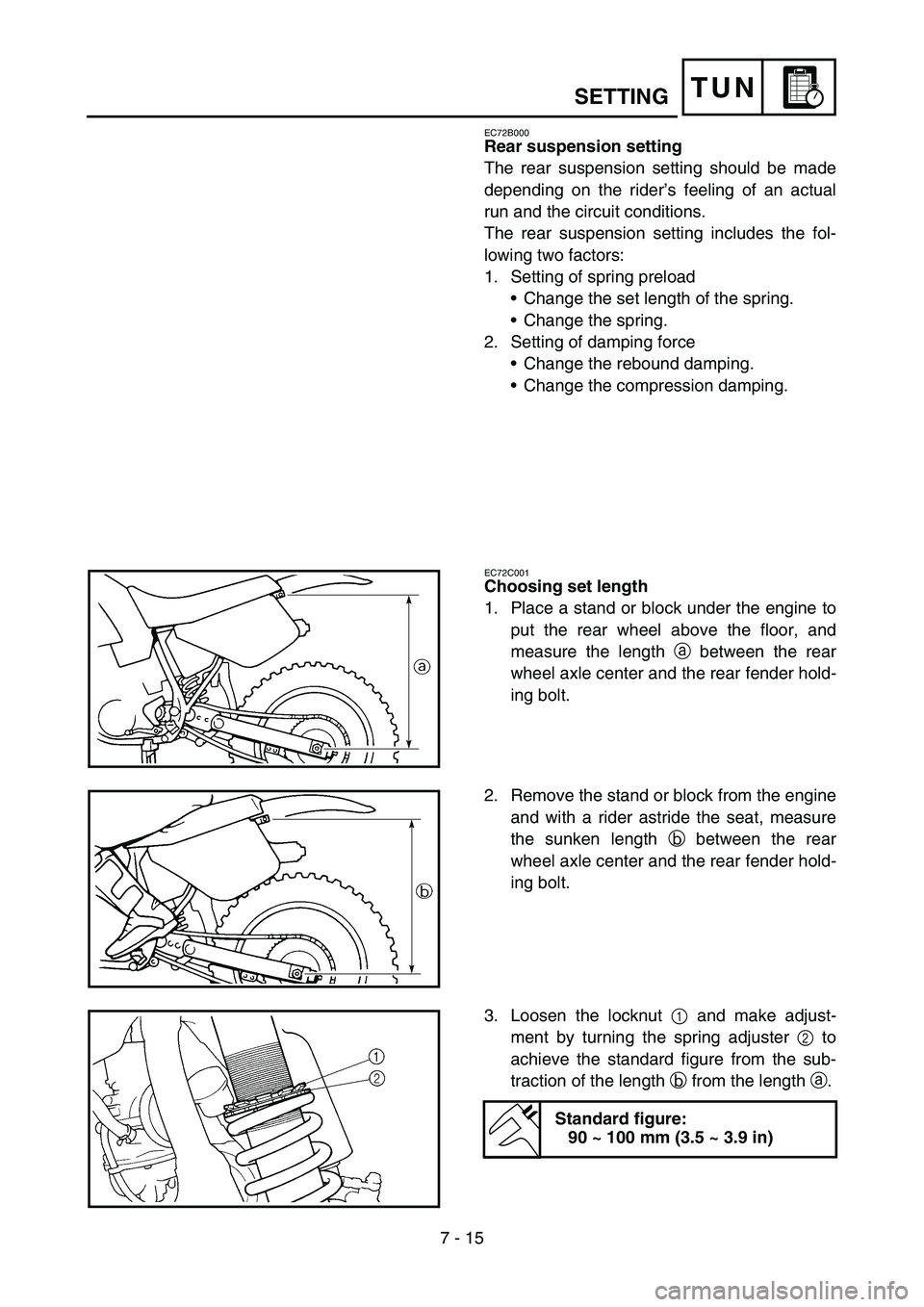
EC72C001
Choosing set length
1. Place a stand or block under the engine to
put the rear wheel above the floor, and
measure the length a between the rear
wheel axle center and the rear fender hold-
ing bolt.
2. Remove the stand or block from the engine
and with a rider astride the seat, measure
the sunken length b between the rear
wheel axle center and the rear fender hold-
ing bolt.
3. Loosen the locknut 1 and make adjust-
ment by turning the spring adjuster 2 to
achieve the standard figure from the sub-
traction of the length b from the length a.
Standard figure:
90 ~ 100 mm (3.5 ~ 3.9 in)
SETTING
Page 776 of 786

7 - 19
TUNSETTING
EC72H002
Suspension setting
•Front fork
NOTE:
•If any of the following symptoms is experienced with the standard position as the base, make
resetting by reference to the adjustment procedure given in the same chart.
•Before any change, set the rear shock absorber sunken length to the standard figure 90 ~ 100 mm
(3.5 ~ 3.9 in).
SymptomSection
Check Adjust
JumpLarge
gapMedium
gapSmall
gap
Stiff over entire rangeCompression damping Turn adjuster counterclockwise (about 2 clicks) to
decrease damping.
Oil level (oil amount) Decrease oil level by about 5 ~ 10 mm (0.2 ~ 0.4 in).
Spring Replace with soft spring.
Unsmooth movement
over entire rangeOuter tube
Check for any bends, dents, and other noticeable
scars, etc. If any, replace affected parts.
Inner tube
Under bracket tightening
torqueRetighten to specified torque.
Poor initial
movementRebound damping Turn adjuster counterclockwise (about 2 clicks) to
decrease damping.
Oil seal Apply grease in oil seal wall.
Soft over entire
range, bottoming outCompression damping Turn adjuster clockwise (about 2 clicks) to increase
damping.
Oil level (oil amount) Increase oil level by about 5 ~ 10 mm (0.2 ~ 0.4 in).
Spring Replace with stiff spring.
Stiff toward stroke
endOil level (oil amount) Decrease oil level by about 5 mm (0.2 in).
Soft toward stroke
end, bottoming outOil level (oil amount) Increase oil level by about 5 mm (0.2 in).
Stiff initial movement Compression dampingTurn adjuster counterclockwise (about 2 clicks) to
decrease damping.
Low front, tending to
lower front postureCompression damping Turn adjuster clockwise (about 2 clicks) to increase
damping.
Rebound damping Turn adjuster counterclockwise (about 2 clicks) to
decrease damping.
Balance with rear end Set sunken length for 95 ~ 100 mm (3.7 ~ 3.9 in)
when one passenger is astride seat (lower rear pos-
ture).
Oil level (oil amount) Increase oil level by about 5 mm (0.2 in).
“Obtrusive” front,
tending to upper front
postureCompression damping Turn adjuster counterclockwise (about 2 clicks) to
decrease damping.
Balance with rear end Set sunken length for 90 ~ 95 mm (3.5 ~ 3.7 in)
when one passenger is astride seat (upper rear pos-
ture).
Spring Replace with soft spring.
Oil lever (oil amount) Decrease oil level by about 5 ~ 10 mm (0.2 ~ 0.4 in).
Page 777 of 786

7 - 20
TUNSETTING
•Rear shock absorber
NOTE:
•If any of the following symptoms is experienced with the standard position as the base, make
resetting by reference to the adjustment procedure given in the same chart.
•Adjust the rebound damping in 2-click increments or decrements.
•Adjust the low compression damping in 1-click increments or decrements.
•Adjust the high compression damping in 1/6 turn increments or decrements.
SymptomSection
Check Adjust
JumpLarge
gapMedium
gapSmall
gap
Stiff, tending to sinkRebound damping Turn adjuster counterclockwise (about 2 clicks) to
decrease damping.
Spring set length Set sunken length for 90 ~ 100 mm (3.5 ~ 3.9 in)
when one passenger is astride seat.
Spongy and unstableRebound damping Turn adjuster clockwise (about 2 clicks) to increase
damping.
Low compression damp-
ingTurn adjuster clockwise (about 1 click) to increase
damping.
Spring Replace with stiff spring.
Heavy and draggingRebound damping Turn adjuster counterclockwise (about 2 clicks) to
decrease damping.
Spring Replace with soft spring.
Poor road grippingRebound damping Turn adjuster counterclockwise (about 2 clicks) to
decrease damping.
Low compression damp-
ingTurn adjuster clockwise (about 1 clicks) to increase
damping.
High compression damp-
ingTurn adjuster clockwise (about 1/6 clicks) to
increase damping.
Spring set length Set sunken length for 90 ~ 100 mm (3.5 ~ 3.9 in)
when one passenger is astride seat.
Spring Replace with soft spring.
Bottoming outHigh compression damp-
ingTurn adjuster clockwise (about 1/6 turn) to increase
damping.
Spring set length Set sunken length for 90 ~ 100 mm (3.5 ~ 3.9 in)
when one passenger in astride seat.
Spring Replace with stiff spring.
BouncingRebound damping Turn adjuster clockwise (about 2 clicks) to increase
damping.
Spring Replace with soft spring.
Stiff travelHigh compression damp-
ingTurn adjuster counterclockwise (about 1/6 turn) to
decrease damping.
Spring set length Set sunken length for 95 ~ 100 mm (3.7 ~ 3.9 in)
when one passenger is astride seat.
Spring Replace with soft spring.