fork oil YAMAHA WR 450F 2006 Owner's Manual
[x] Cancel search | Manufacturer: YAMAHA, Model Year: 2006, Model line: WR 450F, Model: YAMAHA WR 450F 2006Pages: 786, PDF Size: 22.49 MB
Page 590 of 786
5 - 32
CHASFRONT FORK
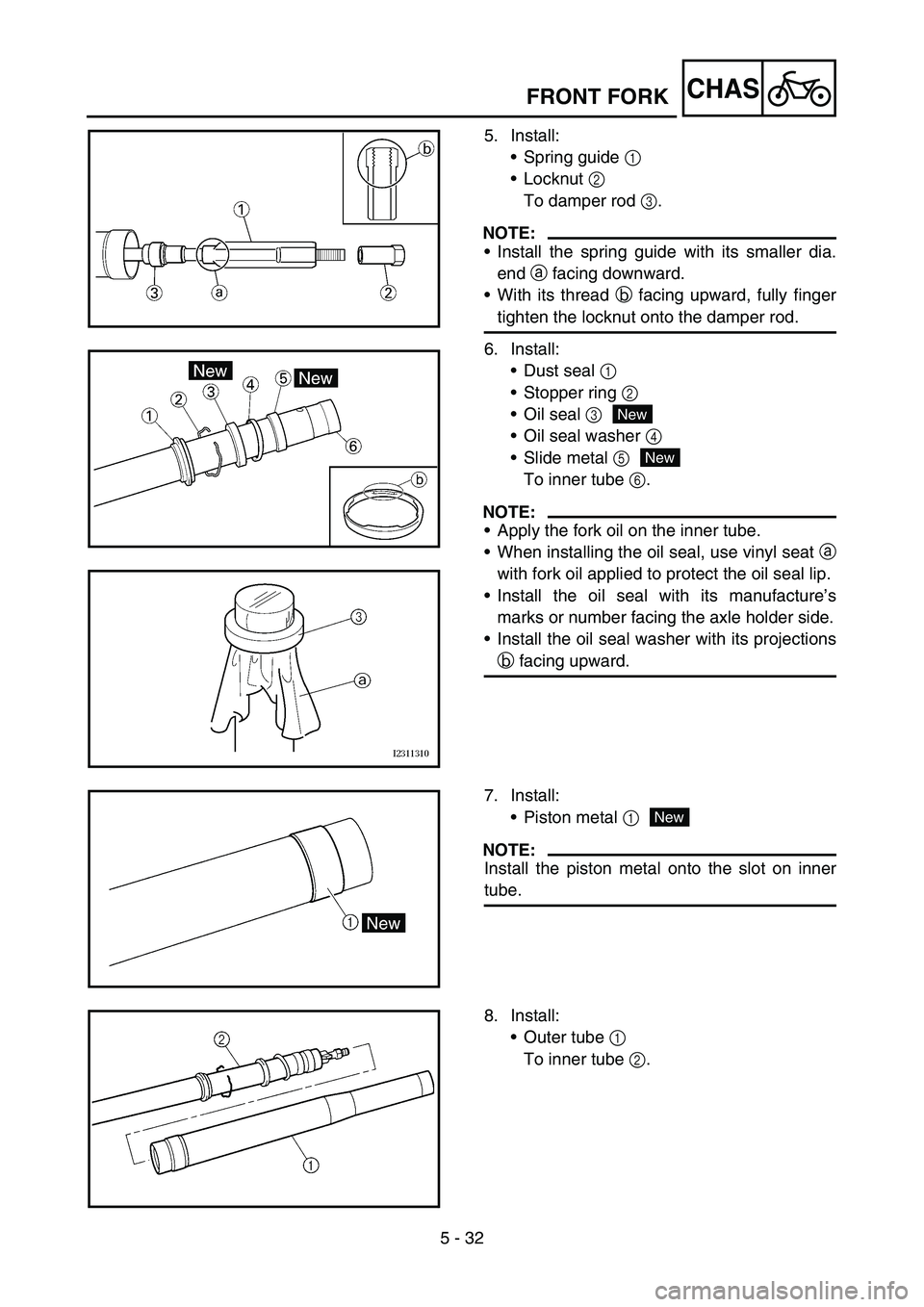
5. Install:
Spring guide 1
Locknut 2
To damper rod 3.
NOTE:
Install the spring guide with its smaller dia.
end a facing downward.
With its thread b facing upward, fully finger
tighten the locknut onto the damper rod.
6. Install:
Dust seal 1
Stopper ring 2
Oil seal 3
Oil seal washer 4
Slide metal 5
To inner tube 6.
NOTE:
Apply the fork oil on the inner tube.
When installing the oil seal, use vinyl seat a
with fork oil applied to protect the oil seal lip.
Install the oil seal with its manufacture’s
marks or number facing the axle holder side.
Install the oil seal washer with its projections
b facing upward.
New
New
7. Install:
Piston metal 1
NOTE:
Install the piston metal onto the slot on inner
tube.
New
8. Install:
Outer tube 1
To inner tube 2.
Page 592 of 786
5 - 33
CHASFRONT FORK
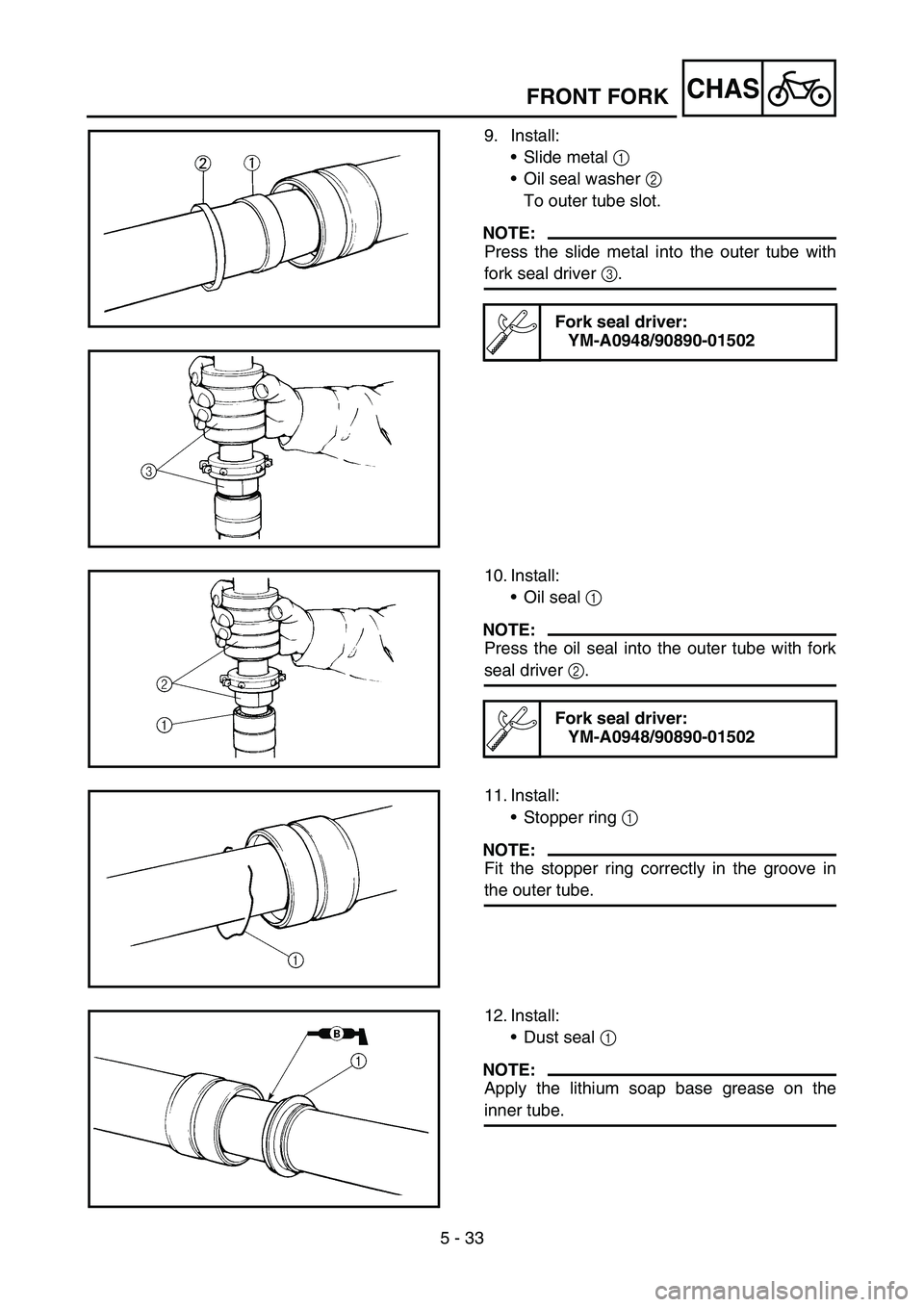
9. Install:
Slide metal 1
Oil seal washer 2
To outer tube slot.
NOTE:
Press the slide metal into the outer tube with
fork seal driver 3.
Fork seal driver:
YM-A0948/90890-01502
10. Install:
Oil seal 1
NOTE:
Press the oil seal into the outer tube with fork
seal driver 2.
Fork seal driver:
YM-A0948/90890-01502
11. Install:
Stopper ring 1
NOTE:
Fit the stopper ring correctly in the groove in
the outer tube.
12. Install:
Dust seal 1
NOTE:
Apply the lithium soap base grease on the
inner tube.
Page 594 of 786
5 - 34
CHASFRONT FORK
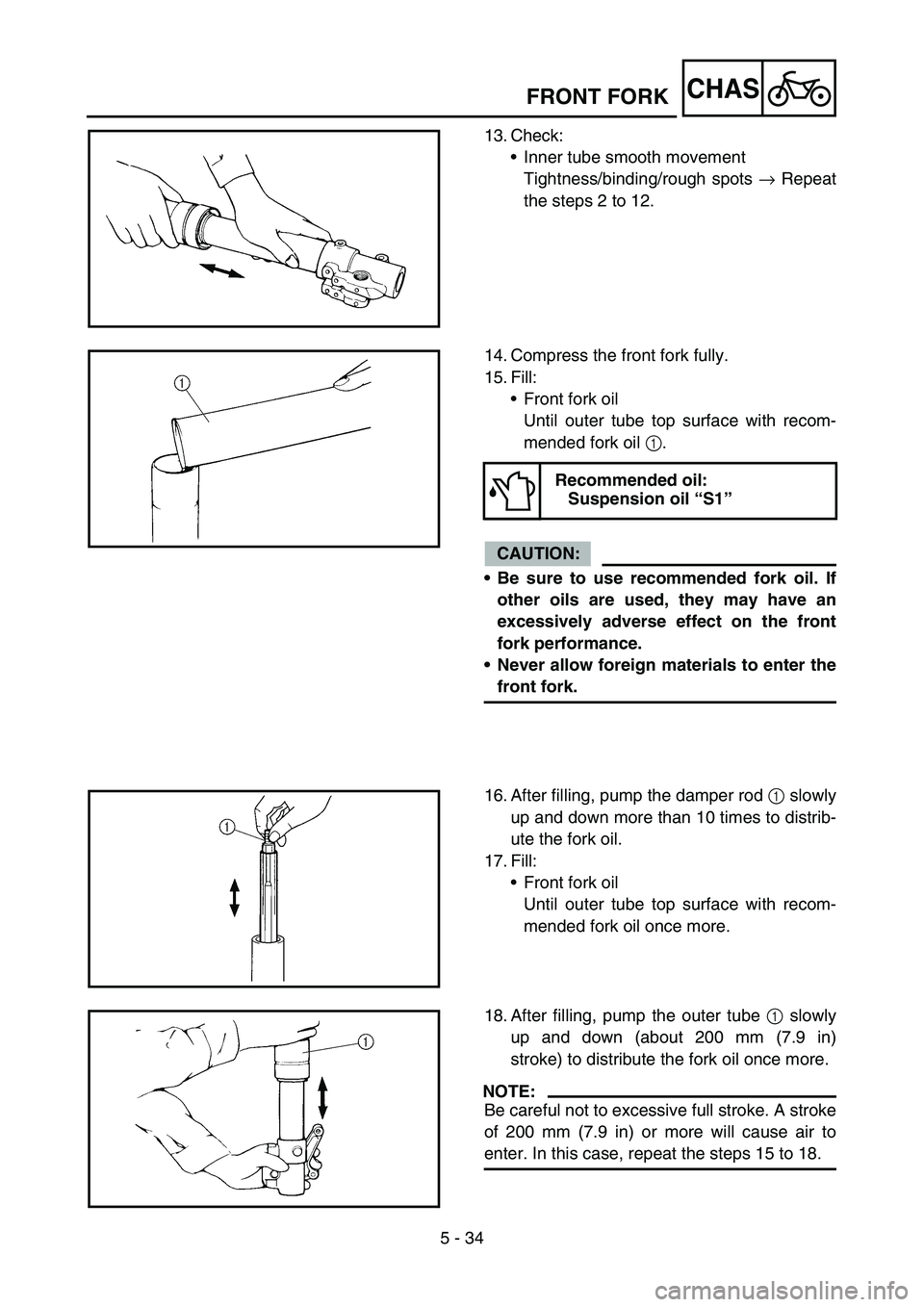
13. Check:
Inner tube smooth movement
Tightness/binding/rough spots → Repeat
the steps 2 to 12.
14. Compress the front fork fully.
15. Fill:
Front fork oil
Until outer tube top surface with recom-
mended fork oil 1.
CAUTION:
Be sure to use recommended fork oil. If
other oils are used, they may have an
excessively adverse effect on the front
fork performance.
Never allow foreign materials to enter the
front fork.
Recommended oil:
Suspension oil “S1”
16. After filling, pump the damper rod 1 slowly
up and down more than 10 times to distrib-
ute the fork oil.
17. Fill:
Front fork oil
Until outer tube top surface with recom-
mended fork oil once more.
18. After filling, pump the outer tube 1 slowly
up and down (about 200 mm (7.9 in)
stroke) to distribute the fork oil once more.
NOTE:
Be careful not to excessive full stroke. A stroke
of 200 mm (7.9 in) or more will cause air to
enter. In this case, repeat the steps 15 to 18.
Page 596 of 786
5 - 35
CHASFRONT FORK
19. Wait ten minutes until the air bubbles have
been removed from the front fork, and the
oil has dispense evenly in system before
setting recommended oil level.
NOTE:
Fill with the fork oil up to the top end of the
outer tube, or the fork oil will not spread over to
every part of the front forks, thus making it
impossible to obtain the correct level.
Be sure to fill with the fork oil up to the top of
the outer tube and bleed the front forks.
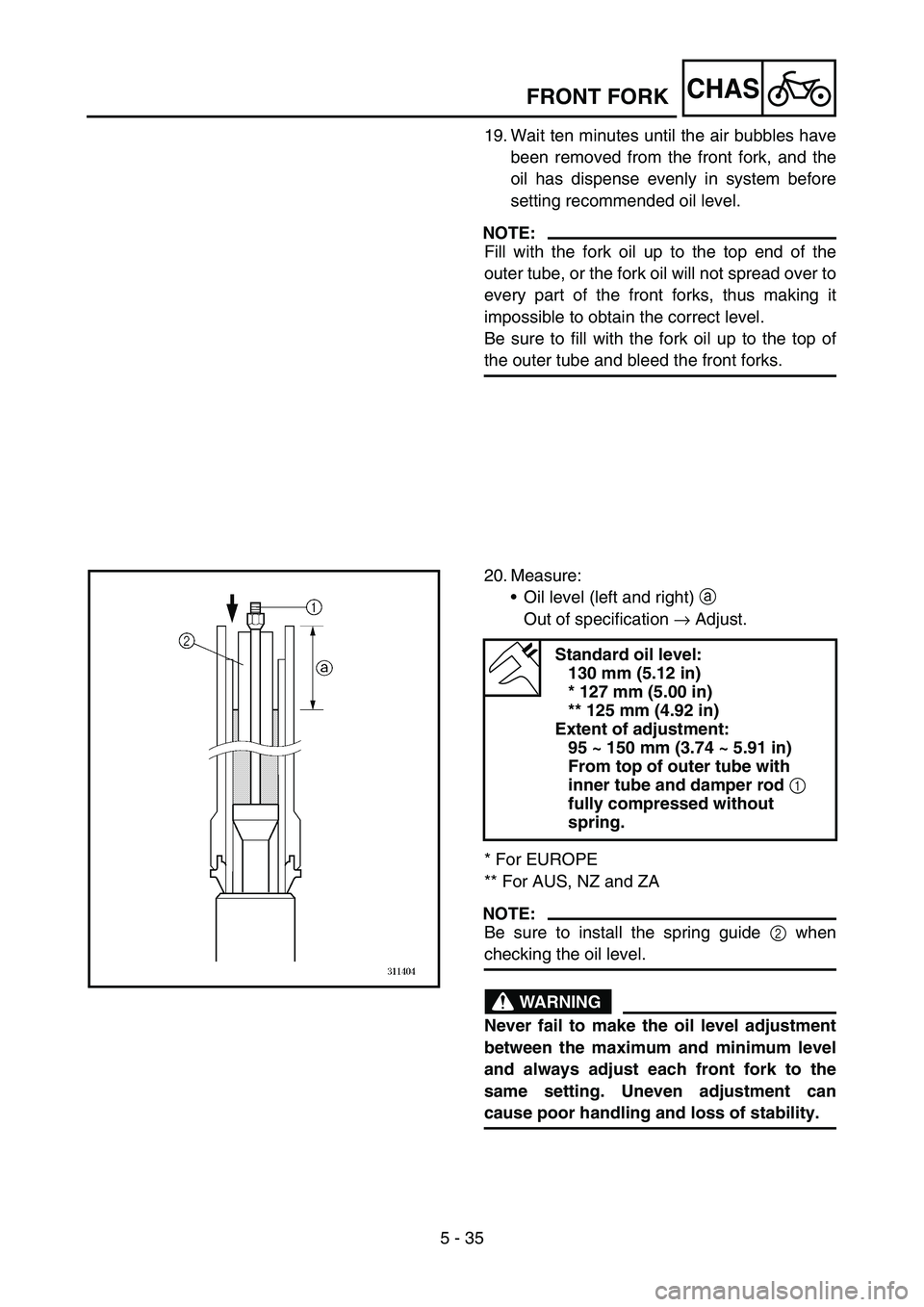
20. Measure:
Oil level (left and right) a
Out of specification → Adjust.
* For EUROPE
** For AUS, NZ and ZA
NOTE:
Be sure to install the spring guide 2 when
checking the oil level.
WARNING
Never fail to make the oil level adjustment
between the maximum and minimum level
and always adjust each front fork to the
same setting. Uneven adjustment can
cause poor handling and loss of stability.
Standard oil level:
130 mm (5.12 in)
* 127 mm (5.00 in)
** 125 mm (4.92 in)
Extent of adjustment:
95 ~ 150 mm (3.74 ~ 5.91 in)
From top of outer tube with
inner tube and damper rod
1
fully compressed without
spring.
Page 760 of 786
7 - 11
TUNSETTING
EC722011
Front fork setting
The front fork setting should be made depend-
ing on the rider’s feeling of an actual run and
the circuit conditions.
The front fork setting includes the following
three factors:
1. Setting of air spring characteristics
•Change the fork oil level.
2. Setting of spring preload
•Change the spring.
•Install the adjustment washer.
3. Setting of damping force
•Change the compression damping.
•Change the rebound damping.
The spring acts on the load and the
damping force acts on the cushion travel
speed.
EC723001
Change in level and characteristics of fork
oil
Damping characteristic near the final stroke
can be changed by changing the fork oil
amount.
CAUTION:
Adjust the oil level in 5 mm (0.2 in) incre-
ments or decrements. Too low oil level
causes the front fork to produce a noise at
full rebound or the rider to feel some pres-
sure on his hands or body. Alternatively, too
high oil level will develop unexpectedly early
oil lock with the consequent shorter front
fork travel and deteriorated performance
and characteristics. Therefore, adjust the
front fork within the specified range.
* For EUROPE
** For AUS, NZ and ZA
Standard oil level:
130 mm (5.12 in)
* 127 mm (5.00 in)
** 125 mm (4.92 in)
Extent of adjustment:
95 ~ 150 mm (3.74 ~ 5.91 in)
From top of outer tube with
inner tube and damper rod fully
compressed without spring.
Page 762 of 786
7 - 12
TUNSETTING
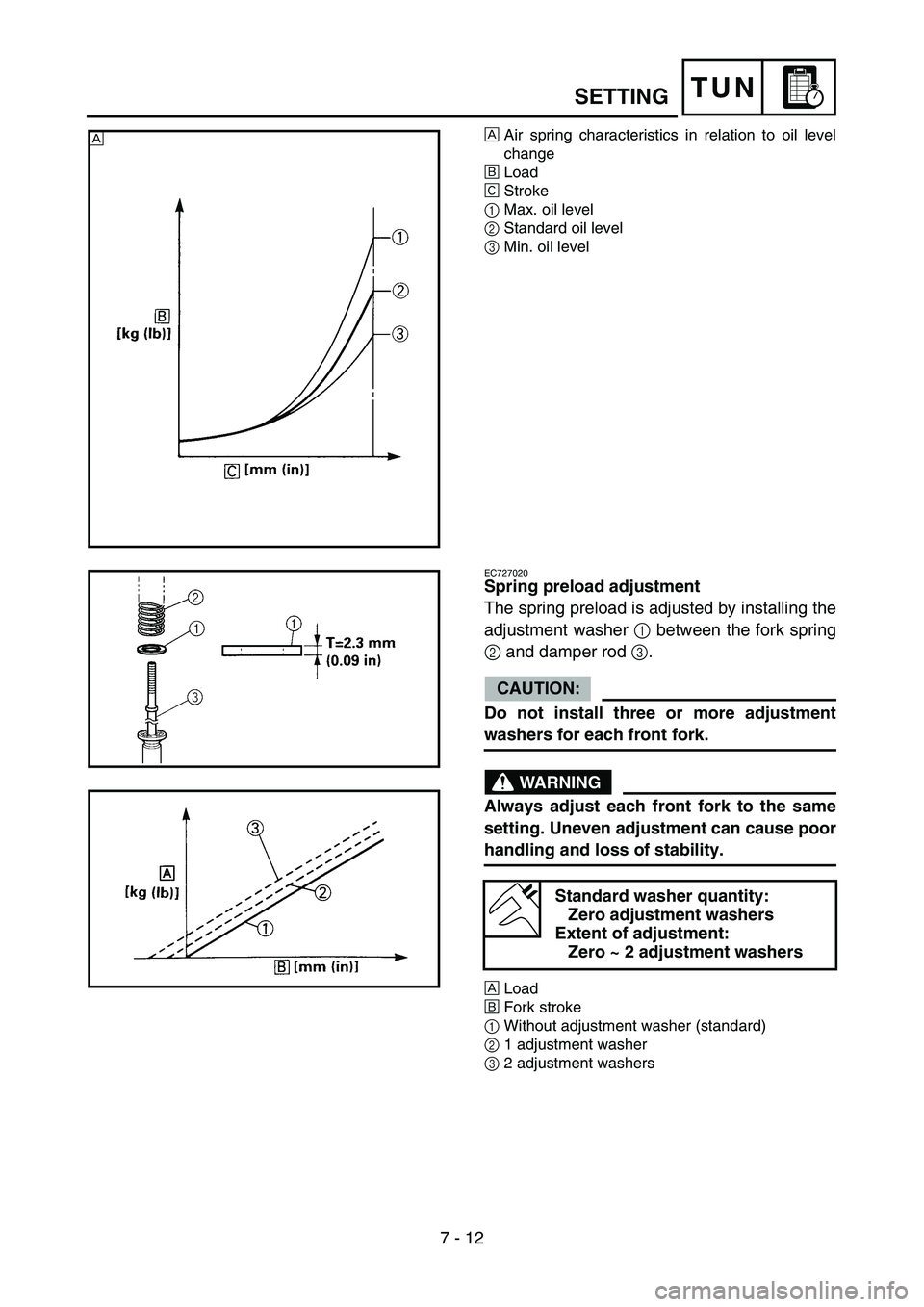
ÈAir spring characteristics in relation to oil level
change
ÉLoad
ÊStroke
1Max. oil level
2Standard oil level
3Min. oil levelÈ
EC727020
Spring preload adjustment
The spring preload is adjusted by installing the
adjustment washer 1
between the fork spring
2
and damper rod 3
.
CAUTION:
Do not install three or more adjustment
washers for each front fork.
WARNING
Always adjust each front fork to the same
setting. Uneven adjustment can cause poor
handling and loss of stability.
ÈLoad
ÉFork stroke
1Without adjustment washer (standard)
21 adjustment washer
32 adjustment washers
Standard washer quantity:
Zero adjustment washers
Extent of adjustment:
Zero ~ 2 adjustment washers
Page 776 of 786

7 - 19
TUNSETTING
EC72H002
Suspension setting
•Front fork
NOTE:
•If any of the following symptoms is experienced with the standard position as the base, make
resetting by reference to the adjustment procedure given in the same chart.
•Before any change, set the rear shock absorber sunken length to the standard figure 90 ~ 100 mm
(3.5 ~ 3.9 in).
SymptomSection
Check Adjust
JumpLarge
gapMedium
gapSmall
gap
Stiff over entire rangeCompression damping Turn adjuster counterclockwise (about 2 clicks) to
decrease damping.
Oil level (oil amount) Decrease oil level by about 5 ~ 10 mm (0.2 ~ 0.4 in).
Spring Replace with soft spring.
Unsmooth movement
over entire rangeOuter tube
Check for any bends, dents, and other noticeable
scars, etc. If any, replace affected parts.
Inner tube
Under bracket tightening
torqueRetighten to specified torque.
Poor initial
movementRebound damping Turn adjuster counterclockwise (about 2 clicks) to
decrease damping.
Oil seal Apply grease in oil seal wall.
Soft over entire
range, bottoming outCompression damping Turn adjuster clockwise (about 2 clicks) to increase
damping.
Oil level (oil amount) Increase oil level by about 5 ~ 10 mm (0.2 ~ 0.4 in).
Spring Replace with stiff spring.
Stiff toward stroke
endOil level (oil amount) Decrease oil level by about 5 mm (0.2 in).
Soft toward stroke
end, bottoming outOil level (oil amount) Increase oil level by about 5 mm (0.2 in).
Stiff initial movement Compression dampingTurn adjuster counterclockwise (about 2 clicks) to
decrease damping.
Low front, tending to
lower front postureCompression damping Turn adjuster clockwise (about 2 clicks) to increase
damping.
Rebound damping Turn adjuster counterclockwise (about 2 clicks) to
decrease damping.
Balance with rear end Set sunken length for 95 ~ 100 mm (3.7 ~ 3.9 in)
when one passenger is astride seat (lower rear pos-
ture).
Oil level (oil amount) Increase oil level by about 5 mm (0.2 in).
“Obtrusive” front,
tending to upper front
postureCompression damping Turn adjuster counterclockwise (about 2 clicks) to
decrease damping.
Balance with rear end Set sunken length for 90 ~ 95 mm (3.5 ~ 3.7 in)
when one passenger is astride seat (upper rear pos-
ture).
Spring Replace with soft spring.
Oil lever (oil amount) Decrease oil level by about 5 ~ 10 mm (0.2 ~ 0.4 in).