6 - 25
–+ELEC
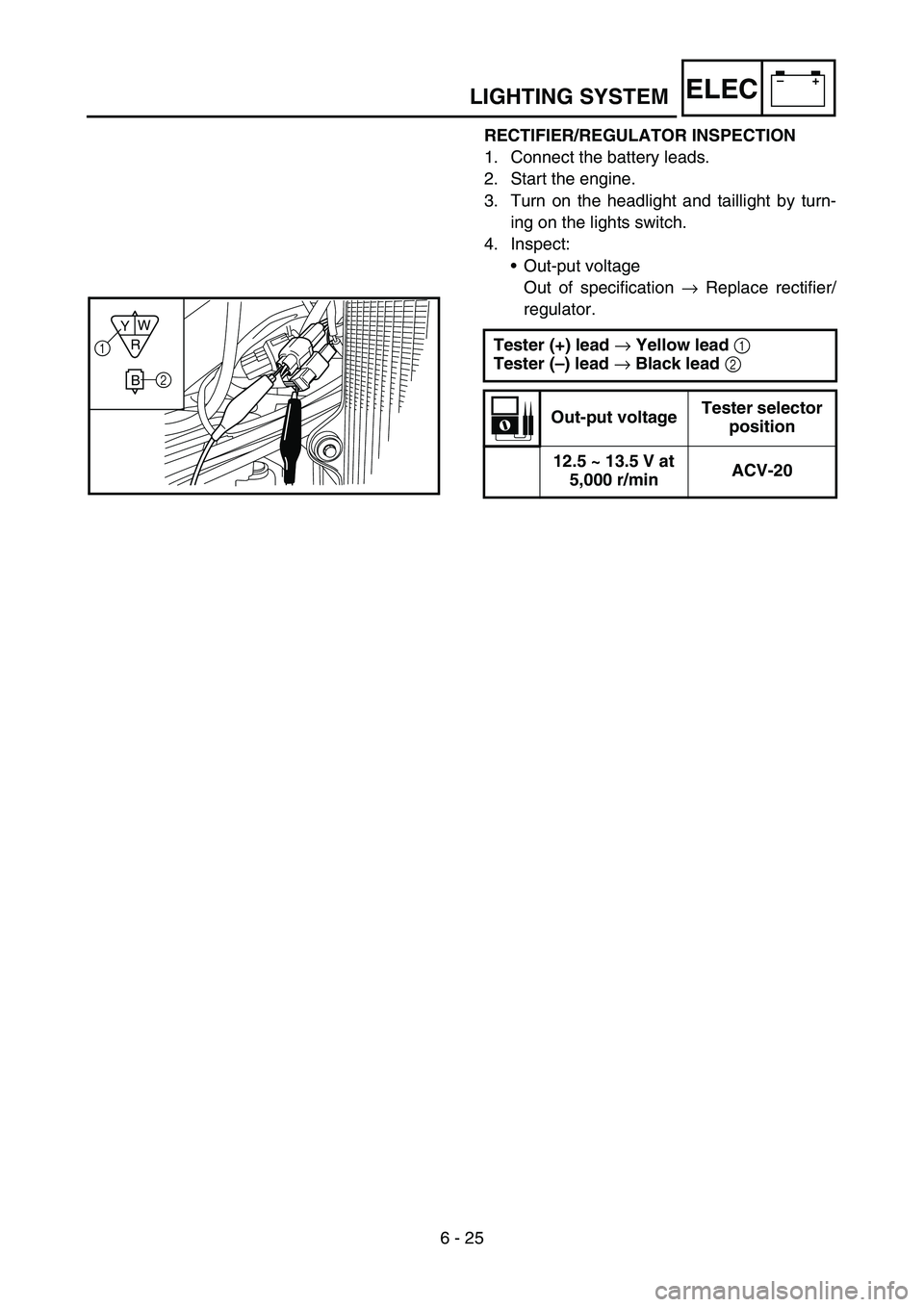
RECTIFIER/REGULATOR INSPECTION
1. Connect the battery leads.
2. Start the engine.
3. Turn on the headlight and taillight by turn-
ing on the lights switch.
4. Inspect:
•Out-put voltage
Out of specification → Replace rectifier/
regulator.
Tester (+) lead → Yellow lead 1
Tester (–) lead → Black lead 2
Out-put voltageTester selector
position
12.5 ~ 13.5 V at
5,000 r/minACV-20
R
BW
Y1
2
LIGHTING SYSTEM
–+ELEC
6 - 26
SIGNALING SYSTEM
SIGNALING SYSTEM
INSPECTION STEPS
If the speedometer will not operate, use the following inspection steps.
*1 marked: Refer to “BATTERY INSPECTION AND CHARGING” section in the CHAPTER 3.
NOTE:
•Remove the following parts before inspection.
1) Headlight
•Use the following special tools in this inspection.
Pocket tester:
YU-3112-C/90890-03112
*1 Check battery. Recharge or replace.
Check each coupler and
wire connection.Repair or replace.
Check multi-function dis-
play.Input voltage Replace wire harness.
Output voltageReplace multi-func-
tion display.
Check speed sensor. Replace.
OK
OK
OK
No good
No good
No good No good
No good
7 - 2
TUN
CAUTION:
The carburetor is extremely sensitive to
foreign matter (dirt, sand, water, etc.).
During installation, do not allow foreign
matter to get into the carburetor.
Always handle the carburetor and its
components carefully. Even slight
scratches, bends or damage to carburetor
parts may prevent the carburetor from
functioning correctly. Carefully perform
all servicing with the appropriate tools
and without applying excessive force.
When the engine is stopped or when
riding at no load, do not open and close
the throttle unnecessarily. Otherwise, too
much fuel may be discharged, starting
may become difficult or the engine may
not run well.
After installing the carburetor, check that
the throttle operates correctly and opens
and closes smoothly.
Atmospheric conditions and carburetor
settings
The air density (i.e., concentration of oxygen
in the air) determines the richness or lean-
ness of the air/fuel mixture. Therefore, refer
to the above table for mixture settings.
That is:
•Higher temperature expands the air with its
resultant reduced density.
•Higher humidity reduces the amount of oxy-
gen in the air by so much of the water vapor
in the same air.
•Lower atmospheric pressure (at a high alti-
tude) reduces the density of the air.
Air temp. HumidityAir
pressure
(altitude)Mixture Setting
High High Low (high) Richer Leaner
Low Low High (low) Leaner Richer
SETTING