length YAMAHA WR 450F 2010 Owner's Manual
[x] Cancel search | Manufacturer: YAMAHA, Model Year: 2010, Model line: WR 450F, Model: YAMAHA WR 450F 2010Pages: 230, PDF Size: 13.87 MB
Page 186 of 230
6-18
FRONT FORK
HANDLING NOTE
Support the machine securely so
there is no danger of it falling over.
The front fork requires careful atten-
tion. So it is recommended that the
front fork be maintained at the deal-
ers.
To prevent an accidental explosion
of air, the following instructions
should be observed:
• The front fork with a built-in pis-
ton rod has a very sophisticated
internal construction and is par-
ticularly sensitive to foreign ma-
terial. Use enough care not to
allow any foreign material to
come in when the oil is replaced
or when the front fork is disas-
sembled and reassembled.
• Before removing the cap bolts or
front forks, be sure to extract the
air from the air chamber com-
pletely.
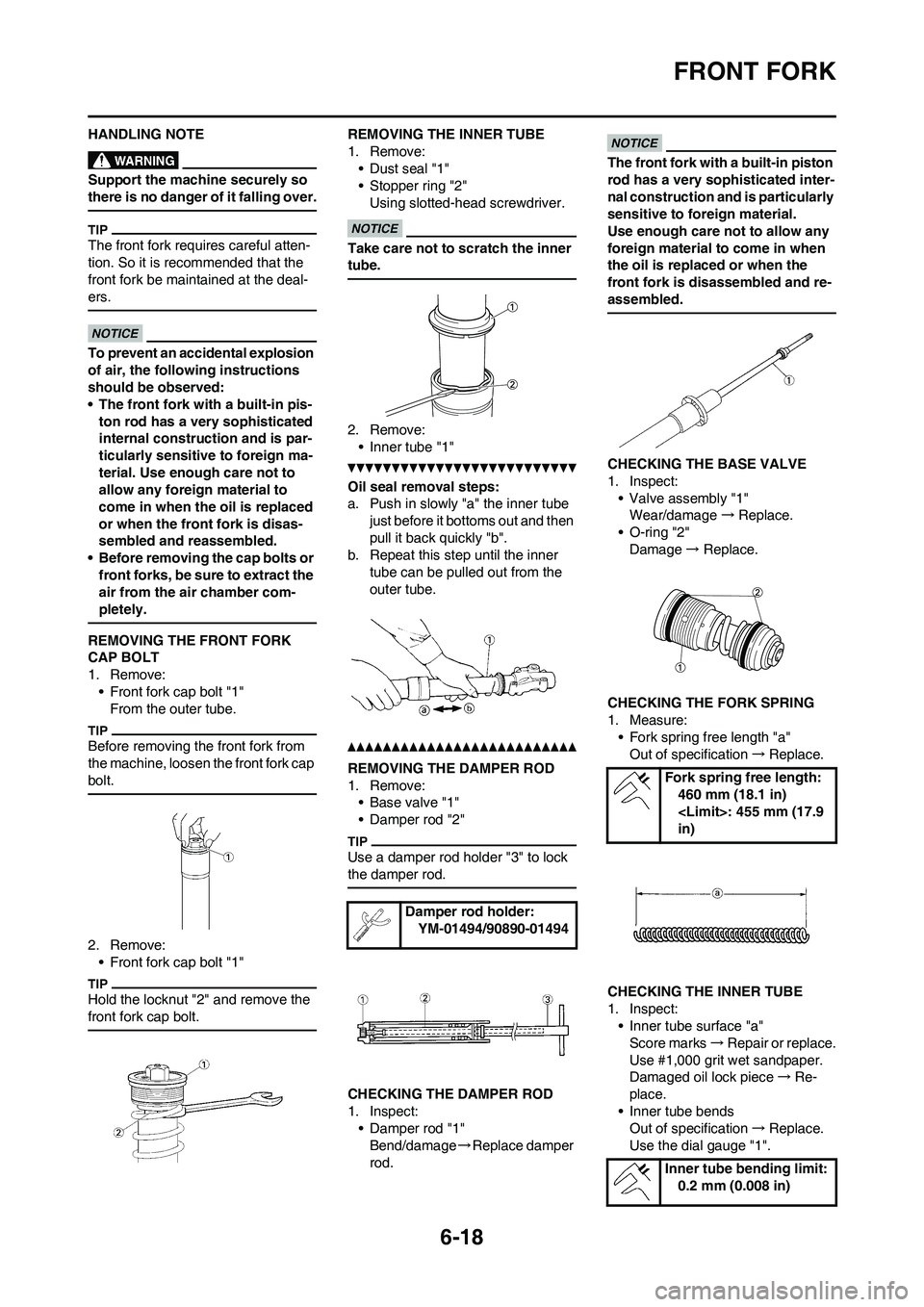
REMOVING THE FRONT FORK
CAP BOLT
1. Remove:
• Front fork cap bolt "1"
From the outer tube.
Before removing the front fork from
the machine, loosen the front fork cap
bolt.
2. Remove:
• Front fork cap bolt "1"
Hold the locknut "2" and remove the
front fork cap bolt.
REMOVING THE INNER TUBE
1. Remove:
• Dust seal "1"
• Stopper ring "2"
Using slotted-head screwdriver.
Take care not to scratch the inner
tube.
2. Remove:
• Inner tube "1"
Oil seal removal steps:
a. Push in slowly "a" the inner tube
just before it bottoms out and then
pull it back quickly "b".
b. Repeat this step until the inner
tube can be pulled out from the
outer tube.
REMOVING THE DAMPER ROD
1. Remove:
• Base valve "1"
• Damper rod "2"
Use a damper rod holder "3" to lock
the damper rod.
CHECKING THE DAMPER ROD
1. Inspect:
• Damper rod "1"
Bend/damage→Replace damper
rod.
The front fork with a built-in piston
rod has a very sophisticated inter-
nal construction and is particularly
sensitive to foreign material.
Use enough care not to allow any
foreign material to come in when
the oil is replaced or when the
front fork is disassembled and re-
assembled.
CHECKING THE BASE VALVE
1. Inspect:
• Valve assembly "1"
Wear/damage →Replace.
• O-ring "2"
Damage→ Replace.
CHECKING THE FORK SPRING
1. Measure:
• Fork spring free length "a"
Out of specification→Replace.
CHECKING THE INNER TUBE
1. Inspect:
• Inner tube surface "a"
Score marks→Repair or replace.
Use #1,000 grit wet sandpaper.
Damaged oil lock piece→Re-
place.
• Inner tube bends
Out of specification→Replace.
Use the dial gauge "1".
Damper rod holder:
YM-01494/90890-01494
Fork spring free length:
460 mm (18.1 in)
in)
Inner tube bending limit:
0.2 mm (0.008 in)
Page 207 of 230

6-39
REAR SHOCK ABSORBER
2. Install:
• Stopper ring (upper bearing) "1"
After installing the stopper ring, push
back the bearing until it contacts the
stopper ring.
3. Install:
• Lower bearing "1"
Install the bearing by pressing it on
the side having the manufacture's
marks or numbers.
INSTALLING THE SPRING (REAR
SHOCK ABSORBER)
1. Install:
• Spring "1"
• Upper spring guide "2"
• Lower spring guide "3"
2. Tighten:
•Adjuster "1"3. Adjust:
• Spring length (installed)
Refer to "ADJUSTING THE
REAR SHOCK ABSORBER
SPRING PRELOAD" section in
the CHAPTER 3.
4. Tighten:
• Locknut "1"
INSTALLING THE REAR SHOCK
ABSORBER
1. Install:
• Dust seal "1"
• O-ring "2"
• Collar "3"
• Apply the molybdenum disulfide
grease on the dust seal lips and col-
lars.
• Apply the lithium soap base grease
on the O-rings.
2. Install:
• Bushing "1"
• Collar "2"
• Dust seal "3"
• Apply the molybdenum disulfide
grease on the bearing and dust seal
lips.
• Install the dust seals with their lips
facing inward.
3. Install:
• Rear shock absorber4. Install:
• Bolt (rear shock absorber-frame)
"1"
• Washer "2"
• Nut (rear shock absorber-frame)
"3"
Apply the molybdenum disulfide
grease on the bolt.
5. Install:
• Bolt (rear shock absorber-relay
arm)"1"
• Nut (rear shock absorber-relay
arm) "2"
Apply the molybdenum disulfide
grease on the bolt.
6. Install:
• Rear frame "1"
• Bolt [rear frame (upper)] "2"
• Bolt [rear frame (lower)] "3" Installed depth of the
bearing "a":
4 mm (0.16 in)
Nut (rear shock absorb-
er-frame):
56 Nm (5.6 m•kg, 40
ft•lb)
Nut (rear shock absorb-
er-relay arm):
53 Nm (5.3 m•kg, 38
ft•lb)
Bolt [rear frame (upper)]:
38 Nm (3.8 m•kg, 27
ft•lb)
Bolt [rear frame (lower)]:
32 Nm (3.2 m•kg, 23
ft•lb)
Page 219 of 230
7-11
ELECTRIC STARTING SYSTEM
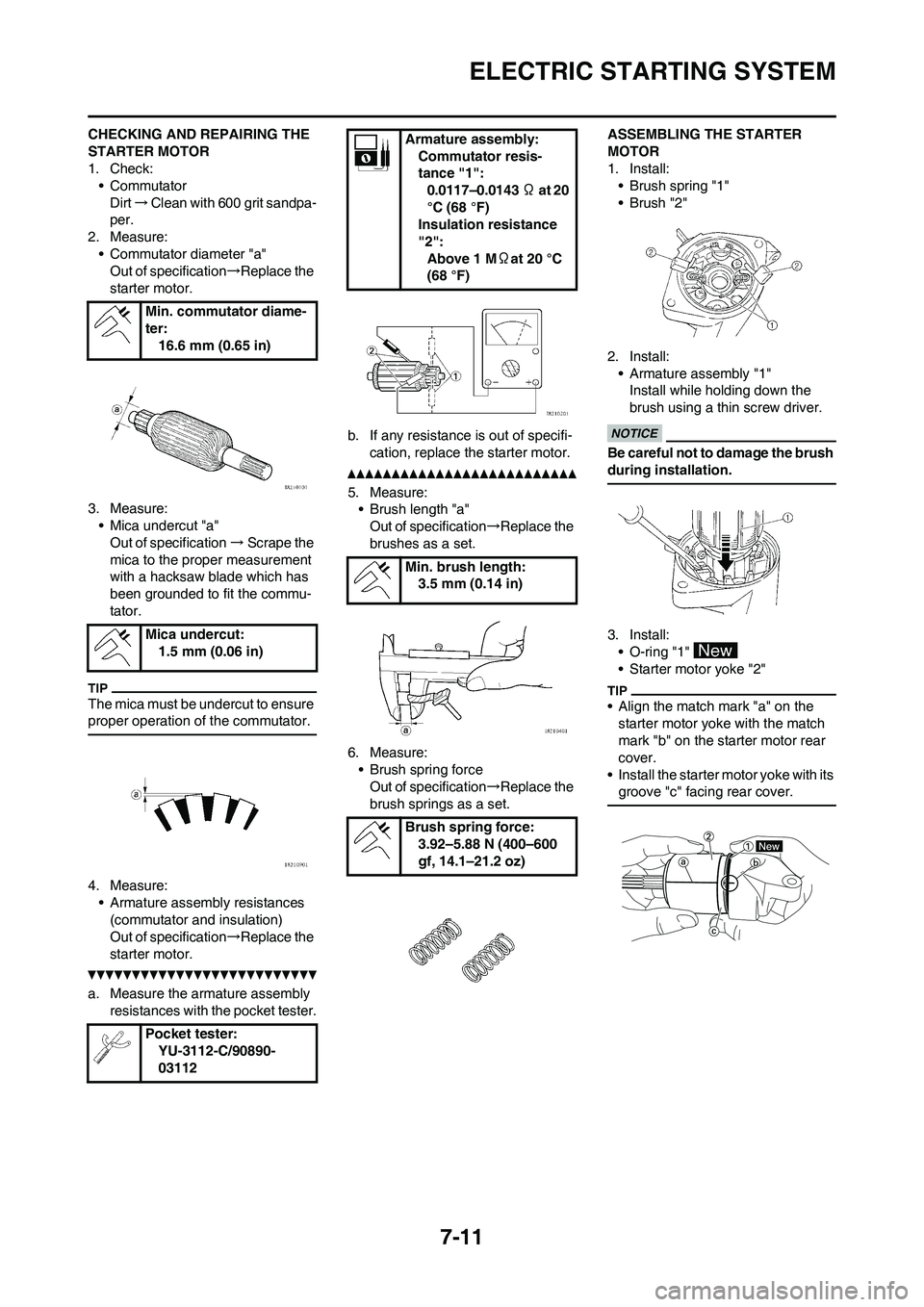
CHECKING AND REPAIRING THE
STARTER MOTOR
1. Check:
• Commutator
Dirt→Clean with 600 grit sandpa-
per.
2. Measure:
• Commutator diameter "a"
Out of specification→Replace the
starter motor.
3. Measure:
• Mica undercut "a"
Out of specification→Scrape the
mica to the proper measurement
with a hacksaw blade which has
been grounded to fit the commu-
tator.
The mica must be undercut to ensure
proper operation of the commutator.
4. Measure:
• Armature assembly resistances
(commutator and insulation)
Out of specification→Replace the
starter motor.
a. Measure the armature assembly
resistances with the pocket tester.b. If any resistance is out of specifi-
cation, replace the starter motor.
5. Measure:
• Brush length "a"
Out of specification→Replace the
brushes as a set.
6. Measure:
• Brush spring force
Out of specification→Replace the
brush springs as a set.ASSEMBLING THE STARTER
MOTOR
1. Install:
• Brush spring "1"
• Brush "2"
2. Install:
• Armature assembly "1"
Install while holding down the
brush using a thin screw driver.
Be careful not to damage the brush
during installation.
3. Install:
• O-ring "1"
• Starter motor yoke "2"
• Align the match mark "a" on the
starter motor yoke with the match
mark "b" on the starter motor rear
cover.
• Install the starter motor yoke with its
groove "c" facing rear cover.
Min. commutator diame-
ter:
16.6 mm (0.65 in)
Mica undercut:
1.5 mm (0.06 in)
Pocket tester:
YU-3112-C/90890-
03112
Armature assembly:
Commutator resis-
tance "1":
0.0117–0.0143 Ω at 20
°C (68 °F)
Insulation resistance
"2":
Above 1 MΩat 20 °C
(68 °F)
Min. brush length:
3.5 mm (0.14 in)
Brush spring force:
3.92–5.88 N (400–600
gf, 14.1–21.2 oz)