warning YAMAHA WR 450F 2012 User Guide
[x] Cancel search | Manufacturer: YAMAHA, Model Year: 2012, Model line: WR 450F, Model: YAMAHA WR 450F 2012Pages: 96, PDF Size: 2.47 MB
Page 28 of 96
INSTRUMENT AND CONTROL FUNCTIONS
3-13
1
23
4
5
6
7
8
9
EAU53100
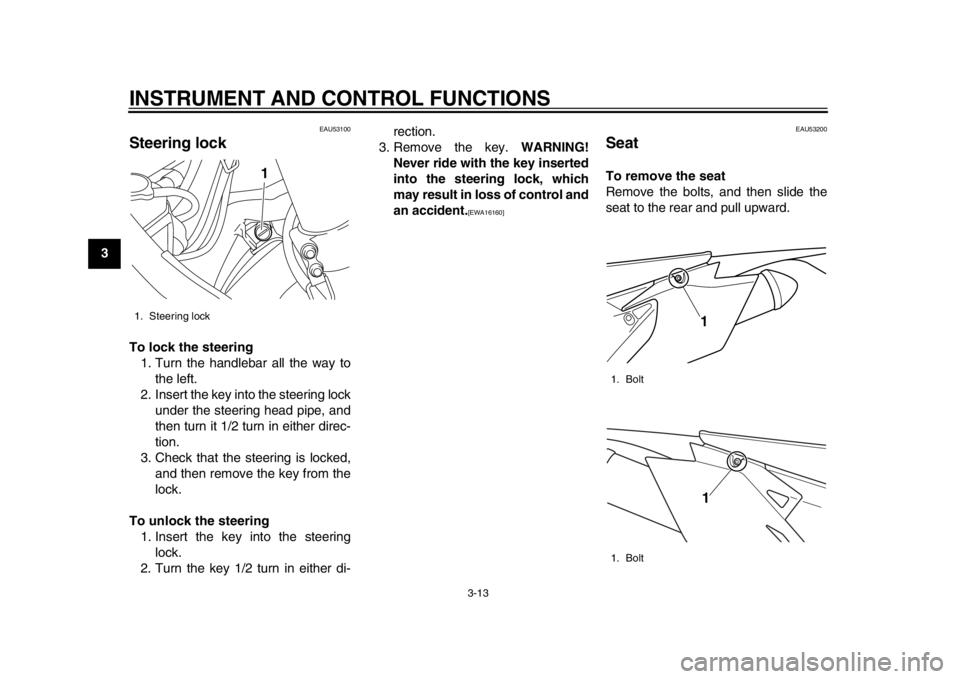
Steering lock To lock the steering1. Turn the handlebar all the way to the left.
2. Insert the key into the steering lock under the steering head pipe, and
then turn it 1/2 turn in either direc-
tion.
3. Check that the steering is locked, and then remove the key from the
lock.
To unlock the steering 1. Insert the key into the steering lock.
2. Turn the key 1/2 turn in either di- rection.
3. Remove the key. WARNING!
Never ride with the key inserted
into the steering lock, which
may result in loss of control and
an accident.
[EWA16160]
EAU53200
Seat To remove the seat
Remove the bolts, and then slide the
seat to the rear and pull upward.
1. Steering lock
1
1. Bolt
1. Bolt
11
1DX-9-E0.book 13 ページ 2011年10月10日 月曜日 午後2時14分
Page 29 of 96
INSTRUMENT AND CONTROL FUNCTIONS
3-14
234
5
6
7
8
9
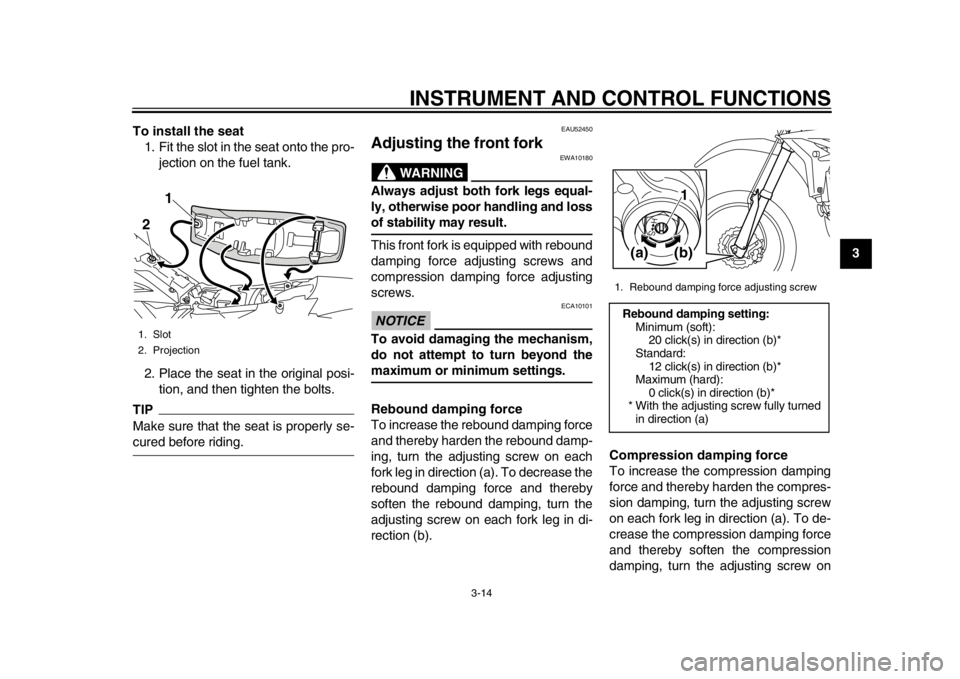
To install the seat
1. Fit the slot in the seat onto the pro- jection on the fuel tank.
2. Place the seat in the original posi- tion, and then tighten the bolts.
TIPMake sure that the seat is properly se-cured before riding.
EAU52450
Adjusting the front fork
WARNING
EWA10180
Always adjust both fork legs equal-
ly, otherwise poor handling and lossof stability may result.
This front fork is equipped with rebound
damping force adjusting screws and
compression damping force adjusting
screws.NOTICE
ECA10101
To avoid damaging the mechanism,
do not attempt to turn beyond themaximum or minimum settings.
Rebound damping force
To increase the rebound damping force
and thereby harden the rebound damp-
ing, turn the adjusting screw on each
fork leg in direction (a). To decrease the
rebound damping force and thereby
soften the rebound damping, turn the
adjusting screw on each fork leg in di-
rection (b). Compression damping force
To increase the compression damping
force and thereby harden the compres-
sion damping, turn the adjusting screw
on each fork leg in direction (a). To de-
crease the compression damping force
and thereby soften the compression
damping, turn the adjusting screw on
1. Slot
2. Projection2
1
1. Rebound damping force adjusting screwRebound damping setting:
Minimum (soft):
20 click(s) in direction (b)*
Standard: 12 click(s) in direction (b)*
Maximum (hard): 0 click(s) in direction (b)*
* With the adjusting screw fully turned
in direction (a)
1
(a) (b)
1DX-9-E0.book 14 ページ 2011年10月10日 月曜日 午後2時14分
Page 30 of 96
INSTRUMENT AND CONTROL FUNCTIONS
3-15
1
23
4
5
6
7
8
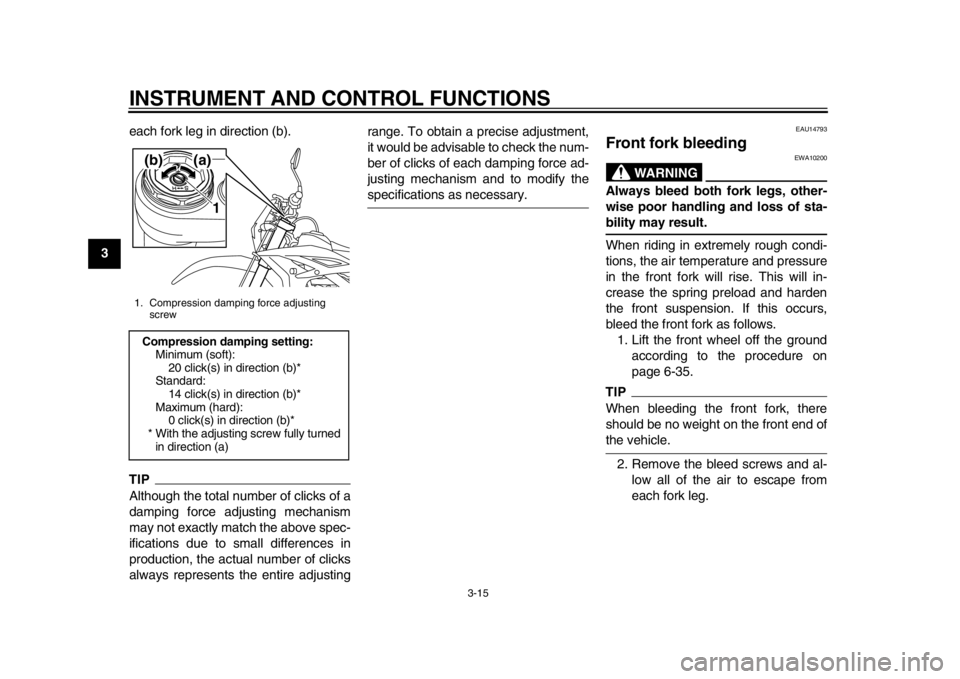
9each fork leg in direction (b).
TIPAlthough the total number of clicks of a
damping force adjusting mechanism
may not exactly match the above spec-
ifications due to small differences in
production, the actual number of clicks
always represents the entire adjusting range. To obtain a precise adjustment,
it would be advisable to check the num-
ber of clicks of each damping force ad-
justing mechanism and to modify the
specifications as necessary.
EAU14793
Front fork bleeding
WARNING
EWA10200
Always bleed both fork legs, other-
wise poor handling and loss of sta-bility may result.
When riding in extremely rough condi-
tions, the air temperature and pressure
in the front fork will rise. This will in-
crease the spring preload and harden
the front suspension. If this occurs,
bleed the front fork as follows.
1. Lift the front wheel off the ground according to the procedure on
page 6-35.TIPWhen bleeding the front fork, there
should be no weight on the front end ofthe vehicle.
2. Remove the bleed screws and al- low all of the air to escape from
each fork leg.
1. Compression damping force adjusting screwCompression damping setting:Minimum (soft):
20 click(s) in direction (b)*
Standard: 14 click(s) in direction (b)*
Maximum (hard): 0 click(s) in direction (b)*
* With the adjusting screw fully turned
in direction (a)
(a)(b)
1
1DX-9-E0.book 15 ページ 2011年10月10日 月曜日 午後2時14分
Page 33 of 96
INSTRUMENT AND CONTROL FUNCTIONS
3-18
234
5
6
7
8
9
visable to check the actual total number
of clicks or turns of each damping force
adjusting mechanism. This adjustment
range may not exactly match the spec-
ifications listed due to small differences
in production.
WARNING
EWA10221
This shock absorber assembly con-
tains highly pressurized nitrogen
gas. Read and understand the fol-
lowing information before handling
the shock absorber assembly.
Do not tamper with or attempt to
open the cylinder assembly.
Do not subject the shock ab-
sorber assembly to an open
flame or other high heat source.
This may cause the unit to ex-
plode due to excessive gas
pressure.
Do not deform or damage the
cylinder in any way. Cylinder
damage will result in poor
damping performance.
Do not dispose of a damaged or
worn-out shock absorber as-
sembly yourself. Take the shock absorber assembly to a Yamaha
dealer for any service.
EAU15305
Sidestand The sidestand is located on the left side
of the frame. Raise the sidestand or
lower it with your foot while holding the
vehicle upright.TIPThe built-in sidestand switch is part of
the ignition circuit cut-off system, which
cuts the ignition in certain situations.
(See the following section for an expla-
nation of the ignition circuit cut-off sys-tem.)
WARNING
EWA10241
The vehicle must not be ridden with
the sidestand down, or if the side-
stand cannot be properly moved up
(or does not stay up), otherwise the
sidestand could contact the ground
and distract the operator, resulting
in a possible loss of control.
Yamaha’s ignition circuit cut-off
system has been designed to assist
the operator in fulfilling the respon-
sibility of raising the sidestand be-
fore starting off. Therefore, check
this system regularly and have a
1DX-9-E0.book 18 ページ 2011年10月10日 月曜日 午後2時14分
Page 35 of 96
INSTRUMENT AND CONTROL FUNCTIONS
3-20
234
5
6
7
8
9
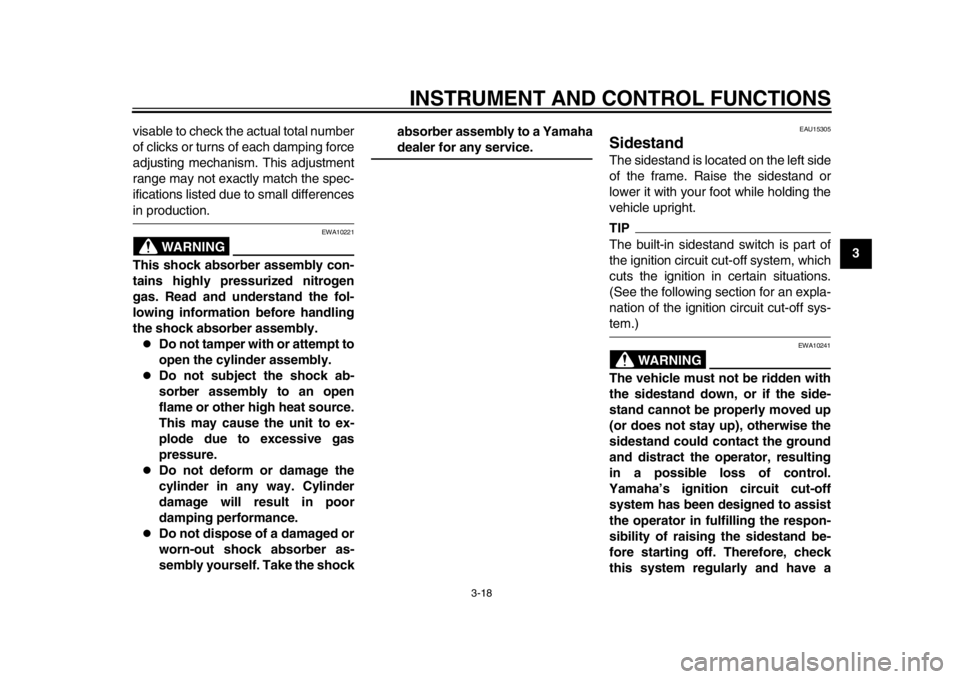
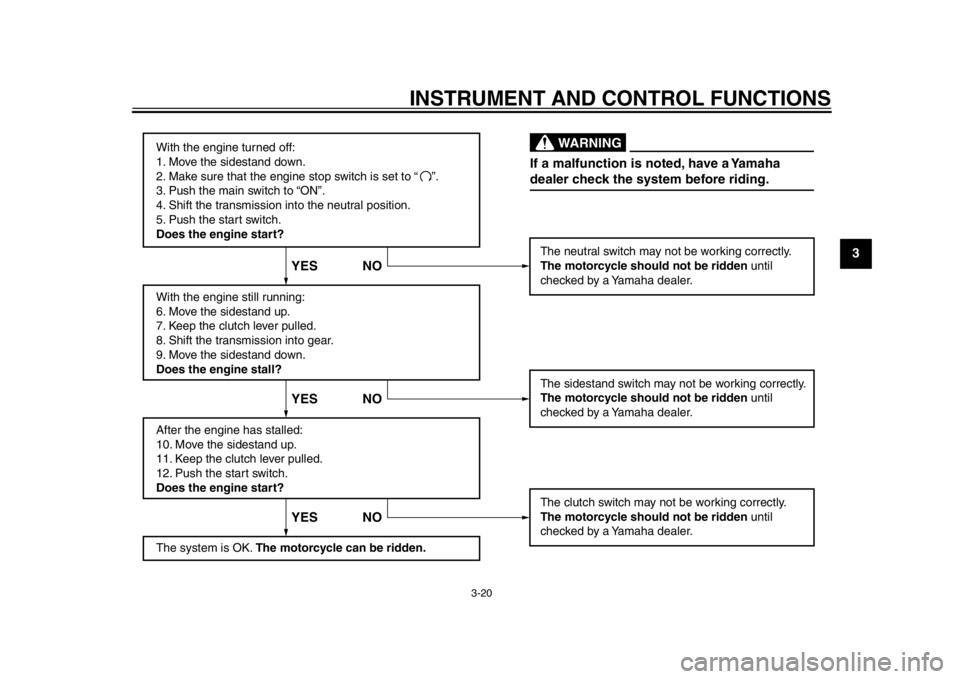
With the engine turned off:
1. Move the sidestand down.
2. Make sure that the engine stop switch is set to “
3. Push the main switch to “ON”.
4. Shift the transmission into the neutral position.
5. Push the start switch.
Does the engine start?
With the engine still running:
6. Move the sidestand up.
7. Keep the clutch lever pulled.
8. Shift the transmission into gear.
9. Move the sidestand down.
Does the engine stall?
After the engine has stalled:
10. Move the sidestand up.
11. Keep the clutch lever pulled.
12. Push the start switch.
Does the engine start?
The system is OK. The motorcycle can be ridden.The neutral switch may not be working correctly.
The motorcycle should not be ridden until
checked by a Yamaha dealer.
The sidestand switch may not be working correctly.
The motorcycle should not be ridden until
checked by a Yamaha dealer.
The clutch switch may not be working correctly.
The motorcycle should not be ridden until
checked by a Yamaha dealer.
YES NO YES NO YES NO
If a malfunction is noted, have a Yamaha
dealer check the system before riding.
WARNING
”.
1DX-9-E0.book 20 ページ 2011年10月10日 月曜日 午後2時14分
Page 36 of 96
4-1
1
2
34
5
6
7
8
9
FOR YOUR SAFETY – PRE-OPERATION CHECKS
EAU15596
Inspect your vehicle each time you use it to make sure the vehicle is in safe operating condition. Always follow the inspection
and maintenance procedures and schedules described in the Owner’s Manual.
WARNING
EWA11151
Failure to inspect or maintain the vehicle properly increases the possibility of an accident or equipment damage.
Do not operate the vehicle if you find any problem. If a problem cannot be corrected by the procedures provided inthis manual, have the vehicle inspected by a Yamaha dealer.
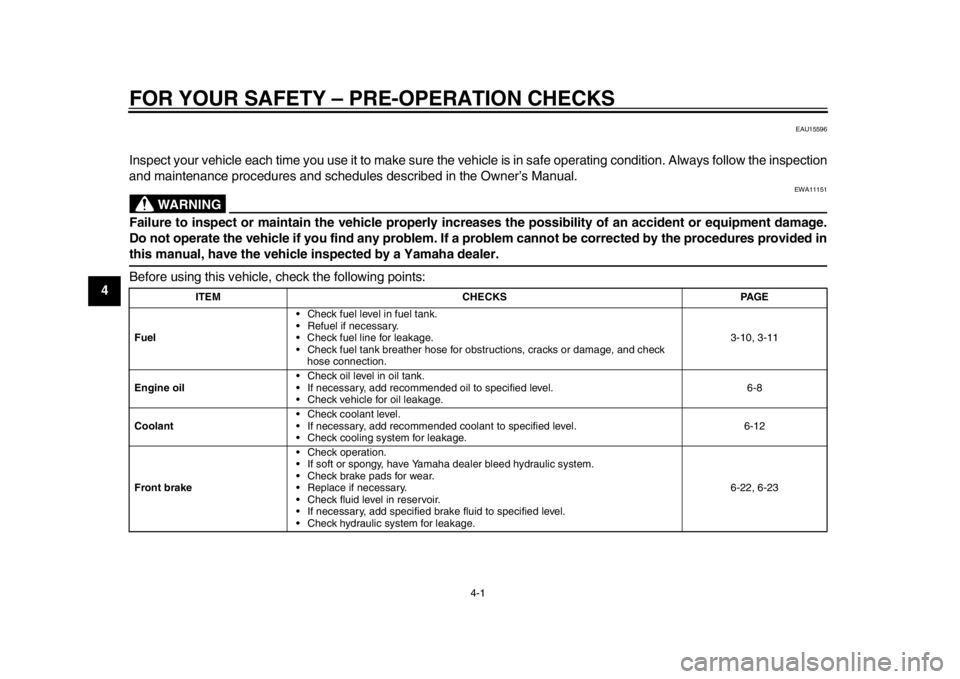
Before using this vehicle, check the following points:
ITEM CHECKS PAGE
Fuel Check fuel level in fuel tank.
Refuel if necessary.
Check fuel line for leakage.
Check fuel tank breather hose for obst
ructions, cracks or damage, and check
hose connection. 3-10, 3-11
Engine oil Check oil level in oil tank.
If necessary, add recommended oil to specified level.
Check vehicle for oil leakage. 6-8
Coolant Check coolant level.
If necessary, add recommended coolant to specified level.
Check cooling system for leakage. 6-12
Front brake Check operation.
If soft or spongy, have Yamaha dealer bleed hydraulic system.
Check brake pads for wear.
Replace if necessary.
Check fluid level in reservoir.
If necessary, add specified brak
e fluid to specified level.
Check hydraulic system for leakage. 6-22, 6-23
1DX-9-E0.book 1 ページ 2011年10月10日 月曜日 午後2時14分
Page 39 of 96
5-1
2
3
456
7
8
9
OPERATION AND IMPORTANT RIDING POINTS
EAU15951
Read the Owner’s Manual carefully to
become familiar with all controls. If
there is a control or function you do not
understand, ask your Yamaha dealer.
WARNING
EWA10271
Failure to familiarize yourself with
the controls can lead to loss of con-
trol, which could cause an accidentor injury.
EAU53110
TIPThis model is equipped with a lean an-
gle sensor to stop the engine in case of
a turnover. To start the engine after a
turnover, be sure to push the main
switch to “OFF” and then to “ON”. Fail-
ing to do so will prevent the engine from
starting even though the engine willcrank when pushing the start switch.
EAU52903
Starting a cold engine In order for the ignition circuit cut-off
system to enable starting, one of the
following conditions must be met:
The transmission is in the neutral
position.
The transmission is in gear with
the clutch lever pulled and the sid-
estand up.
See page 3-19 for more informa-
tion.
1. Push the main swtch to “ON” and make sure that the engine stop
switch is set to “ ”.
The following warning light should
come on for a few seconds, then
go off.
Fuel level warning light
Engine trouble warning light
NOTICE
ECA17781
If a warning light does not come on
initially when the main switch is
pushed to “ON”, or if a warning light
remains on, see page 3-1 for the cor-
responding warning light circuitcheck.
2. Shift the transmission into the neu-
1DX-9-E0.book 1 ページ 2011年10月10日 月曜日 午後2時14分
Page 42 of 96
OPERATION AND IMPORTANT RIDING POINTS
5-4
1
2
3
45
6
7
8
9
EAU52940
Engine break-in
WARNING
EWA10321
Failure to properly maintain the ve-
hicle or performing maintenance ac-
tivities incorrectly may increase
your risk of injury or death during
service or while using the vehicle. If
you are not familiar with vehicle ser-
vice, have a Yamaha dealer performservice.1. Before starting the engine, fill the fuel tank with the fuel.
2. Start and warm up the engine. Check the operation of the controls
and the engine stop switch. (See
page 3-7.) Then, restart the engine
and check its operation within no
more than 5 minutes after it is re-
started.
3. Operate the motorcycle in the low- er gears at moderate throttle open-
ings for five to eight minutes. Stop
the engine.
4. Check how the engine runs when the motorcycle is ridden with the
throttle 1/4 to 1/2 open (low to me-
dium speed) for about one hour. 5. Start the engine and check the op-
eration of the motorcycle through-
out its entire operating range.
Restart the motorcycle and ride it
for about 10 to 15 more minutes.
The motorcycle will now be ready
to ride normally.
After the engine break-in period, thor-
oughly check the motorcycle for loose
parts, oil leakage and any other prob-
lems. Be sure to inspect and make ad-
justments thoroughly, especially cable
and drive chain slack and loose
spokes. In addition, check all fittings
and fasteners for looseness, and tight-
en if necessary.
NOTICE
ECA15560
When any of the following parts
have been replaced, they must
be broken in.
Cylinder or crankshaft:
About one hour of break-in op-
eration is necessary.
Piston, rings or transmission
gears:
These parts require about 30
minutes of break-in operation at
half-throttle or less. Observe the condition of the engine carefully
during operation.
If any engine trouble should oc-
cur during the engine break-in
period, immediately have a
Yamaha dealer check the vehi-cle.
1DX-9-E0.book 4 ページ 2011年10月10日 月曜日 午後2時14分
Page 43 of 96
OPERATION AND IMPORTANT RIDING POINTS
5-5
2
3
456
7
8
9
EAU52410
Parking When parking, stop the engine by
pushing the main switch to “OFF”.
WARNING
EWA10311
Since the engine and exhaust
system can become very hot,
park in a place where pedestri-
ans or children are not likely to
touch them and be burned.
Do not park on a slope or on soft
ground, otherwise the vehicle
may overturn, increasing the
risk of a fuel leak and fire.
Do not park near grass or other
flammable materials whichmight catch fire.
1DX-9-E0.book 5 ページ 2011年10月10日 月曜日 午後2時14分
Page 44 of 96
6-1
1
2
3
4
56
7
8
9
PERIODIC MAINTENANCE AND ADJUSTMENT
EAU17244
Periodic inspection, adjustment, and lu-
brication will keep your vehicle in the
safest and most efficient condition pos-
sible. Safety is an obligation of the vehi-
cle owner/operator. The most important
points of vehicle inspection, adjust-
ment, and lubrication are explained on
the following pages.
The intervals given in the periodic
maintenance charts should be simply
considered as a general guide under
normal riding conditions. However, de-
pending on the weather, terrain, geo-
graphical location, and individual use,
the maintenance intervals may need to
be shortened.
WARNING
EWA10321
Failure to properly maintain the ve-
hicle or performing maintenance ac-
tivities incorrectly may increase
your risk of injury or death during
service or while using the vehicle. If
you are not familiar with vehicle ser-
vice, have a Yamaha dealer performservice.
WARNING
EWA15122
Turn off the engine when performing
maintenance unless otherwise
specified.
A running engine has moving
parts that can catch on body
parts or clothing and electrical
parts that can cause shocks or
fires.
Running the engine while ser-
vicing can lead to eye injury,
burns, fire, or carbon monoxide
poisoning – possibly leading to
death. See page 1-2 for more in-
formation about carbon monox-ide.WARNING
EWA15460
Brake discs, calipers, drums, and
linings can become very hot during
use. To avoid possible burns, let
brake components cool beforetouching them.
EAU17302
Emission controls not only function to
ensure cleaner air, but are also vital to
proper engine operation and maximum
performance. In the following periodic
maintenance charts, the services relat-
ed to emissions control are grouped
separately. These services require
specialized data, knowledge, and
equipment. Maintenance, replacement,
or repair of the emission control devic-
es and systems may be performed by
any repair establishment or individual
that is certified (if applicable). Yamaha
dealers are trained and equipped to
perform these particular services.
1DX-9-E0.book 1 ページ 2011年10月10日 月曜日 午後2時14分