air filter YAMAHA WR 450F 2016 Owner's Manual
[x] Cancel search | Manufacturer: YAMAHA, Model Year: 2016, Model line: WR 450F, Model: YAMAHA WR 450F 2016Pages: 426, PDF Size: 10.86 MB
Page 334 of 426

IGNITION SYSTEM
9-4
EAS2GC1360TROUBLESHOOTING
The ignition system fails to operate (no spark or intermittent spark).
TIP
Before troubleshooting, remove the following part (s):
1. Seat
2. Side cover (left/right)
3. Air scoop (left/right)
4. Fuel tank
5. Air filter case cover1. Check the fuse. Refer to “CHECKING THE FUSES”
on page 9-68. NG
Replace the fuse(s).
OK
2. Check the battery. Refer to “CHECKING AND
CHARGING THE BATTERY” on
page 9-69. NG
• Clean the battery terminals.
• Recharge or replace the battery.
OK
3. Check the spark plug. Refer to “CHECKING THE SPARK
PLUG” on page 3-40. NG
Re-gap or replace the spark plug.
OK
4. Check the ignition spark gap. Refer to “CHECKING THE IGNI-
TION SPARK GAP” on page 9-73. OK
The ignition system is normal.
NG
5. Check the ignition coil. Refer to “CHECKING THE IGNI-
TION COIL” on page 9-74. NG
Replace the ignition coil.
OK
6. Check the crankshaft position sen- sor.
Refer to “CHECKING THE CRANK-
SHAFT POSITION SENSOR” on
page 9-74. NG
Replace the stator assembly.
OK
7. Check the engine stop switch. Refer to “CHECKING THE
SWITCHES” on page 9-64. NG
Replace the engine stop switch.
OK
Page 340 of 426

ELECTRIC STARTING SYSTEM
9-10
EAS2GC1363TROUBLESHOOTING
The starter motor fails to turn.
TIP
Before troubleshooting, remove the following part (s):
1. Seat
2. Side cover (left/right)
3. Air scoop (left/right)
4. Fuel tank
5. Air filter case cover1. Check the fuse. Refer to “CHECKING THE FUSES”
on page 9-68. NG
Replace the fuse(s).
OK
2. Check the battery. Refer to “CHECKING AND
CHARGING THE BATTERY” on
page 9-69. NG
• Clean the battery terminals.
• Recharge or replace the battery.
OK
3. Check the starter motor operation. Refer to “CHECKING THE START-
ER MOTOR OPERATION” on page
9-75. OK
Starter motor is OK. Perform the electric
starting system troubleshooting, starting
with step 5.
NG
4. Check the starter motor. Refer to “CHECKING THE START-
ER MOTOR” on page 6-38. NG
Repair or replace the starter motor.
OK
5. Check the relay unit (Starting circuit cut-off relay).
Refer to “CHECKING THE RE-
LAYS” on page 9-72. NG
Replace the relay unit.
OK
6. Check the diode. Refer to “CHECKING THE DIODE”
on page 9-73. NG
Replace the diode.
OK
7. Check the starter relay. Refer to “CHECKING THE RE-
LAYS” on page 9-72. NG
Replace the starter relay.
OK
Page 410 of 426
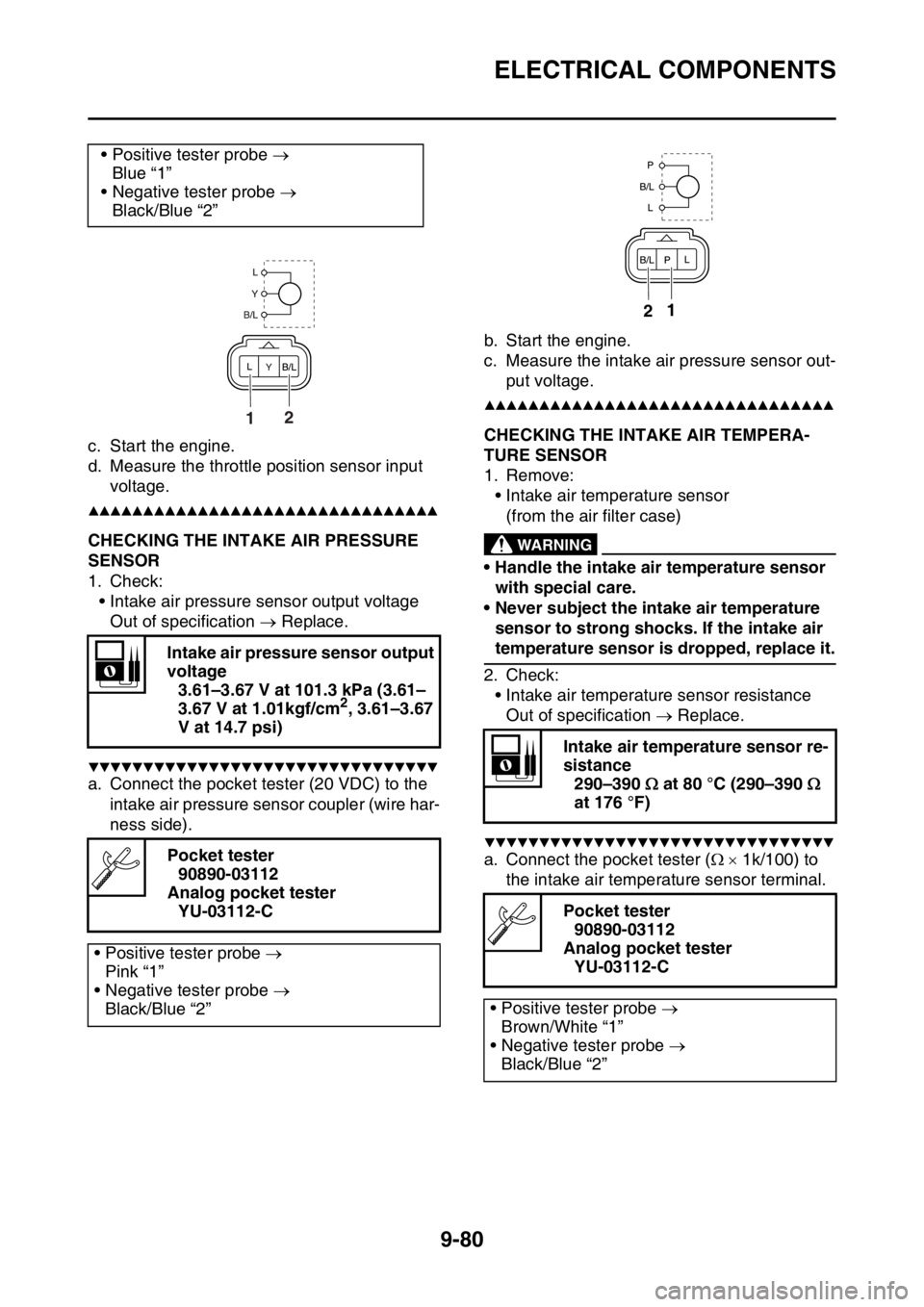
ELECTRICAL COMPONENTS
9-80
c. Start the engine.
d. Measure the throttle position sensor input voltage.
▲▲▲▲▲▲▲▲▲▲▲▲▲▲▲▲▲▲▲▲▲▲▲▲▲▲▲▲▲▲▲▲
EAS2GC1403CHECKING THE INTAKE AIR PRESSURE
SENSOR
1. Check:
• Intake air pressure sensor output voltageOut of specification Replace.
▼▼▼▼▼▼▼▼▼▼▼▼▼▼▼▼▼▼▼▼▼▼▼▼▼▼▼▼▼▼▼▼
a. Connect the pocket tester (20 VDC) to the
intake air pressure sensor coupler (wire har-
ness side). b. Start the engine.
c. Measure the intake air pressure sensor out-
put voltage.
▲▲▲▲▲▲▲▲▲▲▲▲▲▲▲▲▲▲▲▲▲▲▲▲▲▲▲▲▲▲▲▲
EAS2GC1404CHECKING THE INTAKE AIR TEMPERA-
TURE SENSOR
1. Remove:• Intake air temperature sensor(from the air filter case)
EWA
WARNING
• Handle the intake air temperature sensor with special care.
• Never subject the intake air temperature sensor to strong shocks. If the intake air
temperature sensor is dropped, replace it.
2. Check: • Intake air temperature sensor resistanceOut of specification Replace.
▼▼▼▼▼▼▼▼▼▼▼▼▼▼▼▼▼▼▼▼▼▼▼▼▼▼▼▼▼▼▼▼
a. Connect the pocket tester ( 1k/100) to
the intake air temperature sensor terminal.
• Positive tester probe
Blue “1”
• Negative tester probe
Black/Blue “2”
Intake air pressure sensor output
voltage3.61–3.67 V at 101.3 kPa (3.61–
3.67 V at 1.01kgf/cm
2, 3.61–3.67
V at 14.7 psi)
Pocket tester 90890-03112
Analog pocket tester YU-03112-C
• Positive tester probe
Pink “1”
• Negative tester probe
Black/Blue “2”
21
Intake air temperature sensor re-
sistance 290–390 at 80 °C (290–390
at 176 °F)
Pocket tester 90890-03112
Analog pocket tester YU-03112-C
• Positive tester probe Brown/White “1”
• Negative tester probe
Black/Blue “2”
12
Page 414 of 426
TROUBLESHOOTING
10-1
EAS2GC1406
TROUBLESHOOTING
EAS2GC1407GENERAL INFORMATION
TIP
The following guide for troubleshooting does
not cover all the possible causes of trouble. It
should be helpful, however, as a guide to basic
troubleshooting. Refer to the relative procedure
in this manual for checks, adjustments, and re-
placement of parts.
EAS2GC1408STARTING FAILURES
Engine
1. Cylinder and cylinder head• Loose spark plug
• Loose cylinder head or cylinder
• Damaged cylinder head gasket
• Damaged cylinder gasket
• Worn or damaged cylinder
• Incorrect valve clearance
• Improperly sealed valve
• Incorrect valve-to-valve-seat contact
• Incorrect valve timing
• Faulty valve spring
• Seized valve
2. Piston and piston ring(s) • Improperly installed piston ring
• Damaged, worn or fatigued piston ring
• Seized piston ring
• Seized or damaged piston
3. Air filter • Improperly installed air filter
• Clogged air filter element
4. Crankcase and crankshaft • Improperly assembled crankcase
• Seized crankshaft
Fuel system
1. Fuel tank • Empty fuel tank
• Clogged fuel tank breather hose
• Deteriorated or contaminated fuel
• Clogged or damaged fuel hose
2. Fuel pump
• Faulty fuel pump
3. Throttle body • Deteriorated or contaminated fuel
• Sucked-in air Electrical system
1. Battery
• Discharged battery
• Faulty battery
2. Fuse • Blown, damaged or incorrect fuse
• Improperly installed fuse
3. Spark plug • Incorrect spark plug gap
• Incorrect spark plug heat range
• Fouled spark plug
• Worn or damaged electrode
• Worn or damaged insulator
4. Ignition coil • Cracked or broken ignition coil body
• Broken or shorted primary or secondary coils
5. Ignition system • Faulty ECU
• Faulty crankshaft position sensor
• Broken generator rotor woodruff key
6. Switches and wiring
• Faulty ECU
• Faulty engine stop switch
• Broken or shorted wiring
• Faulty neutral switch
• Improperly grounded circuit
• Loose connections
7. Starting system • Faulty starter motor
• Faulty starter relay
• Faulty starting circuit cut-off relay
• Faulty starter clutch
EAS2GC1409INCORRECT ENGINE IDLING SPEED
Engine
1. Cylinder and cylinder head• Incorrect valve clearance
• Damaged valve train components
2. Air filter • Clogged air filter element
Fuel system
1. Throttle body • Damaged or loose throttle body joint
• Improperly synchronized throttle bodies
• Improper throttle cable free play
• Flooded throttle body
Page 415 of 426

TROUBLESHOOTING
10-2
Electrical system
1. Battery• Discharged battery
• Faulty battery
2. Spark plug • Incorrect spark plug gap
• Incorrect spark plug heat range
• Fouled spark plug
• Worn or damaged electrode
• Worn or damaged insulator
• Faulty spark plug cap
3. Ignition coil
• Broken or shorted primary or secondary coil
• Cracked or broken ignition coil
4. Ignition system • Faulty ECU
• Faulty crankshaft position sensor
• Broken generator rotor woodruff key
EAS2GC1410POOR MEDIUM-AND-HIGH-SPEED PER-
FORMANCE
Refer to “STARTING FAILURES” on page 10-
1.
Engine
1. Air filter
• Clogged air filter element
Fuel system
1. Fuel pump • Faulty fuel pump
2. Throttle body
• Defective throttle body
3. ECU • Faulty ECU
EAS2GC1411SHIFTING IS DIFFICULT
Refer to “CLUTCH” on page 6-41.
EAS2GC1412SHIFT PEDAL DOES NOT MOVE
Engine
1. Shift shaft
• Bent shift shaft
2. Shift drum and shift forks • Foreign object in a shift drum groove
• Seized shift fork
• Bent shift fork guide bar
3. Transmission
• Seized transmission gear
• Foreign object between transmission gears
• Improperly assembled transmission
EAS2GC1413
JUMPS OUT OF GEAR
Engine
1. Shift shaft• Incorrect shift pedal position
• Improperly returned stopper lever
2. Shift forks
• Worn shift fork
3. Shift drum • Incorrect axial play
• Worn shift drum groove
4. Transmission • Worn gear dog
EAS2GC1414CLUTCH SLIPS
Engine
1. Clutch• Improperly assembled clutch
• Loose or fatigued clutch spring
• Worn friction plate
• Worn clutch plate
2. Engine oil
• Incorrect oil level
• Incorrect oil viscosity (low)
• Deteriorated oil
EAS2GC1415CLUTCH DRAGS
Engine
1. Clutch• Unevenly tensioned clutch springs
• Warped pressure plate
• Bent clutch plate
• Swollen friction plate
• Bent clutch push rod
• Damaged clutch boss
• Burnt primary driven gear bushing
2. Engine oil • Incorrect oil level
• Incorrect oil viscosity (high)
• Deteriorated oil
EAS2GC1416OVERHEATING
Engine
1. Cylinder head and piston• Heavy carbon buildup
• Clogged coolant passages
2. Engine oil
• Incorrect oil level
• Incorrect oil viscosity
• Inferior oil quality
Page 416 of 426

TROUBLESHOOTING
10-3
Cooling system
1. Coolant• Low coolant level
2. Radiator • Damaged or leaking radiator
• Faulty radiator cap
• Bent or damaged radiator fin
3. Water pump • Damaged or faulty water pump
• Damaged hose
• Improperly connected hose
• Damaged pipe
• Improperly connected pipe
Fuel system
1. Throttle body • Damaged or loose throttle body joint
2. Air filter • Clogged air filter element
Chassis
1. Brake(s) • Dragging brake
Electrical system
1. Spark plug • Incorrect spark plug gap
• Incorrect spark plug heat range
2. Ignition system • Faulty ECU
• Faulty coolant temperature sensor
EAS2GC1417OVERCOOLING
Cooling system
1. Coolant temperature sensor• Faulty coolant temperature sensor
EAS2GC1418POOR BRAKING PERFORMANCE
Chassis
1. Brake(s)• Worn brake pad
• Worn brake disc
• Air in hydraulic brake system
• Leaking brake fluid
• Defective master cylinder kit
• Faulty brake caliper kit
• Faulty brake caliper seal
• Loose union bolt
• Damaged brake hose
• Oil or grease on the brake disc
• Oil or grease on the brake pad
• Incorrect brake fluid level
EAS2GC1419FRONT FORK OIL LEAKING
Chassis
1. Front fork• Bent, damaged, or rusty inner tube
• Cracked or damaged outer tube
• Improperly installed oil seal
• Damaged oil seal lip
• Incorrect oil level (high)
• Loose damper rod assembly bolt
• Damaged damper rod assembly bolt copper
washer
• Cracked or damaged cap bolt O-ring
EAS2GC1420FAULTY FRONT FORK LEGS
Chassis
1. Front fork • Bent or damaged inner tube
• Bent or damaged outer tube
• Broken fork spring
• Bent or damaged damper rod
• Incorrect oil viscosity
• Incorrect oil level
EAS2GC1421UNSTABLE HANDLING
Chassis
1. Handlebar• Bent or improperly installed handlebar
2. Steering head components • Improperly installed upper bracket
• Improperly installed lower bracket(improperly tightened ring nut)
• Bent steering stem
• Damaged ball bearing or bearing race
3. Front fork leg (s) • Uneven oil levels (both front fork legs)
• Unevenly tensioned fork spring (both front fork legs)
• Broken fork spring
• Bent or damaged inner tube
• Bent or damaged outer tube
4. Swingarm • Worn bearing or bushing
• Bent or damaged swingarm
5. Rear shock absorber assembly (-ies) • Faulty rear shock absorber spring
• Leaking oil or gas
6. Tire (s) • Uneven tire pressures (front and rear)
• Incorrect tire pressure
• Uneven tire wear