warning YAMAHA XCITY 125 2012 Owner's Guide
[x] Cancel search | Manufacturer: YAMAHA, Model Year: 2012, Model line: XCITY 125, Model: YAMAHA XCITY 125 2012Pages: 86, PDF Size: 7.38 MB
Page 63 of 86

PERIODIC MAINTENANCE AND ADJUSTMENT
6-22
6 fluid level goes down suddenly, have a
Yamaha dealer check the cause before
further riding.
EAU22721
Changing the brake fluid Have a Yamaha dealer change the
brake fluid at the intervals specified in
the TIP after the periodic maintenance
and lubrication chart. In addition, have
the oil seals of the brake master cylin-
der and caliper as well as the brake
hose replaced at the intervals listed be-
low or whenever they are damaged or
leaking.●
Oil seals: Replace every two
years.
●
Brake hose: Replace every four
years.
EAU23095
Checking and lubricating the
cables The operation of all control cables and
the condition of the cables should be
checked before each ride, and the ca-
bles and cable ends should be lubricat-
ed if necessary. If a cable is damaged
or does not move smoothly, have a
Yamaha dealer check or replace it.
WARNING! Damage to the outer
housing of cables may result in in-
ternal rusting and cause interfer-
ence with cable movement. Replace
damaged cables as soon as possi-
ble to prevent unsafe conditions.[EWA10711]
Recommended lubricant:
Yamaha Chain and Cable Lube or
engine oil
U16PE3E0.book Page 22 Tuesday, June 19, 2012 5:17 PM
Page 65 of 86
PERIODIC MAINTENANCE AND ADJUSTMENT
6-24
6 The operation of the centerstand and
sidestand should be checked before
each ride, and the pivots and metal-to-
metal contact surfaces should be lubri-
cated if necessary.
WARNING
EWA10741
If the centerstand or sidestand does
not move up and down smoothly,
have a Yamaha dealer check or re-
pair it. Otherwise, the centerstand or
sidestand could contact the ground
and distract the operator, resulting
in a possible loss of control.
EAU23272
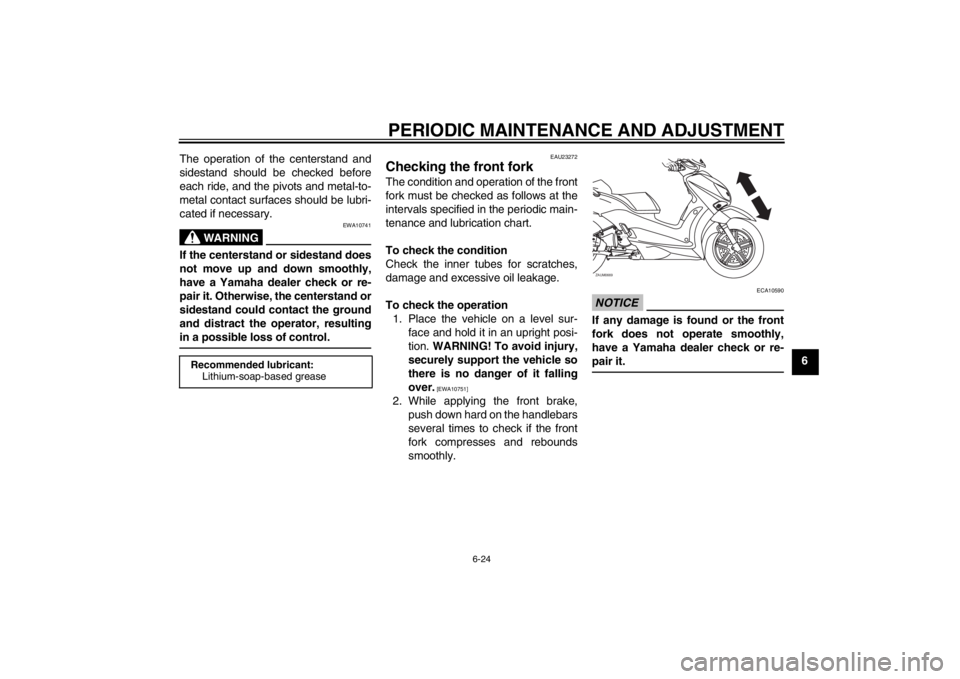
Checking the front fork The condition and operation of the front
fork must be checked as follows at the
intervals specified in the periodic main-
tenance and lubrication chart.
To check the condition
Check the inner tubes for scratches,
damage and excessive oil leakage.
To check the operation
1. Place the vehicle on a level sur-
face and hold it in an upright posi-
tion. WARNING! To avoid injury,
securely support the vehicle so
there is no danger of it falling
over.
[EWA10751]
2. While applying the front brake,
push down hard on the handlebars
several times to check if the front
fork compresses and rebounds
smoothly.
NOTICE
ECA10590
If any damage is found or the front
fork does not operate smoothly,
have a Yamaha dealer check or re-
pair it.
Recommended lubricant:
Lithium-soap-based grease
ZAUM0669
U16PE3E0.book Page 24 Tuesday, June 19, 2012 5:17 PM
Page 66 of 86
PERIODIC MAINTENANCE AND ADJUSTMENT
6-25
6
EAU45511
Checking the steering Worn or loose steering bearings may
cause danger. Therefore, the operation
of the steering must be checked as fol-
lows at the intervals specified in the pe-
riodic maintenance and lubrication
chart.
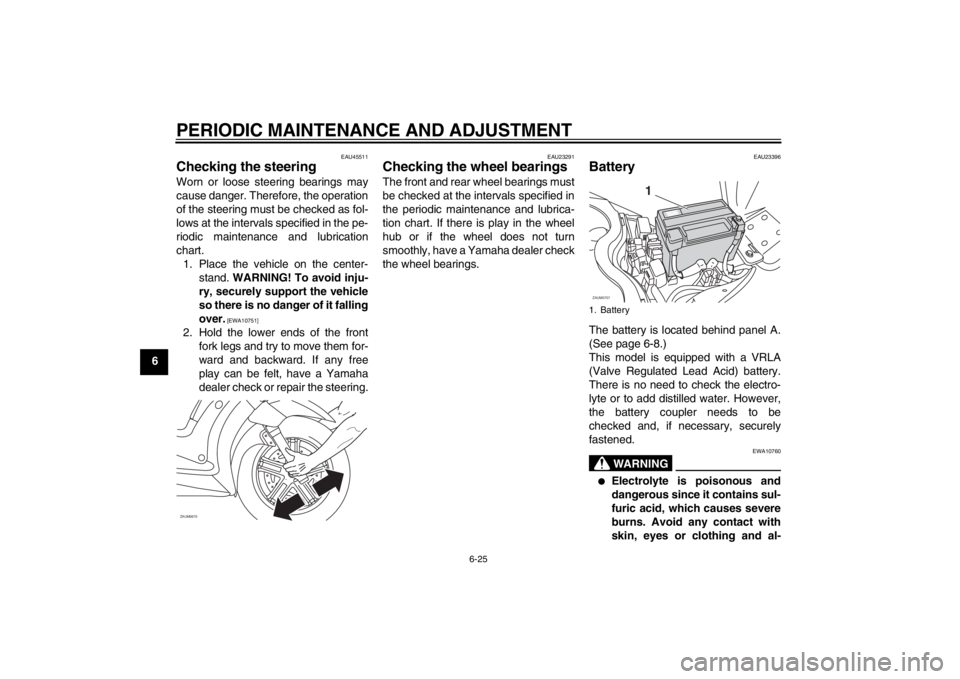
1. Place the vehicle on the center-
stand. WARNING! To avoid inju-
ry, securely support the vehicle
so there is no danger of it falling
over.
[EWA10751]
2. Hold the lower ends of the front
fork legs and try to move them for-
ward and backward. If any free
play can be felt, have a Yamaha
dealer check or repair the steering.
EAU23291
Checking the wheel bearings The front and rear wheel bearings must
be checked at the intervals specified in
the periodic maintenance and lubrica-
tion chart. If there is play in the wheel
hub or if the wheel does not turn
smoothly, have a Yamaha dealer check
the wheel bearings.
EAU23396
Battery The battery is located behind panel A.
(See page 6-8.)
This model is equipped with a VRLA
(Valve Regulated Lead Acid) battery.
There is no need to check the electro-
lyte or to add distilled water. However,
the battery coupler needs to be
checked and, if necessary, securely
fastened.
WARNING
EWA10760
●
Electrolyte is poisonous and
dangerous since it contains sul-
furic acid, which causes severe
burns. Avoid any contact with
skin, eyes or clothing and al-
ZAUM0670
1. Battery
1
ZAUM0707
U16PE3E0.book Page 25 Tuesday, June 19, 2012 5:17 PM
Page 68 of 86
PERIODIC MAINTENANCE AND ADJUSTMENT
6-27
6
EAU23526
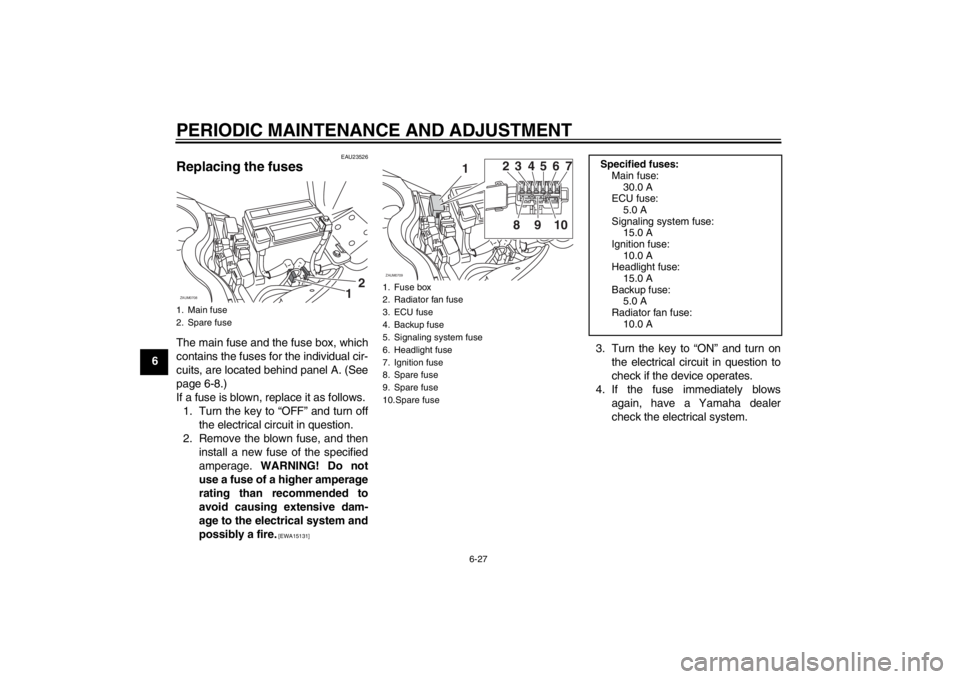
Replacing the fuses The main fuse and the fuse box, which
contains the fuses for the individual cir-
cuits, are located behind panel A. (See
page 6-8.)
If a fuse is blown, replace it as follows.
1. Turn the key to “OFF” and turn off
the electrical circuit in question.
2. Remove the blown fuse, and then
install a new fuse of the specified
amperage. WARNING! Do not
use a fuse of a higher amperage
rating than recommended to
avoid causing extensive dam-
age to the electrical system and
possibly a fire.
[EWA15131]
3. Turn the key to “ON” and turn on
the electrical circuit in question to
check if the device operates.
4. If the fuse immediately blows
again, have a Yamaha dealer
check the electrical system.
1. Main fuse
2. Spare fuse
12
ZAUM0708
1. Fuse box
2. Radiator fan fuse
3. ECU fuse
4. Backup fuse
5. Signaling system fuse
6. Headlight fuse
7. Ignition fuse
8. Spare fuse
9. Spare fuse
10.Spare fuse
1
ZAUM0709
23
8910 456 7
Specified fuses:
Main fuse:
30.0 A
ECU fuse:
5.0 A
Signaling system fuse:
15.0 A
Ignition fuse:
10.0 A
Headlight fuse:
15.0 A
Backup fuse:
5.0 A
Radiator fan fuse:
10.0 A
U16PE3E0.book Page 27 Tuesday, June 19, 2012 5:17 PM
Page 72 of 86
PERIODIC MAINTENANCE AND ADJUSTMENT
6-31
6
EAUM2202
Replacing the license plate
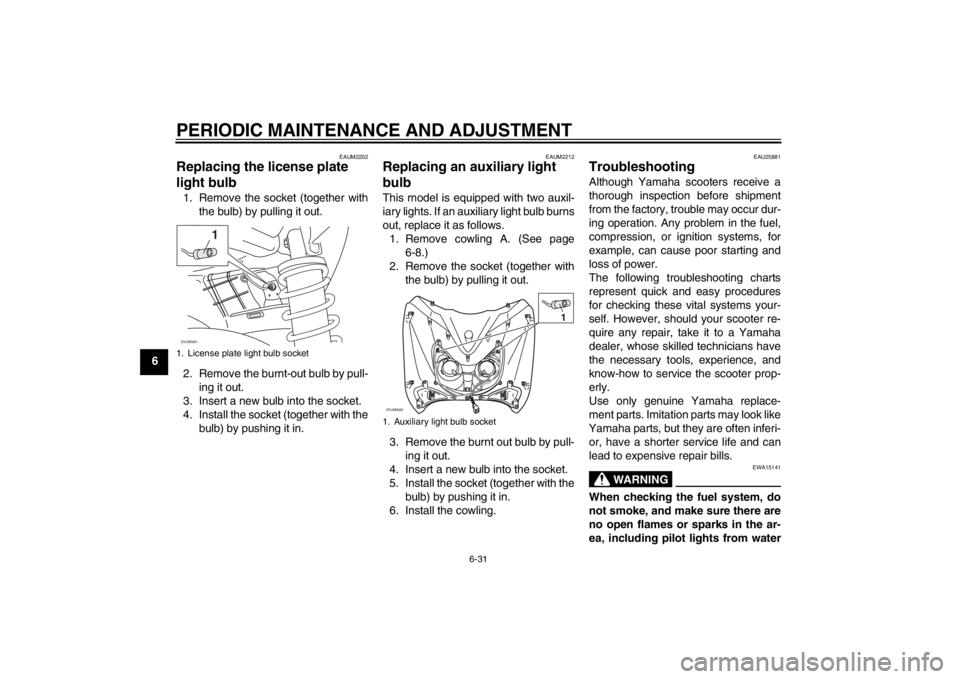
light bulb 1. Remove the socket (together with
the bulb) by pulling it out.
2. Remove the burnt-out bulb by pull-
ing it out.
3. Insert a new bulb into the socket.
4. Install the socket (together with the
bulb) by pushing it in.
EAUM2212
Replacing an auxiliary light
bulb This model is equipped with two auxil-
iary lights. If an auxiliary light bulb burns
out, replace it as follows.
1. Remove cowling A. (See page
6-8.)
2. Remove the socket (together with
the bulb) by pulling it out.
3. Remove the burnt out bulb by pull-
ing it out.
4. Insert a new bulb into the socket.
5. Install the socket (together with the
bulb) by pushing it in.
6. Install the cowling.
EAU25881
Troubleshooting Although Yamaha scooters receive a
thorough inspection before shipment
from the factory, trouble may occur dur-
ing operation. Any problem in the fuel,
compression, or ignition systems, for
example, can cause poor starting and
loss of power.
The following troubleshooting charts
represent quick and easy procedures
for checking these vital systems your-
self. However, should your scooter re-
quire any repair, take it to a Yamaha
dealer, whose skilled technicians have
the necessary tools, experience, and
know-how to service the scooter prop-
erly.
Use only genuine Yamaha replace-
ment parts. Imitation parts may look like
Yamaha parts, but they are often inferi-
or, have a shorter service life and can
lead to expensive repair bills.
WARNING
EWA15141
When checking the fuel system, do
not smoke, and make sure there are
no open flames or sparks in the ar-
ea, including pilot lights from water
1. License plate light bulb socketZAUM0681
1
1. Auxiliary light bulb socketZAUM0682
1
U16PE3E0.book Page 31 Tuesday, June 19, 2012 5:17 PM
Page 75 of 86
PERIODIC MAINTENANCE AND ADJUSTMENT
6-34
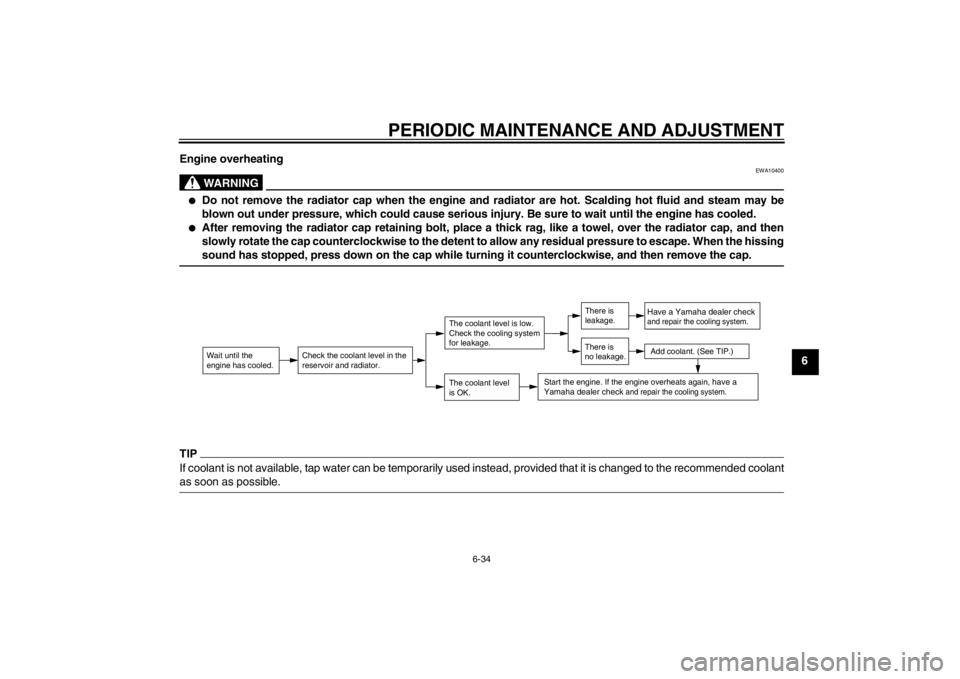
6 Engine overheating
WARNING
EWA10400
●
Do not remove the radiator cap when the engine and radiator are hot. Scalding hot fluid and steam may be
blown out under pressure, which could cause serious injury. Be sure to wait until the engine has cooled.
●
After removing the radiator cap retaining bolt, place a thick rag, like a towel, over the radiator cap, and then
slowly rotate the cap counterclockwise to the detent to allow any residual pressure to escape. When the hissing
sound has stopped, press down on the cap while turning it counterclockwise, and then remove the cap.
TIPIf coolant is not available, tap water can be temporarily used instead, provided that it is changed to the recommended coolant
as soon as possible.
Wait until the
engine has cooled.
Check the coolant level in the
reservoir and radiator.
The coolant level
is OK.The coolant level is low.
Check the cooling system
for leakage.
Have a Yamaha dealer checkand repair the cooling system.Add coolant. (See TIP.)
Start the engine. If the engine overheats again,
have a
Yamaha dealer check
and repair the cooling system.
There is
leakage.
There is
no leakage.
U16PE3E0.book Page 34 Tuesday, June 19, 2012 5:17 PM
Page 77 of 86
SCOOTER CARE AND STORAGE
7-2
7 Test the product on a small hid-
den part of the windshield to
make sure that it does not leave
any marks. If the windshield is
scratched, use a quality plastic
polishing compound after
washing.
After normal useRemove dirt with warm water, a mild
detergent, and a soft, clean sponge,
and then rinse thoroughly with clean
water. Use a toothbrush or bottlebrush
for hard-to-reach areas. Stubborn dirt
and insects will come off more easily if
the area is covered with a wet cloth for
a few minutes before cleaning.
After riding in the rain, near the sea oron salt-sprayed roadsSince sea salt or salt sprayed on the
roads during winter are extremely cor-
rosive in combination with water, carry
out the following steps after each ride in
the rain, near the sea or on salt-
sprayed roads.
TIPSalt sprayed on roads in the winter may
remain well into spring.1. Clean the scooter with cold water
and a mild detergent after the en-
gine has cooled down. NOTICE:
Do not use warm water since it
increases the corrosive action
of the salt.
[ECA10791]
2. Apply a corrosion protection spray
on all metal, including chrome- and
nickel-plated, surfaces to prevent
corrosion.
After cleaning
1. Dry the scooter with a chamois or
an absorbing cloth.
2. Use a chrome polish to shine
chrome, aluminum and stainless-
steel parts, including the exhaust
system. (Even the thermally in-
duced discoloring of stainless-
steel exhaust systems can be re-
moved through polishing.)3. To prevent corrosion, it is recom-
mended to apply a corrosion pro-
tection spray on all metal,
including chrome- and nickel-plat-
ed, surfaces.
4. Use spray oil as a universal clean-
er to remove any remaining dirt.
5. Touch up minor paint damage
caused by stones, etc.
6. Wax all painted surfaces.
7. Let the scooter dry completely be-
fore storing or covering it.
WARNING
EWA10942
Contaminants on the brakes or tires
can cause loss of control.●
Make sure that there is no oil or
wax on the brakes or tires. If
necessary, clean the brake
discs and brake linings with a
regular brake disc cleaner or ac-
etone, and wash the tires with
warm water and a mild deter-
gent.
●
Before operating the scooter
test its braking performance
and cornering behavior.
U16PE3E0.book Page 2 Tuesday, June 19, 2012 5:17 PM
Page 78 of 86
SCOOTER CARE AND STORAGE
7-3
7
NOTICE
ECA10800
●
Apply spray oil and wax spar-
ingly and make sure to wipe off
any excess.
●
Never apply oil or wax to any
rubber and plastic parts, but
treat them with a suitable care
product.
●
Avoid using abrasive polishing
compounds as they will wear
away the paint.
TIP●
Consult a Yamaha dealer for ad-
vice on what products to use.
●
Washing, rainy weather or humid
climates can cause the headlight
lens to fog. Turning the headlight
on for a short period of time will
help remove the moisture from the
lens.
EAU36563
Storage Short-term
Always store your scooter in a cool, dry
place and, if necessary, protect it
against dust with a porous cover. Be
sure the engine and the exhaust sys-
tem are cool before covering the scoot-
er.NOTICE
ECA10820
●
Storing the scooter in a poorly
ventilated room or covering it
with a tarp, while it is still wet,
will allow water and humidity to
seep in and cause rust.
●
To prevent corrosion, avoid
damp cellars, stables (because
of the presence of ammonia)
and areas where strong chemi-
cals are stored.
Long-term
Before storing your scooter for several
months:
1. Follow all the instructions in the
“Care” section of this chapter.2. Fill up the fuel tank and add fuel
stabilizer (if available) to prevent
the fuel tank from rusting and the
fuel from deteriorating.
3. Perform the following steps to pro-
tect the cylinder, piston rings, etc.
from corrosion.
a. Remove the spark plug cap
and spark plug.
b. Pour a teaspoonful of engine oil
into the spark plug bore.
c. Install the spark plug cap onto
the spark plug, and then place
the spark plug on the cylinder
head so that the electrodes are
grounded. (This will limit spark-
ing during the next step.)
d. Turn the engine over several
times with the starter. (This will
coat the cylinder wall with oil.)
e. Remove the spark plug cap
from the spark plug, and then
install the spark plug and the
spark plug cap. WARNING! To
prevent damage or injury
from sparking, make sure to
ground the spark plug elec-
trodes while turning the en-
gine over.
[EWA10951]
U16PE3E0.book Page 3 Tuesday, June 19, 2012 5:17 PM
Page 82 of 86

SPECIFICATIONS
8-3
8
Auxiliary light:
12 V, 5.0 W × 2
License plate light:
12 V, 5.0 W × 1
Meter lighting:
LED
High beam indicator light:
LED
Turn signal indicator light:
LED x 2
Fuel level warning light:
LED
Engine trouble warning light:
LED
Immobilizer system indicator light:
LEDFuses:Main fuse:
30.0 A
Headlight fuse:
15.0 A
Signaling system fuse:
15.0 A
Ignition fuse:
10.0 A
Radiator fan fuse:
10.0 A
ECU fuse:
5.0 A
Backup fuse:
5.0 A
U16PE3E0.book Page 3 Tuesday, June 19, 2012 5:17 PM
Page 84 of 86

INDEXAAcceleration and deceleration................. 5-3
Air filter and V-belt case air filter
elements ............................................. 6-15
Auxiliary light bulb, replacing ................ 6-31BBattery................................................... 6-25
Brake fluid, changing ............................ 6-22
Brake fluid level, checking .................... 6-21
Brake lever, front..................................... 3-9
Brake lever, rear ..................................... 3-9
Brake levers, lubricating........................ 6-23
Braking .................................................... 5-3CCables, checking and lubricating .......... 6-22
Care ........................................................ 7-1
Carrier ................................................... 3-16
Catalytic converters .............................. 3-12
Centerstand and sidestand, checking
and lubricating .................................... 6-23
Coolant.................................................. 6-14
Coolant temperature gauge .................... 3-5
Cowlings and panels, removing and
installing................................................ 6-8DDimmer switch ........................................ 3-9
Display, multi-function ............................. 3-5EEngine break-in ....................................... 5-4
Engine oil .............................................. 6-10
Engine trouble warning light.................... 3-3FFinal transmission oil ............................ 6-13
Front and rear brake lever free play...... 6-19Front and rear brake pads, checking .... 6-20
Front fork, checking .............................. 6-24
Fuel....................................................... 3-10
Fuel consumption, tips for reducing........ 5-4
Fuel gauge.............................................. 3-5
Fuel tank cap ........................................ 3-10
Fuses, replacing ................................... 6-27
HHandlebar switches ................................ 3-8
Headlight bulb, replacing ...................... 6-28
High beam indicator light ........................ 3-3
Horn switch ............................................. 3-9IIdentification numbers ............................ 9-1
Ignition circuit cut-off system ................ 3-17
Immobilizer system ................................. 3-1
Immobilizer system indicator light........... 3-3
Indicator lights and warning light ............ 3-3LLicense plate light bulb, replacing ........ 6-31
Luggage hook ....................................... 3-16MMain switch/steering lock........................ 3-2
Maintenance and lubrication, periodic .... 6-4
Maintenance, emission control system... 6-3
Model label ............................................. 9-1PParking ................................................... 5-5
Part locations .......................................... 2-1SSafe-riding points.................................... 1-5
Safety information................................... 1-1
Seat ...................................................... 3-12Shock absorber assemblies,
adjusting ............................................. 3-15
Sidestand .............................................. 3-16
Spark plug, checking ............................... 6-9
Specifications .......................................... 8-1
Speedometer........................................... 3-4
Starting off ............................................... 5-2
Starting the engine .................................. 5-1
Start switch.............................................. 3-9
Steering, checking................................. 6-25
Storage.................................................... 7-3
Storage compartments .......................... 3-13
TTail/brake light bulb or rear turn signal
light bulb, replacing ............................. 6-30
Throttle grip and cable, checking and
lubricating ........................................... 6-23
Throttle grip free play, checking ............ 6-16
Tires ...................................................... 6-17
Tool kit..................................................... 6-2
Troubleshooting .................................... 6-31
Troubleshooting charts.......................... 6-33
Turn signal indicator light ........................ 3-3
Turn signal light bulb (front),
replacing ............................................. 6-29
Turn signal switch ................................... 3-9VValve clearance..................................... 6-17
Vehicle identification number .................. 9-1WWheel bearings, checking ..................... 6-25
Wheels .................................................. 6-19
Windshield............................................. 3-14
U16PE3E0.book Page 1 Tuesday, June 19, 2012 5:17 PM