brake YAMAHA XENTER 125 2016 User Guide
[x] Cancel search | Manufacturer: YAMAHA, Model Year: 2016, Model line: XENTER 125, Model: YAMAHA XENTER 125 2016Pages: 84, PDF Size: 1.88 MB
Page 33 of 84
Operation and important riding points
5-2
1
2
3
456
7
8
9
10
11
12
than 10 seconds on any one at-
tempt.
EAU16762
Starting offTIPBefore starting off, allow the engine towarm up.
1. While pulling the rear brake lever with your left hand and holding the
grab bar with your right hand, push
the scooter off the centerstand.
2. Sit astride the seat, and then ad- just the rear view mirrors.
3. Switch the turn signals on.
4. Check for oncoming traffic, and then slowly turn the throttle grip (on
the right) in order to take off.
5. Switch the turn signals off.
EAU16782
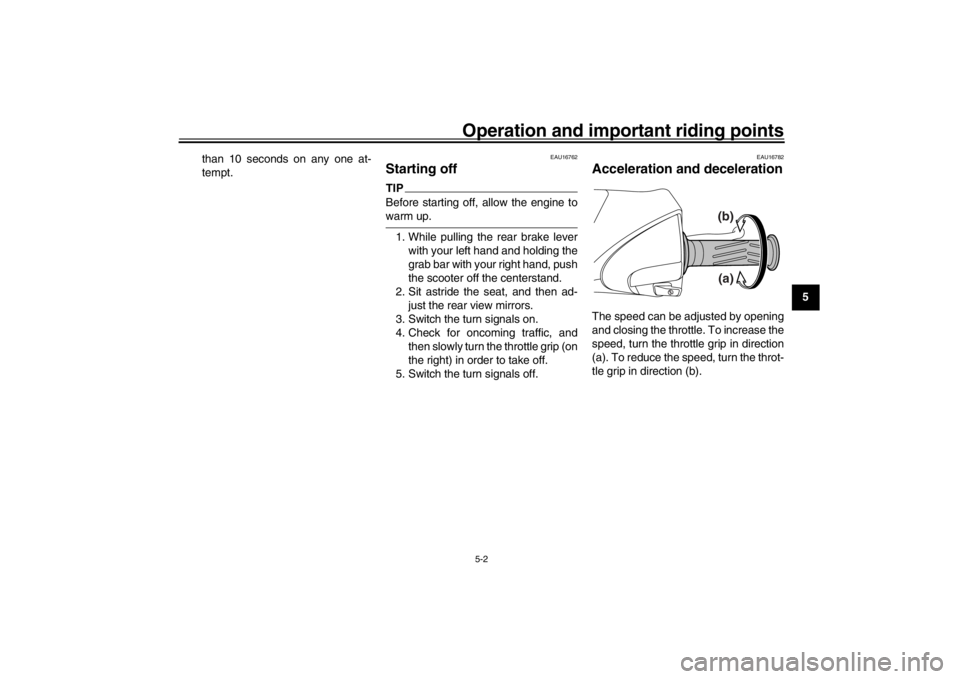
Acceleration and decelerationThe speed can be adjusted by opening
and closing the throttle. To increase the
speed, turn the throttle grip in direction
(a). To reduce the speed, turn the throt-
tle grip in direction (b).
(a)
(b)
U53BE1E0 2 ページ 2015年9月15日 火曜日 午後1時48分
Page 34 of 84
Operation and important riding points
5-3
1
2
3
45
6
7
8
9
10
11
12
EAU16794
Braking
WARNING
EWA10301
Avoid braking hard or suddenly
(especially when leaning over to
one side), otherwise the scooter
may skid or overturn.
Railroad crossings, streetcar
rails, iron plates on road con-
struction sites, and manhole
covers become extremely slip-
pery when wet. Therefore, slow
down when approaching such
areas and cross them with cau-
tion.
Keep in mind that braking on a
wet road is much more difficult.
Ride slowly down a hill, as brak-
ing downhill can be very diffi-cult.
1. Close the throttle completely.
2. Apply both front and rear brakes simultaneously while gradually in-
creasing the pressure.
EAU16821
Tips for reducing fuel
consumptionFuel consumption depends largely on
your riding style. Consider the following
tips to reduce fuel consumption:
Avoid high engine speeds during
acceleration.
Avoid high engine speeds with no
load on the engine.
Turn the engine off instead of let-
ting it idle for an extended length of
time (e.g., in traffic jams, at traffic
lights or at railroad crossings).
EAU16831
Engine break-inThere is never a more important period
in the life of your engine than the period
between 0 and 1000 km (600 mi). For
this reason, you should read the follow-
ing material carefully.
Since the engine is brand new, do not
put an excessive load on it for the first
1000 km (600 mi). The various parts in
the engine wear and polish themselves
to the correct operating clearances.
During this period, prolonged full-throt-
tle operation or any condition that might
result in engine overheating must be
avoided.
EAUT3541
0–150 km (0–90 mi)
Avoid prolonged operation above 1/3
throttle.
After every hour of operation, stop the
engine, and then let it cool for five to ten
minutes.
Vary the engine speed from time to
time. Do not operate the engine at one
set throttle position.
U53BE1E0 3 ページ 2015年9月15日 火曜日 午後1時48分
Page 36 of 84
6-1
1
2
3
4
56
7
8
9
10
11
12
Periodic maintenance and adjustment
EAUS1824
Periodic inspection, adjustment, and lu-
brication will keep your vehicle in the
safest and most efficient condition pos-
sible. Safety is an obligation of the vehi-
cle owner/operator. The most important
points of vehicle inspection, adjust-
ment, and lubrication are explained on
the following pages.
The intervals given in the periodic
maintenance charts should be simply
considered as a general guide under
normal riding conditions. However, de-
pending on the weather, terrain, geo-
graphical location, and individual use,
the maintenance intervals may need to
be shortened.
WARNING
EWA10322
Failure to properly maintain the ve-
hicle or performing maintenance ac-
tivities incorrectly may increase
your risk of injury or death during
service or while using the vehicle. If
you are not familiar with vehicle ser-
vice, have a Yamaha dealer performservice.
WARNING
EWA15123
Turn off the engine when performing
maintenance unless otherwise
specified.
A running engine has moving
parts that can catch on body
parts or clothing and electrical
parts that can cause shocks or
fires.
Running the engine while ser-
vicing can lead to eye injury,
burns, fire, or carbon monoxide
poisoning – possibly leading to
death. See page 1-2 for more in-
formation about carbon monox-ide.WARNING
EWA10331
This scooter is designed for use on
paved roads only. If this scooter is
operated in abnormally dusty, mud-
dy or wet conditions, the air filter el-
ement should be cleaned or
replaced more frequently, otherwise
rapid engine wear may result. Con-
sult a Yamaha dealer for propermaintenance intervals.
WARNING
EWA15461
Brake discs, calipers, drums, and
linings can become very hot during
use. To avoid possible burns, let
brake components cool beforetouching them.
U53BE1E0 1 ページ 2015年9月15日 火曜日 午後1時48分
Page 40 of 84
Periodic maintenance and adjustment
6-5
1
2
3
4
56
7
8
9
10
11
12
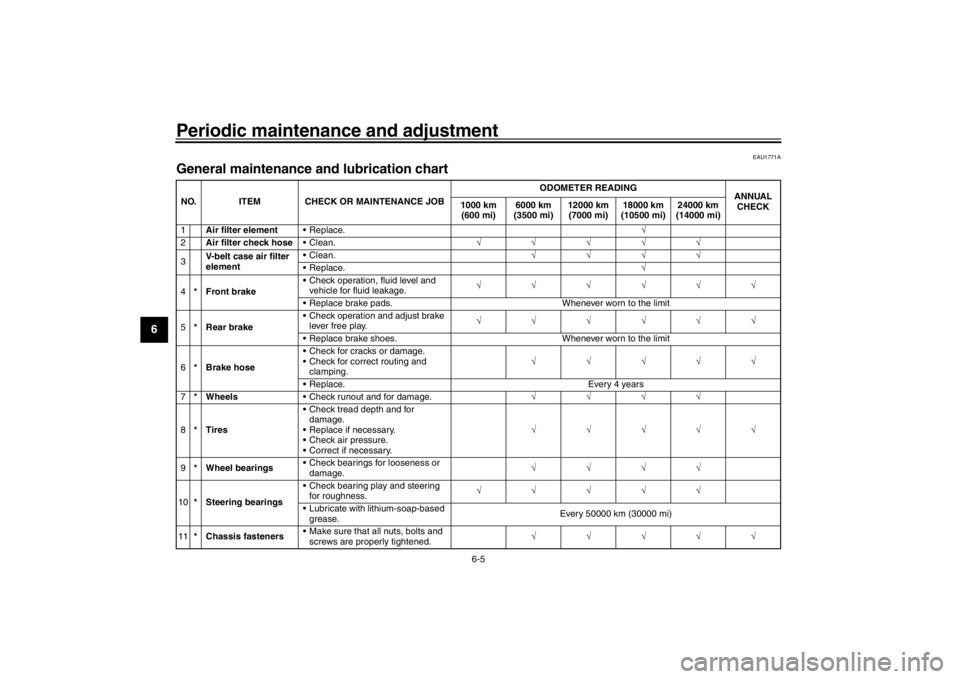
EAU1771A
General maintenance and lubrication chartNO. ITEM CHECK OR MAINTENANCE JOB ODOMETER READING
ANNUAL
CHECK
1000 km
(600 mi) 6000 km
(3500 mi) 12000 km
(7000 mi) 18000 km
(10500 mi) 24000 km
(14000 mi)
1 Air filter element
2 Air filter check hose Clean.
3 V-belt case air filter
element Clean.
4 * Front brake Check operation, fluid level and
vehicle for fluid leakage.
Replace brake pads. Whenever worn to the limit
5 * Rear brake Check operation and adjust brake
lever free play.
Replace brake shoes. Whenever worn to the limit
6 * Brake hose Check for cracks or damage.
Check for correct routing and
clamping.
Replace. Every 4 years
7 * Wheels Check runout and for damage.
8 *Tires Check tread depth and for
damage.
Replace if necessary.
Check air pressure.
Correct if necessary.
9 * Wheel bearings Check bearings for looseness or
damage.
10 * Steering bearings Check bearing play and steering
for roughness.
Lubricate with lithium-soap-based grease. Every 50000 km (30000 mi)
11 * Chassis fasteners Make sure that all nuts, bolts and
screws are properly tightened.
U53BE1E0 5 ページ 2015年9月15日 火曜日 午後1時48分
Page 41 of 84
Periodic maintenance and adjustment
6-6
1
2
3
4
567
8
9
10
11
12
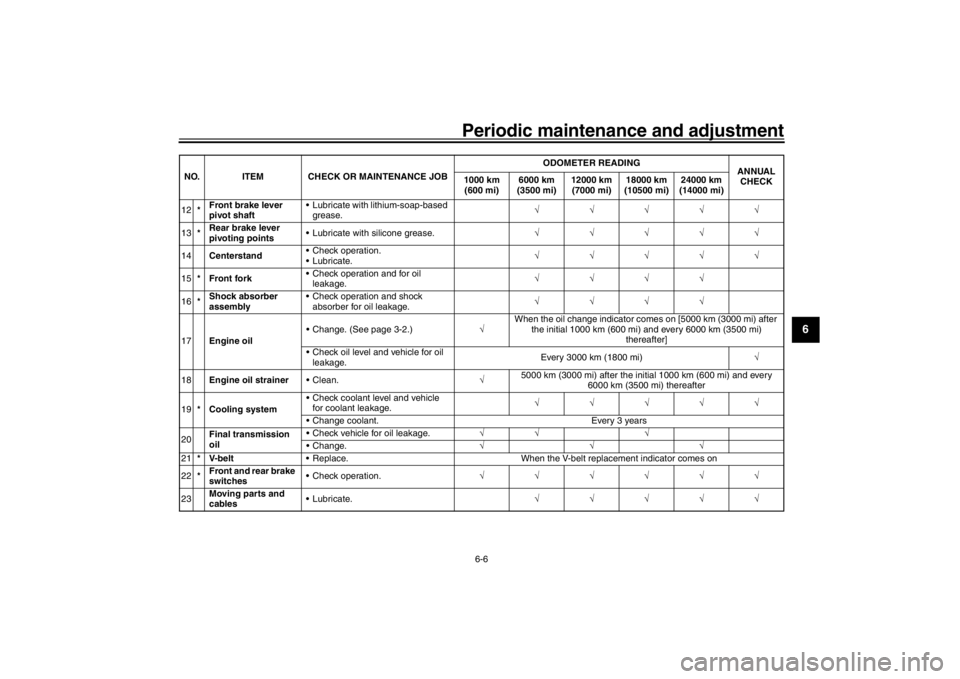
12 *Front brake lever
pivot shaft Lubricate with lithium-soap-based
grease.
13 *Rear brake lever
pivoting points Lubricate with silicone grease.
14 Centerstand Check operation.
Lubricate.
15 *Front fork Check operation and for oil
leakage.
16 *Shock absorber
assembly Check operation and shock
absorber for oil leakage.
17 Engine oil Change. (See page 3-2.)
When the oil change indicator comes on [5000 km (3000 mi) after
the initial 1000 km (600 mi) and every 6000 km (3500 mi) thereafter]
Check oil level and vehicle for oil leakage. Every 3000 km (1800 mi)
18 Engine oil strainer Clean. 5000 km (3000 mi) after the initial 1000 km (600 mi) and every
6000 km (3500 mi) thereafter
19 * Cooling system Check coolant level and vehicle
for coolant leakage.
Change coolant. Every 3 years
20 Final transmission
oil Check vehicle for oil leakage.
Change.
21 *V-belt Replace. When the V-belt replacement indicator comes on
22 *Front and rear brake
switches Check operation.
23 Moving parts and
cables Lubricate.
NO. ITEM CHECK OR MAINTENANCE JOB
ODOMETER READING
ANNUAL
CHECK
1000 km
(600 mi) 6000 km
(3500 mi) 12000 km
(7000 mi) 18000 km
(10500 mi) 24000 km
(14000 mi)
U53BE1E0 6 ページ 2015年9月15日 火曜日 午後1時48分
Page 42 of 84
Periodic maintenance and adjustment
6-7
1
2
3
4
56
7
8
9
10
11
12
EAUT2711
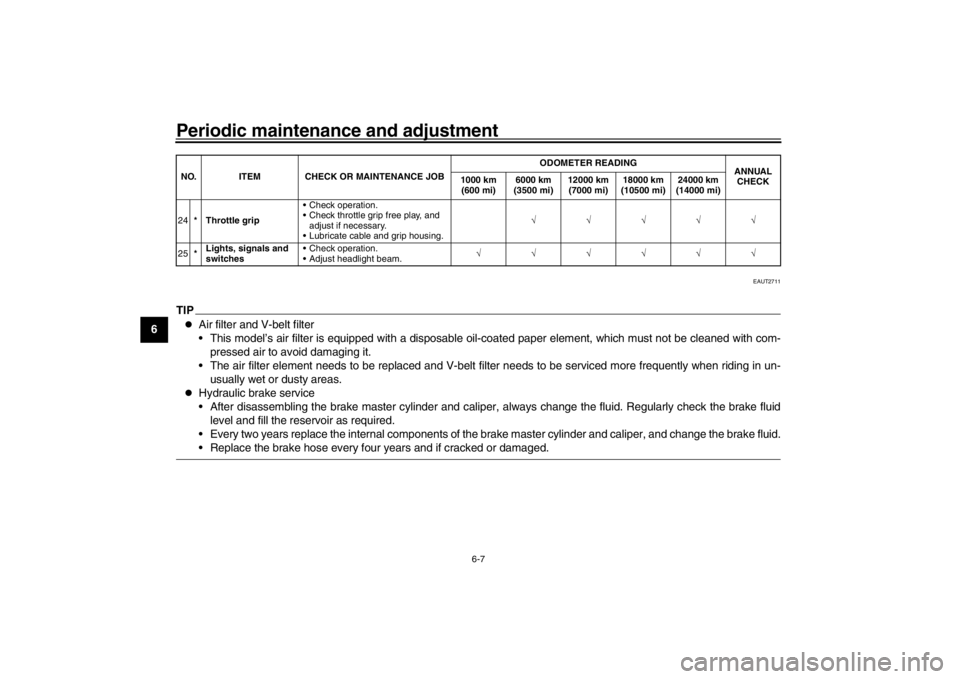
TIP
Air filter and V-belt filter
This model’s air filter is equipped wi th a disposable oil-coated paper elemen t, which must not be cleaned with com-
pressed air to avoid damaging it.
The air filter element needs to be replaced and V-belt filter needs to be serviced more frequently when riding in un- usually wet or dusty areas.
Hydraulic brake service
After disassembling the brake master cylinder and caliper , always change the fluid. Regularly check the brake fluid
level and fill the reservoir as required.
Every two years replace the internal components of the brake master cylinder and caliper, and change the brake fluid. Replace the brake hose every four years and if cracked or damaged.
24 * Throttle grip Check operation.
Check throttle grip free play, and
adjust if necessary.
Lubricate cable and grip housing.
25 *Lights, signals and
switches Check operation.
Adjust headlight beam.
NO. ITEM CHECK OR MAINTENANCE JOB
ODOMETER READING
ANNUAL
CHECK
1000 km
(600 mi) 6000 km
(3500 mi) 12000 km
(7000 mi) 18000 km
(10500 mi) 24000 km
(14000 mi)U53BE1E0 7 ページ 2015年9月15日 火曜日 午後1時48分
Page 54 of 84
Periodic maintenance and adjustment
6-19
1
2
3
4
56
7
8
9
10
11
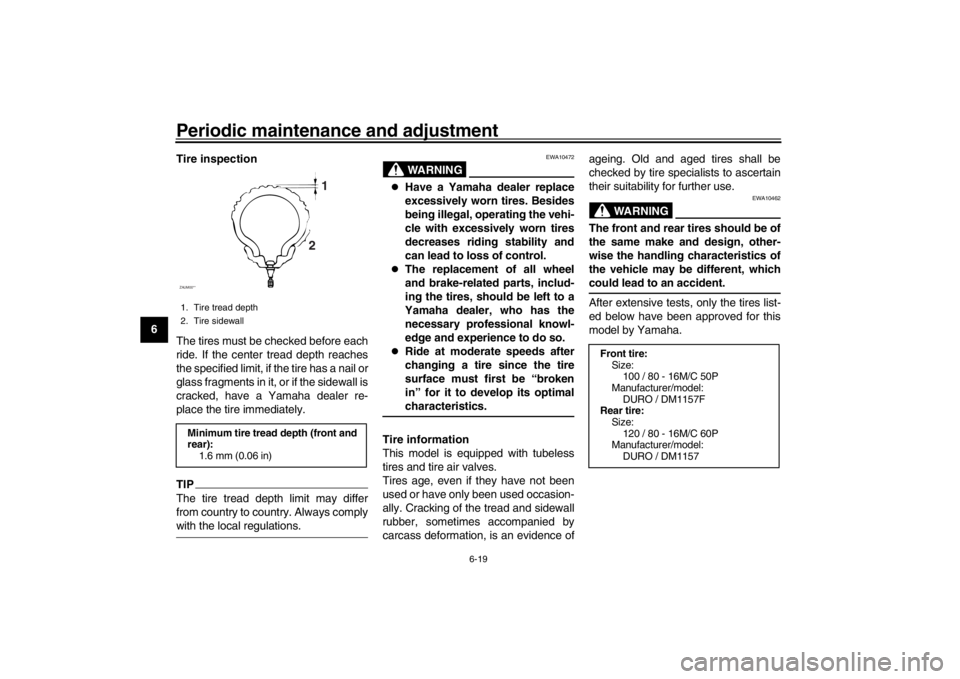
12 Tire inspection
The tires must be checked before each
ride. If the center tread depth reaches
the specified limit, if the tire has a nail or
glass fragments in it, or if the sidewall is
cracked, have a Yamaha dealer re-
place the tire immediately.
TIPThe tire tread depth limit may differ
from country to country. Always complywith the local regulations.
WARNING
EWA10472
Have a Yamaha dealer replace
excessively worn tires. Besides
being illegal, operating the vehi-
cle with excessively worn tires
decreases riding stability and
can lead to loss of control.
The replacement of all wheel
and brake-related parts, includ-
ing the tires, should be left to a
Yamaha dealer, who has the
necessary professional knowl-
edge and experience to do so.
Ride at moderate speeds after
changing a tire since the tire
surface must first be “broken
in” for it to develop its optimalcharacteristics.
Tire information
This model is equipped with tubeless
tires and tire air valves.
Tires age, even if they have not been
used or have only been used occasion-
ally. Cracking of the tread and sidewall
rubber, sometimes accompanied by
carcass deformation, is an evidence of ageing. Old and aged tires shall be
checked by tire specialists to ascertain
their suitability for further use.
WARNING
EWA10462
The front and rear tires should be of
the same make and design, other-
wise the handling characteristics of
the vehicle may be different, whichcould lead to an accident.
After extensive tests, only the tires list-
ed below have been approved for this
model by Yamaha.
1. Tire tread depth
2. Tire sidewallMinimum tire tread depth (front and
rear):
1.6 mm (0.06 in)ZAUM00**
1
2
Front tire:Size: 100 / 80 - 16M/C 50P
Manufacturer/model: DURO / DM1157F
Rear tire: Size:
120 / 80 - 16M/C 60P
Manufacturer/model: DURO / DM1157
U53BE1E0 19 ページ 2015年9月15日 火曜日 午後1時48分
Page 55 of 84
Periodic maintenance and adjustment6-20
1
2
3
4
567
8
9
10
11
12
EAU21963
Cast wheelsTo maximize the performance, durabil-
ity, and safe operation of your vehicle,
note the following points regarding the
specified wheels.
The wheel rims should be checked
for cracks, bends, warpage or oth-
er damage before each ride. If any
damage is found, have a Yamaha
dealer replace the wheel. Do not
attempt even the smallest repair to
the wheel. A deformed or cracked
wheel must be replaced.
The wheel should be balanced
whenever either the tire or wheel
has been changed or replaced. An
unbalanced wheel can result in
poor performance, adverse han-
dling characteristics, and a short-
ened tire life.
EAUS2002
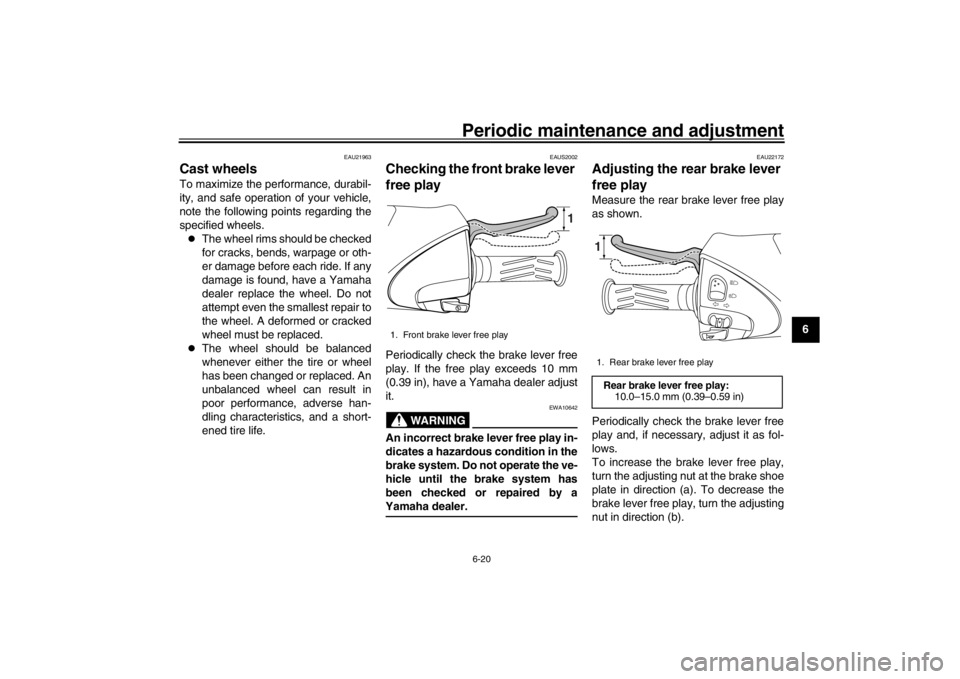
Checking the front brake lever
free playPeriodically check the brake lever free
play. If the free play exceeds 10 mm
(0.39 in), have a Yamaha dealer adjust
it.
WARNING
EWA10642
An incorrect brake lever free play in-
dicates a hazardous condition in the
brake system. Do not operate the ve-
hicle until the brake system has
been checked or repaired by aYamaha dealer.
EAU22172
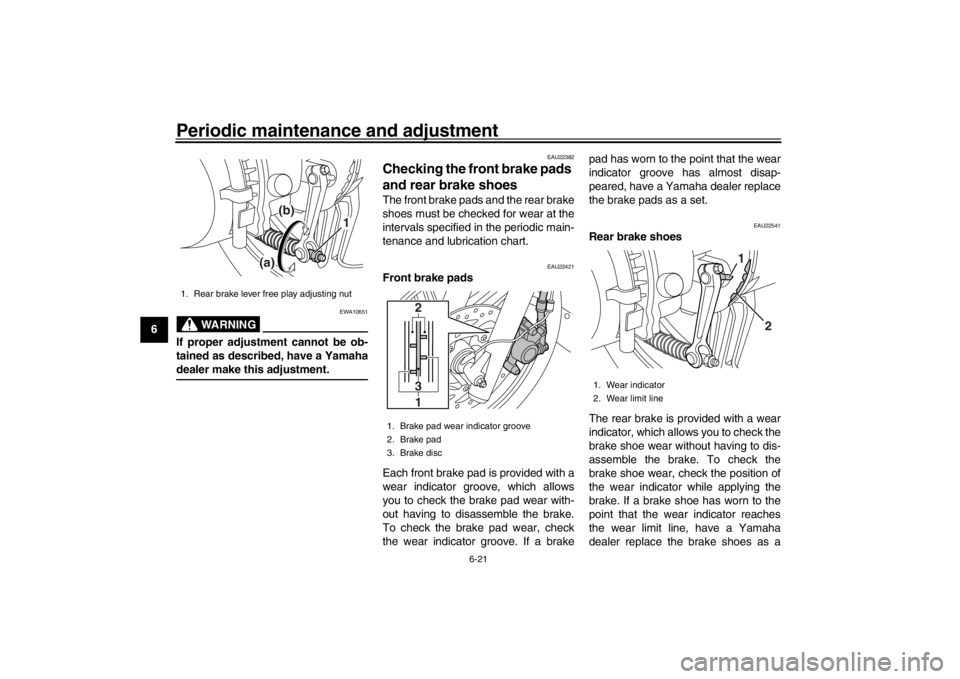
Adjusting the rear brake lever
free playMeasure the rear brake lever free play
as shown.
Periodically check the brake lever free
play and, if necessary, adjust it as fol-
lows.
To increase the brake lever free play,
turn the adjusting nut at the brake shoe
plate in direction (a). To decrease the
brake lever free play, turn the adjusting
nut in direction (b).
1. Front brake lever free play
1
1. Rear brake lever free playRear brake lever free play: 10.0–15.0 mm (0.39–0.59 in)1
U53BE1E0 20 ページ 2015年9月15日 火曜日 午後1時48分
Page 56 of 84
Periodic maintenance and adjustment
6-21
1
2
3
4
56
7
8
9
10
11
12
WARNING
EWA10651
If proper adjustment cannot be ob-
tained as described, have a Yamahadealer make this adjustment.
EAU22382
Checking the front brake pads
and rear brake shoes The front brake pads and the rear brake
shoes must be checked for wear at the
intervals specified in the periodic main-
tenance and lubrication chart.
EAU22421
Front brake pads
Each front brake pad is provided with a
wear indicator groove, which allows
you to check the brake pad wear with-
out having to disassemble the brake.
To check the brake pad wear, check
the wear indicator groove. If a brake pad has worn to the point that the wear
indicator groove has almost disap-
peared, have a Yamaha dealer replace
the brake pads as a set.
EAU22541
Rear brake shoes
The rear brake is provided with a wear
indicator, which allows you to check the
brake shoe wear without having to dis-
assemble the brake. To check the
brake shoe wear, check the position of
the wear indicator while applying the
brake. If a brake shoe has worn to the
point that the wear indicator reaches
the wear limit line, have a Yamaha
dealer replace the brake shoes as a
1. Rear brake lever free play adjusting nut
(a)
(b)
1
1. Brake pad wear indicator groove
2. Brake pad
3. Brake disc
2
3
1
1. Wear indicator
2. Wear limit line
1
2
U53BE1E0 21 ページ 2015年9月15日 火曜日 午後1時48分
Page 57 of 84
Periodic maintenance and adjustment6-22
1
2
3
4
567
8
9
10
11
12
set.
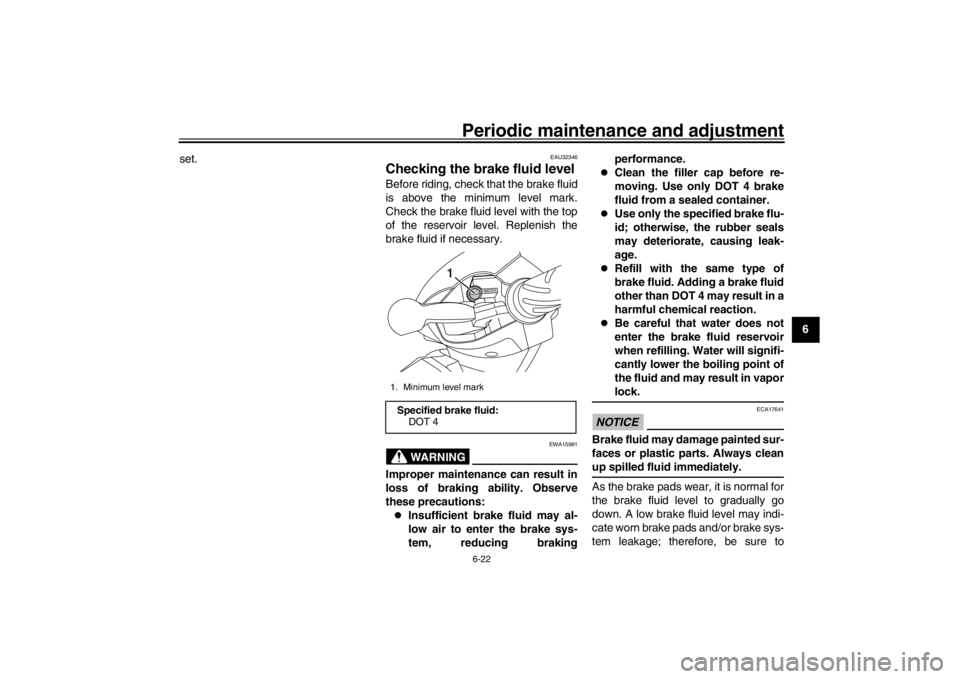
EAU32346
Checking the brake fluid levelBefore riding, check that the brake fluid
is above the minimum level mark.
Check the brake fluid level with the top
of the reservoir level. Replenish the
brake fluid if necessary.
WARNING
EWA15991
Improper maintenance can result in
loss of braking ability. Observe
these precautions:
Insufficient brake fluid may al-
low air to enter the brake sys-
tem, reducing braking performance.
Clean the filler cap before re-
moving. Use only DOT 4 brake
fluid from a sealed container.
Use only the specified brake flu-
id; otherwise, the rubber seals
may deteriorate, causing leak-
age.
Refill with the same type of
brake fluid. Adding a brake fluid
other than DOT 4 may result in a
harmful chemical reaction.
Be careful that water does not
enter the brake fluid reservoir
when refilling. Water will signifi-
cantly lower the boiling point of
the fluid and may result in vaporlock.
NOTICE
ECA17641
Brake fluid may damage painted sur-
faces or plastic parts. Always cleanup spilled fluid immediately.
As the brake pads wear, it is normal for
the brake fluid level to gradually go
down. A low brake fluid level may indi-
cate worn brake pads and/or brake sys-
tem leakage; therefore, be sure to
1. Minimum level markSpecified brake fluid:
DOT 4
1
U53BE1E0 22 ページ 2015年9月15日 火曜日 午後1時48分