air condition YAMAHA XENTER 150 2016 Owners Manual
[x] Cancel search | Manufacturer: YAMAHA, Model Year: 2016, Model line: XENTER 150, Model: YAMAHA XENTER 150 2016Pages: 84, PDF Size: 1.88 MB
Page 9 of 84

Safety information
1-2
12
3
4
5
6
7
8
9
10
11
12
there is no traffic until you have
become thoroughly familiar with
the scooter and all of its con-
trols.
Many accidents have been caused
by error of the scooter operator. A
typical error made by the operator
is veering wide on a turn due to ex-
cessive speed or undercornering
(insufficient lean angle for the
speed).
Always obey the speed limit and
never travel faster than warrant-
ed by road and traffic conditions.
Always signal before turning or changing lanes. Make sure that
other motorists can see you.
The posture of the operator and
passenger is important for proper
control.
The operator should keep bothhands on the handlebar and
both feet on the operator foot-
rests during operation to main-
tain control of the scooter.
The passenger should always hold onto the operator, the seat
strap or grab bar, if equipped,
with both hands and keep both feet on the passenger footrests.
Never carry a passenger unless
he or she can firmly place both
feet on the passenger footrests.
Never ride under the influence of
alcohol or other drugs.
This scooter is designed for
on-road use only. It is not suitable
for off-road use.
Protective Apparel
The majority of fatalities from scooter
accidents are the result of head inju-
ries. The use of a safety helmet is the
single most critical factor in the preven-
tion or reduction of head injuries.
Always wear an approved helmet.
Wear a face shield or goggles.
Wind in your unprotected eyes
could contribute to an impairment
of vision that could delay seeing a
hazard.
The use of a jacket, substantial
shoes, trousers, gloves, etc., is ef-
fective in preventing or reducing
abrasions or lacerations.
Never wear loose-fitting clothes,
otherwise they could catch on the
control levers or wheels and cause injury or an accident.
Always wear protective clothing
that covers your legs, ankles, and
feet. The engine or exhaust sys-
tem become very hot during or af-
ter operation and can cause burns.
A passenger should also observe
the above precautions.
Avoid Carbon Monoxide Poisoning
All engine exhaust contains carbon
monoxide, a deadly gas. Breathing car-
bon monoxide can cause headaches,
dizziness, drowsiness, nausea, confu-
sion, and eventually death.
Carbon Monoxide is a colorless, odor-
less, tasteless gas which may be pres-
ent even if you do not see or smell any
engine exhaust. Deadly levels of car-
bon monoxide can collect rapidly and
you can quickly be overcome and un-
able to save yourself. Also, deadly lev-
els of carbon monoxide can linger for
hours or days in enclosed or poorly
ventilated areas. If you experience any
symptoms of carbon monoxide poison-
ing, leave the area immediately, get
fresh air, and SEEK MEDICAL TREAT-
MENT.
U52SE1E0 2 ページ 2015年9月16日 水曜日 午後5時27分
Page 31 of 84

For your safety – pre-operation checks
4-2
1
2
345
6
7
8
9
10
11
12
Rear brake Check operation.
Lubricate cable if necessary.
Check lever free play.
Adjust if necessary. 6-20, 6-21
Throttle grip Make sure that operation is smooth.
Check throttle grip free play.
If necessary, have Yamaha dealer adjust th
rottle grip free play and lubricate cable
and grip housing. 6-17, 6-24
Control cables Make sure that operation is smooth.
Lubricate if necessary. 6-23
Wheels and tires Check for damage.
Check tire condition and tread depth.
Check air pressure.
Correct if necessary. 6-18, 6-20
Brake levers Make sure that operation is smooth.
Lubricate lever pivoting points if necessary. 6-24
Centerstand Make sure that operation is smooth.
Lubricate pivot if necessary. 6-24
Chassis fasteners Make sure that all nuts, bolts and screws are properly tightened.
Tighten if necessary. —
Instruments, lights, signals
and switches Check operation.
Correct if necessary.
—
ITEM CHECKS PAGE
U52SE1E0 2 ページ 2015年9月16日 水曜日 午後5時27分
Page 36 of 84
6-1
1
2
3
4
56
7
8
9
10
11
12
Periodic maintenance and adjustment
EAUS1824
Periodic inspection, adjustment, and lu-
brication will keep your vehicle in the
safest and most efficient condition pos-
sible. Safety is an obligation of the vehi-
cle owner/operator. The most important
points of vehicle inspection, adjust-
ment, and lubrication are explained on
the following pages.
The intervals given in the periodic
maintenance charts should be simply
considered as a general guide under
normal riding conditions. However, de-
pending on the weather, terrain, geo-
graphical location, and individual use,
the maintenance intervals may need to
be shortened.
WARNING
EWA10322
Failure to properly maintain the ve-
hicle or performing maintenance ac-
tivities incorrectly may increase
your risk of injury or death during
service or while using the vehicle. If
you are not familiar with vehicle ser-
vice, have a Yamaha dealer performservice.
WARNING
EWA15123
Turn off the engine when performing
maintenance unless otherwise
specified.
A running engine has moving
parts that can catch on body
parts or clothing and electrical
parts that can cause shocks or
fires.
Running the engine while ser-
vicing can lead to eye injury,
burns, fire, or carbon monoxide
poisoning – possibly leading to
death. See page 1-2 for more in-
formation about carbon monox-ide.WARNING
EWA10331
This scooter is designed for use on
paved roads only. If this scooter is
operated in abnormally dusty, mud-
dy or wet conditions, the air filter el-
ement should be cleaned or
replaced more frequently, otherwise
rapid engine wear may result. Con-
sult a Yamaha dealer for propermaintenance intervals.
WARNING
EWA15461
Brake discs, calipers, drums, and
linings can become very hot during
use. To avoid possible burns, let
brake components cool beforetouching them.
U52SE1E0 1 ページ 2015年9月16日 水曜日 午後5時27分
Page 53 of 84
Periodic maintenance and adjustment6-18
1
2
3
4
567
8
9
10
11
12
EAU21402
Valve clearanceThe valve clearance changes with use,
resulting in improper air-fuel mixture
and/or engine noise. To prevent this
from occurring, the valve clearance
must be adjusted by a Yamaha dealer
at the intervals specified in the periodic
maintenance and lubrication chart.
EAU61710
TiresTires are the only contact between the
vehicle and the road. Safety in all con-
ditions of riding depends on a relatively
small area of road contact. Therefore, it
is essential to maintain the tires in good
condition at all times and replace them
at the appropriate time with the speci-
fied tires.
Tire air pressure
The tire air pressure should be checked
and, if necessary, adjusted before each
ride.
WARNING
EWA10504
Operation of this vehicle with im-
proper tire pressure may cause se-
vere injury or death from loss of
control.
The tire air pressure must be
checked and adjusted on cold
tires (i.e., when the temperature
of the tires equals the ambient
temperature).
The tire air pressure must be ad-
justed in accordance with the
riding speed and with the total weight of rider, passenger, car-
go, and accessories approved
for this model.WARNING
EWA10512
Never overload your vehicle. Opera-
tion of an overloaded vehicle couldcause an accident.
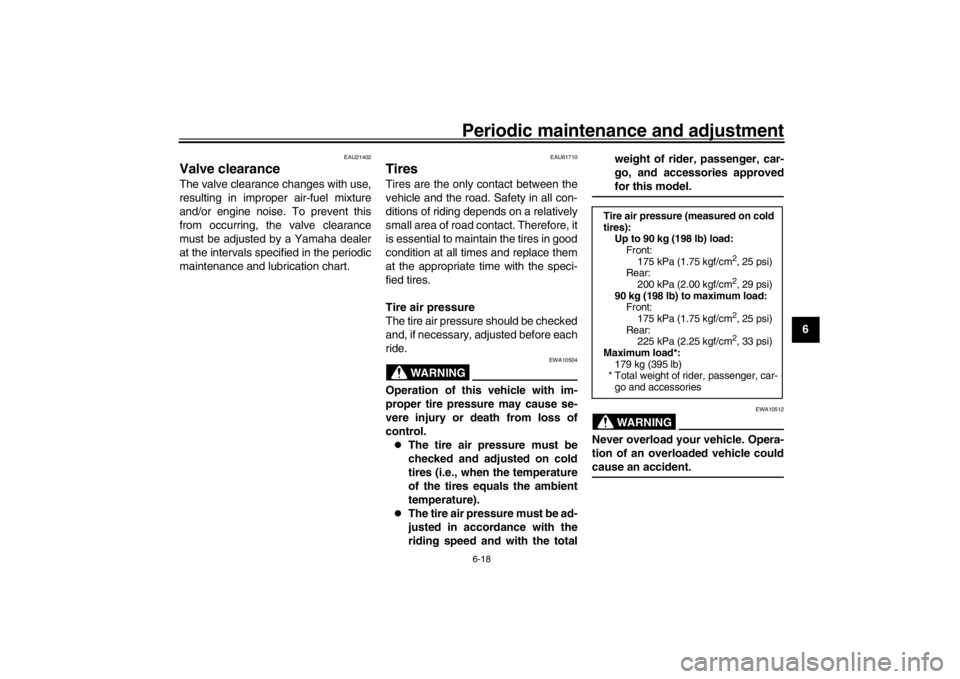
Tire air pressure (measured on cold
tires):
Up to 90 kg (198 lb) load: Front:175 kPa (1.75 kgf/cm
2, 25 psi)
Rear: 200 kPa (2.00 kgf/cm2, 29 psi)
90 kg (198 lb) to maximum load:
Front:175 kPa (1.75 kgf/cm2, 25 psi)
Rear:
225 kPa (2.25 kgf/cm2, 33 psi)
Maximum load*: 179 kg (395 lb)
* Total weight of rider, passenger, car- go and accessories
U52SE1E0 18 ページ 2015年9月16日 水曜日 午後5時27分
Page 55 of 84
Periodic maintenance and adjustment6-20
1
2
3
4
567
8
9
10
11
12
EAU21963
Cast wheelsTo maximize the performance, durabil-
ity, and safe operation of your vehicle,
note the following points regarding the
specified wheels.
The wheel rims should be checked
for cracks, bends, warpage or oth-
er damage before each ride. If any
damage is found, have a Yamaha
dealer replace the wheel. Do not
attempt even the smallest repair to
the wheel. A deformed or cracked
wheel must be replaced.
The wheel should be balanced
whenever either the tire or wheel
has been changed or replaced. An
unbalanced wheel can result in
poor performance, adverse han-
dling characteristics, and a short-
ened tire life.
EAUS2002
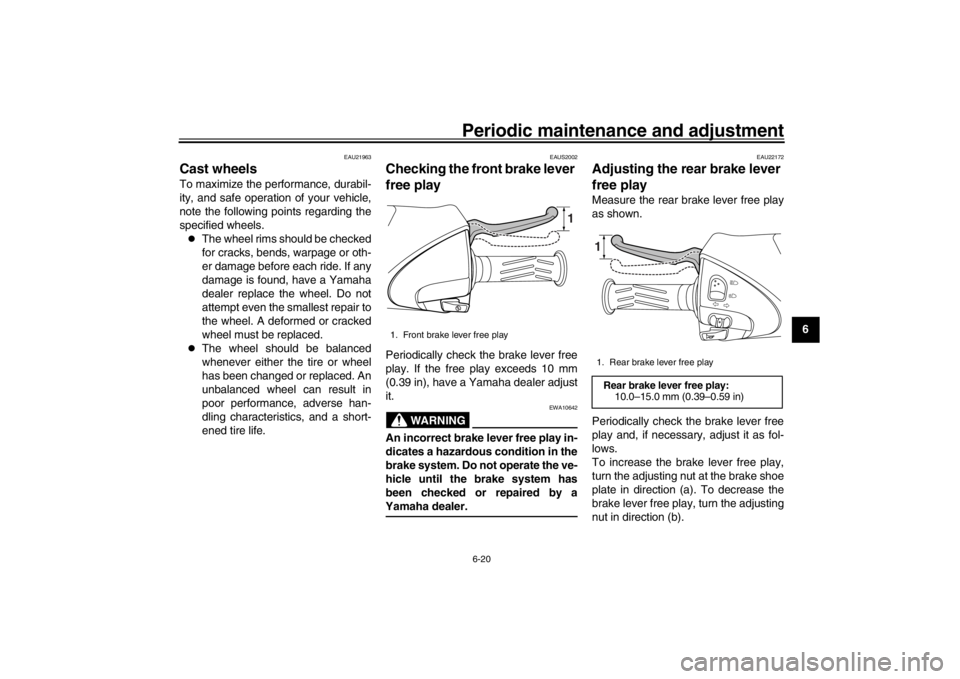
Checking the front brake lever
free playPeriodically check the brake lever free
play. If the free play exceeds 10 mm
(0.39 in), have a Yamaha dealer adjust
it.
WARNING
EWA10642
An incorrect brake lever free play in-
dicates a hazardous condition in the
brake system. Do not operate the ve-
hicle until the brake system has
been checked or repaired by aYamaha dealer.
EAU22172
Adjusting the rear brake lever
free playMeasure the rear brake lever free play
as shown.
Periodically check the brake lever free
play and, if necessary, adjust it as fol-
lows.
To increase the brake lever free play,
turn the adjusting nut at the brake shoe
plate in direction (a). To decrease the
brake lever free play, turn the adjusting
nut in direction (b).
1. Front brake lever free play
1
1. Rear brake lever free playRear brake lever free play: 10.0–15.0 mm (0.39–0.59 in)1
U52SE1E0 20 ページ 2015年9月16日 水曜日 午後5時27分
Page 60 of 84
Periodic maintenance and adjustment
6-25
1
2
3
4
56
7
8
9
10
11
12
EAU23273
Checking the front forkThe condition and operation of the front
fork must be checked as follows at the
intervals specified in the periodic main-
tenance and lubrication chart.
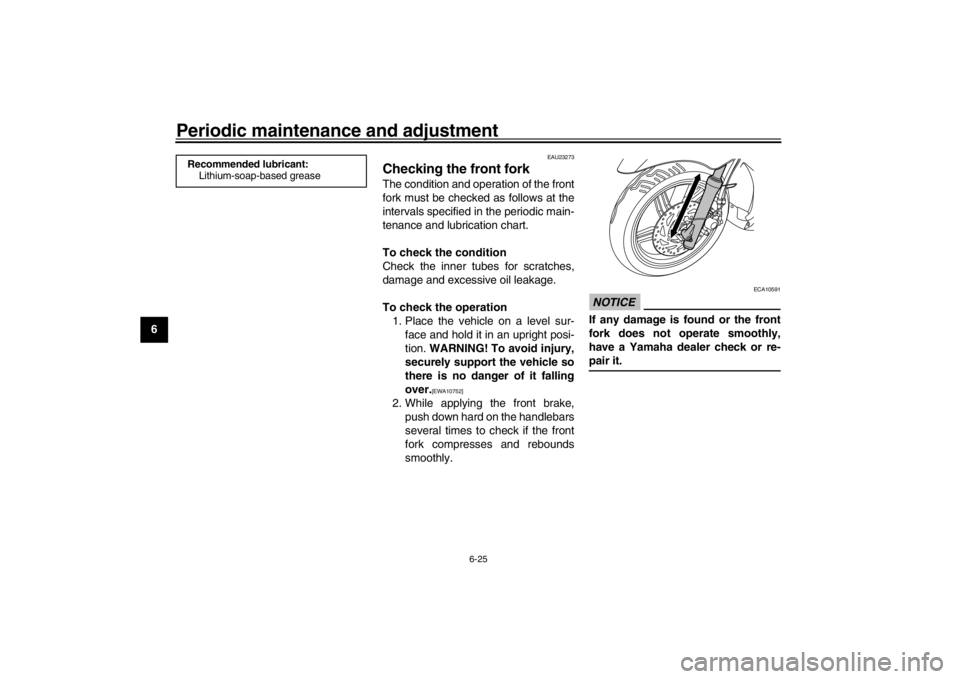
To check the condition
Check the inner tubes for scratches,
damage and excessive oil leakage.
To check the operation 1. Place the vehicle on a level sur- face and hold it in an upright posi-
tion. WARNING! To avoid injury,
securely support the vehicle so
there is no danger of it falling
over.
[EWA10752]
2. While applying the front brake, push down hard on the handlebars
several times to check if the front
fork compresses and rebounds
smoothly.
NOTICE
ECA10591
If any damage is found or the front
fork does not operate smoothly,
have a Yamaha dealer check or re-pair it.
Recommended lubricant:Lithium-soap-based grease
U52SE1E0 25 ページ 2015年9月16日 水曜日 午後5時27分
Page 75 of 84

Specifications
8-2
1
2
3
4
5
6
789
10
11
12
Manufacturer/model: DURO / DM1157FRear tire:Type:Tubeless
Size: 120 / 80 - 16M/C 60P
Manufacturer/model:
DURO / DM1157Loading:Maximum load:179 kg (395 lb)
* (Total weight of rider, passenger, cargo
and accessories)Tire air pressure (measured on cold
tires):Loading condition:90 kg (198 lb)
Front: 175 kPa (1.75 kgf/cm
2, 25 psi)
Rear: 200 kPa (2.00 kgf/cm2, 29 psi)
Loading condition:
90 kg - maximum load
Front: 175 kPa (1.75 kgf/cm2, 25 psi)
Rear: 225 kPa (2.25 kgf/cm2, 33 psi)
Front wheel:Wheel type:Cast wheel
Rim size: J 16M/C × MT2.50
Rear wheel:Wheel type:Cast wheel
Rim size: J 16M/C × MT2.75Front brake:Type:
Hydraulic single disc brake
Specified brake fluid: DOT 4Rear brake:Type:
Mechanical leading trailing drum brakeFront suspension:Type:Telescopic fork
Spring:
Coil spring
Shock absorber: Hydraulic damper
Wheel travel: 100 mm (3.9 in)Rear suspension:Type:Unit swing
Spring: Coil spring
Shock absorber:
Gas-hydraulic damper
Wheel travel: 92 mm (3.6 in)Electrical system:System voltage:
12 V Ignition system:
TCI
Charging system:
AC magneto
Battery:Model:GT7B-4
Voltage, capacity:
10 V, 6.5 Ah (10 HR)Headlight:Bulb type:Halogen bulbBulb voltage, wattage quantity:Headlight:
12 V, 55.0 W 2
Brake/tail light: LED
Front turn signal light:
12 V, 10.0 W 2
Rear turn signal light: 12 V, 10.0 W 2
Auxiliary light: 12 V, 5.0 W 2
License plate light:
12 V, 5.0 W 1
Meter lighting: LED
High beam indicator light: LED
Turn signal indicator light:
LED
Coolant temperature warning light: LED
U52SE1E0 2 ページ 2015年9月16日 水曜日 午後5時27分