Fork YAMAHA XJ6-N 2011 Owners Manual
[x] Cancel search | Manufacturer: YAMAHA, Model Year: 2011, Model line: XJ6-N, Model: YAMAHA XJ6-N 2011Pages: 104, PDF Size: 2.86 MB
Page 7 of 104

TABLE OF CONTENTS
Lubricating the swingarm pivots ......................................... 6-31
Checking the front fork ................. 6-31
Checking the steering ................... 6-32
Checking the wheel bearings ....... 6-32
Battery .......................................... 6-33
Replacing the fuses ...................... 6-34
Replacing the headlight bulb ........ 6-36
Replacing the tail/brake light bulb ........................................... 6-38
Replacing a turn signal light
bulb ........................................... 6-39
Replacing the license plate light bulb ........................................... 6-40
Replacing the auxiliary light bulb ........................................... 6-40
Supporting the motorcycle ............ 6-41
Front wheel
(for non-ABS models) ............... 6-42
Rear wheel
(for non-ABS models) ............... 6-43
Troubleshooting ............................ 6-45
Troubleshooting charts ................. 6-46
MOTORCYCLE CARE AND
STORAGE .......................................... 7-1
Matte color caution ......................... 7-1
Care ................................................ 7-1
Storage ...........................................7-3 SPECIFICATIONS
............................ 8-1
CONSUMER INFORMATION ............ 9-1
Identification numbers .................... 9-1
U20SE3E0.book Page 2 Monday, April 23, 2012 10:47 AM
Page 10 of 104

SAFETY INFORMATION
1-3
1Avoid Carbon Monoxide Poisoning
All engine exhaust contains carbon
monoxide, a deadly gas. Breathing car-
bon monoxide can cause headaches,
dizziness, drowsiness, nausea, confu-
sion, and eventually death.
Carbon Monoxide is a colorless, odor-
less, tasteless gas which may be
present even if you do not see or smell
any engine exhaust. Deadly levels of
carbon monoxide can collect rapidly
and you can quickly be overcome and
unable to save yourself. Also, deadly
levels of carbon monoxide can linger
for hours or days in enclosed or poorly
ventilated areas. If you experience any
symptoms of carbon monoxide poison-
ing, leave the area immediately, get
fresh air, and SEEK MEDICAL TREAT-
MENT.
●
Do not run engine indoors. Even if
you try to ventilate engine exhaust
with fans or open windows and
doors, carbon monoxide can rap-
idly reach dangerous levels.
●
Do not run engine in poorly venti-
lated or partially enclosed areas
such as barns, garages, or car-
ports.
●
Do not run engine outdoors where
engine exhaust can be drawn into
a building through openings such
as windows and doors.
Loading
Adding accessories or cargo to your
motorcycle can adversely affect stabili-
ty and handling if the weight distribution
of the motorcycle is changed. To avoid
the possibility of an accident, use ex-
treme caution when adding cargo or
accessories to your motorcycle. Use
extra care when riding a motorcycle
that has added cargo or accessories.
Here, along with the information about
accessories below, are some general
guidelines to follow if loading cargo to
your motorcycle:
The total weight of the operator, pas-
senger, accessories and cargo must
not exceed the maximum load limit.
Operation of an overloaded vehicle
could cause an accident. When loading within this weight limit,
keep the following in mind:
●
Cargo and accessory weight
should be kept as low and close to
the motorcycle as possible. Se-
curely pack your heaviest items as
close to the center of the vehicle as
possible and make sure to distrib-
ute the weight as evenly as possi-
ble on both sides of the motorcycle
to minimize imbalance or instabili-
ty.
●
Shifting weights can create a sud-
den imbalance. Make sure that ac-
cessories and cargo are securely
attached to the motorcycle before
riding. Check accessory mounts
and cargo restraints frequently.
Properly adjust the suspension for your load (suspension-ad-
justable models only), and
check the condition and pres-
sure of your tires.
Never attach any large or heavy items to the handlebar, front
fork, or front fender. These
items, including such cargo as
sleeping bags, duffel bags, or
Maximum load: XJ6N 195 kg (430 lb)
XJ6NA 190 kg (419 lb)
U20SE3E0.book Page 3 Monday, April 23, 2012 10:47 AM
Page 11 of 104

SAFETY INFORMATION
1-4
1
tents, can create unstable han-
dling or a slow steering re-
sponse.
●
This vehicle is not designed to
pull a trailer or to be attached to
a sidecar.
Genuine Yamaha Accessories
Choosing accessories for your vehicle
is an important decision. Genuine
Yamaha accessories, which are avail- able only from a Yamaha dealer, have
been designed, tested, and approved
by Yamaha for use on your vehicle.
Many companies with no connection to
Yamaha manufacture parts and acces- sories or offer other modifications for
Yamaha vehicles. Yamaha is not in a position to test the products that these
aftermarket companies produce.
Therefore, Yamaha can neither en-
dorse nor recommend the use of ac-
cessories not sold by Yamaha or
modifications not specifically recom-
mended by Yamaha, even if sold and
installed by a Yamaha dealer. Aftermarket Parts, Accessories, and
Modifications
While you may find aftermarket prod-
ucts similar in design and quality to
genuine Yamaha accessories, recog-
nize that some aftermarket accessories
or modifications are not suitable be-
cause of potential safety hazards to you
or others. Installing aftermarket prod-
ucts or having other modifications per-
formed to your vehicle that change any
of the vehicle’s design or operation
characteristics can put you and others
at greater risk of serious injury or death.
You are responsible for injuries related
to changes in the vehicle.
Keep the following guidelines in mind,
as well as those provided under “Load-
ing” when mounting accessories.
●
Never install accessories or carry
cargo that would impair the perfor-
mance of your motorcycle. Care-
fully inspect the accessory before
using it to make sure that it does
not in any way reduce ground
clearance or cornering clearance, limit suspension travel, steering
travel or control operation, or ob-
scure lights or reflectors.
Accessories fitted to the handle- bar or the front fork area can
create instability due to improper
weight distribution or aerody-
namic changes. If accessories
are added to the handlebar or
front fork area, they must be as
lightweight as possible and
should be kept to a minimum.
Bulky or large accessories may seriously affect the stability of
the motorcycle due to aerody-
namic effects. Wind may at-
tempt to lift the motorcycle, or
the motorcycle may become un-
stable in cross winds. These ac-
cessories may also cause
instability when passing or being
passed by large vehicles.
Certain accessories can dis- place the operator from his or
her normal riding position. This
improper position limits the free-
dom of movement of the opera-
U20SE3E0.book Page 4 Monday, April 23, 2012 10:47 AM
Page 12 of 104

SAFETY INFORMATION
1-5
1tor and may limit control ability,
therefore, such accessories are
not recommended.
●
Use caution when adding electri-
cal accessories. If electrical acces-
sories exceed the capacity of the
motorcycle’s electrical system, an
electric failure could result, which
could cause a dangerous loss of
lights or engine power.
Aftermarket Tires and Rims
The tires and rims that came with your
motorcycle were designed to match the
performance capabilities and to provide
the best combination of handling, brak-
ing, and comfort. Other tires, rims, siz-
es, and combinations may not be
appropriate. Refer to page 6-19 for tire
specifications and more information on
replacing your tires.
Transporting the Motorcycle
Be sure to observe following instruc-
tions before transporting the motorcy-
cle in another vehicle.
●
Remove all loose items from the
motorcycle.
●
Check that the fuel cock (if
equipped) is in the “OFF” position
and that there are no fuel leaks.
●
Point the front wheel straight
ahead on the trailer or in the truck
bed, and choke it in a rail to pre-
vent movement.
●
Shift the transmission in gear (for
models with a manual transmis-
sion).
●
Secure the motorcycle with tie-
downs or suitable straps that are
attached to solid parts of the mo-
torcycle, such as the frame or up-
per front fork triple clamp (and not,
for example, to rubber-mounted
handlebars or turn signals, or parts
that could break). Choose the lo-
cation for the straps carefully so
the straps will not rub against
painted surfaces during transport.
●
The suspension should be com-
pressed somewhat by the tie-
downs, if possible, so that the mo-
torcycle will not bounce excessive-
ly during transport.
U20SE3E0.book Page 5 Monday, April 23, 2012 10:47 AM
Page 51 of 104

PERIODIC MAINTENANCE AND ADJUSTMENT
6-6
6
19*Front fork Check operation and for oil leak-
age. √√√√
20 *Shock absorber as-
sembly Check operation and shock ab-
sorber for oil leakage. √√√√
21 Engine oil Change.
Check oil level and vehicle for oil
leakage. √√√√√√
22 Engine oil filter car-
tridge Replace.
√√√
23 *Cooling system Check coolant level and vehicle
for coolant leakage. √√√√√
Change with ethylene glycol anti- freeze coolant. Every 3 years
24 *Front and rear brake
switches Check operation.
√√√√√√
25 Moving parts and
cables
Lubricate.
√√√√√
26 *Throttle grip Check operation.
Check throttle grip free play, and
adjust if necessary.
Lubricate cable and grip housing. √√√√√
27 *Lights, signals and
switches Check operation.
Adjust headlight beam.
√√√√√√
NO. ITEM CHECK OR MAINTENANCE JOB
ODOMETER READING
ANNUAL
CHECK
1000 km
(600 mi) 10000 km
(6000 mi) 20000 km
(12000 mi) 30000 km
(18000 mi) 40000 km
(24000 mi)
U20SE3E0.book Page 6 Monday, April 23, 2012 10:47 AM
Page 76 of 104
PERIODIC MAINTENANCE AND ADJUSTMENT
6-31
6
EAU23202
Checking and lubricating the
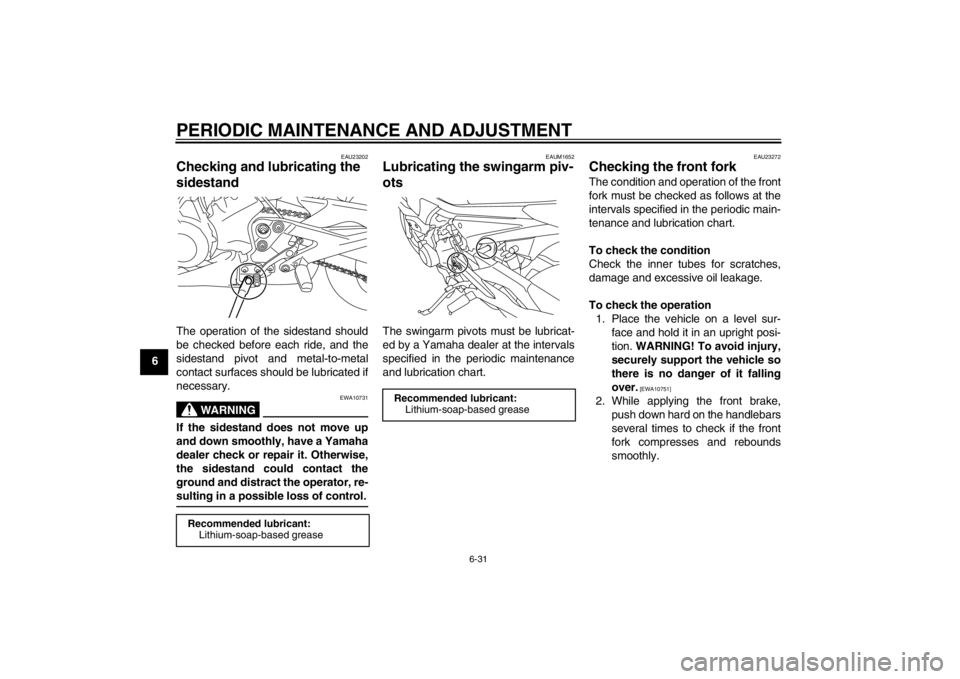
sidestand The operation of the sidestand should
be checked before each ride, and the
sidestand pivot and metal-to-metal
contact surfaces should be lubricated if
necessary.
WARNING
EWA10731
If the sidestand does not move up
and down smoothly, have a Yamaha
dealer check or repair it. Otherwise,
the sidestand could contact the
ground and distract the operator, re-
sulting in a possible loss of control.
EAUM1652
Lubricating the swingarm piv-
ots The swingarm pivots must be lubricat-
ed by a Yamaha dealer at the intervals
specified in the periodic maintenance
and lubrication chart.
EAU23272
Checking the front fork The condition and operation of the front
fork must be checked as follows at the
intervals specified in the periodic main-
tenance and lubrication chart.
To check the condition
Check the inner tubes for scratches,
damage and excessive oil leakage.
To check the operation1. Place the vehicle on a level sur- face and hold it in an upright posi-
tion. WARNING! To avoid injury,
securely support the vehicle so
there is no danger of it falling
over.
[EWA10751]
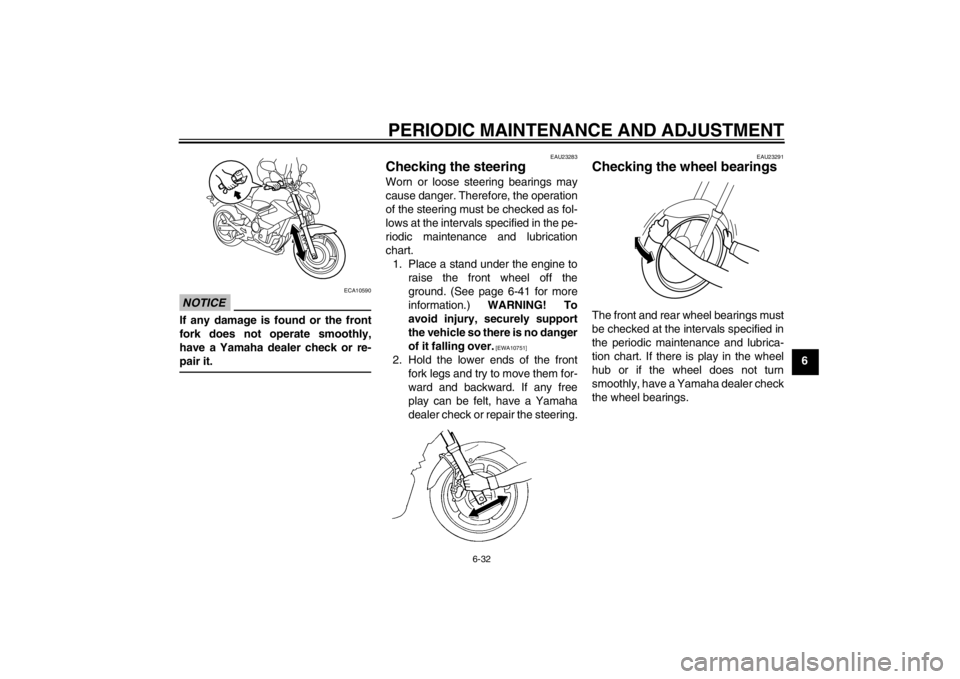
2. While applying the front brake, push down hard on the handlebars
several times to check if the front
fork compresses and rebounds
smoothly.
Recommended lubricant:Lithium-soap-based grease
Recommended lubricant:Lithium-soap-based grease
U20SE3E0.book Page 31 Monday, April 23, 2012 10:47 AM
Page 77 of 104
PERIODIC MAINTENANCE AND ADJUSTMENT
6-32
6
NOTICE
ECA10590
If any damage is found or the front
fork does not operate smoothly,
have a Yamaha dealer check or re-
pair it.
EAU23283
Checking the steering Worn or loose steering bearings may
cause danger. Therefore, the operation
of the steering must be checked as fol-
lows at the intervals specified in the pe-
riodic maintenance and lubrication
chart.1. Place a stand under the engine to raise the front wheel off the
ground. (See page 6-41 for more
information.) WARNING! To
avoid injury, securely support
the vehicle so there is no danger
of it falling over.
[EWA10751]
2. Hold the lower ends of the front fork legs and try to move them for-
ward and backward. If any free
play can be felt, have a Yamaha
dealer check or repair the steering.
EAU23291
Checking the wheel bearings The front and rear wheel bearings must
be checked at the intervals specified in
the periodic maintenance and lubrica-
tion chart. If there is play in the wheel
hub or if the wheel does not turn
smoothly, have a Yamaha dealer check
the wheel bearings.
U20SE3E0.book Page 32 Monday, April 23, 2012 10:47 AM
Page 87 of 104
PERIODIC MAINTENANCE AND ADJUSTMENT
6-42
6
EAU44791
Front wheel (for non-ABS
models)
WARNING
EWA14840
For the ABS model, have a Yamaha
dealer remove and install the wheel.
EAU24492
To remove the front wheel
WARNING
EWA10821
To avoid injury, securely support the
vehicle so there is no danger of it
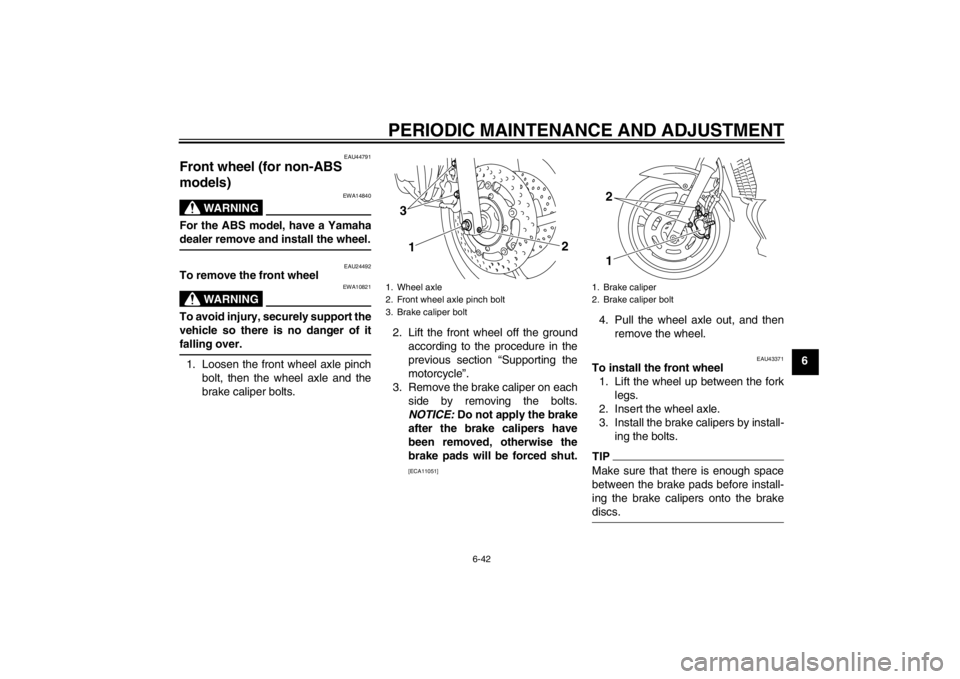
falling over.1. Loosen the front wheel axle pinchbolt, then the wheel axle and the
brake caliper bolts. 2. Lift the front wheel off the ground
according to the procedure in the
previous section “Supporting the
motorcycle”.
3. Remove the brake caliper on each side by removing the bolts.
NOTICE: Do not apply the brake
after the brake calipers have
been removed, otherwise the
brake pads will be forced shut.
[ECA11051]
4. Pull the wheel axle out, and then remove the wheel.
EAU43371
To install the front wheel1. Lift the wheel up between the fork legs.
2. Insert the wheel axle.
3. Install the brake calipers by install- ing the bolts.TIPMake sure that there is enough space
between the brake pads before install-
ing the brake calipers onto the brake
discs.
1. Wheel axle
2. Front wheel axle pinch bolt
3. Brake caliper bolt
13
2
1. Brake caliper
2. Brake caliper bolt
1 2
U20SE3E0.book Page 42 Monday, April 23, 2012 10:47 AM
Page 88 of 104
PERIODIC MAINTENANCE AND ADJUSTMENT
6-43
64. Lower the front wheel so that it is
on the ground, and then put the
sidestand down.
5. Tighten the wheel axle, the front wheel axle pinch bolt and the
brake caliper bolts to the specified
torques.
6. Push down hard on the handlebar several times to check for proper
fork operation.
EAU44801
Rear wheel (for non-ABS mod-
els)
WARNING
EWA14840
For the ABS model, have a Yamaha
dealer remove and install the wheel.
EAU34414
To remove the rear wheel
WARNING
EWA10821
To avoid injury, securely support the
vehicle so there is no danger of it
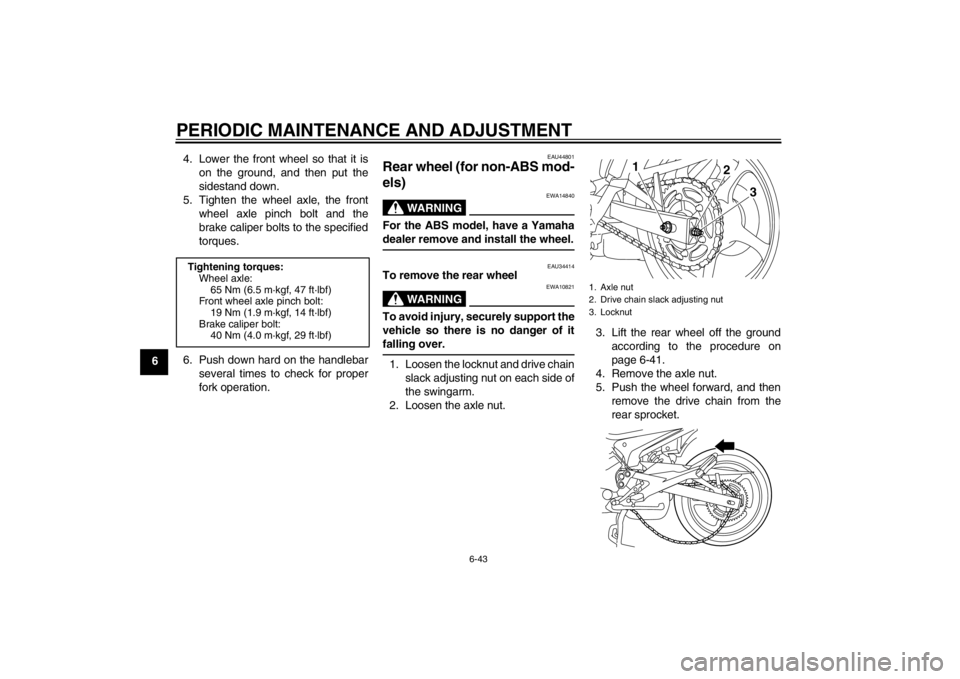
falling over.1. Loosen the locknut and drive chainslack adjusting nut on each side of
the swingarm.
2. Loosen the axle nut. 3. Lift the rear wheel off the ground
according to the procedure on
page 6-41.
4. Remove the axle nut.
5. Push the wheel forward, and then remove the drive chain from the
rear sprocket.
Tightening torques:Wheel axle:65 Nm (6.5 m·kgf, 47 ft·lbf)
Front wheel axle pinch bolt:
19 Nm (1.9 m·kgf, 14 ft·lbf)
Brake caliper bolt: 40 Nm (4.0 m·kgf, 29 ft·lbf)
1. Axle nut
2. Drive chain slack adjusting nut
3. Locknut
1
3
2
U20SE3E0.book Page 43 Monday, April 23, 2012 10:47 AM
Page 94 of 104
MOTORCYCLE CARE AND STORAGE
7-2
7off any detergent residue using
plenty of water, as it is harmful
to plastic parts.
●
Do not use any harsh chemical
products on plastic parts. Be
sure to avoid using cloths or
sponges which have been in
contact with strong or abrasive
cleaning products, solvent or
thinner, fuel (gasoline), rust re-
movers or inhibitors, brake flu-
id, antifreeze or electrolyte.
●
Do not use high-pressure wash-
ers or steam-jet cleaners since
they cause water seepage and
deterioration in the following ar-
eas: seals (of wheel and swing-
arm bearings, fork and brakes),
electric components (couplers,
connectors, instruments,
switches and lights), breather
hoses and vents.
●
For motorcycles equipped with
a windshield: Do not use strong
cleaners or hard sponges as
they will cause dulling or
scratching. Some cleaning com-
pounds for plastic may leave
scratches on the windshield. Test the product on a small hid-
den part of the windshield to
make sure that it does not leave
any marks. If the windshield is
scratched, use a quality plastic
polishing compound after
washing.
After normal useRemove dirt with warm water, a mild
detergent, and a soft, clean sponge,
and then rinse thoroughly with clean
water. Use a toothbrush or bottlebrush
for hard-to-reach areas. Stubborn dirt
and insects will come off more easily if
the area is covered with a wet cloth for
a few minutes before cleaning.
After riding in the rain, near the sea oron salt-sprayed roadsSince sea salt or salt sprayed on roads
during winter are extremely corrosive in
combination with water, carry out the
following steps after each ride in the
rain, near the sea or on salt-sprayed
roads.
TIPSalt sprayed on roads in the winter may
remain well into spring.1. Clean the motorcycle with cold wa-
ter and a mild detergent, after the
engine has cooled down.
NOTICE: Do not use warm water
since it increases the corrosive
action of the salt.
[ECA10791]
2. Apply a corrosion protection spray on all metal, including chrome- and
nickel-plated, surfaces to prevent
corrosion.
After cleaning 1. Dry the motorcycle with a chamois or an absorbing cloth.
2. Immediately dry the drive chain and lubricate it to prevent it from
rusting.
3. Use a chrome polish to shine chrome, aluminum and stainless-
steel parts, including the exhaust
system. (Even the thermally in-
duced discoloring of stainless-
steel exhaust systems can be re-
moved through polishing.)
U20SE3E0.book Page 2 Monday, April 23, 2012 10:47 AM