ABS YAMAHA XJ6-N 2012 User Guide
[x] Cancel search | Manufacturer: YAMAHA, Model Year: 2012, Model line: XJ6-N, Model: YAMAHA XJ6-N 2012Pages: 104, PDF Size: 2.86 MB
Page 30 of 104
INSTRUMENT AND CONTROL FUNCTIONS
3-15
3wheel hubs may be damaged, result-
ing in improper performance of the
ABS system.
EAU13074
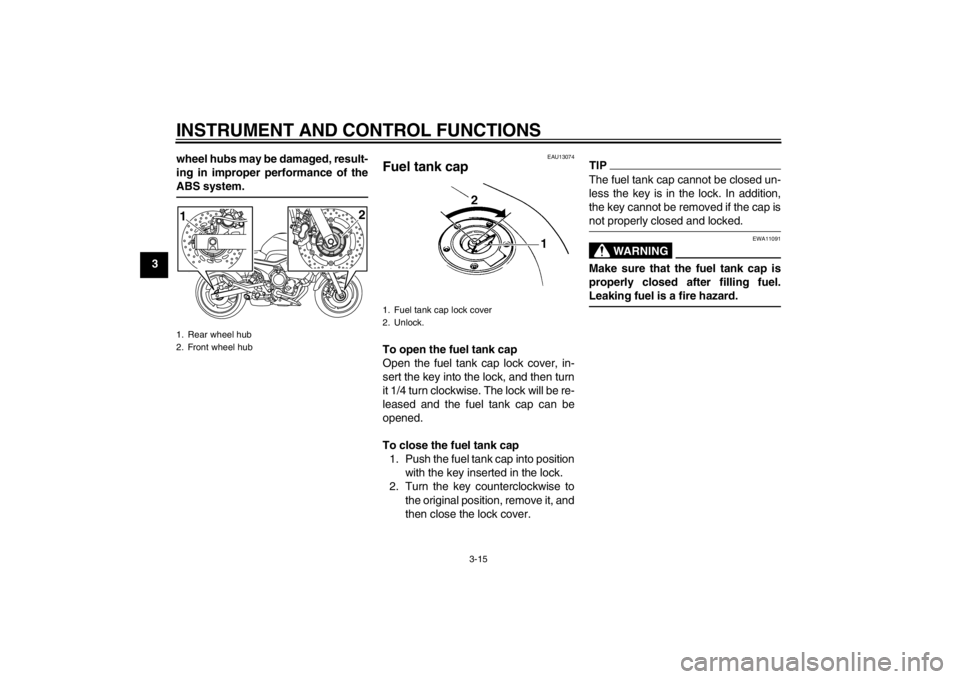
Fuel tank cap To open the fuel tank cap
Open the fuel tank cap lock cover, in-
sert the key into the lock, and then turn
it 1/4 turn clockwise. The lock will be re-
leased and the fuel tank cap can be
opened.
To close the fuel tank cap
1. Push the fuel tank cap into position with the key inserted in the lock.
2. Turn the key counterclockwise to the original position, remove it, and
then close the lock cover.
TIPThe fuel tank cap cannot be closed un-
less the key is in the lock. In addition,
the key cannot be removed if the cap is
not properly closed and locked.
WARNING
EWA11091
Make sure that the fuel tank cap is
properly closed after filling fuel.
Leaking fuel is a fire hazard.
1. Rear wheel hub
2. Front wheel hub1
2
1. Fuel tank cap lock cover
2. Unlock.
U20SE3E0.book Page 15 Monday, April 23, 2012 10:47 AM
Page 35 of 104
INSTRUMENT AND CONTROL FUNCTIONS
3-20
3
EAU46831
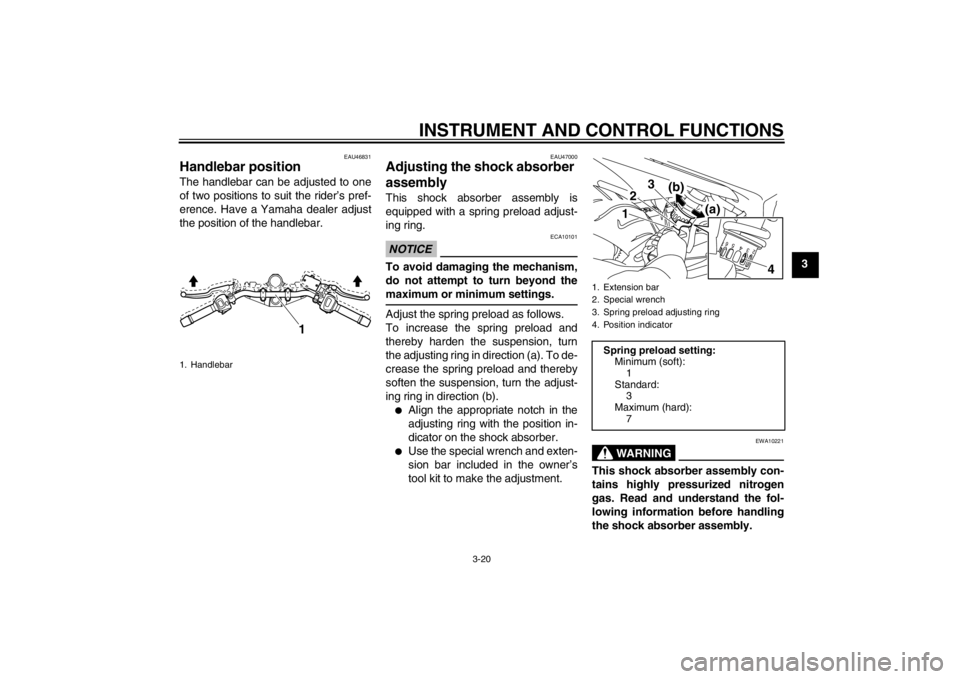
Handlebar position The handlebar can be adjusted to one
of two positions to suit the rider’s pref-
erence. Have a Yamaha dealer adjust
the position of the handlebar.
EAU47000
Adjusting the shock absorber
assembly This shock absorber assembly is
equipped with a spring preload adjust-
ing ring.NOTICE
ECA10101
To avoid damaging the mechanism,
do not attempt to turn beyond the
maximum or minimum settings.Adjust the spring preload as follows.
To increase the spring preload and
thereby harden the suspension, turn
the adjusting ring in direction (a). To de-
crease the spring preload and thereby
soften the suspension, turn the adjust-
ing ring in direction (b).●
Align the appropriate notch in the
adjusting ring with the position in-
dicator on the shock absorber.
●
Use the special wrench and exten-
sion bar included in the owner’s
tool kit to make the adjustment.
WARNING
EWA10221
This shock absorber assembly con-
tains highly pressurized nitrogen
gas. Read and understand the fol-
lowing information before handling
the shock absorber assembly.
1. Handlebar
1
1. Extension bar
2. Special wrench
3. Spring preload adjusting ring
4. Position indicator
Spring preload setting:Minimum (soft): 1
Standard: 3
Maximum (hard):
7
12
3
(a)
(b)
4
U20SE3E0.book Page 20 Monday, April 23, 2012 10:47 AM
Page 36 of 104
INSTRUMENT AND CONTROL FUNCTIONS
3-21
3
●
Do not tamper with or attempt to
open the cylinder assembly.
●
Do not subject the shock ab-
sorber assembly to an open
flame or other high heat source.
This may cause the unit to ex-
plode due to excessive gas
pressure.
●
Do not deform or damage the
cylinder in any way. Cylinder
damage will result in poor
damping performance.
●
Do not dispose of a damaged or
worn-out shock absorber as-
sembly yourself. Take the shock
absorber assembly to a Yamaha
dealer for any service.
EAU15305
Sidestand The sidestand is located on the left side
of the frame. Raise the sidestand or
lower it with your foot while holding the
vehicle upright.TIPThe built-in sidestand switch is part of
the ignition circuit cut-off system, which
cuts the ignition in certain situations.
(See the following section for an expla-
nation of the ignition circuit cut-off sys-
tem.)
WARNING
EWA10241
The vehicle must not be ridden with
the sidestand down, or if the side-
stand cannot be properly moved up (or does not stay up), otherwise the
sidestand could contact the ground
and distract the operator, resulting
in a possible loss of control.
Yamaha’s ignition circuit cut-off system has been designed to assist
the operator in fulfilling the respon-
sibility of raising the sidestand be-
fore starting off. Therefore, check this system regularly and have a
Yamaha dealer repair it if it does not function properly.
U20SE3E0.book Page 21 Monday, April 23, 2012 10:47 AM
Page 43 of 104

OPERATION AND IMPORTANT RIDING POINTS
5-2
5
a warning or indicator light remains
on, see page 3-4 for the correspond-
ing warning and indicator light cir-
cuit check.
For ABS models:The ABS warning light should
come on when the main switch is
turned to “ON” and then go off after
traveling at a speed of 10 km/h (6
mi/h) or higher.
NOTICE
ECA17680
If the ABS warning light does not
come on and then go off as ex-
plained above, see page 3-4 for the
indicator light circuit check.2. Shift the transmission into the neu-
tral position. The neutral indicator
light should come on. If not, ask a
Yamaha dealer to check the elec- trical circuit.
3. Start the engine by pushing the start switch.
If the engine fails to start, release
the start switch, wait a few sec-
onds, and then try again. Each
starting attempt should be as short
as possible to preserve the bat- tery. Do not crank the engine more
than 10 seconds on any one at-
tempt.
NOTICE
ECA11042
For maximum engine life, never ac-
celerate hard when the engine is
cold!
EAU16671
Shifting Shifting gears lets you control the
amount of engine power available for
starting off, accelerating, climbing hills,
etc.
The gear positions are shown in the il-
lustration.TIPTo shift the transmission into the neu-
tral position, press the shift pedal down
repeatedly until it reaches the end of its
travel, and then slightly raise it.1. Shift pedal
2. Neutral position
1
N
2 3
4
5
6
1
2
U20SE3E0.book Page 2 Monday, April 23, 2012 10:47 AM
Page 51 of 104

PERIODIC MAINTENANCE AND ADJUSTMENT
6-6
6
19*Front fork Check operation and for oil leak-
age. √√√√
20 *Shock absorber as-
sembly Check operation and shock ab-
sorber for oil leakage. √√√√
21 Engine oil Change.
Check oil level and vehicle for oil
leakage. √√√√√√
22 Engine oil filter car-
tridge Replace.
√√√
23 *Cooling system Check coolant level and vehicle
for coolant leakage. √√√√√
Change with ethylene glycol anti- freeze coolant. Every 3 years
24 *Front and rear brake
switches Check operation.
√√√√√√
25 Moving parts and
cables
Lubricate.
√√√√√
26 *Throttle grip Check operation.
Check throttle grip free play, and
adjust if necessary.
Lubricate cable and grip housing. √√√√√
27 *Lights, signals and
switches Check operation.
Adjust headlight beam.
√√√√√√
NO. ITEM CHECK OR MAINTENANCE JOB
ODOMETER READING
ANNUAL
CHECK
1000 km
(600 mi) 10000 km
(6000 mi) 20000 km
(12000 mi) 30000 km
(18000 mi) 40000 km
(24000 mi)
U20SE3E0.book Page 6 Monday, April 23, 2012 10:47 AM
Page 69 of 104
PERIODIC MAINTENANCE AND ADJUSTMENT
6-24
6
EAU50750
Brake light switches (for ABS
models) The brake light, which is activated by
the brake pedal and brake lever, should
come on just before braking takes ef-
fect. If necessary, have a Yamaha deal-
er adjust the brake light switches.
EAU50760
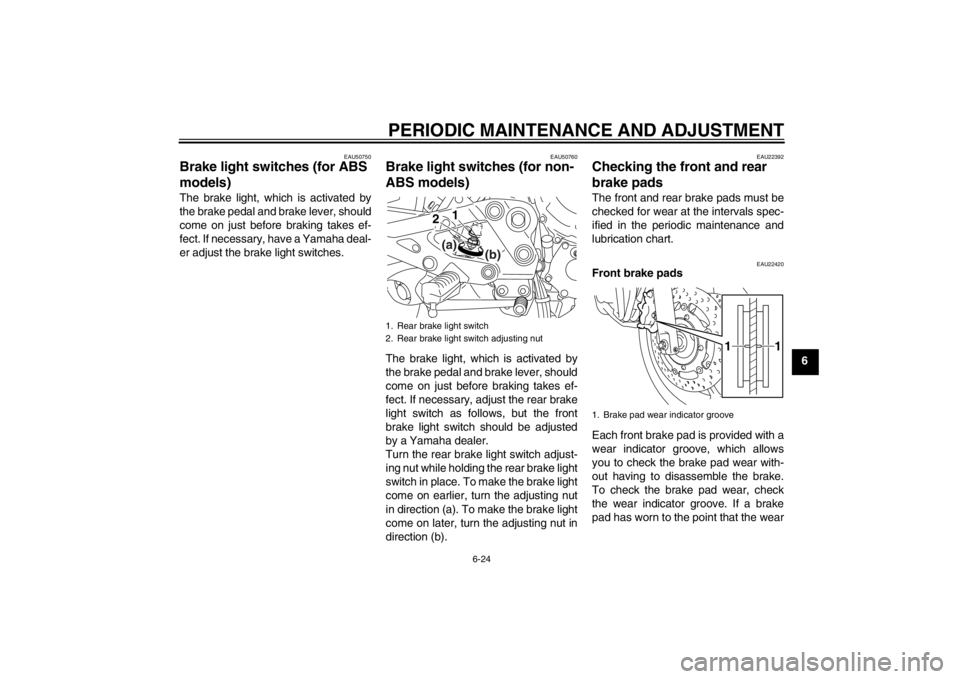
Brake light switches (for non-
ABS models) The brake light, which is activated by
the brake pedal and brake lever, should
come on just before braking takes ef-
fect. If necessary, adjust the rear brake
light switch as follows, but the front
brake light switch should be adjusted
by a Yamaha dealer.
Turn the rear brake light switch adjust-
ing nut while holding the rear brake light
switch in place. To make the brake light
come on earlier, turn the adjusting nut
in direction (a). To make the brake light
come on later, turn the adjusting nut in
direction (b).
EAU22392
Checking the front and rear
brake pads The front and rear brake pads must be
checked for wear at the intervals spec-
ified in the periodic maintenance and
lubrication chart.
EAU22420
Front brake pads
Each front brake pad is provided with a
wear indicator groove, which allows
you to check the brake pad wear with-
out having to disassemble the brake.
To check the brake pad wear, check
the wear indicator groove. If a brake
pad has worn to the point that the wear
1. Rear brake light switch
2. Rear brake light switch adjusting nut
1
2(a)
(b)
1. Brake pad wear indicator groove
11
U20SE3E0.book Page 24 Monday, April 23, 2012 10:47 AM
Page 80 of 104
PERIODIC MAINTENANCE AND ADJUSTMENT
6-35
6XJ6NA XJ6NA
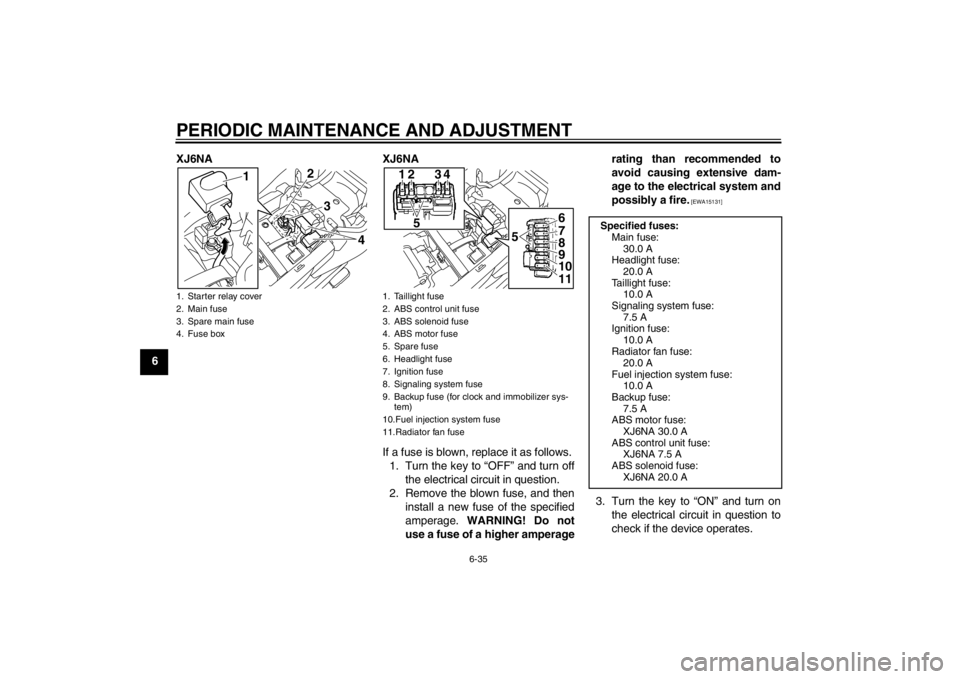
If a fuse is blown, replace it as follows.1. Turn the key to “OFF” and turn off the electrical circuit in question.
2. Remove the blown fuse, and then install a new fuse of the specified
amperage. WARNING! Do not
use a fuse of a higher amperage rating than recommended to
avoid causing extensive dam-
age to the electrical system and
possibly a fire.
[EWA15131]
3. Turn the key to “ON” and turn on
the electrical circuit in question to
check if the device operates.
1. Starter relay cover
2. Main fuse
3. Spare main fuse
4. Fuse box
2
4
3
1
1. Taillight fuse
2. ABS control unit fuse
3. ABS solenoid fuse
4. ABS motor fuse
5. Spare fuse
6. Headlight fuse
7. Ignition fuse
8. Signaling system fuse
9. Backup fuse (for clock and immobilizer sys-
tem)
10.Fuel injection system fuse
11.Radiator fan fuse
1
5 56
7
8
9
10
11
234
Specified fuses:
Main fuse:30.0 A
Headlight fuse:
20.0 A
Taillight fuse: 10.0 A
Signaling system fuse: 7.5 A
Ignition fuse:
10.0 A
Radiator fan fuse: 20.0 A
Fuel injection system fuse: 10.0 A
Backup fuse:
7.5 A
ABS motor fuse: XJ6NA 30.0 A
ABS control unit fuse: XJ6NA 7.5 A
ABS solenoid fuse:
XJ6NA 20.0 A
U20SE3E0.book Page 35 Monday, April 23, 2012 10:47 AM
Page 87 of 104
PERIODIC MAINTENANCE AND ADJUSTMENT
6-42
6
EAU44791
Front wheel (for non-ABS
models)
WARNING
EWA14840
For the ABS model, have a Yamaha
dealer remove and install the wheel.
EAU24492
To remove the front wheel
WARNING
EWA10821
To avoid injury, securely support the
vehicle so there is no danger of it
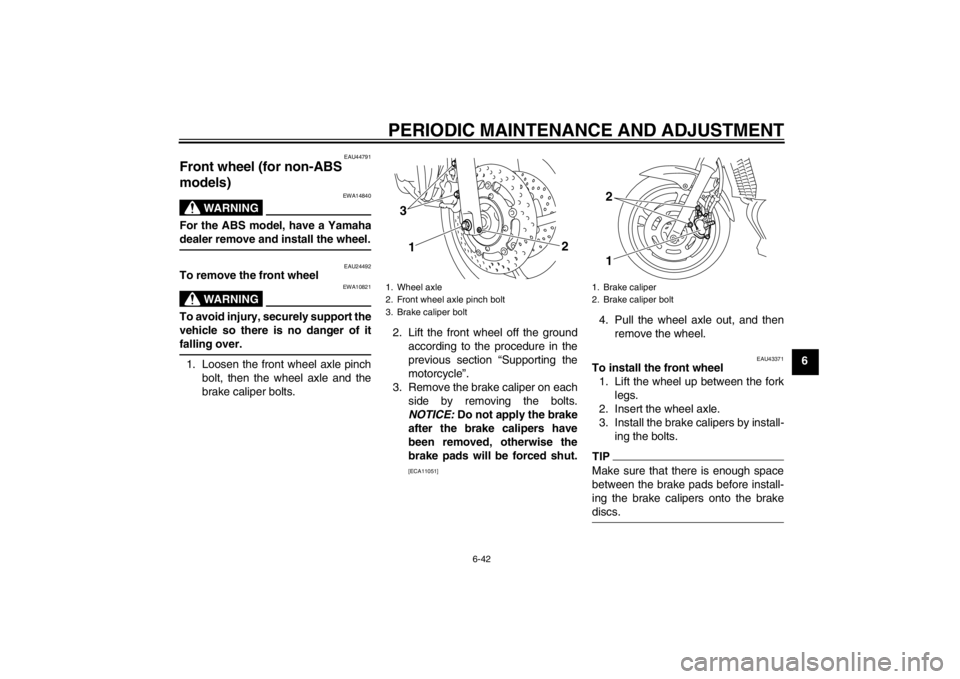
falling over.1. Loosen the front wheel axle pinchbolt, then the wheel axle and the
brake caliper bolts. 2. Lift the front wheel off the ground
according to the procedure in the
previous section “Supporting the
motorcycle”.
3. Remove the brake caliper on each side by removing the bolts.
NOTICE: Do not apply the brake
after the brake calipers have
been removed, otherwise the
brake pads will be forced shut.
[ECA11051]
4. Pull the wheel axle out, and then remove the wheel.
EAU43371
To install the front wheel1. Lift the wheel up between the fork legs.
2. Insert the wheel axle.
3. Install the brake calipers by install- ing the bolts.TIPMake sure that there is enough space
between the brake pads before install-
ing the brake calipers onto the brake
discs.
1. Wheel axle
2. Front wheel axle pinch bolt
3. Brake caliper bolt
13
2
1. Brake caliper
2. Brake caliper bolt
1 2
U20SE3E0.book Page 42 Monday, April 23, 2012 10:47 AM
Page 88 of 104
PERIODIC MAINTENANCE AND ADJUSTMENT
6-43
64. Lower the front wheel so that it is
on the ground, and then put the
sidestand down.
5. Tighten the wheel axle, the front wheel axle pinch bolt and the
brake caliper bolts to the specified
torques.
6. Push down hard on the handlebar several times to check for proper
fork operation.
EAU44801
Rear wheel (for non-ABS mod-
els)
WARNING
EWA14840
For the ABS model, have a Yamaha
dealer remove and install the wheel.
EAU34414
To remove the rear wheel
WARNING
EWA10821
To avoid injury, securely support the
vehicle so there is no danger of it
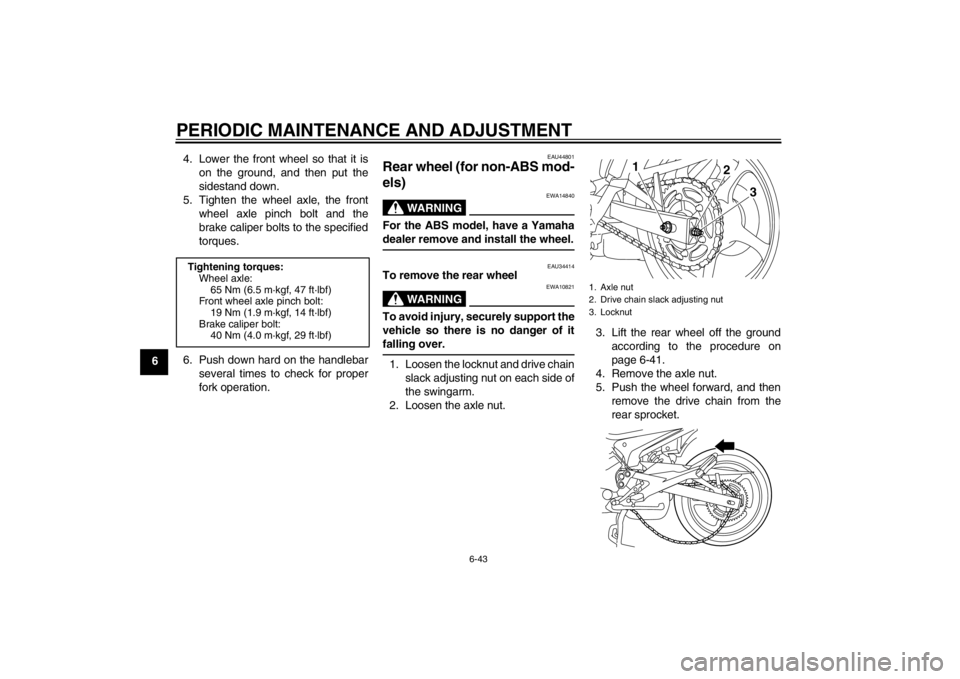
falling over.1. Loosen the locknut and drive chainslack adjusting nut on each side of
the swingarm.
2. Loosen the axle nut. 3. Lift the rear wheel off the ground
according to the procedure on
page 6-41.
4. Remove the axle nut.
5. Push the wheel forward, and then remove the drive chain from the
rear sprocket.
Tightening torques:Wheel axle:65 Nm (6.5 m·kgf, 47 ft·lbf)
Front wheel axle pinch bolt:
19 Nm (1.9 m·kgf, 14 ft·lbf)
Brake caliper bolt: 40 Nm (4.0 m·kgf, 29 ft·lbf)
1. Axle nut
2. Drive chain slack adjusting nut
3. Locknut
1
3
2
U20SE3E0.book Page 43 Monday, April 23, 2012 10:47 AM
Page 94 of 104
MOTORCYCLE CARE AND STORAGE
7-2
7off any detergent residue using
plenty of water, as it is harmful
to plastic parts.
●
Do not use any harsh chemical
products on plastic parts. Be
sure to avoid using cloths or
sponges which have been in
contact with strong or abrasive
cleaning products, solvent or
thinner, fuel (gasoline), rust re-
movers or inhibitors, brake flu-
id, antifreeze or electrolyte.
●
Do not use high-pressure wash-
ers or steam-jet cleaners since
they cause water seepage and
deterioration in the following ar-
eas: seals (of wheel and swing-
arm bearings, fork and brakes),
electric components (couplers,
connectors, instruments,
switches and lights), breather
hoses and vents.
●
For motorcycles equipped with
a windshield: Do not use strong
cleaners or hard sponges as
they will cause dulling or
scratching. Some cleaning com-
pounds for plastic may leave
scratches on the windshield. Test the product on a small hid-
den part of the windshield to
make sure that it does not leave
any marks. If the windshield is
scratched, use a quality plastic
polishing compound after
washing.
After normal useRemove dirt with warm water, a mild
detergent, and a soft, clean sponge,
and then rinse thoroughly with clean
water. Use a toothbrush or bottlebrush
for hard-to-reach areas. Stubborn dirt
and insects will come off more easily if
the area is covered with a wet cloth for
a few minutes before cleaning.
After riding in the rain, near the sea oron salt-sprayed roadsSince sea salt or salt sprayed on roads
during winter are extremely corrosive in
combination with water, carry out the
following steps after each ride in the
rain, near the sea or on salt-sprayed
roads.
TIPSalt sprayed on roads in the winter may
remain well into spring.1. Clean the motorcycle with cold wa-
ter and a mild detergent, after the
engine has cooled down.
NOTICE: Do not use warm water
since it increases the corrosive
action of the salt.
[ECA10791]
2. Apply a corrosion protection spray on all metal, including chrome- and
nickel-plated, surfaces to prevent
corrosion.
After cleaning 1. Dry the motorcycle with a chamois or an absorbing cloth.
2. Immediately dry the drive chain and lubricate it to prevent it from
rusting.
3. Use a chrome polish to shine chrome, aluminum and stainless-
steel parts, including the exhaust
system. (Even the thermally in-
duced discoloring of stainless-
steel exhaust systems can be re-
moved through polishing.)
U20SE3E0.book Page 2 Monday, April 23, 2012 10:47 AM