brake YAMAHA XJ6-N 2013 User Guide
[x] Cancel search | Manufacturer: YAMAHA, Model Year: 2013, Model line: XJ6-N, Model: YAMAHA XJ6-N 2013Pages: 104, PDF Size: 2.86 MB
Page 46 of 104
PERIODIC MAINTENANCE AND ADJUSTMENT
6-1
6
EAU17244
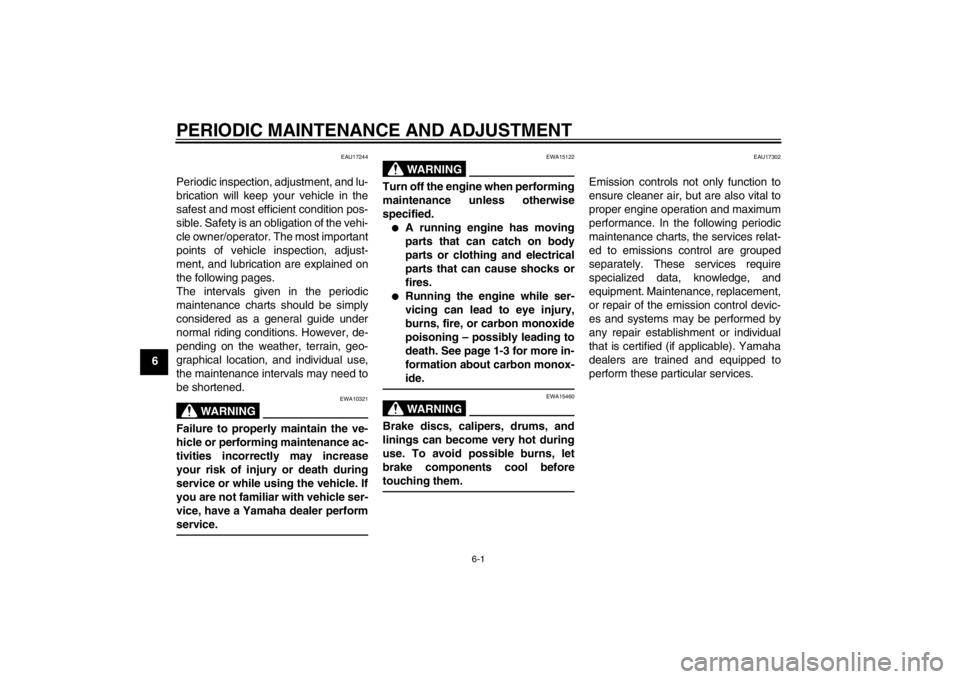
Periodic inspection, adjustment, and lu-
brication will keep your vehicle in the
safest and most efficient condition pos-
sible. Safety is an obligation of the vehi-
cle owner/operator. The most important
points of vehicle inspection, adjust-
ment, and lubrication are explained on
the following pages.
The intervals given in the periodic
maintenance charts should be simply
considered as a general guide under
normal riding conditions. However, de-
pending on the weather, terrain, geo-
graphical location, and individual use,
the maintenance intervals may need to
be shortened.
WARNING
EWA10321
Failure to properly maintain the ve-
hicle or performing maintenance ac-
tivities incorrectly may increase
your risk of injury or death during
service or while using the vehicle. If
you are not familiar with vehicle ser-
vice, have a Yamaha dealer perform
service.
WARNING
EWA15122
Turn off the engine when performing
maintenance unless otherwise
specified.●
A running engine has moving
parts that can catch on body
parts or clothing and electrical
parts that can cause shocks or
fires.
●
Running the engine while ser-
vicing can lead to eye injury,
burns, fire, or carbon monoxide
poisoning – possibly leading to
death. See page 1-3 for more in-
formation about carbon monox-
ide.WARNING
EWA15460
Brake discs, calipers, drums, and
linings can become very hot during
use. To avoid possible burns, let
brake components cool before
touching them.
EAU17302
Emission controls not only function to
ensure cleaner air, but are also vital to
proper engine operation and maximum
performance. In the following periodic
maintenance charts, the services relat-
ed to emissions control are grouped
separately. These services require
specialized data, knowledge, and
equipment. Maintenance, replacement,
or repair of the emission control devic-
es and systems may be performed by
any repair establishment or individual
that is certified (if applicable). Yamaha
dealers are trained and equipped to
perform these particular services.
U20SE3E0.book Page 1 Monday, April 23, 2012 10:47 AM
Page 49 of 104

PERIODIC MAINTENANCE AND ADJUSTMENT
6-4
6
EAU1770E
General maintenance and lubrication chart NO. ITEM CHECK OR MAINTENANCE JOB ODOMETER READING
ANNUAL
CHECK
1000 km
(600 mi) 10000 km
(6000 mi) 20000 km
(12000 mi) 30000 km
(18000 mi) 40000 km
(24000 mi)
1 Air filter element Replace. √
2Clutch Check operation.
Adjust.
√√√√√
3 *Front brake Check operation, fluid level and
vehicle for fluid leakage. √√√√√√
Replace brake pads. Whenever worn to the limit
4 *Rear brake Check operation, fluid level and
vehicle for fluid leakage. √√√√√√
Replace brake pads. Whenever worn to the limit
5 *Brake hoses Check for cracks or damage.
Check for correct routing and
clamping. √√√√√
Replace. Every 4 years
6 *Wheels Check runout and for damage. √√√√
7 *Tires Check tread depth and for dam-
age.
Replace if necessary.
Check air pressure.
Correct if necessary. √√√√√
8 *Wheel bearings Check bearing for looseness or
damage. √√√√
U20SE3E0.book Page 4 Monday, April 23, 2012 10:47 AM
Page 50 of 104
PERIODIC MAINTENANCE AND ADJUSTMENT
6-5
6
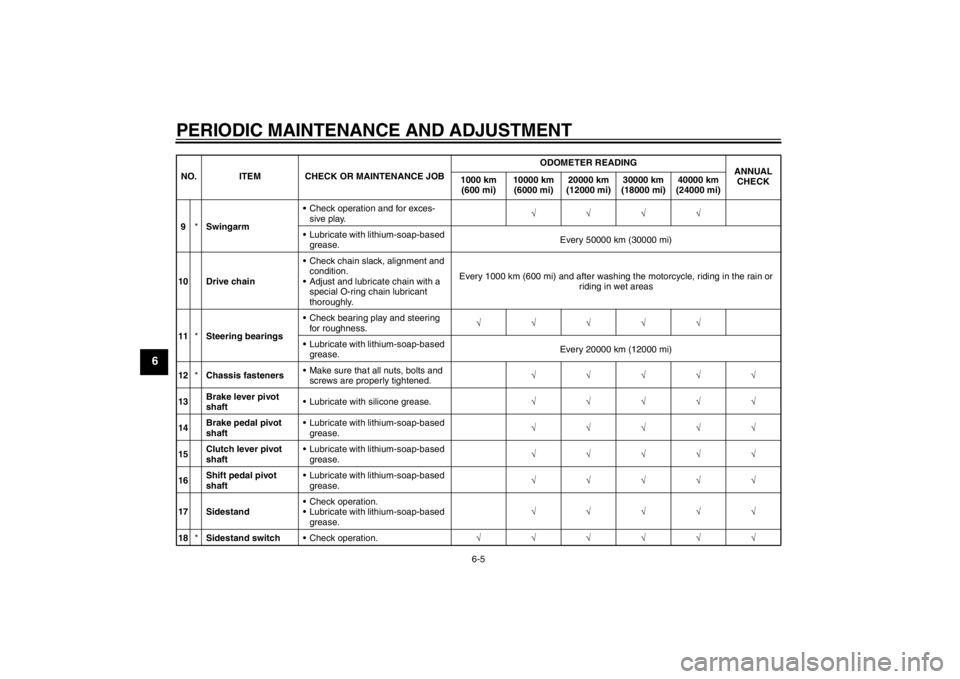
9*Swingarm Check operation and for exces-
sive play. √√√√
Lubricate with lithium-soap-based grease. Every 50000 km (30000 mi)
10 Drive chain Check chain slack, alignment and
condition.
Adjust and lubricate chain with a special O-ring chain lubricant
thoroughly. Every 1000 km (600 mi) and after washing the motorcycle, riding in the rain or
riding in wet areas
11 *Steering bearings Check bearing play and steering
for roughness. √√√√√
Lubricate with lithium-soap-based grease. Every 20000 km (12000 mi)
12 *Chassis fasteners Make sure that all nuts, bolts and
screws are properly tightened. √√√√√
13 Brake lever pivot
shaft Lubricate with silicone grease.
√√√√√
14 Brake pedal pivot
shaft Lubricate with lithium-soap-based
grease. √√√√√
15 Clutch lever pivot
shaft Lubricate with lithium-soap-based
grease. √√√√√
16 Shift pedal pivot
shaft Lubricate with lithium-soap-based
grease. √√√√√
17 Sidestand Check operation.
Lubricate with lithium-soap-based
grease. √√√√√
18 *Sidestand switch Check operation. √√√√√√
NO. ITEM CHECK OR MAINTENANCE JOB
ODOMETER READING
ANNUAL
CHECK
1000 km
(600 mi) 10000 km
(6000 mi) 20000 km
(12000 mi) 30000 km
(18000 mi) 40000 km
(24000 mi)
U20SE3E0.book Page 5 Monday, April 23, 2012 10:47 AM
Page 51 of 104
PERIODIC MAINTENANCE AND ADJUSTMENT
6-6
6
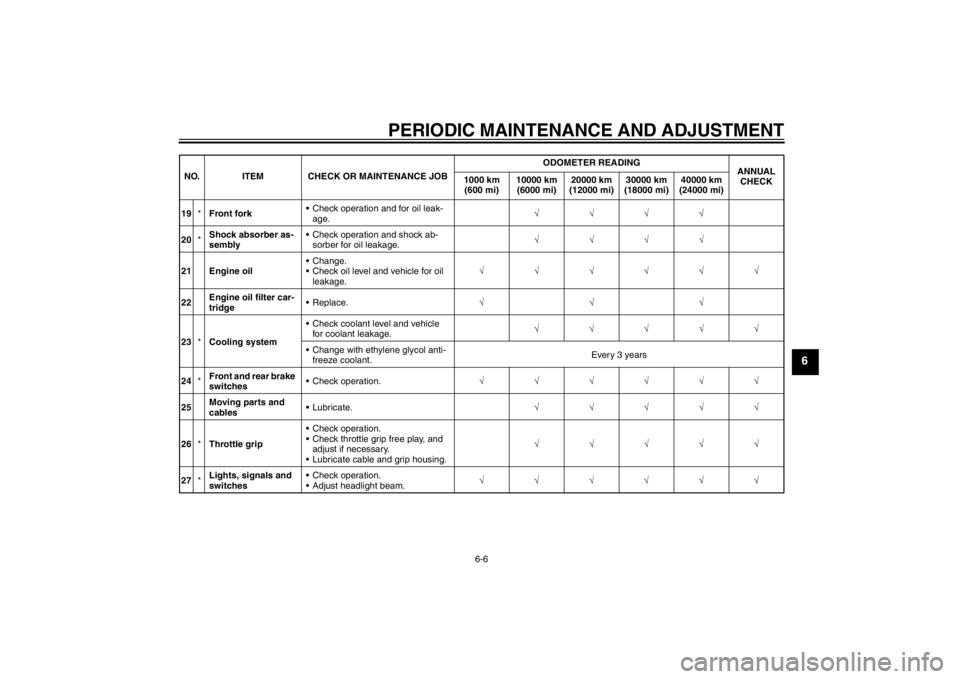
19*Front fork Check operation and for oil leak-
age. √√√√
20 *Shock absorber as-
sembly Check operation and shock ab-
sorber for oil leakage. √√√√
21 Engine oil Change.
Check oil level and vehicle for oil
leakage. √√√√√√
22 Engine oil filter car-
tridge Replace.
√√√
23 *Cooling system Check coolant level and vehicle
for coolant leakage. √√√√√
Change with ethylene glycol anti- freeze coolant. Every 3 years
24 *Front and rear brake
switches Check operation.
√√√√√√
25 Moving parts and
cables
Lubricate.
√√√√√
26 *Throttle grip Check operation.
Check throttle grip free play, and
adjust if necessary.
Lubricate cable and grip housing. √√√√√
27 *Lights, signals and
switches Check operation.
Adjust headlight beam.
√√√√√√
NO. ITEM CHECK OR MAINTENANCE JOB
ODOMETER READING
ANNUAL
CHECK
1000 km
(600 mi) 10000 km
(6000 mi) 20000 km
(12000 mi) 30000 km
(18000 mi) 40000 km
(24000 mi)
U20SE3E0.book Page 6 Monday, April 23, 2012 10:47 AM
Page 52 of 104
PERIODIC MAINTENANCE AND ADJUSTMENT
6-7
6
EAU18680
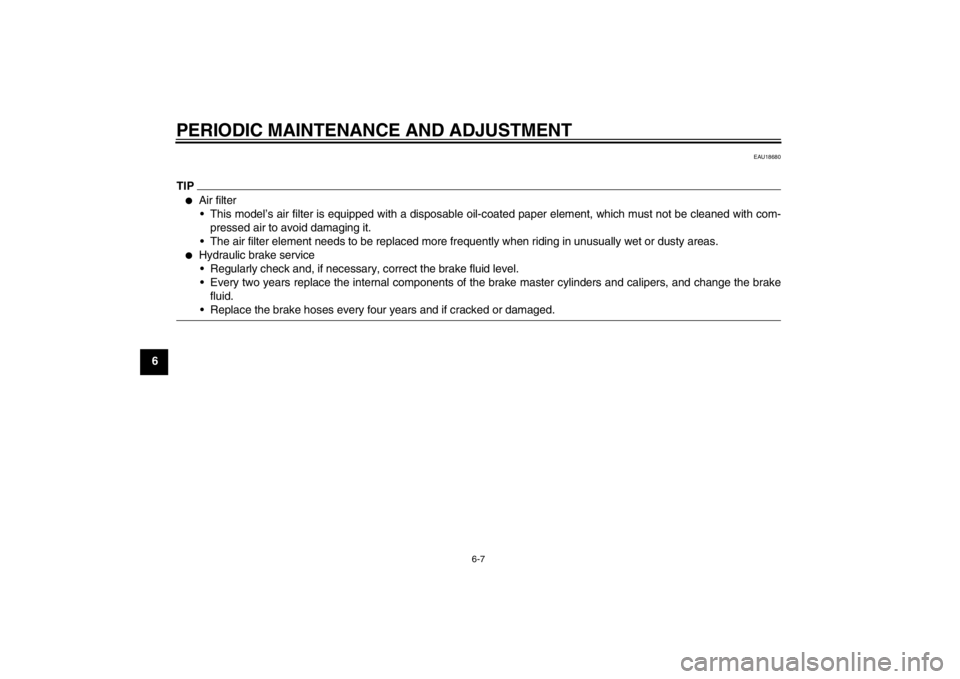
TIP●
Air filter This model’s air filter is equipped with a disposable oil-coated paper element, which must not be cleaned with com- pressed air to avoid damaging it.
The air filter element needs to be replaced more frequently when riding in unusually wet or dusty areas.
●
Hydraulic brake service Regularly check and, if necessary, correct the brake fluid level.
Every two years replace the internal components of the brake master cylinders and calipers, and change the brake fluid.
Replace the brake hoses every four years and if cracked or damaged.
U20SE3E0.book Page 7 Monday, April 23, 2012 10:47 AM
Page 65 of 104
PERIODIC MAINTENANCE AND ADJUSTMENT
6-20
6
weight of rider, passenger, car-
go, and accessories approved
for this model.
WARNING
EWA10511
Never overload your vehicle. Opera-
tion of an overloaded vehicle could
cause an accident.Tire inspection
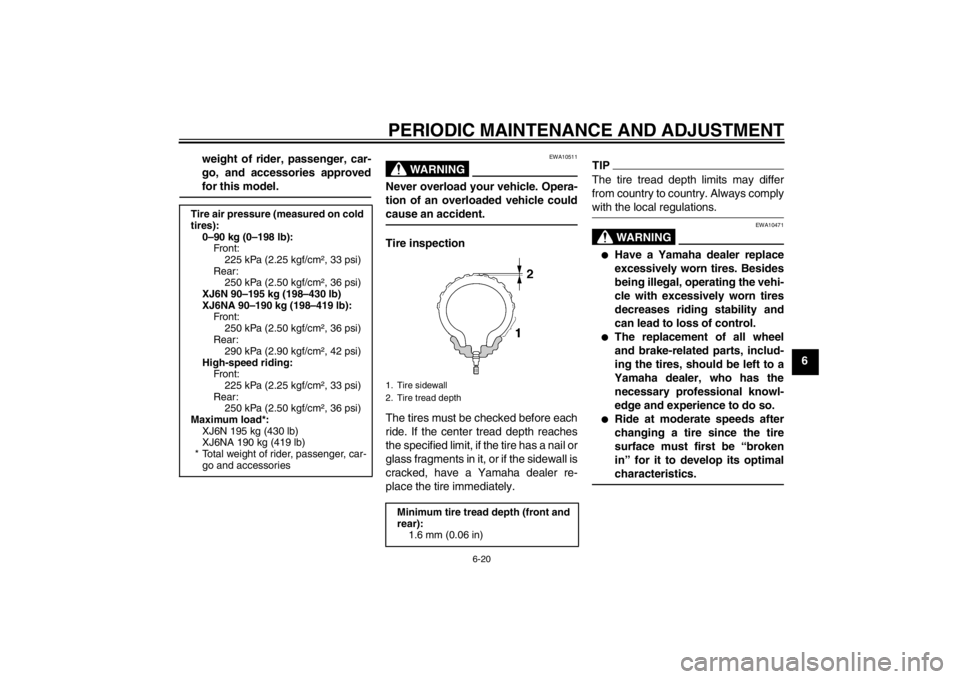
The tires must be checked before each
ride. If the center tread depth reaches
the specified limit, if the tire has a nail or
glass fragments in it, or if the sidewall is
cracked, have a Yamaha dealer re-
place the tire immediately.
TIPThe tire tread depth limits may differ
from country to country. Always comply
with the local regulations.
WARNING
EWA10471
●
Have a Yamaha dealer replace
excessively worn tires. Besides
being illegal, operating the vehi-
cle with excessively worn tires
decreases riding stability and
can lead to loss of control.
●
The replacement of all wheel
and brake-related parts, includ-
ing the tires, should be left to a
Yamaha dealer, who has the necessary professional knowl-
edge and experience to do so.
●
Ride at moderate speeds after
changing a tire since the tire
surface must first be “broken
in” for it to develop its optimal
characteristics.
Tire air pressure (measured on cold
tires): 0–90 kg (0–198 lb):Front:
225 kPa (2.25 kgf/cm², 33 psi)
Rear: 250 kPa (2.50 kgf/cm², 36 psi)
XJ6N 90–195 kg (198–430 lb)
XJ6NA 90–190 kg (198–419 lb): Front:
250 kPa (2.50 kgf/cm², 36 psi)
Rear: 290 kPa (2.90 kgf/cm², 42 psi)
High-speed riding: Front: 225 kPa (2.25 kgf/cm², 33 psi)
Rear: 250 kPa (2.50 kgf/cm², 36 psi)
Maximum load*:
XJ6N 195 kg (430 lb)
XJ6NA 190 kg (419 lb)
* Total weight of rider, passenger, car-
go and accessories
1. Tire sidewall
2. Tire tread depth
Minimum tire tread depth (front and
rear): 1.6 mm (0.06 in)
U20SE3E0.book Page 20 Monday, April 23, 2012 10:47 AM
Page 68 of 104
PERIODIC MAINTENANCE AND ADJUSTMENT
6-23
6
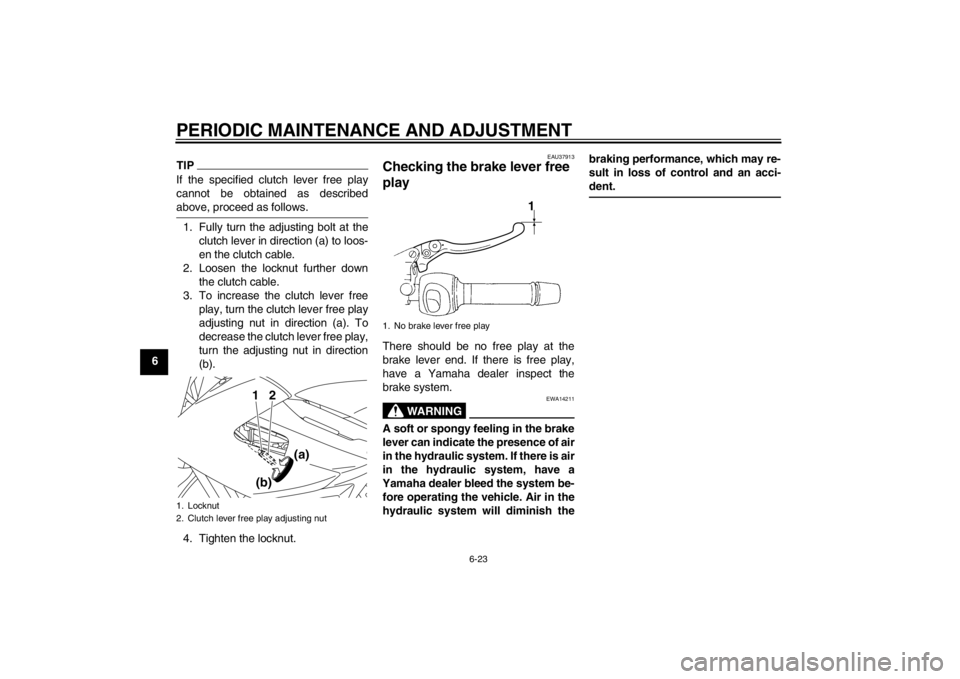
TIPIf the specified clutch lever free play
cannot be obtained as described
above, proceed as follows.1. Fully turn the adjusting bolt at theclutch lever in direction (a) to loos-
en the clutch cable.
2. Loosen the locknut further down the clutch cable.
3. To increase the clutch lever free play, turn the clutch lever free play
adjusting nut in direction (a). To
decrease the clutch lever free play,
turn the adjusting nut in direction
(b).
4. Tighten the locknut.
EAU37913
Checking the brake lever free
play There should be no free play at the
brake lever end. If there is free play,
have a Yamaha dealer inspect the
brake system.
WARNING
EWA14211
A soft or spongy feeling in the brake
lever can indicate the presence of air
in the hydraulic system. If there is air
in the hydraulic system, have a
Yamaha dealer bleed the system be- fore operating the vehicle. Air in the
hydraulic system will diminish the braking performance, which may re-
sult in loss of control and an acci-
dent.
1. Locknut
2. Clutch lever free play adjusting nut
1
2
(b) (a)
1. No brake lever free play
1
U20SE3E0.book Page 23 Monday, April 23, 2012 10:47 AM
Page 69 of 104
PERIODIC MAINTENANCE AND ADJUSTMENT
6-24
6
EAU50750
Brake light switches (for ABS
models) The brake light, which is activated by
the brake pedal and brake lever, should
come on just before braking takes ef-
fect. If necessary, have a Yamaha deal-
er adjust the brake light switches.
EAU50760
Brake light switches (for non-
ABS models) The brake light, which is activated by
the brake pedal and brake lever, should
come on just before braking takes ef-
fect. If necessary, adjust the rear brake
light switch as follows, but the front
brake light switch should be adjusted
by a Yamaha dealer.
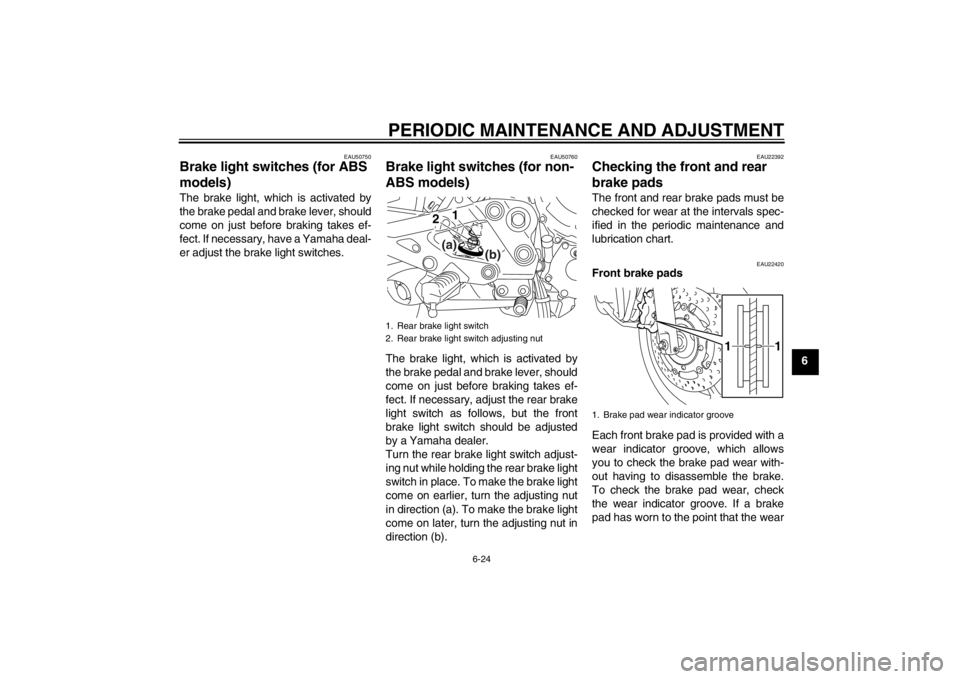
Turn the rear brake light switch adjust-
ing nut while holding the rear brake light
switch in place. To make the brake light
come on earlier, turn the adjusting nut
in direction (a). To make the brake light
come on later, turn the adjusting nut in
direction (b).
EAU22392
Checking the front and rear
brake pads The front and rear brake pads must be
checked for wear at the intervals spec-
ified in the periodic maintenance and
lubrication chart.
EAU22420
Front brake pads
Each front brake pad is provided with a
wear indicator groove, which allows
you to check the brake pad wear with-
out having to disassemble the brake.
To check the brake pad wear, check
the wear indicator groove. If a brake
pad has worn to the point that the wear
1. Rear brake light switch
2. Rear brake light switch adjusting nut
1
2(a)
(b)
1. Brake pad wear indicator groove
11
U20SE3E0.book Page 24 Monday, April 23, 2012 10:47 AM
Page 70 of 104
PERIODIC MAINTENANCE AND ADJUSTMENT
6-25
6indicator groove has almost disap-
peared, have a Yamaha dealer replace
the brake pads as a set.
EAU46291
Rear brake pads
Each rear brake pad is provided with
wear indicator grooves, which allow
you to check the brake pad wear with-
out having to disassemble the brake.
To check the brake pad wear, check
the wear indicator grooves. If a brake
pad has worn to the point that a wear
indicator groove almost appears, have
a Yamaha dealer replace the brake
pads as a set.
EAU39372
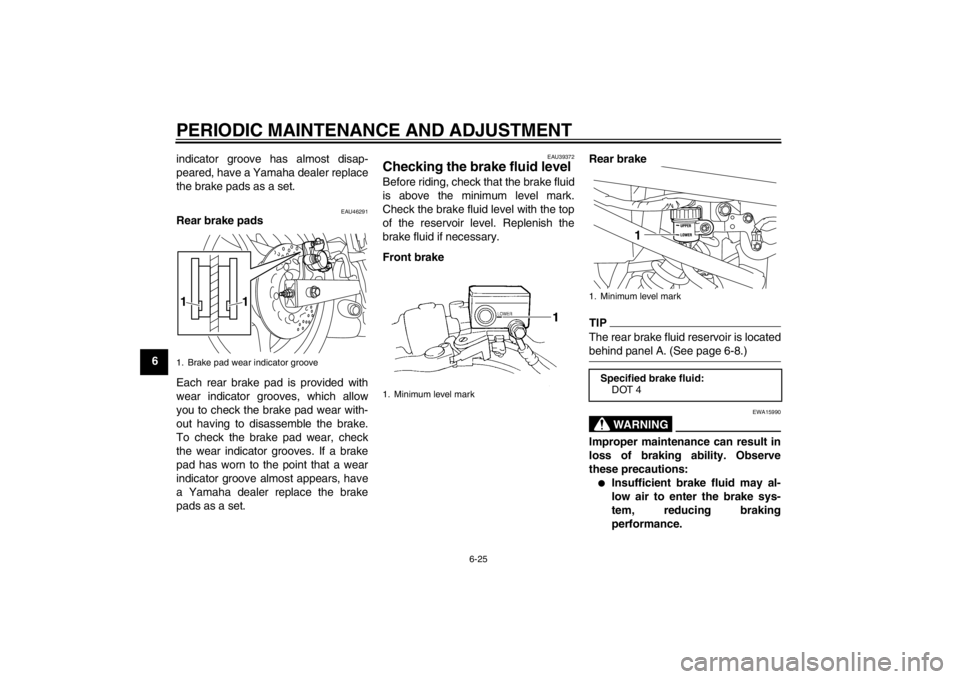
Checking the brake fluid level Before riding, check that the brake fluid
is above the minimum level mark.
Check the brake fluid level with the top
of the reservoir level. Replenish the
brake fluid if necessary.
Front brake
Rear brake
TIPThe rear brake fluid reservoir is located
behind panel A. (See page 6-8.)
WARNING
EWA15990
Improper maintenance can result in
loss of braking ability. Observe
these precautions:●
Insufficient brake fluid may al-
low air to enter the brake sys-
tem, reducing braking
performance.
1. Brake pad wear indicator groove1
1
1. Minimum level mark
1. Minimum level markSpecified brake fluid:
DOT 4
1
U20SE3E0.book Page 25 Monday, April 23, 2012 10:47 AM
Page 71 of 104
PERIODIC MAINTENANCE AND ADJUSTMENT
6-26
6
●
Clean the filler cap before re-
moving. Use only DOT 4 brake
fluid from a sealed container.
●
Use only the specified brake flu-
id; otherwise, the rubber seals
may deteriorate, causing leak-
age.
●
Refill with the same type of
brake fluid. Adding a brake fluid
other than DOT 4 may result in a
harmful chemical reaction.
●
Be careful that water does not
enter the brake fluid reservoir
when refilling. Water will signifi-
cantly lower the boiling point of
the fluid and may result in vapor
lock.
NOTICE
ECA17640
Brake fluid may damage painted sur-
faces or plastic parts. Always clean
up spilled fluid immediately.As the brake pads wear, it is normal for
the brake fluid level to gradually go
down. A low brake fluid level may indi-
cate worn brake pads and/or brake sys-
tem leakage; therefore, be sure to
check the brake pads for wear and thebrake system for leakage. If the brake
fluid level goes down suddenly, have a
Yamaha dealer check the cause before
further riding.
EAU22731
Changing the brake fluid Have a Yamaha dealer change the
brake fluid at the intervals specified in
the TIP after the periodic maintenance
and lubrication chart. In addition, have
the oil seals of the master cylinders and
calipers as well as the brake hoses re-
placed at the intervals listed below or
whenever they are damaged or leak-
ing.●
Oil seals: Replace every two
years.
●
Brake hoses: Replace every four
years.
U20SE3E0.book Page 26 Monday, April 23, 2012 10:47 AM