lock YAMAHA XJ6-N 2016 User Guide
[x] Cancel search | Manufacturer: YAMAHA, Model Year: 2016, Model line: XJ6-N, Model: YAMAHA XJ6-N 2016Pages: 104, PDF Size: 2.91 MB
Page 28 of 104
Instrument and control functions
3-14
3
EAU51802
ABS (for ABS mo dels)
The Yamaha ABS (Anti-lock Brake
System) features a dual electronic con-
trol system, which acts on the front and
rear brakes independently.
Operate the brakes with ABS as you
would conventional brakes. If the ABS
is activated, a pulsating sensation may
be felt at the brake lever or brake ped-
al. In this situation, continue to apply
the brakes and let the ABS work; do
not “pump” the brakes as this will re-
duce braking effectiveness.
WARNING
EWA16051
Always keep a sufficient distance
from the vehicle ahea d to match the
ri din g speed even with ABS.
The ABS performs best with
lon g b rakin g d istances.
On certain surfaces, such as
rou gh or g ravel roa ds, the b rak-
in g d istance may be lon ger with
the ABS than without.
The ABS is monitored by an ECU,
which will revert the system to conven-
tional braking if a malfunction occurs.
TIP
The ABS performs a self-diagno-
sis test each time the vehicle first
starts off after the key is turned to
“ON” and the vehicle has traveled
at a speed of 10 km/h (6 mi/h) or
higher. During this test, a “click-
ing” noise can be heard from un-
der the seat, and if the brake lever
or brake pedal is even slightly ap-
plied, a vibration can be felt at the
lever and pedal, but these do not
indicate a malfunction.
This ABS has a test mode which
allows the owner to experience
the pulsation at the brake lever or
brake pedal when the ABS is op-
erating. However, special tools are
required, so please consult your
Yamaha dealer.
NOTICE
ECA16121
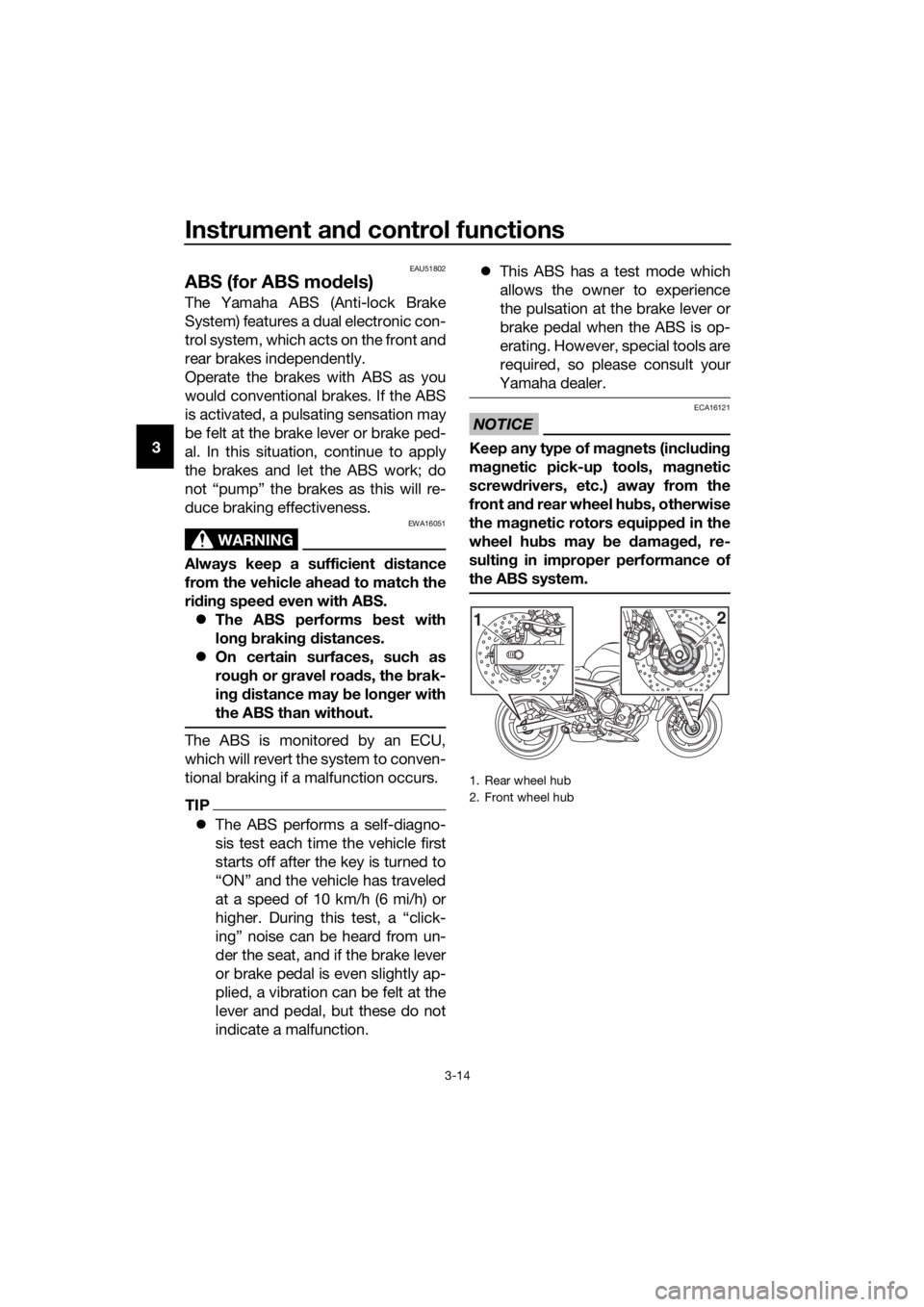
Keep any type of mag nets (includin g
ma gnetic pick-up tools, ma gnetic
screwd rivers, etc.) away from the
front an d rear wheel hu bs, otherwise
the ma gnetic rotors equippe d in the
wheel hu bs may be damag ed , re-
sultin g in improper performance of
the ABS system.
1. Rear wheel hub
2. Front wheel hub
12
UB61E1E0.book Page 14 Wednesday, October 21, 2015 11:19 AM
Page 29 of 104
Instrument and control functions
3-15
3
EAU13075
Fuel tank cap
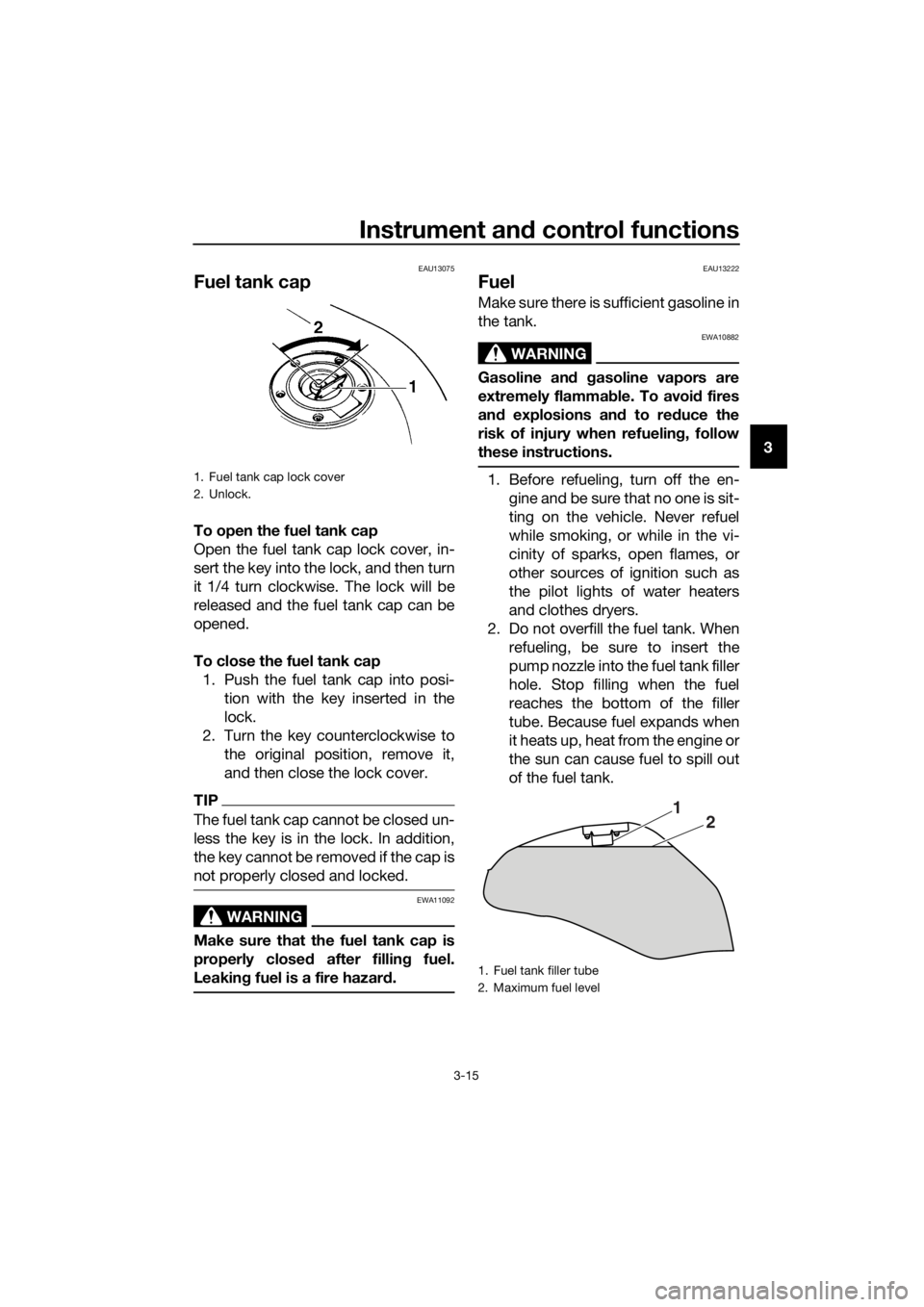
To open the fuel tank cap
Open the fuel tank cap lock cover, in-
sert the key into the lock, and then turn
it 1/4 turn clockwise. The lock will be
released and the fuel tank cap can be
opened.
To close the fuel tank cap
1. Push the fuel tank cap into posi- tion with the key inserted in the
lock.
2. Turn the key counterclockwise to the original position, remove it,
and then close the lock cover.
TIP
The fuel tank cap cannot be closed un-
less the key is in the lock. In addition,
the key cannot be removed if the cap is
not properly closed and locked.
WARNING
EWA11092
Make sure that the fuel tank cap is
properly closed after filling fuel.
Leakin g fuel is a fire hazar d.
EAU13222
Fuel
Make sure there is sufficient gasoline in
the tank.
WARNING
EWA10882
Gasoline an d gasoline vapors are
extremely flamma ble. To avoi d fires
an d explosions an d to re duce the
risk of injury when refueling , follow
these instructions.
1. Before refueling, turn off the en- gine and be sure that no one is sit-
ting on the vehicle. Never refuel
while smoking, or while in the vi-
cinity of sparks, open flames, or
other sources of ignition such as
the pilot lights of water heaters
and clothes dryers.
2. Do not overfill the fuel tank. When refueling, be sure to insert the
pump nozzle into the fuel tank filler
hole. Stop filling when the fuel
reaches the bottom of the filler
tube. Because fuel expands when
it heats up, heat from the engine or
the sun can cause fuel to spill out
of the fuel tank.1. Fuel tank cap lock cover
2. Unlock.
1. Fuel tank filler tube
2. Maximum fuel level
1 2
UB61E1E0.book Page 15 Wednesday, October 21, 2015 11:19 AM
Page 31 of 104
Instrument and control functions
3-17
3
EAU55512
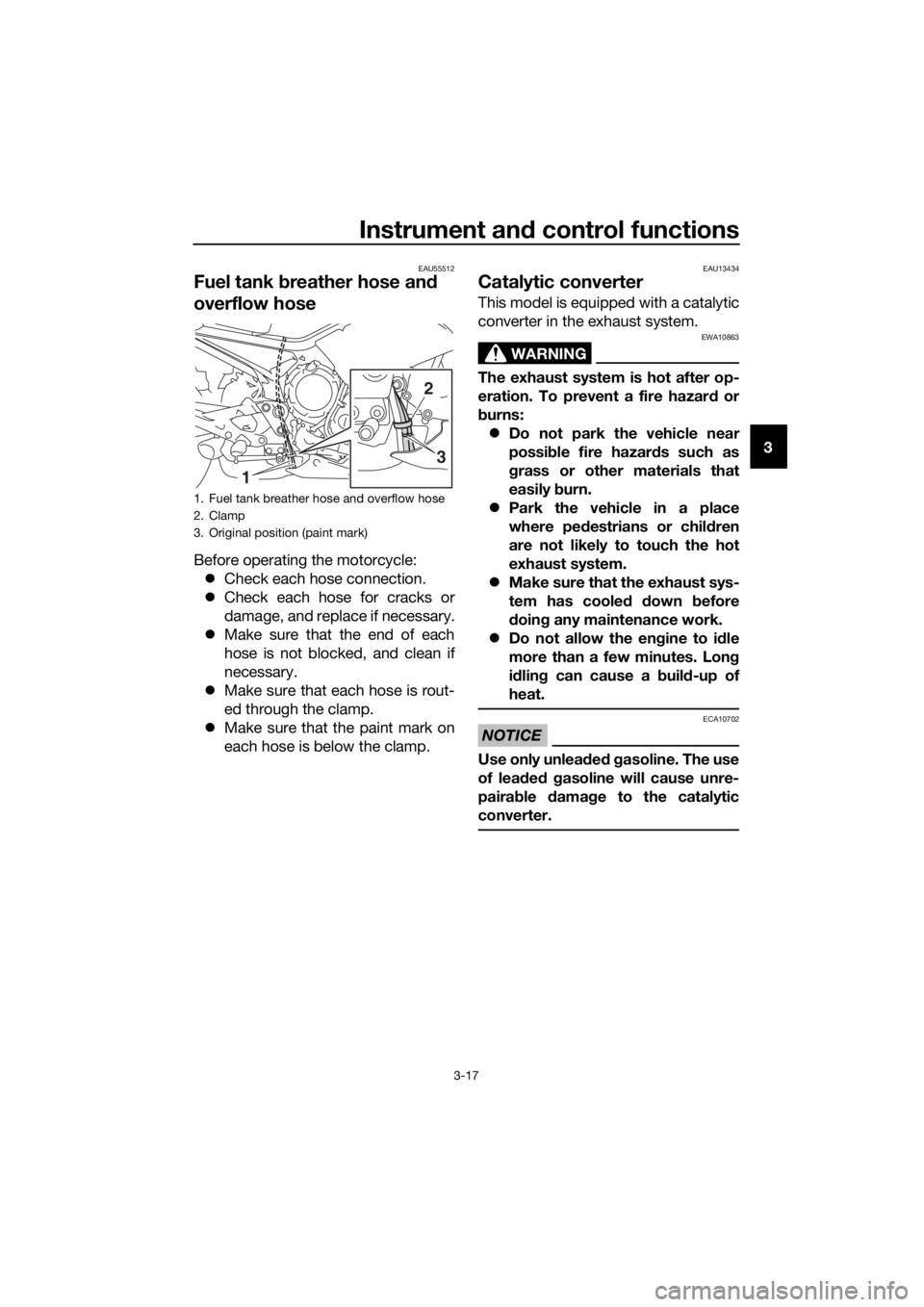
Fuel tank breather hose an d
overflow hose
Before operating the motorcycle:
Check each hose connection.
Check each hose for cracks or
damage, and replace if necessary.
Make sure that the end of each
hose is not blocked, and clean if
necessary.
Make sure that each hose is rout-
ed through the clamp.
Make sure that the paint mark on
each hose is below the clamp.
EAU13434
Catalytic converter
This model is equipped with a catalytic
converter in the exhaust system.
WARNING
EWA10863
The exhaust system is hot after op-
eration. To prevent a fire hazar d or
b urns:
Do not park the vehicle near
possi ble fire hazar ds such as
g rass or other materials that
easily burn.
Park the vehicle in a place
where pe destrians or chil dren
are not likely to touch the hot
exhaust system.
Make sure that the exhaust sys-
tem has coole d down before
d oin g any maintenance work.
Do not allow the en gine to i dle
more than a few minutes. Lon g
i d lin g can cause a b uild-up of
heat.
NOTICE
ECA10702
Use only unlea ded g asoline. The use
of lead ed g asoline will cause unre-
paira ble damag e to the catalytic
converter.
1. Fuel tank breather hose and overflow hose
2. Clamp
3. Original position (paint mark)
3
1
2
UB61E1E0.book Page 17 Wednesday, October 21, 2015 11:19 AM
Page 32 of 104
Instrument and control functions
3-18
3
EAU32981
Seat
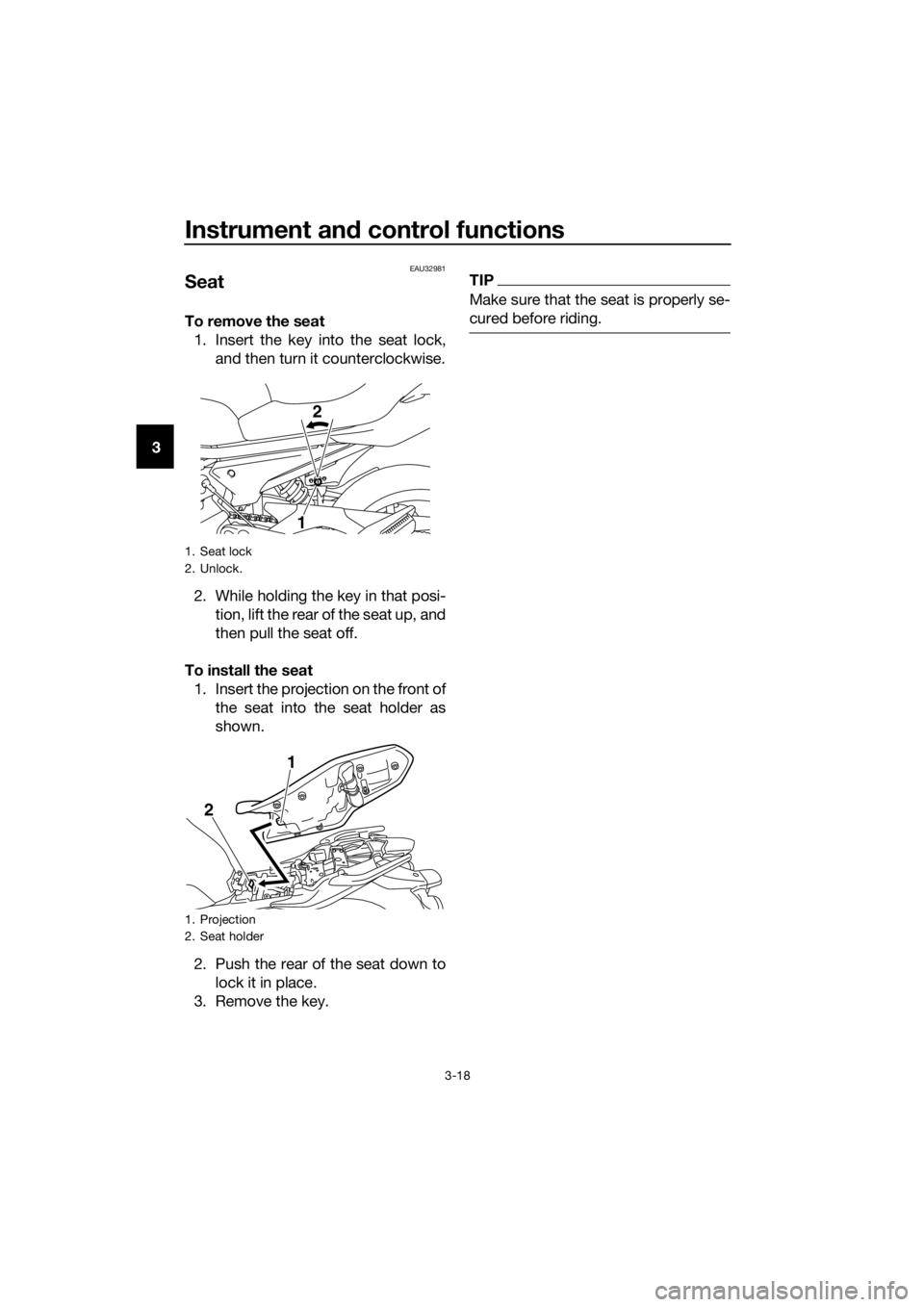
To remove the seat
1. Insert the key into the seat lock, and then turn it counterclockwise.
2. While holding the key in that posi- tion, lift the rear of the seat up, and
then pull the seat off.
To install the seat 1. Insert the projection on the front of the seat into the seat holder as
shown.
2. Push the rear of the seat down to lock it in place.
3. Remove the key.
TIP
Make sure that the seat is properly se-
cured before riding.
1. Seat lock
2. Unlock.
1. Projection
2. Seat holder
1 2
1
2
UB61E1E0.book Page 18 Wednesday, October 21, 2015 11:19 AM
Page 66 of 104
Periodic maintenance an d a djustment
6-22
6
EAU46731
A djustin g the clutch lever free
play
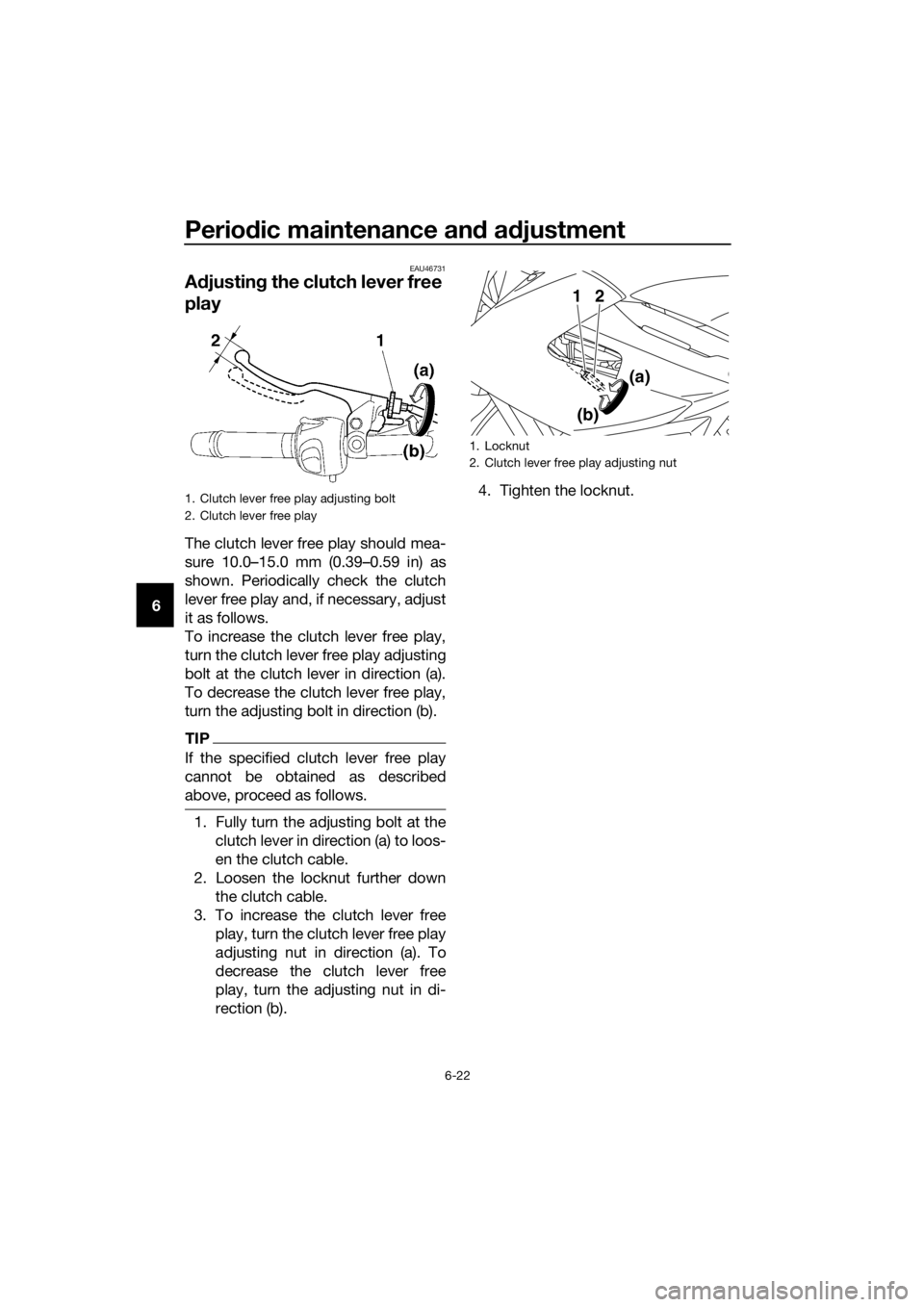
The clutch lever free play should mea-
sure 10.0–15.0 mm (0.39–0.59 in) as
shown. Periodically check the clutch
lever free play and, if necessary, adjust
it as follows.
To increase the clutch lever free play,
turn the clutch lever free play adjusting
bolt at the clutch lever in direction (a).
To decrease the clutch lever free play,
turn the adjusting bolt in direction (b).
TIP
If the specified clutch lever free play
cannot be obtained as described
above, proceed as follows.
1. Fully turn the adjusting bolt at the
clutch lever in direction (a) to loos-
en the clutch cable.
2. Loosen the locknut further down the clutch cable.
3. To increase the clutch lever free play, turn the clutch lever free play
adjusting nut in direction (a). To
decrease the clutch lever free
play, turn the adjusting nut in di-
rection (b). 4. Tighten the locknut.
1. Clutch lever free play adjusting bolt
2. Clutch lever free play
1. Locknut
2. Clutch lever free play adjusting nut
12
(b) (a)
UB61E1E0.book Page 22 Wednesday, October 21, 2015 11:19 AM
Page 69 of 104
Periodic maintenance an d a djustment
6-25
6
EAU43113
Checkin g the brake flui d level
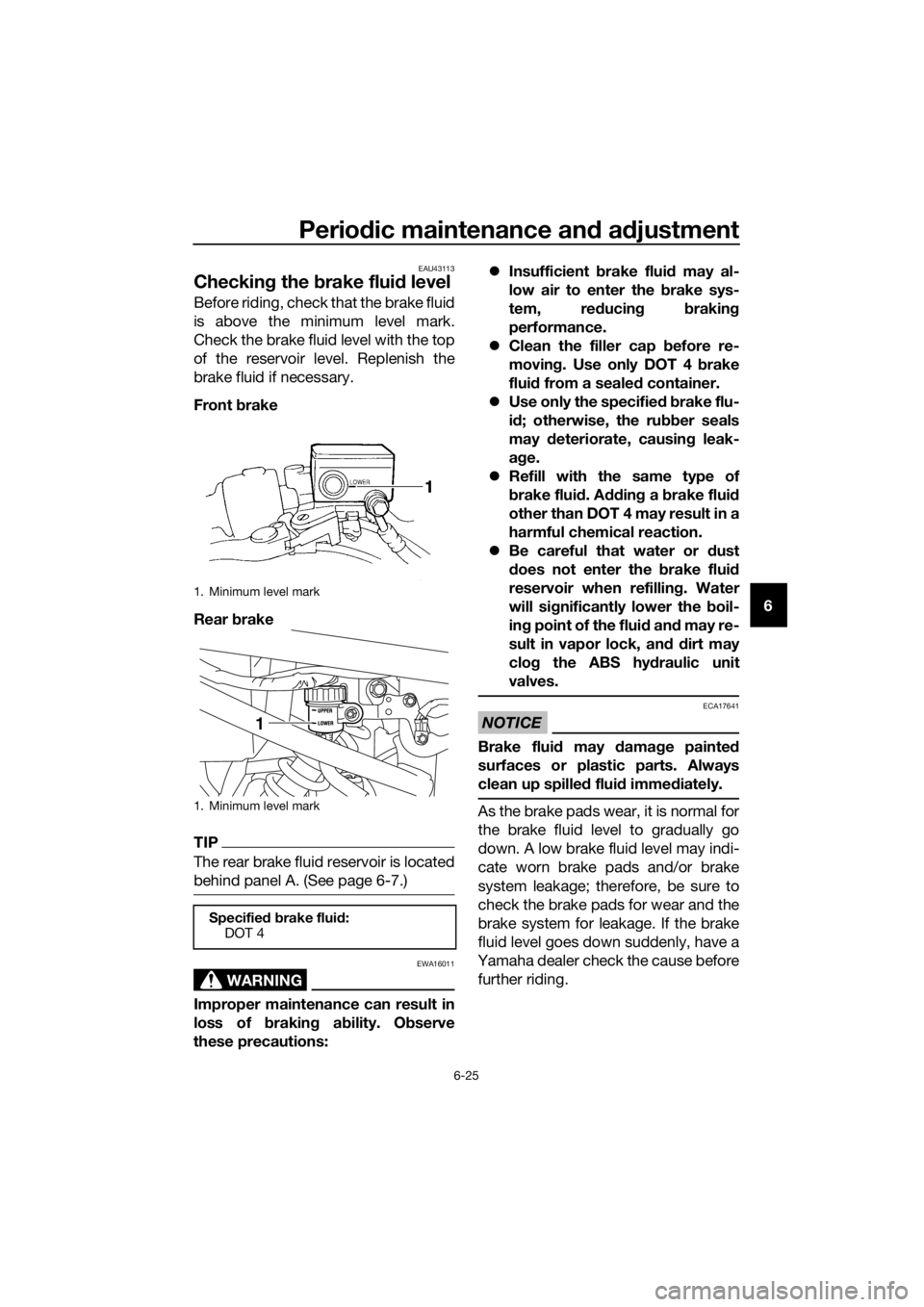
Before riding, check that the brake fluid
is above the minimum level mark.
Check the brake fluid level with the top
of the reservoir level. Replenish the
brake fluid if necessary.
Front brake
Rear brake
TIP
The rear brake fluid reservoir is located
behind panel A. (See page 6-7.)
WARNING
EWA16011
Improper maintenance can result in
loss of brakin g a bility. O bserve
these precautions:
Insufficient brake flui d may al-
low air to enter the brake sys-
tem, re ducin g brakin g
performance.
Clean the filler cap before re-
moving . Use only DOT 4 b rake
flui d from a seale d container.
Use only the specifie d b rake flu-
i d ; otherwise, the ru bber seals
may deteriorate, causin g leak-
a g e.
Refill with the same type of
brake flui d. A ddin g a brake flui d
other than DOT 4 may result in a
harmful chemical reaction.
Be careful that water or dust
d oes not enter the brake flui d
reservoir when refilling . Water
will si gnificantly lower the boil-
in g point of the flui d an d may re-
sult in vapor lock, an d d ir t may
clo g th
e ABS hy draulic unit
valves.
NOTICE
ECA17641
Brake flui d may d amage painte d
surfaces or plastic parts. Always
clean up spille d flui d imme diately.
As the brake pads wear, it is normal for
the brake fluid level to gradually go
down. A low brake fluid level may indi-
cate worn brake pads and/or brake
system leakage; therefore, be sure to
check the brake pads for wear and the
brake system for leakage. If the brake
fluid level goes down suddenly, have a
Yamaha dealer check the cause before further riding.
1. Minimum level mark
1. Minimum level mark
Specified b rake flui d:
DOT 4
1
UB61E1E0.book Page 25 Wednesday, October 21, 2015 11:19 AM
Page 70 of 104
Periodic maintenance an d a djustment
6-26
6
EAU22733
Chan gin g the brake flui d
Have a Yamaha dealer change the
brake fluid at the intervals specified in
the periodic maintenance and lubrica-
tion chart. In addition, have the oil seals
of the master cylinders and calipers as
well as the brake hoses replaced at the
intervals listed below or whenever they
are damaged or leaking.
Oil seals: Replace every two
years.
Brake hoses: Replace every four
years.
EAU22762
Drive chain slack
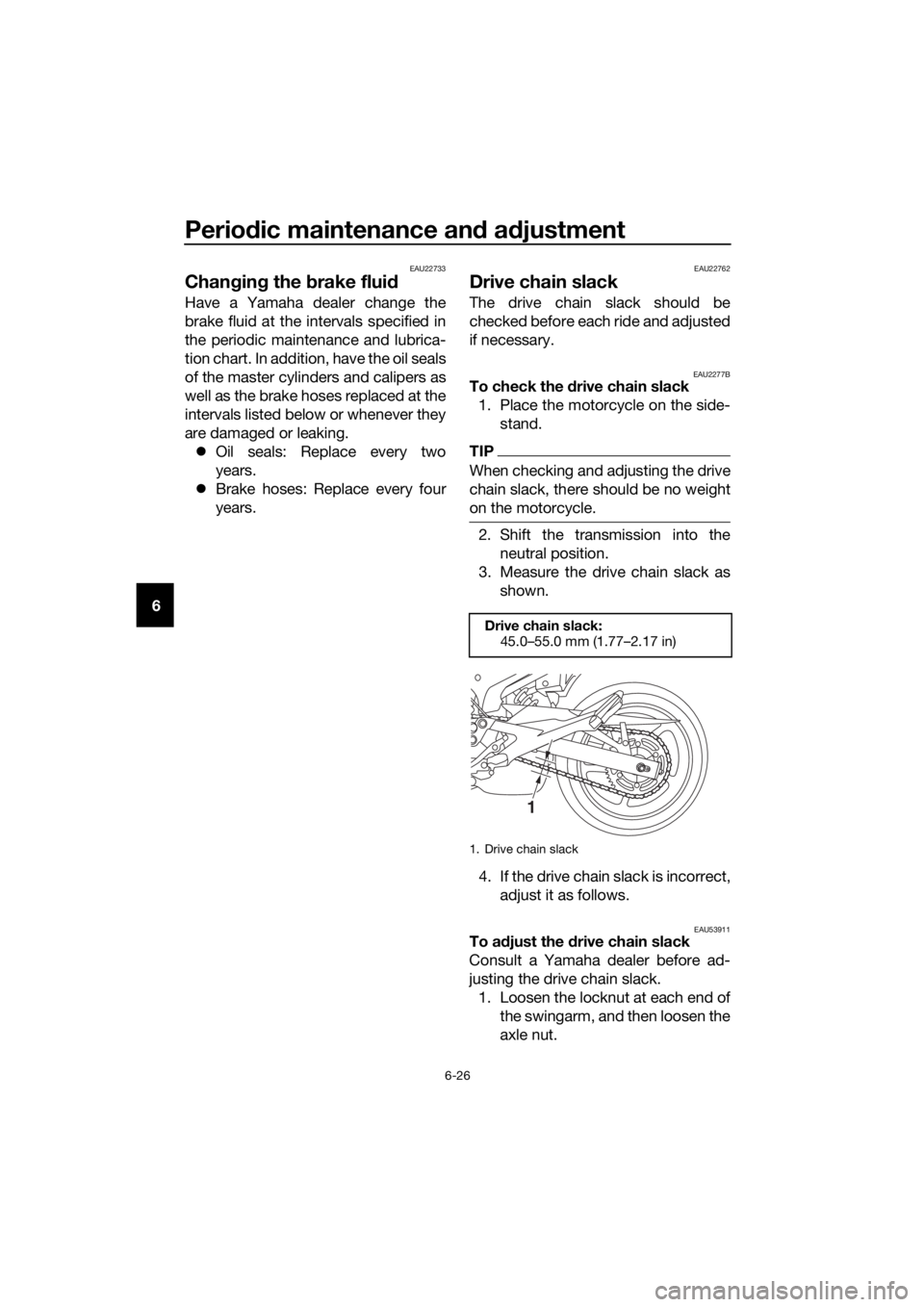
The drive chain slack should be
checked before each ride and adjusted
if necessary.
EAU2277BTo check the d rive chain slack
1. Place the motorcycle on the side- stand.
TIP
When checking and adjusting the drive
chain slack, there should be no weight
on the motorcycle.
2. Shift the transmission into theneutral position.
3. Measure the drive chain slack as shown.
4. If the drive chain slack is incorrect, adjust it as follows.
EAU53911To a djust the d rive chain slack
Consult a Yamaha dealer before ad-
justing the drive chain slack. 1. Loosen the locknut at each end of the swingarm, and then loosen the
axle nut.
Drive chain slack:45.0–55.0 mm (1.77–2.17 in)
1. Drive chain slack
1
UB61E1E0.book Page 26 Wednesday, October 21, 2015 11:19 AM
Page 71 of 104
Periodic maintenance an d a djustment
6-27
6
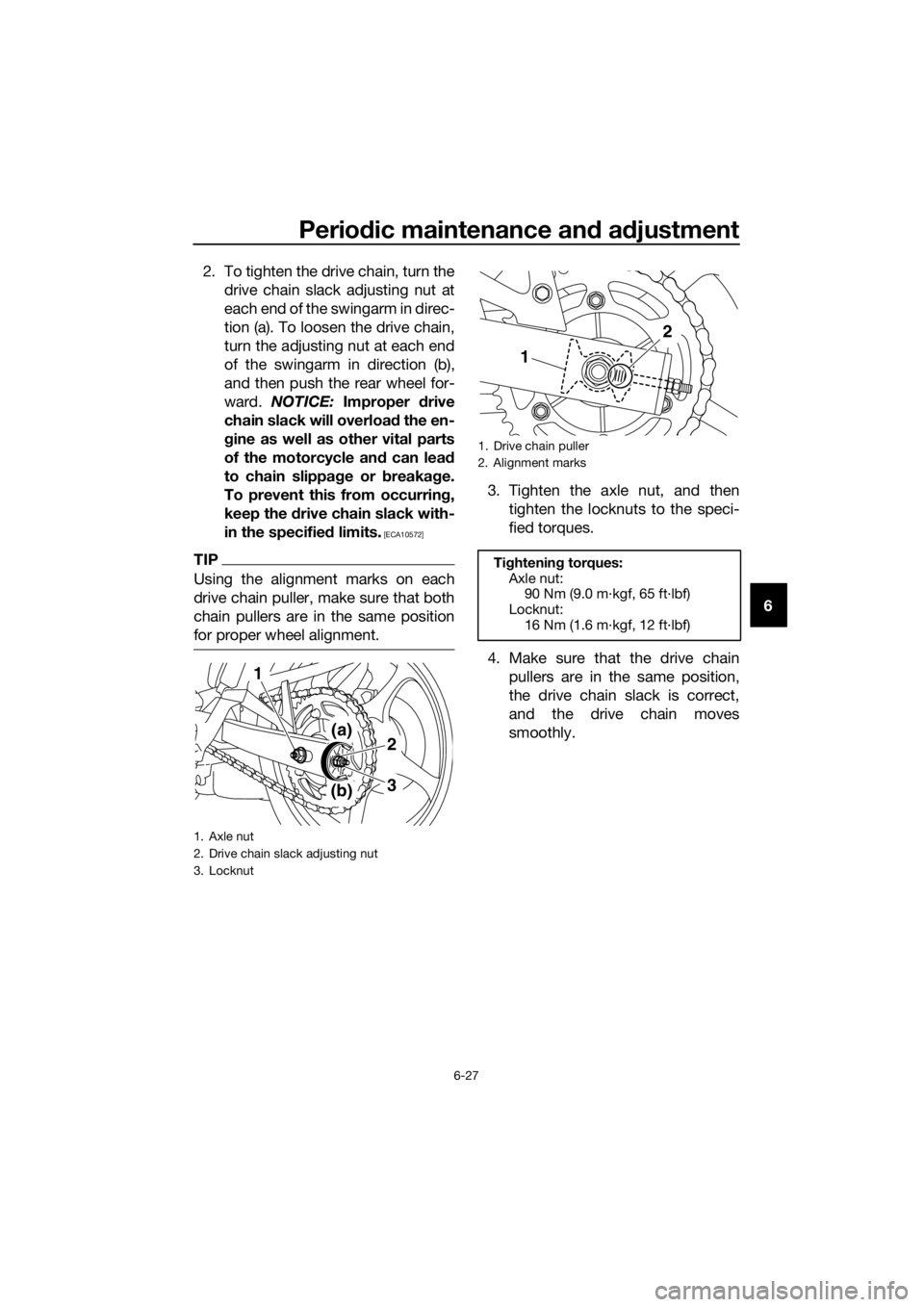
2. To tighten the drive chain, turn the
drive chain slack adjusting nut at
each end of the swingarm in direc-
tion (a). To loosen the drive chain,
turn the adjusting nut at each end
of the swingarm in direction (b),
and then push the rear wheel for-
ward. NOTICE: Improper d rive
chain slack will overloa d the en-
g ine as well as other vital parts
of the motorcycle an d can lead
to chain slippag e or breakag e.
To prevent this from occurrin g,
keep the d rive chain slack with-
in the specified limits.
[ECA10572]
TIP
Using the alignment marks on each
drive chain puller, make sure that both
chain pullers are in the same position
for proper wheel alignment.
3. Tighten the axle nut, and then
tighten the locknuts to the speci-
fied torques.
4. Make sure that the drive chain pullers are in the same position,
the drive chain slack is correct,
and the drive chain moves
smoothly.
1. Axle nut
2. Drive chain slack adjusting nut
3. Locknut
3
1
2(a)
(b)
1. Drive chain puller
2. Alignment marks
Tightenin g torques:
Axle nut: 90 Nm (9.0 m·kgf, 65 ft·lbf)
Locknut:
16 Nm (1.6 m·kgf, 12 ft·lbf)
1
2
UB61E1E0.book Page 27 Wednesday, October 21, 2015 11:19 AM
Page 78 of 104
Periodic maintenance an d a djustment
6-34
6 3. Fully charge the battery before
installation. NOTICE: When in-
stallin g the battery, be sure the
key is turne d to “OFF”, then
connect the positive lea d b efore
connectin g the ne gative lead .
[ECA16841]
4. After installation, make sure that
the battery leads are properly con-
nected to the battery terminals.
NOTICE
ECA16531
Always keep the battery char ged .
Storin g a d ischar ged battery can
cause permanent b attery damag e.
EAU47174
Replacin g the fuses
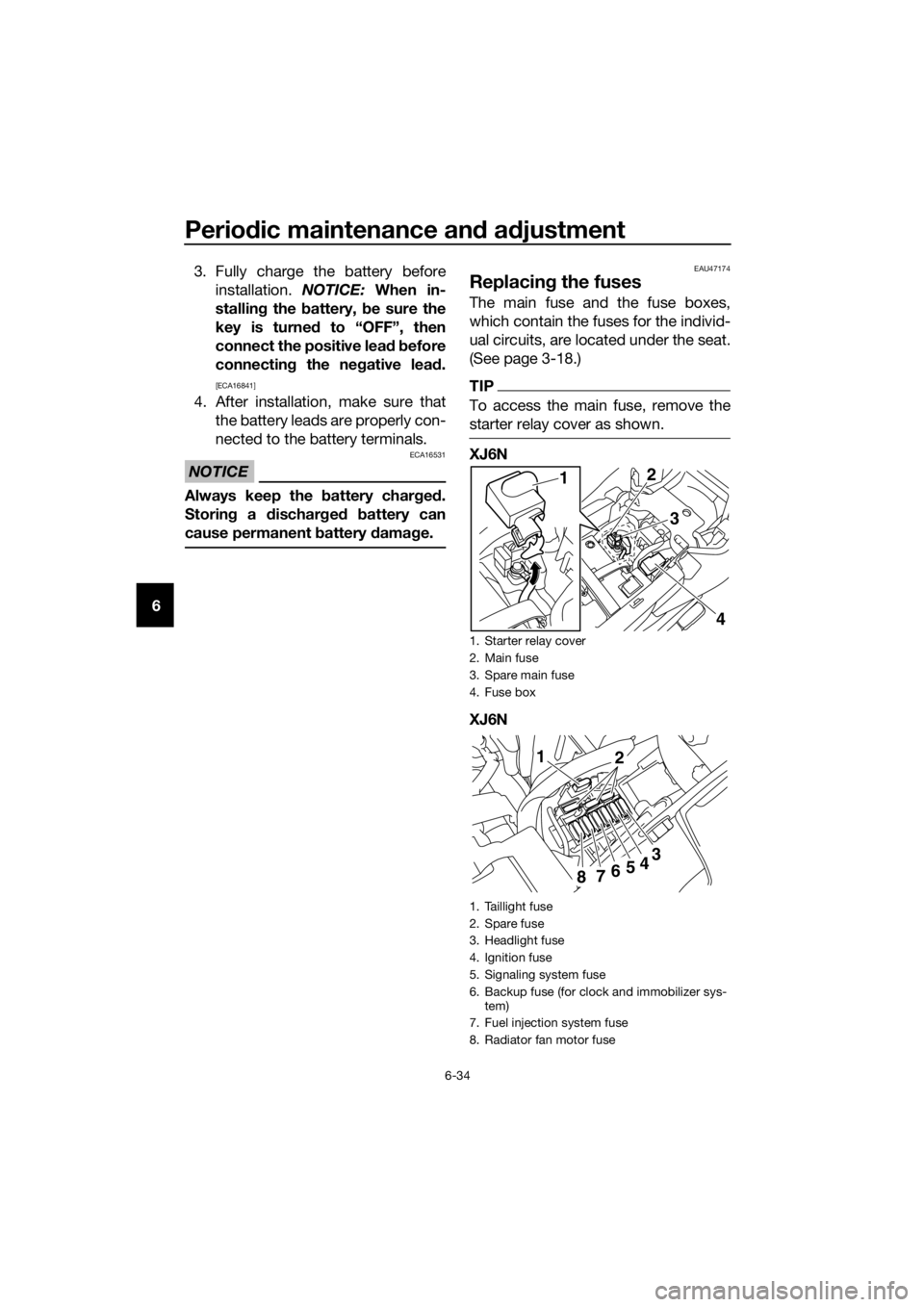
The main fuse and the fuse boxes,
which contain the fuses for the individ-
ual circuits, are located under the seat.
(See page 3-18.)
TIP
To access the main fuse, remove the
starter relay cover as shown.
XJ6N
XJ6N
1. Starter relay cover
2. Main fuse
3. Spare main fuse
4. Fuse box
1. Taillight fuse
2. Spare fuse
3. Headlight fuse
4. Ignition fuse
5. Signaling system fuse
6. Backup fuse (for clock and immobilizer sys-
tem)
7. Fuel injection system fuse
8. Radiator fan motor fuse
2
4
3
1
1
2
3
4
5
6
7
8
UB61E1E0.book Page 34 Wednesday, October 21, 2015 11:19 AM
Page 79 of 104
Periodic maintenance an d a djustment
6-35
6
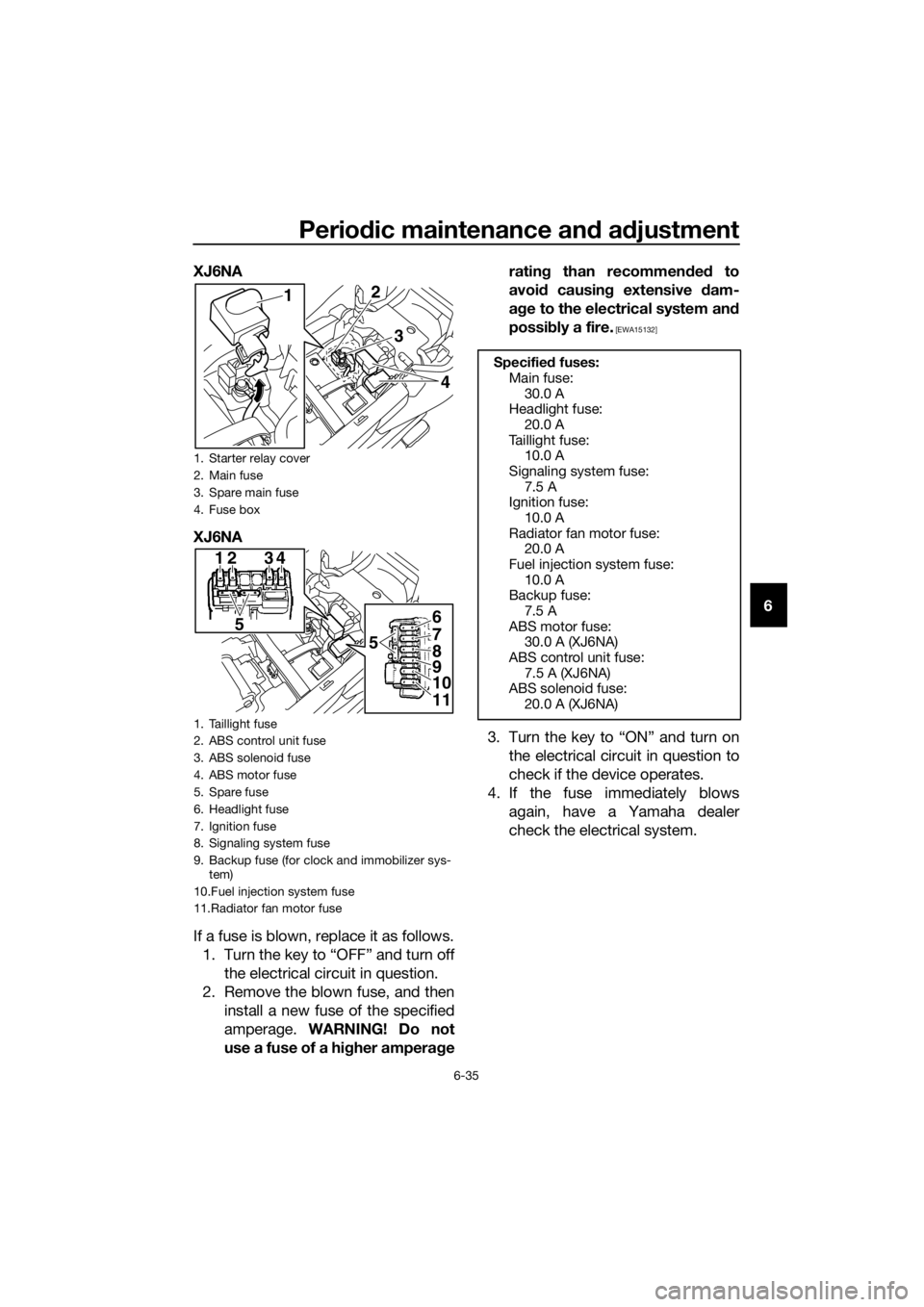
XJ6NA
XJ6NA
If a fuse is blown, replace it as follows.
1. Turn the key to “OFF” and turn off the electrical circuit in question.
2. Remove the blown fuse, and then install a new fuse of the specified
amperage. WARNING! Do not
use a fuse of a hi gher ampera ge ratin
g than recommen ded to
avoi d causin g extensive dam-
a g e to the electrical system an d
possi bly a fire.
[EWA15132]
3. Turn the key to “ON” and turn on
the electrical circuit in question to
check if the device operates.
4. If the fuse immediately blows again, have a Yamaha dealer
check the electrical system.
1. Starter relay cover
2. Main fuse
3. Spare main fuse
4. Fuse box
1. Taillight fuse
2. ABS control unit fuse
3. ABS solenoid fuse
4. ABS motor fuse
5. Spare fuse
6. Headlight fuse
7. Ignition fuse
8. Signaling system fuse
9. Backup fuse (for clock and immobilizer sys-tem)
10.Fuel injection system fuse
11.Radiator fan motor fuse
2
4
3
1
1
5 56
7
8
9
10
11
234
Specified
fuses:
Main fuse: 30.0 A
Headlight fuse:
20.0 A
Taillight fuse: 10.0 A
Signaling system fuse: 7.5 A
Ignition fuse:
10.0 A
Radiator fan motor fuse: 20.0 A
Fuel injection system fuse: 10.0 A
Backup fuse:
7.5 A
ABS motor fuse: 30.0 A (XJ6NA)
ABS control unit fuse: 7.5 A (XJ6NA)
ABS solenoid fuse:
20.0 A (XJ6NA)
UB61E1E0.book Page 35 Wednesday, October 21, 2015 11:19 AM