engine YAMAHA XJ6-N 2016 Owner's Manual
[x] Cancel search | Manufacturer: YAMAHA, Model Year: 2016, Model line: XJ6-N, Model: YAMAHA XJ6-N 2016Pages: 104, PDF Size: 2.91 MB
Page 41 of 104
Operation and important ri din g points
5-2
5
EAU51792
Startin g the eng ine
In order for the ignition circuit cut-off
system to enable starting, one of the
following conditions must be met:
The transmission is in the neutral
position.
The transmission is in gear with
the clutch lever pulled and the
sidestand up.
See page 3-22 for more informa-
tion.
1. Turn the key to “ON” and make sure that the engine stop switch is
set to “ ”.
The following warning lights and
indicator light should come on for
a few seconds, then go off. Oil level warning light
Coolant temperature warning
light
Engine trouble warning light
Immobilizer system indicator
light
NOTICE
ECA17671
If the ab ove warnin g li ghts or in dica-
tor li ght do not come on initially
when the key is turned to “ON”, or if
a warnin g or in dicator li ght remains
on, see pa ge 3-4 for the correspon d-
in g warnin g an d in dicator li ght cir-
cuit check.
For ABS models:
The ABS warning light should
come on when the main switch is
turned to “ON” and then go off af-
ter traveling at a speed of 10 km/h
(6 mi/h) or higher.
NOTICE
ECA17682
If the ABS warnin g li ght does not
come on an d then go off as ex-
plained above, see pa ge 3-4 for the
warnin g li ght circuit check.
2. Shift the transmission into the
neutral position. The neutral indi-
cator light should come on. If not,
ask a Yamaha dealer to check the
electrical circuit.
3. Start the engine by pushing the start switch.
If the engine fails to start, release
the start switch, wait a few sec-
onds, and then try again. Each
starting attempt should be as
short as possible to preserve the
battery. Do not crank the engine
more than 10 seconds on any one
attempt.
NOTICE
ECA11043
For maximum en gine life, never ac-
celerate har d when the en gine is
col d!
UB61E1E0.book Page 2 Wednesday, October 21, 2015 11:19 AM
Page 42 of 104
Operation and important rid ing points
5-3
5
EAU16673
Shiftin g
Shifting gears lets you control the
amount of engine power available for
starting off, accelerating, climbing hills,
etc.
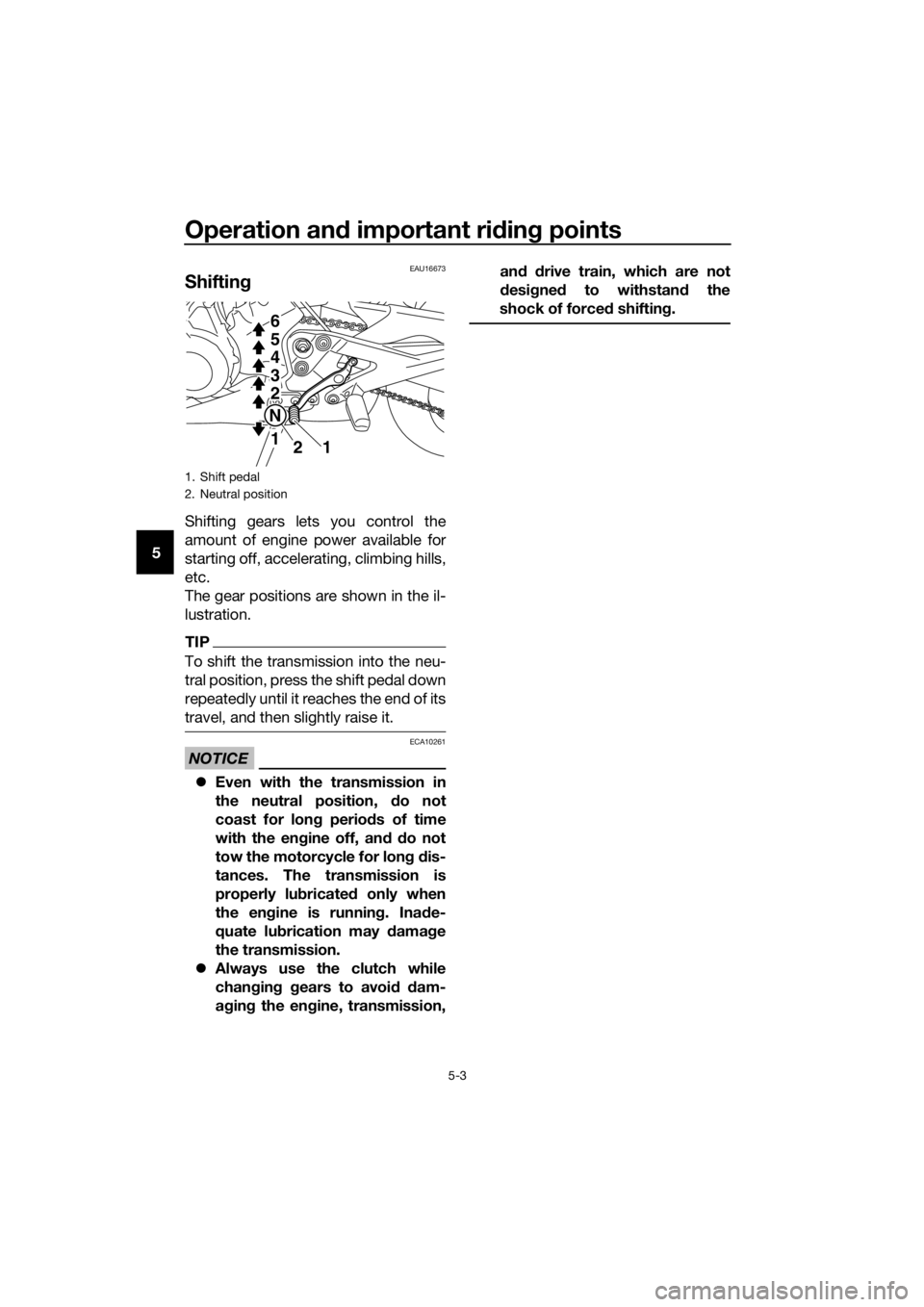
The gear positions are shown in the il-
lustration.
TIP
To shift the transmission into the neu-
tral position, press the shift pedal down
repeatedly until it reaches the end of its
travel, and then slightly raise it.
NOTICE
ECA10261
Even with the transmission in
the neutral position, d o not
coast for lon g period s of time
with the en gine off, an d d o not
tow the motorcycle for lon g d is-
tances. The transmission is
properly lu bricated only when
the en gine is runnin g. Ina de-
quate lu brication may damag e
the transmission.
Always use the clutch while
chan gin g g ears to avoi d d am-
a g in g the en gine, transmission, an
d d rive train, which are not
d esi gne d to withstan d the
shock of force d shifting .
1. Shift pedal
2. Neutral position
1
N
2 3
4
5
612
UB61E1E0.book Page 3 Wednesday, October 21, 2015 11:19 AM
Page 43 of 104

Operation and important ri din g points
5-4
5
EAU16811
Tips for re ducin g fuel con-
sumption
Fuel consumption depends largely on
your riding style. Consider the follow-
ing tips to reduce fuel consumption:
Shift up swiftly, and avoid high en-
gine speeds during acceleration.
Do not rev the engine while shift-
ing down, and avoid high engine
speeds with no load on the en-
gine.
Turn the engine off instead of let-
ting it idle for an extended length
of time (e.g., in traffic jams, at traf-
fic lights or at railroad crossings).
EAU16842
Engine break-in
There is never a more important period
in the life of your engine than the period
between 0 and 1600 km (1000 mi). For
this reason, you should read the fol-
lowing material carefully.
Since the engine is brand new, do not
put an excessive load on it for the first
1600 km (1000 mi). The various parts in
the engine wear and polish themselves
to the correct operating clearances.
During this period, prolonged full-throt-
tle operation or any condition that
might result in engine overheating
must be avoided.
EAU17094
0–1000 km (0–600 mi)
Avoid prolonged operation above 5800
r/min. NOTICE: After 1000 km (600
mi) of operation, the en gine oil must
b e chan ged an d the oil filter car-
tri dge or element replaced .
[ECA10303]
1000–1600 km (600–1000 mi)
Avoid prolonged operation above 7000
r/min.
1600 km (1000 mi) and b eyon d
The vehicle can now be operated nor-
mally.
NOTICE
ECA10311
Keep the en gine speed out of
the tachometer red zone.
If any en gine trou ble shoul d oc-
cur durin g the en gine break-in
period , imme diately have a
Yamaha dealer check the vehi-
cle.
UB61E1E0.book Page 4 Wednesday, October 21, 2015 11:19 AM
Page 44 of 104

Operation and important rid ing points
5-5
5
EAU17214
Parkin g
When parking, stop the engine, and
then remove the key from the main
switch.
WARNING
EWA10312
Since the en gine an d exhaust
system can become very hot,
park in a place where pe destri-
ans or chil dren are not likely to
touch them an d b e burne d.
Do not park on a slope or on soft
groun d, otherwise the vehicle
may overturn, increasin g the
risk of a fuel leak an d fire.
Do not park near grass or other
flamma ble materials which
mi ght catch fire.
UB61E1E0.book Page 5 Wednesday, October 21, 2015 11:19 AM
Page 46 of 104
Periodic maintenance an d a djustment
6-2
6
EAU17303
Emission controls not only function to
ensure cleaner air, but are also vital to
proper engine operation and maximum
performance. In the following periodic
maintenance charts, the services relat-
ed to emissions control are grouped
separately. These services require
specialized data, knowledge, and
equipment. Maintenance, replace-
ment, or repair of the emission control
devices and systems may be per-
formed by any repair establishment or
individual that is certified (if applicable).
Yamaha dealers are trained and equipped to perform these particular
services.
EAU39692
Owner’s tool kit
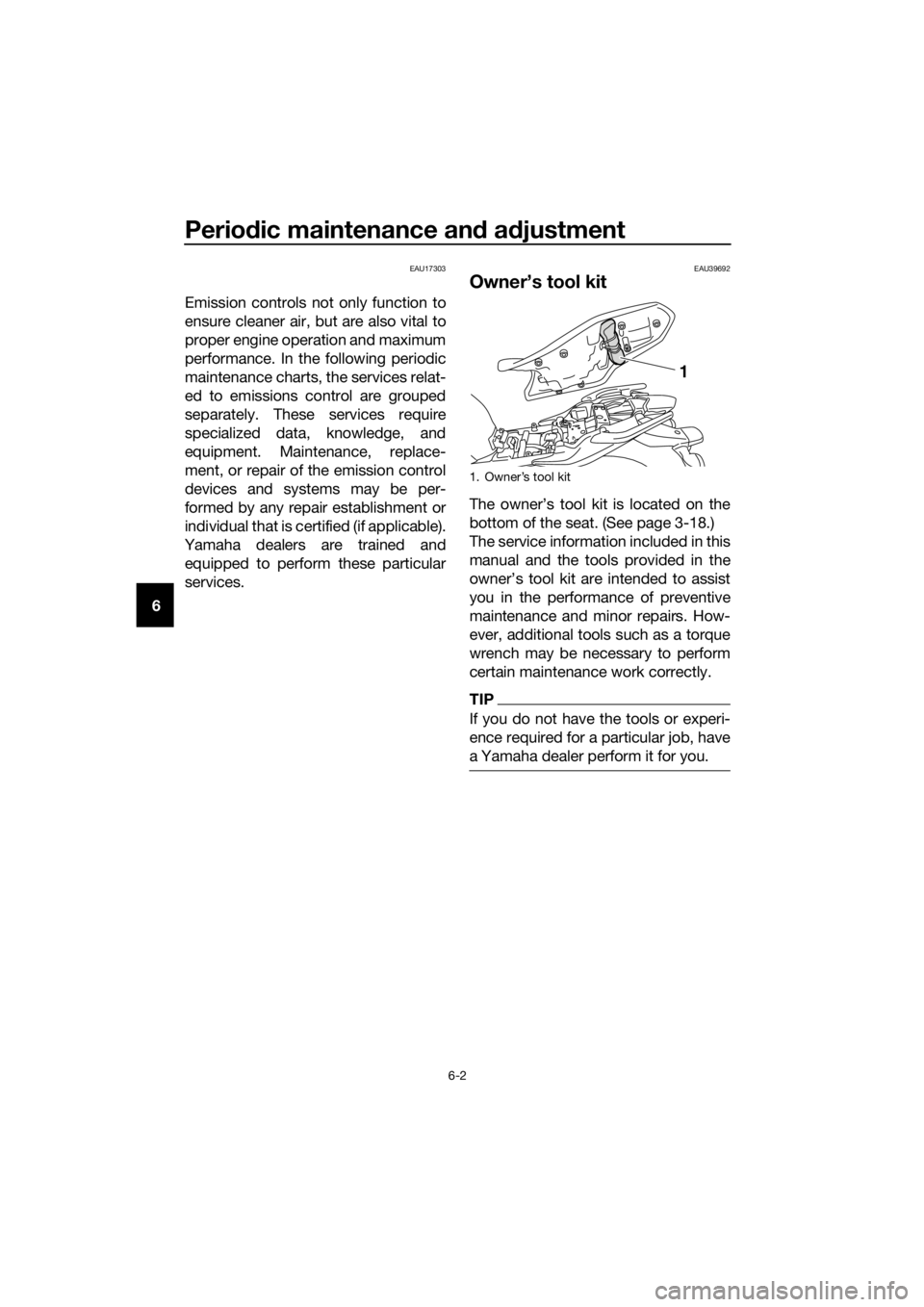
The owner’s tool kit is located on the
bottom of the seat. (See page 3-18.)
The service information included in this
manual and the tools provided in the
owner’s tool kit are intended to assist
you in the performance of preventive
maintenance and minor repairs. How-
ever, additional tools such as a torque
wrench may be necessary to perform
certain maintenance work correctly.
TIP
If you do not have the tools or experi-
ence required for a particular job, have
a Yamaha dealer perform it for you.
1. Owner’s tool kit
1
UB61E1E0.book Page 2 Wednesday, October 21, 2015 11:19 AM
Page 47 of 104

Periodic maintenance an d a djustment
6-3
6
EAU46862
TIP
The annual checks must b e performed every year, except if a kilometer-
b ased maintenance, or for the UK, a milea ge- based maintenance, is
performed instead.
From 50000 km (30000 mi), repeat the maintenance intervals starting from
10000 km (6000 mi).
Items marked with an asterisk should be performed by a Yamaha dealer as
they require special tools, data and technical skills.
EAU63321
Perio dic maintenance chart for the emission control system
NO. ITEM
1 *Fuel line • Check fuel hoses for cracks or
damage. √√√√√
2 *Spark plu gs • Check condition.
• Clean and regap.
√√
• Replace. √√
3 *Va l ve s • Check valve clearance.
•Adjust.
Every 40000 km (24000 mi)
4 *Fuel injection • Adjust engine idling speed and
synchronization. √√√√√√
5 *Air in
duction sys-
tem • Check the air cut-off valve, reed
valve, and hose for damage.
• Replace the entire air induction system if necessary. √√√√√X 1000 km
CHECK OR
MAINTENANCE JOB
X 1000 mi
ODOMETER READINGS
ANNUAL CHECK
110203040
0.66121824
UB61E1E0.book Page 3 Wednesday, October 21, 2015 11:19 AM
Page 52 of 104
Periodic maintenance an d a djustment
6-8
6
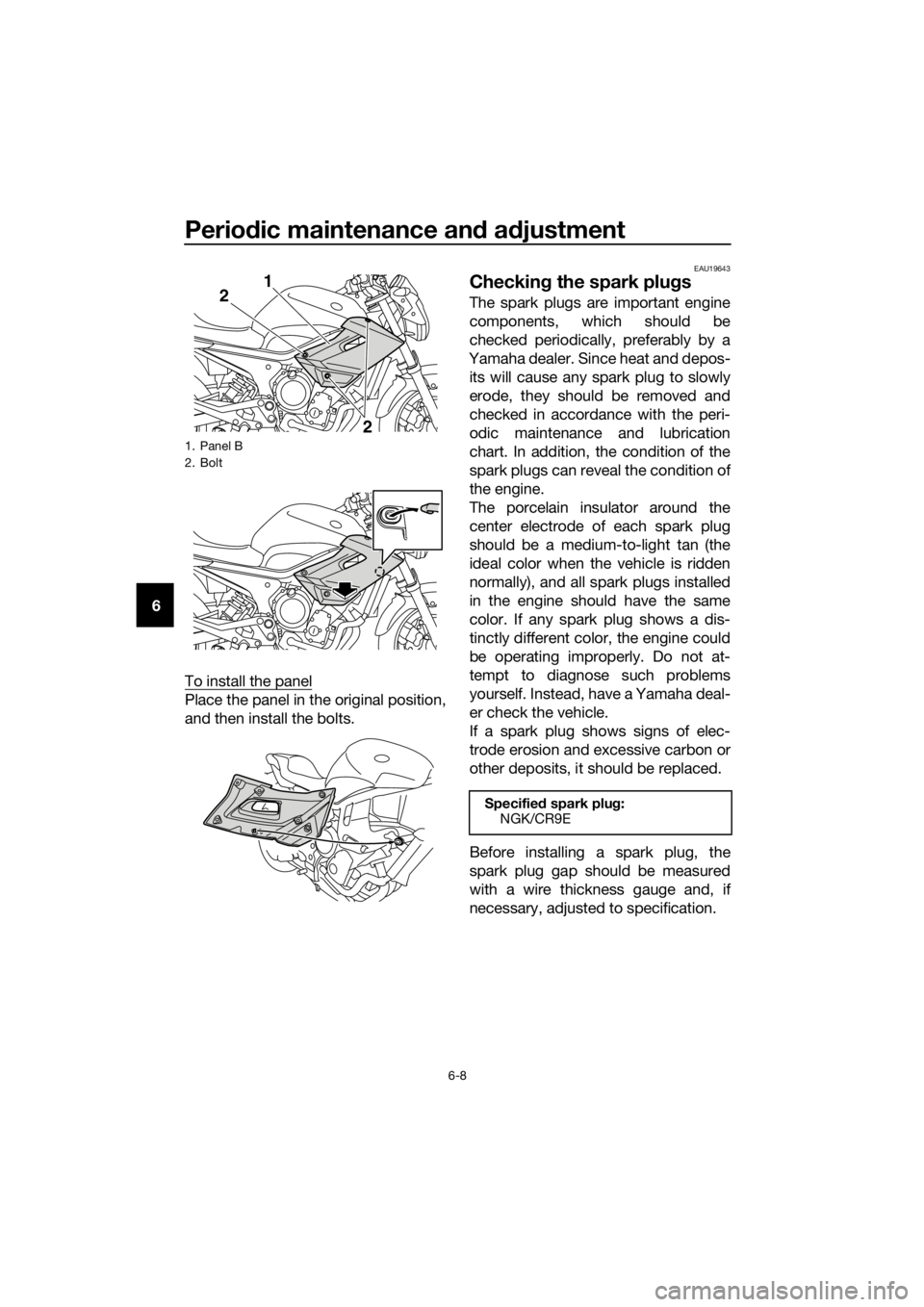
To install the panel
Place the panel in the original position,
and then install the bolts.
EAU19643
Checkin g the spark plu gs
The spark plugs are important engine
components, which should be
checked periodically, preferably by a
Yamaha dealer. Since heat and depos- its will cause any spark plug to slowly
erode, they should be removed and
checked in accordance with the peri-
odic maintenance and lubrication
chart. In addition, the condition of the
spark plugs can reveal the condition of
the engine.
The porcelain insulator around the
center electrode of each spark plug
should be a medium-to-light tan (the
ideal color when the vehicle is ridden
normally), and all spark plugs installed
in the engine should have the same
color. If any spark plug shows a dis-
tinctly different color, the engine could
be operating improperly. Do not at-
tempt to diagnose such problems
yourself. Instead, have a Yamaha deal-
er check the vehicle.
If a spark plug shows signs of elec-
trode erosion and excessive carbon or
other deposits, it should be replaced.
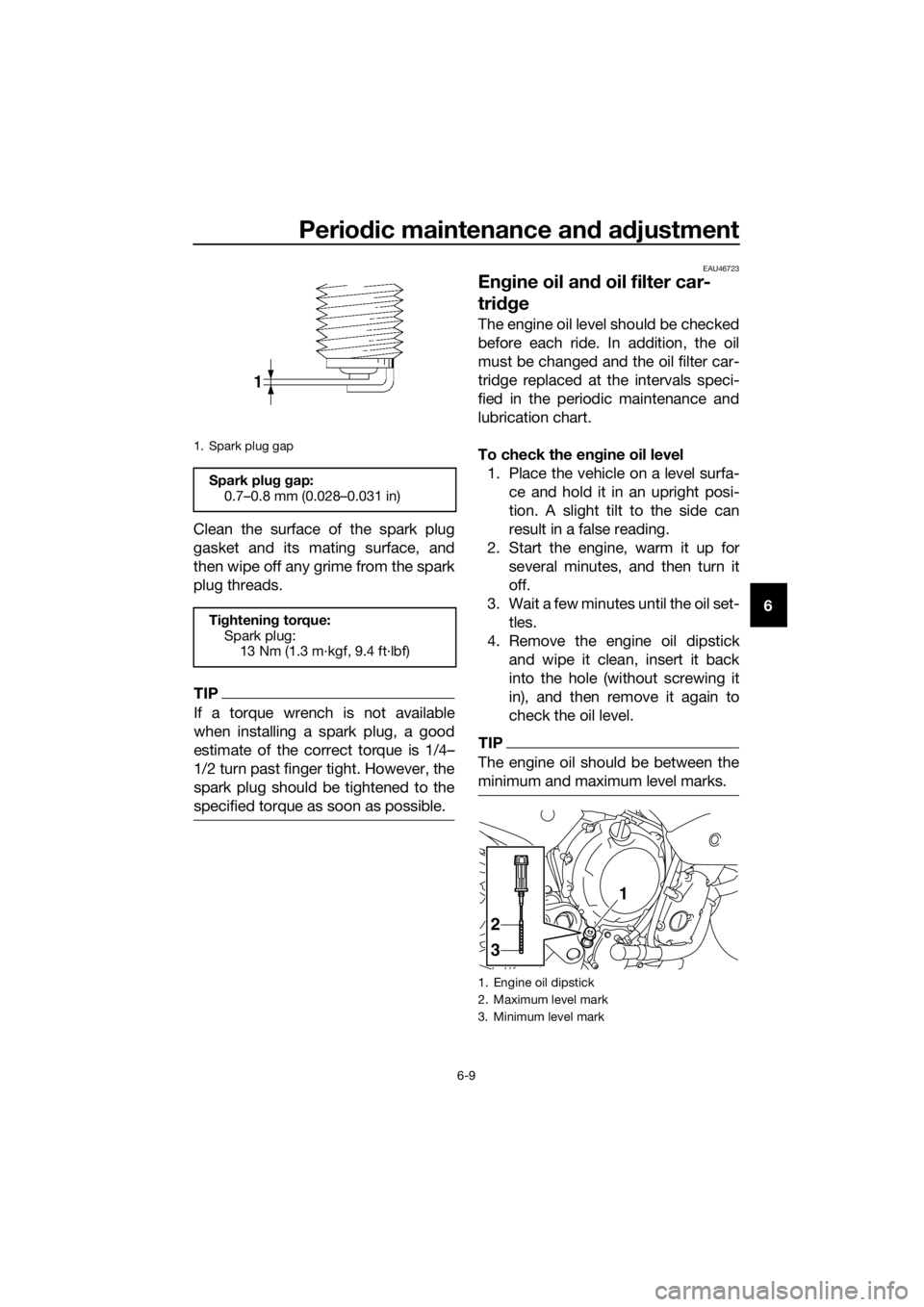
Before installing a spark plug, the
spark plug gap should be measured
with a wire thickness gauge and, if
necessary, adjusted to specification.
1. Panel B
2. Bolt
1
2
2
Specified spark plu g:
NGK/CR9E
UB61E1E0.book Page 8 Wednesday, October 21, 2015 11:19 AM
Page 53 of 104
Periodic maintenance an d a djustment
6-9
6
Clean the surface of the spark plug
gasket and its mating surface, and
then wipe off any grime from the spark
plug threads.
TIP
If a torque wrench is not available
when installing a spark plug, a good
estimate of the correct torque is 1/4–
1/2 turn past finger tight. However, the
spark plug should be tightened to the
specified torque as soon as possible.
EAU46723
En
gine oil an d oil filter car-
tri dge
The engine oil level should be checked
before each ride. In addition, the oil
must be changed and the oil filter car-
tridge replaced at the intervals speci-
fied in the periodic maintenance and
lubrication chart.
To check the en gine oil level
1. Place the vehicle on a level surfa- ce and hold it in an upright posi-
tion. A slight tilt to the side can
result in a false reading.
2. Start the engine, warm it up for several minutes, and then turn it
off.
3. Wait a few minutes until the oil set- tles.
4. Remove the engine oil dipstick and wipe it clean, insert it back
into the hole (without screwing it
in), and then remove it again to
check the oil level.
TIP
The engine oil should be between the
minimum and maximum level marks.
1. Spark plug gap
Spark plu g g ap:
0.7–0.8 mm (0.028–0.031 in)
Ti ghtening torque:
Spark plug: 13 Nm (1.3 m·kgf, 9.4 ft·lbf)
1. Engine oil dipstick
2. Maximum level mark
3. Minimum level mark
1
2
3
UB61E1E0.book Page 9 Wednesday, October 21, 2015 11:19 AM
Page 54 of 104
Periodic maintenance an d a djustment
6-10
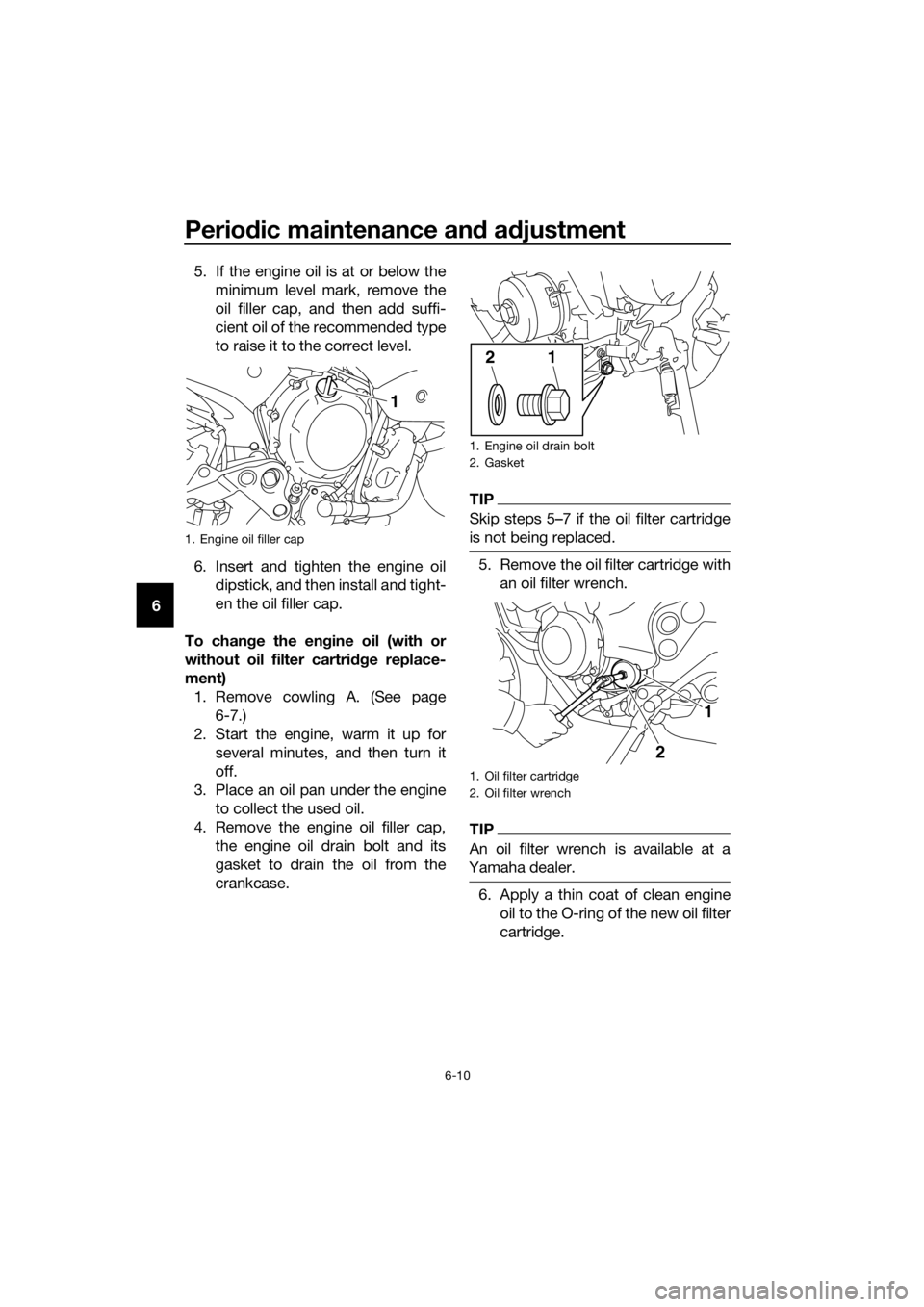
6 5. If the engine oil is at or below the
minimum level mark, remove the
oil filler cap, and then add suffi-
cient oil of the recommended type
to raise it to the correct level.
6. Insert and tighten the engine oil dipstick, and then install and tight-
en the oil filler cap.
To chan ge the en gine oil (with or
without oil filter cartri dge replace-
ment) 1. Remove cowling A. (See page 6-7.)
2. Start the engine, warm it up for several minutes, and then turn it
off.
3. Place an oil pan under the engine to collect the used oil.
4. Remove the engine oil filler cap, the engine oil drain bolt and its
gasket to drain the oil from the
crankcase.
TIP
Skip steps 5–7 if the oil filter cartridge
is not being replaced.
5. Remove the oil filter cartridge withan oil filter wrench.
TIP
An oil filter wrench is available at a
Yamaha dealer.
6. Apply a thin coat of clean engine oil to the O-ring of the new oil filter
cartridge.
1. Engine oil filler cap
1
1. Engine oil drain bolt
2. Gasket
1. Oil filter cartridge
2. Oil filter wrench
12
1
2
UB61E1E0.book Page 10 Wednesday, October 21, 2015 11:19 AM
Page 55 of 104
Periodic maintenance an d a djustment
6-11
6
TIP
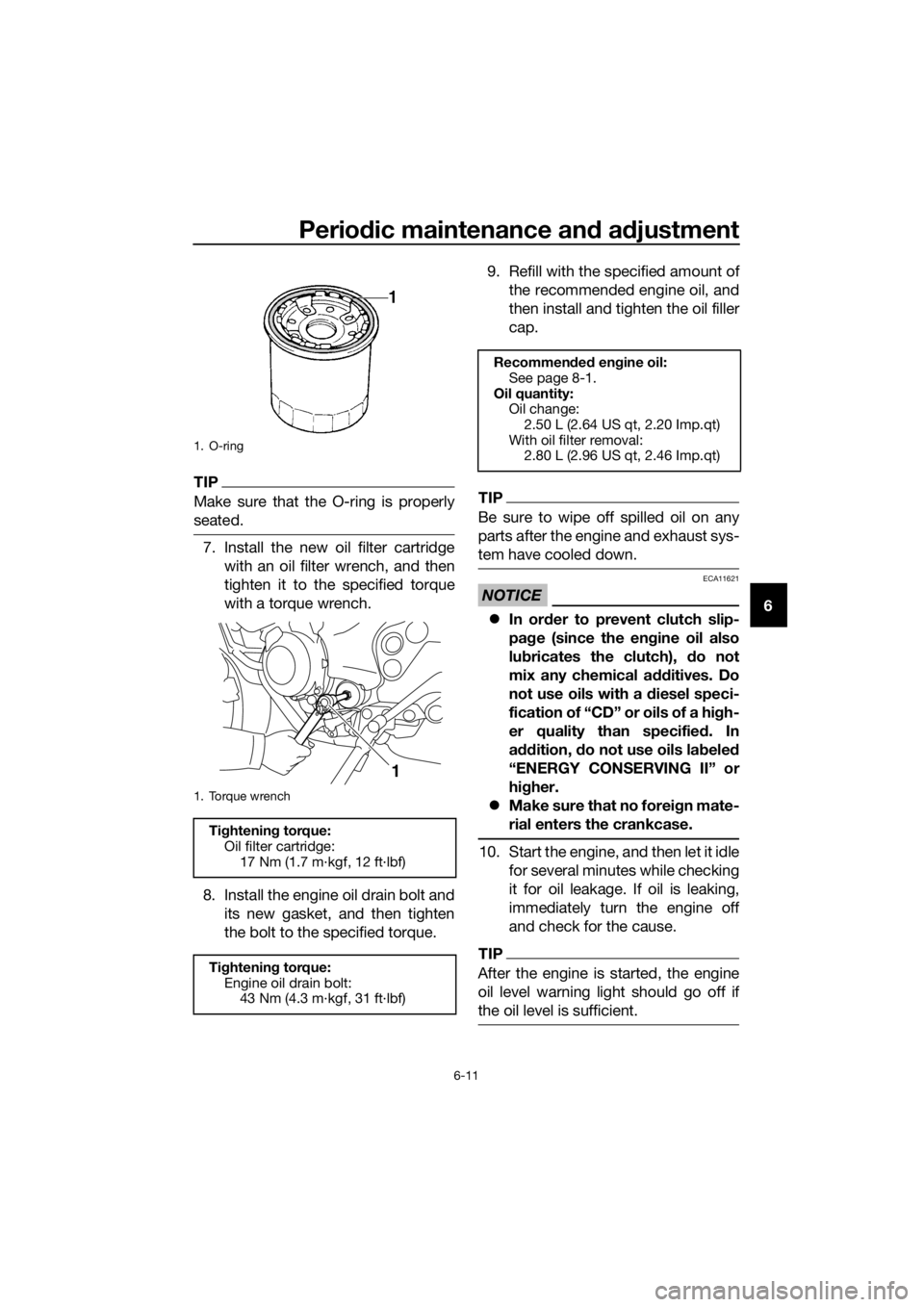
Make sure that the O-ring is properly
seated.
7. Install the new oil filter cartridge
with an oil filter wrench, and then
tighten it to the specified torque
with a torque wrench.
8. Install the engine oil drain bolt and its new gasket, and then tighten
the bolt to the specified torque. 9. Refill with the specified amount of
the recommended engine oil, and
then install and tighten the oil filler
cap.
TIP
Be sure to wipe off spilled oil on any
parts after the engine and exhaust sys-
tem have cooled down.
NOTICE
ECA11621
In or der to prevent clutch slip-
pa ge (since the en gine oil also
lu bricates the clutch), do not
mix any chemical additives. Do
not use oils with a diesel speci-
fication of “CD” or oils of a hi gh-
er quality than specified . In
a dd ition, do not use oils la bele d
“ENERGY CONSERVING II” or
hi gher.
Make sure that no forei gn mate-
rial enters the crankcase.
10. Start the engine, and then let it idle for several minutes while checking
it for oil leakage. If oil is leaking,
immediately turn the engine off
and check for the cause.
TIP
After the engine is started, the engine
oil level warning light should go off if
the oil level is sufficient.
1. O-ring
1. Torque wrench
Tightening torque:
Oil filter cartridge: 17 Nm (1.7 m·kgf, 12 ft·lbf)
Ti ghtening torque:
Engine oil drain bolt: 43 Nm (4.3 m·kgf, 31 ft·lbf)
1
Recommen ded en gine oil:
See page 8-1.
Oil quantity: Oil change:
2.50 L (2.64 US qt, 2.20 Imp.qt)
With oil filter removal: 2.80 L (2.96 US qt, 2.46 Imp.qt)
UB61E1E0.book Page 11 Wednesday, October 21, 2015 11:19 AM