brake light YAMAHA XJ6-S 2012 Owners Manual
[x] Cancel search | Manufacturer: YAMAHA, Model Year: 2012, Model line: XJ6-S, Model: YAMAHA XJ6-S 2012Pages: 102, PDF Size: 2.68 MB
Page 6 of 102

TABLE OF CONTENTSSAFETY INFORMATION ..................1-1
DESCRIPTION ..................................2-1
Left view ..........................................2-1
Right view ........................................2-2
Controls and instruments.................2-3
INSTRUMENT AND CONTROL
FUNCTIONS .......................................3-1
Immobilizer system .........................3-1
Main switch/steering lock ................3-2
Indicator lights and warning lights ..............................3-4
Multi-function meter unit .................3-8
Anti-theft alarm (optional) .............3-11
Handlebar switches ......................3-12
Clutch lever ...................................3-13
Shift pedal .....................................3-14
Brake lever ...................................3-14
Brake pedal ..................................3-14
ABS ..............................................3-15
Fuel tank cap ................................3-16
Fuel ...............................................3-16
Fuel tank breather hose and
overflow hose ............................3-17
Catalytic converter ........................3-18
Seat ..............................................3-18
Rear view mirrors .........................3-19
Sidecases .....................................3-20
Adjusting the shock absorber
assembly ...................................3-21 Carrier .......................................... 3-22
Sidestand ..................................... 3-22
Ignition circuit cut-off system ........ 3-23
FOR YOUR SAFETY –
PRE-OPERATION CHECKS ............. 4-1
OPERATION AND IMPORTANT
RIDING POINTS ................................. 5-1
Starting the engine ......................... 5-1
Shifting ........................................... 5-2
Tips for reducing fuel consumption ............................... 5-3
Engine break-in .............................. 5-3
Parking ........................................... 5-4
PERIODIC MAINTENANCE AND
ADJUSTMENT ................................... 6-1
Owner’s tool kit ............................... 6-2
Periodic maintenance chart for the emission control system ....... 6-3
General maintenance and lubrication chart .......................... 6-4
Removing and installing cowlings and panels .................................. 6-8
Checking the spark plugs ............. 6-10
Engine oil and oil filter cartridge ... 6-11
Coolant ......................................... 6-14
Replacing the air filter element ..... 6-18
Adjusting the engine idling
speed ........................................ 6-19 Checking the throttle grip free
play ........................................... 6-20
Valve clearance ........................... 6-20
Tires ............................................. 6-20
Cast wheels ................................. 6-23
Adjusting the clutch lever free play ........................................... 6-23
Checking the brake lever free
play ........................................... 6-24
Brake light switches ..................... 6-25
Checking the front and rear brake pads .......................................... 6-25
Checking the brake fluid level ...... 6-26
Changing the brake fluid .............. 6-27
Drive chain slack .......................... 6-27
Cleaning and lubricating the drive chain ......................................... 6-29
Checking and lubricating the cables ................................. 6-29
Checking and lubricating
the throttle grip and cable ......... 6-30
Checking and lubricating the brake and shift pedals ........ 6-30
Checking and lubricating the brake and clutch levers ...... 6-31
Checking and lubricating the
centerstand and sidestand ....... 6-31
Lubricating the swingarm pivots ........................................ 6-32
Checking the front fork ................. 6-32
Checking the steering .................. 6-33U1PWEAE0.book Page 1 Tuesda y, February 7, 2012 4:21 PM
Page 7 of 102

TABLE OF CONTENTS
Checking the wheel bearings ....... 6-33
Battery .......................................... 6-34
Replacing the fuses ...................... 6-35
Replacing the headlight bulb ........ 6-37
Replacing the tail/brake light bulb ........................................... 6-38
Replacing a turn signal light bulb ........................................... 6-38
Replacing the license plate light bulb ........................................... 6-39
Auxiliary light bulb ........................ 6-40
Troubleshooting ............................ 6-40
Troubleshooting charts ................. 6-41
Checking the engine guards and
rear guards ................................ 6-43
MOTORCYCLE CARE AND
STORAGE .......................................... 7-1
Matte color caution ......................... 7-1
Care ................................................ 7-1
Storage ...........................................7-3
SPECIFICATIONS ............................. 8-1
CONSUMER INFORMATION ............. 9-1
Identification numbers .................... 9-1
U1PWEAE0.book Page 2 Tuesda y, February 7, 2012 4:21 PM
Page 19 of 102
INSTRUMENT AND CONTROL FUNCTIONS
3-4
3
EAU49391
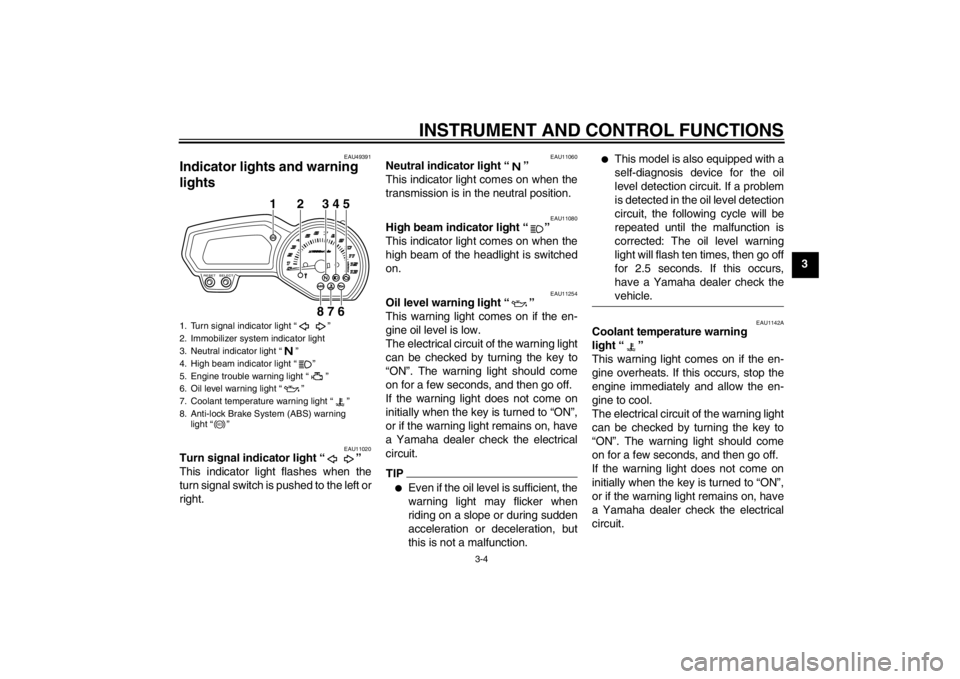
Indicator lights and warning
lights
EAU11020
Turn signal indicator light “ ”
This indicator light flashes when the
turn signal switch is pushed to the left or
right.
EAU11060
Neutral indicator light “ ”
This indicator light comes on when the
transmission is in the neutral position.
EAU11080
High beam indicator light “ ”
This indicator light comes on when the
high beam of the headlight is switched
on.
EAU11254
Oil level warning light “ ”
This warning light comes on if the en-
gine oil level is low.
The electrical circuit of the warning light
can be checked by turning the key to
“ON”. The warning light should come
on for a few seconds, and then go off.
If the warning light does not come on
initially when the key is turned to “ON”,
or if the warning light remains on, have
a Yamaha dealer check the electrical
circuit.TIP●
Even if the oil level is sufficient, the
warning light may flicker when
riding on a slope or during sudden
acceleration or deceleration, but
this is not a malfunction.
●
This model is also equipped with a
self-diagnosis device for the oil
level detection circuit. If a problem
is detected in the oil level detection
circuit, the following cycle will be
repeated until the malfunction is
corrected: The oil level warning
light will flash ten times, then go off
for 2.5 seconds. If this occurs,
have a Yamaha dealer check the
vehicle.
EAU1142A
Coolant temperature warning
light “ ”
This warning light comes on if the en-
gine overheats. If this occurs, stop the
engine immediately and allow the en-
gine to cool.
The electrical circuit of the warning light
can be checked by turning the key to
“ON”. The warning light should come
on for a few seconds, and then go off.
If the warning light does not come on
initially when the key is turned to “ON”,
or if the warning light remains on, have
a Yamaha dealer check the electrical
circuit.
1. Turn signal indicator light “ ”
2. Immobilizer system indicator light
3. Neutral indicator light “ ”
4. High beam indicator light “ ”
5. Engine trouble warning light “ ”
6. Oil level warning light “ ”
7. Coolant temperature warning light “ ”
8. Anti-lock Brake System (ABS) warning light “ ”
1 2 345
76
8
ABS
U1PWEAE0.book Page 4 Tuesda y, February 7, 2012 4:21 PM
Page 22 of 102
INSTRUMENT AND CONTROL FUNCTIONS
3-7
3
EAU11534
Engine trouble warning light “ ”
This warning light comes on or flashes
if a problem is detected in the electrical
circuit monitoring the engine. If this oc-
curs, have a Yamaha dealer check the
self-diagnosis system. (See page 3-10
for an explanation of the self-diagnosis
device.)
The electrical circuit of the warning light
can be checked by turning the key to
“ON”. The warning light should come
on for a few seconds, and then go off.
If the warning light does not come on
initially when the key is turned to “ON”,
or if the warning light remains on, have
a Yamaha dealer check the electrical
circuit.
EAU39502
ABS warning light “ ”
If this warning light comes on or flashes
while riding, the ABS may not work cor-
rectly. If this occurs, have a Yamaha
dealer check the system as soon as
possible. (See page 3-15.)
WARNING
EWA10081
If the ABS warning light comes on or
flashes while riding, the brake sys-
tem reverts to conventional braking.
Therefore, be careful not to cause
the wheels to lock during emergen-
cy braking. If the warning light
comes on or flashes while riding,
have a Yamaha dealer check the
brake system as soon as possible.The electrical circuit of the warning light
can be checked by turning the key to
“ON”. The warning light should come
on for a few seconds, and then go off.
If the warning light does not come on
initially when the key is turned to “ON”,
or if the warning light remains on, have
a Yamaha dealer check the electrical
circuit.
EAU38624
Immobilizer system indicator light
The electrical circuit of the indicator
light can be checked by turning the key
to “ON”. The indicator light should
come on for a few seconds, and then
go off.If the indicator light does not come on
initially when the key is turned to “ON”,
or if the indicator light remains on, have
a Yamaha dealer check the electrical
circuit.
When the key is turned to “OFF” and 30
seconds have passed, the indicator
light will start flashing indicating the im-
mobilizer system is enabled. After 24
hours have passed, the indicator light
will stop flashing, however the immobi-
lizer system is still enabled.
The self-diagnosis device also detects
problems in the immobilizer system cir-
cuits. (See page 3-10 for an explana-
tion of the self-diagnosis device.)
ABS
U1PWEAE0.book Page 7 Tuesda
y, February 7, 2012 4:21 PM
Page 30 of 102
INSTRUMENT AND CONTROL FUNCTIONS
3-15
3
EAU39533
ABS The Yamaha ABS (Anti-lock Brake
System) features a dual electronic con-
trol system, which acts on the front and
rear brakes independently. The ABS is
monitored by an ECU, which will have
recourse to manual braking if a mal-
function occurs.
WARNING
EWA10090
●
The ABS performs best on long
braking distances.
●
On certain (rough or gravel)
roads, the braking distance may
be longer with than without the
ABS. Therefore, always keep a
sufficient distance to the vehicle
ahead to match the riding
speed.
TIP●
The ABS performs a self-diagno-
sis test for a few seconds each
time the vehicle first starts off after
the key was turned to “ON”. During
this test, a “clicking” noise can be
heard from under the seat, and if
the brake lever or brake pedal areeven slightly applied, a vibration
can be felt at the lever and pedal,
but these do not indicate a mal-
function.
●
When the ABS is activated, the
brakes are operated in the usual
way. A pulsating action may be felt
at the brake lever or brake pedal,
but this does not indicate a mal-
function.
●
This ABS has a test mode which
allows the owner to experience the
pulsating at the brake lever or
brake pedal when the ABS is oper-
ating. However, special tools are
required, so please consult your
Yamaha dealer when performing
this test.
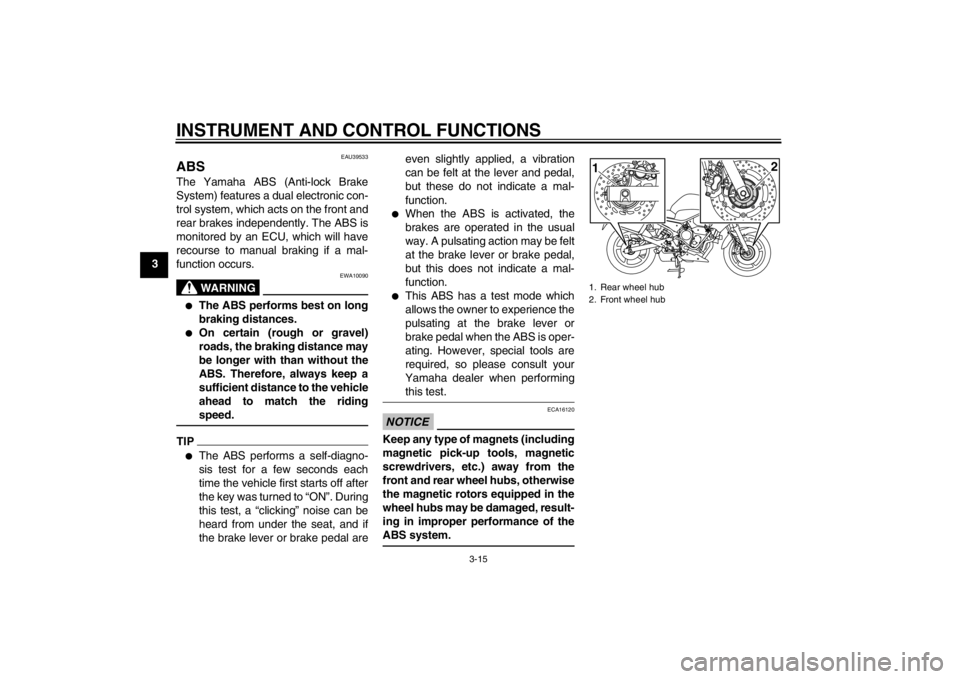
NOTICE
ECA16120
Keep any type of magnets (including
magnetic pick-up tools, magnetic
screwdrivers, etc.) away from the
front and rear wheel hubs, otherwise
the magnetic rotors equipped in the
wheel hubs may be damaged, result-
ing in improper performance of the
ABS system.
1. Rear wheel hub
2. Front wheel hub
2
1
U1PWEAE0.book Page 15 Tuesday, February 7, 2012 4:21 PM
Page 52 of 102

PERIODIC MAINTENANCE AND ADJUSTMENT
6-6
6
19*Front fork Check operation and for oil leak-
age. √√√√
20 *Shock absorber as-
sembly Check operation and shock ab-
sorber for oil leakage. √√√√
21 Engine oil Change.
Check oil level and vehicle for oil
leakage. √√√√√√
22 Engine oil filter car-
tridge Replace.
√√√
23 *Cooling system Check coolant level and vehicle
for coolant leakage. √√√√√
Change with ethylene glycol anti- freeze coolant. Every 3 years
24 *Front and rear brake
switches Check operation.
√√√√√√
25 Moving parts and
cables
Lubricate.
√√√√√
26 *Throttle grip Check operation.
Check throttle grip free play, and
adjust if necessary.
Lubricate cable and grip housing. √√√√√
27 *Lights, signals and
switches Check operation.
Adjust headlight beam.
√√√√√√
NO. ITEM CHECK OR MAINTENANCE JOB
ODOMETER READING
ANNUAL
CHECK
1000 km
(600 mi) 10000 km
(6000 mi) 20000 km
(12000 mi) 30000 km
(18000 mi) 40000 km
(24000 mi)U1PWEAE0.book Page 6 Tuesda y, February 7, 2012 4:21 PM
Page 71 of 102
PERIODIC MAINTENANCE AND ADJUSTMENT
6-25
6
EAU36503
Brake light switches The brake light, which is activated by
the brake pedal and brake lever, should
come on just before braking takes ef-
fect. If necessary, have a Yamaha deal-
er adjust the brake light switches.
EAU22392
Checking the front and rear
brake pads The front and rear brake pads must be
checked for wear at the intervals spec-
ified in the periodic maintenance and
lubrication chart.
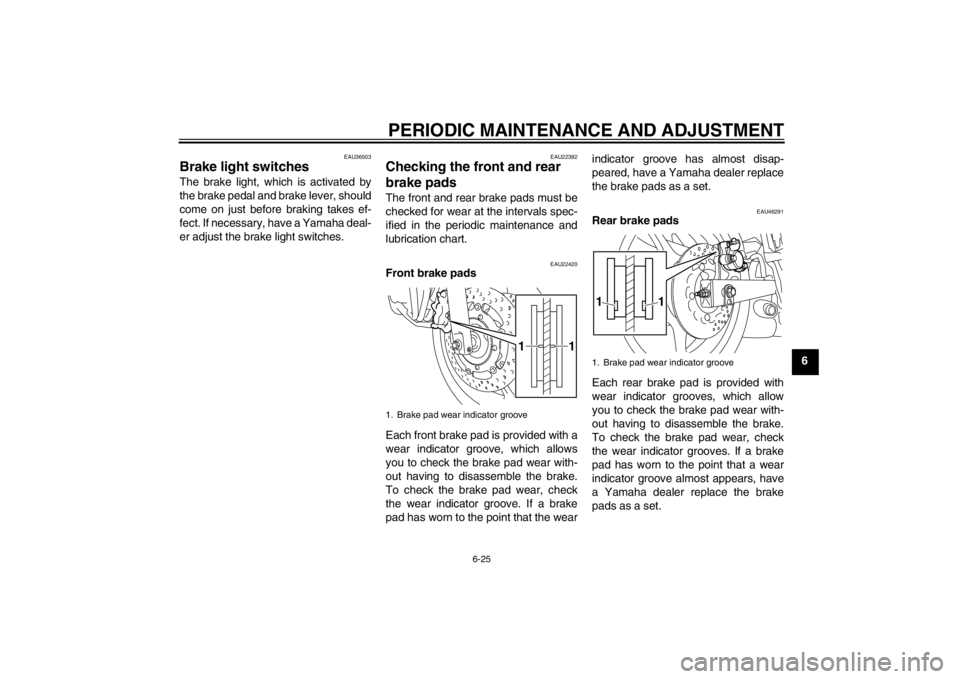
EAU22420
Front brake pads
Each front brake pad is provided with a
wear indicator groove, which allows
you to check the brake pad wear with-
out having to disassemble the brake.
To check the brake pad wear, check
the wear indicator groove. If a brake
pad has worn to the point that the wearindicator groove has almost disap-
peared, have a Yamaha dealer replace
the brake pads as a set.
EAU46291
Rear brake pads
Each rear brake pad is provided with
wear indicator grooves, which allow
you to check the brake pad wear with-
out having to disassemble the brake.
To check the brake pad wear, check
the wear indicator grooves. If a brake
pad has worn to the point that a wear
indicator groove almost appears, have
a Yamaha dealer replace the brake
pads as a set.
1. Brake pad wear indicator groove
11
1. Brake pad wear indicator groove1
1
U1PWEAE0.book Page 25 Tuesday, February 7, 2012 4:21 PM
Page 84 of 102
PERIODIC MAINTENANCE AND ADJUSTMENT
6-38
6
EAU47021
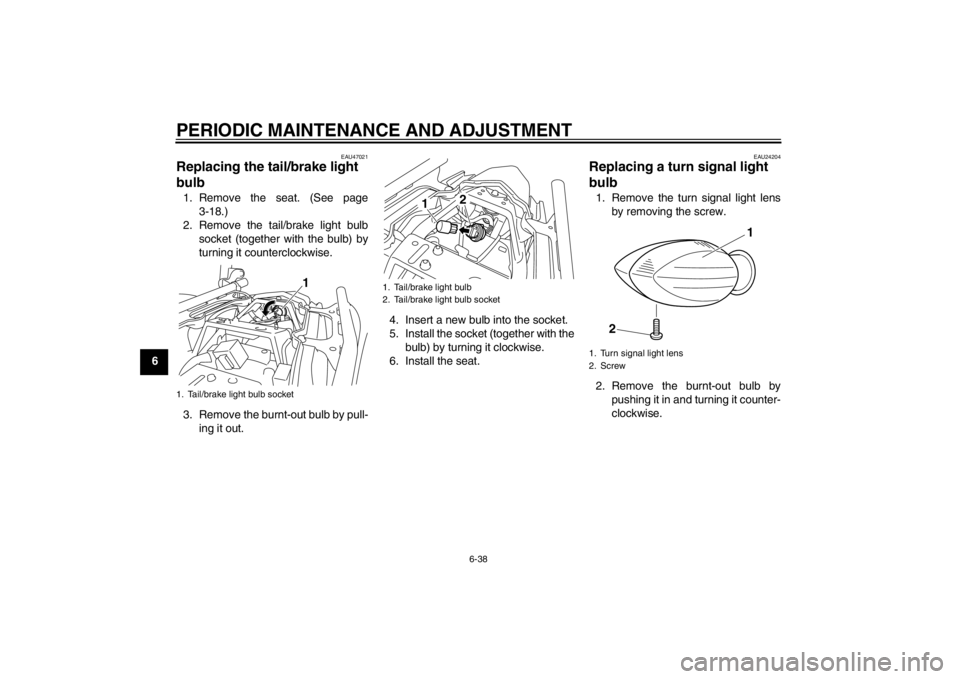
Replacing the tail/brake light
bulb 1. Remove the seat. (See page3-18.)
2. Remove the tail/brake light bulb socket (together with the bulb) by
turning it counterclockwise.
3. Remove the burnt-out bulb by pull- ing it out. 4. Insert a new bulb into the socket.
5. Install the socket (together with the
bulb) by turning it clockwise.
6. Install the seat.
EAU24204
Replacing a turn signal light
bulb 1. Remove the turn signal light lens by removing the screw.
2. Remove the burnt-out bulb by pushing it in and turning it counter-
clockwise.
1. Tail/brake light bulb socket
1
1. Tail/brake light bulb
2. Tail/brake light bulb socket
2
1
1. Turn signal light lens
2. Screw
1
2
U1PWEAE0.book Page 38 Tuesday, February 7, 2012 4:21 PM
Page 91 of 102

MOTORCYCLE CARE AND STORAGE
7-2
7
off any detergent residue using
plenty of water, as it is harmful
to plastic parts.
●
Do not use any harsh chemical
products on plastic parts. Be
sure to avoid using cloths or
sponges which have been in
contact with strong or abrasive
cleaning products, solvent or
thinner, fuel (gasoline), rust re-
movers or inhibitors, brake flu-
id, antifreeze or electrolyte.
●
Do not use high-pressure wash-
ers or steam-jet cleaners since
they cause water seepage and
deterioration in the following ar-
eas: seals (of wheel and swing-
arm bearings, fork and brakes),
electric components (couplers,
connectors, instruments,
switches and lights), breather
hoses and vents.
●
For motorcycles equipped with
a windshield: Do not use strong
cleaners or hard sponges as
they will cause dulling or
scratching. Some cleaning com-
pounds for plastic may leave
scratches on the windshield. Test the product on a small hid-
den part of the windshield to
make sure that it does not leave
any marks. If the windshield is
scratched, use a quality plastic
polishing compound after
washing.
After normal useRemove dirt with warm water, a mild
detergent, and a soft, clean sponge,
and then rinse thoroughly with clean
water. Use a toothbrush or bottlebrush
for hard-to-reach areas. Stubborn dirt
and insects will come off more easily if
the area is covered with a wet cloth for
a few minutes before cleaning.
After riding in the rain, near the sea oron salt-sprayed roadsSince sea salt or salt sprayed on roads
during winter are extremely corrosive in
combination with water, carry out the
following steps after each ride in the
rain, near the sea or on salt-sprayed
roads.
TIPSalt sprayed on roads in the winter may
remain well into spring.1. Clean the motorcycle with cold wa-
ter and a mild detergent, after the
engine has cooled down.
NOTICE: Do not use warm water
since it increases the corrosive
action of the salt.
[ECA10791]
2. Apply a corrosion protection spray on all metal, including chrome- and
nickel-plated, surfaces to prevent
corrosion.
After cleaning 1. Dry the motorcycle with a chamois or an absorbing cloth.
2. Immediately dry the drive chain and lubricate it to prevent it from
rusting.
3. Use a chrome polish to shine chrome, aluminum and stainless-
steel parts, including the exhaust
system. (Even the thermally in-
duced discoloring of stainless-
steel exhaust systems can be re-
moved through polishing.)
U1PWEAE0.book Page 2 Tuesda y, February 7, 2012 4:21 PM
Page 92 of 102

MOTORCYCLE CARE AND STORAGE
7-3
74. To prevent corrosion, it is recom-
mended to apply a corrosion pro-
tection spray on all metal,
including chrome- and nickel-plat-
ed, surfaces.
5. Use spray oil as a universal clean- er to remove any remaining dirt.
6. Touch up minor paint damage caused by stones, etc.
7. Wax all painted surfaces.
8. Let the motorcycle dry completely before storing or covering it.
WARNING
EWA11131
Contaminants on the brakes or tires
can cause loss of control.●
Make sure that there is no oil or
wax on the brakes or tires.
●
If necessary, clean the brake
discs and brake linings with a
regular brake disc cleaner or ac-
etone, and wash the tires with
warm water and a mild deter-
gent. Before riding at higher
speeds, test the motorcycle’s
braking performance and cor-
nering behavior.
NOTICE
ECA10800
●
Apply spray oil and wax spar-
ingly and make sure to wipe off
any excess.
●
Never apply oil or wax to any
rubber and plastic parts, but
treat them with a suitable care
product.
●
Avoid using abrasive polishing
compounds as they will wear
away the paint.
TIP●
Consult a Yamaha dealer for ad-
vice on what products to use.
●
Washing, rainy weather or humid
climates can cause the headlight
lens to fog. Turning the headlight
on for a short period of time will
help remove the moisture from the
lens.
EAU26182
Storage Short-term
Always store your motorcycle in a cool,
dry place and, if necessary, protect it
against dust with a porous cover. Be
sure the engine and the exhaust sys-
tem are cool before covering the motor-
cycle.NOTICE
ECA10810
●
Storing the motorcycle in a
poorly ventilated room or cover-
ing it with a tarp, while it is still
wet, will allow water and humid-
ity to seep in and cause rust.
●
To prevent corrosion, avoid
damp cellars, stables (because
of the presence of ammonia)
and areas where strong chemi-
cals are stored.
Long-term
Before storing your motorcycle for sev-
eral months:1. Follow all the instructions in the “Care” section of this chapter.
U1PWEAE0.book Page 3 Tuesda y, February 7, 2012 4:21 PM