engine coolant YAMAHA XJ6-S 2013 User Guide
[x] Cancel search | Manufacturer: YAMAHA, Model Year: 2013, Model line: XJ6-S, Model: YAMAHA XJ6-S 2013Pages: 102, PDF Size: 2.7 MB
Page 50 of 102

PERIODIC MAINTENANCE AND ADJUSTMENT
6-6
6
19*Front fork Check operation and for oil leak-
age. √√√√
20 *Shock absorber as-
sembly Check operation and shock ab-
sorber for oil leakage. √√√√
21 Engine oil Change.
Check oil level and vehicle for oil
leakage. √√√√√√
22 Engine oil filter car-
tridge Replace.
√√√
23 *Cooling system Check coolant level and vehicle
for coolant leakage. √√√√√
Change coolant. Every 3 years
24 *Front and rear brake
switches Check operation.
√√√√√√
25 Moving parts and
cables
Lubricate.
√√√√√
26 *Throttle grip Check operation.
Check throttle grip free play, and
adjust if necessary.
Lubricate cable and grip housing. √√√√√
27 *Lights, signals and
switches Check operation.
Adjust headlight beam.
√√√√√√
NO. ITEM CHECK OR MAINTENANCE JOB
ODOMETER READING
ANNUAL
CHECK
1000 km
(600 mi) 10000 km
(6000 mi) 20000 km
(12000 mi) 30000 km
(18000 mi) 40000 km
(24000 mi)U36CE3E0.book Page 6 Wednesday, May 30, 2012 11:51 AM
Page 58 of 102
PERIODIC MAINTENANCE AND ADJUSTMENT
6-14
610. Start the engine, and then let it idle
for several minutes while checking
it for oil leakage. If oil is leaking, im-
mediately turn the engine off and
check for the cause.
TIPAfter the engine is started, the engine
oil level warning light should go off if the
oil level is sufficient.NOTICE
ECA10401
If the oil level warning light flickers
or remains on even if the oil level is
correct, immediately turn the engine
off and have a Yamaha dealer check
the vehicle.11. Turn the engine off, wait a few min-utes until the oil settles, and then
check the oil level and correct it if
necessary.
12. Install the cowling.
EAU20070
Coolant The coolant level should be checked
before each ride. In addition, the cool-
ant must be changed at the intervals
specified in the periodic maintenance
and lubrication chart.
EAU47560
To check the coolant level 1. Place the vehicle on the center- stand.TIP●
The coolant level must be checked
on a cold engine since the level
varies with engine temperature.
●
Make sure that the vehicle is posi-
tioned straight up when checking
the coolant level. A slight tilt to the
side can result in a false reading.
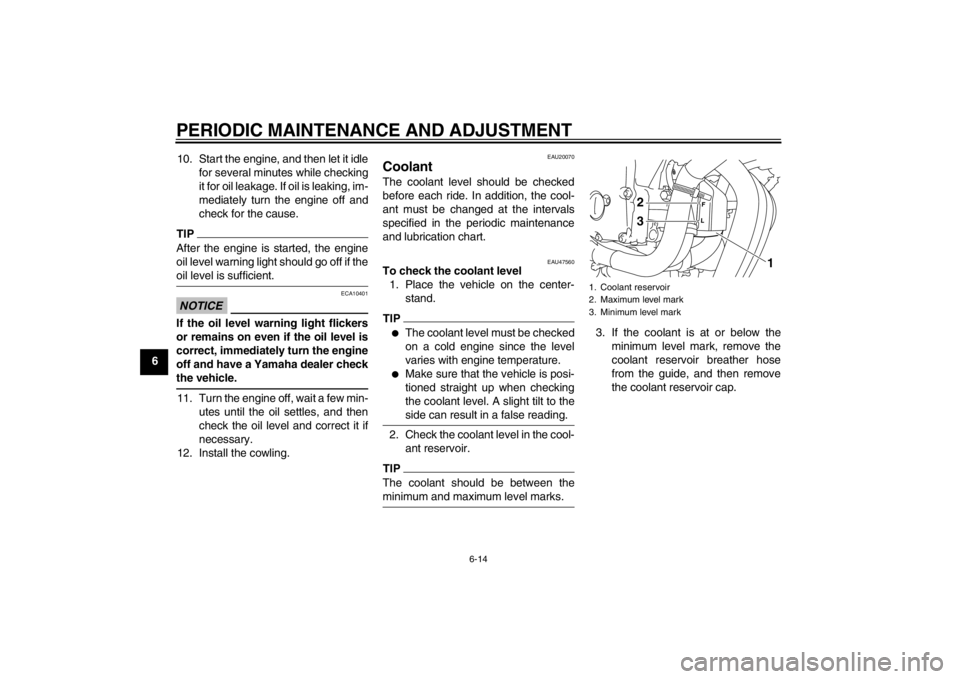
2. Check the coolant level in the cool-ant reservoir.TIPThe coolant should be between the
minimum and maximum level marks.
3. If the coolant is at or below theminimum level mark, remove the
coolant reservoir breather hose
from the guide, and then remove
the coolant reservoir cap.1. Coolant reservoir
2. Maximum level mark
3. Minimum level mark
1
2
3
U36CE3E0.book Page 14 Wednesday, May 30, 2012 11:51 AM
Page 59 of 102
PERIODIC MAINTENANCE AND ADJUSTMENT
6-15
6
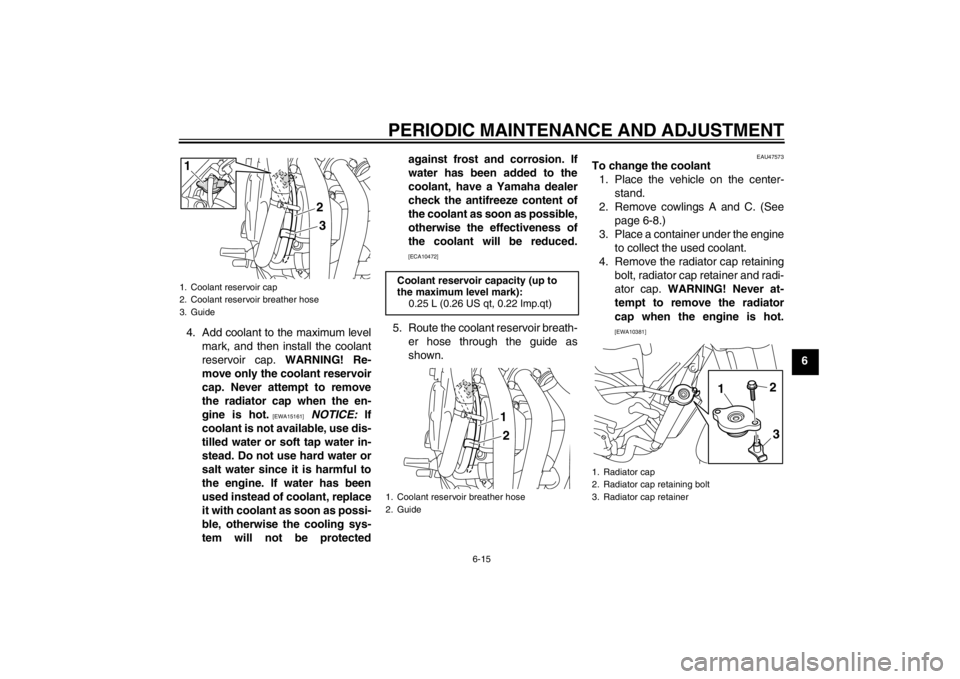
4. Add coolant to the maximum level
mark, and then install the coolant
reservoir cap. WARNING! Re-
move only the coolant reservoir
cap. Never attempt to remove
the radiator cap when the en-
gine is hot.
[EWA15161]
NOTICE: If
coolant is not available, use dis-
tilled water or soft tap water in-
stead. Do not use hard water or
salt water since it is harmful to
the engine. If water has been
used instead of coolant, replace
it with coolant as soon as possi-
ble, otherwise the cooling sys-
tem will not be protected against frost and corrosion. If
water has been added to the
coolant, have a Yamaha dealer
check the antifreeze content of
the coolant as soon as possible,
otherwise the effectiveness of
the coolant will be reduced.
[ECA10472]
5. Route the coolant reservoir breath-
er hose through the guide as
shown.
EAU47573
To change the coolant1. Place the vehicle on the center- stand.
2. Remove cowlings A and C. (See page 6-8.)
3. Place a container under the engine to collect the used coolant.
4. Remove the radiator cap retaining bolt, radiator cap retainer and radi-
ator cap. WARNING! Never at-
tempt to remove the radiator
cap when the engine is hot.
[EWA10381]
1. Coolant reservoir cap
2. Coolant reservoir breather hose
3. Guide
3
1
2
Coolant reservoir capacity (up to
the maximum level mark):0.25 L (0.26 US qt, 0.22 Imp.qt)
1. Coolant reservoir breather hose
2. Guide
2
1
1. Radiator cap
2. Radiator cap retaining bolt
3. Radiator cap retainer
2
1
3
U36CE3E0.book Page 15 Wednesday, May 30, 2012 11:51 AM
Page 61 of 102
PERIODIC MAINTENANCE AND ADJUSTMENT
6-17
6
13. Install the radiator cap.
14. Install the coolant reservoir cap.
15. Start the engine, let it idle for sev-
eral minutes, and then turn it off.
16. Remove the radiator cap to check the coolant level in the radiator. If
necessary, add sufficient coolant
until it reaches the top of the radia-
tor, and then install the radiator
cap, radiator cap retainer and radi-
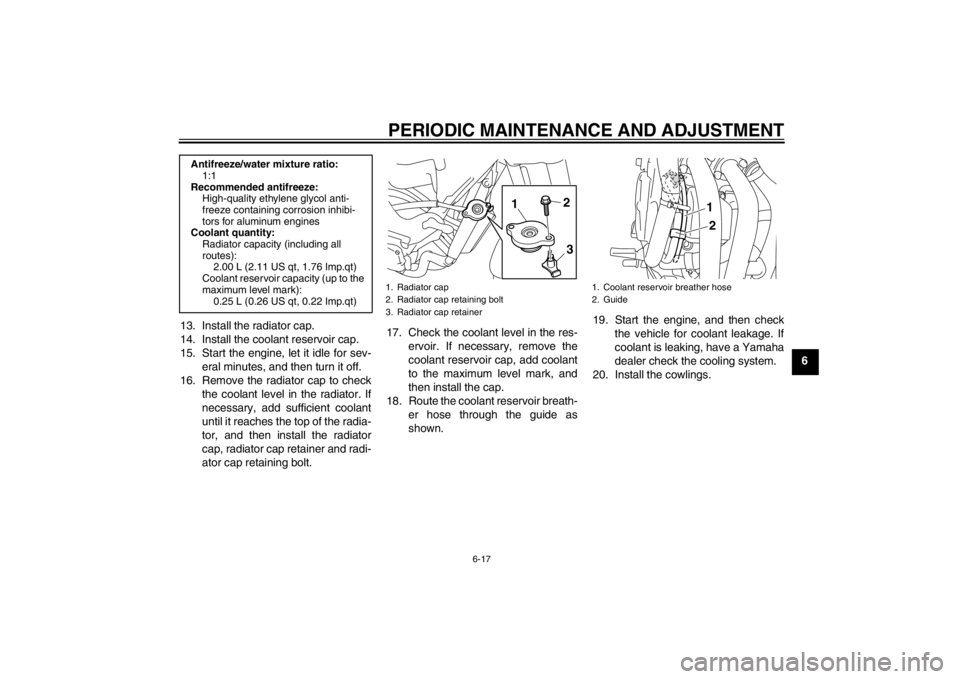
ator cap retaining bolt. 17. Check the coolant level in the res-
ervoir. If necessary, remove the
coolant reservoir cap, add coolant
to the maximum level mark, and
then install the cap.
18. Route the coolant reservoir breath- er hose through the guide as
shown. 19. Start the engine, and then check
the vehicle for coolant leakage. If
coolant is leaking, have a Yamaha
dealer check the cooling system.
20. Install the cowlings.
Antifreeze/water mixture ratio: 1:1
Recommended antifreeze: High-quality ethylene glycol anti-
freeze containing corrosion inhibi-
tors for aluminum engines
Coolant quantity:
Radiator capacity (including all
routes):2.00 L (2.11 US qt, 1.76 Imp.qt)
Coolant reservoir capacity (up to the
maximum level mark): 0.25 L (0.26 US qt, 0.22 Imp.qt)
1. Radiator cap
2. Radiator cap retaining bolt
3. Radiator cap retainer
2
1
3
1. Coolant reservoir breather hose
2. Guide
2
1
U36CE3E0.book Page 17 Wednesday, May 30, 2012 11:51 AM
Page 89 of 102
PERIODIC MAINTENANCE AND ADJUSTMENT
6-45
6
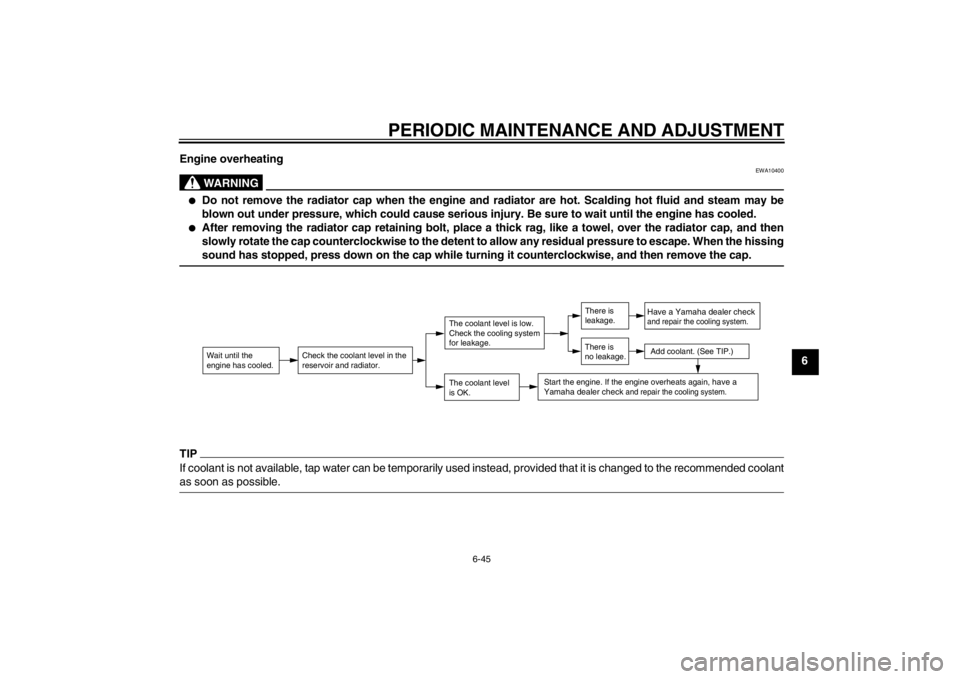
Engine overheating
WARNING
EWA10400
●
Do not remove the radiator cap when the engine and radiator are hot. Scalding hot fluid and steam may be
blown out under pressure, which could cause serious injury. Be sure to wait until the engine has cooled.
●
After removing the radiator cap retaining bolt, place a th
ick rag, like a towel, over the radiator cap, and then
slowly rotate the cap counterclockwise to the detent to allow any residual pressure to escape. When the hissing
sound has stopped, press down on the cap while turning it counterclockwise, and then remove the cap.
TIPIf coolant is not available, tap water can be temporarily used instead, provided that it is changed to the recommended coolant
as soon as possible.
Wait until the
engine has cooled.
Check the coolant level in the
reservoir and radiator.
The coolant level
is OK.The coolant level is low.
Check the cooling system
for leakage.
Have a Yamaha dealer checkand repair the cooling system.Add coolant. (See TIP.)
Start the engine. If the engine overheats again,
have a
Yamaha dealer check
and repair the cooling system.
There is
leakage.
There is
no leakage.
U36CE3E0.book Page 45 Wednesday, May 30, 2012 11:51 AM
Page 94 of 102
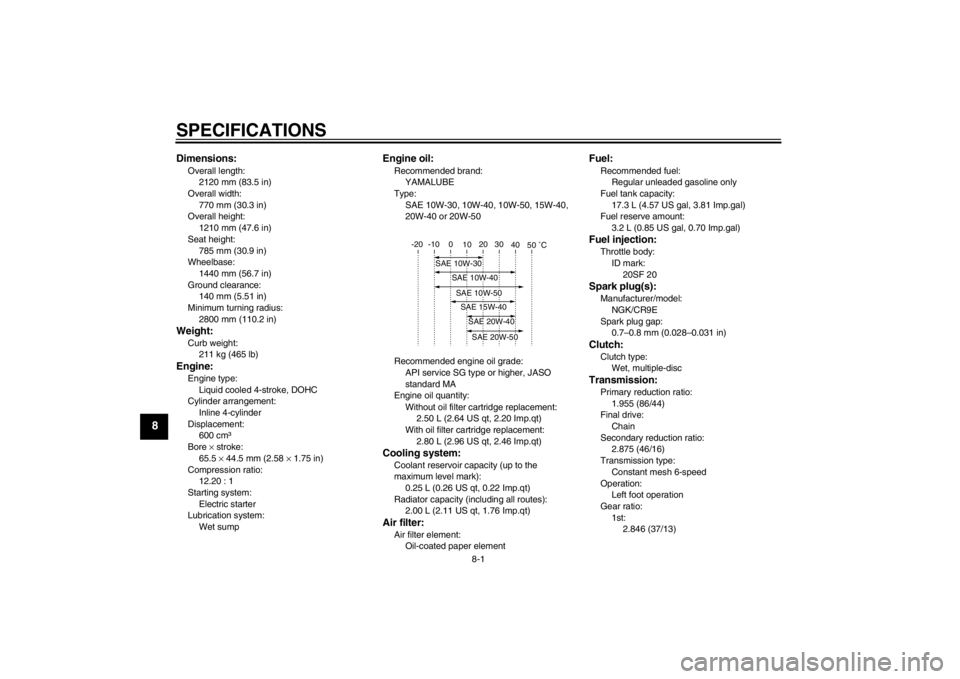
SPECIFICATIONS
8-1
8
Dimensions:Overall length:2120 mm (83.5 in)
Overall width:
770 mm (30.3 in)
Overall height: 1210 mm (47.6 in)
Seat height: 785 mm (30.9 in)
Wheelbase:
1440 mm (56.7 in)
Ground clearance: 140 mm (5.51 in)
Minimum turning radius: 2800 mm (110.2 in)Weight:Curb weight:211 kg (465 lb)Engine:Engine type:
Liquid cooled 4-stroke, DOHC
Cylinder arrangement: Inline 4-cylinder
Displacement: 600 cm³
Bore × stroke:
65.5 × 44.5 mm (2.58 × 1.75 in)
Compression ratio: 12.20 : 1
Starting system: Electric starter
Lubrication system:
Wet sump
Engine oil:Recommended brand:YAMALUBE
Type:
SAE 10W-30, 10W-40, 10W-50, 15W-40,
20W-40 or 20W-50
Recommended engine oil grade: API service SG type or higher, JASO
standard MA
Engine oil quantity:
Without oil filter cartridge replacement: 2.50 L (2.64 US qt, 2.20 Imp.qt)
With oil filter cartridge replacement:
2.80 L (2.96 US qt, 2.46 Imp.qt)Cooling system:Coolant reservoir capacity (up to the
maximum level mark):0.25 L (0.26 US qt, 0.22 Imp.qt)
Radiator capacity (including all routes): 2.00 L (2.11 US qt, 1.76 Imp.qt)Air filter:Air filter element:Oil-coated paper element
Fuel:Recommended fuel:Regular unleaded gasoline only
Fuel tank capacity:
17.3 L (4.57 US gal, 3.81 Imp.gal)
Fuel reserve amount: 3.2 L (0.85 US gal, 0.70 Imp.gal)Fuel injection:Throttle body:
ID mark: 20SF 20Spark plug(s):Manufacturer/model:NGK/CR9E
Spark plug gap: 0.7–0.8 mm (0.028–0.031 in)Clutch:Clutch type:Wet, multiple-discTransmission:Primary reduction ratio:
1.955 (86/44)
Final drive: Chain
Secondary reduction ratio: 2.875 (46/16)
Transmission type:
Constant mesh 6-speed
Operation: Left foot operation
Gear ratio: 1st: 2.846 (37/13)
-20 -10 0 10 20 30
40 50 C
SAE 10W-30
SAE 15W-40SAE 20W-40SAE 20W-50
SAE 10W-40SAE 10W-50
U36CE3E0.book Page 1 Wednesday, May 30, 2012 11:51 AM
Page 96 of 102

SPECIFICATIONS
8-3
8
Charging system:AC magnetoBattery:Model:
GT12B-4
Voltage, capacity: 12 V, 10.0 AhHeadlight:Bulb type:
Halogen bulbBulb voltage, wattage × quantity:Headlight:
12 V, 60.0 W/55.0 W × 1
Tail/brake light:
12 V, 5.0 W/21.0 W × 1
Front turn signal light: 12 V, 10.0 W × 2
Rear turn signal light: 12 V, 10.0 W × 2
Auxiliary light:
12 V, 5.0 W × 1
License plate light: 12 V, 5.0 W × 1
Meter lighting: LED
Neutral indicator light:
LED
High beam indicator light: LED
Oil level warning light: LED
Turn signal indicator light:
LED Coolant temperature warning light:
LED
Engine trouble warning light: LED
Immobilizer system indicator light:
LED
Fuses:Main fuse:30.0 A
Headlight fuse:
20.0 A
Taillight fuse: 10.0 A
Signaling system fuse: 7.5 A
Ignition fuse:
10.0 A
Radiator fan fuse: 20.0 A
Fuel injection system fuse: 10.0 A
Backup fuse:
7.5 A
U36CE3E0.book Page 3 Wednesday, May 30, 2012 11:51 AM
Page 98 of 102

INDEXAAir filter element, replacing ................... 6-18
Auxiliary light bulb ................................. 6-39BBattery................................................... 6-34
Brake and clutch levers, checking and lubricating ........................................... 6-31
Brake and shift pedals, checking and lubricating ........................................... 6-30
Brake fluid, changing ............................ 6-27
Brake fluid level, checking .................... 6-26
Brake lever ............................................ 3-13
Brake lever free play, checking ............. 6-24
Brake light switches .............................. 6-25
Brake pedal ........................................... 3-13CCables, checking and lubricating .......... 6-30
Care ........................................................ 7-1
Catalytic converter ................................ 3-16
Centerstand and sidestand, checking and lubricating .................................... 6-32
Clutch lever ........................................... 3-12
Clutch lever free play, adjusting ............ 6-23
Coolant.................................................. 6-14
Coolant temperature warning light .......... 3-4
Cowlings and panels, removing and
installing................................................ 6-8DDimmer switch ...................................... 3-11
Drive chain, cleaning and lubricating .... 6-29
Drive chain slack ................................... 6-28EEngine break-in ....................................... 5-3
Engine idling speed............................... 6-19 Engine oil and oil filter cartridge ........... 6-11
Engine stop switch................................ 3-12
Engine trouble warning light ................... 3-7
FFront and rear brake pads, checking .... 6-25
Front fork, checking .............................. 6-33
Fuel....................................................... 3-14
Fuel consumption, tips for reducing........ 5-3
Fuel tank breather hose and overflow
hose ................................................... 3-15
Fuel tank cap ........................................ 3-14
Fuses, replacing ................................... 6-35HHandlebar position, adjusting ............... 3-18
Handlebar switches .............................. 3-11
Hazard switch ....................................... 3-12
Headlight bulb, replacing ...................... 6-36
Helmet holder ....................................... 3-17
High beam indicator light ........................ 3-4
Horn switch ........................................... 3-12IIdentification numbers ............................ 9-1
Ignition circuit cut-off system ................ 3-21
Immobilizer system ................................. 3-1
Immobilizer system indicator light........... 3-7
Indicator lights and warning lights .......... 3-4LLicense plate light bulb, replacing ........ 6-39MMain switch/steering lock........................ 3-2
Maintenance and lubrication, periodic .... 6-4
Maintenance, emission control system... 6-3
Matte color, caution ................................ 7-1
Model label ............................................. 9-1 Multi-function meter unit .......................... 3-7
NNeutral indicator light .............................. 3-4OOil level warning light .............................. 3-4PParking .................................................... 5-4
Part locations .......................................... 2-1
Pass switch ........................................... 3-11RRear view mirrors .................................. 3-19SSafety information ................................... 1-1
Seat ....................................................... 3-16
Shifting .................................................... 5-2
Shift pedal ............................................. 3-13
Shock absorber assembly, adjusting .... 3-19
Sidestand .............................................. 3-20
Spark plugs, checking ........................... 6-10
Specifications .......................................... 8-1
Starting the engine .................................. 5-1
Start switch............................................ 3-12
Steering, checking................................. 6-33
Storage.................................................... 7-3
Storage compartment............................ 3-18
Swingarm pivots, lubricating ................. 6-32TTail/brake light bulb, replacing .............. 6-37
Throttle grip and cable, checking and
lubricating ........................................... 6-30
Throttle grip free play, checking ............ 6-20
Tires ...................................................... 6-20
Tool kit..................................................... 6-2
Troubleshooting .................................... 6-42
U36CE3E0.book Page 1 Wednesday, May 30, 2012 11:51 AM