clutch YAMAHA XJ600S 2000 User Guide
[x] Cancel search | Manufacturer: YAMAHA, Model Year: 2000, Model line: XJ600S, Model: YAMAHA XJ600S 2000Pages: 101, PDF Size: 19.23 MB
Page 44 of 101
R
5-4
OPERATION AND IMPORTANT RIDING POINTS
/Net/layout8/layout_G2/work/Imai_work/OM-PS/AA9156_XJ600SN-E6/English/E-5.frame
EAU01258
Starting a warm engine
The starter (choke) is not required
when the engine is warm.
EC000046
CAUTION:
See the ÒEngine break-inÓ section
prior to operating the motorcycle for
the first time.
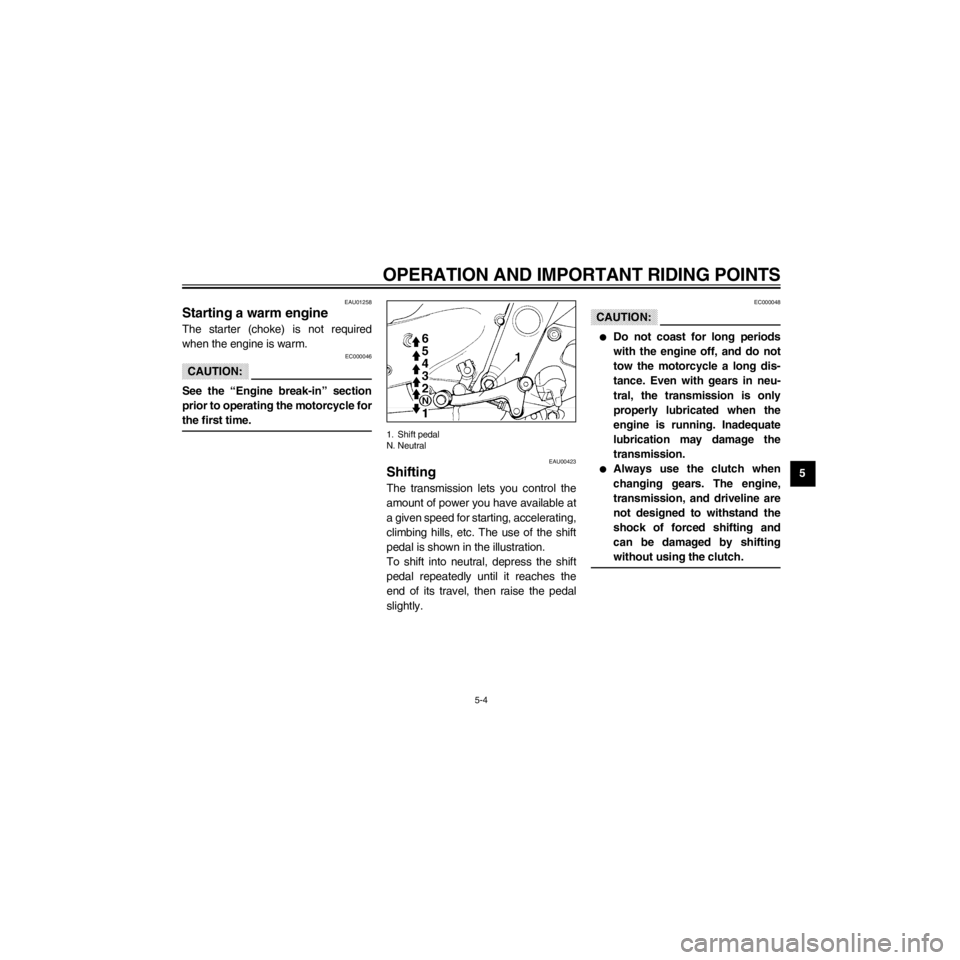
1. Shift pedal
N. Neutral
EAU00423
Shifting
The transmission lets you control the
amount of power you have available at
a given speed for starting, accelerating,
climbing hills, etc. The use of the shift
pedal is shown in the illustration.
To shift into neutral, depress the shift
pedal repeatedly until it reaches the
end of its travel, then raise the pedal
slightly.
EC000048
CAUTION:
lDo not coast for long periods
with the engine off, and do not
tow the motorcycle a long dis-
tance. Even with gears in neu-
tral, the transmission is only
properly lubricated when the
engine is running. Inadequate
lubrication may damage the
transmission.
lAlways use the clutch when
changing gears. The engine,
transmission, and driveline are
not designed to withstand the
shock of forced shifting and
can be damaged by shifting
without using the clutch.
Page 45 of 101
L
5-5
OPERATION AND IMPORTANT RIDING POINTS
/Net/layout8/layout_G2/work/Imai_work/OM-PS/AA9156_XJ600SN-E6/English/E-5.frame
EAU02937
Recommended shift points
(for Switzerland only)
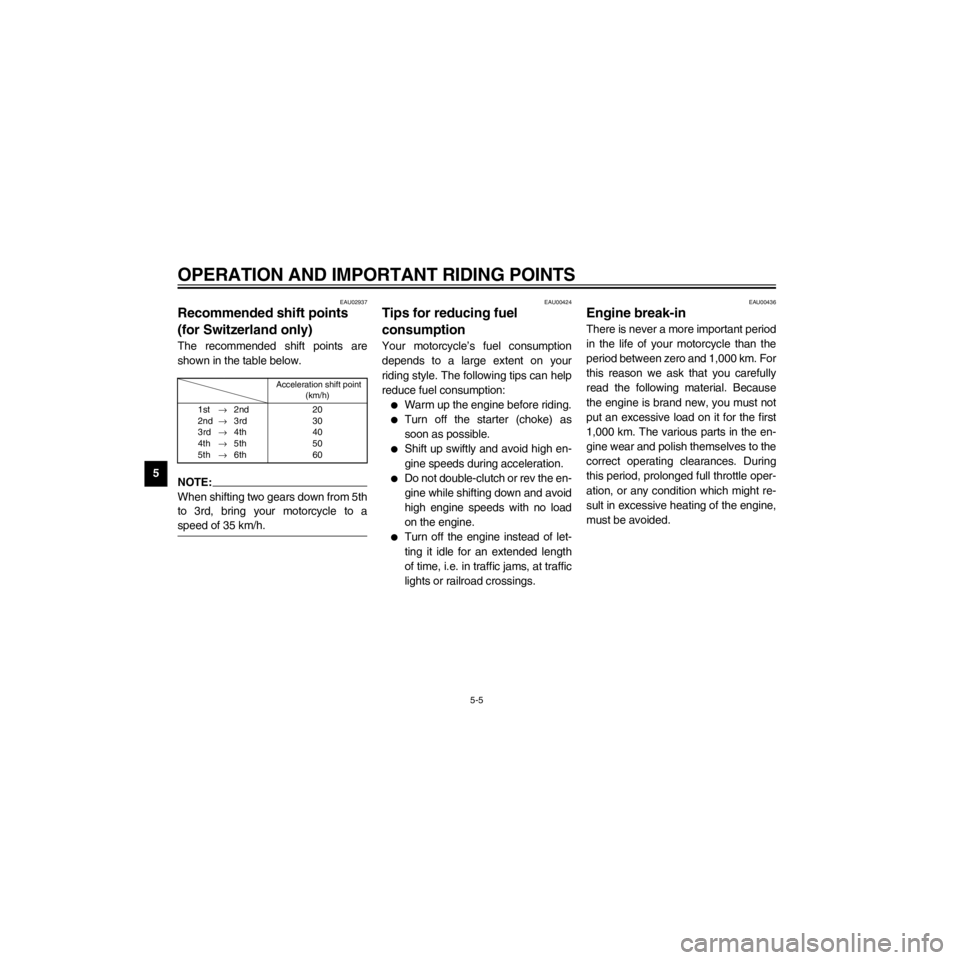
The recommended shift points are
shown in the table below.
NOTE:
When shifting two gears down from 5th
to 3rd, bring your motorcycle to a
speed of 35 km/h.
Acceleration shift point
(km/h)
1st®2nd
2nd®3rd
3rd®4th
4th®5th
5th®6th20
30
40
50
60
EAU00424
Tips for reducing fuel
consumption
Your motorcycleÕs fuel consumption
depends to a large extent on your
riding style. The following tips can help
reduce fuel consumption:
lWarm up the engine before riding.
lTurn off the starter (choke) as
soon as possible.
lShift up swiftly and avoid high en-
gine speeds during acceleration.
lDo not double-clutch or rev the en-
gine while shifting down and avoid
high engine speeds with no load
on the engine.
lTurn off the engine instead of let-
ting it idle for an extended length
of time, i.e. in traffic jams, at traffic
lights or railroad crossings.
EAU00436
Engine break-in
There is never a more important period
in the life of your motorcycle than the
period between zero and 1,000 km. For
this reason we ask that you carefully
read the following material. Because
the engine is brand new, you must not
put an excessive load on it for the first
1,000 km. The various parts in the en-
gine wear and polish themselves to the
correct operating clearances. During
this period, prolonged full throttle oper-
ation, or any condition which might re-
sult in excessive heating of the engine,
must be avoided.
Page 48 of 101
R
PERIODIC MAINTENANCE AND MINOR REPAIR
/Net/layout8/layout_G2/work/Imai_work/OM-PS/AA9156_XJ600SN-E6/English/E-6TOC.-
Tool kit ................................................................ 6-1
Periodic maintenance and lubrication................. 6-2
Panel removal and installation ........................... 6-5
Panel A ............................................................... 6-5
Spark plug inspection ......................................... 6-6
Engine oil............................................................ 6-7
Air filter ............................................................. 6-10
Carburetor adjustment ...................................... 6-11
Idle speed adjustment ...................................... 6-12
Throttle cable free play inspection .................... 6-12
Valve clearance adjustment ............................. 6-13
Tires ................................................................. 6-13
Wheels ............................................................. 6-15
Clutch lever free play adjustment ..................... 6-15
Rear brake pedal height adjustment ................ 6-17
Brake light switch adjustment ........................... 6-17
Checking the front and rear brake pads ........... 6-18
Inspecting the brake fluid level ......................... 6-19
Brake fluid replacement .................................... 6-20
Drive chain slack check .................................... 6-20
Drive chain slack adjustment ............................ 6-21Drive chain lubrication....................................... 6-21
Cable inspection and lubrication ....................... 6-22
Throttle cable and grip lubrication ..................... 6-22
Brake and shift pedal lubrication ....................... 6-22
Brake and clutch lever lubrication ..................... 6-23
Center and sidestand lubrication ...................... 6-23
Rear suspension lubrication.............................. 6-23
Front fork inspection ......................................... 6-24
Steering inspection ........................................... 6-24
Wheel bearings ................................................. 6-25
Battery............................................................... 6-25
Fuse replacement ............................................. 6-26
Headlight bulb replacement (for XJ600S) ......... 6-27
Headlight bulb replacement (for XJ600N) ......... 6-29
Front wheel removal ......................................... 6-31
Front wheel installation ..................................... 6-31
Rear wheel removal .......................................... 6-33
Rear wheel installation ...................................... 6-34
Troubleshooting ................................................ 6-34
Troubleshooting chart ....................................... 6-35
Page 50 of 101

R
6-2
PERIODIC MAINTENANCE AND MINOR REPAIR
/Net/layout8/layout_G2/work/Imai_work/OM-PS/AA9156_XJ600SN-E6/English/E-6.frame
EAU00473
PERIODIC MAINTENANCE AND LUBRICATION
NO. ITEM CHECKS AND MAINTENANCE JOBSINITIAL
(1,000 km)EVERY
6,000 km
or
6 months
(whichever
comes first)12,000 km
or
12 months
(whichever
comes first)
1
*Fuel line ¥ Check fuel hoses and vacuum hose for cracks or damage.
¥ Replace if necessary.ÖÖ
2
*Fuel filter¥ Check condition.
¥ Replace if necessary.Ö
3 Spark plugs¥ Check condition.
¥ Clean, regap or replace if necessary.ÖÖÖ
4
*Valves¥ Check valve clearance.
¥ Adjust if necessary.Every 24,000 km or 24 months
(whichever comes first)
5 Air filter¥ Clean or replace if necessary.ÖÖ
6Clutch¥ Check operation.
¥ Adjust or replace cable.ÖÖÖ
7
*Front brake¥ Check operation, fluid level and vehicle for fluid leakage. (See NOTE
on page 6-4.)
¥ Correct accordingly.
¥ Replace brake pads if necessary.ÖÖÖ
8
*Rear brake¥ Check operation, fluid level and vehicle for fluid leakage. (See NOTE
on page 6-4.)
¥ Correct accordingly.
¥ Replace brake pads if necessary.ÖÖÖ
9
*Wheels¥ Check balance, runout and for damage.
¥ Rebalance or replace if necessary.ÖÖ
10
*Tires¥ Check tread depth and for damage.
¥ Replace if necessary.
¥ Check air pressure.
¥ Correct if necessary.ÖÖ
Page 57 of 101

L
6-9
PERIODIC MAINTENANCE AND MINOR REPAIR
/Net/layout8/layout_G2/work/Imai_work/OM-PS/AA9156_XJ600SN-E6/English/E-6.frame
1. Torque wrench
7. Install the new oil filter and tighten
it to the specified torque with an oil
filter wrench.
NOTE:
When installing the oil filter, tighten it to
the proper torque by using a torque
wrench.
Tightening torque:
Oil filter:
17 Nm (1.7 mákg)
8. Fill the engine with sufficient oil to
reach the specified level. Install
the oil filler cap and tighten it.
EC000066
CAUTION:
lDo not put in any chemical addi-
tives. Engine oil also lubricates
the clutch and additives could
cause clutch slippage.
lBe sure no foreign material en-
ters the crankcase. Recommended oil:
See page 8-1.
Oil quantity:
Total amount:
3.1 L
Periodic oil change:
2.3 L
With oil filter replacement:
2.6 L
9. Start the engine and warm it up for
several minutes. While warming
up, check for oil leakage. If oil
leakage is found, stop the engine
immediately and check for the
cause.
NOTE:
After the engine is started, the oil level
indicator light should go off if the oil is at
the specified level.
EC000067
CAUTION:
If the indicator light flickers or re-
mains on, immediately stop the en-
gine and consult with a Yamaha
dealer.
Page 63 of 101
L
6-15
PERIODIC MAINTENANCE AND MINOR REPAIR
/Net/layout8/layout_G2/work/Imai_work/OM-PS/AA9156_XJ600SN-E6/English/E-6.frame
EAU00683
Operating the motorcycle with ex-
cessively worn tires decrease riding
stability and can lead to loss of con-
trol. Have excessively worn tires re-
placed by a Yamaha dealer
immediately. Brakes, tires, and re-
lated wheel parts replacement
should be left to a Yamaha Service
Technician.
EAU00687
Wheels
To ensure maximum performance,
long service, and safe operation, note
the following:
lAlways inspect the wheels before
a ride. Check for cracks, bends, or
warpage of the wheels. If any ab-
normal condition exists in a wheel,
consult a Yamaha dealer. Do not
attempt even small repairs to the
wheel. If a wheel is deformed or
cracked, it must be replaced.
lTires and wheels should be bal-
anced whenever either one is
changed or replaced. Failure to
have a wheel balanced can result
in poor performance, adverse han-
dling characteristics, and short-
ened tire life.
lRide at moderate speeds after
changing a tire since the tire sur-
face must first be broken in for it to
develop its optimal characteristics.
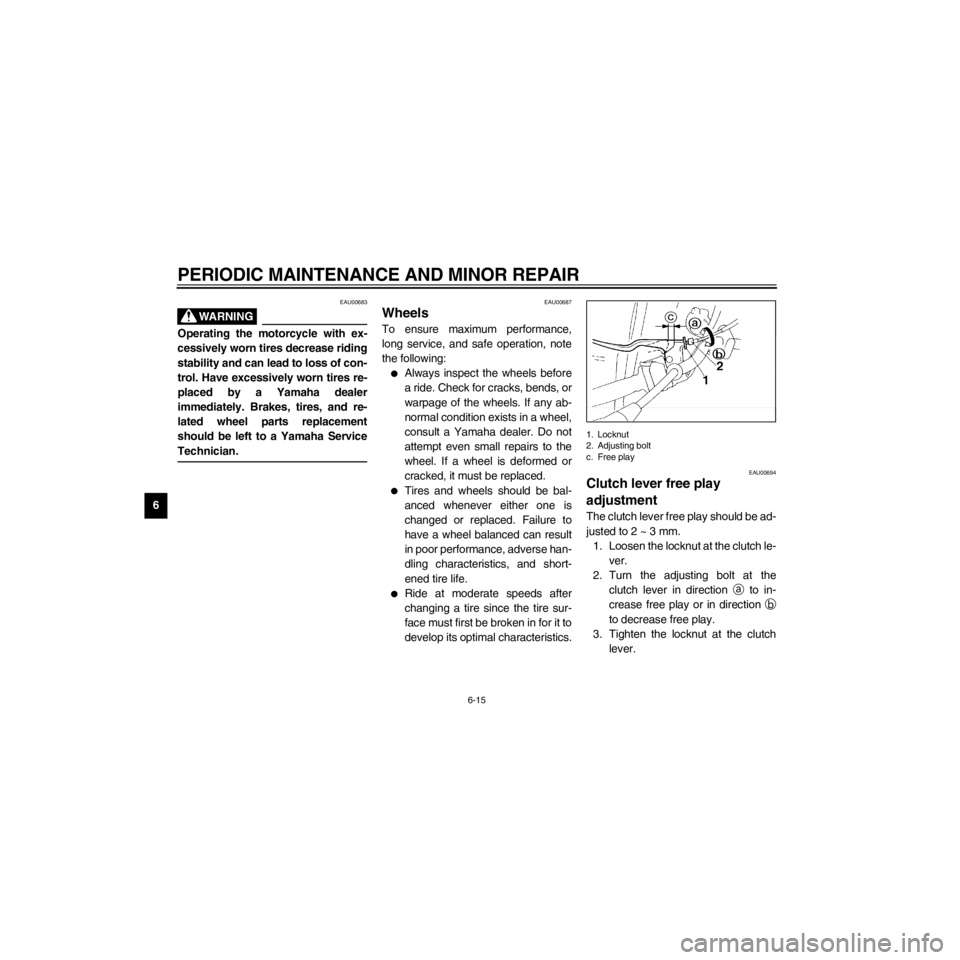
1. Locknut
2. Adjusting bolt
c. Free play
EAU00694
Clutch lever free play
adjustment
The clutch lever free play should be ad-
justed to 2 ~ 3 mm.
1. Loosen the locknut at the clutch le-
ver.
2. Turn the adjusting bolt at the
clutch lever in direction a
to in-
crease free play or in direction b
to decrease free play.
3. Tighten the locknut at the clutch
lever.
Page 64 of 101
R
6-16
PERIODIC MAINTENANCE AND MINOR REPAIR
/Net/layout8/layout_G2/work/Imai_work/OM-PS/AA9156_XJ600SN-E6/English/E-6.frame
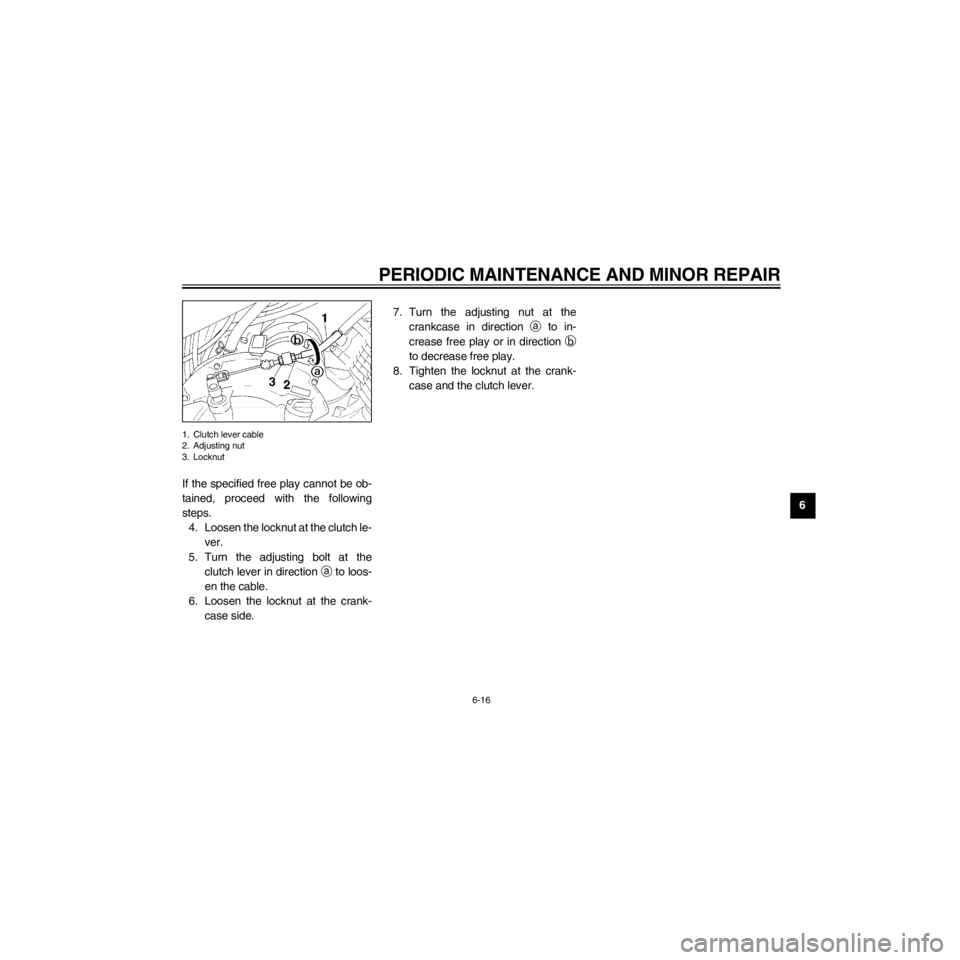
1. Clutch lever cable
2. Adjusting nut
3. Locknut
If the specified free play cannot be ob-
tained, proceed with the following
steps.
4. Loosen the locknut at the clutch le-
ver.
5. Turn the adjusting bolt at the
clutch lever in direction a
to loos-
en the cable.
6. Loosen the locknut at the crank-
case side.7. Turn the adjusting nut at the
crankcase in direction a
to in-
crease free play or in direction b
to decrease free play.
8. Tighten the locknut at the crank-
case and the clutch lever.
Page 71 of 101
L
6-23
PERIODIC MAINTENANCE AND MINOR REPAIR
/Net/layout8/layout_G2/work/Imai_work/OM-PS/AA9156_XJ600SN-E6/English/E-6.frame
EAU02985
Brake and clutch lever
lubrication
Lubricate the pivoting parts.
Recommended lubricant:
Engine oil
EAU02965
Center and sidestand
lubrication
Lubricate the pivoting and mating
joints.
Check to see that the center and side-
stand move up and down smoothly.
EW000114
If the center and/or sidestand does
not move smoothly, consult a
Yamaha dealer.Recommended lubricant:
Engine oil
EAU00790
Rear suspension lubrication
Lubricate the pivoting parts.
Recommended lubricant:
Molybdenum disulfide grease
Page 91 of 101
L
8-1
SPECIFICATIONS
/Net/layout8/layout_G2/work/Imai_work/OM-PS/AA9156_XJ600SN-E6/English/E-8.frame
Specifications
Model XJ600S / XJ600N
Dimensions
Overall length 2,170 mm
Overall width 735 mm
Overall height
XJ600S 1,205 mm
XJ600N 1,090 mm
Seat hight 770 mm
Wheelbase 1,445 mm
Ground clearance 150 mm
Minimum turning radius 2,700 mm
Basic weight (with oil and full fuel tank)
XJ600S 213 kg
XJ600N 210 kg
Engine
Engine type Air-cooled 4-stroke, DOHC
Cylinder arrangement Forward-inclined parallel
4-cyclinder
Displacement 598 cm
3
Bore´ Stroke 58.5 ´ 55.7 mm
Compression ratio 10:1
Starting system Electric starter
Lubrication system Wet sump
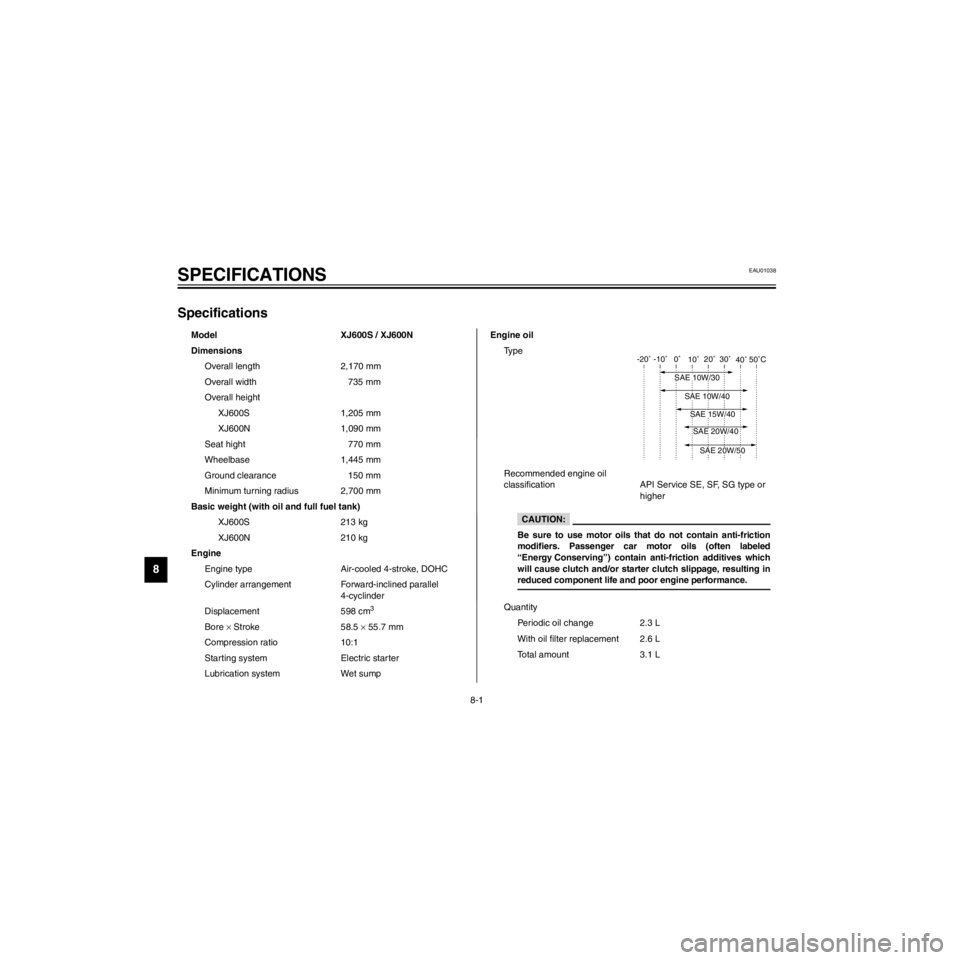
Engine oil
Ty p e
Recommended engine oil
classiÞcation API Service SE, SF, SG type or
higher
Quantity
Periodic oil change 2.3 L
With oil Þlter replacement 2.6 L
Total amount 3.1 L
-20û -10û 0û
10û20û 30û
40û50ûC
SAE 10W/30
SAE 15W/40
SAE 20W/40
SAE 20W/50
SAE 10W/40
CAUTION:
Be sure to use motor oils that do not contain anti-friction
modifiers. Passenger car motor oils (often labeled
ÒEnergy ConservingÓ) contain anti-friction additives which
will cause clutch and/or starter clutch slippage, resulting in
reduced component life and poor engine performance.
EAU01038
Page 92 of 101
R
8-2
SPECIFICATIONS
/Net/layout8/layout_G2/work/Imai_work/OM-PS/AA9156_XJ600SN-E6/English/E-8.frame
Air filterDry type element
Fuel
Type Regular unleaded gasoline
Fuel tank capacity 17.0 L
Reserve amount 3.5 L
Carburetor
Ty p e´quantity BDS28 ´ 4
Manufacturer MIKUNI
Spark plug
Type/Manufacturer CR8E / NGK
U24ESR-N / DENSO
Gap 0.7 ~ 0.8 mm
Clutch typeWet, multiple-disc
Transmission
Primary reduction system Spur gear
Primary reduction ratio 2.225
Secondary reduction system Chain drive
Secondary reduction ratio 3.000 (except for CH, A)
2.875 (for CH, A)
Number of drive chain
sprocket teeth (rear/front) 48/16 (except for CH, A)
46/16 (for CH, A)
Transmission type Constant mesh 6-speedOperation Left foot operation
Gear ratio
1st 2.733
2nd 1.778
3rd 1.333
4th 1.074
5th 0.913
6th 0.821
Chassis
Frame type Double cradle
Caster angle 25°
Tr a i l 9 7 m m
Tire
Front
Type Tubeless
Size 110 / 80-17 57H
Manufacturer/model MICHELIN / MACADAM 50
DUNLOP / D103FA
Rear
Type Tubeless
Size 130 / 70-18 63H
Manufacturer/model MICHELIN / MACADAM 50
DUNLOP / D103A