warning light YAMAHA XJ6F 2016 User Guide
[x] Cancel search | Manufacturer: YAMAHA, Model Year: 2016, Model line: XJ6F, Model: YAMAHA XJ6F 2016Pages: 104, PDF Size: 2.88 MB
Page 58 of 104
Periodic maintenance an d a djustment
6-13
6 9. Refill with the specified amount of
the recommended engine oil, and
then install and tighten the oil filler
cap.
TIP
Be sure to wipe off spilled oil on any
parts after the engine and exhaust sys-
tem have cooled down.
NOTICE
ECA11621
In or der to prevent clutch slip-
pa ge (since the en gine oil also
lu bricates the clutch), do not
mix any chemical additives. Do
not use oils with a diesel speci-
fication of “CD” or oils of a hi gh-
er quality than specifie d. In
a ddition, do not use oils la bele d
“ENERGY CONSERVING II” or
hi gher.
Make sure that no forei gn mate-
rial enters the crankcase.
10. Start the engine, and then let it idle for several minutes while checking
it for oil leakage. If oil is leaking,
immediately turn the engine off
and check for the cause.
TIP
After the engine is started, the engine
oil level warning light should go off if
the oil level is sufficient.
NOTICE
ECA10402
If the oil level warnin g li ght flickers
or remains on even if the oil level is
correct, imme diately turn the en gine
off an d have a Yamaha dealer check
the vehicle.
11. Turn the engine off, wait a few minutes until the oil settles, and
then check the oil level and cor-
rect it if necessary.
12. Install the cowling.
Recommen ded en gine oil:
See page 8-1.
Oil quantity: Oil change:
2.50 L (2.64 US qt, 2.20 Imp.qt)
With oil filter removal: 2.80 L (2.96 US qt, 2.46 Imp.qt)
UBS1E0E0.book Page 13 Thursday, October 8, 2015 3:40 PM
Page 59 of 104
Periodic maintenance an d a djustment
6-14
6
EAU20071
Coolant
The coolant level should be checked
before each ride. In addition, the cool-
ant must be changed at the intervals
specified in the periodic maintenance
and lubrication chart.
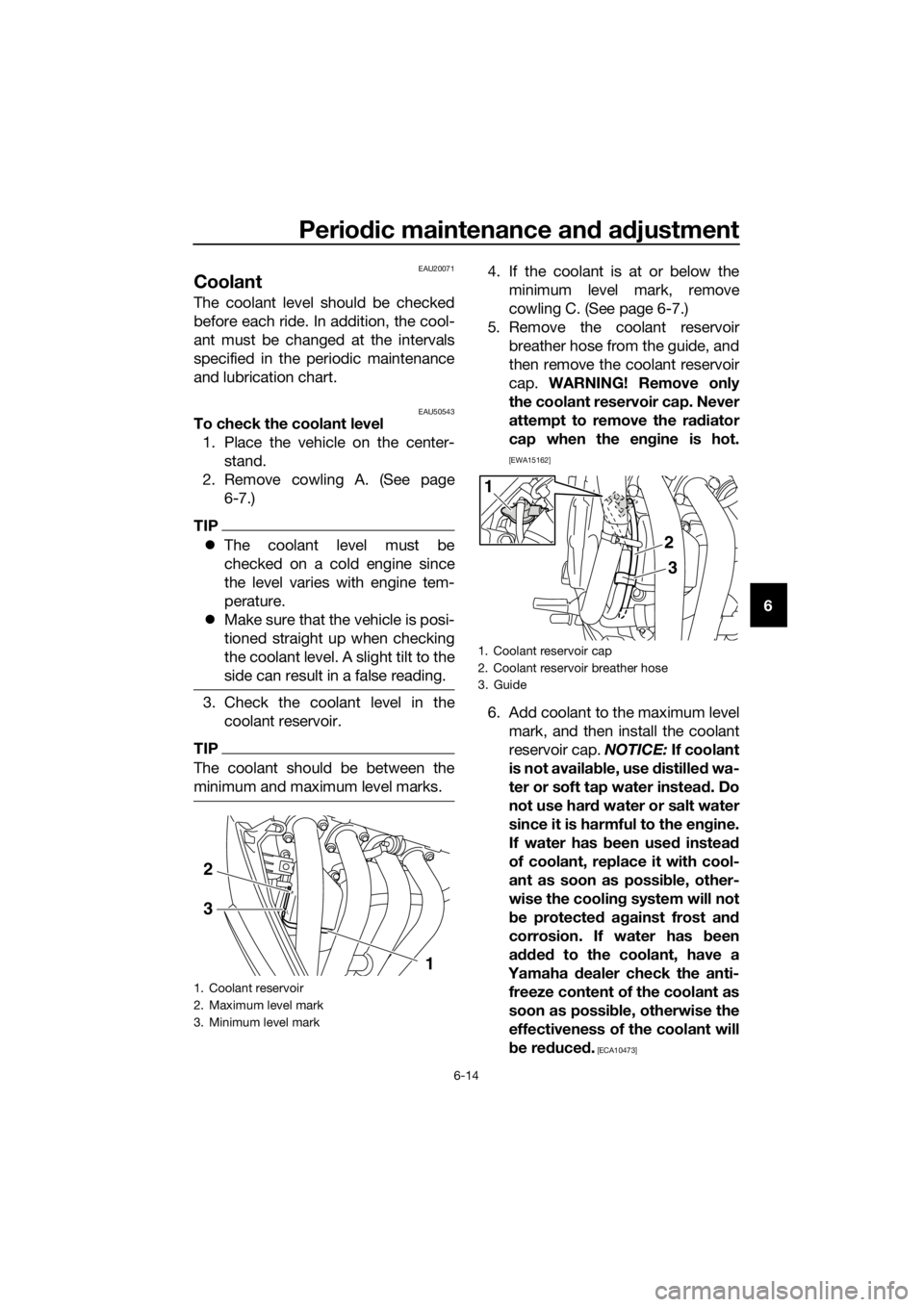
EAU50543To check the coolant level
1. Place the vehicle on the center- stand.
2. Remove cowling A. (See page 6-7.)
TIP
The coolant level must be
checked on a cold engine since
the level varies with engine tem-
perature.
Make sure that the vehicle is posi-
tioned straight up when checking
the coolant level. A slight tilt to the
side can result in a false reading.
3. Check the coolant level in the
coolant reservoir.
TIP
The coolant should be between the
minimum and maximum level marks.
4. If the coolant is at or below theminimum level mark, remove
cowling C. (See page 6-7.)
5. Remove the coolant reservoir breather hose from the guide, and
then remove the coolant reservoir
cap. WARNING! Remove only
the coolant reservoir cap. Never
attempt to remove the ra diator
cap when the en gine is hot.
[EWA15162]
6. Add coolant to the maximum level
mark, and then install the coolant
reservoir cap. NOTICE: If coolant
is not availa ble, use distille d wa-
ter or soft tap water instea d. Do
not use har d water or salt water
since it is harmful to the en gine.
If water has been used instead
of coolant, replace it with cool-
ant as soon as possi ble, other-
wise the coolin g system will not
b e protecte d a gainst frost an d
corrosion. If water has been
a dd ed to the coolant, have a
Yamaha dealer check the anti-
freeze content of the coolant as
soon as possi ble, otherwise the
effectiveness of the coolant will
b e red uced.
[ECA10473]
1. Coolant reservoir
2. Maximum level mark
3. Minimum level mark
1
2
3
1. Coolant reservoir cap
2. Coolant reservoir breather hose
3. Guide
3
1
2
UBS1E0E0.book Page 14 Thursday, October 8, 2015 3:40 PM
Page 81 of 104
Periodic maintenance an d a djustment
6-36
6
EAU47174
Replacin g the fuses
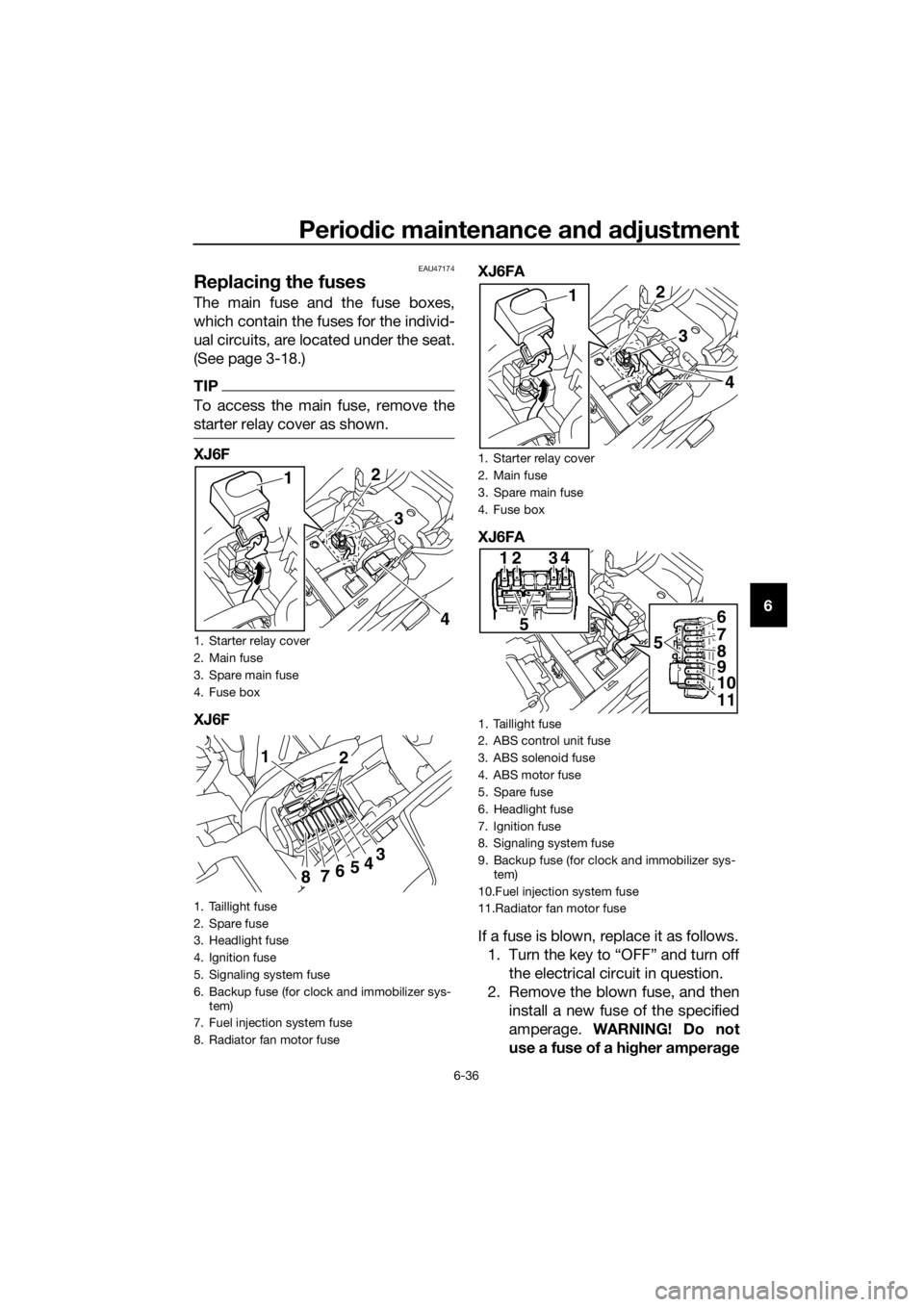
The main fuse and the fuse boxes,
which contain the fuses for the individ-
ual circuits, are located under the seat.
(See page 3-18.)
TIP
To access the main fuse, remove the
starter relay cover as shown.
XJ6F
XJ6F XJ6FA
XJ6FA
If a fuse is blown, replace it as follows.
1. Turn the key to “OFF” and turn off the electrical circuit in question.
2. Remove the blown fuse, and then install a new fuse of the specified
amperage. WARNING! Do not
use a fuse of a hi gher ampera ge
1. Starter relay cover
2. Main fuse
3. Spare main fuse
4. Fuse box
1. Taillight fuse
2. Spare fuse
3. Headlight fuse
4. Ignition fuse
5. Signaling system fuse
6. Backup fuse (for clock and immobilizer sys-
tem)
7. Fuel injection system fuse
8. Radiator fan motor fuse
2
4
3
1
1
2
3
4
5
6
7
8
1. Starter relay cover
2. Main fuse
3. Spare main fuse
4. Fuse box
1. Taillight fuse
2. ABS control unit fuse
3. ABS solenoid fuse
4. ABS motor fuse
5. Spare fuse
6. Headlight fuse
7. Ignition fuse
8. Signaling system fuse
9. Backup fuse (for clock and immobilizer sys-
tem)
10.Fuel injection system fuse
11.Radiator fan motor fuse
2
4
3
1
1
5 56
7
8
9
10
11
234
UBS1E0E0.book Page 36 Thursday, October 8, 2015 3:40 PM
Page 85 of 104
Periodic maintenance an d a djustment
6-40
6
EAU24314
Replacin g the license plate
li g ht bul b
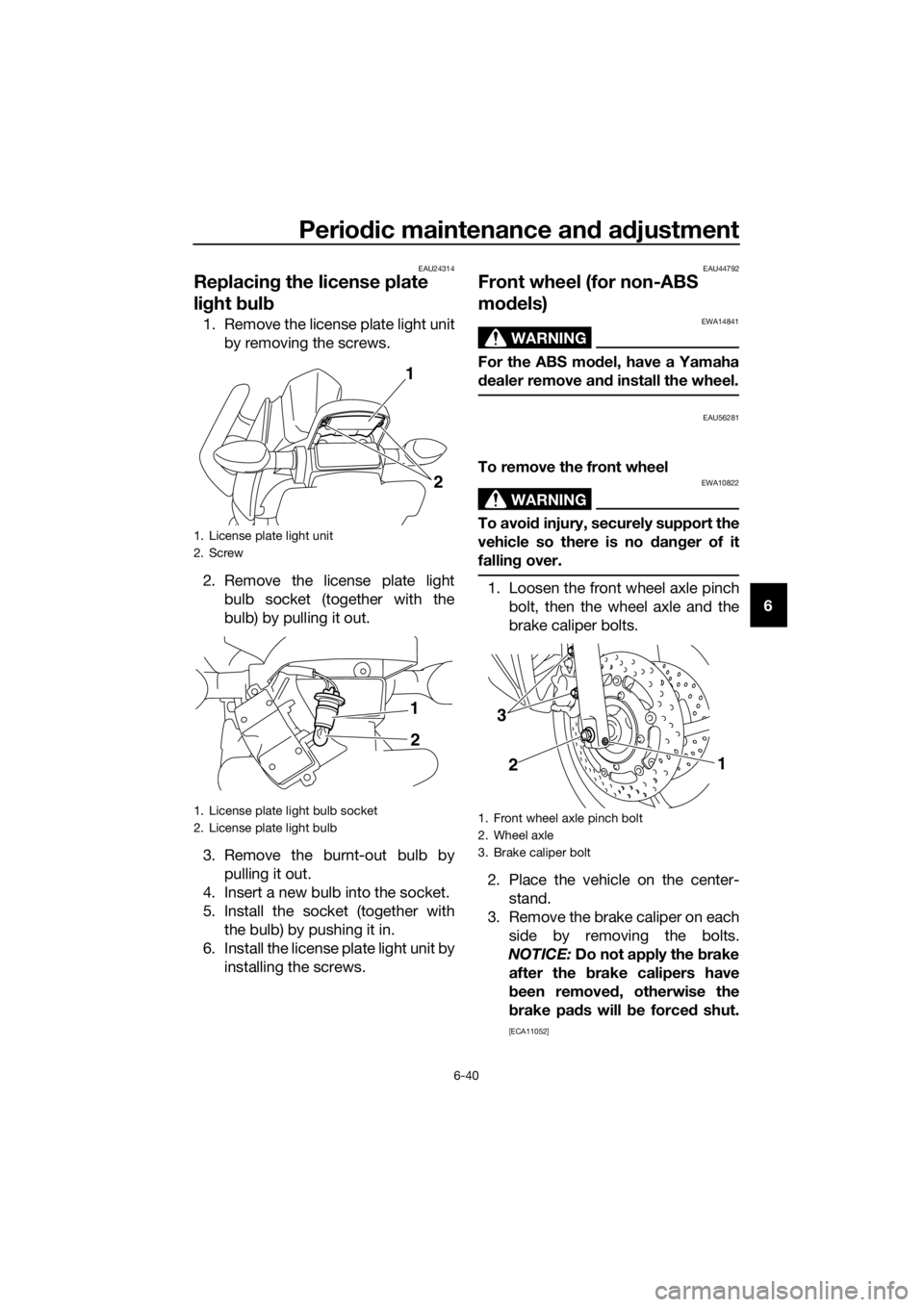
1. Remove the license plate light unit
by removing the screws.
2. Remove the license plate light bulb socket (together with the
bulb) by pulling it out.
3. Remove the burnt-out bulb by pulling it out.
4. Insert a new bulb into the socket.
5. Install the socket (together with the bulb) by pushing it in.
6. Install the license plate light unit by installing the screws.
EAU44792
Front wheel (for non-ABS
mo dels)
WARNING
EWA14841
For the ABS mo del, have a Yamaha
d ealer remove an d install the wheel.
EAU56281
To remove the front wheel
WARNING
EWA10822
To avoi d injury, securely support the
vehicle so there is no dan ger of it
fallin g over.
1. Loosen the front wheel axle pinch
bolt, then the wheel axle and the
brake caliper bolts.
2. Place the vehicle on the center- stand.
3. Remove the brake caliper on each side by removing the bolts.
NOTICE: Do not apply the brake
after the brake calipers have
b een removed , otherwise the
b rake pa ds will be forced shut.
[ECA11052]
1. License plate light unit
2. Screw
1. License plate light bulb socket
2. License plate light bulb
2
1
1
2
1. Front wheel axle pinch bolt
2. Wheel axle
3. Brake caliper bolt
2
3
1
UBS1E0E0.book Page 40 Thursday, October 8, 2015 3:40 PM
Page 87 of 104
Periodic maintenance an d a djustment
6-42
6
EAU44802
Rear wheel (for non-ABS
mo dels)
WARNING
EWA14841
For the ABS mo del, have a Yamaha
d ealer remove an d install the wheel.
EAU56672
To remove the rear wheel
WARNING
EWA10822
To avoi d injury, securely support the
vehicle so there is no d anger of it
fallin g over.
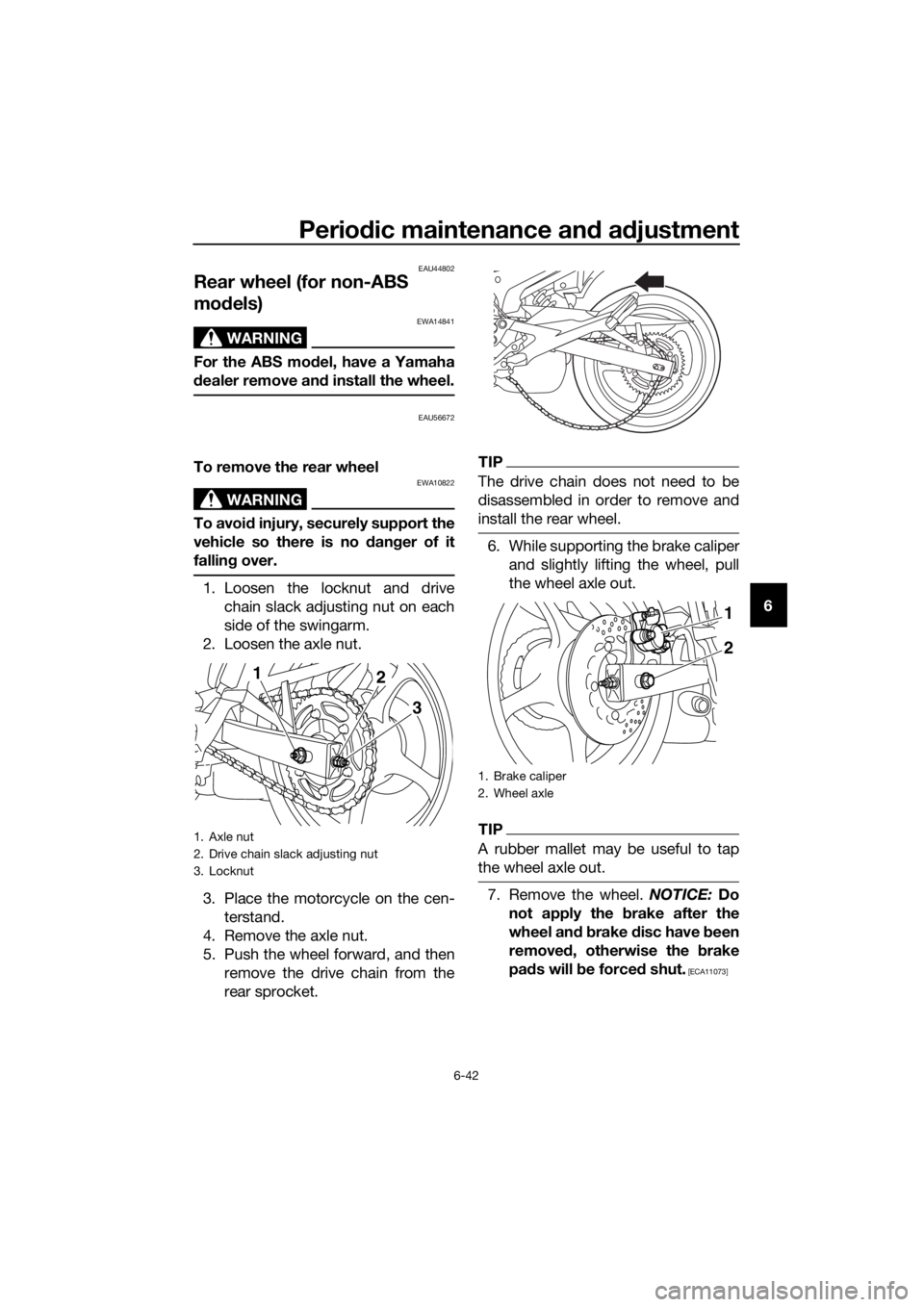
1. Loosen the locknut and drive
chain slack adjusting nut on each
side of the swingarm.
2. Loosen the axle nut.
3. Place the motorcycle on the cen- terstand.
4. Remove the axle nut.
5. Push the wheel forward, and then remove the drive chain from the
rear sprocket.
TIP
The drive chain does not need to be
disassembled in order to remove and
install the rear wheel.
6. While supporting the brake caliperand slightly lifting the wheel, pull
the wheel axle out.
TIP
A rubber mallet may be useful to tap
the wheel axle out.
7. Remove the wheel. NOTICE: Do
not apply the b rake after the
wheel an d b rake disc have been
remove d, otherwise the brake
pa ds will be forced shut.
[ECA11073]
1. Axle nut
2. Drive chain slack adjusting nut
3. Locknut
1
3
2
1. Brake caliper
2. Wheel axle
1
2
UBS1E0E0.book Page 42 Thursday, October 8, 2015 3:40 PM
Page 93 of 104
Motorcycle care and stora ge
7-3
7
2. Apply a corrosion protection spray
on all metal, including chrome-
and nickel-plated, surfaces to pre-
vent corrosion.
Cleaning the windshield
Avoid using any alkaline or strong acid
cleaner, gasoline, brake fluid, or any
other solvent. Clean the windshield
with a cloth or sponge dampened with
a mild detergent, and then wash it off
thoroughly with water. For additional
cleaning, use Yamaha Windshield
Cleaner or another high-quality wind-
shield cleaner. Some cleaning com-
pounds for plastics may leave
scratches on the windshield. Before
using such cleaners, test an area of the
windshield which does not affect your
visibility and which cannot be easily
recognized.
After cleaning 1. Dry the motorcycle with a chamois or an absorbing cloth.
2. Immediately dry the drive chain and lubricate it to prevent it from
rusting.
3. Use a chrome polish to shine chrome, aluminum and stainless-
steel parts, including the exhaust
system. (Even the thermally in-
duced discoloring of stainless-
steel exhaust systems can be re-
moved through polishing.)
4. To prevent corrosion, it is recom- mended to apply a corrosion pro-
tection spray on all metal,
including chrome- and nickel-plat-
ed, surfaces.
5. Use spray oil as a universal clean- er to remove any remaining dirt. 6. Touch up minor paint damage
caused by stones, etc.
7. Wax all painted surfaces.
8. Let the motorcycle dry completely before storing or covering it.WARNING
EWA11132
Contaminants on the b rakes or tires
can cause loss of control. Make sure that there is no oil or
wax on the brakes or tires.
If necessary, clean the brake
d iscs an d b rake linin gs with a
re gular brake disc cleaner or
acetone, an d wash the tires with
warm water an d a mil d d eter-
g ent. Before ri din g at hi gher
speed s, test the motorcycle’s
b rakin g performance an d cor-
nering b ehavior.
NOTICE
ECA10801
Apply spray oil an d wax spar-
in gly an d make sure to wipe off
any excess.
Never apply oil or wax to any
rubber an d plastic parts, b ut
treat them with a suita ble care
prod uct.
Avoi d using abrasive polishin g
compoun ds as they will wear
away the paint.
TIP
Consult a Yamaha dealer for ad-
vice on what products to use.
Washing, rainy weather or humid
climates can cause the headlight
lens to fog. Turning the headlight
UBS1E0E0.book Page 3 Thursday, October 8, 2015 3:40 PM
Page 98 of 104

Specifications
8-3
8
Battery:
Model:GT12B-4
Voltage, capacity:
12 V, 10.0 Ah (10 HR)
Hea dlig ht:
Bulb type:
Halogen bulb
Bul b watta ge × quantity:
Headlight:
H4, 60.0 W/55.0 W x 1
Brake/tail light: 21.0 W/5.0 W × 1
Front turn signal light:
10.0 W × 2
Rear turn signal light:
10.0 W × 2
Auxiliary light: 5.0 W × 1
License plate light: 5.0 W × 1
Meter lighting:
LED
Neutral indicator light: LED
High beam indicator light: LED
Oil level warning light:
LED
Turn signal indicator light: LED
Coolant temperature warning light: LED
Engine trouble warning light:
LED
ABS warning light: LED (XJ6FA)
Immobilizer system indicator light: LED
Fuse(s):
Main fuse:30.0 A
Headlight fuse: 20.0 A
Taillight fuse:
10.0 A
Signaling system fuse: 7.5 A
Ignition fuse: 10.0 A Radiator fan motor fuse:
20.0 A
Fuel injection system fuse: 10.0 A
ABS control unit fuse:
7.5 A (XJ6FA)
ABS motor fuse: 30.0 A (XJ6FA)
ABS solenoid fuse: 20.0 A (XJ6FA)
Backup fuse:
7.5 A
UBS1E0E0.book Page 3 Thursday, October 8, 2015 3:40 PM
Page 101 of 104

10-1
10
Index
A
ABS (for ABS models) .......................... 3-14
ABS warning light (for ABS models)....... 3-5
Air filter element, replacing................... 6-17
Auxiliary light bulb ................................ 6-38
B
Battery .................................................. 6-34
Brake and clutch levers, checking
and lubricating ................................... 6-31
Brake and shift pedals, checking and lubricating ................................... 6-31
Brake fluid, changing ........................... 6-27
Brake fluid level, checking ................... 6-26
Brake lever ........................................... 3-13
Brake lever free play, checking ............ 6-24
Brake light switches ............................. 6-25
Brake pedal .......................................... 3-13
Brake/tail light bulb, replacing ............. 6-39
C
Cables, checking and lubricating ......... 6-30
Care ........................................................ 7-1
Catalytic converter ............................... 3-17
Centerstand and sidestand, checking and lubricating ................................... 6-32
Clutch lever .......................................... 3-12
Clutch lever free play, adjusting ........... 6-23
Coolant ................................................. 6-14
Coolant temperature warning light ......... 3-4
Cowlings and panels, removing and installing ............................................... 6-7
D
Dimmer switch ..................................... 3-10
Drive chain, cleaning and lubricating ... 6-29
Drive chain slack .................................. 6-28
E
Engine break-in ...................................... 5-4
Engine idling speed .............................. 6-19
Engine oil and oil filter cartridge ........... 6-11
Engine serial number.............................. 9-1
Engine stop switch ............................... 3-11
Engine trouble warning light................... 3-5
F
Front and rear brake pads, checking ... 6-25
Front fork, checking ............................. 6-33
Fuel....................................................... 3-15
Fuel consumption, tips for reducing ...... 5-4
Fuel tank breather hose and overflow hose ................................................... 3-17
Fuel tank cap........................................ 3-15
Fuses, replacing ................................... 6-36
H
Handlebar position, adjusting ............... 3-20
Handlebar switches .............................. 3-10
Hazard switch ....................................... 3-11
Headlight bulb, replacing ...................... 6-37
Helmet holder ....................................... 3-19
High beam indicator light........................ 3-4
Horn switch........................................... 3-11
I
Identification numbers ............................ 9-1
Ignition circuit cut-off system ............... 3-23
Immobilizer system ................................. 3-1
Immobilizer system indicator light .......... 3-6
Indicator lights and warning lights .......... 3-4
L
License plate light bulb, replacing ........ 6-40
M
Main switch/steering lock ....................... 3-2
Maintenance and lubrication, periodic ... 6-4
Maintenance, emission control system .................................................. 6-3
Matte color, caution ................................ 7-1
Model label ............................................. 9-1
Multi-function meter unit ........................ 3-6
N
Neutral indicator light.............................. 3-4
O
Oil level warning light .............................. 3-4
P
Parking .................................................... 5-5
Part locations .......................................... 2-1
Pass switch........................................... 3-10
R
Rear view mirrors .................................. 3-21
S
Safety information................................... 1-1
Seat....................................................... 3-18
Shifting .................................................... 5-3
Shift pedal............................................. 3-12
Shock absorber assembly, adjusting ... 3-21
Sidestand .............................................. 3-22
Spark plugs, checking .......................... 6-10
Specifications ......................................... 8-1
Starting the engine.................................. 5-2
Start switch ........................................... 3-11
Steering, checking ................................ 6-33
Storage ................................................... 7-4
Storage compartment ........................... 3-20
Swingarm pivots, lubricating ................ 6-32
UBS1E0E0.book Page 1 Thursday, October 8, 2015 3:40 PM