ECU YAMAHA XJ900S 2000 Owners Manual
[x] Cancel search | Manufacturer: YAMAHA, Model Year: 2000, Model line: XJ900S, Model: YAMAHA XJ900S 2000Pages: 97, PDF Size: 2.08 MB
Page 29 of 97
INSTRUMENT AND CONTROL FUNCTIONS
3-15
3
EAU02925
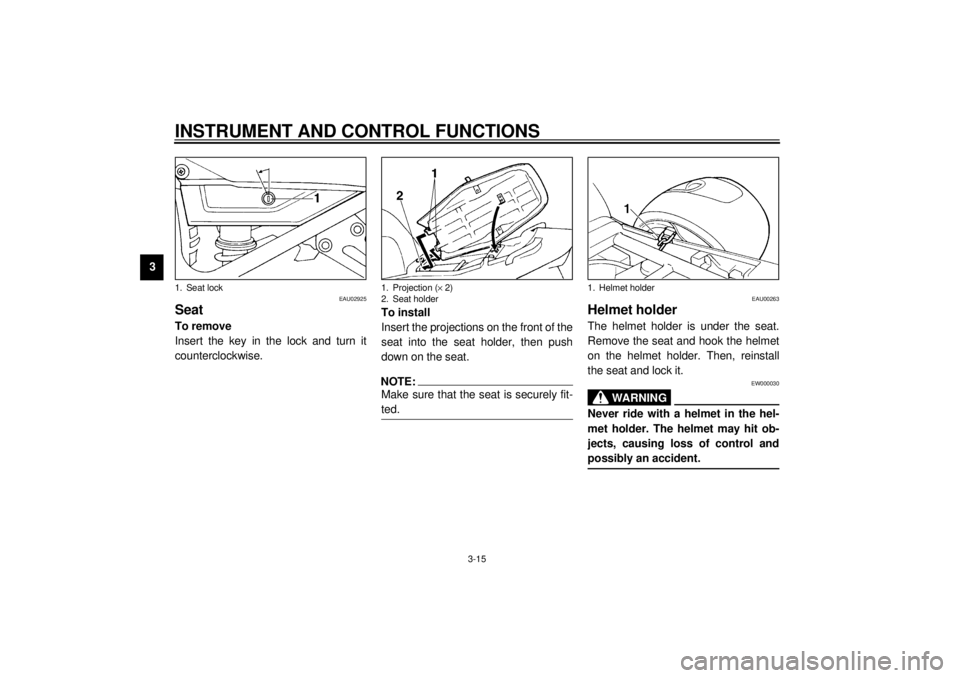
SeatTo remove
Insert the key in the lock and turn it
counterclockwise.To install
Insert the projections on the front of the
seat into the seat holder, then push
down on the seat.
NOTE:@ Make sure that the seat is securely fit-
ted. @
EAU00263
Helmet holderThe helmet holder is under the seat.
Remove the seat and hook the helmet
on the helmet holder. Then, reinstall
the seat and lock it.
EW000030
WARNING
@ Never ride with a helmet in the hel-
met holder. The helmet may hit ob-
jects, causing loss of control and
possibly an accident. @
1. Seat lock
1. Projection (´ 2)
2. Seat holder
1. Helmet holder
Page 30 of 97
INSTRUMENT AND CONTROL FUNCTIONS
3-16
3
EAU01688
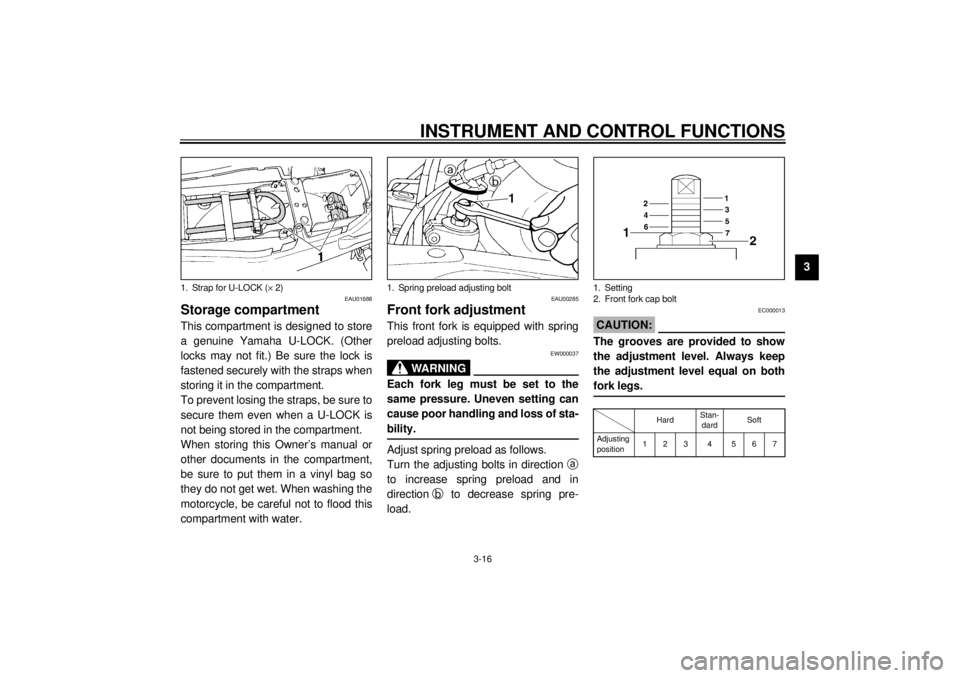
Storage compartmentThis compartment is designed to store
a genuine Yamaha U-LOCK. (Other
locks may not fit.) Be sure the lock is
fastened securely with the straps when
storing it in the compartment.
To prevent losing the straps, be sure to
secure them even when a U-LOCK is
not being stored in the compartment.
When storing this Owner’s manual or
other documents in the compartment,
be sure to put them in a vinyl bag so
they do not get wet. When washing the
motorcycle, be careful not to flood this
compartment with water.
EAU00285
Front fork adjustmentThis front fork is equipped with spring
preload adjusting bolts.
EW000037
WARNING
@ Each fork leg must be set to the
same pressure. Uneven setting can
cause poor handling and loss of sta-
bility. @Adjust spring preload as follows.
Turn the adjusting bolts in direction
a
to increase spring preload and in
direction
b to decrease spring pre-
load.
EC000013
CAUTION:@ The grooves are provided to show
the adjustment level. Always keep
the adjustment level equal on both
fork legs. @CI-18E
1. Strap for U-LOCK (´ 2)
1. Spring preload adjusting bolt
1. Setting
2. Front fork cap bolt
HardStan-
dardSoft
Adjusting
position123 4 567
Page 61 of 97
PERIODIC MAINTENANCE AND MINOR REPAIR
6-15
6
EAU00658
TiresTo ensure maximum performance,
long service and safe operation, note
the following:
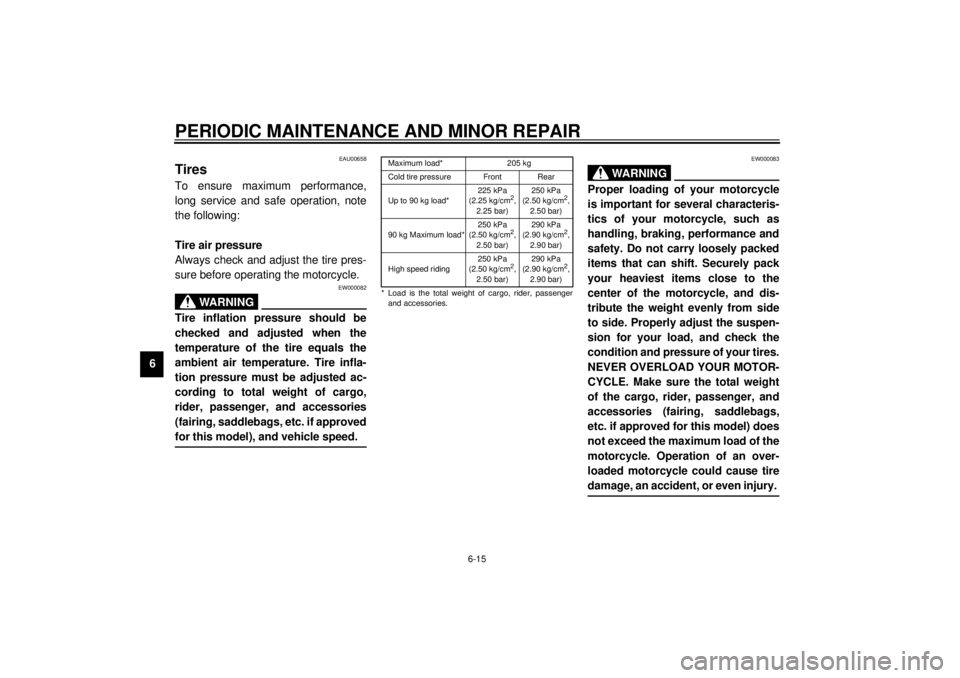
Tire air pressure
Always check and adjust the tire pres-
sure before operating the motorcycle.
EW000082
WARNING
@ Tire inflation pressure should be
checked and adjusted when the
temperature of the tire equals the
ambient air temperature. Tire infla-
tion pressure must be adjusted ac-
cording to total weight of cargo,
rider, passenger, and accessories
(fairing, saddlebags, etc. if approved
for this model), and vehicle speed. @
CE-33EEW000083
WARNING
@ Proper loading of your motorcycle
is important for several characteris-
tics of your motorcycle, such as
handling, braking, performance and
safety. Do not carry loosely packed
items that can shift. Securely pack
your heaviest items close to the
center of the motorcycle, and dis-
tribute the weight evenly from side
to side. Properly adjust the suspen-
sion for your load, and check the
condition and pressure of your tires.
NEVER OVERLOAD YOUR MOTOR-
CYCLE. Make sure the total weight
of the cargo, rider, passenger, and
accessories (fairing, saddlebags,
etc. if approved for this model) does
not exceed the maximum load of the
motorcycle. Operation of an over-
loaded motorcycle could cause tire
damage, an accident, or even injury. @
Maximum load* 205 kg
Cold tire pressure Front Rear
Up to 90 kg load*225 kPa
(2.25 kg/cm
2,
2.25 bar)250 kPa
(2.50 kg/cm
2,
2.50 bar)
90 kg Maximum load*250 kPa
(2.50 kg/cm
2,
2.50 bar)290 kPa
(2.90 kg/cm
2,
2.90 bar)
High speed riding250 kPa
(2.50 kg/cm
2,
2.50 bar)290 kPa
(2.90 kg/cm
2,
2.90 bar)
* Load is the total weight of cargo, rider, passenger
and accessories.
Page 63 of 97
PERIODIC MAINTENANCE AND MINOR REPAIR
6-17
6
EW000080
WARNING
@ l
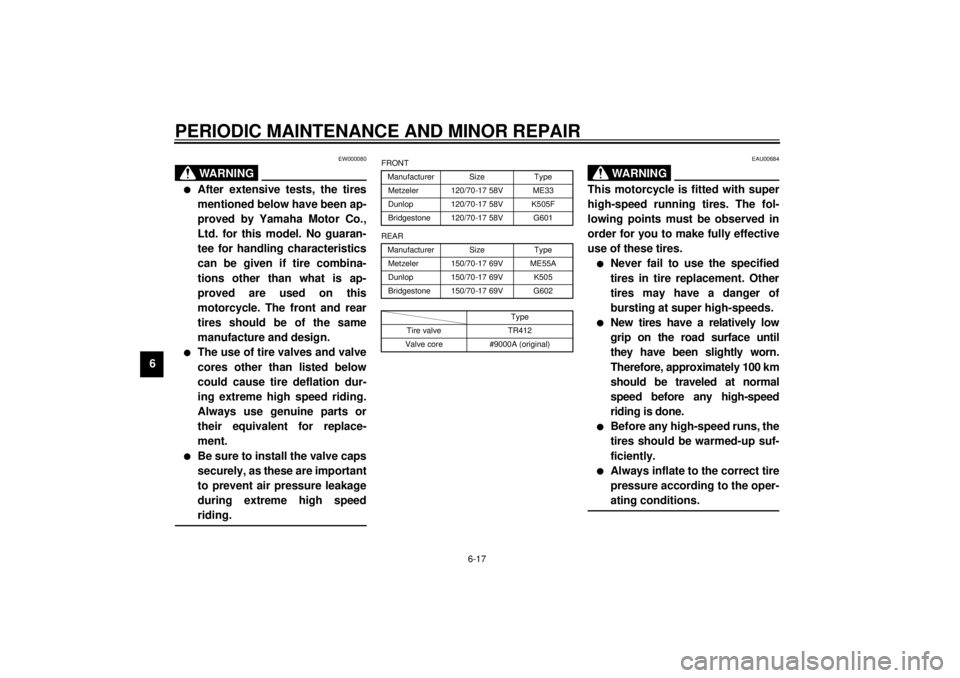
After extensive tests, the tires
mentioned below have been ap-
proved by Yamaha Motor Co.,
Ltd. for this model. No guaran-
tee for handling characteristics
can be given if tire combina-
tions other than what is ap-
proved are used on this
motorcycle. The front and rear
tires should be of the same
manufacture and design.
l
The use of tire valves and valve
cores other than listed below
could cause tire deflation dur-
ing extreme high speed riding.
Always use genuine parts or
their equivalent for replace-
ment.
l
Be sure to install the valve caps
securely, as these are important
to prevent air pressure leakage
during extreme high speed
riding.
@
CE-10E
CE-12EEAU00684
WARNING
@ This motorcycle is fitted with super
high-speed running tires. The fol-
lowing points must be observed in
order for you to make fully effective
use of these tires.l
Never fail to use the specified
tires in tire replacement. Other
tires may have a danger of
bursting at super high-speeds.
l
New tires have a relatively low
grip on the road surface until
they have been slightly worn.
Therefore, approximately 100 km
should be traveled at normal
speed before any high-speed
riding is done.
l
Before any high-speed runs, the
tires should be warmed-up suf-
ficiently.
l
Always inflate to the correct tire
pressure according to the oper-
ating conditions.
@
FRONT
Manufacturer Size Type
Metzeler 120/70-17 58V ME33
Dunlop 120/70-17 58V K505F
Bridgestone 120/70-17 58V G601
REAR
Manufacturer Size Type
Metzeler 150/70-17 69V ME55A
Dunlop 150/70-17 69V K505
Bridgestone 150/70-17 69V G602
Type
Tire valve TR412
Valve core #9000A (original)
Page 69 of 97
PERIODIC MAINTENANCE AND MINOR REPAIR
6-23
6
EAU02939
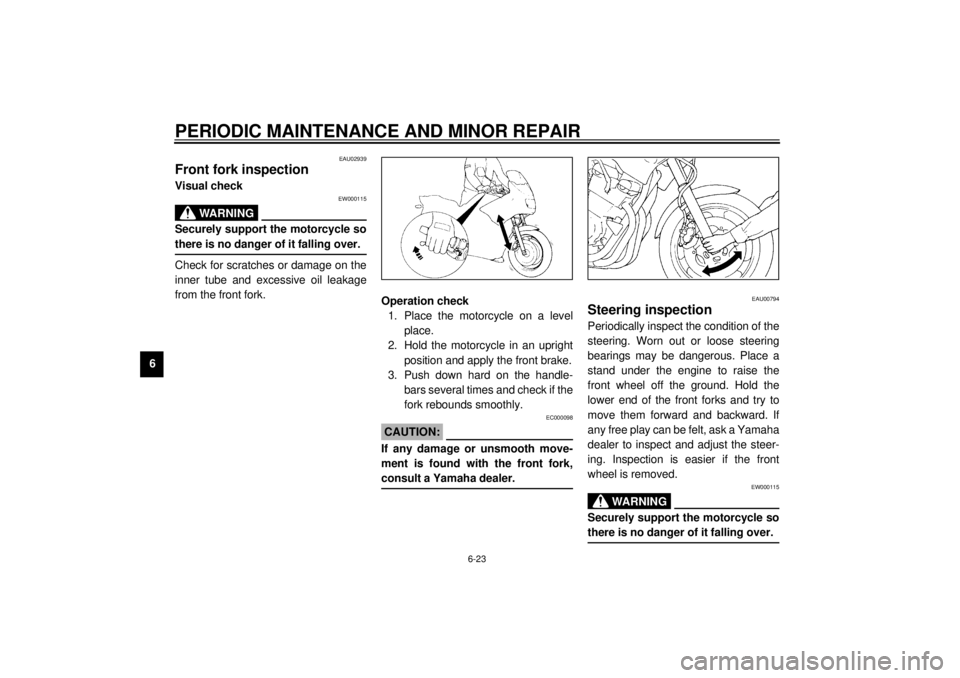
Front fork inspectionVisual check
EW000115
WARNING
@ Securely support the motorcycle so
there is no danger of it falling over. @Check for scratches or damage on the
inner tube and excessive oil leakage
from the front fork.
Operation check
1. Place the motorcycle on a level
place.
2. Hold the motorcycle in an upright
position and apply the front brake.
3. Push down hard on the handle-
bars several times and check if the
fork rebounds smoothly.
EC000098
CAUTION:@ If any damage or unsmooth move-
ment is found with the front fork,
consult a Yamaha dealer. @
EAU00794
Steering inspectionPeriodically inspect the condition of the
steering. Worn out or loose steering
bearings may be dangerous. Place a
stand under the engine to raise the
front wheel off the ground. Hold the
lower end of the front forks and try to
move them forward and backward. If
any free play can be felt, ask a Yamaha
dealer to inspect and adjust the steer-
ing. Inspection is easier if the front
wheel is removed.
EW000115
WARNING
@ Securely support the motorcycle so
there is no danger of it falling over. @
Page 73 of 97

PERIODIC MAINTENANCE AND MINOR REPAIR
6-27
63. Put a new bulb into position and
secure it in place with the bulb
holder.
EC000105
CAUTION:@ Avoid touching the glass part of a
bulb. Keep it free from oil; other-
wise, the transparency of the glass,
life of the bulb, and luminous flux
will be adversely affected. If oil gets
on a bulb, thoroughly clean it with a
cloth moistened with alcohol or lac-
quer thinner. @
4. Install the bulb holder cover and
the headlight connector.
If a headlight beam adjustment is
necessary, ask a Yamaha dealer
to make adjustment.
EAU00869
Front wheel removal
EW000122
WARNING
@ l
It is advisable to have a Yamaha
dealer service the wheel.
l
Securely support the motor-
cycle so there is no danger of it
falling over.
@1. Place the motorcycle on the cen-
terstand.
2. Remove the speedometer cable
from the front wheel side.
1. Don’t touch
1. Speedometer cable
Page 76 of 97

PERIODIC MAINTENANCE AND MINOR REPAIR
6-30
6
EAU01557
Rear wheel removal
EW000122
WARNING
@ l
It is advisable to have a Yamaha
dealer service the wheel.
l
Securely support the motor-
cycle so there is no danger of it
falling over.
@1. Loosen the wheel axle nut and
pinch bolt.
2. Place the motorcycle on the cen-
terstand.3. Remove the caliper bolts and
wheel axle nut.
4. Remove the brake torque rod cot-
ter pin, nut and bolt.
5. While supporting the brake cali-
per, pull out the wheel axle.
6. Move the wheel to the right to sep-
arate it from the final gear case,
then remove the wheel.
NOTE:@ Do not depress the brake pedal when
the disc and caliper are separated. @
1. Axle nut
1. Pinch bolt
1. Nut
2. Brake torque rod
3. Cotter pin
4. Bolt (´ 2)
Page 77 of 97

PERIODIC MAINTENANCE AND MINOR REPAIR
6-31
6
EAU01558*
Rear wheel installation1. Apply a light coating of lithium
soap base grease to the final gear
case splines and the rear wheel
hub splines.
2. Install the wheel and the wheel ax-
le.
3. Install the caliper and caliper bolts.
Make sure there is enough gap
between the brake pads before in-
stalling the caliper onto the brake
disc.4. Install the brake torque rod bolt
and nut.
5. Install the pinch bolt and tighten it
to the specified torque.
6. Take the motorcycle off the cen-
terstand.
7. Tighten the axle nut, caliper bolts
and brake torque rod nut to the
specified torques.
8. Secure the brake torque rod nut
with a new cotter pin.
EAU01008
TroubleshootingAlthough Yamaha motorcycles receive
a rigid inspection before shipment from
the factory, trouble may occur during
operation.
Any problem in the fuel, compression,
or ignition systems can cause poor
starting and loss of power. The trouble-
shooting chart describes a quick, easy
procedure for making checks.
If your motorcycle requires any repair,
bring it to a Yamaha dealer. The skilled
technicians at a Yamaha dealership
have the tools, experience, and know-
how to properly service your motor-
cycle. Use only genuine Yamaha parts
on your motorcycle. Imitation parts may
look like Yamaha parts, but they are of-
ten inferior. Consequently, they have a
shorter service life and can lead to ex-
pensive repair bills.
1. Splines
Tightening torque:
Pinch bolt:
16 Nm (1.6 m·kg)
Axle nut:
105 Nm (10.5 m·kg)
Caliper bolt:
35 Nm (3.5 m·kg)
Brake torque rod nut:
23 Nm (2.3 m·kg)