brake YAMAHA XJ900S 2001 User Guide
[x] Cancel search | Manufacturer: YAMAHA, Model Year: 2001, Model line: XJ900S, Model: YAMAHA XJ900S 2001Pages: 100, PDF Size: 10.87 MB
Page 64 of 100
PERIODIC MAINTENANCE AND MINOR REPAIR
6-21
6
EAU00713
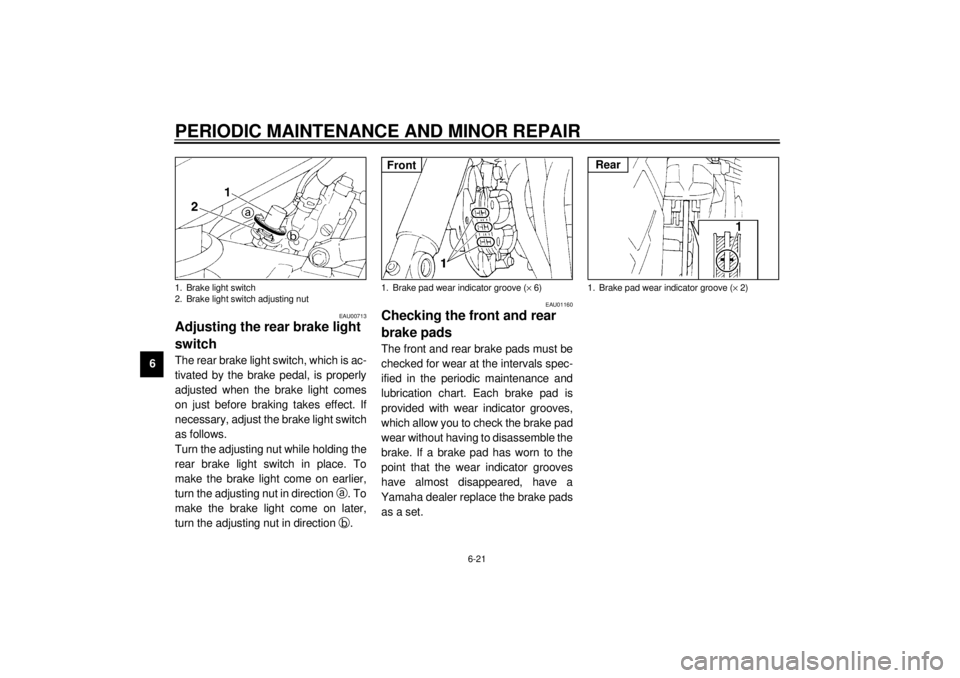
Adjusting the rear brake light
switch The rear brake light switch, which is ac-
tivated by the brake pedal, is properly
adjusted when the brake light comes
on just before braking takes effect. If
necessary, adjust the brake light switch
as follows.
Turn the adjusting nut while holding the
rear brake light switch in place. To
make the brake light come on earlier,
turn the adjusting nut in direction
a. To
make the brake light come on later,
turn the adjusting nut in direction
b.
EAU01160
Checking the front and rear
brake pads The front and rear brake pads must be
checked for wear at the intervals spec-
ified in the periodic maintenance and
lubrication chart. Each brake pad is
provided with wear indicator grooves,
which allow you to check the brake pad
wear without having to disassemble the
brake. If a brake pad has worn to the
point that the wear indicator grooves
have almost disappeared, have a
Yamaha dealer replace the brake pads
as a set.
1. Brake light switch
2. Brake light switch adjusting nut
1. Brake pad wear indicator groove (´ 6)Front
1. Brake pad wear indicator groove (´ 2)Rear
E_4km.book Page 21 Thursday, September 7, 2000 9:32 AM
Page 65 of 100
PERIODIC MAINTENANCE AND MINOR REPAIR
6-22
6
EAU03682
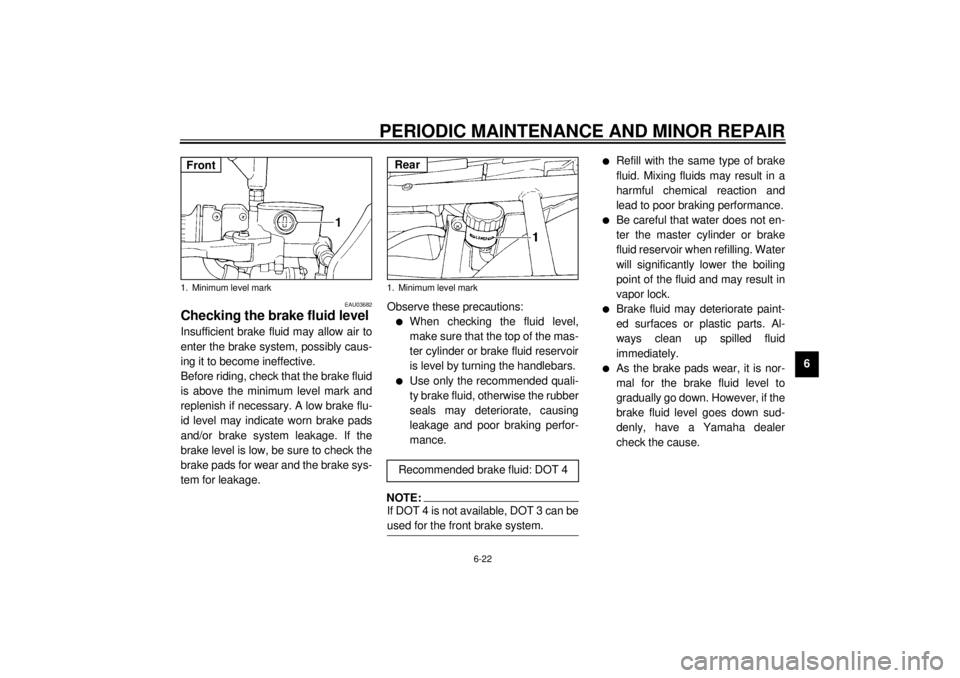
Checking the brake fluid level Insufficient brake fluid may allow air to
enter the brake system, possibly caus-
ing it to become ineffective.
Before riding, check that the brake fluid
is above the minimum level mark and
replenish if necessary. A low brake flu-
id level may indicate worn brake pads
and/or brake system leakage. If the
brake level is low, be sure to check the
brake pads for wear and the brake sys-
tem for leakage.Observe these precautions:
l
When checking the fluid level,
make sure that the top of the mas-
ter cylinder or brake fluid reservoir
is level by turning the handlebars.
l
Use only the recommended quali-
ty brake fluid, otherwise the rubber
seals may deteriorate, causing
leakage and poor braking perfor-
mance.
NOTE:@ If DOT 4 is not available, DOT 3 can be
used for the front brake system. @
l
Refill with the same type of brake
fluid. Mixing fluids may result in a
harmful chemical reaction and
lead to poor braking performance.
l
Be careful that water does not en-
ter the master cylinder or brake
fluid reservoir when refilling. Water
will significantly lower the boiling
point of the fluid and may result in
vapor lock.
l
Brake fluid may deteriorate paint-
ed surfaces or plastic parts. Al-
ways clean up spilled fluid
immediately.
l
As the brake pads wear, it is nor-
mal for the brake fluid level to
gradually go down. However, if the
brake fluid level goes down sud-
denly, have a Yamaha dealer
check the cause.
1. Minimum level markFront
1. Minimum level markRecommended brake fluid: DOT 4Rear
E_4km.book Page 22 Thursday, September 7, 2000 9:32 AM
Page 66 of 100
PERIODIC MAINTENANCE AND MINOR REPAIR
6-23
6
EAU03238
Changing the brake fluid Have a Yamaha dealer change the
brake fluid at the intervals specified in
the periodic maintenance and lubrica-
tion chart. In addition, have the oil seals
of the brake master cylinder and caliper
as well as the brake hose replaced at
the intervals listed below or whenever
they are damaged or leaking.l
Oil seals: Replace every two
years.
l
Brake hose: Replace every four
years.
EAU02962
Checking and lubricating the
cables The operation of all control cables and
the condition of the cables should be
checked before each ride, and the ca-
bles and cable ends should be lubricat-
ed if necessary. If a cable is damaged
or does not move smoothly, have a
Yamaha dealer check or replace it.
EW000112
WARNING
@ Damage to the outer sheath may in-
terfere with proper cable operation
and will cause the inner cable to
rust. Replace a damaged cable as
soon as possible to prevent unsafe
conditions. @
EAU03209
Checking and lubricating the
throttle grip and cable The operation of the throttle grip and
the condition of the throttle cable
should be checked before each ride,
and the cable should be lubricated or
replaced if necessary.NOTE:@ Since the throttle grip must be removed
to access the throttle cable end, the
throttle grip and the cable should al-
ways be lubricated at the same time. @1. Remove the throttle grip by remov-
ing the screws.
2. Disconnect the throttle cable, hold
it up, and then apply several drops
of oil to the cable end, allowing it to
trickle into the sheath.
3. Connect the throttle cable, and
then grease the inside of the throt-
tle grip housing.
4. Grease the metal-to-metal contact
surface of the throttle grip, and
then install the grip by installing
the screws. Recommended lubricant:
Engine oil
E_4km.book Page 23 Thursday, September 7, 2000 9:32 AM
Page 67 of 100
PERIODIC MAINTENANCE AND MINOR REPAIR
6-24
6
EAU03370
Checking and lubricating the
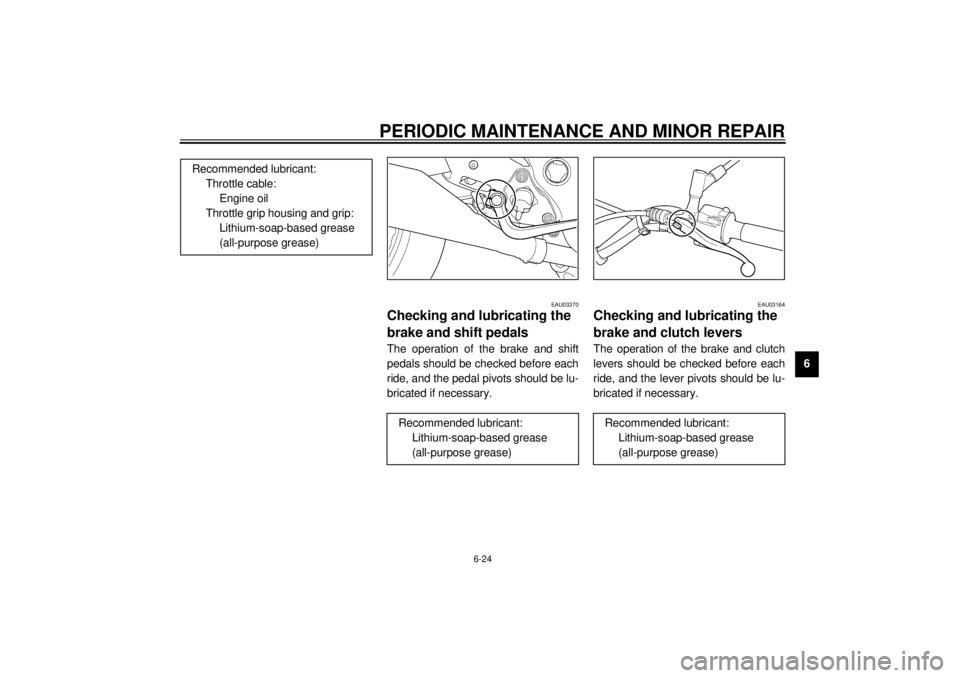
brake and shift pedals The operation of the brake and shift
pedals should be checked before each
ride, and the pedal pivots should be lu-
bricated if necessary.
EAU03164
Checking and lubricating the
brake and clutch levers The operation of the brake and clutch
levers should be checked before each
ride, and the lever pivots should be lu-
bricated if necessary. Recommended lubricant:
Throttle cable:
Engine oil
Throttle grip housing and grip:
Lithium-soap-based grease
(all-purpose grease)
Recommended lubricant:
Lithium-soap-based grease
(all-purpose grease)
Recommended lubricant:
Lithium-soap-based grease
(all-purpose grease)
E_4km.book Page 24 Thursday, September 7, 2000 9:32 AM
Page 69 of 100
PERIODIC MAINTENANCE AND MINOR REPAIR
6-26
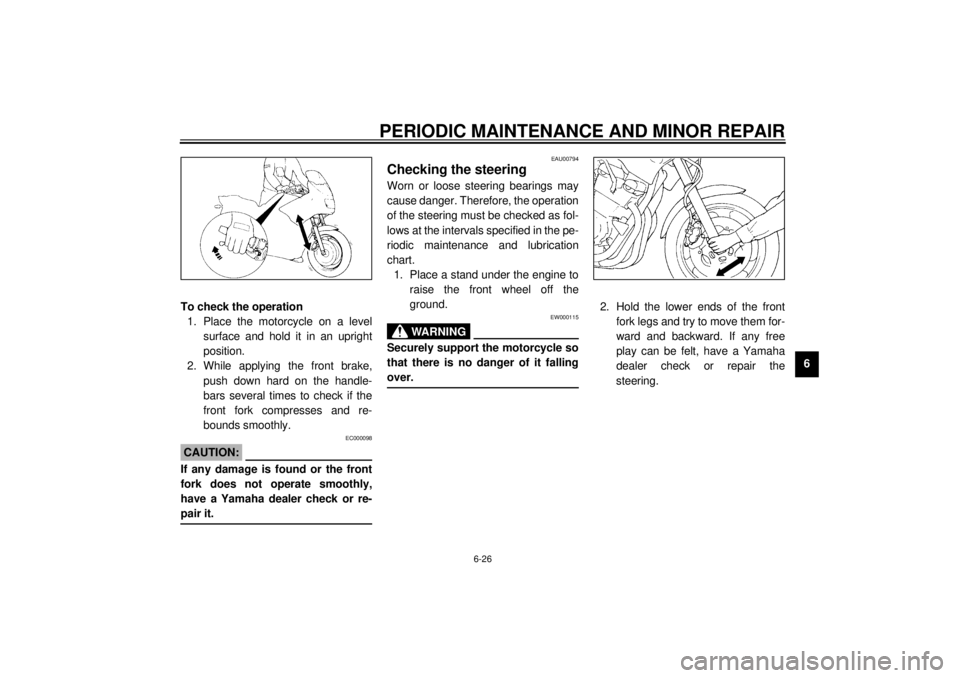
6 To check the operation
1. Place the motorcycle on a level
surface and hold it in an upright
position.
2. While applying the front brake,
push down hard on the handle-
bars several times to check if the
front fork compresses and re-
bounds smoothly.
EC000098
CAUTION:@ If any damage is found or the front
fork does not operate smoothly,
have a Yamaha dealer check or re-
pair it. @
EAU00794
Checking the steering Worn or loose steering bearings may
cause danger. Therefore, the operation
of the steering must be checked as fol-
lows at the intervals specified in the pe-
riodic maintenance and lubrication
chart.
1. Place a stand under the engine to
raise the front wheel off the
ground.
EW000115
WARNING
@ Securely support the motorcycle so
that there is no danger of it falling
over. @
2. Hold the lower ends of the front
fork legs and try to move them for-
ward and backward. If any free
play can be felt, have a Yamaha
dealer check or repair the
steering.
E_4km.book Page 26 Thursday, September 7, 2000 9:32 AM
Page 74 of 100
PERIODIC MAINTENANCE AND MINOR REPAIR
6-31
6
EAU03598
Front wheel To remove the front wheel
EW000122
WARNING
@ l
It is advisable to have a Yamaha
dealer service the wheel.
l
Securely support the motor-
cycle so that there is no danger
of it falling over.
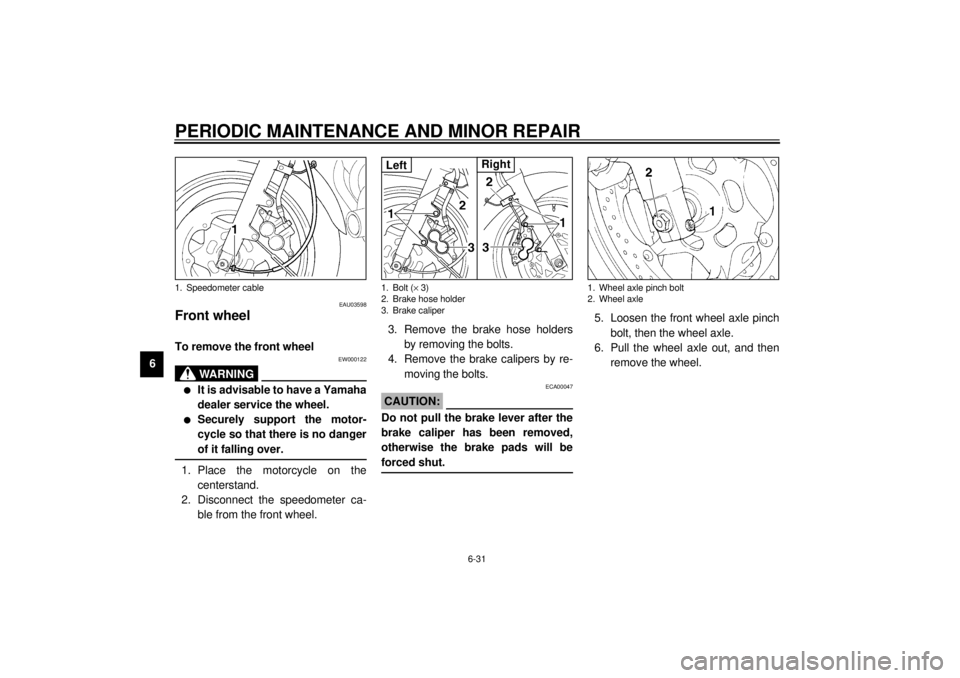
@1. Place the motorcycle on the
centerstand.
2. Disconnect the speedometer ca-
ble from the front wheel.3. Remove the brake hose holders
by removing the bolts.
4. Remove the brake calipers by re-
moving the bolts.
ECA00047
CAUTION:@ Do not pull the brake lever after the
brake caliper has been removed,
otherwise the brake pads will be
forced shut. @
5. Loosen the front wheel axle pinch
bolt, then the wheel axle.
6. Pull the wheel axle out, and then
remove the wheel.
1. Speedometer cable
1. Bolt (´ 3)
2. Brake hose holder
3. Brake caliperLeft
Right
1. Wheel axle pinch bolt
2. Wheel axle
E_4km.book Page 31 Thursday, September 7, 2000 9:32 AM
Page 75 of 100
PERIODIC MAINTENANCE AND MINOR REPAIR
6-32
6
EAU03420
To install the front wheel
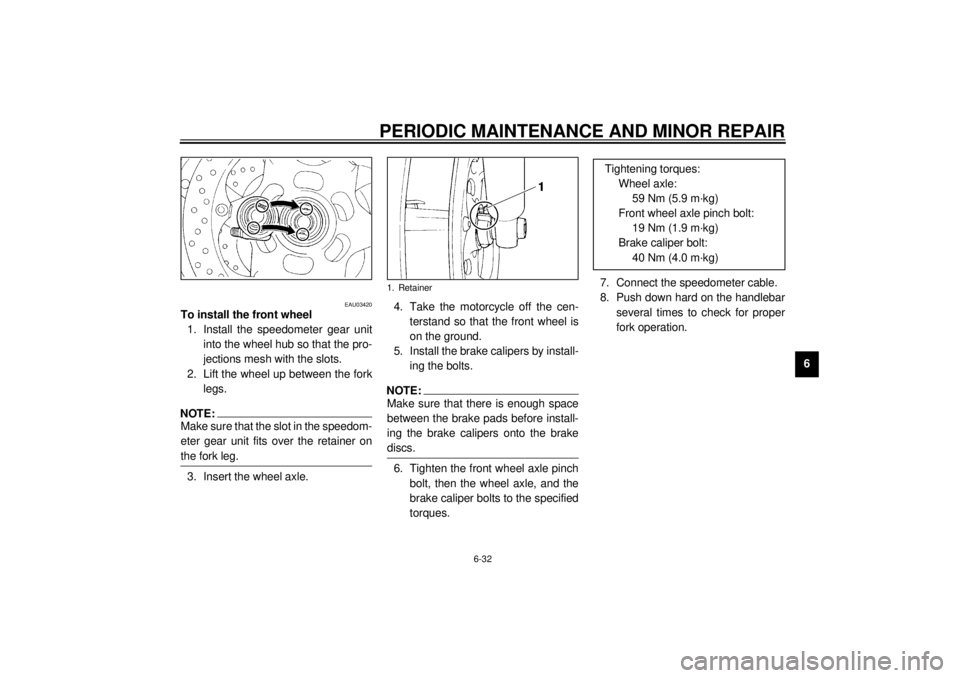
1. Install the speedometer gear unit
into the wheel hub so that the pro-
jections mesh with the slots.
2. Lift the wheel up between the fork
legs.NOTE:@ Make sure that the slot in the speedom-
eter gear unit fits over the retainer on
the fork leg. @3. Insert the wheel axle.4. Take the motorcycle off the cen-
terstand so that the front wheel is
on the ground.
5. Install the brake calipers by install-
ing the bolts.
NOTE:@ Make sure that there is enough space
between the brake pads before install-
ing the brake calipers onto the brake
discs. @6. Tighten the front wheel axle pinch
bolt, then the wheel axle, and the
brake caliper bolts to the specified
torques.7. Connect the speedometer cable.
8. Push down hard on the handlebar
several times to check for proper
fork operation.1. Retainer
Tightening torques:
Wheel axle:
59 Nm (5.9 m·kg)
Front wheel axle pinch bolt:
19 Nm (1.9 m·kg)
Brake caliper bolt:
40 Nm (4.0 m·kg)
E_4km.book Page 32 Thursday, September 7, 2000 9:32 AM
Page 76 of 100
PERIODIC MAINTENANCE AND MINOR REPAIR
6-33
6
EAU03410
Rear wheel To remove the rear wheel
EW000122
WARNING
@ l
It is advisable to have a Yamaha
dealer service the wheel.
l
Securely support the motor-
cycle so that there is no danger
of it falling over.
@
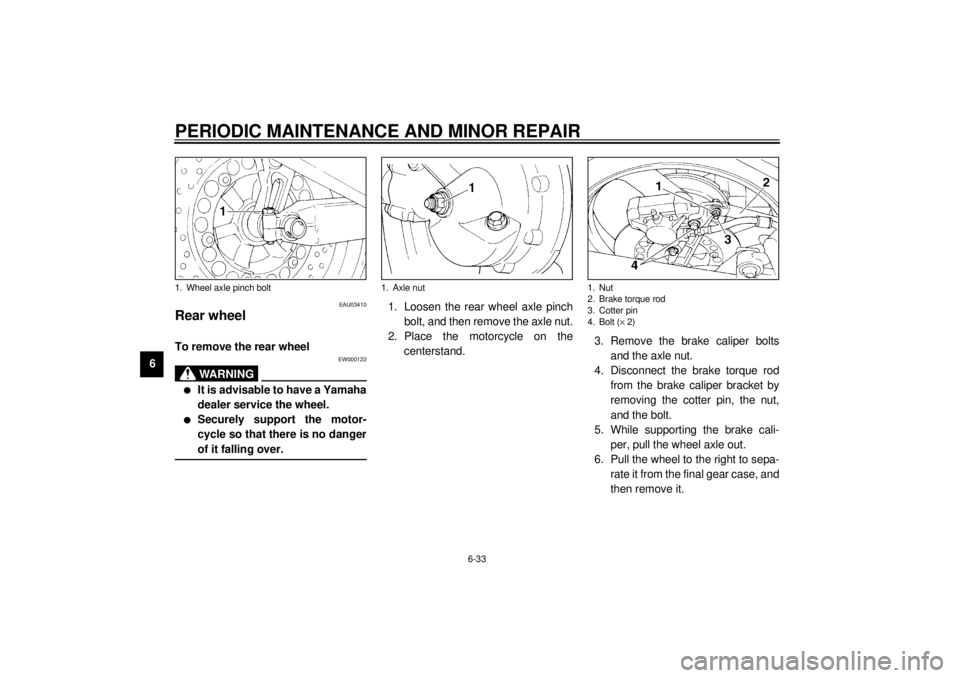
1. Loosen the rear wheel axle pinch
bolt, and then remove the axle nut.
2. Place the motorcycle on the
centerstand.3. Remove the brake caliper bolts
and the axle nut.
4. Disconnect the brake torque rod
from the brake caliper bracket by
removing the cotter pin, the nut,
and the bolt.
5. While supporting the brake cali-
per, pull the wheel axle out.
6. Pull the wheel to the right to sepa-
rate it from the final gear case, and
then remove it.
1. Wheel axle pinch bolt
1. Axle nut
1. Nut
2. Brake torque rod
3. Cotter pin
4. Bolt (´ 2)
E_4km.book Page 33 Thursday, September 7, 2000 9:32 AM
Page 77 of 100
PERIODIC MAINTENANCE AND MINOR REPAIR
6-34
6
ECA00062
CAUTION:@ Do not push the brake pedal after
the wheel has been removed togeth-
er with the brake disc, otherwise the
brake pads will be forced shut. @
EAU03411
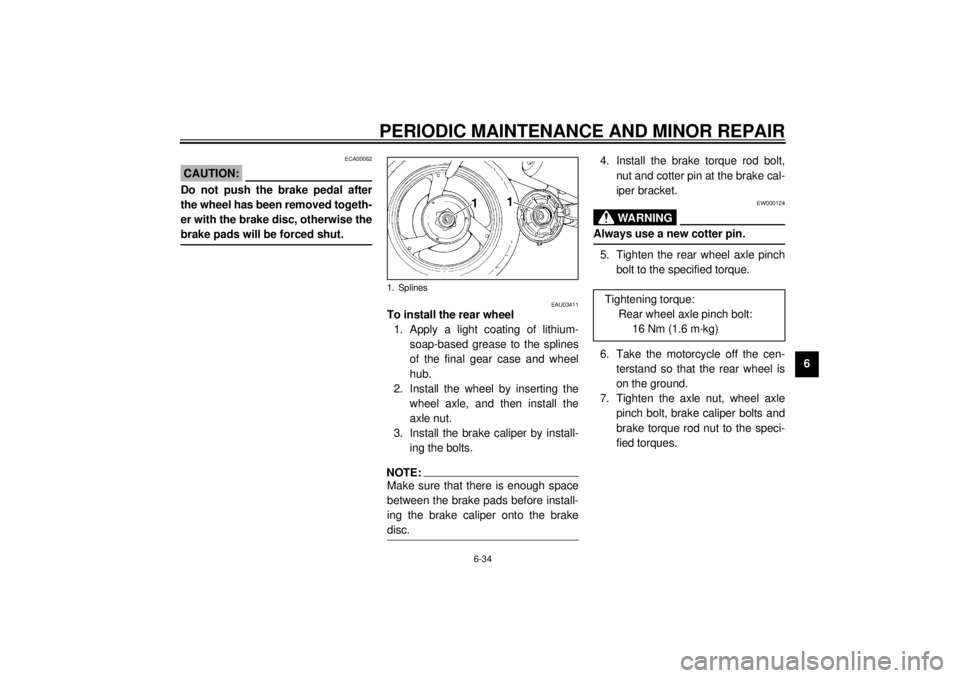
To install the rear wheel
1. Apply a light coating of lithium-
soap-based grease to the splines
of the final gear case and wheel
hub.
2. Install the wheel by inserting the
wheel axle, and then install the
axle nut.
3. Install the brake caliper by install-
ing the bolts.NOTE:@ Make sure that there is enough space
between the brake pads before install-
ing the brake caliper onto the brake
disc. @
4. Install the brake torque rod bolt,
nut and cotter pin at the brake cal-
iper bracket.
EW000124
WARNING
@ Always use a new cotter pin. @5. Tighten the rear wheel axle pinch
bolt to the specified torque.
6. Take the motorcycle off the cen-
terstand so that the rear wheel is
on the ground.
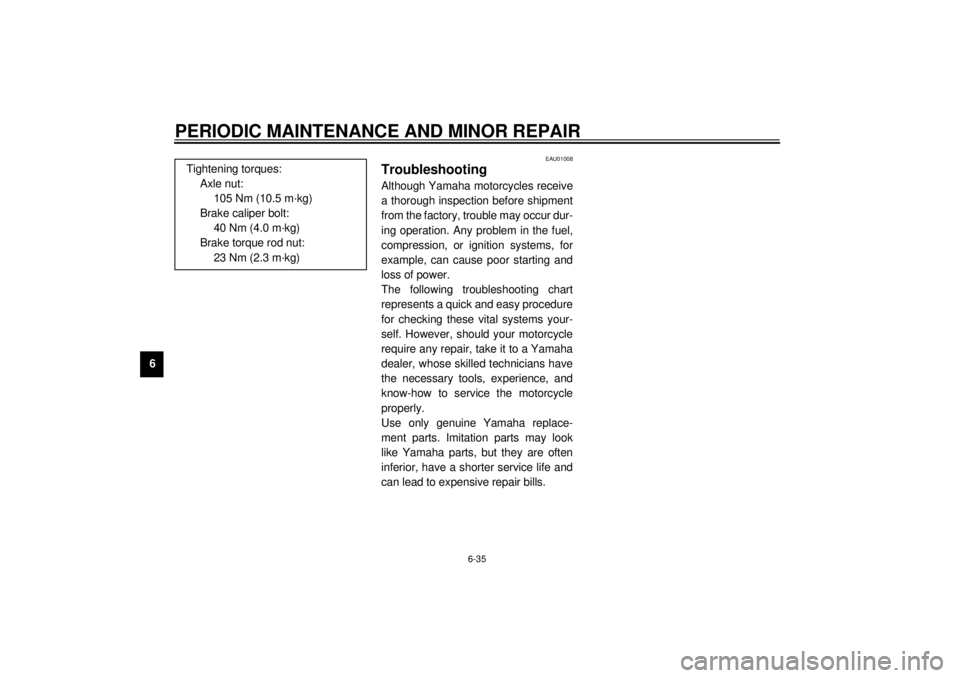
7. Tighten the axle nut, wheel axle
pinch bolt, brake caliper bolts and
brake torque rod nut to the speci-
fied torques.
1. Splines
Tightening torque:
Rear wheel axle pinch bolt:
16 Nm (1.6 m·kg)
E_4km.book Page 34 Thursday, September 7, 2000 9:32 AM
Page 78 of 100
PERIODIC MAINTENANCE AND MINOR REPAIR
6-35
6
EAU01008
Troubleshooting Although Yamaha motorcycles receive
a thorough inspection before shipment
from the factory, trouble may occur dur-
ing operation. Any problem in the fuel,
compression, or ignition systems, for
example, can cause poor starting and
loss of power.
The following troubleshooting chart
represents a quick and easy procedure
for checking these vital systems your-
self. However, should your motorcycle
require any repair, take it to a Yamaha
dealer, whose skilled technicians have
the necessary tools, experience, and
know-how to service the motorcycle
properly.
Use only genuine Yamaha replace-
ment parts. Imitation parts may look
like Yamaha parts, but they are often
inferior, have a shorter service life and
can lead to expensive repair bills. Tightening torques:
Axle nut:
105 Nm (10.5 m·kg)
Brake caliper bolt:
40 Nm (4.0 m·kg)
Brake torque rod nut:
23 Nm (2.3 m·kg)
E_4km.book Page 35 Thursday, September 7, 2000 9:32 AM