fuel YAMAHA XJ900S 2001 Owners Manual
[x] Cancel search | Manufacturer: YAMAHA, Model Year: 2001, Model line: XJ900S, Model: YAMAHA XJ900S 2001Pages: 100, PDF Size: 10.87 MB
Page 14 of 100
DESCRIPTION
2-3
2
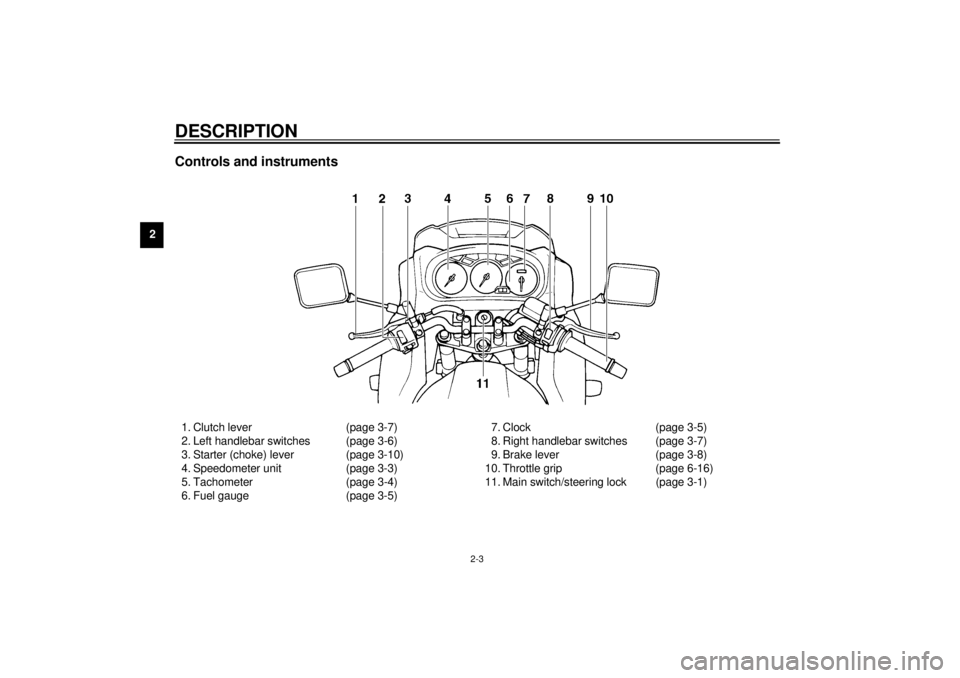
Controls and instruments1. Clutch lever (page 3-7)
2. Left handlebar switches (page 3-6)
3. Starter (choke) lever (page 3-10)
4. Speedometer unit (page 3-3)
5. Tachometer (page 3-4)
6. Fuel gauge (page 3-5)7. Clock (page 3-5)
8. Right handlebar switches (page 3-7)
9. Brake lever (page 3-8)
10. Throttle grip (page 6-16)
11. Main switch/steering lock (page 3-1)
E_4km.book Page 3 Thursday, September 7, 2000 9:32 AM
Page 15 of 100
3
INSTRUMENT AND CONTROL FUNCTIONS
Main switch/steering lock ..................................... 3-1
Indicator and warning lights ................................ 3-2
Speedometer unit ................................................ 3-3
Tachometer .......................................................... 3-4
Self-diagnosis device ........................................... 3-4
Anti-theft alarm (optional) .................................... 3-5
Fuel gauge ........................................................... 3-5
Clock .................................................................... 3-5
Handlebar switches ............................................. 3-6
Clutch lever .......................................................... 3-7
Shift pedal ............................................................ 3-8
Brake lever .......................................................... 3-8Brake pedal ......................................................... 3-8
Fuel tank cap ...................................................... 3-9
Fuel ..................................................................... 3-9
Fuel tank breather hose (for Germany only) ..... 3-10
Starter (choke) lever .......................................... 3-10
Seat ................................................................... 3-11
Helmet holder .................................................... 3-11
Storage compartment ....................................... 3-12
Adjusting the front fork ...................................... 3-13
Adjusting the shock absorber assembly ............ 3-13
Sidestand .......................................................... 3-15
Ignition circuit cut-off system ............................. 3-15
E_4km.book Page 1 Thursday, September 7, 2000 9:32 AM
Page 17 of 100
INSTRUMENT AND CONTROL FUNCTIONS
3-2
3
EAU01590
(Parking)
The steering is locked, and the taillight
and auxiliary light are on, but all other
electrical systems are off. The key can
be removed.
The steering must be locked before the
key can be turned to “ ”.
ECA00043
CAUTION:@ Do not use the parking position for
an extended length of time, other-
wise the battery may discharge. @
EAU03034
Indicator and warning lights
EAU03299
Turn signal indicator lights
“” / “”
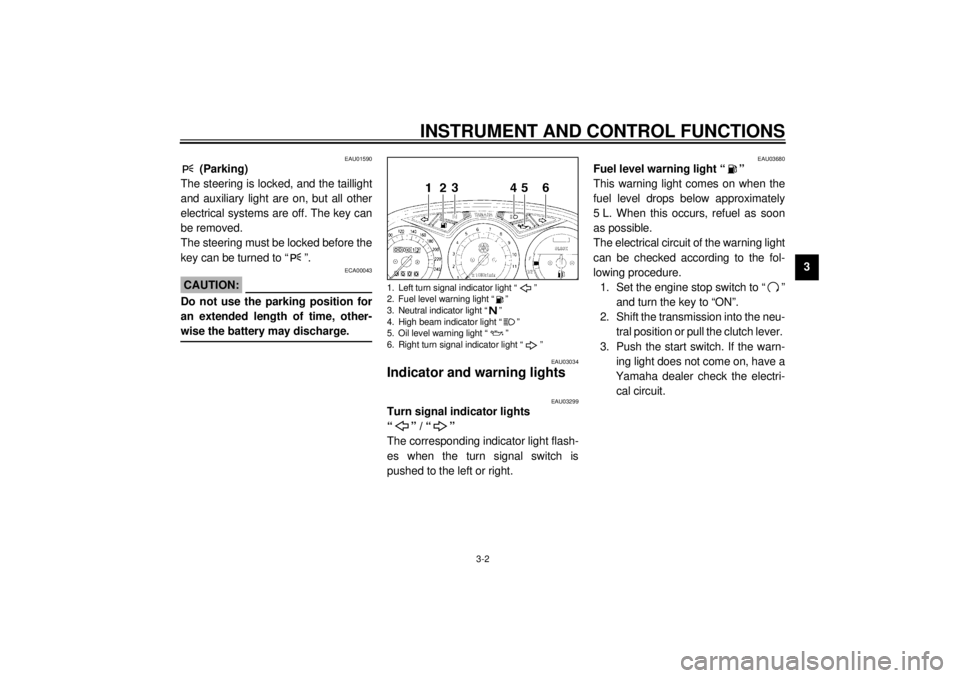
The corresponding indicator light flash-
es when the turn signal switch is
pushed to the left or right.
EAU03680
Fuel level warning light “ ”
This warning light comes on when the
fuel level drops below approximately
5 L. When this occurs, refuel as soon
as possible.
The electrical circuit of the warning light
can be checked according to the fol-
lowing procedure.
1. Set the engine stop switch to “ ”
and turn the key to “ON”.
2. Shift the transmission into the neu-
tral position or pull the clutch lever.
3. Push the start switch. If the warn-
ing light does not come on, have a
Yamaha dealer check the electri-
cal circuit.
1. Left turn signal indicator light “ ”
2. Fuel level warning light “ ”
3. Neutral indicator light “ ”
4. High beam indicator light “ ”
5. Oil level warning light “ ”
6. Right turn signal indicator light “ ”
E_4km.book Page 2 Thursday, September 7, 2000 9:32 AM
Page 18 of 100
INSTRUMENT AND CONTROL FUNCTIONS
3-3
3
EAU00061
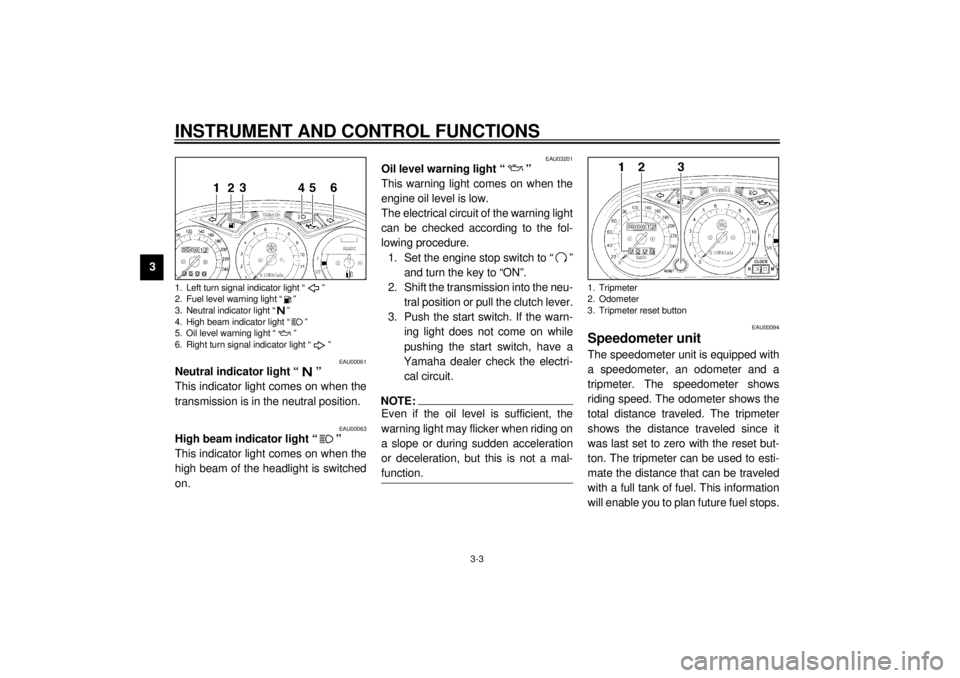
Neutral indicator light “ ”
This indicator light comes on when the
transmission is in the neutral position.
EAU00063
High beam indicator light “ ”
This indicator light comes on when the
high beam of the headlight is switched
on.
EAU03201
Oil level warning light “ ”
This warning light comes on when the
engine oil level is low.
The electrical circuit of the warning light
can be checked according to the fol-
lowing procedure.
1. Set the engine stop switch to “ ”
and turn the key to “ON”.
2. Shift the transmission into the neu-
tral position or pull the clutch lever.
3. Push the start switch. If the warn-
ing light does not come on while
pushing the start switch, have a
Yamaha dealer check the electri-
cal circuit.NOTE:@ Even if the oil level is sufficient, the
warning light may flicker when riding on
a slope or during sudden acceleration
or deceleration, but this is not a mal-
function. @
EAU00094
Speedometer unit The speedometer unit is equipped with
a speedometer, an odometer and a
tripmeter. The speedometer shows
riding speed. The odometer shows the
total distance traveled. The tripmeter
shows the distance traveled since it
was last set to zero with the reset but-
ton. The tripmeter can be used to esti-
mate the distance that can be traveled
with a full tank of fuel. This information
will enable you to plan future fuel stops.
1. Left turn signal indicator light “ ”
2. Fuel level warning light “ ”
3. Neutral indicator light “ ”
4. High beam indicator light “ ”
5. Oil level warning light “ ”
6. Right turn signal indicator light “ ”
1. Tripmeter
2. Odometer
3. Tripmeter reset button
E_4km.book Page 3 Thursday, September 7, 2000 9:32 AM
Page 20 of 100
INSTRUMENT AND CONTROL FUNCTIONS
3-5
3
EAU00109
Anti-theft alarm (optional) This motorcycle can be equipped with
an optional anti-theft alarm by a
Yamaha dealer. Contact a Yamaha
dealer for more information.
EAU00110
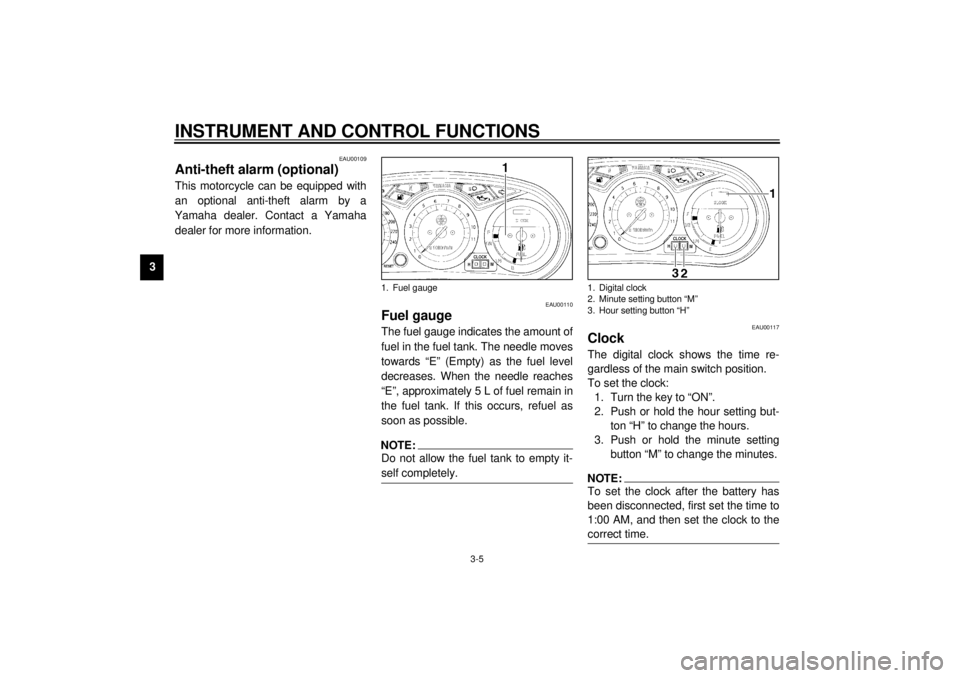
Fuel gauge The fuel gauge indicates the amount of
fuel in the fuel tank. The needle moves
towards “E” (Empty) as the fuel level
decreases. When the needle reaches
“E”, approximately 5 L of fuel remain in
the fuel tank. If this occurs, refuel as
soon as possible.NOTE:@ Do not allow the fuel tank to empty it-
self completely. @
EAU00117
Clock The digital clock shows the time re-
gardless of the main switch position.
To set the clock:
1. Turn the key to “ON”.
2. Push or hold the hour setting but-
ton “H” to change the hours.
3. Push or hold the minute setting
button “M” to change the minutes.NOTE:@ To set the clock after the battery has
been disconnected, first set the time to
1:00 AM, and then set the clock to the
correct time. @
1. Fuel gauge
1. Digital clock
2. Minute setting button “M”
3. Hour setting button “H”
E_4km.book Page 5 Thursday, September 7, 2000 9:32 AM
Page 24 of 100
INSTRUMENT AND CONTROL FUNCTIONS
3-9
3
EAU02935
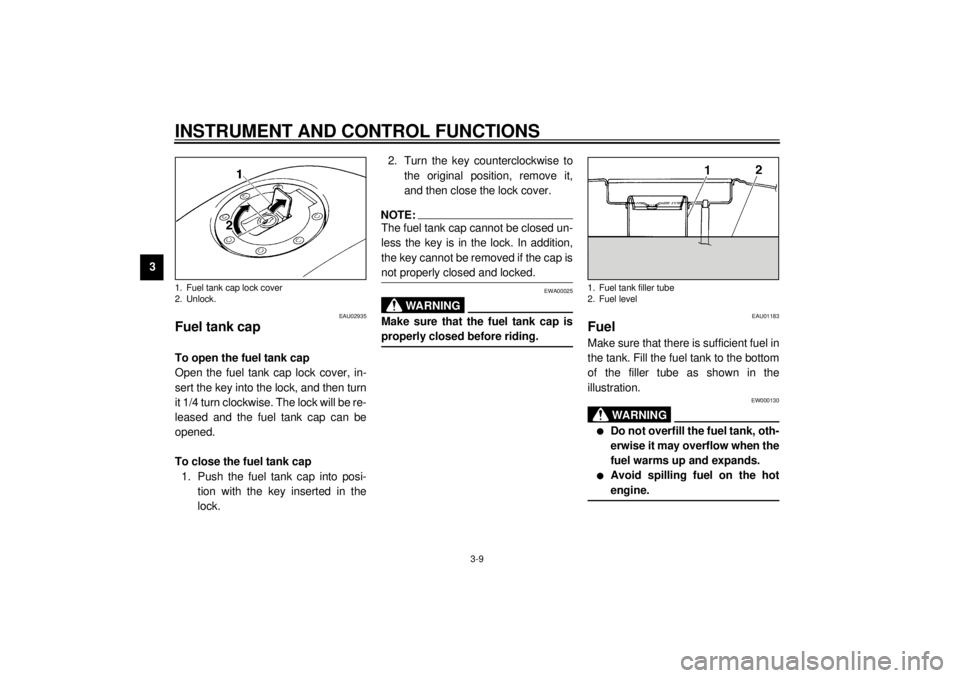
Fuel tank cap To open the fuel tank cap
Open the fuel tank cap lock cover, in-
sert the key into the lock, and then turn
it 1/4 turn clockwise. The lock will be re-
leased and the fuel tank cap can be
opened.
To close the fuel tank cap
1. Push the fuel tank cap into posi-
tion with the key inserted in the
lock. 2. Turn the key counterclockwise to
the original position, remove it,
and then close the lock cover.
NOTE:@ The fuel tank cap cannot be closed un-
less the key is in the lock. In addition,
the key cannot be removed if the cap is
not properly closed and locked. @
EWA00025
WARNING
@ Make sure that the fuel tank cap is
properly closed before riding. @
EAU01183
Fuel Make sure that there is sufficient fuel in
the tank. Fill the fuel tank to the bottom
of the filler tube as shown in the
illustration.
EW000130
WARNING
@ l
Do not overfill the fuel tank, oth-
erwise it may overflow when the
fuel warms up and expands.
l
Avoid spilling fuel on the hot
engine.
@
1. Fuel tank cap lock cover
2. Unlock.
1. Fuel tank filler tube
2. Fuel level
E_4km.book Page 9 Thursday, September 7, 2000 9:32 AM
Page 25 of 100
INSTRUMENT AND CONTROL FUNCTIONS
3-10
3
EAU00186
CAUTION:@ l
Immediately wipe off spilled fuel
with a clean, dry, soft cloth,
since fuel may deteriorate paint-
ed surfaces or plastic parts.
l
For Germany only: Whenever
replacement is necessary, use a
fuel tank cap of the same spe-
cial design as the original.
@
EAU00191
NOTE:@ If knocking (or pinging) occurs, use
gasoline of a different brand or with a
higher octane grade. @
EAU00196
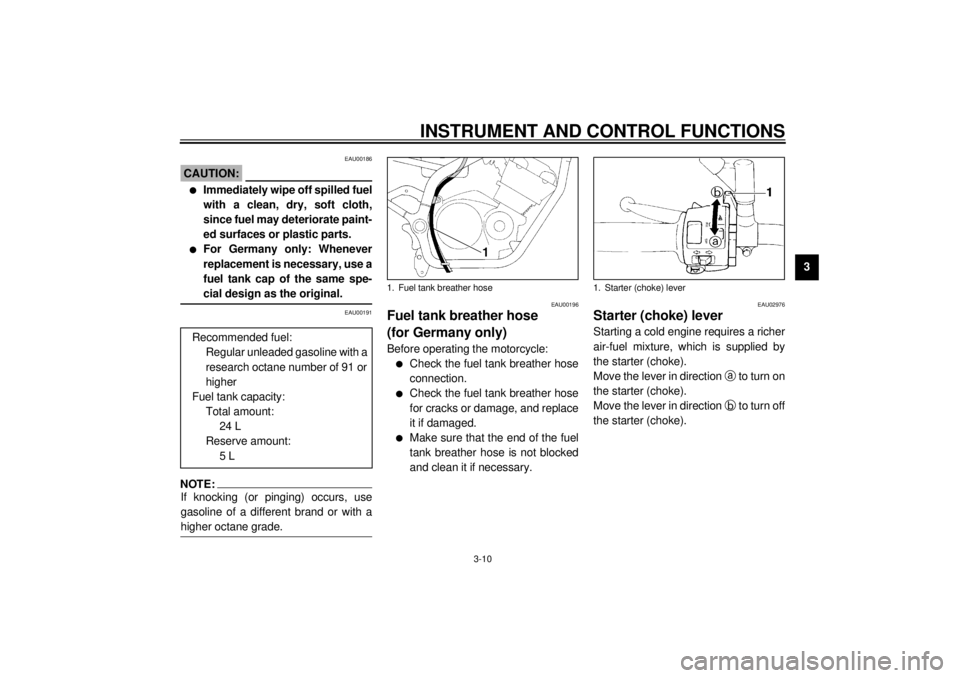
Fuel tank breather hose
(for Germany only) Before operating the motorcycle:l
Check the fuel tank breather hose
connection.
l
Check the fuel tank breather hose
for cracks or damage, and replace
it if damaged.
l
Make sure that the end of the fuel
tank breather hose is not blocked
and clean it if necessary.
EAU02976
Starter (choke) lever Starting a cold engine requires a richer
air-fuel mixture, which is supplied by
the starter (choke).
Move the lever in direction
a to turn on
the starter (choke).
Move the lever in direction
b to turn off
the starter (choke). Recommended fuel:
Regular unleaded gasoline with a
research octane number of 91 or
higher
Fuel tank capacity:
Total amount:
24 L
Reserve amount:
5 L
1. Fuel tank breather hose
1. Starter (choke) lever
E_4km.book Page 10 Thursday, September 7, 2000 9:32 AM
Page 34 of 100

4-1
4
EAU01114
4-PRE-OPERATION CHECKSThe condition of a vehicle is the owner’s responsibility. Vital components can start to deteriorate quickly and unexpectedly,
even if the vehicle remains unused (for example, as a result of exposure to the elements). Any damage, fluid leakage or loss
of tire air pressure could have serious consequences. Therefore, it is very important, in addition to a thorough visual inspec-
tion, to check the following points before each ride.
EAU03439
Pre-operation check list
ITEM CHECKS PAGE
Fuel• Check fuel level in fuel tank.
• Refuel if necessary.
• Check fuel line for leakage.3-9–3-10
Engine oil• Check oil level in engine.
• If necessary, add recommended oil to specified level.
• Check vehicle for oil leakage.6-8
Final gear oil• Check vehicle for oil leakage. 6-11–6-12
Front brake• Check operation.
• If soft or spongy, have Yamaha dealer bleed hydraulic system.
• Check fluid level in reservoir.
• If necessary, add recommended brake fluid to specified level.
• Check hydraulic system for leakage.6-21–6-23
Rear brake• Check operation.
• If soft or spongy, have Yamaha dealer bleed hydraulic system.
• Check fluid level in reservoir.
• If necessary, add recommended brake fluid to specified level.
• Check hydraulic system for leakage.6-21–6-23
Clutch• Check operation.
• Lubricate cable if necessary.
• Check lever free play.
• Adjust if necessary.6-20
Throttle grip• Make sure that operation is smooth.
• Lubricate throttle grip, housing and cables if necessary.
• Check free play.
• If necessary, have Yamaha dealer make adjustment.6-16, 6-23–6-24
Control cables• Make sure that operation is smooth.
• Lubricate if necessary.6-23
E_4km.book Page 1 Thursday, September 7, 2000 9:32 AM
Page 37 of 100
OPERATION AND IMPORTANT RIDING POINTS
5
Starting a cold engine ....................................................................... 5-1
Starting a warm engine ..................................................................... 5-3
Shifting .............................................................................................. 5-3
Recommended shift points (for Switzerland only) ............................. 5-4
Tips for reducing fuel consumption ................................................... 5-4
Engine break-in ................................................................................. 5-4
Parking .............................................................................................. 5-5
E_4km.book Page 1 Thursday, September 7, 2000 9:32 AM
Page 38 of 100
5-1
5
EAU00372
5-OPERATION AND IMPORTANT RIDING POINTS
EAU00373
WARNING
@ l
Become thoroughly familiar
with all operating controls and
their functions before riding.
Consult a Yamaha dealer re-
garding any control or function
that you do not thoroughly
understand.
l
Never start the engine or oper-
ate it in a closed area for any
length of time. Exhaust fumes
are poisonous, and inhaling
them can cause loss of con-
sciousness and death within a
short time. Always make sure
that there is adequate
ventilation.
l
Before starting out, make sure
that the sidestand is up. If the
sidestand is not raised com-
pletely, it could contact the
ground and distract the opera-
tor, resulting in a possible loss
of control.
@
EAU01627*
Starting a cold engine In order for the ignition circuit cut-off
system to enable starting, one of the
following conditions must be met:l
The transmission is in the neutral
position.
l
The transmission is in gear with
the clutch lever pulled and the
sidestand up.
EW000054
WARNING
@ l
Before starting the engine,
check the function of the igni-
tion circuit cut-off system ac-
cording to the procedure
described on page 3-17.
l
Never ride with the sidestand
down.
@1. Turn the key to “ON” and make
sure that the engine stop switch is
set to “ ”.
EC000035
CAUTION:@ If the fuel level warning light comes
on, check the fuel level, and, if nec-
essary, refuel as soon as possible. @2. Shift the transmission into the neu-
tral position.NOTE:@ When the transmission is in the neutral
position, the neutral indicator light
should be on, otherwise have a
Yamaha dealer check the electrical
circuit. @3. Turn the starter (choke) on and
completely close the throttle. (See
page 3-10 for starter (choke) oper-
ation.)
4. Start the engine by pushing the
start switch.
E_4km.book Page 1 Thursday, September 7, 2000 9:32 AM