service YAMAHA XJ900S 2001 Owners Manual
[x] Cancel search | Manufacturer: YAMAHA, Model Year: 2001, Model line: XJ900S, Model: YAMAHA XJ900S 2001Pages: 100, PDF Size: 10.87 MB
Page 29 of 100
INSTRUMENT AND CONTROL FUNCTIONS
3-14
3
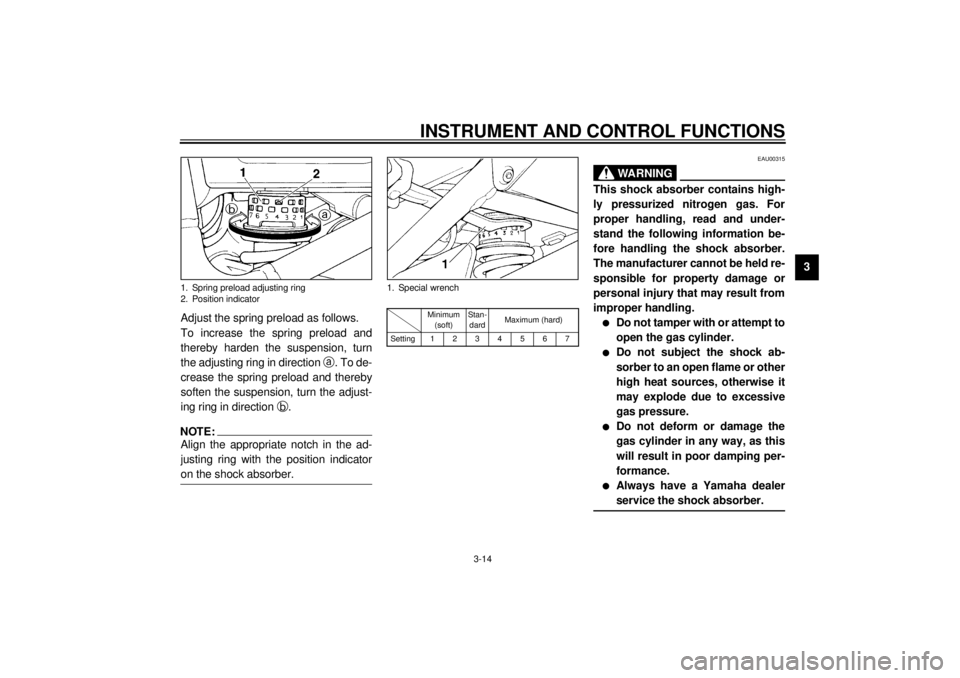
Adjust the spring preload as follows.
To increase the spring preload and
thereby harden the suspension, turn
the adjusting ring in direction
a. To de-
crease the spring preload and thereby
soften the suspension, turn the adjust-
ing ring in direction
b.
NOTE:@ Align the appropriate notch in the ad-
justing ring with the position indicator
on the shock absorber. @
CI-01EEAU00315
WARNING
@ This shock absorber contains high-
ly pressurized nitrogen gas. For
proper handling, read and under-
stand the following information be-
fore handling the shock absorber.
The manufacturer cannot be held re-
sponsible for property damage or
personal injury that may result from
improper handling.l
Do not tamper with or attempt to
open the gas cylinder.
l
Do not subject the shock ab-
sorber to an open flame or other
high heat sources, otherwise it
may explode due to excessive
gas pressure.
l
Do not deform or damage the
gas cylinder in any way, as this
will result in poor damping per-
formance.
l
Always have a Yamaha dealer
service the shock absorber.
@
1. Spring preload adjusting ring
2. Position indicator
1. Special wrench
Minimum
(soft)Stan-
dardMaximum (hard)
Setting1234567
E_4km.book Page 14 Thursday, September 7, 2000 9:32 AM
Page 44 of 100
6-1
6
EAU00462
6-PERIODIC MAINTENANCE AND MINOR REPAIR
EAU00464
Safety is an obligation of the owner.
Periodic inspection, adjustment and lu-
brication will keep your vehicle in the
safest and most efficient condition pos-
sible. The most important points of in-
spection, adjustment, and lubrication
are explained on the following pages.
The intervals given in the periodic
maintenance and lubrication chart
should be simply considered as a gen-
eral guide under normal riding condi-
tions. However, DEPENDING ON THE
WEATHER, TERRAIN, GEOGRAPHI-
CAL LOCATION, AND INDIVIDUAL
USE, THE MAINTENANCE INTER-
VALS MAY NEED TO BE
SHORTENED.
EW000060
WARNING
@ If you are not familiar with motor-
cycle maintenance work, have a
Yamaha dealer do it for you. @
EAU03394
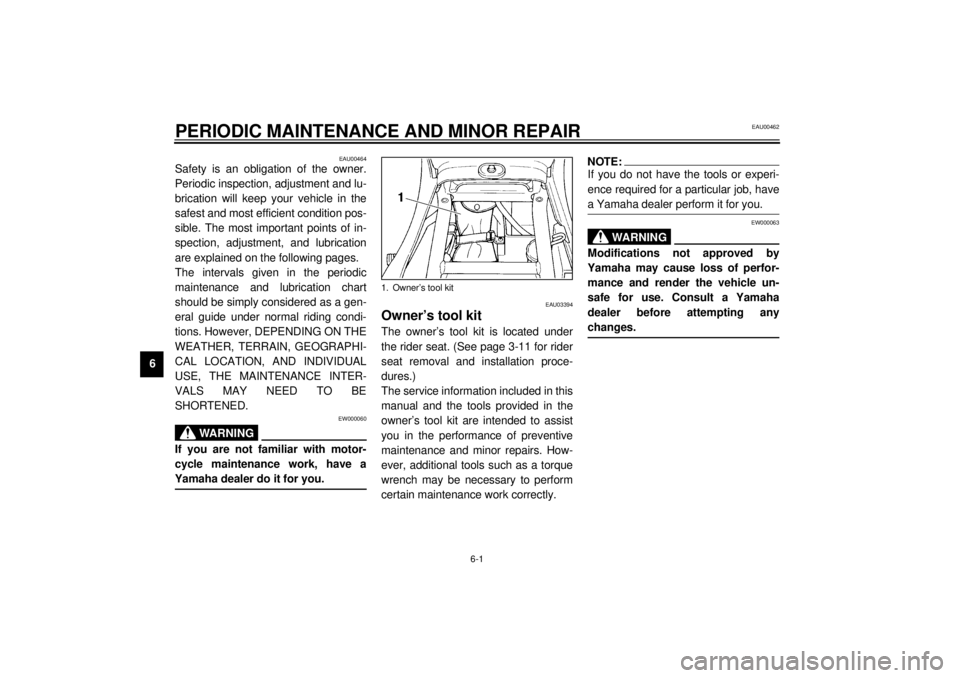
Owner’s tool kit The owner’s tool kit is located under
the rider seat. (See page 3-11 for rider
seat removal and installation proce-
dures.)
The service information included in this
manual and the tools provided in the
owner’s tool kit are intended to assist
you in the performance of preventive
maintenance and minor repairs. How-
ever, additional tools such as a torque
wrench may be necessary to perform
certain maintenance work correctly.
NOTE:@ If you do not have the tools or experi-
ence required for a particular job, have
a Yamaha dealer perform it for you. @
EW000063
WARNING
@ Modifications not approved by
Yamaha may cause loss of perfor-
mance and render the vehicle un-
safe for use. Consult a Yamaha
dealer before attempting any
changes. @
1. Owner’s tool kit
E_4km.book Page 1 Thursday, September 7, 2000 9:32 AM
Page 47 of 100
PERIODIC MAINTENANCE AND MINOR REPAIR
6-4
6
EAU03541
NOTE:@l
The air filter needs more frequent service if you are riding in unusually wet or dusty areas.
l
Hydraulic brake service
• Regularly check and, if necessary, correct the brake fluid level.
• Every two years replace the internal components of the brake master cylinder and caliper, and change the brake fluid.
• Replace the brake hoses every four years and if cracked or damaged.
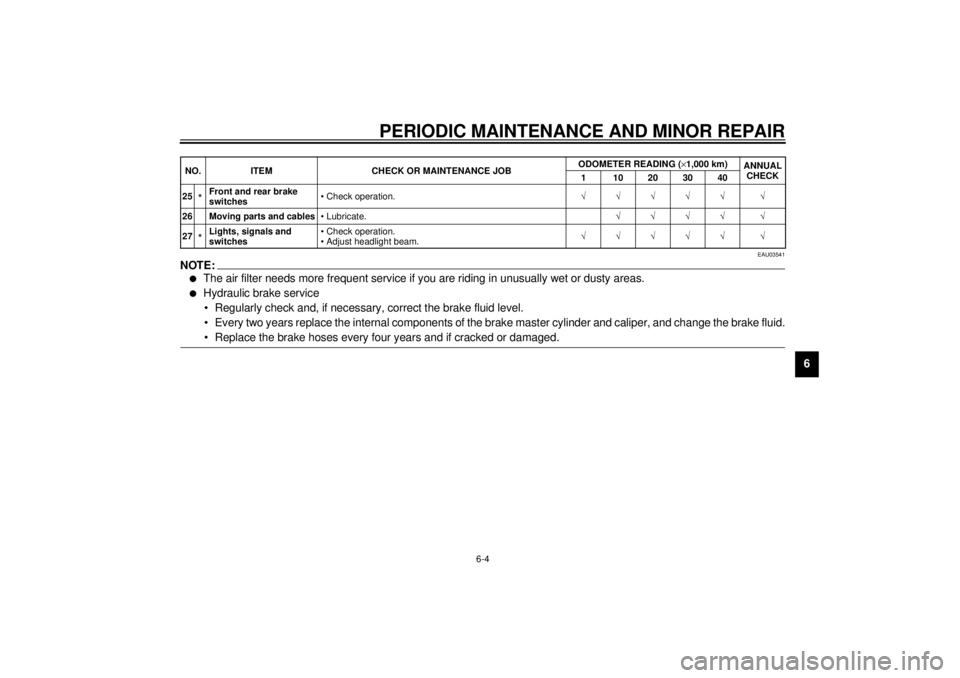
@25
*Front and rear brake
switches• Check operation.ÖÖÖÖÖ Ö
26 Moving parts and cables• Lubricate.ÖÖÖÖ Ö
27*Lights, signals and
switches• Check operation.
• Adjust headlight beam.ÖÖÖÖÖ Ö NO. ITEM CHECK OR MAINTENANCE JOBODOMETER READING (´1,000 km)
ANNUAL
CHECK
1 10203040
E_4km.book Page 4 Thursday, September 7, 2000 9:32 AM
Page 58 of 100
PERIODIC MAINTENANCE AND MINOR REPAIR
6-15
6
EAU00630
Adjusting the carburetors The carburetors are important parts of
the engine and require very sophisti-
cated adjustment. Therefore, most car-
buretor adjustments should be left to a
Yamaha dealer, who has the neces-
sary professional knowledge and expe-
rience. The adjustment described in
the following section, however, may be
serviced by the owner as part of routine
maintenance.
EC000095
CAUTION:@ The carburetors have been set and
extensively tested at the Yamaha
factory. Changing these settings
without sufficient technical knowl-
edge may result in poor perfor-
mance of or damage to the engine. @
EAU00632
Adjusting the engine idling
speed The engine idling speed must be
checked and, if necessary, adjusted as
follows at the intervals specified in the
periodic maintenance and lubrication
chart.
1. Start the engine and warm it up
for several minutes at 1,000–
2,000 r/min while occasionally rev-
ving it to 4,000–5,000 r/min.NOTE:@ The engine is warm when it quickly re-
sponds to the throttle. @
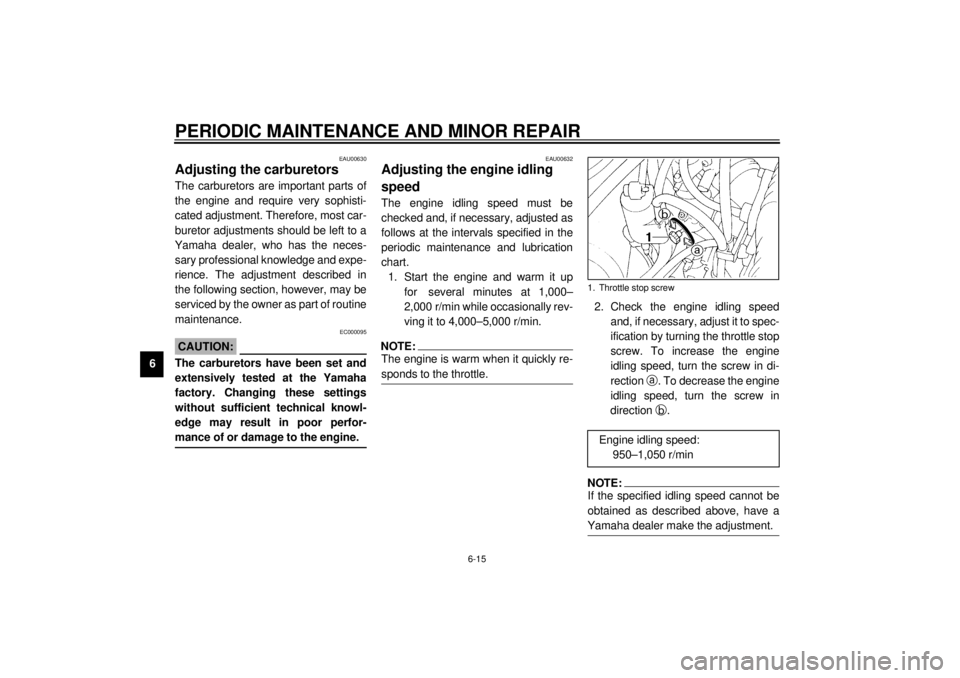
2. Check the engine idling speed
and, if necessary, adjust it to spec-
ification by turning the throttle stop
screw. To increase the engine
idling speed, turn the screw in di-
rection
a. To decrease the engine
idling speed, turn the screw in
direction
b.NOTE:@ If the specified idling speed cannot be
obtained as described above, have a
Yamaha dealer make the adjustment. @ 1. Throttle stop screw
Engine idling speed:
950–1,050 r/min
E_4km.book Page 15 Thursday, September 7, 2000 9:32 AM
Page 74 of 100
PERIODIC MAINTENANCE AND MINOR REPAIR
6-31
6
EAU03598
Front wheel To remove the front wheel
EW000122
WARNING
@ l
It is advisable to have a Yamaha
dealer service the wheel.
l
Securely support the motor-
cycle so that there is no danger
of it falling over.
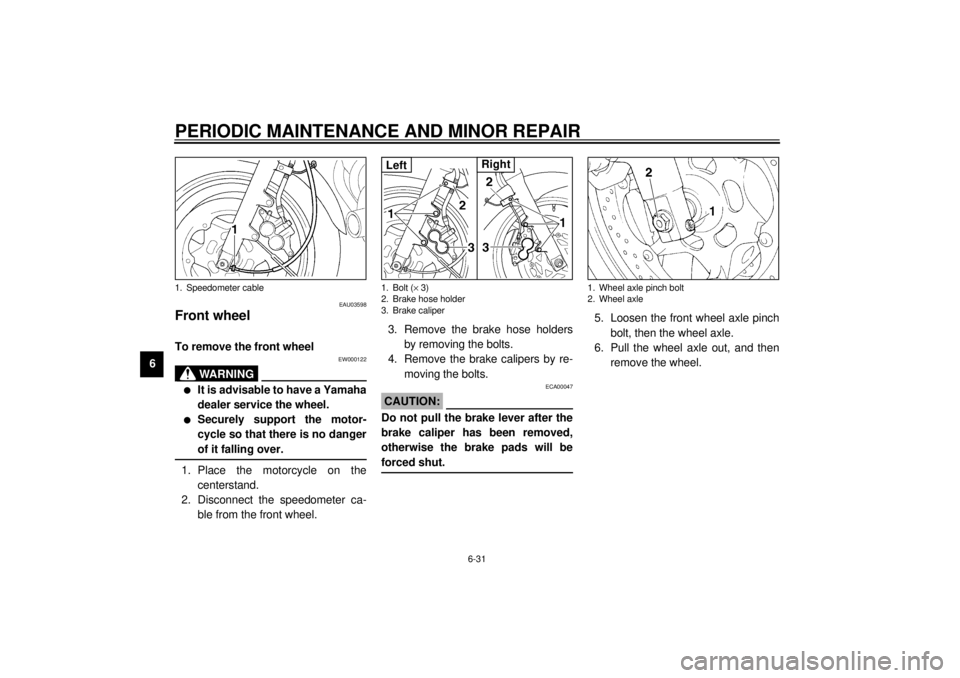
@1. Place the motorcycle on the
centerstand.
2. Disconnect the speedometer ca-
ble from the front wheel.3. Remove the brake hose holders
by removing the bolts.
4. Remove the brake calipers by re-
moving the bolts.
ECA00047
CAUTION:@ Do not pull the brake lever after the
brake caliper has been removed,
otherwise the brake pads will be
forced shut. @
5. Loosen the front wheel axle pinch
bolt, then the wheel axle.
6. Pull the wheel axle out, and then
remove the wheel.
1. Speedometer cable
1. Bolt (´ 3)
2. Brake hose holder
3. Brake caliperLeft
Right
1. Wheel axle pinch bolt
2. Wheel axle
E_4km.book Page 31 Thursday, September 7, 2000 9:32 AM
Page 76 of 100
PERIODIC MAINTENANCE AND MINOR REPAIR
6-33
6
EAU03410
Rear wheel To remove the rear wheel
EW000122
WARNING
@ l
It is advisable to have a Yamaha
dealer service the wheel.
l
Securely support the motor-
cycle so that there is no danger
of it falling over.
@
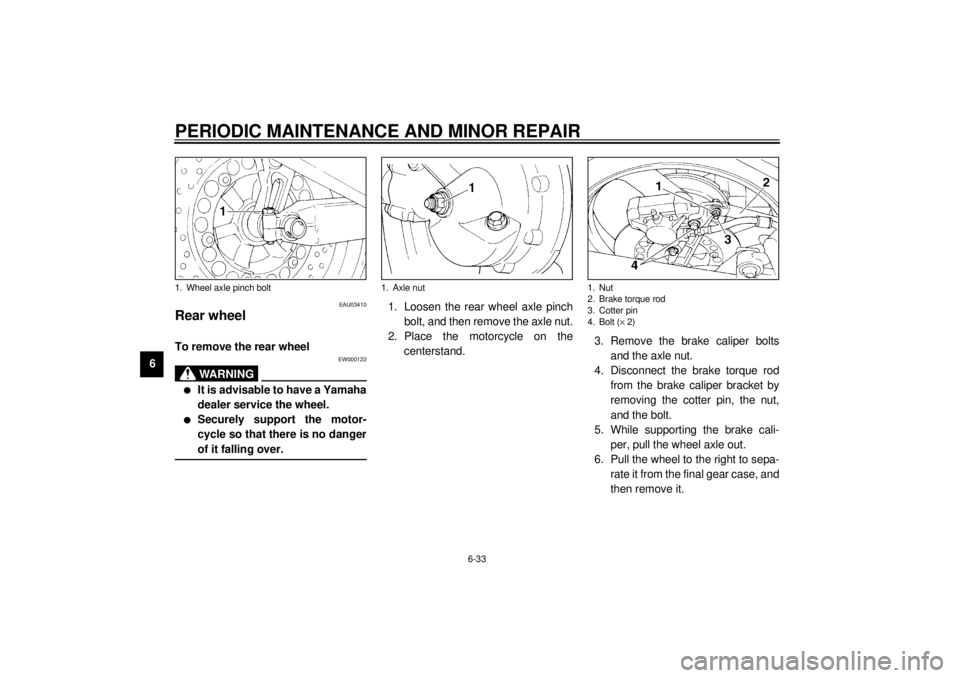
1. Loosen the rear wheel axle pinch
bolt, and then remove the axle nut.
2. Place the motorcycle on the
centerstand.3. Remove the brake caliper bolts
and the axle nut.
4. Disconnect the brake torque rod
from the brake caliper bracket by
removing the cotter pin, the nut,
and the bolt.
5. While supporting the brake cali-
per, pull the wheel axle out.
6. Pull the wheel to the right to sepa-
rate it from the final gear case, and
then remove it.
1. Wheel axle pinch bolt
1. Axle nut
1. Nut
2. Brake torque rod
3. Cotter pin
4. Bolt (´ 2)
E_4km.book Page 33 Thursday, September 7, 2000 9:32 AM
Page 78 of 100

PERIODIC MAINTENANCE AND MINOR REPAIR
6-35
6
EAU01008
Troubleshooting Although Yamaha motorcycles receive
a thorough inspection before shipment
from the factory, trouble may occur dur-
ing operation. Any problem in the fuel,
compression, or ignition systems, for
example, can cause poor starting and
loss of power.
The following troubleshooting chart
represents a quick and easy procedure
for checking these vital systems your-
self. However, should your motorcycle
require any repair, take it to a Yamaha
dealer, whose skilled technicians have
the necessary tools, experience, and
know-how to service the motorcycle
properly.
Use only genuine Yamaha replace-
ment parts. Imitation parts may look
like Yamaha parts, but they are often
inferior, have a shorter service life and
can lead to expensive repair bills. Tightening torques:
Axle nut:
105 Nm (10.5 m·kg)
Brake caliper bolt:
40 Nm (4.0 m·kg)
Brake torque rod nut:
23 Nm (2.3 m·kg)
E_4km.book Page 35 Thursday, September 7, 2000 9:32 AM
Page 88 of 100
8-1
8
EAU01038
8-SPECIFICATIONSSpecifications CS-01E
Model XJ900S
Dimensions
Overall length 2,230 mm
Overall width 750 mm
Overall height 1,300 mm
Seat height 795 mm
Wheelbase 1,505 mm
Ground clearance 130 mm
Minimum turning radius 3,000 mm
Basic weight (with oil and full
fuel tank)
265 kg
Engine
Engine type Air-cooled 4-stroke, DOHC
Cylinder arrangement Forward-inclined parallel
4-cylinder
Displacement 892 cm
3
Bore ´ Stroke 68.5 ´ 60.5 mm
Compression ratio 10:1
Starting system Electric starter
Lubrication system Wet sumpEngine oil
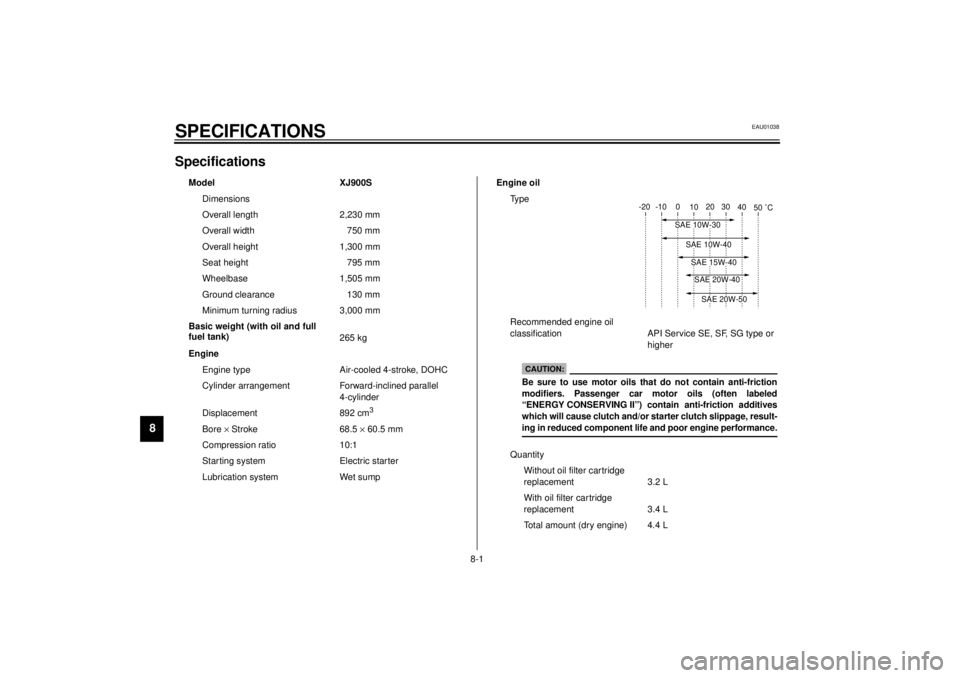
Ty p e
Recommended engine oil
classification API Service SE, SF, SG type or
higher
Quantity
Without oil filter cartridge
replacement 3.2 L
With oil filter car tridge
replacement 3.4 L
Total amount (dry engine) 4.4 L
-20 -10 0
10 20 30
40
50 ˚C
SAE 10W-30
SAE 15W-40SAE 20W-40SAE 20W-50
SAE 10W-40
CAUTION:Be sure to use motor oils that do not contain anti-friction
modifiers. Passenger car motor oils (often labeled
“ENERGY CONSERVING II”) contain anti-friction additives
which will cause clutch and/or starter clutch slippage, result-
ing in reduced component life and poor engine performance.
E_4km.book Page 1 Thursday, September 7, 2000 9:32 AM