fuel YAMAHA XJR 1300 2000 User Guide
[x] Cancel search | Manufacturer: YAMAHA, Model Year: 2000, Model line: XJR 1300, Model: YAMAHA XJR 1300 2000Pages: 95, PDF Size: 2.92 MB
Page 36 of 95

5
OPERATION AND IMPORTANT RIDING POINTS
Starting the engine ............................................................................. 5-1
Starting a warm engine ...................................................................... 5-4
Shifting ............................................................................................... 5-4
Recommended shift points (for Switzerland only) .............................. 5-5
Tips for reducing fuel consumption .................................................... 5-5
Engine break-in .................................................................................. 5-5
Parking ............................................................................................... 5-6
Page 39 of 95

OPERATION AND IMPORTANT RIDING POINTS
5-3
51. Turn the fuel cock to “ON”.
2. Turn the main switch to “ON” and
the engine stop switch to “ ”.
3. Shift transmission into neutral.
NOTE:@ When the transmission is in neutral, the
neutral indicator light should be on. If
the light does not come on, ask a
Yamaha dealer to inspect it. @4. Turn on the starter (choke) and
completely close the throttle grip.
5. Start the engine by pushing the
start switch.NOTE:@ If the engine fails to start, release the
start switch, wait a few seconds, then
try again. Each attempt should be as
short as possible to preserve the bat-
tery. Do not crank the engine more
than 10 seconds on any one attempt. @
EC000034
CAUTION:@ The oil level indicator light should
come on when the start switch is
pushed and should go off when the
start switch is released. If the indica-
tor light flickers or remains on, im-
mediately stop the engine and
check the engine oil level and for oil
leakage. If necessary, fill the engine
with oil and check to see that the oil
level indicator light goes off. If the
light does not go off even with suffi-
cient oil in the crankcase or the light
does not come on when pushing the
start switch, consult a Yamaha deal-
er. @6. After starting the engine, move the
starter (choke) halfway back.NOTE:@ For maximum engine life, never accel-
erate hard with a cold engine! @
7. After the engine is warm, turn off
the starter (choke) completely.NOTE:@ The engine is warm when it responds
normally to the throttle with the starter
(choke) turned off. @
Page 41 of 95

OPERATION AND IMPORTANT RIDING POINTS
5-5
5
EAU02941
Recommended shift points
(for Switzerland only)The recommended shift points are
shown in the table below.CF-25ENOTE:@ When shifting two gears down from 4th
to 2nd, bring your motorcycle to a
speed of 35 km/h. @
EAU00424
Tips for reducing fuel
consumptionYour motorcycle’s fuel consumption
depends to a large extent on your
riding style. The following tips can help
reduce fuel consumption:l
Warm up the engine before riding.
l
Turn off the starter (choke) as
soon as possible.
l
Shift up swiftly and avoid high en-
gine speeds during acceleration.
l
Do not double-clutch or rev the en-
gine while shifting down and avoid
high engine speeds with no load
on the engine.
l
Turn off the engine instead of let-
ting it idle for an extended length
of time, i.e. in traffic jams, at traffic
lights or railroad crossings.
EAU01128
Engine break-inThere is never a more important period
in the life of your motorcycle than the
period between zero and 1,600 km. For
this reason we ask that you carefully
read the following material. Because
the engine is brand new, you must not
put an excessive load on it for the first
1,600 km. The various parts in the en-
gine wear and polish themselves to the
correct operating clearances. During
this period, prolonged full throttle oper-
ation, or any condition which might re-
sult in excessive heating of the engine,
must be avoided.
Acceleration shift point
(km/h)
1st®2nd
2nd®3rd
3rd®4th
4th®5th23
36
50
60
Page 46 of 95

PERIODIC MAINTENANCE AND MINOR REPAIR
6-2
6
EAU00473
PERIODIC MAINTENANCE AND LUBRICATION
CP-01ENO. ITEM CHECKS AND MAINTENANCE JOBSINITIAL
(1,000 km)EVERY
6,000 km
or
6 months
(whichever
comes first)12,000 km
or
12 months
(whichever
comes first)
1
*Fuel line• Check fuel hoses and vacuum hose for cracks or damage.
• Replace if necessary.ÖÖ
2*Fuel filter• Check condition.
• Replace if necessary.Ö
3 Spark plugs• Check condition.
• Clean, regap or replace if necessary.ÖÖÖ
4*Valves• Check valve clearance.
• Adjust if necessary.Every 24,000 km or 24 months
(whichever comes first)
5 Air filter• Clean or replace if necessary.ÖÖ
6*Clutch• Check operation, fluid level and vehicle for fluid leakage.
(See NOTE on page 6-4.)
• Correct accordingly. ÖÖÖ
7*Front brake• Check operation, fluid level and vehicle for fluid leakage.
(See NOTE on page 6-4.)
• Correct accordingly.
• Replace brake pads if necessary.ÖÖÖ
8*Rear brake• Check operation, fluid level and vehicle for fluid leakage.
(See NOTE on page 6-4.)
• Correct accordingly.
• Replace brake pads if necessary.ÖÖÖ
9*Wheels• Check balance, runout and for damage.
• Rebalance or replace if necessary.ÖÖ
Page 56 of 95

PERIODIC MAINTENANCE AND MINOR REPAIR
6-12
6 2. Set the idle to the specified engine
speed by adjusting the throttle
stop screw. Turn the screw in di-
rection
a to increase engine
speed and in direction
b to de-
crease engine speed.
NOTE:@ If the specified idle speed cannot be
obtained by performing the above ad-
justment, consult a Yamaha dealer. @
EAU00635
Throttle cable free play
inspectionThere should be a free play of 3 ~
5 mm at the throttle grip. If the free play
is incorrect, ask a Yamaha dealer to
make this adjustment.
EAU00637
Valve clearance adjustmentThe correct valve clearance changes
with use, resulting in improper fuel/air
supply or engine noise. To prevent this,
the valve clearance must be adjusted
regularly. This adjustment however,
should be left to a professional
Yamaha service technician.
1. Throttle stop screw
Standard idle speed:
1,000 ~ 1,100 r/min
a. Free play
Page 75 of 95

PERIODIC MAINTENANCE AND MINOR REPAIR
6-31
6
EAU01317
Rear wheel installation1. Install the caliper bracket and
wheel assembly, then insert the
axle.
2. Install and adjust the drive chain.
(See page 6-19 for details about
adjusting the drive chain slack.)
3. Install the brake torque rod bolt
and nut.
4. Install the caliper and caliper bolts.
Make sure there is enough gap
between the brake pads before in-
stalling the caliper onto the brake
disc.
5. Take the motorcycle off the cen-
terstand.
6. Tighten the axle nut, caliper bolts
and the brake torque rod nut to the
specified torques.
EAU01008
TroubleshootingAlthough Yamaha motorcycles receive
a rigid inspection before shipment from
the factory, trouble may occur during
operation.
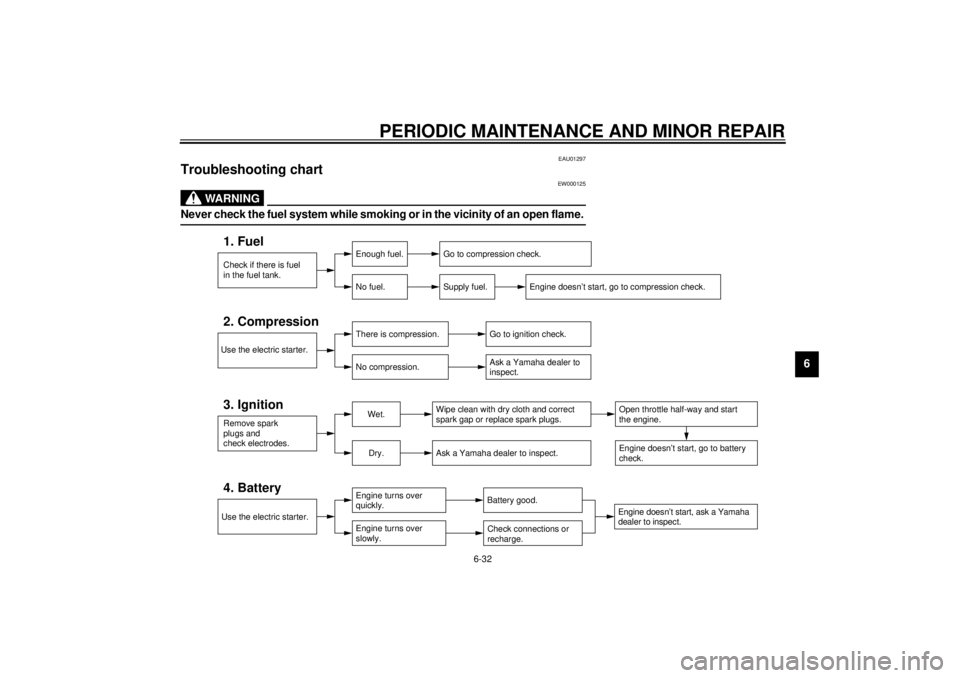
Any problem in the fuel, compression,
or ignition systems can cause poor
starting and loss of power. The trouble-
shooting chart describes a quick, easy
procedure for making checks.
If your motorcycle requires any repair,
bring it to a Yamaha dealer. The skilled
technicians at a Yamaha dealership
have the tools, experience, and know-
how to properly service your motor-
cycle. Use only genuine Yamaha parts
on your motorcycle. Imitation parts may
look like Yamaha parts, but they are of-
ten inferior. Consequently, they have a
shorter service life and can lead to ex-
pensive repair bills. Tightening torque:
Axle nut:
150 Nm (15.0 m·kg)
Caliper bolt:
40 Nm (4.0 m·kg)
Brake torque rod nut:
23 Nm (2.3 m·kg)
Page 76 of 95
PERIODIC MAINTENANCE AND MINOR REPAIR
6-32
6
EAU01297
Troubleshooting chart
EW000125
WARNING
@ Never check the fuel system while smoking or in the vicinity of an open flame. @
Check if there is fuel
in the fuel tank.1. Fuel
Enough fuel.
No fuel.
Go to compression check.
Supply fuel.
Use the electric starter.2. Compression
There is compression.
No compression.
Go to ignition check.
Ask a Yamaha dealer to
inspect.
Remove spark
plugs and
check electrodes.3. Ignition
Wet.
Dry.
Wipe clean with dry cloth and correct
spark gap or replace spark plugs.
Ask a Yamaha dealer to inspect.
Engine doesn’t start, go to battery
check.Open throttle half-way and start
the engine.
Use the electric starter.4. Battery
Engine turns over
quickly.
Engine turns over
slowly.
Battery good.Check connections or
recharge.
Engine doesn’t start, ask a Yamaha
dealer to inspect.
Engine doesn’t start, go to compression check.
Page 80 of 95
MOTORCYCLE CARE AND STORAGE
7-2
7
ECA00010
CAUTION:@ l
Avoid using strong acidic wheel
cleaners, especially on spoked
wheels. If you do use such
products for hard-to-remove
dirt, do not leave it on any long-
er than instructed, then thor-
oughly rinse it off with water,
immediately dry the area and
apply a corrosion protection
spray.
l
Improper cleaning can damage
windshields, cowlings, panels
and other plastic parts. Use
only a soft, clean cloth or
sponge with mild detergent and
water to clean plastic.
l
Do not use any harsh chemical
products on plastic parts. Be
sure to avoid using cloths or
sponges which have been in
contact with strong or abrasive
cleaning products, solvent or
thinner, fuel (gasoline), rust re-
movers or inhibitors, brake flu-
id, antifreeze or electrolyte.
l
Do not use high-pressure wash-
ers or steam-jet cleaners since
they cause water seepage and
deterioration in the following ar-
eas: seals (of wheel bearings,
swingarm bearings, forks and
brakes), electric components
(couplers, connectors, instru-
ments, switches and lights),
breather hoses and vents.
l
For motorcycles equipped with
a windshield: Do not use strong
cleaners or hard sponges as
they will cause dulling or
scratching. Some cleaning
compounds for plastic may
leave scratches on the wind-
shield. Test the product on a
small hidden part of the wind-
shield to make sure they do not
leave any marks. If the wind-
shield is scratched, use a quali-
ty plastic polishing compound
after washing.
@After riding in the rain, near the sea oron salt-sprayed roadsSince sea salt or salt sprayed on the
roads in the winter are extremely corro-
sive in combination with water, carry
out the following steps after each ride
in the rain, near the sea or on salt-
sprayed roads. (Salt sprayed in the
winter may remain on the roads well
into spring.)
Page 82 of 95

MOTORCYCLE CARE AND STORAGE
7-4
7
ECA00013
CAUTION:@ l
Apply spray oil and wax spar-
ingly and wipe off any excess.
l
Never apply oil or wax on rub-
ber and plastic parts, but treat
them with a suitable care prod-
uct.
l
Avoid using abrasive polishing
compounds as they wear away
the paint.
@NOTE:@ Consult a Yamaha dealer for advice on
what products to use. @
StorageShort-term
Always store your motorcycle in a cool,
dry place and, if necessary, protect it
against dust with a porous cover.
ECA00014
CAUTION:@ l
Storing the motorcycle in a
poorly ventilated room or cover-
ing it with a tarp while it is still
wet will allow water and humidi-
ty to seep in and cause rust.
l
To prevent corrosion, avoid
damp cellars, stables (because
of the presence of ammonia)
and areas where strong chemi-
cals are stored.
@
Long-term
Before storing your motorcycle for
several months:
1. Follow all the instructions in the
“Care” section of this chapter.
2. Drain the carburetor float cham-
bers by loosening the drain bolts;
this will prevent fuel deposits from
building up. Pour the drained fuel
into the fuel tank.
3. Only for motorcycles equipped
with a fuel cock which has an
“OFF” position: Turn the fuel cock
to “OFF”.
4. Fill up the fuel tank and add fuel
stabilizer (if available) to prevent
the fuel tank from rusting and the
fuel from deteriorating.
5. Perform the following steps to pro-
tect the cylinders, piston rings, etc.
from corrosion.
Page 85 of 95

8-1
8
EAU01038
8-SPECIFICATIONSSpecifications
Model XJR1300/XJR1300SP
Dimensions
Overall length 2,250 mm (for SF, N, S)
2,175 mm (except for SF, N, S)
Overall width 775 mm
Overall height 1,115 mm
Seat height 775 mm
Wheelbase 1,500 mm
Ground clearance 120 mm
Minimum turning radius 2,800 mm
Basic weight (with oil and full
fuel tank)
253 kg
Engine
Engine type Air-cooled 4-stroke, DOHC
Cylinder arrangement Forward-inclined parallel
4-cylinder
Displacement 1,250 cm
3
Bore ´ Stroke 79.0 ´ 63.8 mm
Compression ratio 9.7:1
Starting system Electric starter
Lubrication system Wet sumpEngine oil
Ty p e
Recommended engine oil
classification API Service SE, SF, SG type or
higher
Quantity
Periodic oil change 3.0 L
With oil filter replacement 3.35 L
Total amount 4.2 L
Air filterDry type element
-20˚ -10˚ 0˚
10˚20˚ 30˚
40˚50˚C
SAE 10W/30
SAE 15W/40SAE 20W/40SAE 20W/50
SAE 10W/40
CAUTION:Be sure to use motor oils that do not contain anti-friction
modifiers. Passenger car motor oils (often labeled
“Energy Conserving”) contain anti-friction additives which
will cause clutch and/or starter clutch slippage, resulting in
reduced component life and poor engine performance.