maintenance YAMAHA XJR 1300 2000 Owner's Guide
[x] Cancel search | Manufacturer: YAMAHA, Model Year: 2000, Model line: XJR 1300, Model: YAMAHA XJR 1300 2000Pages: 95, PDF Size: 2.92 MB
Page 72 of 95
PERIODIC MAINTENANCE AND MINOR REPAIR
6-28
6
EAU00869
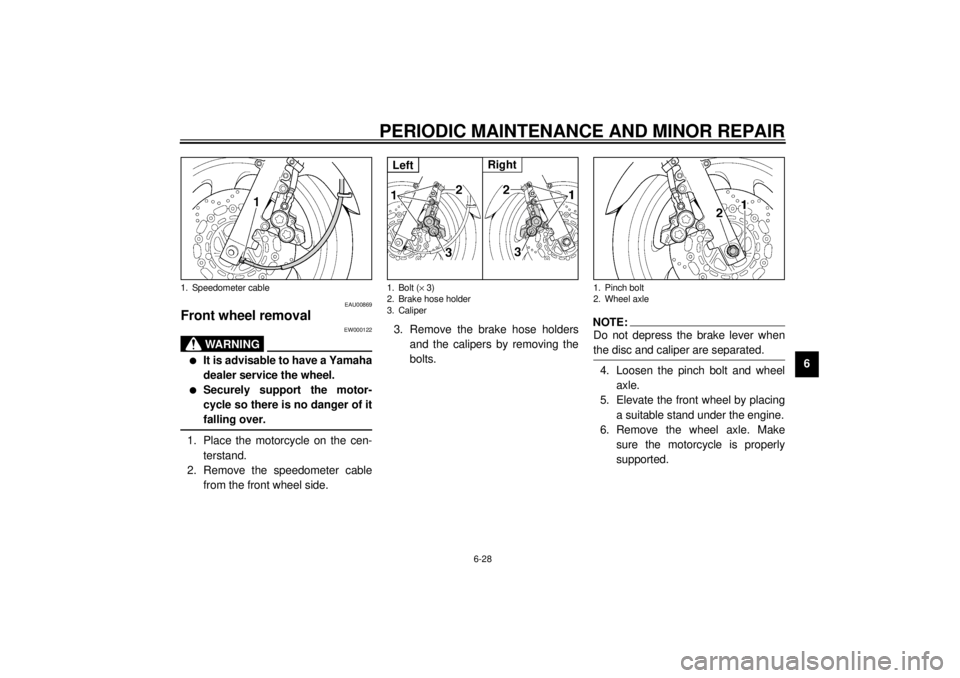
Front wheel removal
EW000122
WARNING
@ l
It is advisable to have a Yamaha
dealer service the wheel.
l
Securely support the motor-
cycle so there is no danger of it
falling over.
@1. Place the motorcycle on the cen-
terstand.
2. Remove the speedometer cable
from the front wheel side.3. Remove the brake hose holders
and the calipers by removing the
bolts.
NOTE:@ Do not depress the brake lever when
the disc and caliper are separated. @4. Loosen the pinch bolt and wheel
axle.
5. Elevate the front wheel by placing
a suitable stand under the engine.
6. Remove the wheel axle. Make
sure the motorcycle is properly
supported.
1. Speedometer cable
1. Bolt (´ 3)
2. Brake hose holder
3. CaliperLeft
Right
1. Pinch bolt
2. Wheel axle
Page 73 of 95
PERIODIC MAINTENANCE AND MINOR REPAIR
6-29
6
EAU01758*
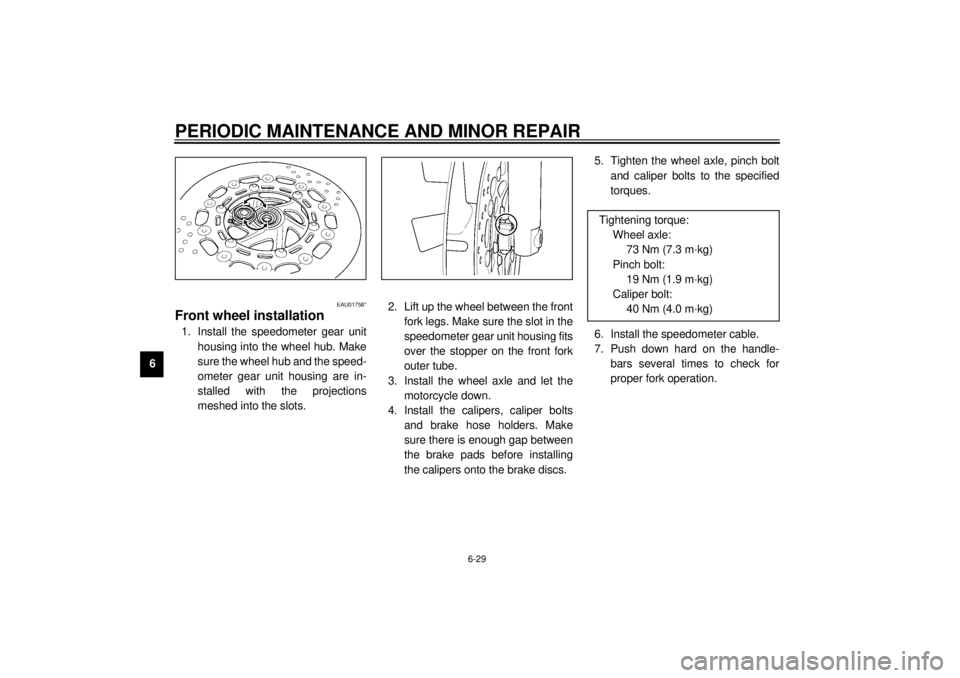
Front wheel installation1. Install the speedometer gear unit
housing into the wheel hub. Make
sure the wheel hub and the speed-
ometer gear unit housing are in-
stalled with the projections
meshed into the slots.2. Lift up the wheel between the front
fork legs. Make sure the slot in the
speedometer gear unit housing fits
over the stopper on the front fork
outer tube.
3. Install the wheel axle and let the
motorcycle down.
4. Install the calipers, caliper bolts
and brake hose holders. Make
sure there is enough gap between
the brake pads before installing
the calipers onto the brake discs.5. Tighten the wheel axle, pinch bolt
and caliper bolts to the specified
torques.
6. Install the speedometer cable.
7. Push down hard on the handle-
bars several times to check for
proper fork operation.
Tightening torque:
Wheel axle:
73 Nm (7.3 m·kg)
Pinch bolt:
19 Nm (1.9 m·kg)
Caliper bolt:
40 Nm (4.0 m·kg)
Page 74 of 95
PERIODIC MAINTENANCE AND MINOR REPAIR
6-30
6
EAU01318
Rear wheel removal
EW000122
WARNING
@ l
It is advisable to have a Yamaha
dealer service the wheel.
l
Securely support the motor-
cycle so there is no danger of it
falling over.
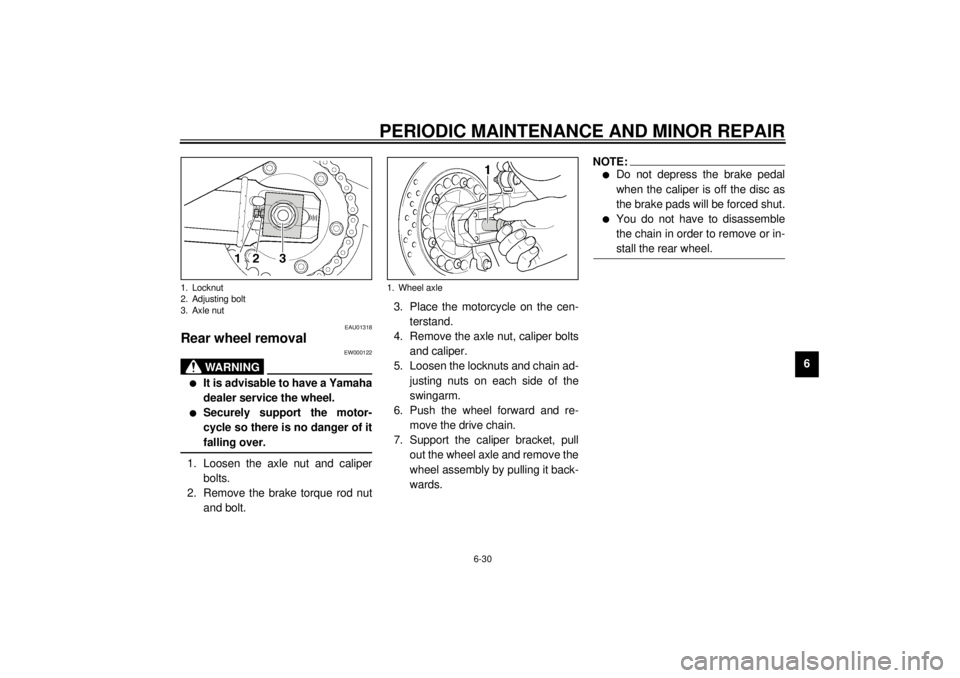
@1. Loosen the axle nut and caliper
bolts.
2. Remove the brake torque rod nut
and bolt.3. Place the motorcycle on the cen-
terstand.
4. Remove the axle nut, caliper bolts
and caliper.
5. Loosen the locknuts and chain ad-
justing nuts on each side of the
swingarm.
6. Push the wheel forward and re-
move the drive chain.
7. Support the caliper bracket, pull
out the wheel axle and remove the
wheel assembly by pulling it back-
wards.
NOTE:@ l
Do not depress the brake pedal
when the caliper is off the disc as
the brake pads will be forced shut.
l
You do not have to disassemble
the chain in order to remove or in-
stall the rear wheel.
@
1. Locknut
2. Adjusting bolt
3. Axle nut
1. Wheel axle
Page 75 of 95

PERIODIC MAINTENANCE AND MINOR REPAIR
6-31
6
EAU01317
Rear wheel installation1. Install the caliper bracket and
wheel assembly, then insert the
axle.
2. Install and adjust the drive chain.
(See page 6-19 for details about
adjusting the drive chain slack.)
3. Install the brake torque rod bolt
and nut.
4. Install the caliper and caliper bolts.
Make sure there is enough gap
between the brake pads before in-
stalling the caliper onto the brake
disc.
5. Take the motorcycle off the cen-
terstand.
6. Tighten the axle nut, caliper bolts
and the brake torque rod nut to the
specified torques.
EAU01008
TroubleshootingAlthough Yamaha motorcycles receive
a rigid inspection before shipment from
the factory, trouble may occur during
operation.
Any problem in the fuel, compression,
or ignition systems can cause poor
starting and loss of power. The trouble-
shooting chart describes a quick, easy
procedure for making checks.
If your motorcycle requires any repair,
bring it to a Yamaha dealer. The skilled
technicians at a Yamaha dealership
have the tools, experience, and know-
how to properly service your motor-
cycle. Use only genuine Yamaha parts
on your motorcycle. Imitation parts may
look like Yamaha parts, but they are of-
ten inferior. Consequently, they have a
shorter service life and can lead to ex-
pensive repair bills. Tightening torque:
Axle nut:
150 Nm (15.0 m·kg)
Caliper bolt:
40 Nm (4.0 m·kg)
Brake torque rod nut:
23 Nm (2.3 m·kg)
Page 76 of 95
PERIODIC MAINTENANCE AND MINOR REPAIR
6-32
6
EAU01297
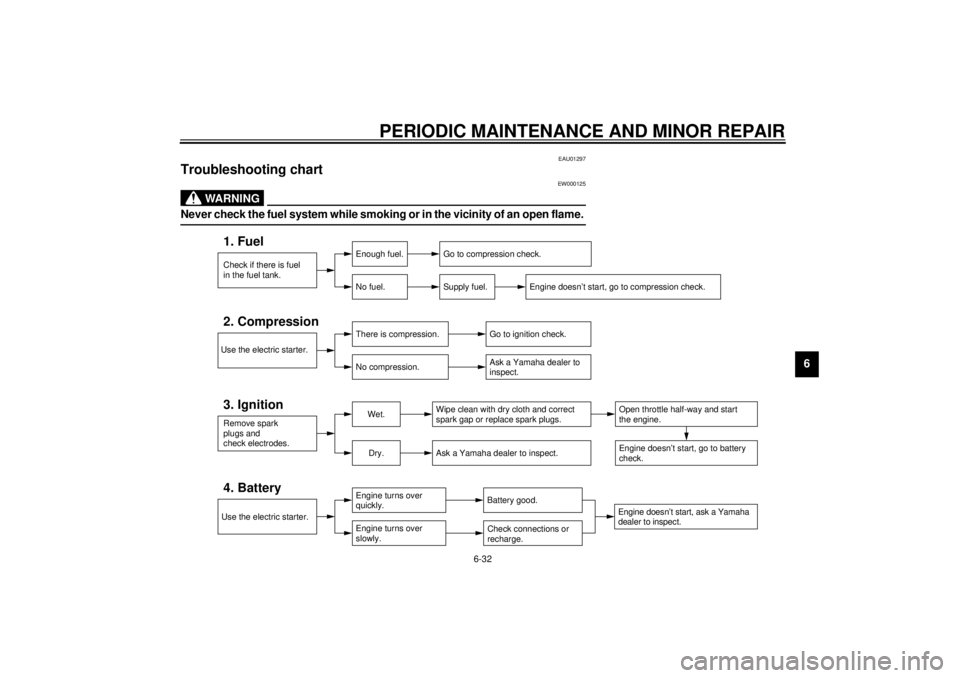
Troubleshooting chart
EW000125
WARNING
@ Never check the fuel system while smoking or in the vicinity of an open flame. @
Check if there is fuel
in the fuel tank.1. Fuel
Enough fuel.
No fuel.
Go to compression check.
Supply fuel.
Use the electric starter.2. Compression
There is compression.
No compression.
Go to ignition check.
Ask a Yamaha dealer to
inspect.
Remove spark
plugs and
check electrodes.3. Ignition
Wet.
Dry.
Wipe clean with dry cloth and correct
spark gap or replace spark plugs.
Ask a Yamaha dealer to inspect.
Engine doesn’t start, go to battery
check.Open throttle half-way and start
the engine.
Use the electric starter.4. Battery
Engine turns over
quickly.
Engine turns over
slowly.
Battery good.Check connections or
recharge.
Engine doesn’t start, ask a Yamaha
dealer to inspect.
Engine doesn’t start, go to compression check.
Page 83 of 95

MOTORCYCLE CARE AND STORAGE
7-5
7a. Remove the spark plug caps and
spark plugs.
b. Pour a teaspoonful of engine oil
into each spark plug bore.
c. Install the spark plug caps onto the
spark plugs and place the spark
plugs on the cylinder head so that
the electrodes are grounded. (This
will limit sparking during the next
step.)
d. Turn the engine over several times
with the starter. (This will coat the
cylinder walls with oil.)
e. Remove the spark plug caps from
the spark plugs, install the spark
plugs and then the spark plug
caps.
EWA00003
WARNING
@ When turning the engine over, be
sure to ground the spark plug elec-
trodes to prevent damage or injury
from sparking. @
6. Lubricate all control cables and
the pivoting points of all levers and
pedals as well as of the sidestand/
centerstand.
7. Check and, if necessary, correct
the tire air pressure, then raise the
motorcycle so that both of its
wheels are off the ground. Alterna-
tively, turn the wheels a little every
month in order to prevent the tires
from becoming degraded in one
spot.
8. Cover up the muffler outlets with
plastic bags to prevent moisture
from entering.9. Remove the battery and fully
charge it. Store it in a cool, dry
place and recharge it once a
month. Do not store the battery in
an excessively cold or warm place
(less than 0 °C or more than
30 °C). For more information, see
“Battery storage” in the chapter
“PERIODIC MAINTENANCE AND
MINOR REPAIRS”.
NOTE:@ Make any necessary repairs before
storing the motorcycle. @
Page 93 of 95
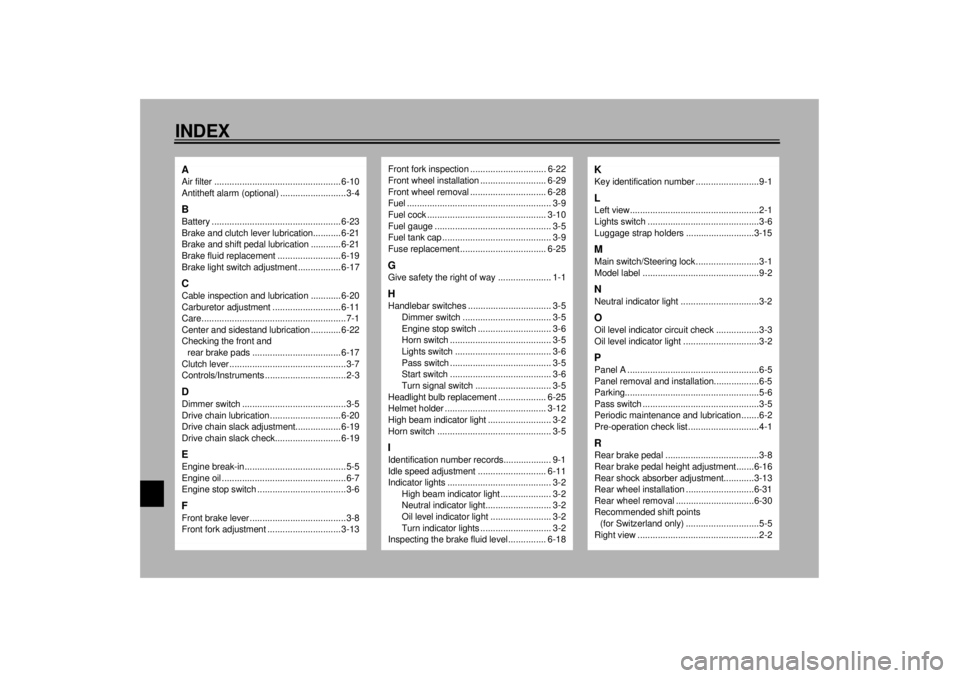
10-INDEXAAir filter .................................................. 6-10
Antitheft alarm (optional) ..........................3-4BBattery ................................................... 6-23
Brake and clutch lever lubrication........... 6-21
Brake and shift pedal lubrication ............ 6-21
Brake fluid replacement ......................... 6-19
Brake light switch adjustment ................. 6-17CCable inspection and lubrication ............ 6-20
Carburetor adjustment ........................... 6-11
Care.........................................................7-1
Center and sidestand lubrication ............ 6-22
Checking the front and
rear brake pads ................................... 6-17
Clutch lever ..............................................3-7
Controls/Instruments ................................2-3DDimmer switch .........................................3-5
Drive chain lubrication ............................ 6-20
Drive chain slack adjustment.................. 6-19
Drive chain slack check.......................... 6-19EEngine break-in........................................5-5
Engine oil .................................................6-7
Engine stop switch ...................................3-6FFront brake lever ......................................3-8
Front fork adjustment ............................. 3-13
Front fork inspection .............................. 6-22
Front wheel installation .......................... 6-29
Front wheel removal .............................. 6-28
Fuel ......................................................... 3-9
Fuel cock ............................................... 3-10
Fuel gauge .............................................. 3-5
Fuel tank cap ........................................... 3-9
Fuse replacement.................................. 6-25GGive safety the right of way ..................... 1-1HHandlebar switches ................................. 3-5
Dimmer switch ................................... 3-5
Engine stop switch ............................. 3-6
Horn switch ........................................ 3-5
Lights switch ...................................... 3-6
Pass switch ........................................ 3-5
Start switch ........................................ 3-6
Turn signal switch .............................. 3-5
Headlight bulb replacement ................... 6-25
Helmet holder ........................................ 3-12
High beam indicator light ......................... 3-2
Horn switch ............................................. 3-5IIdentification number records................... 9-1
Idle speed adjustment ........................... 6-11
Indicator lights ......................................... 3-2
High beam indicator light .................... 3-2
Neutral indicator light.......................... 3-2
Oil level indicator light ........................ 3-2
Turn indicator lights ............................ 3-2
Inspecting the brake fluid level............... 6-18
KKey identification number .........................9-1LLeft view...................................................2-1
Lights switch ............................................3-6
Luggage strap holders ...........................3-15MMain switch/Steering lock .........................3-1
Model label ..............................................9-2NNeutral indicator light ...............................3-2OOil level indicator circuit check .................3-3
Oil level indicator light ..............................3-2PPanel A ....................................................6-5
Panel removal and installation..................6-5
Parking.....................................................5-6
Pass switch ..............................................3-5
Periodic maintenance and lubrication .......6-2
Pre-operation check list ............................4-1RRear brake pedal .....................................3-8
Rear brake pedal height adjustment.......6-16
Rear shock absorber adjustment............3-13
Rear wheel installation ...........................6-31
Rear wheel removal ...............................6-30
Recommended shift points
(for Switzerland only) .............................5-5
Right view ................................................2-2