check engine YAMAHA XJR 1300 2001 User Guide
[x] Cancel search | Manufacturer: YAMAHA, Model Year: 2001, Model line: XJR 1300, Model: YAMAHA XJR 1300 2001Pages: 100, PDF Size: 11.75 MB
Page 47 of 100
PERIODIC MAINTENANCE AND MINOR REPAIR
6-4
6
EAU03058
NOTE:_ l
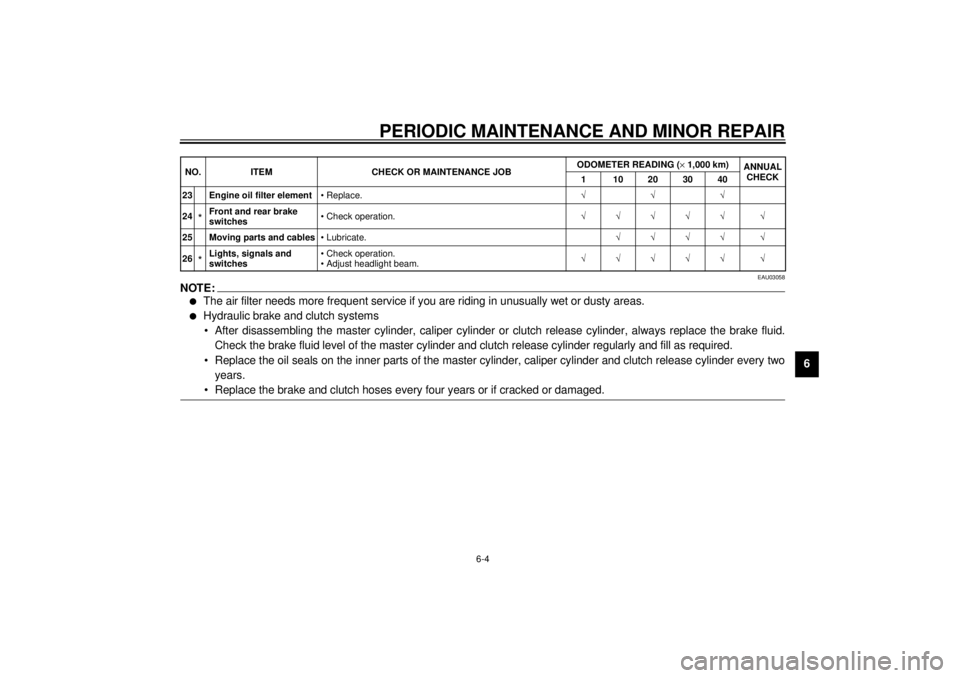
The air filter needs more frequent service if you are riding in unusually wet or dusty areas.
l
Hydraulic brake and clutch systems
• After disassembling the master cylinder, caliper cylinder or clutch release cylinder, always replace the brake fluid.
Check the brake fluid level of the master cylinder and clutch release cylinder regularly and fill as required.
• Replace the oil seals on the inner parts of the master cylinder, caliper cylinder and clutch release cylinder every two
years.
• Replace the brake and clutch hoses every four years or if cracked or damaged.
_23 Engine oil filter element• Replace.ÖÖÖ
24
*Front and rear brake
switches• Check operation.ÖÖÖÖÖ Ö
25 Moving parts and cables• Lubricate.ÖÖÖÖ Ö
26*Lights, signals and
switches• Check operation.
• Adjust headlight beam.ÖÖÖÖÖ Ö NO. ITEM CHECK OR MAINTENANCE JOBODOMETER READING (´1,000 km)
ANNUAL
CHECK
1 10203040
E_5ea.book Page 4 Wednesday, October 4, 2000 4:14 PM
Page 49 of 100
PERIODIC MAINTENANCE AND MINOR REPAIR
6-6
6
EAU03329
Checking the spark plugs The spark plugs are important engine
components, which are easy to check.
Since heat and deposits will cause any
spark plug to slowly erode, the spark
plugs should be removed and checked
in accordance with the periodic mainte-
nance and lubrication chart. In addition,
the condition of the spark plugs can re-
veal the condition of the engine.
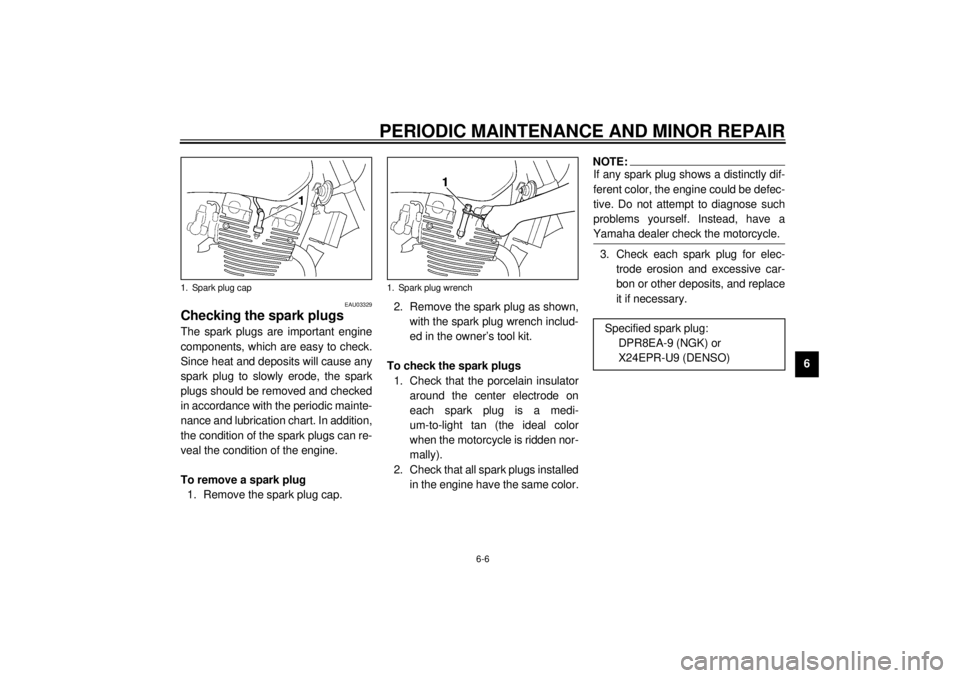
To remove a spark plug
1. Remove the spark plug cap.2. Remove the spark plug as shown,
with the spark plug wrench includ-
ed in the owner’s tool kit.
To check the spark plugs
1. Check that the porcelain insulator
around the center electrode on
each spark plug is a medi-
um-to-light tan (the ideal color
when the motorcycle is ridden nor-
mally).
2. Check that all spark plugs installed
in the engine have the same color.
NOTE:_ If any spark plug shows a distinctly dif-
ferent color, the engine could be defec-
tive. Do not attempt to diagnose such
problems yourself. Instead, have a
Yamaha dealer check the motorcycle. _3. Check each spark plug for elec-
trode erosion and excessive car-
bon or other deposits, and replace
it if necessary.
1. Spark plug cap
1. Spark plug wrench
Specified spark plug:
DPR8EA-9 (NGK) or
X24EPR-U9 (DENSO)
E_5ea.book Page 6 Wednesday, October 4, 2000 4:14 PM
Page 50 of 100
PERIODIC MAINTENANCE AND MINOR REPAIR
6-7
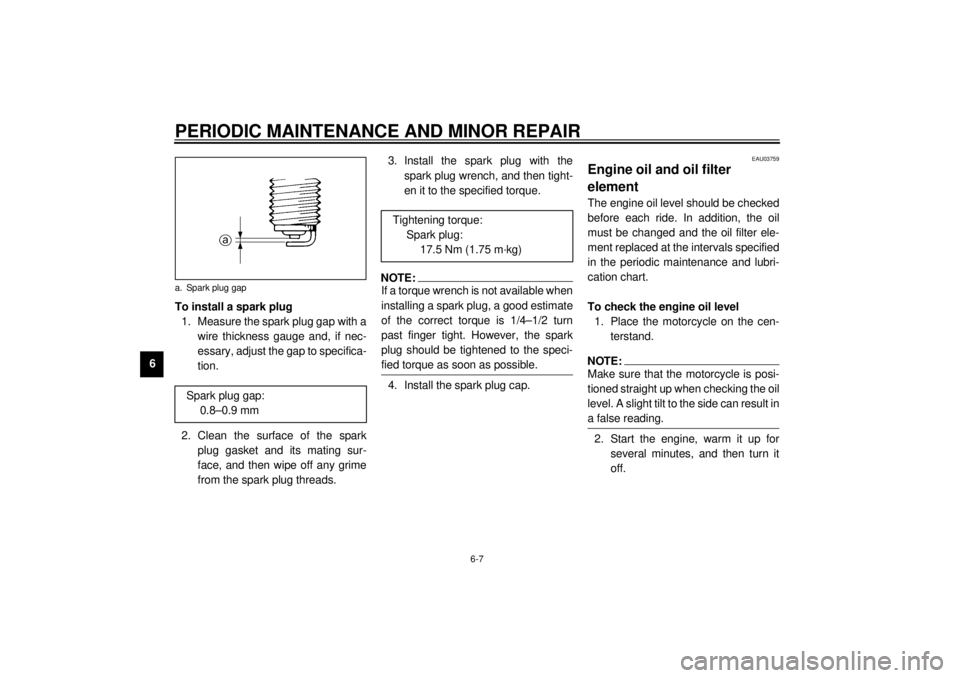
6To install a spark plug
1. Measure the spark plug gap with a
wire thickness gauge and, if nec-
essary, adjust the gap to specifica-
tion.
2. Clean the surface of the spark
plug gasket and its mating sur-
face, and then wipe off any grime
from the spark plug threads.3. Install the spark plug with the
spark plug wrench, and then tight-
en it to the specified torque.
NOTE:_ If a torque wrench is not available when
installing a spark plug, a good estimate
of the correct torque is 1/4–1/2 turn
past finger tight. However, the spark
plug should be tightened to the speci-
fied torque as soon as possible. _4. Install the spark plug cap.
EAU03759
Engine oil and oil filter
element The engine oil level should be checked
before each ride. In addition, the oil
must be changed and the oil filter ele-
ment replaced at the intervals specified
in the periodic maintenance and lubri-
cation chart.
To check the engine oil level
1. Place the motorcycle on the cen-
terstand.NOTE:_ Make sure that the motorcycle is posi-
tioned straight up when checking the oil
level. A slight tilt to the side can result in
a false reading. _2. Start the engine, warm it up for
several minutes, and then turn it
off.
a. Spark plug gapSpark plug gap:
0.8–0.9 mm
Tightening torque:
Spark plug:
17.5 Nm (1.75 m·kg)
E_5ea.book Page 7 Wednesday, October 4, 2000 4:14 PM
Page 51 of 100
PERIODIC MAINTENANCE AND MINOR REPAIR
6-8
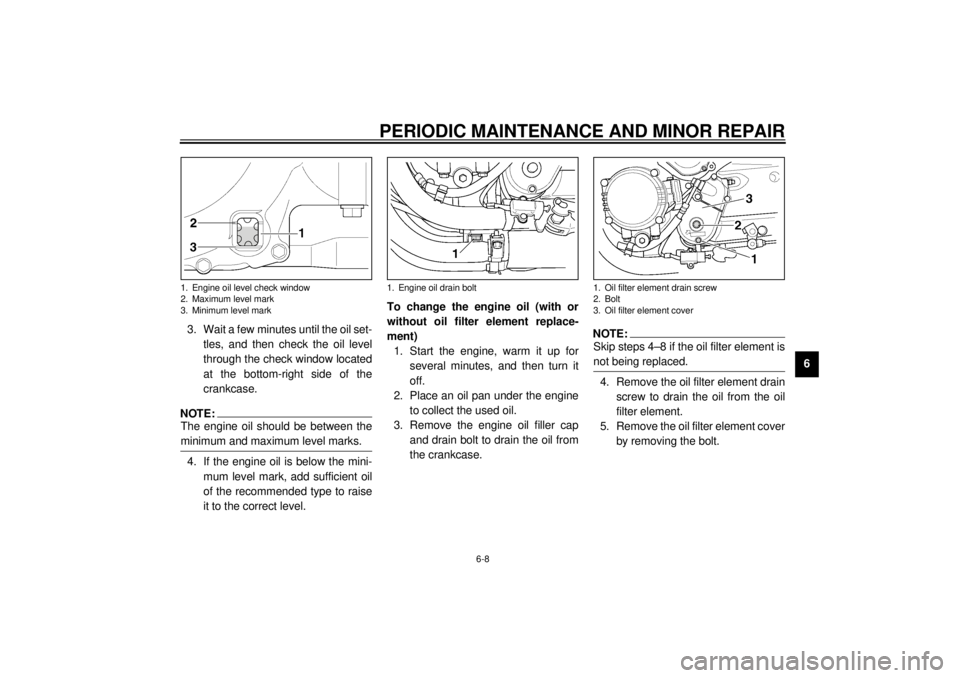
6 3. Wait a few minutes until the oil set-
tles, and then check the oil level
through the check window located
at the bottom-right side of the
crankcase.
NOTE:_ The engine oil should be between the
minimum and maximum level marks. _4. If the engine oil is below the mini-
mum level mark, add sufficient oil
of the recommended type to raise
it to the correct level.To change the engine oil (with or
without oil filter element replace-
ment)
1. Start the engine, warm it up for
several minutes, and then turn it
off.
2. Place an oil pan under the engine
to collect the used oil.
3. Remove the engine oil filler cap
and drain bolt to drain the oil from
the crankcase.
NOTE:_ Skip steps 4–8 if the oil filter element is
not being replaced. _4. Remove the oil filter element drain
screw to drain the oil from the oil
filter element.
5. Remove the oil filter element cover
by removing the bolt.
1. Engine oil level check window
2. Maximum level mark
3. Minimum level mark
1. Engine oil drain bolt
1. Oil filter element drain screw
2. Bolt
3. Oil filter element cover
E_5ea.book Page 8 Wednesday, October 4, 2000 4:14 PM
Page 53 of 100
PERIODIC MAINTENANCE AND MINOR REPAIR
6-10
6
EC000066
CAUTION:_ l
In order to prevent clutch slip-
page (since the engine oil also
lubricates the clutch), do not
mix any chemical additives with
the oil.
l
Make sure that no foreign mate-
rial enters the crankcase.
_11. Start the engine, and then let it idle
for several minutes while checking
it for oil leakage. If oil is leaking,
immediately turn the engine off
and check for the cause.
NOTE:_ After the engine is started, the engine
oil level warning light should go off if the
oil level is sufficient. _
EC000067
CAUTION:_ If the oil level warning light flickers
or remains on, immediately turn the
engine off and have a Yamaha deal-
er check the vehicle. _12. Turn the engine off, and then
check the oil level and correct it if
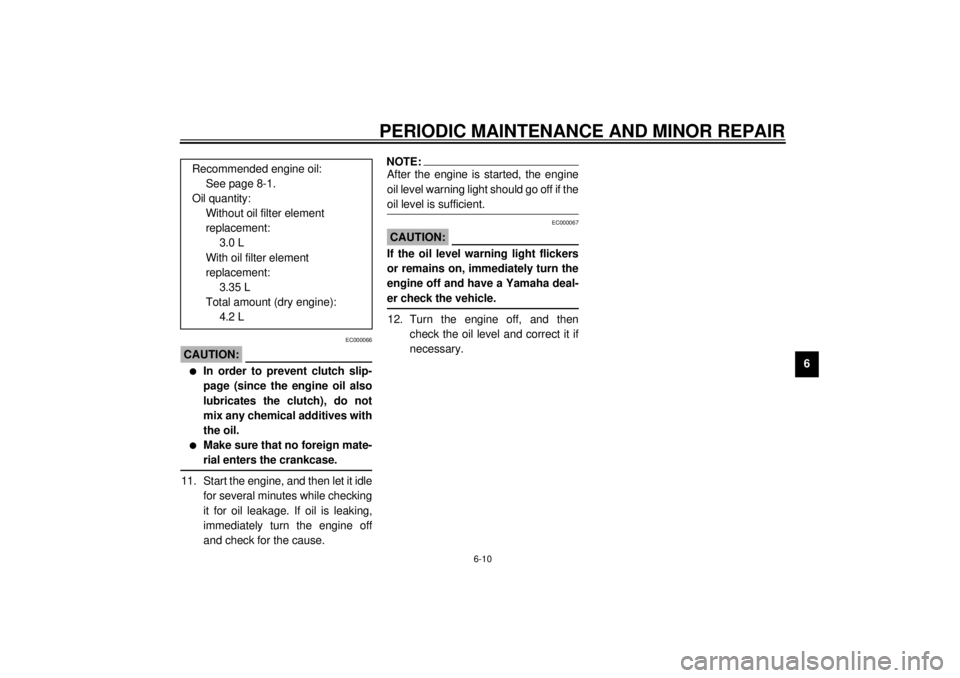
necessary. Recommended engine oil:
See page 8-1.
Oil quantity:
Without oil filter element
replacement:
3.0 L
With oil filter element
replacement:
3.35 L
Total amount (dry engine):
4.2 L
E_5ea.book Page 10 Wednesday, October 4, 2000 4:14 PM
Page 56 of 100
PERIODIC MAINTENANCE AND MINOR REPAIR
6-13
6
EAU00632
Adjusting the engine idling
speed The engine idling speed must be
checked and, if necessary, adjusted as
follows at the intervals specified in the
periodic maintenance and lubrication
chart.
1. Start the engine and warm it up
for several minutes at 1,000–
2,000 r/min while occasionally
revving it to 4,000–5,000 r/min.NOTE:_ The engine is warm when it quickly re-
sponds to the throttle. _
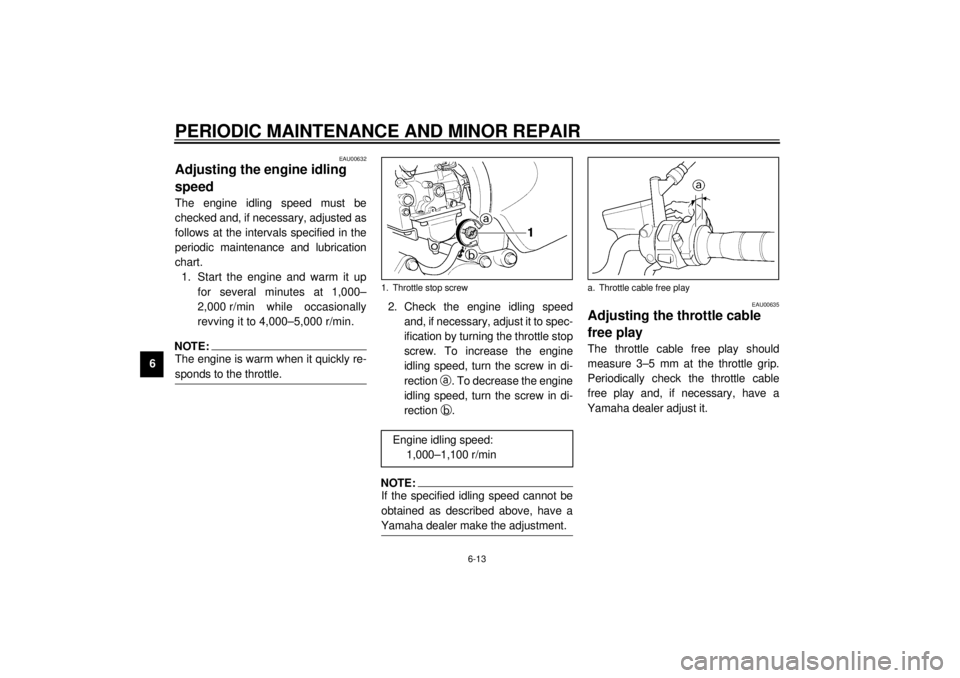
2. Check the engine idling speed
and, if necessary, adjust it to spec-
ification by turning the throttle stop
screw. To increase the engine
idling speed, turn the screw in di-
rection
a. To decrease the engine
idling speed, turn the screw in di-
rection
b.NOTE:_ If the specified idling speed cannot be
obtained as described above, have a
Yamaha dealer make the adjustment. _
EAU00635
Adjusting the throttle cable
free play The throttle cable free play should
measure 3–5 mm at the throttle grip.
Periodically check the throttle cable
free play and, if necessary, have a
Yamaha dealer adjust it.
1. Throttle stop screw
Engine idling speed:
1,000–1,100 r/min
a. Throttle cable free play
E_5ea.book Page 13 Wednesday, October 4, 2000 4:14 PM
Page 57 of 100
PERIODIC MAINTENANCE AND MINOR REPAIR
6-14
6
EAU00637
Adjusting the valve clearance The valve clearance changes with use,
resulting in improper air-fuel mixture
and/or engine noise. To prevent this
from occurring, the valve clearance
must be adjusted by a Yamaha dealer
at the intervals specified in the periodic
maintenance and lubrication chart.
EAU00658
Tires To maximize the performance, durabil-
ity, and safe operation of your motor-
cycle, note the following points
regarding the specified tires.
Tire air pressure
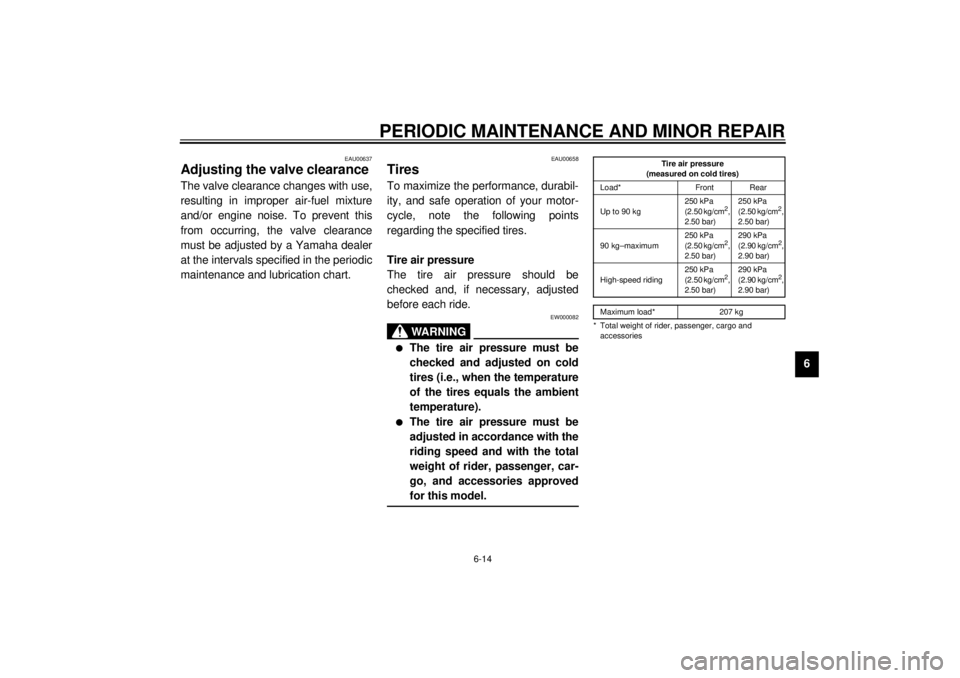
The tire air pressure should be
checked and, if necessary, adjusted
before each ride.
EW000082
WARNING
_ l
The tire air pressure must be
checked and adjusted on cold
tires (i.e., when the temperature
of the tires equals the ambient
temperature).
l
The tire air pressure must be
adjusted in accordance with the
riding speed and with the total
weight of rider, passenger, car-
go, and accessories approved
for this model.
_
CE-01E
CE-07E
Tire air pressure
(measured on cold tires)
Load* Front Rear
Up to 90 kg250 kPa
(2.50 kg/cm
2,
2.50 bar)250 kPa
(2.50 kg/cm
2,
2.50 bar)
90 kg–maximum250 kPa
(2.50 kg/cm
2,
2.50 bar)290 kPa
(2.90 kg/cm
2,
2.90 bar)
High-speed riding250 kPa
(2.50 kg/cm
2,
2.50 bar)290 kPa
(2.90 kg/cm
2,
2.90 bar)
Maximum load* 207 kg
* Total weight of rider, passenger, cargo and
accessories
E_5ea.book Page 14 Wednesday, October 4, 2000 4:14 PM
Page 66 of 100
PERIODIC MAINTENANCE AND MINOR REPAIR
6-23
6
EAU02962
Checking and lubricating the
cables The operation of all control cables and
the condition of the cables should be
checked before each ride, and the ca-
bles and cable ends should be lubricat-
ed if necessary. If a cable is damaged
or does not move smoothly, have a
Yamaha dealer check or replace it.
EW000112
WARNING
_ Damage to the outer sheath may in-
terfere with proper cable operation
and will cause the inner cable to
rust. Replace a damaged cable as
soon as possible to prevent unsafe
conditions. _
EAU03209
Checking and lubricating the
throttle grip and cable The operation of the throttle grip and
the condition of the throttle cable
should be checked before each ride,
and the cable should be lubricated or
replaced if necessary.NOTE:_ Since the throttle grip must be removed
to access the throttle cable end, the
throttle grip and the cable should al-
ways be lubricated at the same time. _1. Remove the throttle grip by remov-
ing the screws.
2. Disconnect the throttle cable, hold
it up, and then apply several drops
of oil to the cable end, allowing it to
trickle into the sheath.
3. Connect the throttle cable, and
then grease the inside of the throt-
tle grip housing.
4. Grease the metal-to-metal contact
surface of the throttle grip, and
then install the grip by installing
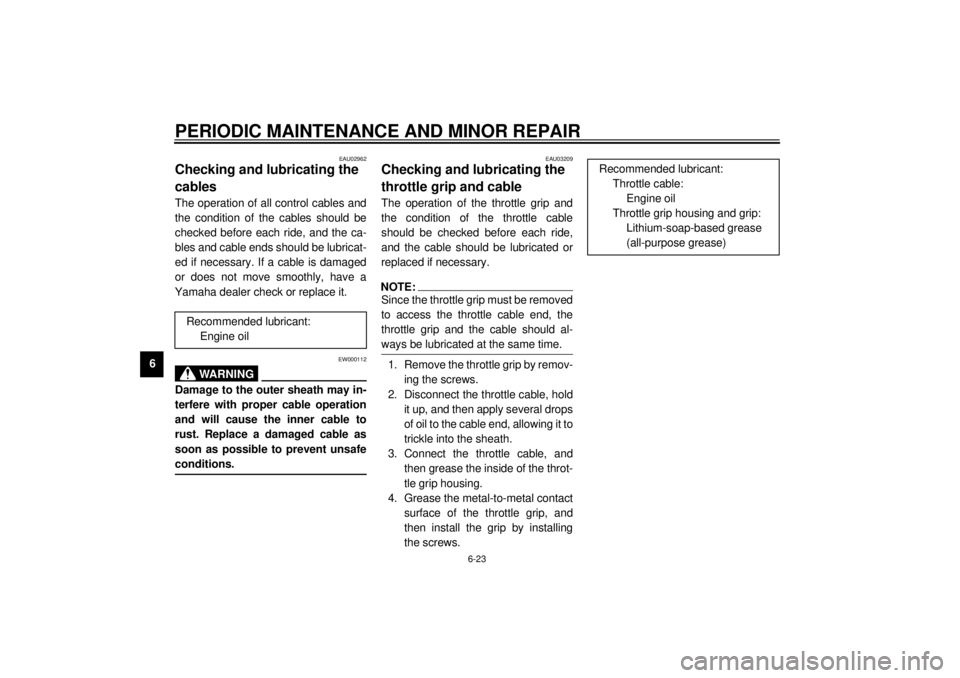
the screws. Recommended lubricant:
Engine oil
Recommended lubricant:
Throttle cable:
Engine oil
Throttle grip housing and grip:
Lithium-soap-based grease
(all-purpose grease)
E_5ea.book Page 23 Wednesday, October 4, 2000 4:14 PM
Page 69 of 100
PERIODIC MAINTENANCE AND MINOR REPAIR
6-26
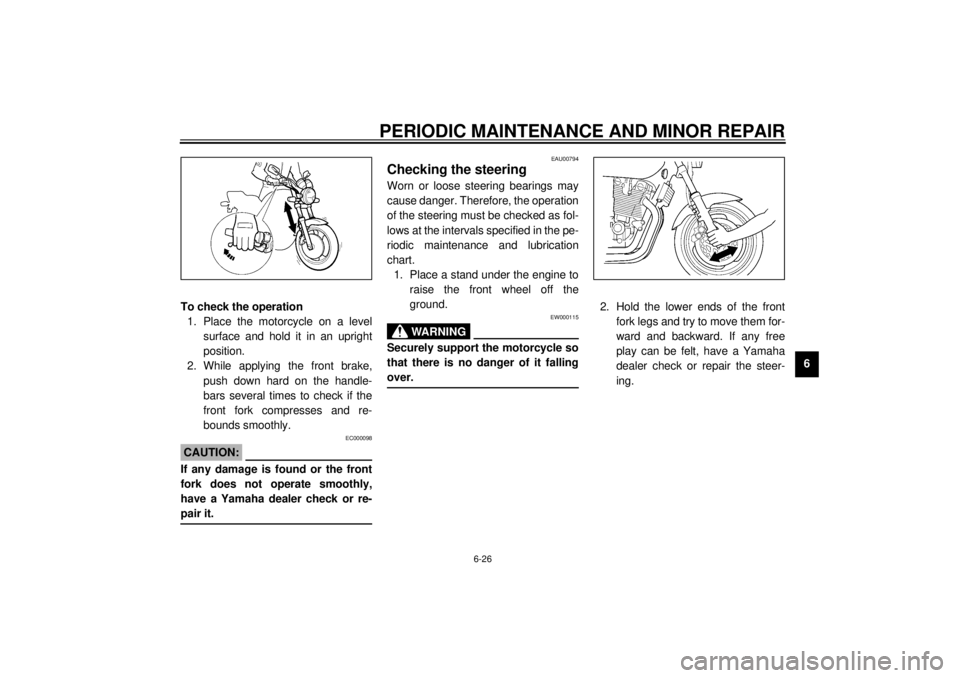
6 To check the operation
1. Place the motorcycle on a level
surface and hold it in an upright
position.
2. While applying the front brake,
push down hard on the handle-
bars several times to check if the
front fork compresses and re-
bounds smoothly.
EC000098
CAUTION:_ If any damage is found or the front
fork does not operate smoothly,
have a Yamaha dealer check or re-
pair it. _
EAU00794
Checking the steering Worn or loose steering bearings may
cause danger. Therefore, the operation
of the steering must be checked as fol-
lows at the intervals specified in the pe-
riodic maintenance and lubrication
chart.
1. Place a stand under the engine to
raise the front wheel off the
ground.
EW000115
WARNING
_ Securely support the motorcycle so
that there is no danger of it falling
over. _
2. Hold the lower ends of the front
fork legs and try to move them for-
ward and backward. If any free
play can be felt, have a Yamaha
dealer check or repair the steer-
ing.
E_5ea.book Page 26 Wednesday, October 4, 2000 4:14 PM
Page 80 of 100
PERIODIC MAINTENANCE AND MINOR REPAIR
6-37
6
EAU01297
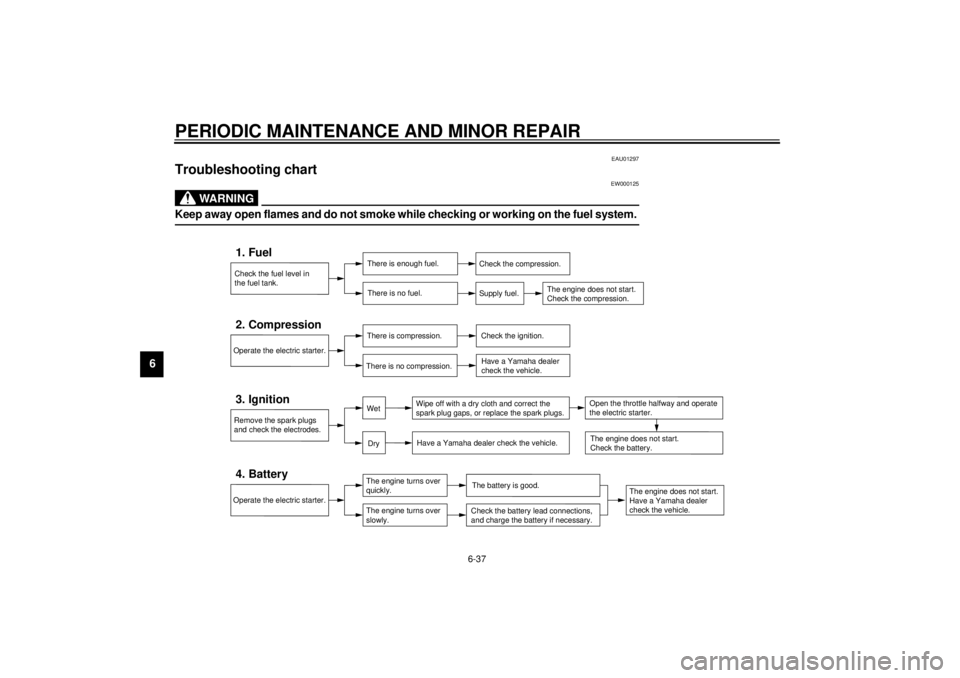
Troubleshooting chart
EW000125
WARNING
_ Keep away open flames and do not smoke while checking or working on the fuel system. _
Check the fuel level in
the fuel tank.1. Fuel
There is enough fuel.
There is no fuel.
Check the compression.
Supply fuel.
The engine does not start.
Check the compression.
Operate the electric starter.2. Compression
There is compression.
There is no compression.
Check the ignition.
Have a Yamaha dealer
check the vehicle.
Remove the spark plugs
and check the electrodes.3. Ignition
Wipe off with a dry cloth and correct the
spark plug gaps, or replace the spark plugs.
Have a Yamaha dealer check the vehicle.
The engine does not start.
Have a Yamaha dealer
check the vehicle.
The engine does not start.
Check the battery.
Operate the electric starter.4. Battery
The engine turns over
quickly.
The engine turns over
slowly.
The battery is good.Check the battery lead connections,
and charge the battery if necessary.
DryWet
Open the throttle halfway and operate
the electric starter.
E_5ea.book Page 37 Wednesday, October 4, 2000 4:14 PM