maintenance YAMAHA XJR 1300 2001 Owners Manual
[x] Cancel search | Manufacturer: YAMAHA, Model Year: 2001, Model line: XJR 1300, Model: YAMAHA XJR 1300 2001Pages: 100, PDF Size: 11.75 MB
Page 7 of 100
TABLE OF CONTENTS
1 GIVE SAFETY THE RIGHT OF WAY
1
2 DESCRIPTION
2
3 INSTRUMENT AND CONTROL FUNCTIONS
3
4 PRE-OPERATION CHECKS
4
5 OPERATION AND IMPORTANT RIDING POINTS
5
6 PERIODIC MAINTENANCE AND MINOR REPAIR
6
7 MOTORCYCLE CARE AND STORAGE
7
8 SPECIFICATIONS
8
9 CONSUMER INFORMATION
9
INDEX
EAU00009
E_5ea.book Page 1 Wednesday, October 4, 2000 4:14 PM
Page 10 of 100
1
1-1
1-GIVE SAFETY THE RIGHT OF WAY
EAU00021
Motorcycles are fascinating vehicles, which can give you an unsurpassed feeling of power and
freedom. However, they also impose certain limits, which you must accept; even the best motorcycle
does not ignore the laws of physics.
Regular care and maintenance are essential for preserving value and operating condition of your
motorcycle. Moreover, what is true for the motorcycle is also true for the rider: good performance
depends on being in good shape. Riding under the influence of medication, drugs and alcohol is, of
course, out of the question. Motorcycle riders—more than car drivers—must always be at their mental
and physical best. Under the influence of even small amounts of alcohol, there is a tendency to take
dangerous risks.
Protective clothing is as essential for the motorcycle rider as seat belts are for car drivers and
passengers. Always wear a complete motorcycle suit (whether made of leather or tear-resistant
synthetic materials with protectors), sturdy boots, motorcycle gloves and a properly fitting helmet.
Optimum protective wear, however, should not encourage carelessness. Although full-coverage
helmets and suits, in particular, create an illusion of total safety and protection, motorcyclists will
always be vulnerable. Riders who lack critical self-control run the risk of going too fast and are apt to
take chances. This is even more dangerous in wet weather. The good motorcyclist rides safely,
predictably and defensively—avoiding all dangers, including those caused by others.
Enjoy your ride!
E_5ea.book Page 1 Wednesday, October 4, 2000 4:14 PM
Page 43 of 100
6
PERIODIC MAINTENANCE AND MINOR REPAIR
Owner’s tool kit .................................................... 6-1
Periodic maintenance and lubrication chart ......... 6-2
Removing and installing the panel ....................... 6-5
Checking the spark plugs .................................... 6-6
Engine oil and oil filter element ............................ 6-7
Cleaning the air filter element ............................ 6-11
Adjusting the carburetors ................................... 6-12
Adjusting the engine idling speed ...................... 6-13
Adjusting the throttle cable free play .................. 6-13
Adjusting the valve clearance ............................ 6-14
Tires ................................................................... 6-14
Wheels ............................................................... 6-17
Adjusting the brake pedal position ..................... 6-17
Rear brake light switch adjustment .................... 6-18
Checking the front and rear brake pads ............. 6-19
Checking the brake fluid level ............................ 6-19
Changing the brake fluid .................................... 6-20
Drive chain slack ................................................ 6-21
Lubricating the drive chain ................................. 6-22
Checking and lubricating the cables .................. 6-23Checking and lubricating the throttle
grip and cable ................................................. 6-23
Checking and lubricating the brake and
shift pedals ...................................................... 6-24
Checking and lubricating the brake and
clutch levers .................................................... 6-24
Checking and lubricating the centerstand and
sidestand ......................................................... 6-25
Checking the front fork ...................................... 6-25
Checking the steering ....................................... 6-26
Checking the wheel bearings ............................ 6-27
Battery ............................................................... 6-27
Replacing the fuses .......................................... 6-29
Replacing the headlight bulb ............................. 6-29
Replacing the tail/brake light bulb ..................... 6-31
Replacing a turn signal light bulb ...................... 6-31
Front wheel ....................................................... 6-32
Rear wheel ........................................................ 6-34
Troubleshooting ................................................. 6-36
Troubleshooting chart ........................................ 6-37
E_5ea.book Page 1 Wednesday, October 4, 2000 4:14 PM
Page 44 of 100
6-1
6
EAU00462
6-PERIODIC MAINTENANCE AND MINOR REPAIR
EAU00464
Safety is an obligation of the owner.
Periodic inspection, adjustment and lu-
brication will keep your vehicle in the
safest and most efficient condition pos-
sible. The most important points of in-
spection, adjustment, and lubrication
are explained on the following pages.
The intervals given in the periodic
maintenance and lubrication chart
should be simply considered as a gen-
eral guide under normal riding condi-
tions. However, DEPENDING ON THE
WEATHER, TERRAIN, GEOGRAPHI-
CAL LOCATION, AND INDIVIDUAL
USE, THE MAINTENANCE INTER-
VALS MAY NEED TO BE SHORT-
ENED.
EW000060
WARNING
_ If you are not familiar with motor-
cycle maintenance work, have a
Yamaha dealer do it for you. _
EAU03758
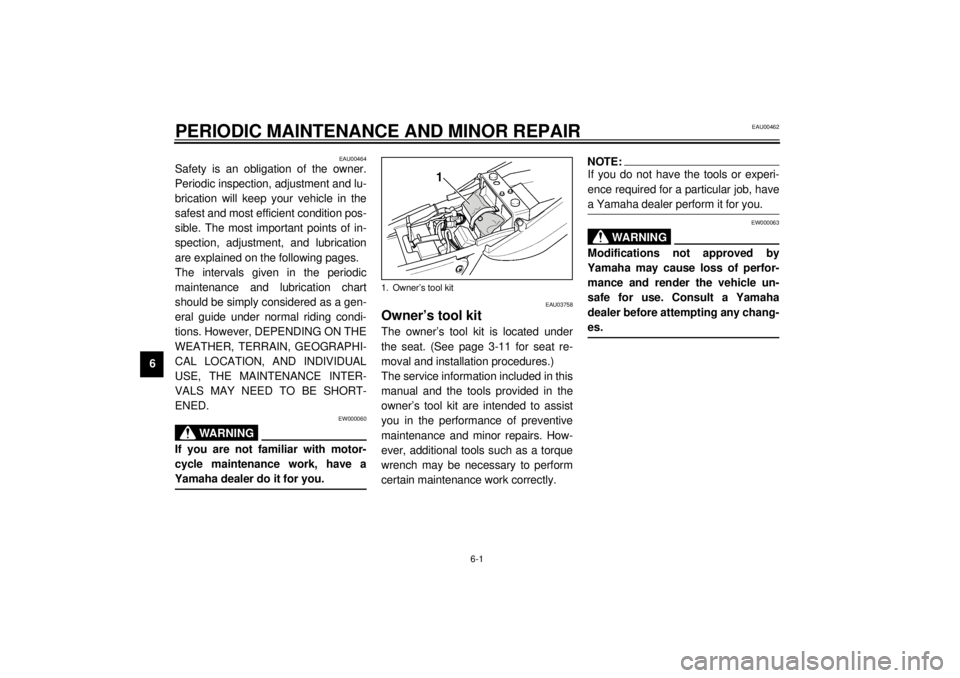
Owner’s tool kit The owner’s tool kit is located under
the seat. (See page 3-11 for seat re-
moval and installation procedures.)
The service information included in this
manual and the tools provided in the
owner’s tool kit are intended to assist
you in the performance of preventive
maintenance and minor repairs. How-
ever, additional tools such as a torque
wrench may be necessary to perform
certain maintenance work correctly.
NOTE:_ If you do not have the tools or experi-
ence required for a particular job, have
a Yamaha dealer perform it for you. _
EW000063
WARNING
_ Modifications not approved by
Yamaha may cause loss of perfor-
mance and render the vehicle un-
safe for use. Consult a Yamaha
dealer before attempting any chang-
es. _
1. Owner’s tool kit
E_5ea.book Page 1 Wednesday, October 4, 2000 4:14 PM
Page 45 of 100
PERIODIC MAINTENANCE AND MINOR REPAIR
6-2
6
EAU03685
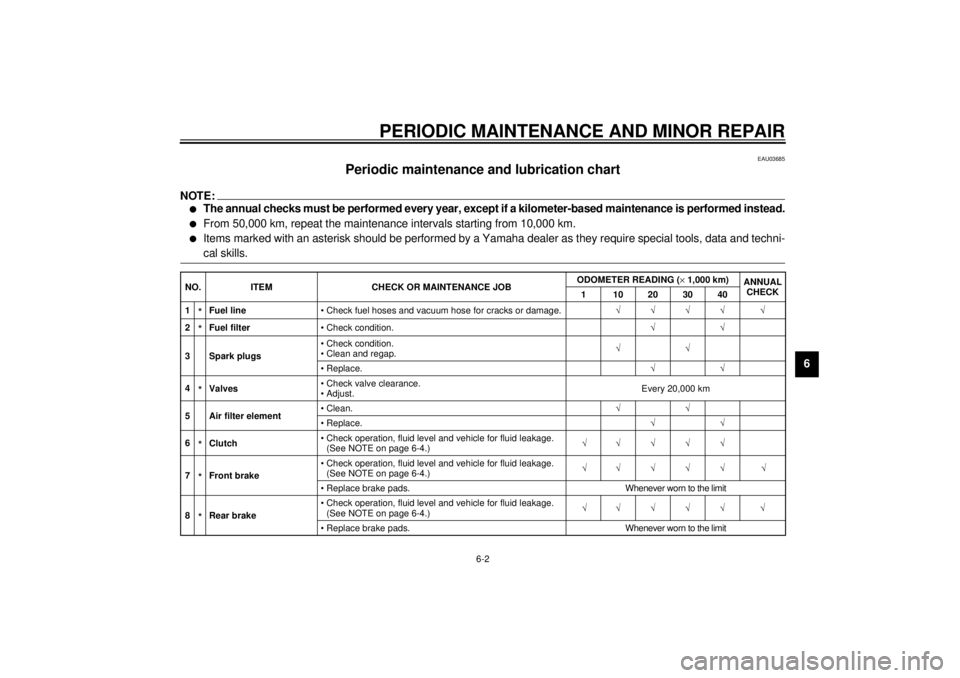
Periodic maintenance and lubrication chart
NOTE:_ l
The annual checks must be performed every year, except if a kilometer-based maintenance is performed instead.
l
From 50,000 km, repeat the maintenance intervals starting from 10,000 km.
l
Items marked with an asterisk should be performed by a Yamaha dealer as they require special tools, data and techni-
cal skills.
_
CP-03ENO. ITEM CHECK OR MAINTENANCE JOBODOMETER READING (´1,000 km)
ANNUAL
CHECK
1 10203040
1
*Fuel line• Check fuel hoses and vacuum hose for cracks or damage.ÖÖÖÖ Ö
2*Fuel filter• Check condition.ÖÖ
3 Spark plugs• Check condition.
• Clean and regap.ÖÖ
• Replace.ÖÖ
4*Valves• Check valve clearance.
•Adjust.Every 20,000 km
5 Air filter element•Clean.ÖÖ
• Replace.ÖÖ
6*Clutch• Check operation, fluid level and vehicle for fluid leakage.
(See NOTE on page 6-4.) ÖÖÖÖÖ
7*Front brake• Check operation, fluid level and vehicle for fluid leakage.
(See NOTE on page 6-4.)ÖÖÖÖÖ Ö
• Replace brake pads. Whenever worn to the limit
8*Rear brake• Check operation, fluid level and vehicle for fluid leakage.
(See NOTE on page 6-4.)ÖÖÖÖÖ Ö
• Replace brake pads. Whenever worn to the limit
E_5ea.book Page 2 Wednesday, October 4, 2000 4:14 PM
Page 46 of 100

PERIODIC MAINTENANCE AND MINOR REPAIR
6-3
6
9
*Brake hoses• Check for cracks or damage.ÖÖÖÖ Ö
• Replace. (See NOTE on page 6-4.) Every 4 years
10*Wheels• Check runout and for damage.ÖÖÖÖ
11*Tires• Check tread depth and for damage.
• Replace if necessary.
• Check air pressure.
• Correct if necessary.ÖÖÖÖ
12*Wheel bearings• Check bearing for looseness or damage.ÖÖÖÖ
13*Swingarm• Check operation and for excessive play.ÖÖÖÖ
• Lubricate with molybdenum disulfide grease. Every 50,000 km
14 Drive chain• Check chain slack.
• Make sure that the rear wheel is properly aligned.
• Clean and lubricate.Every 1,000 km and after washing
the motorcycle or riding in the rain.
15*Steering bearings• Check bearing play and steering for roughness.ÖÖÖÖÖ
• Lubricate with lithium-soap-based grease. Every 20,000 km
16*Chassis fasteners• Make sure that all nuts, bolts and screws are properly tightened.ÖÖÖÖ Ö
17 Sidestand/centerstand• Check operation.
• Lubricate.ÖÖÖÖ Ö
18*Sidestand switch• Check operation.ÖÖÖÖÖ Ö
19*Front fork• Check operation and for oil leakage.ÖÖÖÖ
20*Rear shock absorber
assemblies• Check operation and shock absorbers for oil leakage.ÖÖÖÖ
21*Carburetors• Check starter (choke) operation.
• Adjust engine idling speed and synchronization.ÖÖÖÖÖ Ö
22 Engine oil• Change.ÖÖÖÖÖ Ö NO. ITEM CHECK OR MAINTENANCE JOBODOMETER READING (´1,000 km)
ANNUAL
CHECK
1 10203040
E_5ea.book Page 3 Wednesday, October 4, 2000 4:14 PM
Page 47 of 100
PERIODIC MAINTENANCE AND MINOR REPAIR
6-4
6
EAU03058
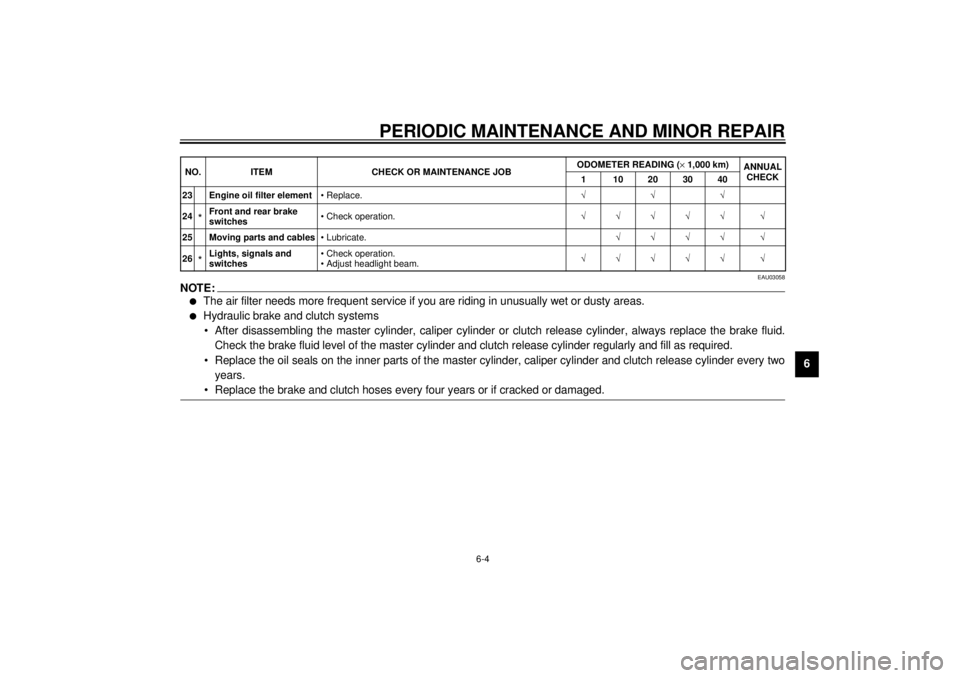
NOTE:_ l
The air filter needs more frequent service if you are riding in unusually wet or dusty areas.
l
Hydraulic brake and clutch systems
• After disassembling the master cylinder, caliper cylinder or clutch release cylinder, always replace the brake fluid.
Check the brake fluid level of the master cylinder and clutch release cylinder regularly and fill as required.
• Replace the oil seals on the inner parts of the master cylinder, caliper cylinder and clutch release cylinder every two
years.
• Replace the brake and clutch hoses every four years or if cracked or damaged.
_23 Engine oil filter element• Replace.ÖÖÖ
24
*Front and rear brake
switches• Check operation.ÖÖÖÖÖ Ö
25 Moving parts and cables• Lubricate.ÖÖÖÖ Ö
26*Lights, signals and
switches• Check operation.
• Adjust headlight beam.ÖÖÖÖÖ Ö NO. ITEM CHECK OR MAINTENANCE JOBODOMETER READING (´1,000 km)
ANNUAL
CHECK
1 10203040
E_5ea.book Page 4 Wednesday, October 4, 2000 4:14 PM
Page 48 of 100
PERIODIC MAINTENANCE AND MINOR REPAIR
6-5
6
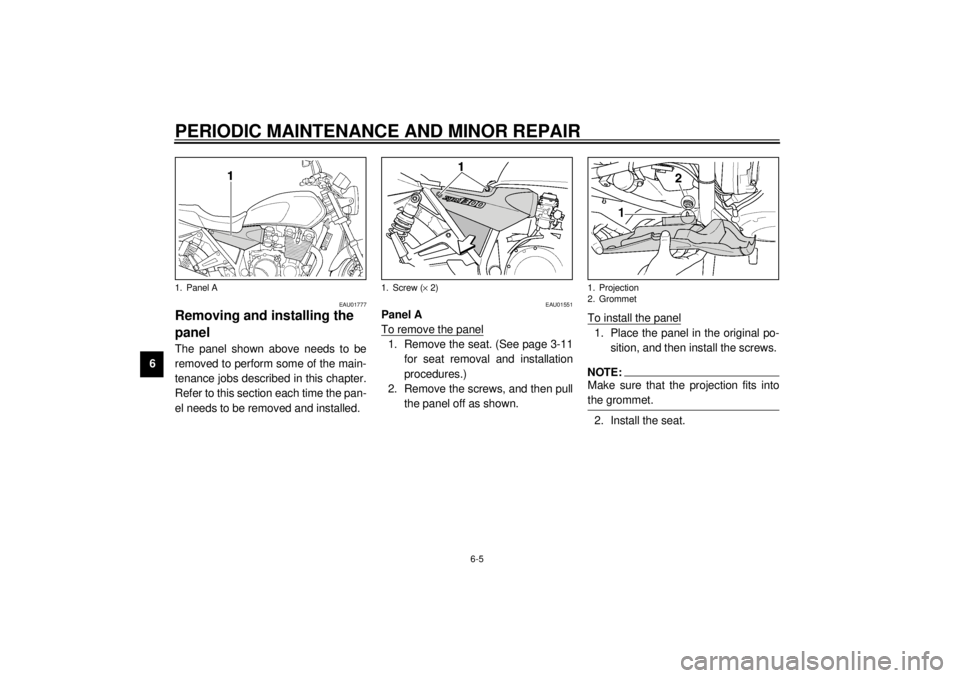
EAU01777
Removing and installing the
panel The panel shown above needs to be
removed to perform some of the main-
tenance jobs described in this chapter.
Refer to this section each time the pan-
el needs to be removed and installed.
EAU01551
Panel A
To remove the panel1. Remove the seat. (See page 3-11
for seat removal and installation
procedures.)
2. Remove the screws, and then pull
the panel off as shown.To install the panel
1. Place the panel in the original po-
sition, and then install the screws.NOTE:_ Make sure that the projection fits into
the grommet. _2. Install the seat.
1. Panel A
1. Screw (´ 2)
1. Projection
2. Grommet
E_5ea.book Page 5 Wednesday, October 4, 2000 4:14 PM
Page 49 of 100
PERIODIC MAINTENANCE AND MINOR REPAIR
6-6
6
EAU03329
Checking the spark plugs The spark plugs are important engine
components, which are easy to check.
Since heat and deposits will cause any
spark plug to slowly erode, the spark
plugs should be removed and checked
in accordance with the periodic mainte-
nance and lubrication chart. In addition,
the condition of the spark plugs can re-
veal the condition of the engine.
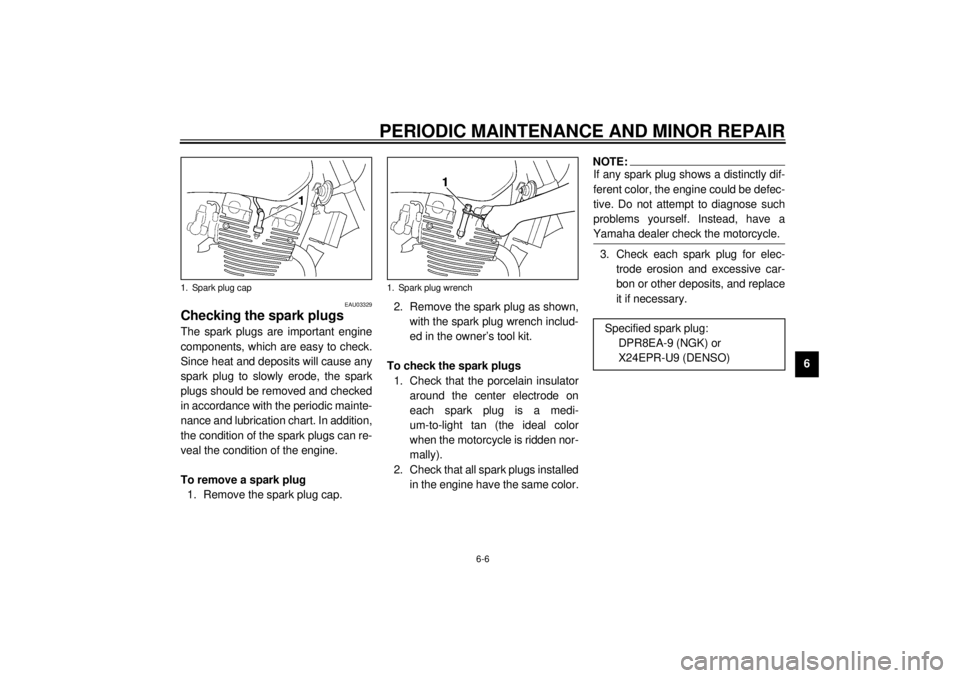
To remove a spark plug
1. Remove the spark plug cap.2. Remove the spark plug as shown,
with the spark plug wrench includ-
ed in the owner’s tool kit.
To check the spark plugs
1. Check that the porcelain insulator
around the center electrode on
each spark plug is a medi-
um-to-light tan (the ideal color
when the motorcycle is ridden nor-
mally).
2. Check that all spark plugs installed
in the engine have the same color.
NOTE:_ If any spark plug shows a distinctly dif-
ferent color, the engine could be defec-
tive. Do not attempt to diagnose such
problems yourself. Instead, have a
Yamaha dealer check the motorcycle. _3. Check each spark plug for elec-
trode erosion and excessive car-
bon or other deposits, and replace
it if necessary.
1. Spark plug cap
1. Spark plug wrench
Specified spark plug:
DPR8EA-9 (NGK) or
X24EPR-U9 (DENSO)
E_5ea.book Page 6 Wednesday, October 4, 2000 4:14 PM
Page 50 of 100
PERIODIC MAINTENANCE AND MINOR REPAIR
6-7
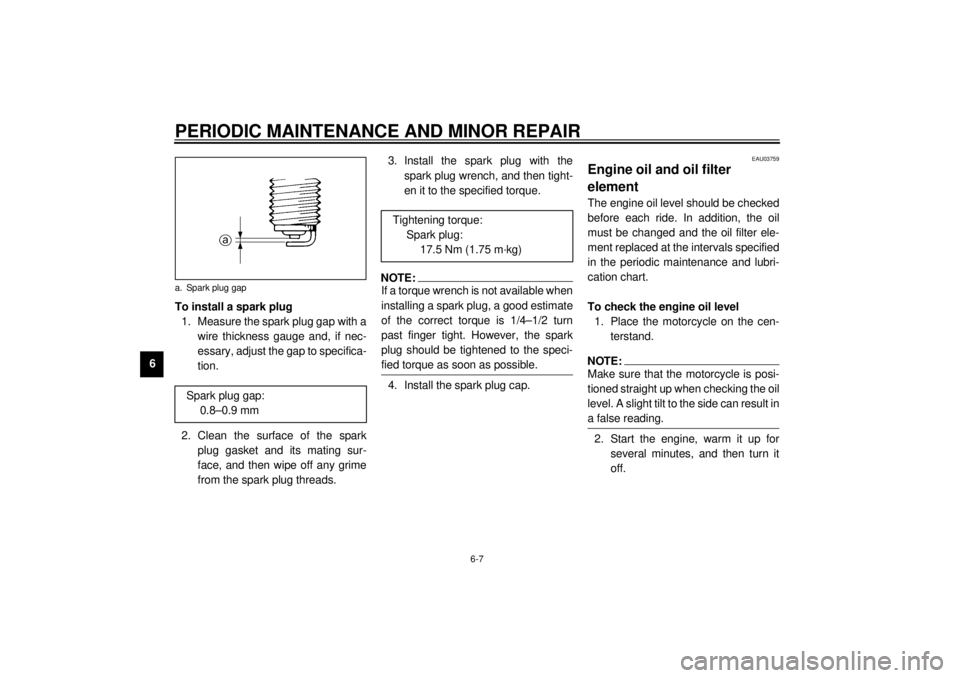
6To install a spark plug
1. Measure the spark plug gap with a
wire thickness gauge and, if nec-
essary, adjust the gap to specifica-
tion.
2. Clean the surface of the spark
plug gasket and its mating sur-
face, and then wipe off any grime
from the spark plug threads.3. Install the spark plug with the
spark plug wrench, and then tight-
en it to the specified torque.
NOTE:_ If a torque wrench is not available when
installing a spark plug, a good estimate
of the correct torque is 1/4–1/2 turn
past finger tight. However, the spark
plug should be tightened to the speci-
fied torque as soon as possible. _4. Install the spark plug cap.
EAU03759
Engine oil and oil filter
element The engine oil level should be checked
before each ride. In addition, the oil
must be changed and the oil filter ele-
ment replaced at the intervals specified
in the periodic maintenance and lubri-
cation chart.
To check the engine oil level
1. Place the motorcycle on the cen-
terstand.NOTE:_ Make sure that the motorcycle is posi-
tioned straight up when checking the oil
level. A slight tilt to the side can result in
a false reading. _2. Start the engine, warm it up for
several minutes, and then turn it
off.
a. Spark plug gapSpark plug gap:
0.8–0.9 mm
Tightening torque:
Spark plug:
17.5 Nm (1.75 m·kg)
E_5ea.book Page 7 Wednesday, October 4, 2000 4:14 PM