Spark YAMAHA XJR 1300 2013 Owners Manual
[x] Cancel search | Manufacturer: YAMAHA, Model Year: 2013, Model line: XJR 1300, Model: YAMAHA XJR 1300 2013Pages: 98, PDF Size: 2.34 MB
Page 6 of 98

TABLE OF CONTENTSSAFETY INFORMATION ..................1-1
DESCRIPTION ..................................2-1
Left view ..........................................2-1
Right view ........................................2-2
Controls and instruments.................2-3
INSTRUMENT AND CONTROL
FUNCTIONS .......................................3-1
Immobilizer system .........................3-1
Main switch/steering lock ................3-2
Indicator lights and warning lights ............................................3-4
Speedometer ..................................3-5
Tachometer ....................................3-5
Multi-function display ......................3-6
Anti-theft alarm (optional) ...............3-9
Handlebar switches ........................3-9
Clutch lever ...................................3-10
Shift pedal .....................................3-11
Brake lever ...................................3-11
Brake pedal ..................................3-12
Fuel tank cap ................................3-12
Fuel ...............................................3-13
Fuel tank breather hose and overflow hose ............................3-14
Catalytic converters ......................3-15
Seat ..............................................3-15
Helmet holder ...............................3-16
Storage compartment ...................3-16
Adjusting the front fork ..................3-17 Adjusting the shock absorber
assembly ................................... 3-19
Luggage strap holders ................. 3-21
EXUP system ............................... 3-22
Sidestand ..................................... 3-22
Ignition circuit cut-off system ........ 3-23
FOR YOUR SAFETY –
PRE-OPERATION CHECKS ............. 4-1
OPERATION AND IMPORTANT
RIDING POINTS ................................. 5-1
Starting the engine ......................... 5-1
Shifting ........................................... 5-2
Tips for reducing fuel consumption ............................... 5-3
Engine break-in .............................. 5-3
Parking ........................................... 5-4
PERIODIC MAINTENANCE AND
ADJUSTMENT ................................... 6-1
Owner’s tool kit ............................... 6-2
Periodic maintenance chart for the emission control system ............. 6-3
General maintenance and lubrication chart .......................... 6-4
Removing and installing panels ..... 6-8
Checking the spark plugs ............... 6-9
Engine oil and oil filter element .... 6-10
Replacing the air filter element and cleaning the check hose .... 6-13 Checking the throttle grip free
play ........................................... 6-14
Valve clearance ........................... 6-15
Tires ............................................. 6-15
Cast wheels ................................. 6-18
Clutch lever .................................. 6-18
Checking the brake lever free play ........................................... 6-18
Brake light switches ..................... 6-19
Checking the front and rear brake pads .......................................... 6-20
Checking the brake and clutch fluid levels ................................. 6-20
Changing the brake and clutch
fluids ......................................... 6-22
Drive chain slack .......................... 6-22
Cleaning and lubricating the drive chain ......................................... 6-23
Checking and lubricating the cables ....................................... 6-24
Checking and lubricating the throttle grip and cable ............... 6-24
Checking and lubricating the
brake and shift pedals .............. 6-25
Checking and lubricating the brake and clutch levers ............ 6-25
Checking and lubricating the centerstand and sidestand ....... 6-26
Lubricating the swingarm
pivots ........................................ 6-27
Checking the front fork ................. 6-27U5WME9E0.book Page 1 Friday, December 7, 2012 3:50 PM
Page 28 of 98
INSTRUMENT AND CONTROL FUNCTIONS
3-13
3
TIPThe fuel tank cap cannot be closed un-
less the key is in the lock. In addition,
the key cannot be removed if the cap is
not properly closed and locked.
WARNING
EWA11091
Make sure that the fuel tank cap is
properly closed after filling fuel.
Leaking fuel is a fire hazard.
EAU13221
Fuel Make sure there is sufficient gasoline in
the tank.
WARNING
EWA10881
Gasoline and gasoline vapors are
extremely flammable. To avoid fires
and explosions and to reduce the
risk of injury when refueling, follow
these instructions.1. Before refueling, turn off the en-gine and be sure that no one is sit-
ting on the vehicle. Never refuel
while smoking, or while in the vi-
cinity of sparks, open flames, or
other sources of ignition such as
the pilot lights of water heaters and
clothes dryers.
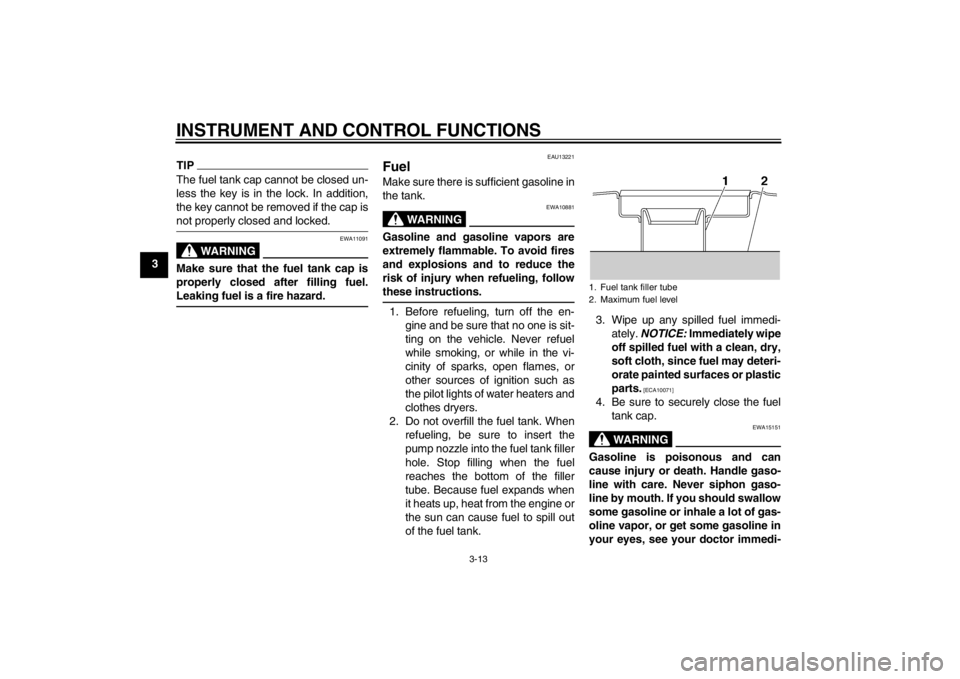
2. Do not overfill the fuel tank. When refueling, be sure to insert the
pump nozzle into the fuel tank filler
hole. Stop filling when the fuel
reaches the bottom of the filler
tube. Because fuel expands when
it heats up, heat from the engine or
the sun can cause fuel to spill out
of the fuel tank. 3. Wipe up any spilled fuel immedi-
ately. NOTICE: Immediately wipe
off spilled fuel with a clean, dry,
soft cloth, since fuel may deteri-
orate painted surfaces or plastic
parts.
[ECA10071]
4. Be sure to securely close the fuel tank cap.
WARNING
EWA15151
Gasoline is poisonous and can
cause injury or death. Handle gaso-
line with care. Never siphon gaso-
line by mouth. If you should swallow
some gasoline or inhale a lot of gas-
oline vapor, or get some gasoline in
your eyes, see your doctor immedi-1. Fuel tank filler tube
2. Maximum fuel level
U5WME9E0.book Page 13 Friday, December 7, 2012 3:50 PM
Page 29 of 98
INSTRUMENT AND CONTROL FUNCTIONS
3-14
3
ately. If gasoline spills on your skin,
wash with soap and water. If gaso-
line spills on your clothing, change
your clothes.
EAU43422
NOTICE
ECA11400
Use only unleaded gasoline. The use
of leaded gasoline will cause severe
damage to internal engine parts,
such as the valves and piston rings,
as well as to the exhaust system.Your Yamaha engine has been de-
signed to use premium unleaded gaso-
line with a research octane number of
95 or higher. If knocking (or pinging) oc-
curs, use a gasoline of a different brand. Use of unleaded fuel will extend
spark plug life and reduce maintenance
costs.
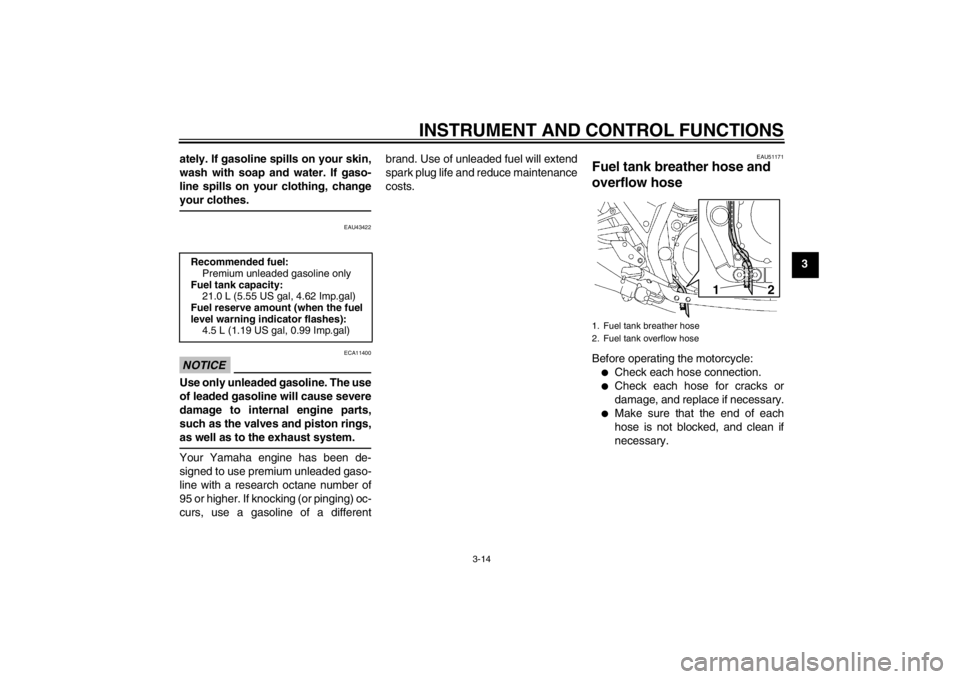
EAU51171
Fuel tank breather hose and
overflow hose Before operating the motorcycle:●
Check each hose connection.
●
Check each hose for cracks or
damage, and replace if necessary.
●
Make sure that the end of each
hose is not blocked, and clean if
necessary.
Recommended fuel:
Premium unleaded gasoline only
Fuel tank capacity: 21.0 L (5.55 US gal, 4.62 Imp.gal)
Fuel reserve amount (when the fuel
level warning indicator flashes): 4.5 L (1.19 US gal, 0.99 Imp.gal)
1. Fuel tank breather hose
2. Fuel tank overflow hose
2
1
U5WME9E0.book Page 14 Friday, December 7, 2012 3:50 PM
Page 49 of 98

PERIODIC MAINTENANCE AND ADJUSTMENT
6-3
6
EAU46861
TIP●
The annual checks must be performed every year, except if a kilometer-based maintenance, or for the UK, a
mileage-based maintenance, is performed instead.
●
From 50000 km (30000 mi), repeat the maintenance intervals starting from 10000 km (6000 mi).
●
Items marked with an asterisk should be performed by a Yamaha dealer as they require special tools, data and technical
skills.
EAU46910
Periodic maintenance chart for the emission control system NO. ITEM CHECK OR MAINTENANCE JOBODOMETER READING
ANNUAL
CHECK
1000 km
(600 mi) 10000 km
(6000 mi) 20000 km
(12000 mi) 30000 km
(18000 mi) 40000 km
(24000 mi)
1 *Fuel line Check fuel hoses for cracks or
damage. √√√√√
2 Spark plugs Check condition.
Clean and regap.
√√
Replace. √√
3 *Valves Check valve clearance.
Adjust.
Every 20000 km (12000 mi)
4 *Fuel injection sys-
tem Adjust synchronization.
√√√√√√
5 *Muffler and exhaust
pipe Check the screw clamp(s) for
looseness. √√√√√
6 *Air induction sys-
tem Check the air cut-off valve, reed
valve, and hose for damage.
Replace any damaged parts if necessary. √√√√√
U5WME9E0.book Page 3 Friday, December 7, 2012 3:50 PM
Page 55 of 98
PERIODIC MAINTENANCE AND ADJUSTMENT
6-9
6
EAU19193
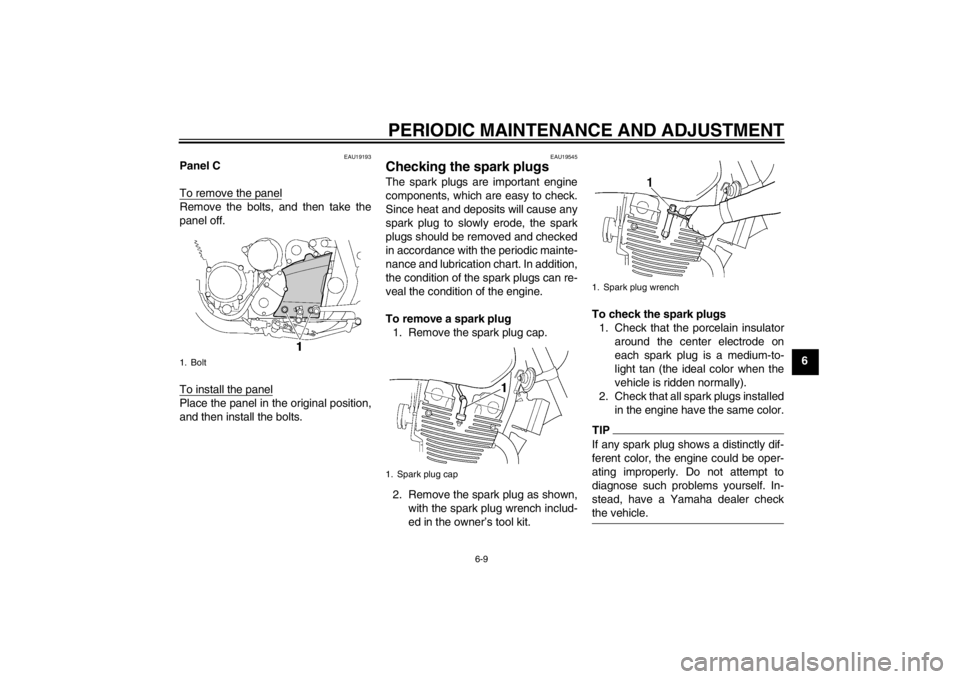
Panel C
To remove the panelRemove the bolts, and then take the
panel off.
To install the panelPlace the panel in the original position,
and then install the bolts.
EAU19545
Checking the spark plugs The spark plugs are important engine
components, which are easy to check.
Since heat and deposits will cause any
spark plug to slowly erode, the spark
plugs should be removed and checked
in accordance with the periodic mainte-
nance and lubrication chart. In addition,
the condition of the spark plugs can re-
veal the condition of the engine.
To remove a spark plug1. Remove the spark plug cap.
2. Remove the spark plug as shown, with the spark plug wrench includ-
ed in the owner’s tool kit. To check the spark plugs
1. Check that the porcelain insulator around the center electrode on
each spark plug is a medium-to-
light tan (the ideal color when the
vehicle is ridden normally).
2. Check that all spark plugs installed in the engine have the same color.
TIPIf any spark plug shows a distinctly dif-
ferent color, the engine could be oper-
ating improperly. Do not attempt to
diagnose such problems yourself. In-
stead, have a Yamaha dealer check
the vehicle.
1. Bolt
1. Spark plug cap
1. Spark plug wrench
U5WME9E0.book Page 9 Friday, December 7, 2012 3:50 PM
Page 56 of 98
PERIODIC MAINTENANCE AND ADJUSTMENT
6-10
63. Check each spark plug for elec-
trode erosion and excessive car-
bon or other deposits, and replace
it if necessary.
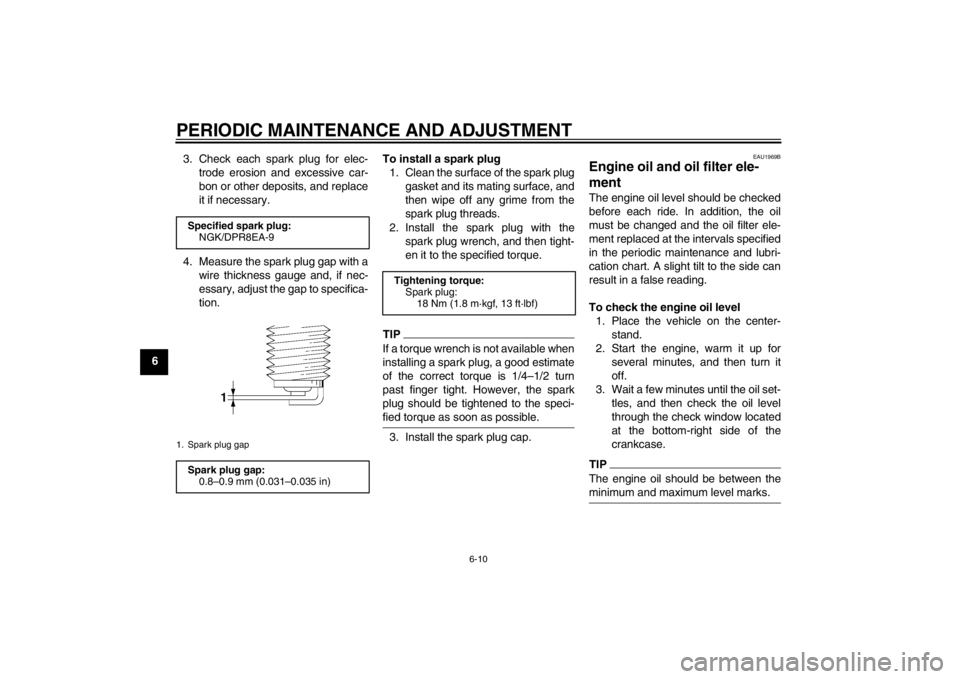
4. Measure the spark plug gap with a wire thickness gauge and, if nec-
essary, adjust the gap to specifica-
tion. To install a spark plug
1. Clean the surface of the spark plug gasket and its mating surface, and
then wipe off any grime from the
spark plug threads.
2. Install the spark plug with the spark plug wrench, and then tight-
en it to the specified torque.
TIPIf a torque wrench is not available when
installing a spark plug, a good estimate
of the correct torque is 1/4–1/2 turn
past finger tight. However, the spark
plug should be tightened to the speci-
fied torque as soon as possible.3. Install the spark plug cap.
EAU1969B
Engine oil and oil filter ele-
ment The engine oil level should be checked
before each ride. In addition, the oil
must be changed and the oil filter ele-
ment replaced at the intervals specified
in the periodic maintenance and lubri-
cation chart. A slight tilt to the side can
result in a false reading.
To check the engine oil level1. Place the vehicle on the center- stand.
2. Start the engine, warm it up for several minutes, and then turn it
off.
3. Wait a few minutes until the oil set- tles, and then check the oil level
through the check window located
at the bottom-right side of the
crankcase.TIPThe engine oil should be between the
minimum and maximum level marks.
Specified spark plug:NGK/DPR8EA-91. Spark plug gapSpark plug gap:0.8–0.9 mm (0.031–0.035 in)
Tightening torque:
Spark plug:18 Nm (1.8 m·kgf, 13 ft·lbf)
U5WME9E0.book Page 10 Friday, December 7, 2012 3:50 PM
Page 75 of 98
PERIODIC MAINTENANCE AND ADJUSTMENT
6-29
6
skin, eyes or clothing and al-
ways shield your eyes when
working near batteries. In case
of contact, administer the fol-
lowing FIRST AID.
EXTERNAL: Flush with plenty of water.
INTERNAL: Drink large quan- tities of water or milk and im-
mediately call a physician.
EYES: Flush with water for 15 minutes and seek prompt
medical attention.
●
Batteries produce explosive hy-
drogen gas. Therefore, keep
sparks, flames, cigarettes, etc.,
away from the battery and pro-
vide sufficient ventilation when
charging it in an enclosed
space.
●
KEEP THIS AND ALL BATTER-
IES OUT OF THE REACH OF
CHILDREN.
To charge the battery
Have a Yamaha dealer charge the bat-
tery as soon as possible if it seems to
have discharged. Keep in mind that the battery tends to discharge more quickly
if the vehicle is equipped with optional
electrical accessories.
NOTICE
ECA16521
To charge a VRLA (Valve Regulated
Lead Acid) battery, a special (con-
stant-voltage) battery charger is re-
quired. Using a conventional battery
charger will damage the battery.To store the battery
1. If the vehicle will not be used for more than one month, remove the
battery, fully charge it, and then
place it in a cool, dry place.
NOTICE: When removing the
battery, be sure the key is
turned to “OFF”, then discon-
nect the negative lead before
disconnecting the positive lead.
[ECA16302]
2. If the battery will be stored for more than two months, check it at least
once a month and fully charge it if
necessary.
3. Fully charge the battery before in- stallation. NOTICE: When install-
ing the battery, be sure the key is turned to “OFF”, then con-
nect the positive lead before
connecting the negative lead.
[ECA16840]
4. After installation, make sure that
the battery leads are properly con-
nected to the battery terminals.NOTICE
ECA16530
Always keep the battery charged.
Storing a discharged battery can
cause permanent battery damage.
U5WME9E0.book Page 29 Friday, December 7, 2012 3:50 PM
Page 83 of 98

PERIODIC MAINTENANCE AND ADJUSTMENT
6-37
6
EAU25843
To install the rear wheel1. Place the wheel and the brake cal- iper bracket in the original position.
2. Insert the wheel axle through the brake caliper bracket and wheel
from the right-hand side, and then
install the axle nut.
3. Install the drive chain onto the rear sprocket.
4. Connect the brake torque rod to the brake caliper bracket by install-
ing the bolt and the nut.
5. Install the brake caliper by install- ing the bolts.TIPMake sure that there is enough space
between the brake pads before install-
ing the brake caliper onto the brake
disc.6. Adjust the drive chain slack. (Seepage 6-22.)
7. Take the motorcycle off the center- stand, and then put the sidestand
down.
8. Tighten the axle nut, brake caliper bolts and brake torque rod nut to
the specified torques.
EAU25851
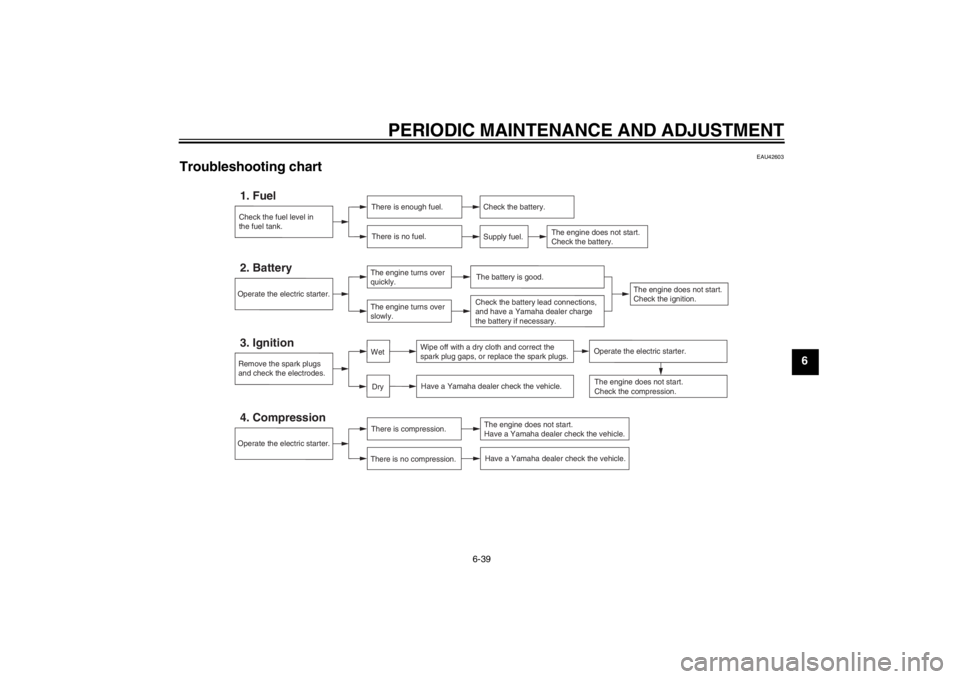
Troubleshooting Although Yamaha motorcycles receive
a thorough inspection before shipment
from the factory, trouble may occur dur-
ing operation. Any problem in the fuel,
compression, or ignition systems, for
example, can cause poor starting and
loss of power.
The following troubleshooting chart
represents a quick and easy procedure
for checking these vital systems your-
self. However, should your motorcycle
require any repair, take it to a Yamaha
dealer, whose skilled technicians have
the necessary tools, experience, and
know-how to service the motorcycle
properly.
Use only genuine Yamaha replace-
ment parts. Imitation parts may look like
Yamaha parts, but they are often inferi-
or, have a shorter service life and can
lead to expensive repair bills.
WARNING
EWA15141
When checking the fuel system, do
not smoke, and make sure there are
no open flames or sparks in the ar-
ea, including pilot lights from water
Tightening torques:Axle nut:
150 Nm (15 m·kgf, 108 ft·lbf)
Brake caliper bolt:
40 Nm (4.0 m·kgf, 29 ft·lbf)
Brake torque rod nut: 23 Nm (2.3 m·kgf, 17 ft·lbf)
U5WME9E0.book Page 37 Friday, December 7, 2012 3:50 PM
Page 85 of 98
PERIODIC MAINTENANCE AND ADJUSTMENT
6-39
6
EAU42603
Troubleshooting chart
Check the fuel level in
the fuel tank.1. Fuel
There is enough fuel.There is no fuel.
Check the battery.
Supply fuel.
The engine does not start.
Check the battery.
Remove the spark plugs
and check the electrodes.3. Ignition
Wipe off with a dry cloth and correct the
spark plug gaps, or replace the spark plugs.
Have a Yamaha dealer check the vehicle.
Operate the electric starter.4. Compression
There is compression.
There is no compression.
The engine does not start.
Have a Yamaha dealer check the vehicle.Have a Yamaha dealer check the vehicle.
The engine does not start.
Check the compression.
Operate the electric starter.2. Battery
The engine turns over
quickly.
The engine turns over
slowly.
The engine does not start.
Check the ignition.
The battery is good.Check the battery lead connections,
and have a Yamaha dealer charge
the battery if necessary.
DryWet
Operate the electric starter.
U5WME9E0.book Page 39 Friday, December 7, 2012 3:50 PM
Page 86 of 98
MOTORCYCLE CARE AND STORAGE
7-1
7
EAU37833
Matte color caution NOTICE
ECA15192
Some models are equipped with
matte colored finished parts. Be
sure to consult a Yamaha dealer for
advice on what products to use be-
fore cleaning the vehicle. Using a
brush, harsh chemical products or
cleaning compounds when cleaning
these parts will scratch or damage
their surface. Wax also should not
be applied to any matte colored fin-
ished parts.
EAU26014
Care While the open design of a motorcycle
reveals the attractiveness of the tech-
nology, it also makes it more vulnera-
ble. Rust and corrosion can develop
even if high-quality components are
used. A rusty exhaust pipe may go un-
noticed on a car, however, it detracts
from the overall appearance of a motor-
cycle. Frequent and proper care does
not only comply with the terms of the
warranty, but it will also keep your mo-
torcycle looking good, extend its life
and optimize its performance.
Before cleaning1. Cover the muffler outlet with a plastic bag after the engine has
cooled down.
2. Make sure that all caps and covers as well as all electrical couplers
and connectors, including the
spark plug caps, are tightly in-
stalled.
3. Remove extremely stubborn dirt, like oil burnt onto the crankcase,
with a degreasing agent and a
brush, but never apply such prod- ucts onto seals, gaskets, sprock-
ets, the drive chain and wheel
axles. Always rinse the dirt and de-
greaser off with water.
Cleaning
NOTICE
ECA10772
●
Avoid using strong acidic wheel
cleaners, especially on spoked
wheels. If such products are
used on hard-to-remove dirt, do
not leave the cleaner on the af-
fected area any longer than in-
structed. Also, thoroughly rinse
the area off with water, immedi-
ately dry it, and then apply a cor-
rosion protection spray.
●
Improper cleaning can damage
plastic parts (such as cowlings,
panels, windshields, headlight
lenses, meter lenses, etc.) and
the mufflers. Use only a soft,
clean cloth or sponge with wa-
ter to clean plastic. However, if
the plastic parts cannot be thor-
oughly cleaned with water, di-
luted mild detergent with water
may be used. Be sure to rinse
U5WME9E0.book Page 1 Friday, December 7, 2012 3:50 PM