lock YAMAHA XJR 1300 2015 User Guide
[x] Cancel search | Manufacturer: YAMAHA, Model Year: 2015, Model line: XJR 1300, Model: YAMAHA XJR 1300 2015Pages: 98, PDF Size: 2.6 MB
Page 29 of 98
INSTRUMENT AND CONTROL FUNCTIONS
3-14
3
ately. If g
asoline spills on your skin,
wash with soap an d water. If gaso-
line spills on your clothin g, chan ge
your clothes.
EAUM3111
NOTICE
ECA11401
Use only unlea ded g asoline. The use
of lead ed g asoline will cause severe
d amag e to internal en gine parts,
such as the valves an d piston rin gs,
as well as to the exhaust system.Your Yamaha engine has been de-
signed to use premium unleaded gas-
oline with a research octane number of
95 or higher. If knocking (or pinging)
occurs, use a gasoline of a different brand. Use of unleaded fuel will extend
spark plug life and reduce mainte-
nance costs.
Gasohol
There are two types of gasohol: gaso-
hol containing ethanol and that con-
taining methanol. Gasohol containing
ethanol can be used if the ethanol con-
tent does not exceed 10% (E10). Gas-
ohol containing methanol is not
recommended by Yamaha because it
can cause damage to the fuel system
or vehicle performance problems.
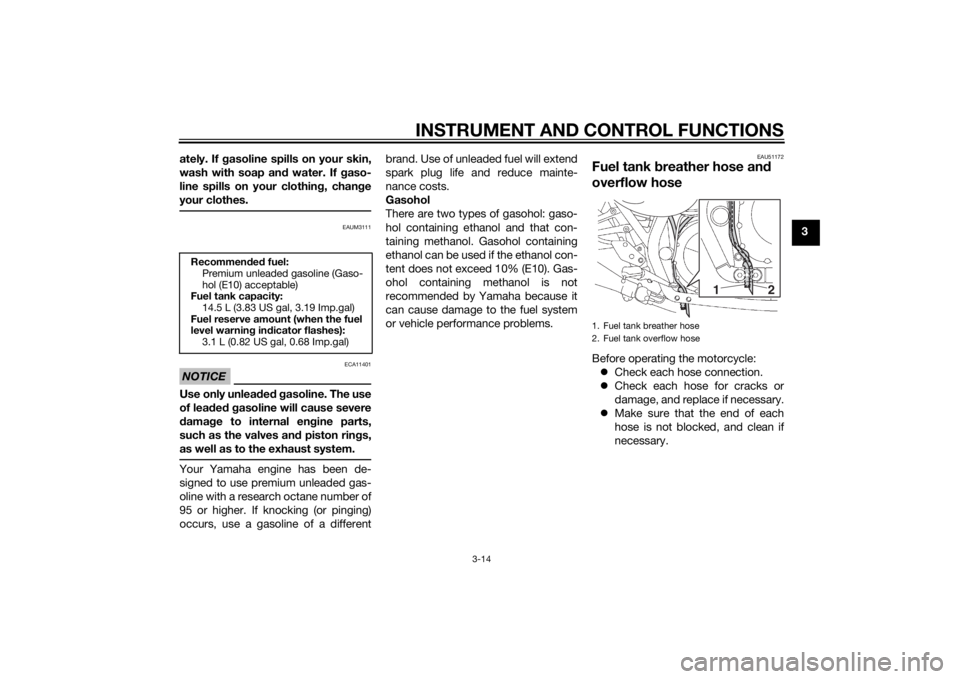
EAU51172
Fuel tank
breather hose an d
overflow hoseBefore operating the motorcycle:
Check each hose connection.
Check each hose for cracks or
damage, and replace if necessary.
Make sure that the end of each
hose is not blocked, and clean if
necessary.
Recommen ded fuel:
Premium unleaded gasoline (Gaso-
hol (E10) acceptable)
Fuel tank capacity:
14.5 L (3.83 US gal, 3.19 Imp.gal)
Fuel reserve amount (when the fuel
level warnin g in dicator flashes):
3.1 L (0.82 US gal, 0.68 Imp.gal)
1. Fuel tank breather hose
2. Fuel tank overflow hose
2
1
U2PNE0E0.book Page 14 Tuesda y, September 16, 2014 4:15 PM
Page 30 of 98
INSTRUMENT AND CONTROL FUNCTIONS
3-15
3
EAU13446
Catalytic convertersThis vehicle is equipped with catalytic
converters in the exhaust system.
WARNING
EWA10863
The exhaust system is hot after op-
eration. To prevent a fire hazard or
b urns:
Do not park the vehicle near
possi ble fire hazard s such as
g rass or other materials that
easily burn.
Park the vehicle in a place
where ped estrians or chil dren
are not likely to touch the hot
exhaust system.
Make sure that the exhaust sys-
tem has cooled down before
d oin g any maintenance work.
Do not allow the en gine to id le
more than a few minutes. Lon g
i d lin g can cause a b uild-up of
heat.
NOTICE
ECA10702
Use only unlea ded g asoline. The use
of lead ed g asoline will cause unre-
pairab le dama ge to the catalytic
converter.
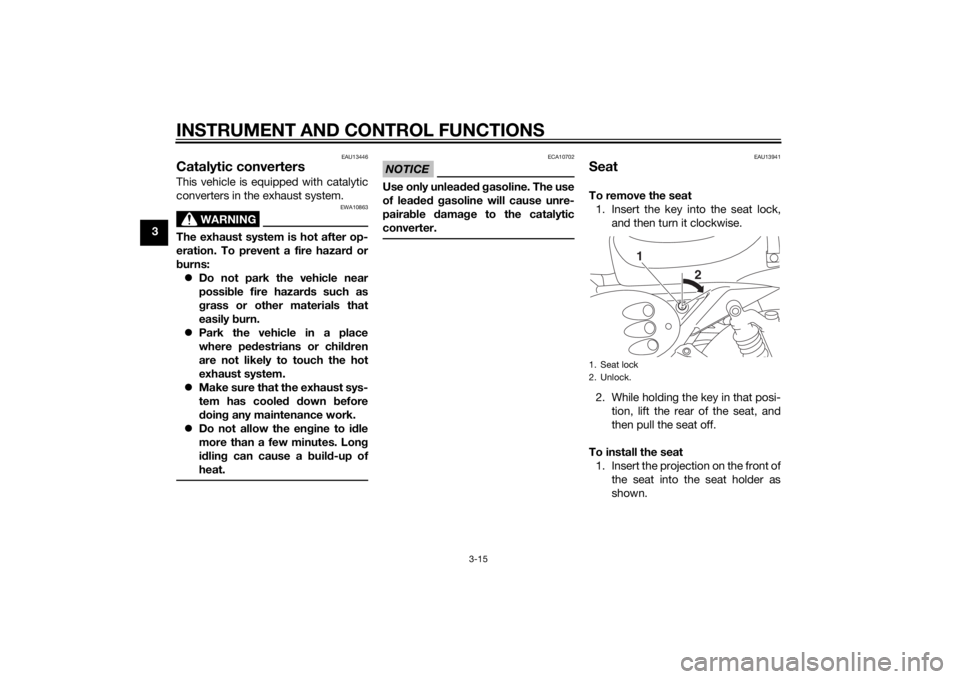
EAU13941
SeatTo remove the seat 1. Insert the key into the seat lock, and then turn it clockwise.
2. While holding the key in that posi- tion, lift the rear of the seat, and
then pull the seat off.
To install the seat 1. Insert the projection on the front of the seat into the seat holder as
shown.1. Seat lock
2. Unlock.
1
2
U2PNE0E0.book Page 15 Tuesda y, September 16, 2014 4:15 PM
Page 31 of 98
INSTRUMENT AND CONTROL FUNCTIONS
3-16
3
2. Push the rear of the seat down to lock it in place.
3. Remove the key.
TIPMake sure that the seat is properly se-
cured before riding.
EAU14744
A djustin g the front fork
WARNING
EWA10181
Always a djust both fork leg s equally,
otherwise poor han dlin g an d loss of
sta bility may result.This front fork is equipped with spring
preload adjusting bolts, rebound
damping force adjusting screws and
compression damping force adjusting
screws.NOTICE
ECA10102
To avoi d d amag ing the mechanism,
d o not attempt to turn b eyond the
maximum or minimum settin gs.Sprin g preloa d
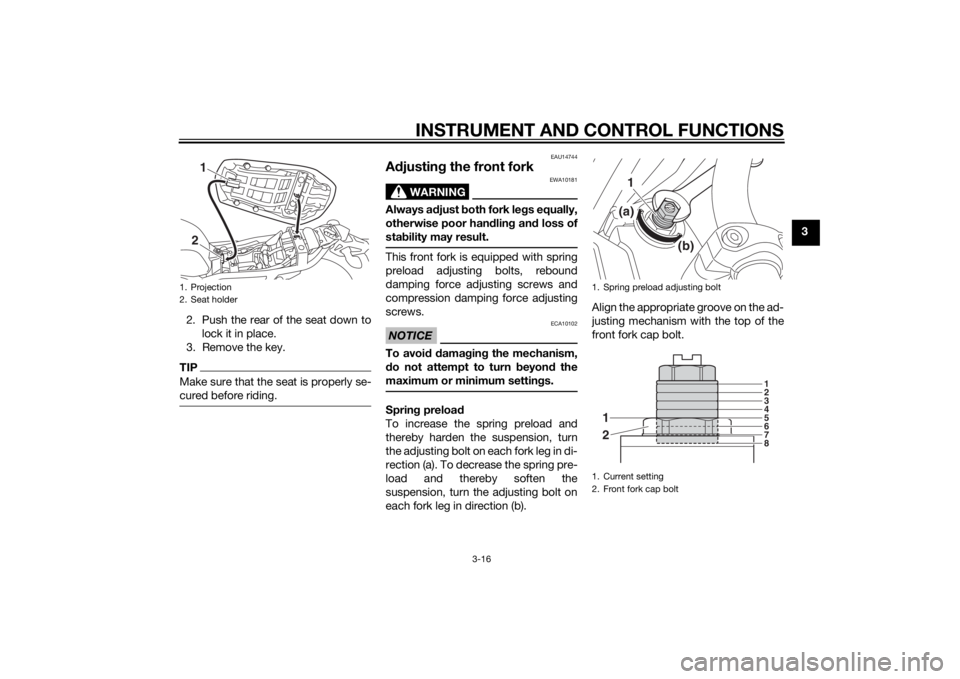
To increase the spring preload and
thereby harden the suspension, turn
the adjusting bolt on each fork leg in di-
rection (a). To decrease the spring pre-
load and thereby soften the
suspension, turn the adjusting bolt on
each fork leg in direction (b). Align the appropriate groove on the ad-
justing mechanism with the top of the
front fork cap bolt.
1. Projection
2. Seat holder
12
1. Spring preload adjusting bolt
1. Current setting
2. Front fork cap bolt
1(a)
(b)
2 1
1
2
3
4
5
6
7
8
U2PNE0E0.book Page 16 Tuesda
y, September 16, 2014 4:15 PM
Page 33 of 98
INSTRUMENT AND CONTROL FUNCTIONS
3-18
3
justment, it would be advisable to
check the number of clicks of each
damping force adjusting mechanism
and to modify the specifications as
necessary.
EAU43257
A
djustin g the shock a bsor ber
assemb ly
WARNING
EWA10211
Always a djust both shock ab sorber
assem blies equally, otherwise poor
han dlin g an d loss of stab ility may re-
sult.Each shock absorber assembly is
equipped with a spring preload adjust-
ing ring and rebound and compression
damping force adjusting knobs.
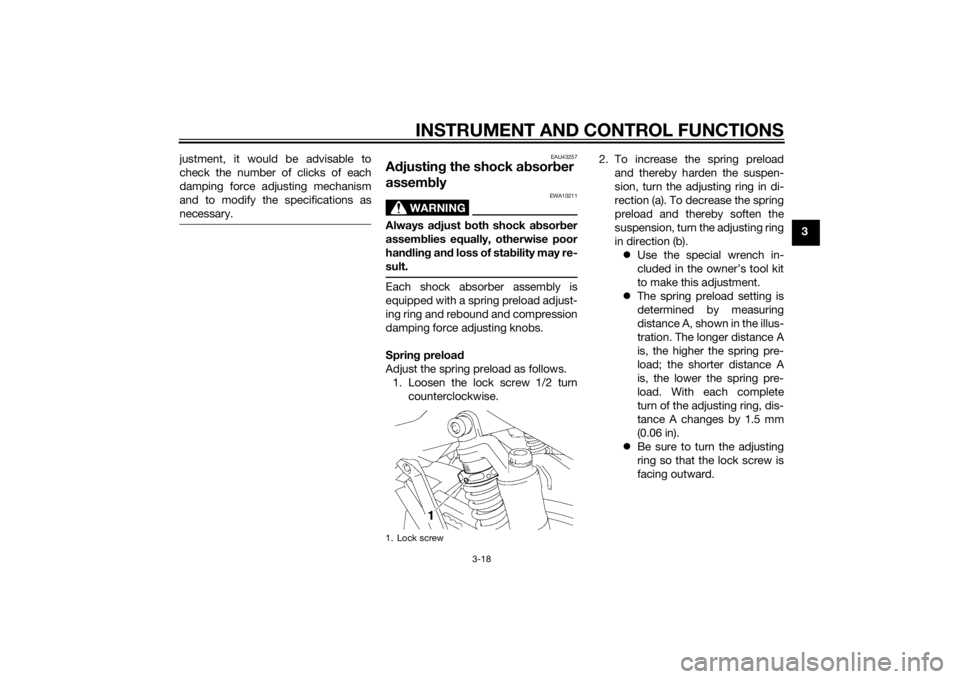
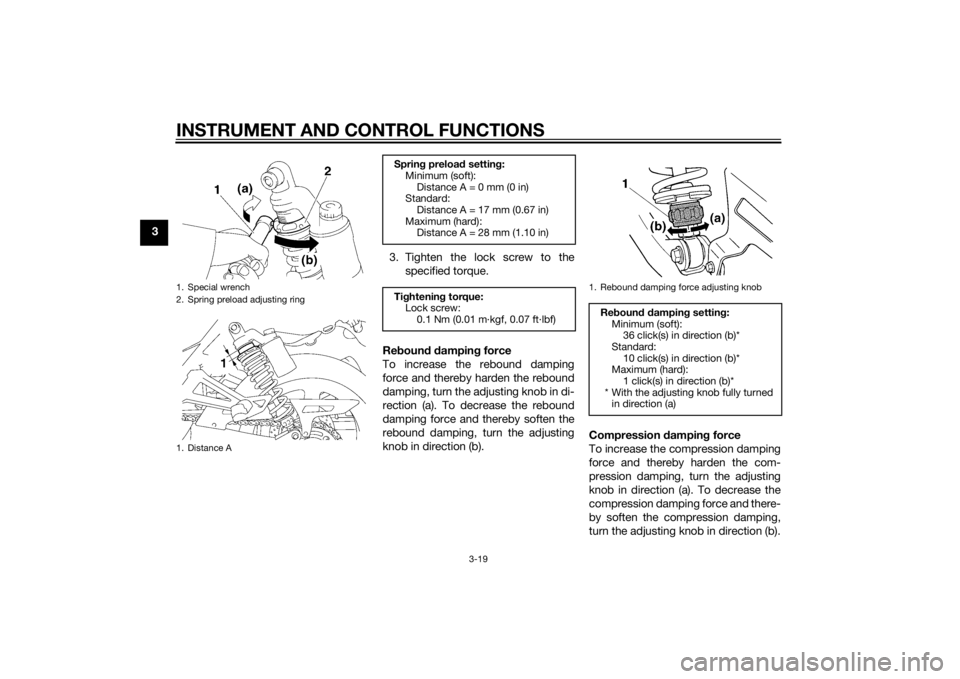
Sprin g preloa d
Adjust the spring preload as follows. 1. Loosen the lock screw 1/2 turn counterclockwise. 2. To increase the spring preload
and thereby harden the suspen-
sion, turn the adjusting ring in di-
rection (a). To decrease the spring
preload and thereby soften the
suspension, turn the adjusting ring
in direction (b). Use the special wrench in-
cluded in the owner’s tool kit
to make this adjustment.
The spring preload setting is
determined by measuring
distance A, shown in the illus-
tration. The longer distance A
is, the higher the spring pre-
load; the shorter distance A
is, the lower the spring pre-
load. With each complete
turn of the adjusting ring, dis-
tance A changes by 1.5 mm
(0.06 in).
Be sure to turn the adjusting
ring so that the lock screw is
facing outward.1. Lock screw
U2PNE0E0.book Page 18 Tuesda y, September 16, 2014 4:15 PM
Page 34 of 98
INSTRUMENT AND CONTROL FUNCTIONS
3-19
33. Tighten the lock screw to thespecified torque.
Re boun d d ampin g force
To increase the rebound damping
force and thereby harden the rebound
damping, turn the adjusting knob in di-
rection (a). To decrease the rebound
damping force and thereby soften the
rebound damping, turn the adjusting
knob in direction (b). Compression
dampin g force
To increase the compression damping
force and thereby harden the com-
pression damping, turn the adjusting
knob in direction (a). To decrease the
compression damping force and there-
by soften the compression damping,
turn the adjusting knob in direction (b).
1. Special wrench
2. Spring preload adjusting ring
1. Distance A
Sprin g preloa d setting :
Minimum (soft):
Distance A = 0 mm (0 in)
Standard:
Distance A = 17 mm (0.67 in)
Maximum (hard): Distance A = 28 mm (1.10 in)
Ti ghtenin g torque:
Lock screw:
0.1 Nm (0.01 m·kgf, 0.07 ft·lbf)
1. Rebound damping force adjusting knobRe boun d d ampin g setting :
Minimum (soft): 36 click(s) in direction (b)*
Standard: 10 click(s) in direction (b)*
Maximum (hard):
1 click(s) in direction (b)*
* With the adjusting knob fully turned in direction (a)
U2PNE0E0.book Page 19 Tuesda y, September 16, 2014 4:15 PM
Page 66 of 98
PERIODIC MAINTENANCE AND ADJUSTMENT
6-21
6
WARNING
EWA16001
Improper maintenance can result in
loss of braking a bility or clutch oper-
ation. O bserve these precautions:
Insufficient brake or clutch flui d
may allow air to enter the brake
or clutch system, re ducing
b rakin g or clutch performance.
Clean the filler caps before re-
moving . Use only DOT 4 b rake
flui d from a seale d container.
Use only the specified b rake flu-
i d ; otherwise, the ru bber seals
may deteriorate, causin g leak-
a g e.
Refill with the same type of
brake flui d. A ddin g a brake flui d
other than DOT 4 may result in a
harmful chemical reaction.
Be careful that water does not
enter the brake or clutch flui d
reservoir when refillin g. Water will si
gnificantly lower the boil-
in g point of the flui d an d may re-
sult in vapor lock.
NOTICE
ECA17641
Brake fluid may damag e painted
surfaces or plastic parts. Always
clean up spille d flui d imme diately.The brake or clutch fluid reservoir dia-
phragm will lose its shape from the
negative pressure if the fluid level goes
down too far. Be sure to return the dia-
phragm to its original shape before in-
stalling it into the brake or clutch fluid
reservoir.
As the brake pads wear, it is normal for
the brake fluid level to gradually go
down. A low brake fluid level may indi-
cate worn brake pads and/or brake
system leakage; therefore, be sure to
check the brake pads for wear and the
brake system for leakage. A low clutch
fluid level may indicate clutch system
leakage; therefore, be sure to check
the clutch system for leakage. If the
brake or clutch fluid level goes down
suddenly, have a Yamaha dealer check
the cause before further riding.
EAU22754
Chan gin g the brake an d
clutch flui dsHave a Yamaha dealer change the
brake and clutch fluids at the intervals
specified in the periodic maintenance
and lubrication chart. In addition, have
the oil seals of the brake and clutch
master cylinders and calipers as well
as the brake and clutch hoses replaced
at the intervals listed below or whenev-
er they are damaged or leaking.
Oil seals: Replace every two
years.
Brake and clutch hoses: Replace
every four years.
Specifie d b rake an d clutch flui d:
DOT 4 brake fluid
U2PNE0E0.book Page 21 Tuesda y, September 16, 2014 4:15 PM
Page 67 of 98
PERIODIC MAINTENANCE AND ADJUSTMENT
6-22
6
EAU22762
Drive chain slackThe drive chain slack should be
checked before each ride and adjusted
if necessary.
EAU22776
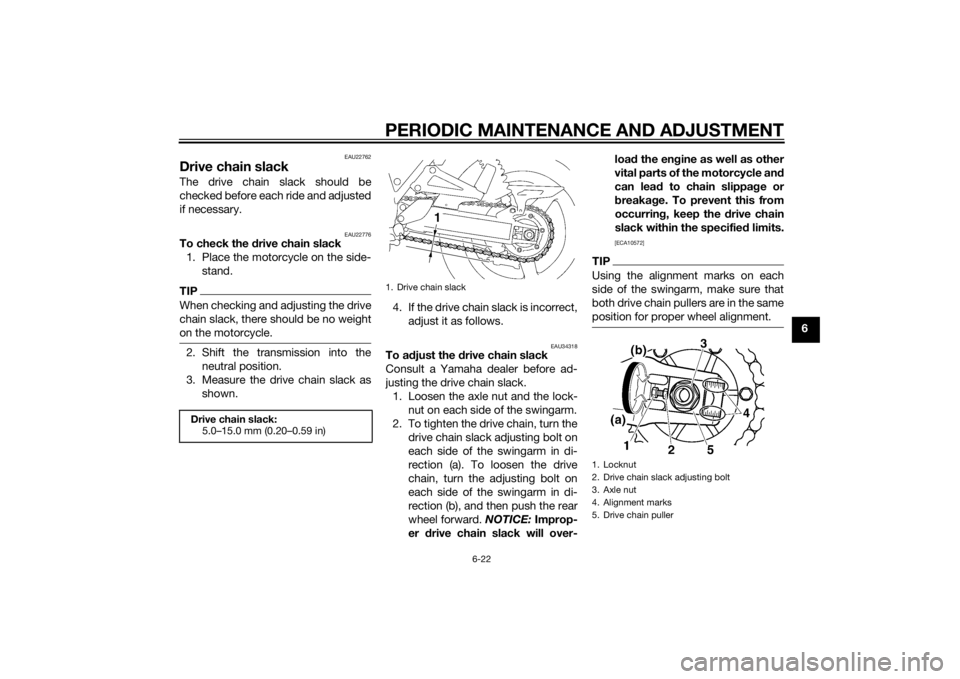
To check the drive chain slack
1. Place the motorcycle on the side- stand.TIPWhen checking and adjusting the drive
chain slack, there should be no weight
on the motorcycle.2. Shift the transmission into the neutral position.
3. Measure the drive chain slack as shown. 4. If the drive chain slack is incorrect,
adjust it as follows.
EAU34318
To a djust the drive chain slack
Consult a Yamaha dealer before ad-
justing the drive chain slack. 1. Loosen the axle nut and the lock- nut on each side of the swingarm.
2. To tighten the drive chain, turn the drive chain slack adjusting bolt on
each side of the swingarm in di-
rection (a). To loosen the drive
chain, turn the adjusting bolt on
each side of the swingarm in di-
rection (b), and then push the rear
wheel forward. NOTICE: Improp-
er drive chain slack will over- loa
d the en gine as well as other
vital parts of the motorcycle and
can lead to chain slippa ge or
b reakag e. To prevent this from
occurrin g, keep the d rive chain
slack within the specified limits.
[ECA10572]
TIPUsing the alignment marks on each
side of the swingarm, make sure that
both drive chain pullers are in the same
position for proper wheel alignment.
Drive chain slack:
5.0–15.0 mm (0.20–0.59 in)
1. Drive chain slack
1
1. Locknut
2. Drive chain slack adjusting bolt
3. Axle nut
4. Alignment marks
5. Drive chain puller
U2PNE0E0.book Page 22 Tuesda y, September 16, 2014 4:15 PM
Page 68 of 98
PERIODIC MAINTENANCE AND ADJUSTMENT
6-23
63. Tighten the axle nut, then the lock-
nuts to their specified torques.
4. Make sure that the drive chain pullers are in the same position,
the drive chain slack is correct,
and the drive chain moves
smoothly.
EAU23026
Cleanin g an d lu bricatin g the
d rive chainThe drive chain must be cleaned and
lubricated at the intervals specified in
the periodic maintenance and lubrica-
tion chart, otherwise it will quickly wear
out, especially when riding in dusty or
wet areas. Service the drive chain as
follows.NOTICE
ECA10584
The drive chain must b e lubricated
after washin g the motorcycle, ri din g
in the rain or ri din g in wet areas.1. Clean the drive chain with kero-
sene and a small soft brush.
NOTICE: To prevent d amaging
the O-rin gs, do not clean the
d rive chain with steam cleaners,
hi gh-pressure washers or inap-
propriate solvents.
[ECA11122]
2. Wipe the drive chain dry.
3. Thoroughly lubricate the drive chain with a special O-ring chain
lubricant. NOTICE: Do not use
en gine oil or any other lu bri-
cants for the drive chain, as they may contain su
bstances that
coul d damag e the O-rin gs.
[ECA11112]
Ti ghtenin g torques:
Axle nut: 150 Nm (15 m·kgf, 108 ft·lbf)
Locknut:
16 Nm (1.6 m·kgf, 12 ft·lbf)
U2PNE0E0.book Page 23 Tuesda y, September 16, 2014 4:15 PM
Page 75 of 98
PERIODIC MAINTENANCE AND ADJUSTMENT
6-30
6
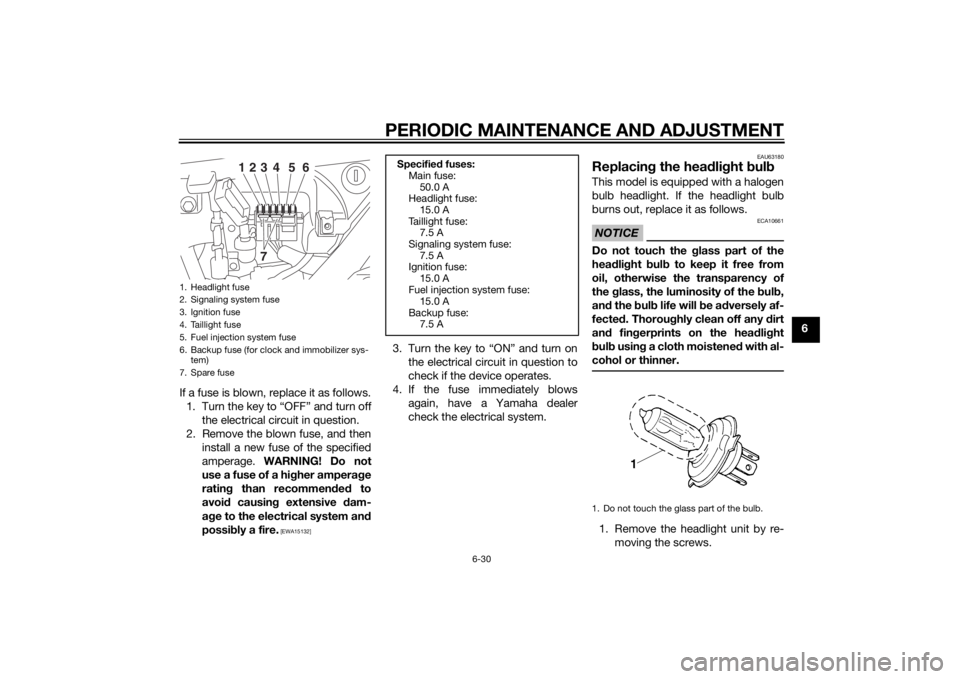
If a fuse is blown, replace it as follows. 1. Turn the key to “OFF” and turn off the electrical circuit in question.
2. Remove the blown fuse, and then install a new fuse of the specified
amperage. WARNING! Do not
use a fuse of a hi gher ampera ge
ratin g than recommen ded to
avoi d causin g extensive dam-
a g e to the electrical system an d
possi bly a fire.
[EWA15132]
3. Turn the key to “ON” and turn on
the electrical circuit in question to
check if the device operates.
4. If the fuse immediately blows again, have a Yamaha dealer
check the electrical system.
EAU63180
Replacin g the hea dlig ht bul bThis model is equipped with a halogen
bulb headlight. If the headlight bulb
burns out, replace it as follows.NOTICE
ECA10661
Do not touch the glass part of the
hea dlig ht bul b to keep it free from
oil, otherwise the transparency of
the glass, the luminosity of the bul b,
an d the b ulb life will b e adversely af-
fected . Thorou ghly clean off any d irt
an d fin gerprints on the head light
b ul b using a cloth moistened with al-
cohol or thinner.1. Remove the headlight unit by re- moving the screws.
1. Headlight fuse
2. Signaling system fuse
3. Ignition fuse
4. Taillight fuse
5. Fuel injection system fuse
6. Backup fuse (for clock and immobilizer sys-tem)
7. Spare fuse
123
4
5
6
7
Specified fuses:
Main fuse:
50.0 A
Headlight fuse:
15.0 A
Taillight fuse: 7.5 A
Signaling system fuse: 7.5 A
Ignition fuse:
15.0 A
Fuel injection system fuse: 15.0 A
Backup fuse: 7.5 A
1. Do not touch the glass part of the bulb.
U2PNE0E0.book Page 30 Tuesda y, September 16, 2014 4:15 PM
Page 77 of 98
PERIODIC MAINTENANCE AND ADJUSTMENT
6-32
6
EAU65440
Replacing the auxiliary li ght
b ul bIf the auxiliary light bulb burns out, re-
place it as follows.
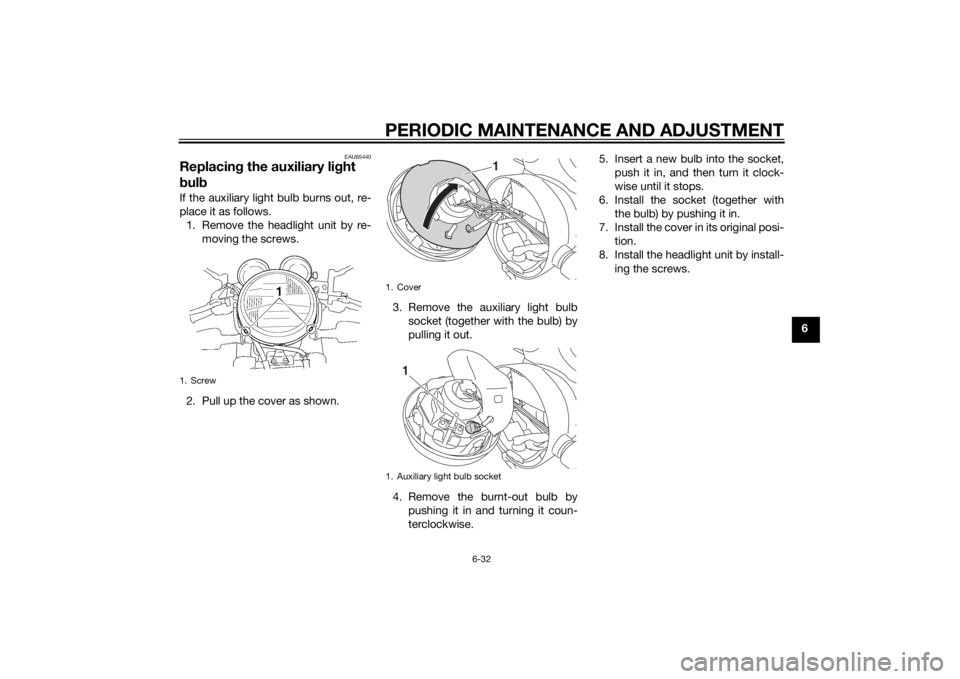
1. Remove the headlight unit by re- moving the screws.
2. Pull up the cover as shown. 3. Remove the auxiliary light bulb
socket (together with the bulb) by
pulling it out.
4. Remove the burnt-out bulb by pushing it in and turning it coun-
terclockwise. 5. Insert a new bulb into the socket,
push it in, and then turn it clock-
wise until it stops.
6. Install the socket (together with the bulb) by pushing it in.
7. Install the cover in its original posi- tion.
8. Install the headlight unit by install- ing the screws.1. Screw
1. Cover
1. Auxiliary light bulb socket
1
1
U2PNE0E0.book Page 32 Tuesda y, September 16, 2014 4:15 PM