warning YAMAHA XL 1200 2001 User Guide
[x] Cancel search | Manufacturer: YAMAHA, Model Year: 2001, Model line: XL 1200, Model: YAMAHA XL 1200 2001Pages: 131, PDF Size: 8.12 MB
Page 45 of 131
2-20
E
EJU00698b
Multifunction meter
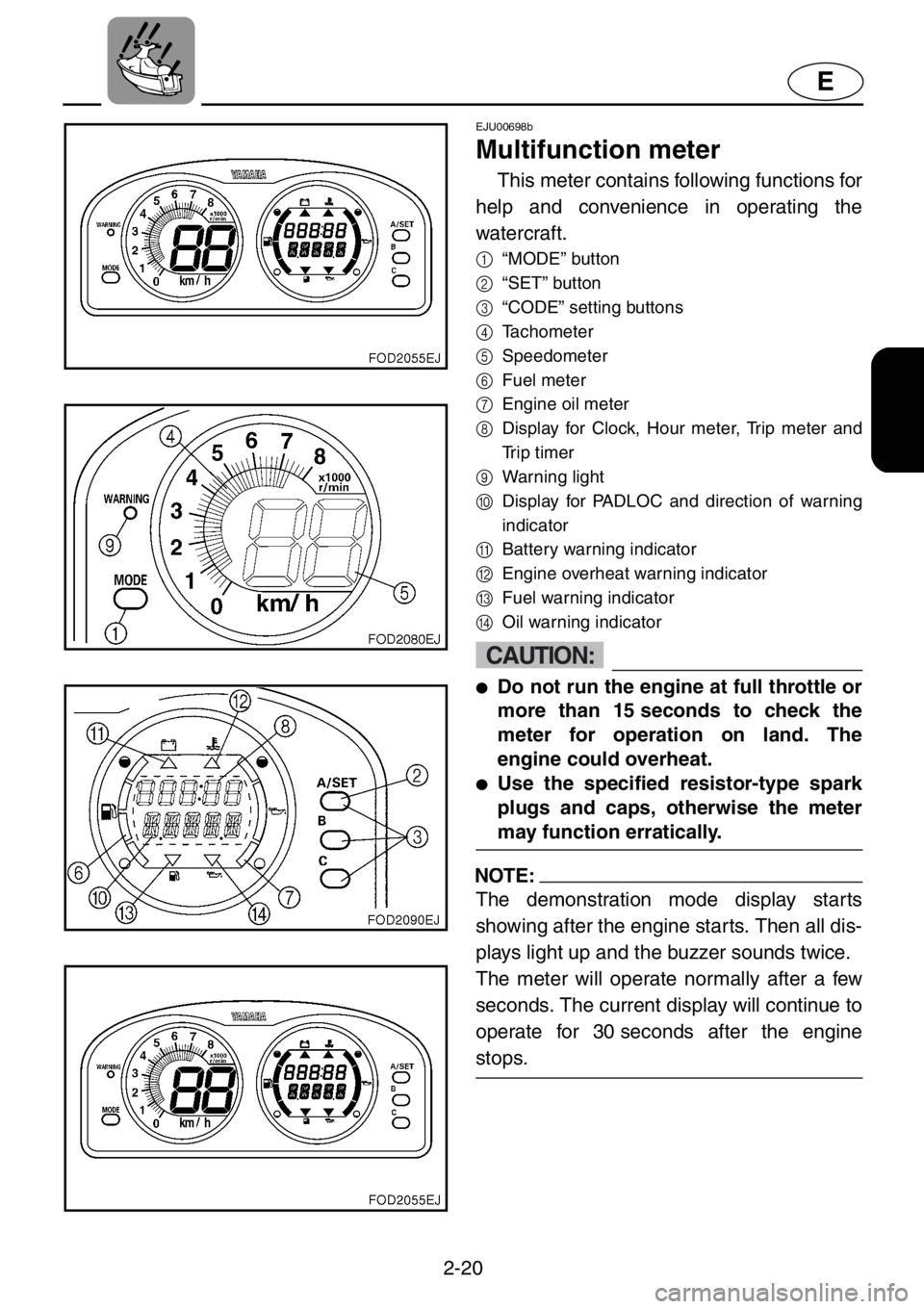
This meter contains following functions for
help and convenience in operating the
watercraft.
1
“MODE” button
2
“SET” button
3
“CODE” setting buttons
4
Tachometer
5
Speedometer
6
Fuel meter
7
Engine oil meter
8
Display for Clock, Hour meter, Trip meter and
Trip timer
9
Warning light
0
Display for PADLOC and direction of warning
indicator
A
Battery warning indicator
B
Engine overheat warning indicator
C
Fuel warning indicator
D
Oil warning indicator
CAUTION:
●Do not run the engine at full throttle or
more than 15 seconds to check the
meter for operation on land. The
engine could overheat.
●Use the specified resistor-type spark
plugs and caps, otherwise the meter
may function erratically.
NOTE:
The demonstration mode display starts
showing after the engine starts. Then all dis-
plays light up and the buzzer sounds twice.
The meter will operate normally after a few
seconds. The current display will continue to
operate for 30 seconds after the engine
stops.
Page 46 of 131
2-21
E
EJU00711a
PADLOC (Programmable
digital locking ignition)
This feature is provided to deter unautho-
rized use.
The function allows you to choose either
“START” or “LOCK” mode, as the situation
requires, much as you would use an ignition
key in a motor vehicle. If you have previously
chosen “LOCK” mode, the engine will not
start unless the right code is put in to select
“START” mode.
NOTE:
If you do not use the PADLOC system, it is
unnecessary to perform the initial setting of
the PADLOC. In this case, the “START”
mode is automatically selected.
PADLOC initial setting
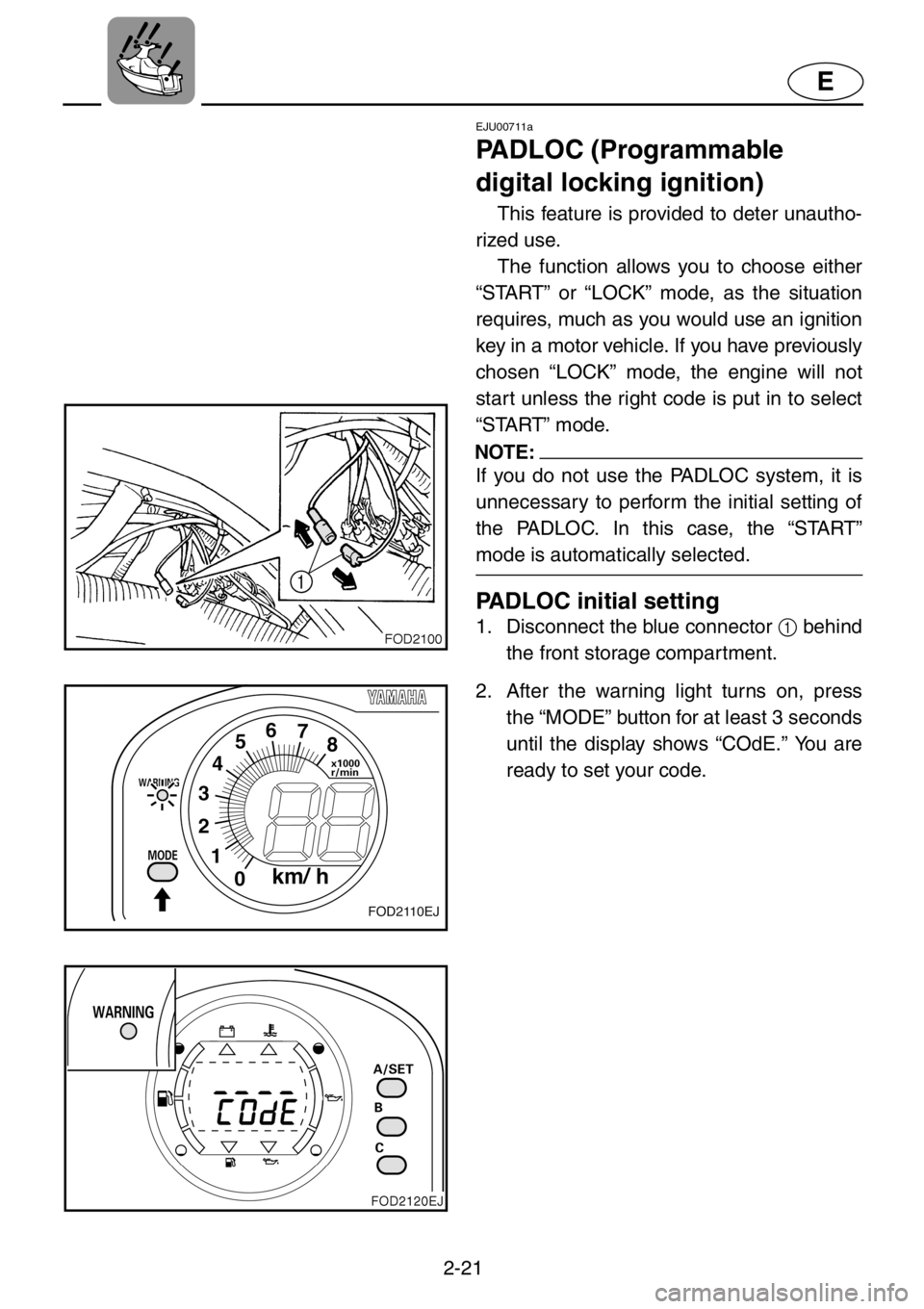
1. Disconnect the blue connector 1 behind
the front storage compartment.
2. After the warning light turns on, press
the “MODE” button for at least 3 seconds
until the display shows “COdE.” You are
ready to set your code.
Page 47 of 131
2-22
E
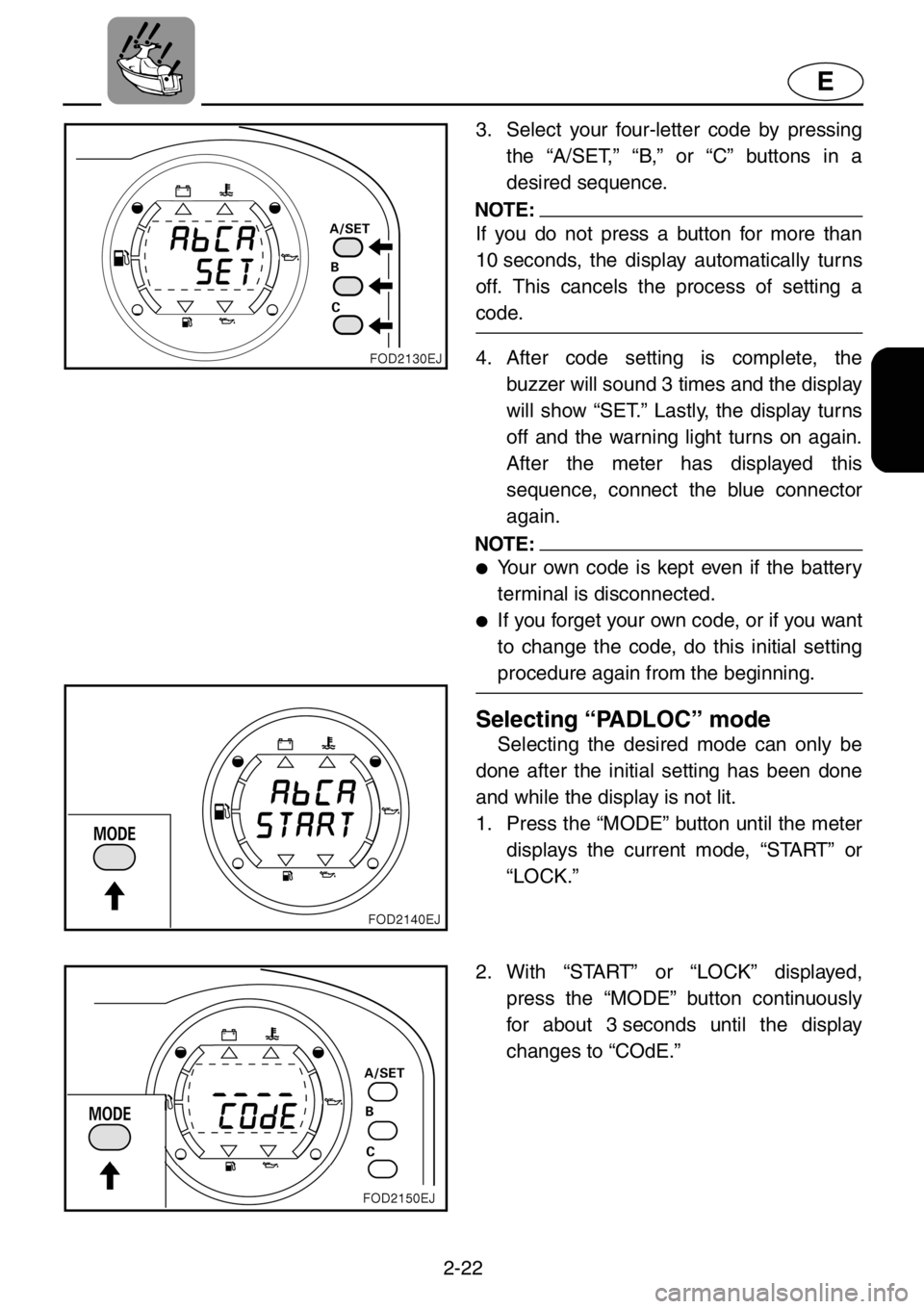
3. Select your four-letter code by pressing
the “A/SET,” “B,” or “C” buttons in a
desired sequence.
NOTE:
If you do not press a button for more than
10 seconds, the display automatically turns
off. This cancels the process of setting a
code.
4. After code setting is complete, the
buzzer will sound 3 times and the display
will show “SET.” Lastly, the display turns
off and the warning light turns on again.
After the meter has displayed this
sequence, connect the blue connector
again.
NOTE:
●Your own code is kept even if the battery
terminal is disconnected.
●If you forget your own code, or if you want
to change the code, do this initial setting
procedure again from the beginning.
Selecting “PADLOC” mode
Selecting the desired mode can only be
done after the initial setting has been done
and while the display is not lit.
1. Press the “MODE” button until the meter
displays the current mode, “START” or
“LOCK.”
2. With “START” or “LOCK” displayed,
press the “MODE” button continuously
for about 3 seconds until the display
changes to “COdE.”
Page 52 of 131
2-27
E
EJU00712
Tr i p m e t e r
A tripmeter is provided for measuring the
approximate distance traveled.
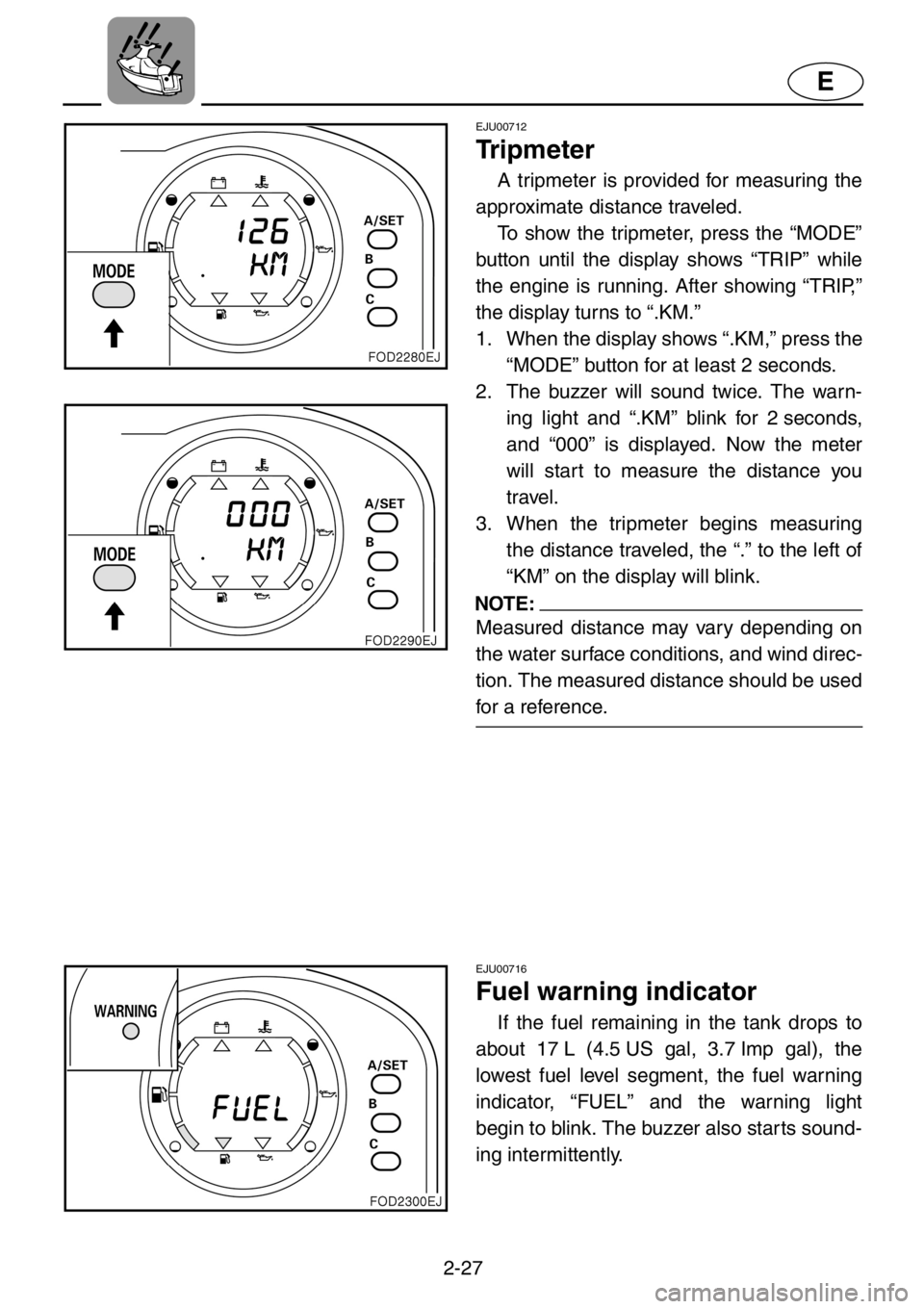
To show the tripmeter, press the “MODE”
button until the display shows “TRIP” while
the engine is running. After showing “TRIP,”
the display turns to “.KM.”
1. When the display shows “.KM,” press the
“MODE” button for at least 2 seconds.
2. The buzzer will sound twice. The warn-
ing light and “.KM” blink for 2 seconds,
and “000” is displayed. Now the meter
will start to measure the distance you
travel.
3. When the tripmeter begins measuring
the distance traveled, the “.” to the left of
“KM” on the display will blink.
NOTE:
Measured distance may vary depending on
the water surface conditions, and wind direc-
tion. The measured distance should be used
for a reference.
EJU00716
Fuel warning indicator
If the fuel remaining in the tank drops to
about 17 L (4.5 US gal, 3.7 Imp gal), the
lowest fuel level segment, the fuel warning
indicator, “FUEL” and the warning light
begin to blink. The buzzer also starts sound-
ing intermittently.
Page 53 of 131
2-28
E
EJU00717a
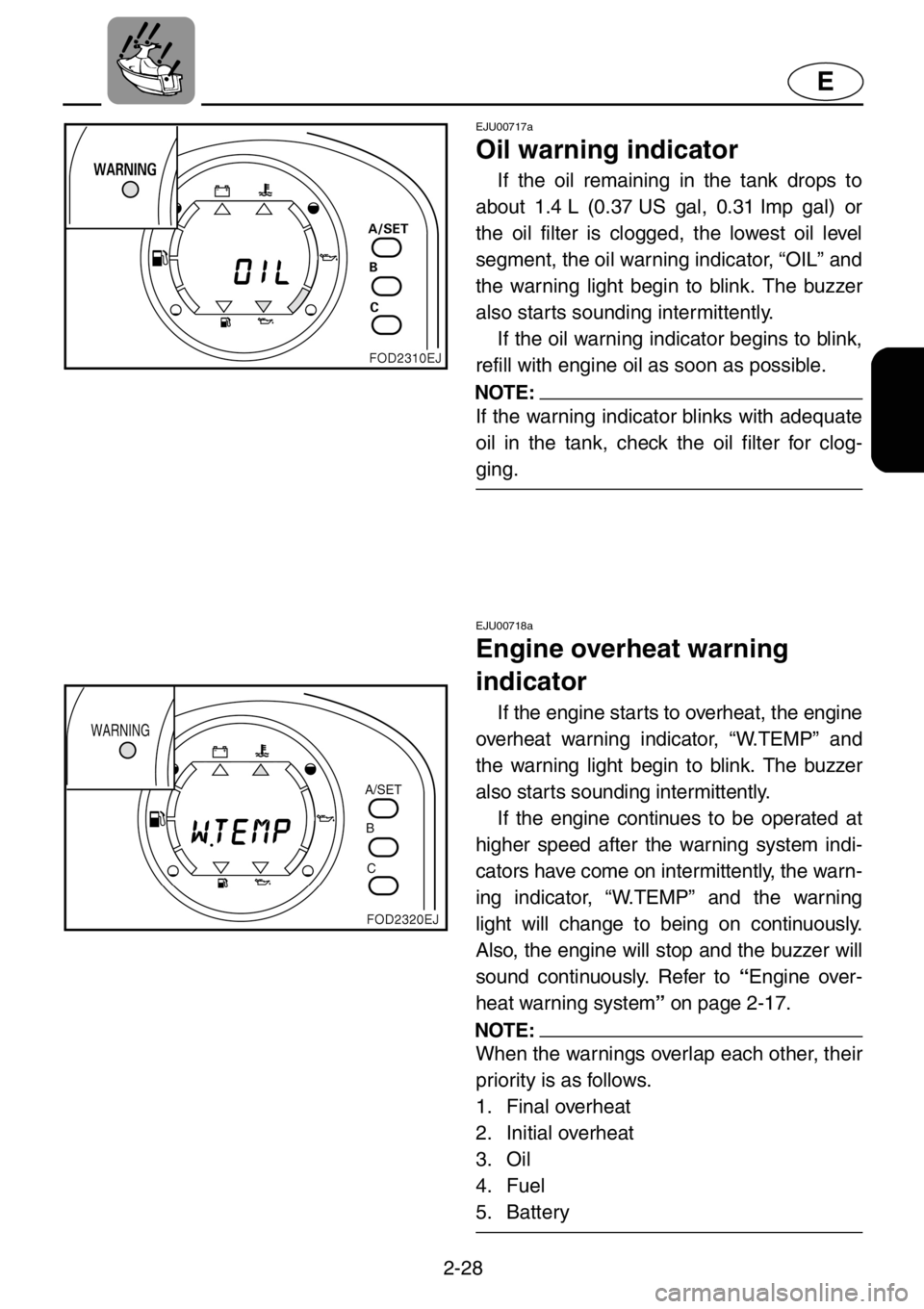
Oil warning indicator
If the oil remaining in the tank drops to
about 1.4 L (0.37 US gal, 0.31 Imp gal) or
the oil filter is clogged, the lowest oil level
segment, the oil warning indicator, “OIL” and
the warning light begin to blink. The buzzer
also starts sounding intermittently.
If the oil warning indicator begins to blink,
refill with engine oil as soon as possible.
NOTE:
If the warning indicator blinks with adequate
oil in the tank, check the oil filter for clog-
ging.
EJU00718a
Engine overheat warning
indicator
If the engine starts to overheat, the engine
overheat warning indicator, “W.TEMP” and
the warning light begin to blink. The buzzer
also starts sounding intermittently.
If the engine continues to be operated at
higher speed after the warning system indi-
cators have come on intermittently, the warn-
ing indicator, “W.TEMP” and the warning
light will change to being on continuously.
Also, the engine will stop and the buzzer will
sound continuously. Refer to “Engine over-
heat warning system” on page 2-17.
NOTE:
When the warnings overlap each other, their
priority is as follows.
1. Final overheat
2. Initial overheat
3. Oil
4. Fuel
5. Battery
Page 54 of 131
2-29
E
EJU00719
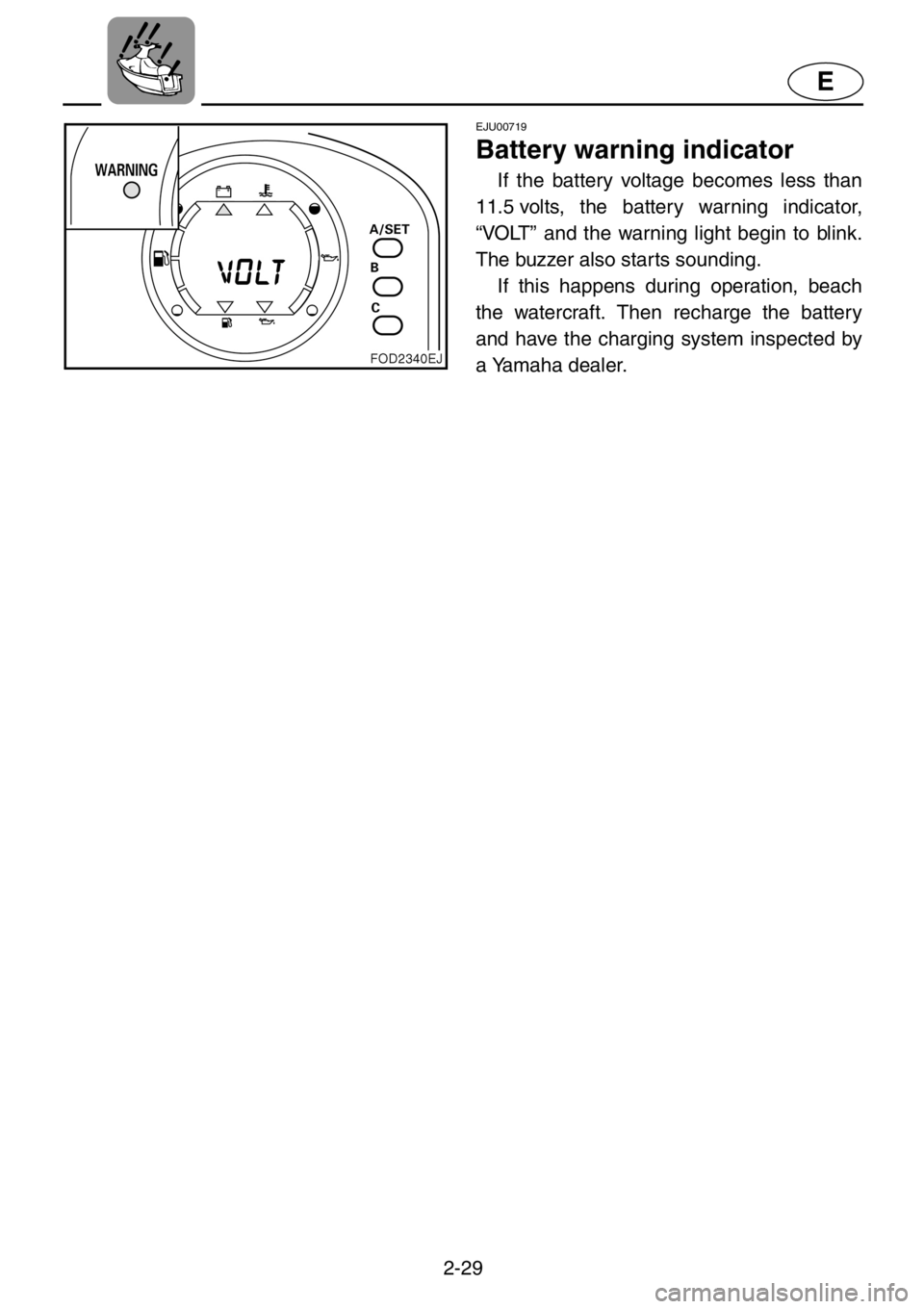
Battery warning indicator
If the battery voltage becomes less than
11.5 volts, the battery warning indicator,
“VOLT” and the warning light begin to blink.
The buzzer also starts sounding.
If this happens during operation, beach
the watercraft. Then recharge the battery
and have the charging system inspected by
a Yamaha dealer.
Page 58 of 131
3-1
E
EJU00411a
Fuel and oil
This engine uses Yamaha’s oil injection
system, which provides superior lubrication
by ensuring the proper oil ratio for all operat-
ing conditions. No fuel premixing is neces-
sary except during the engine break-in
period. Simply pour gasoline into the fuel
tank and oil into the oil tank.
Gasoline
WARNING
GASOLINE AND ITS VAPORS ARE
HIGHLY FLAMMABLE AND EXPLOSIVE!
●Do not smoke when refueling, and
keep away from sparks, flames, or
other sources of ignition.
●Stop engine before refueling.
●Refuel in a well-ventilated area. Do not
stand or sit on the watercraft while
refueling in case of fire.
●Take care not to spill gasoline. If gaso-
line spills, wipe it up immediately with
dry rags. Always properly dispose of
gasoline-soaked rags.
●Avoid overfilling the fuel tank. Stop fill-
ing when the fuel level just reaches the
bottom of the filler tube. Do not fill up
the filler tube because fuel expands as
it warms up and could overflow.
●Tighten the filler cap securely after
refueling.
●If you should swallow some gasoline,
inhale a lot of gasoline vapor, or get
gasoline in your eyes, get immediate
medical attention.
●If any gasoline spills onto your skin,
immediately wash with soap and
water. Change clothing if gasoline
spills on it.
Page 61 of 131
3-4
E
EJU00419a
Filling the oil tank
WARNING
●Do not add gasoline to the oil tank.
Fire or explosion could result.
●Oil in the bilge is a serious fire hazard.
Wipe up any spilled oil immediately.
CAUTION:
Do not allow the oil tank to become com-
pletely empty. If the oil tank becomes
empty the oil injection pump must be
bled to ensure proper oil flow, otherwise
engine damage may occur. If bleeding of
the oil pump is necessary, have a
Yamaha dealer bleed it.
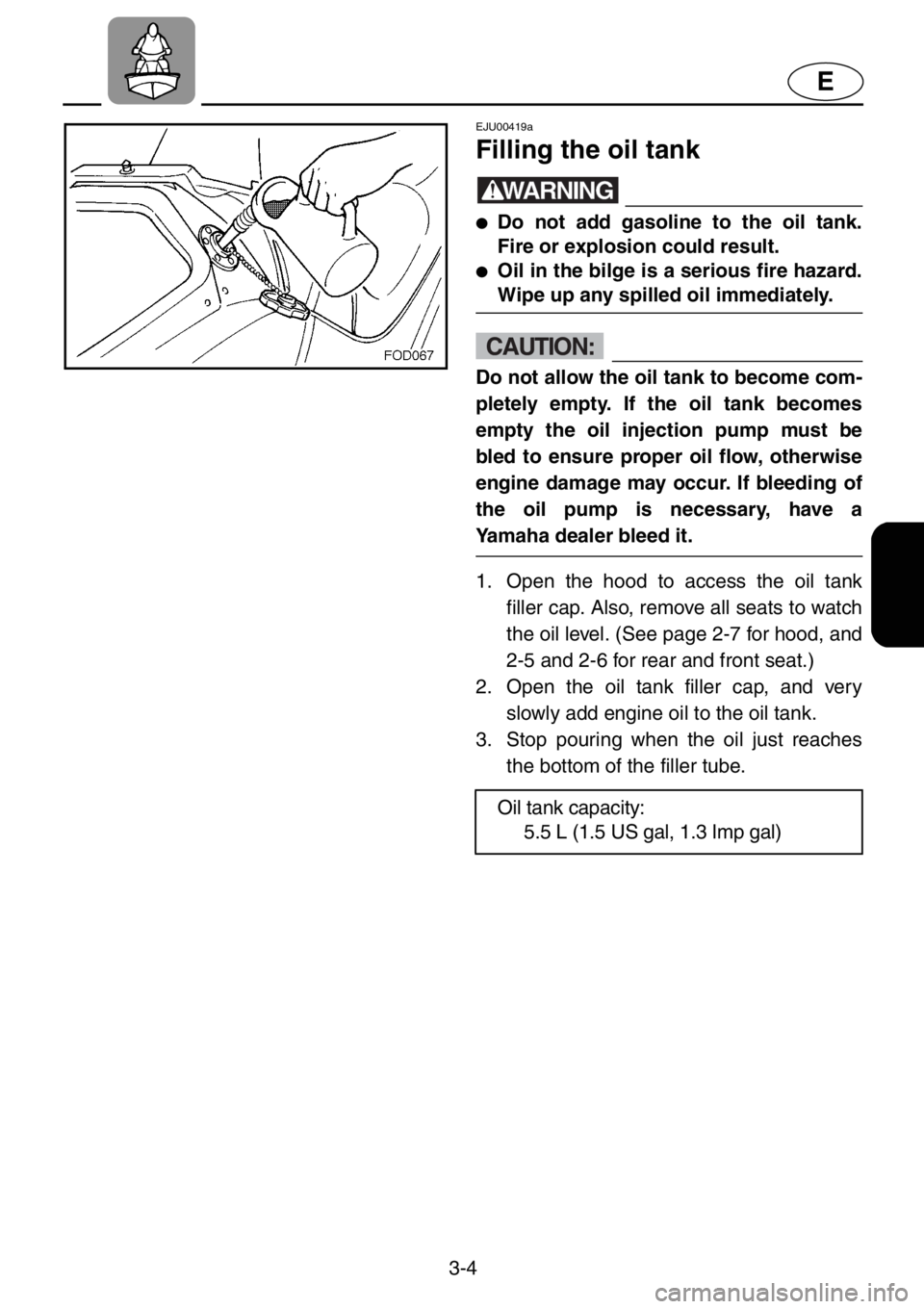
1. Open the hood to access the oil tank
filler cap. Also, remove all seats to watch
the oil level. (See page 2-7 for hood, and
2-5 and 2-6 for rear and front seat.)
2. Open the oil tank filler cap, and very
slowly add engine oil to the oil tank.
3. Stop pouring when the oil just reaches
the bottom of the filler tube.
Oil tank capacity:
5.5 L (1.5 US gal, 1.3 Imp gal)
Page 62 of 131
3-5
E
EJU00422
Pre-operation checks
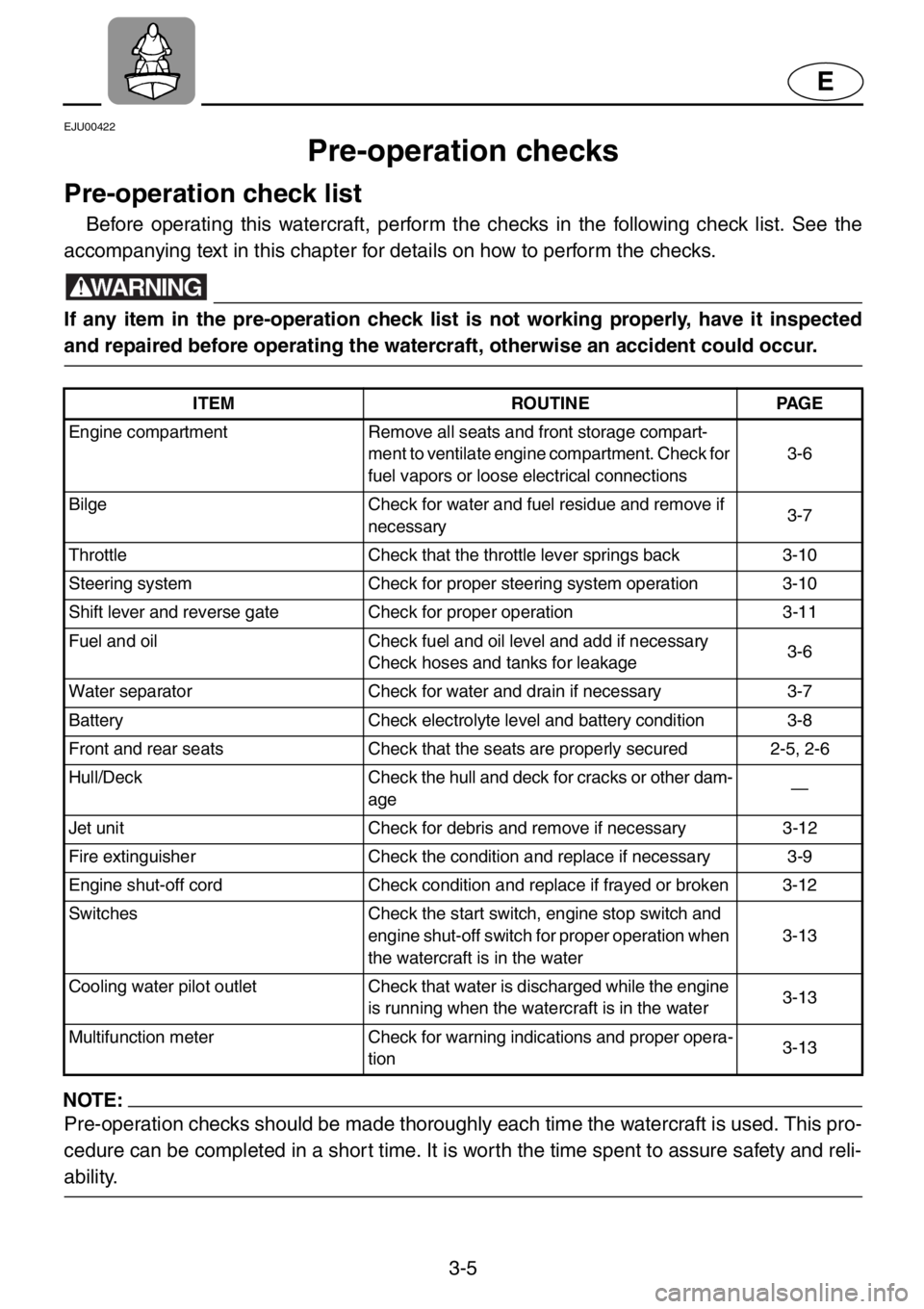
Pre-operation check list
Before operating this watercraft, perform the checks in the following check list. See the
accompanying text in this chapter for details on how to perform the checks.
WARNING
If any item in the pre-operation check list is not working properly, have it inspected
and repaired before operating the watercraft, otherwise an accident could occur.
NOTE:
Pre-operation checks should be made thoroughly each time the watercraft is used. This pro-
cedure can be completed in a short time. It is worth the time spent to assure safety and reli-
ability.
ITEM ROUTINE PAGE
Engine compartment Remove all seats and front storage compart-
ment to ventilate engine compartment. Check for
fuel vapors or loose electrical connections3-6
Bilge Check for water and fuel residue and remove if
necessary3-7
Throttle Check that the throttle lever springs back 3-10
Steering system Check for proper steering system operation 3-10
Shift lever and reverse gate Check for proper operation 3-11
Fuel and oil Check fuel and oil level and add if necessary
Check hoses and tanks for leakage3-6
Water separator Check for water and drain if necessary 3-7
Battery Check electrolyte level and battery condition 3-8
Front and rear seats Check that the seats are properly secured 2-5, 2-6
Hull/Deck Check the hull and deck for cracks or other dam-
age—
Jet unit Check for debris and remove if necessary 3-12
Fire extinguisher Check the condition and replace if necessary 3-9
Engine shut-off cord Check condition and replace if frayed or broken 3-12
Switches Check the start switch, engine stop switch and
engine shut-off switch for proper operation when
the watercraft is in the water3-13
Cooling water pilot outlet Check that water is discharged while the engine
is running when the watercraft is in the water3-13
Multifunction meter Check for warning indications and proper opera-
tion3-13
Page 63 of 131
3-6
E
EJU00426
Pre-operation check points
Engine compartment
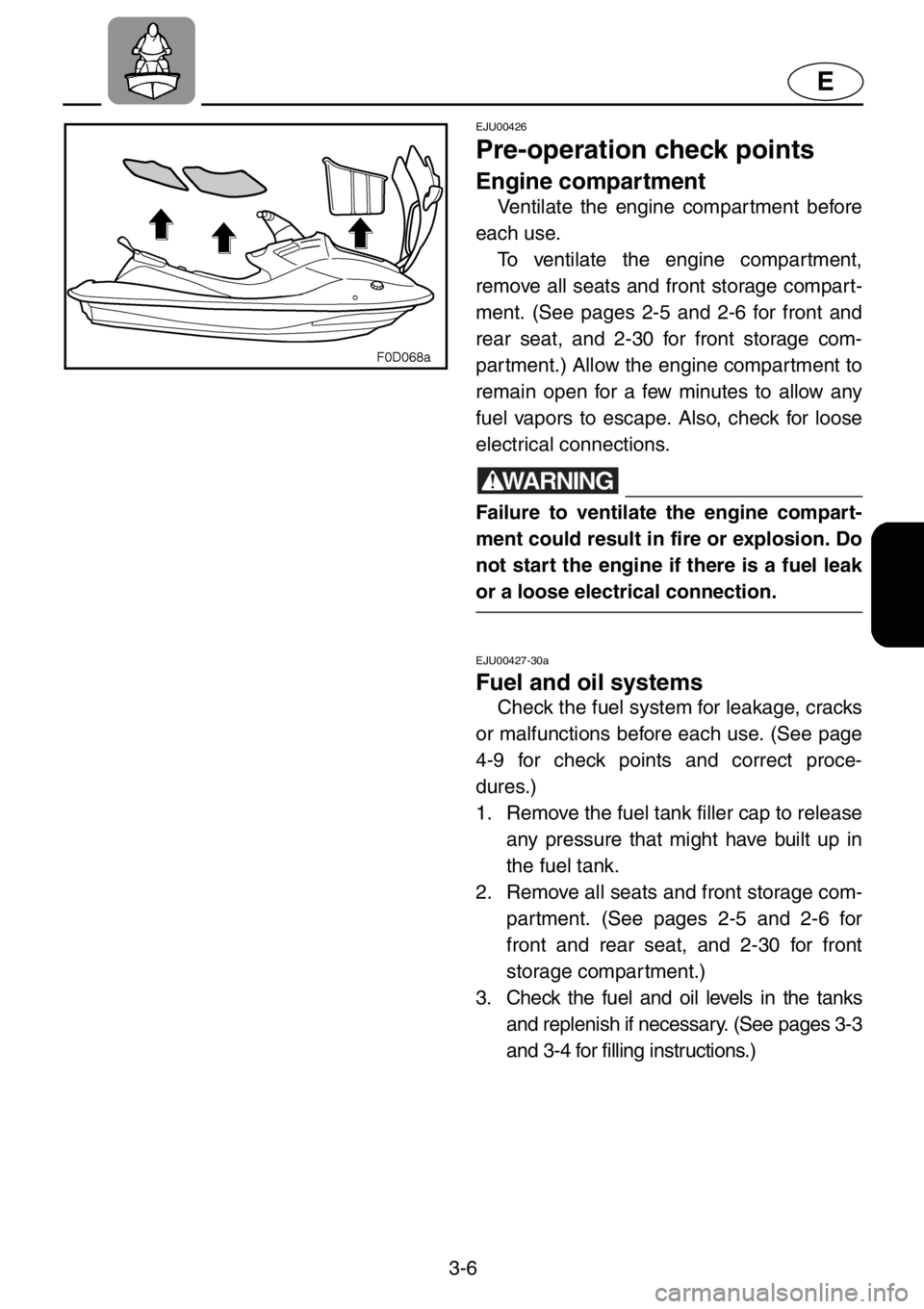
Ventilate the engine compar tment before
each use.
To ventilate the engine compartment,
remove all seats and front storage compart-
ment. (See pages 2-5 and 2-6 for front and
rear seat, and 2-30 for front storage com-
partment.) Allow the engine compartment to
remain open for a few minutes to allow any
fuel vapors to escape. Also, check for loose
electrical connections.
WARNING
Failure to ventilate the engine compart-
ment could result in fire or explosion. Do
not start the engine if there is a fuel leak
or a loose electrical connection.
EJU00427-30a
Fuel and oil systems
Check the fuel system for leakage, cracks
or malfunctions before each use. (See page
4-9 for check points and correct proce-
dures.)
1. Remove the fuel tank filler cap to release
any pressure that might have built up in
the fuel tank.
2. Remove all seats and front storage com-
partment. (See pages 2-5 and 2-6 for
front and rear seat, and 2-30 for front
storage compartment.)
3. Check the fuel and oil levels in the tanks
and replenish if necessary. (See pages 3-3
and 3-4 for filling instructions.)