ECU YAMAHA XL 700 2001 User Guide
[x] Cancel search | Manufacturer: YAMAHA, Model Year: 2001, Model line: XL 700, Model: YAMAHA XL 700 2001Pages: 111, PDF Size: 12.05 MB
Page 50 of 111
3-9
E
F0P03010
EJU00728
Fire extinguisher
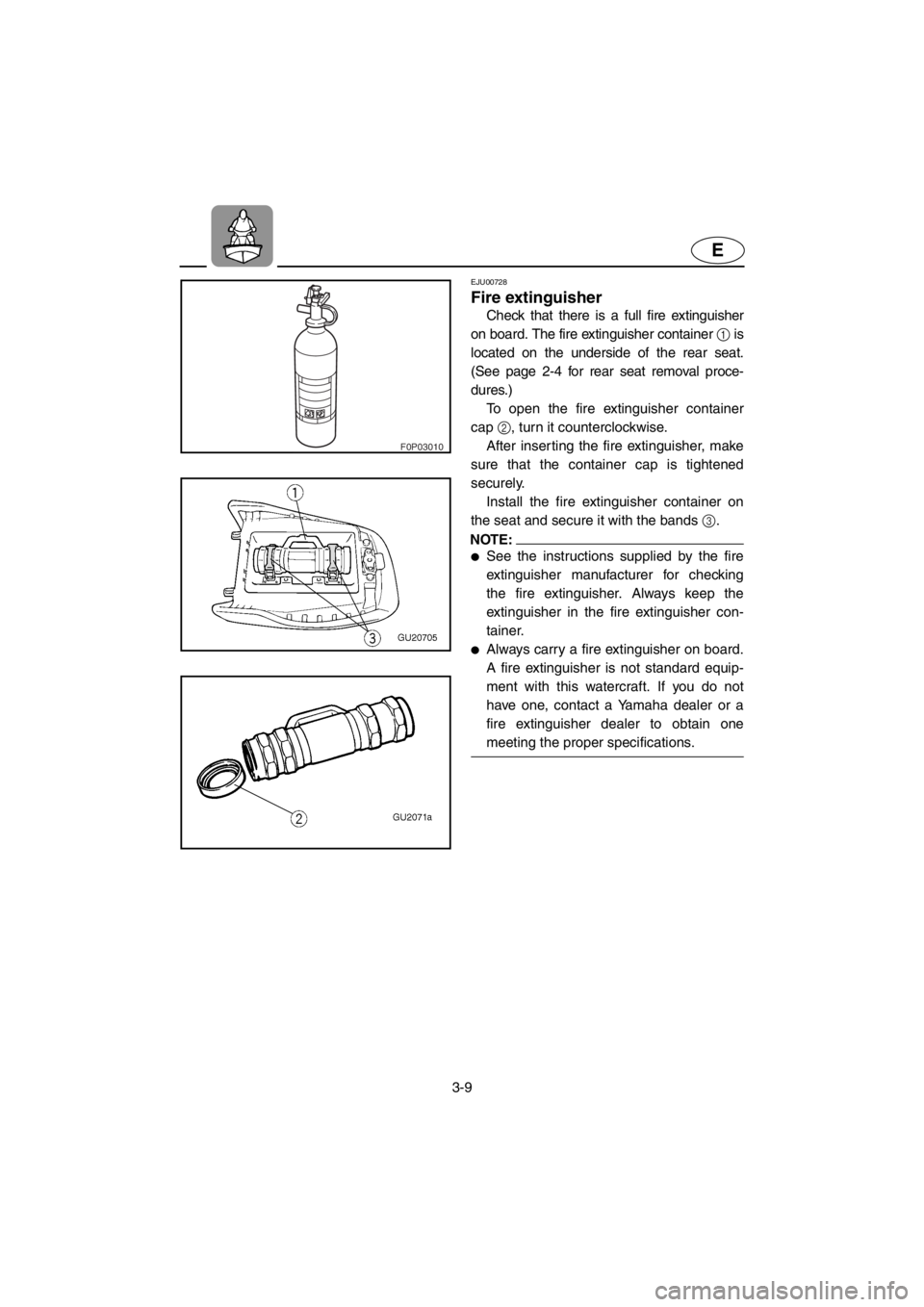
Check that there is a full fire extinguisher
on board. The fire extinguisher container 1 is
located on the underside of the rear seat.
(See page 2-4 for rear seat removal proce-
dures.)
To open the fire extinguisher container
cap2, turn it counterclockwise.
After inserting the fire extinguisher, make
sure that the container cap is tightened
securely.
Install the fire extinguisher container on
the seat and secure it with the bands 3.
NOTE:
●See the instructions supplied by the fire
extinguisher manufacturer for checking
the fire extinguisher. Always keep the
extinguisher in the fire extinguisher con-
tainer.
●Always carry a fire extinguisher on board.
A fire extinguisher is not standard equip-
ment with this watercraft. If you do not
have one, contact a Yamaha dealer or a
fire extinguisher dealer to obtain one
meeting the proper specifications.
E_F0M-72-3.fm Page 9 Thursday, July 27, 2000 9:52 AM
Page 54 of 111
3-13
E
EJU00676a
Operation
WARNING
Before operating your watercraft,
become familiar with all controls. Con-
sult your Yamaha dealer about any con-
trol or function you do not fully
understand. Failure to understand how
controls work could cause an accident or
prevent you from avoiding an accident.
CAUTION:
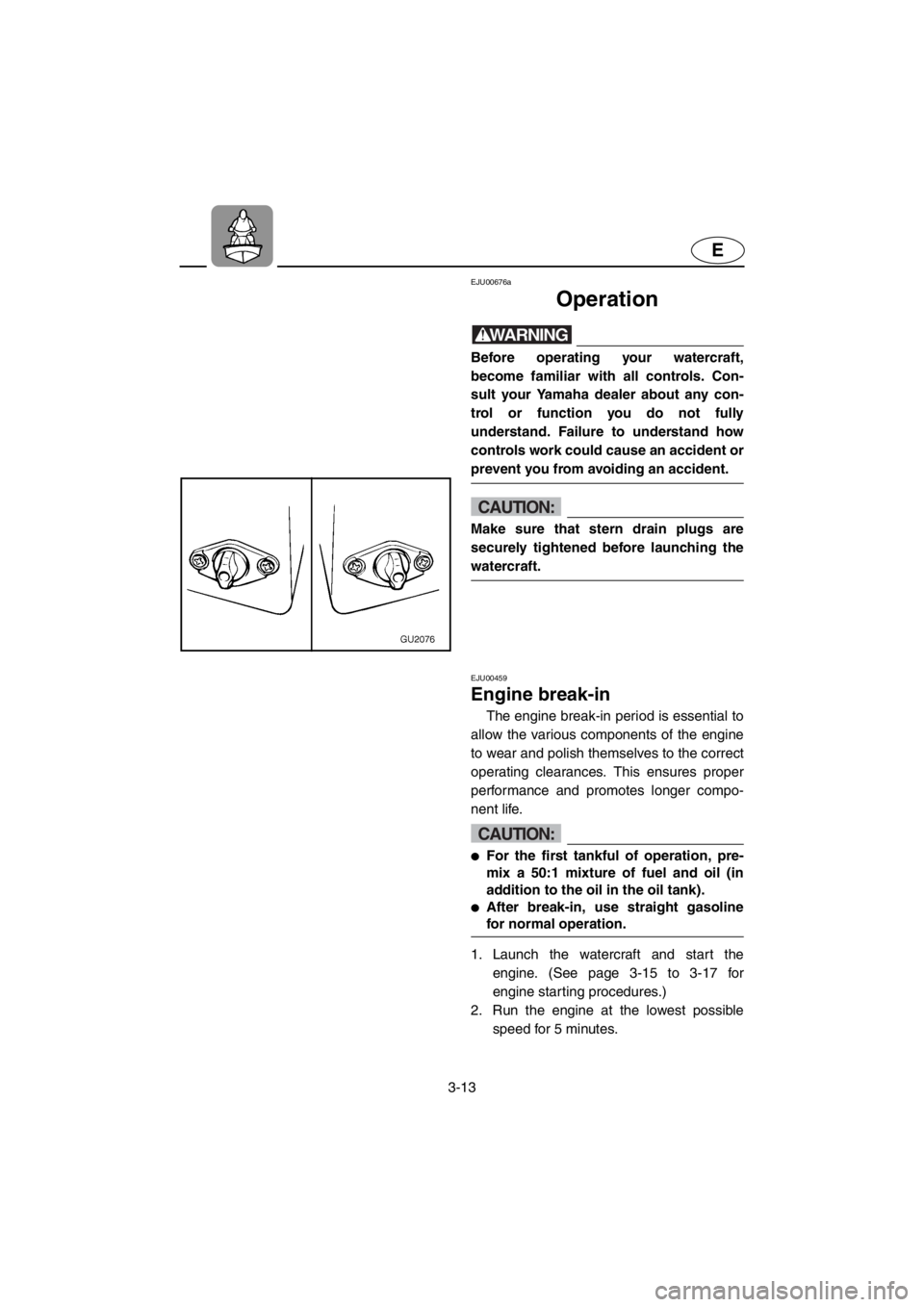
Make sure that stern drain plugs are
securely tightened before launching the
watercraft.
EJU00459
Engine break-in
The engine break-in period is essential to
allow the various components of the engine
to wear and polish themselves to the correct
operating clearances. This ensures proper
performance and promotes longer compo-
nent life.
CAUTION:
●For the first tankful of operation, pre-
mix a 50:1 mixture of fuel and oil (in
addition to the oil in the oil tank).
●After break-in, use straight gasoline
for normal operation.
1. Launch the watercraft and start the
engine. (See page 3-15 to 3-17 for
engine starting procedures.)
2. Run the engine at the lowest possible
speed for 5 minutes.
E_F0M-72-3.fm Page 13 Thursday, July 27, 2000 9:52 AM
Page 65 of 111
3-24
E
EJU00737a
Boarding with passengers
WARNING
Severe internal injuries can occur if
water is forced into body cavities as a
result of being near the jet thrust nozzle.
Do not apply throttle until each passen-
ger is seated with his or her feet on the
floor of the footwell and is holding on to
the person in front of him or her.
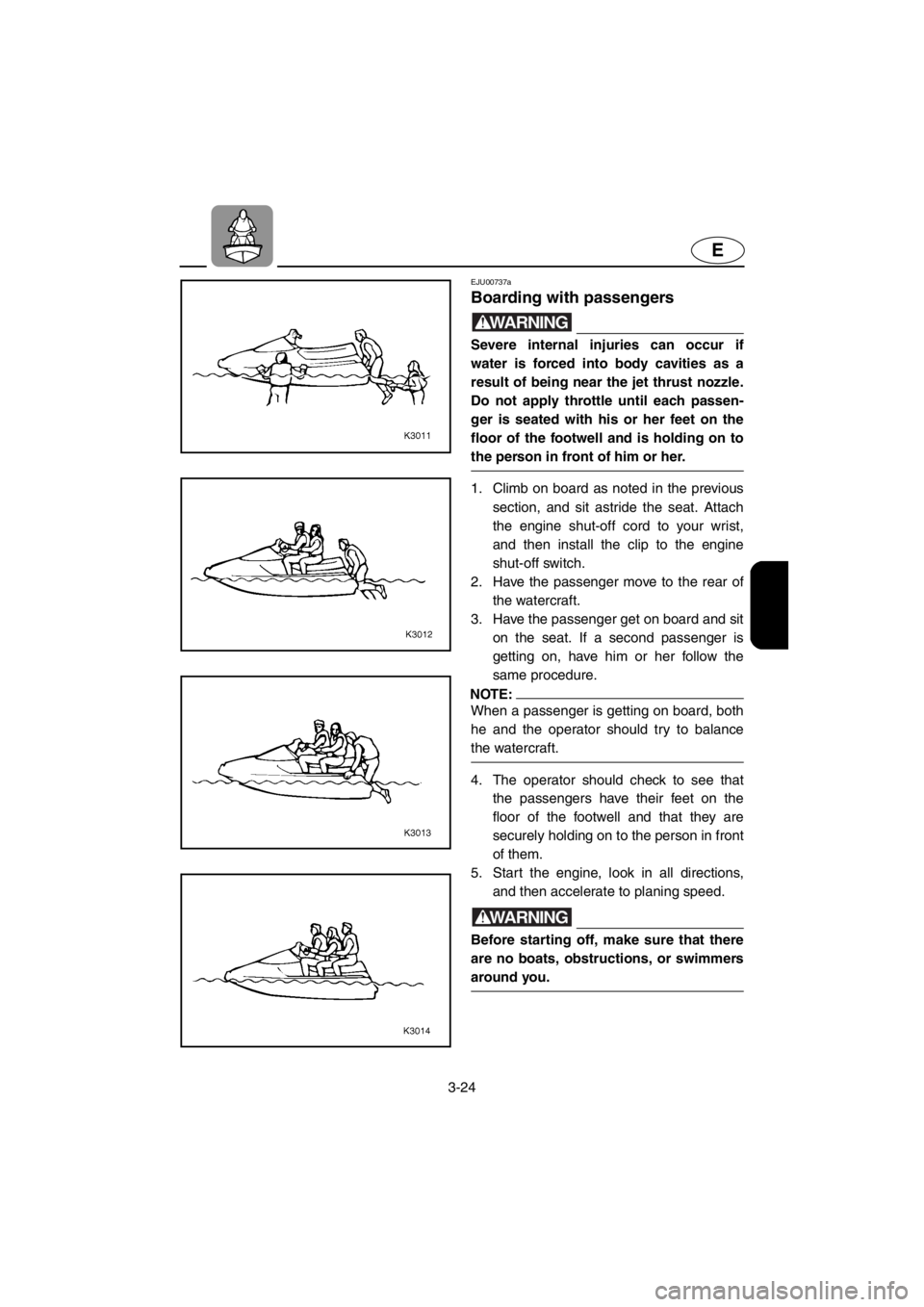
1. Climb on board as noted in the previous
section, and sit astride the seat. Attach
the engine shut-off cord to your wrist,
and then install the clip to the engine
shut-off switch.
2. Have the passenger move to the rear of
the watercraft.
3. Have the passenger get on board and sit
on the seat. If a second passenger is
getting on, have him or her follow the
same procedure.
NOTE:
When a passenger is getting on board, both
he and the operator should try to balance
the watercraft.
4. The operator should check to see that
the passengers have their feet on the
floor of the footwell and that they are
securely holding on to the person in front
of them.
5. Start the engine, look in all directions,
and then accelerate to planing speed.
WARNING
Before starting off, make sure that there
are no boats, obstructions, or swimmers
around you.
E_F0M-72-3.fm Page 24 Thursday, July 27, 2000 9:52 AM
Page 74 of 111
3-33
E
EJU00679
Transporting
WARNING
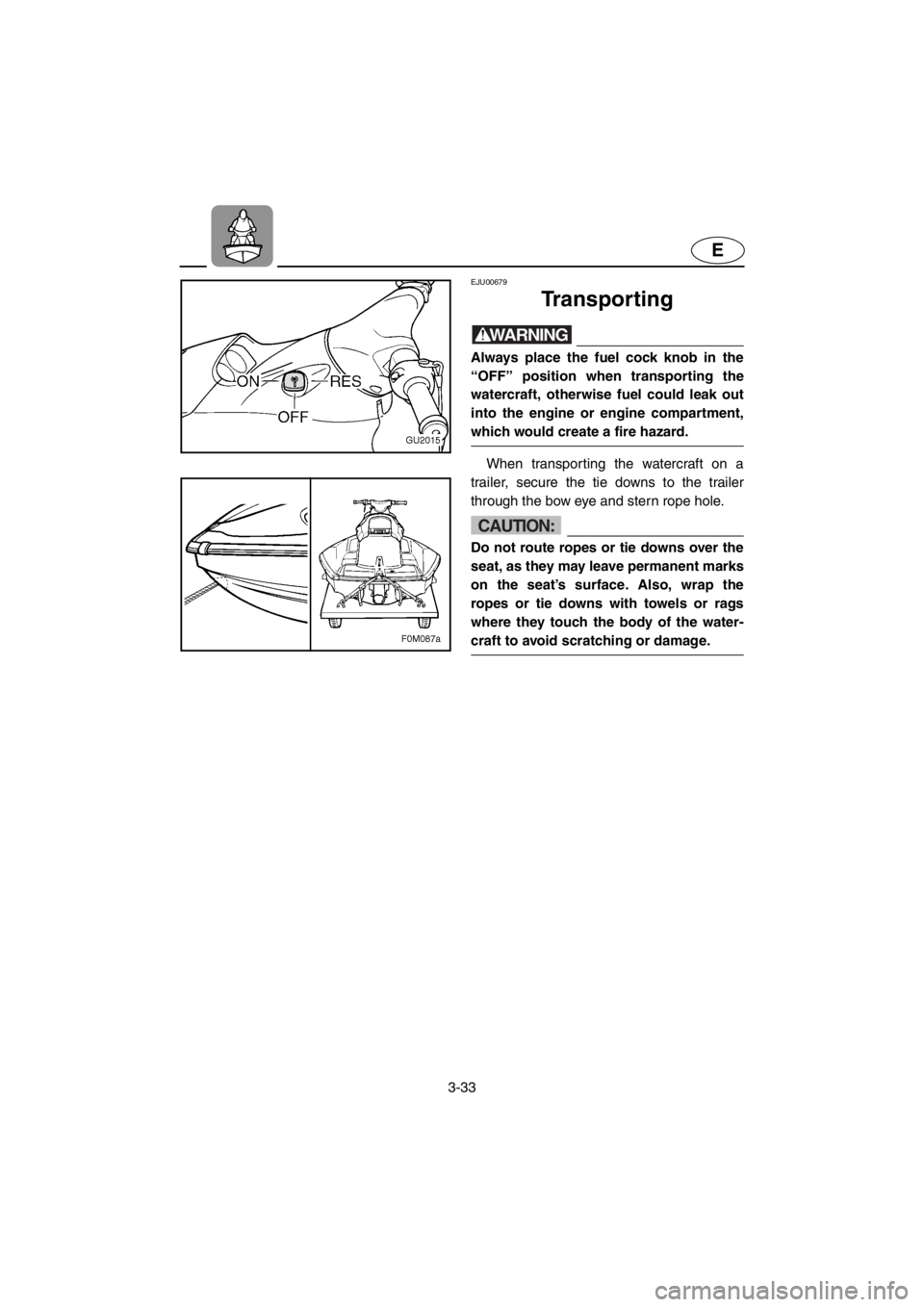
Always place the fuel cock knob in the
“OFF” position when transporting the
watercraft, otherwise fuel could leak out
into the engine or engine compartment,
which would create a fire hazard.
When transporting the watercraft on a
trailer, secure the tie downs to the trailer
through the bow eye and stern rope hole.
CAUTION:
Do not route ropes or tie downs over the
seat, as they may leave permanent marks
on the seat’s surface. Also, wrap the
ropes or tie downs with towels or rags
where they touch the body of the water-
craft to avoid scratching or damage.
E_F0M-72-3.fm Page 33 Thursday, July 27, 2000 9:52 AM
Page 77 of 111
4-2
E
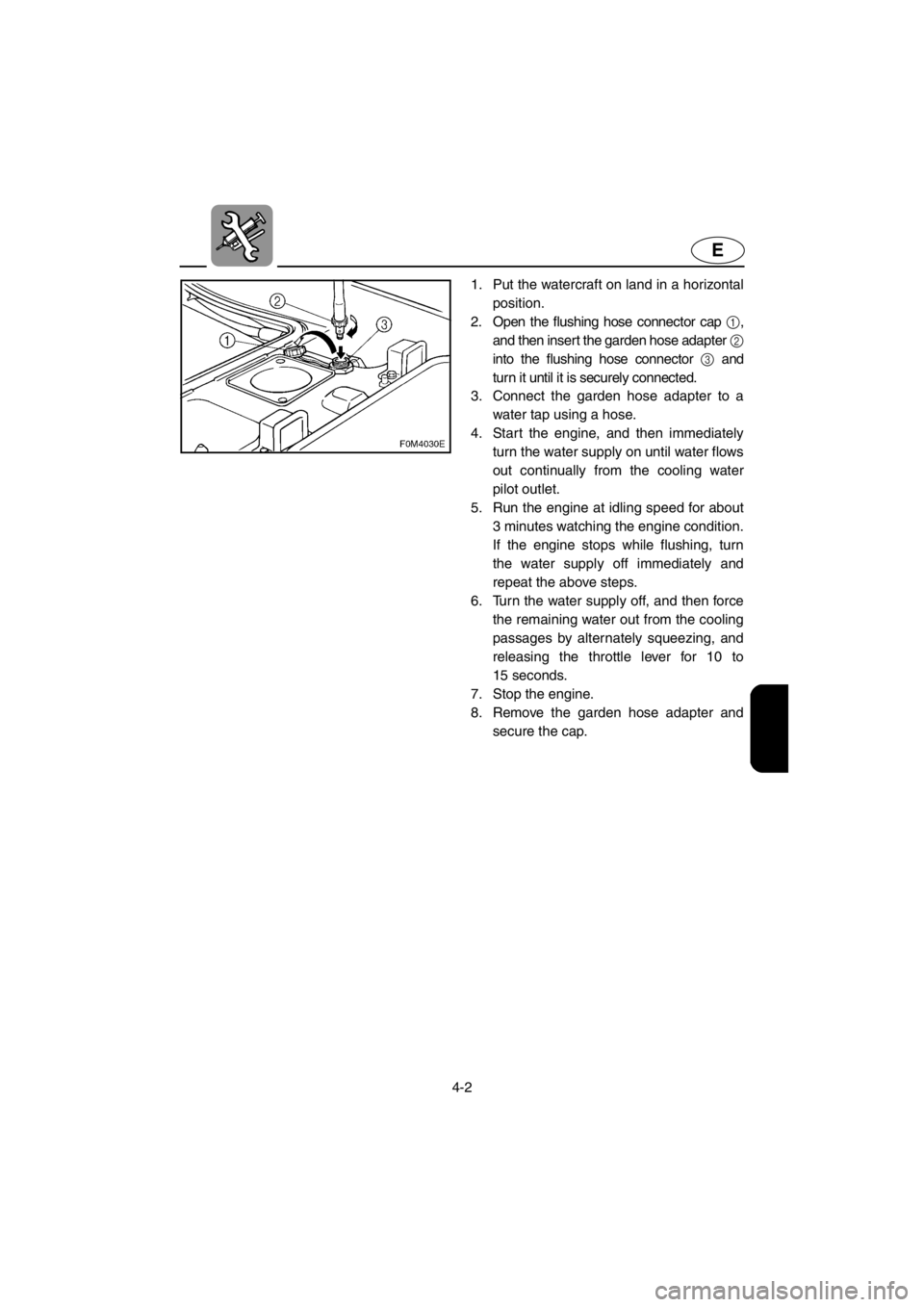
1. Put the watercraft on land in a horizontal
position.
2. Open the flushing hose connector cap 1,
and then inser t the garden hose adapter
2
into the flushing hose connector 3 and
turn it until it is securely connected.
3. Connect the garden hose adapter to a
water tap using a hose.
4. Start the engine, and then immediately
turn the water supply on until water flows
out continually from the cooling water
pilot outlet.
5. Run the engine at idling speed for about
3 minutes watching the engine condition.
If the engine stops while flushing, turn
the water supply off immediately and
repeat the above steps.
6. Turn the water supply off, and then force
the remaining water out from the cooling
passages by alternately squeezing, and
releasing the throttle lever for 10 to
15 seconds.
7. Stop the engine.
8. Remove the garden hose adapter and
secure the cap.
E_F0M-72-4.fm Page 2 Thursday, July 27, 2000 9:53 AM
Page 78 of 111
4-3
E
EJU00526a
Lubrication
WARNING
To reduce the risk of fire or explosion:
Never pour or spray gasoline, or any sub-
stance other than engine fogging oil
through the holes in the carburetor
silencer cover.
CAUTION:
●Be sure to replace the cap securely
after fogging the engine. Otherwise
water could enter the engine and
cause damage.
●Do not attempt to run the engine at full
throttle or for more than 15 seconds
while the watercraft is out of the water,
otherwise the engine may overheat
and/or seize.
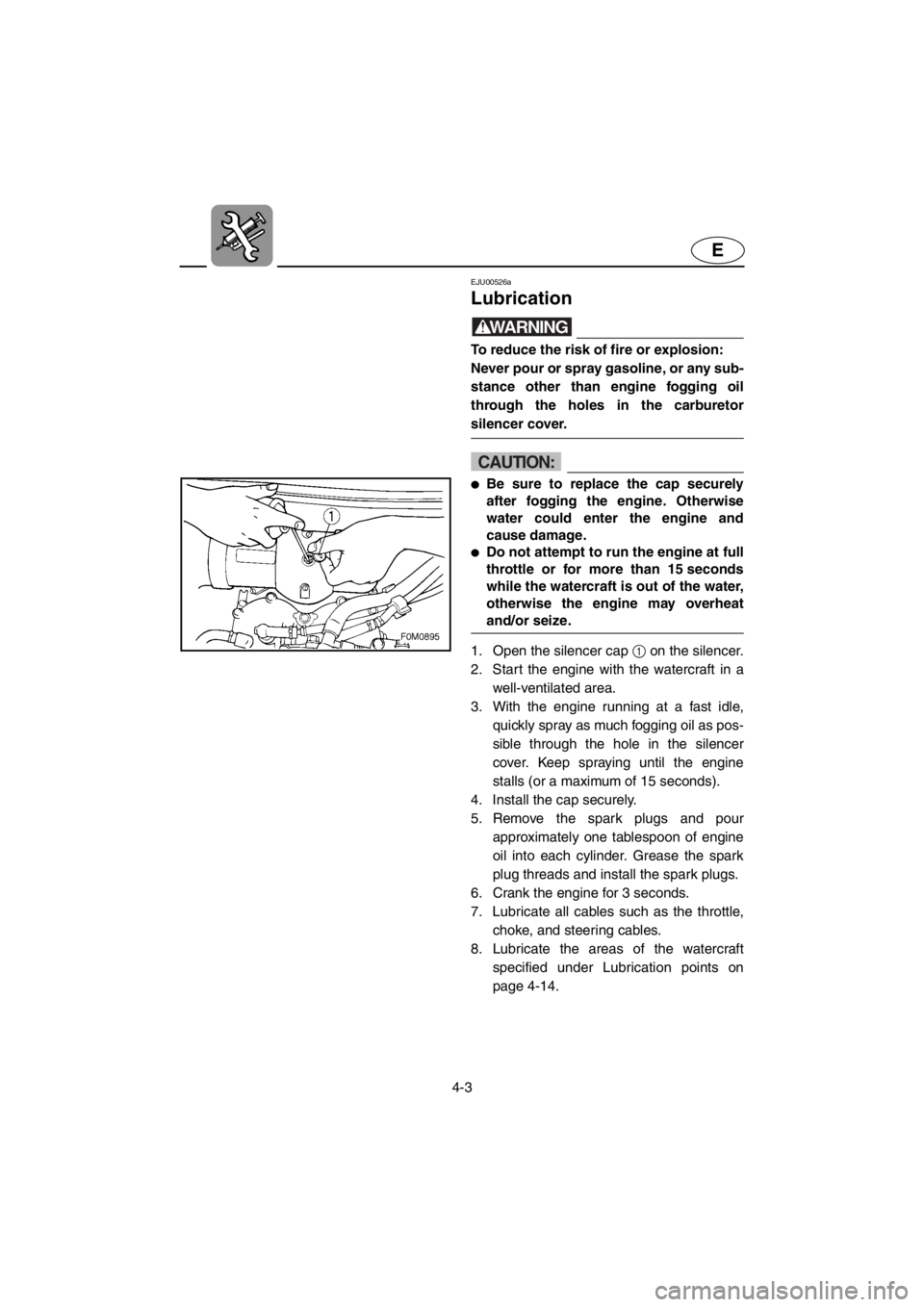
1. Open the silencer cap 1 on the silencer.
2. Start the engine with the watercraft in a
well-ventilated area.
3. With the engine running at a fast idle,
quickly spray as much fogging oil as pos-
sible through the hole in the silencer
cover. Keep spraying until the engine
stalls (or a maximum of 15 seconds).
4. Install the cap securely.
5. Remove the spark plugs and pour
approximately one tablespoon of engine
oil into each cylinder. Grease the spark
plug threads and install the spark plugs.
6. Crank the engine for 3 seconds.
7. Lubricate all cables such as the throttle,
choke, and steering cables.
8. Lubricate the areas of the watercraft
specified under Lubrication points on
page 4-14.
E_F0M-72-4.fm Page 3 Thursday, July 27, 2000 9:53 AM
Page 90 of 111
4-15
E
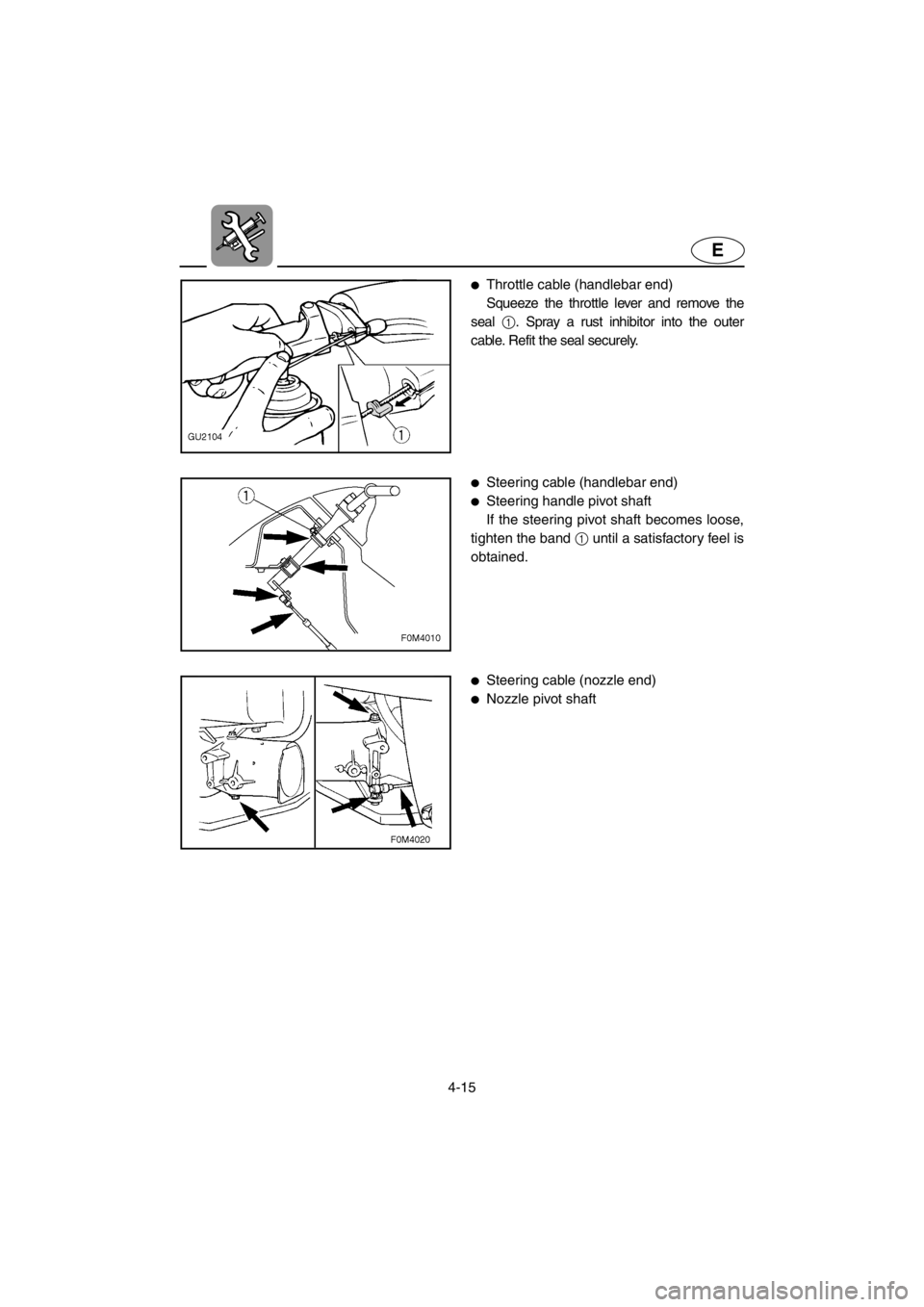
●Throttle cable (handlebar end)
Squeeze the throttle lever and remove the
seal
1. Spray a rust inhibitor into the outer
cable. Refit the seal securely.
●Steering cable (handlebar end)
●Steering handle pivot shaft
If the steering pivot shaft becomes loose,
tighten the band 1 until a satisfactory feel is
obtained.
●Steering cable (nozzle end)
●Nozzle pivot shaft
E_F0M-72-4.fm Page 15 Thursday, July 27, 2000 9:53 AM
Page 92 of 111
4-17
E
EJU00572
Inspecting the battery
Check the level of the battery electrolyte
and make sure the leads are secure.
WARNING
Battery electrolyte is poisonous and dan-
gerous, causing severe burns, etc. Elec-
trolyte contains sulfuric acid. Avoid
contact with skin, eyes or clothing.
Antidotes
External: Flush with water.
Internal: Drink large quantities of water
or milk. Follow with milk of magnesia,
beaten egg or vegetable oil. Call physi-
cian immediately.
Eyes: Flush with water for 15 minutes
and get prompt medical attention.
Batteries produce explosive gases. Keep
sparks, flame, cigarettes, etc., well away.
If using or charging the battery in an
enclosed space, make sure that it is well
ventilated. Always shield your eyes when
working near batteries.
KEEP OUT OF THE REACH OF CHIL-
DREN.
CAUTION:
Be careful not to place the battery on its
side.
Make sure to remove the battery from the
battery compartment when adding bat-
tery electrolyte or charging the battery.
When checking the battery, make sure
the breather hose is connected to the
battery and not obstructed.
E_F0M-72-4.fm Page 17 Thursday, July 27, 2000 9:53 AM
Page 93 of 111
4-18
E
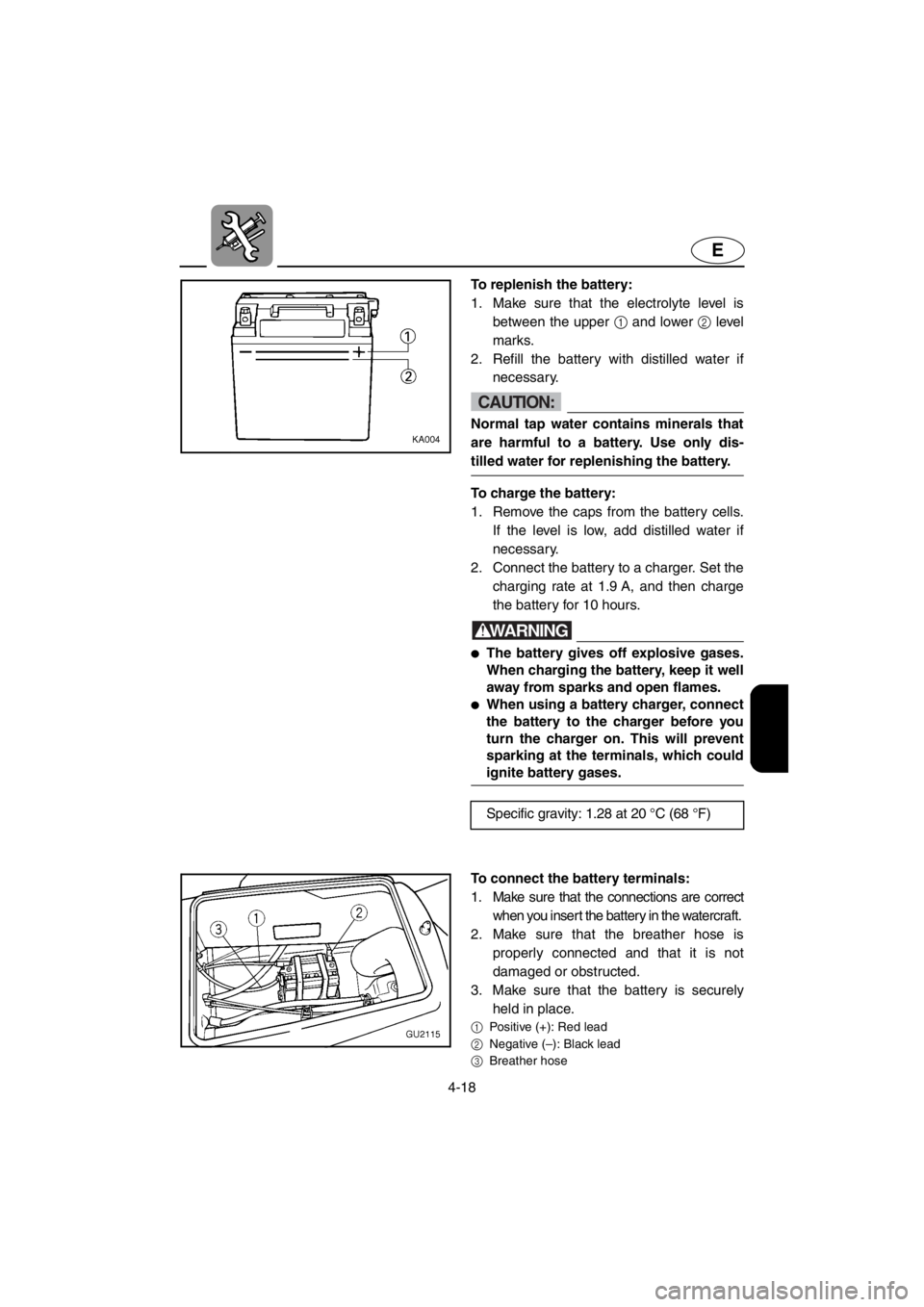
To replenish the battery:
1. Make sure that the electrolyte level is
between the upper 1 and lower 2 level
marks.
2. Refill the battery with distilled water if
necessary.
CAUTION:
Normal tap water contains minerals that
are harmful to a battery. Use only dis-
tilled water for replenishing the battery.
To charge the battery:
1. Remove the caps from the battery cells.
If the level is low, add distilled water if
necessary.
2. Connect the battery to a charger. Set the
charging rate at 1.9 A, and then charge
the battery for 10 hours.
WARNING
●The battery gives off explosive gases.
When charging the battery, keep it well
away from sparks and open flames.
●When using a battery charger, connect
the battery to the charger before you
turn the charger on. This will prevent
sparking at the terminals, which could
ignite battery gases.
Specific gravity: 1.28 at 20 °C (68 °F)
To connect the battery terminals:
1. Make sure that the connections are correct
when you insert the battery in the watercraft.
2. Make sure that the breather hose is
properly connected and that it is not
damaged or obstructed.
3. Make sure that the battery is securely
held in place.
1Positive (+): Red lead
2Negative (–): Black lead
3Breather hose
E_F0M-72-4.fm Page 18 Thursday, July 27, 2000 9:53 AM
Page 102 of 111
5-5
E
EJU00600
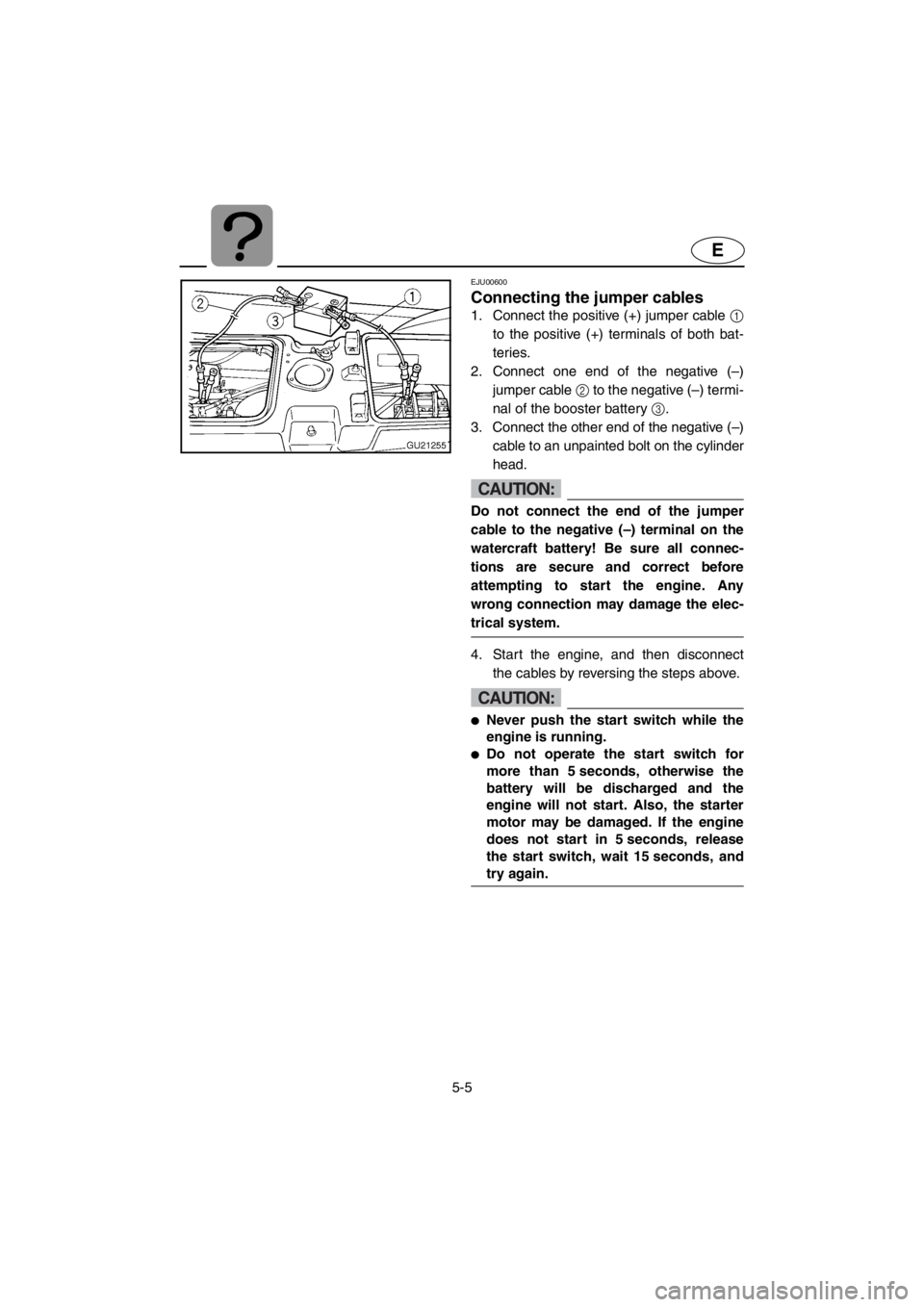
Connecting the jumper cables
1. Connect the positive (+) jumper cable 1
to the positive (+) terminals of both bat-
teries.
2. Connect one end of the negative (–)
jumper cable 2 to the negative (–) termi-
nal of the booster battery 3.
3. Connect the other end of the negative (–)
cable to an unpainted bolt on the cylinder
head.
CAUTION:
Do not connect the end of the jumper
cable to the negative (–) terminal on the
watercraft battery! Be sure all connec-
tions are secure and correct before
attempting to start the engine. Any
wrong connection may damage the elec-
trical system.
4. Start the engine, and then disconnect
the cables by reversing the steps above.
CAUTION:
●Never push the start switch while the
engine is running.
●Do not operate the start switch for
more than 5 seconds, otherwise the
battery will be discharged and the
engine will not start. Also, the starter
motor may be damaged. If the engine
does not start in 5 seconds, release
the start switch, wait 15 seconds, and
try again.
E_F0M-72-5.fm Page 5 Thursday, July 27, 2000 9:58 AM