warning YAMAHA XL 700 2001 Owner's Manual
[x] Cancel search | Manufacturer: YAMAHA, Model Year: 2001, Model line: XL 700, Model: YAMAHA XL 700 2001Pages: 111, PDF Size: 12.05 MB
Page 59 of 111
3-18
E
EJU00463a
Stopping the engine
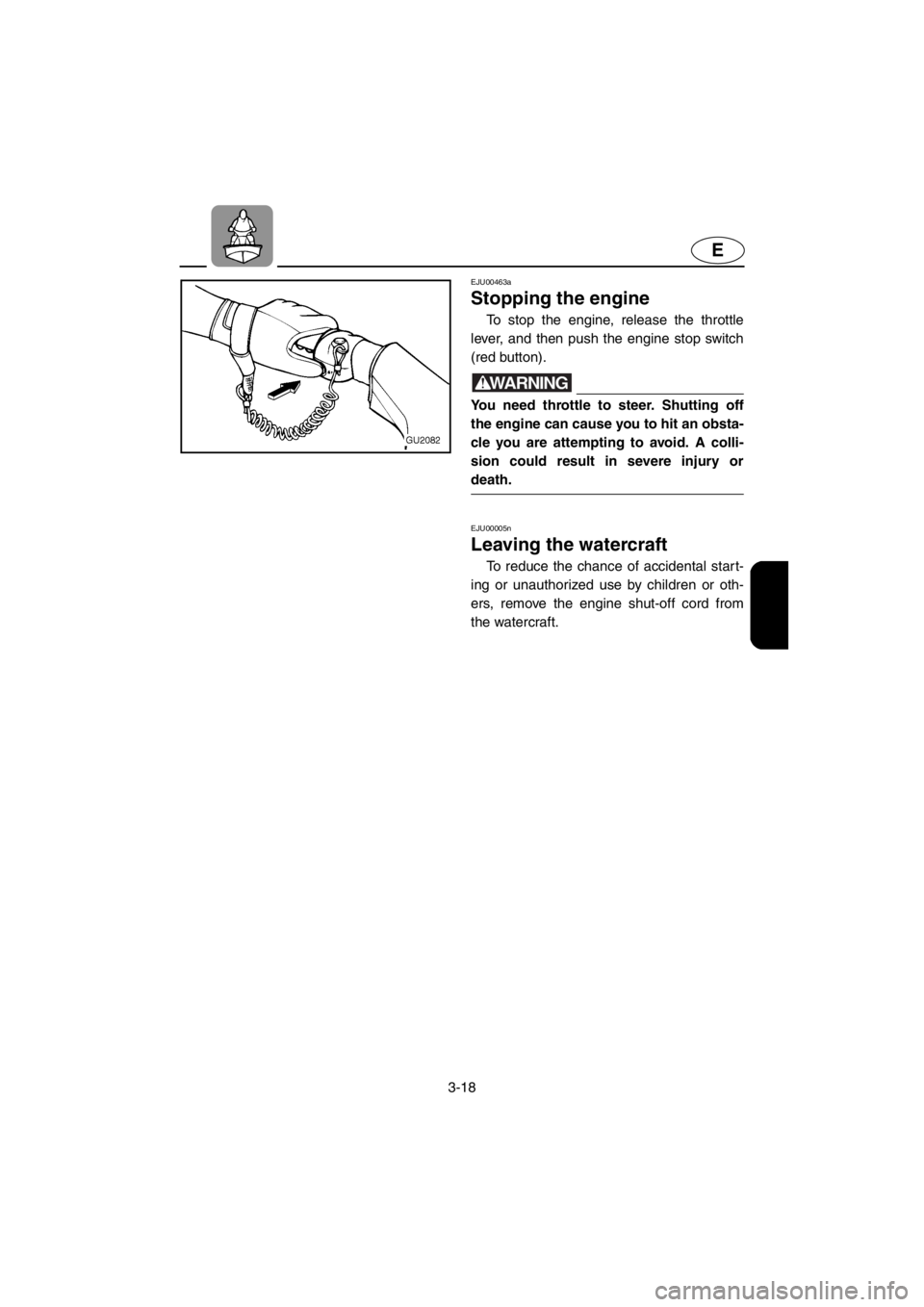
To stop the engine, release the throttle
lever, and then push the engine stop switch
(red button).
WARNING
You need throttle to steer. Shutting off
the engine can cause you to hit an obsta-
cle you are attempting to avoid. A colli-
sion could result in severe injury or
death.
EJU00005n
Leaving the watercraft
To reduce the chance of accidental start-
ing or unauthorized use by children or oth-
ers, remove the engine shut-off cord from
the watercraft.
E_F0M-72-3.fm Page 18 Thursday, July 27, 2000 9:52 AM
Page 60 of 111
3-19
E
EJU00674
Operating your watercraft
Getting to know your
watercraft
Operating your watercraft requires skills
acquired through practice over a period of
time. Take the time to learn the basic tech-
niques well before attempting more difficult
maneuvers.
Operating your new watercraft can be a
very enjoyable activity, providing you with
hours of pleasure. However, it is essential to
familiarize yourself with the operation of the
watercraft to achieve the skill level neces-
sary to enjoy riding safely. Before operating
this watercraft, read this Owner’s/Operator’s
Manual, the Riding Practice Guide and all
warning and caution labels on the water-
craft. Pay particular attention to the safety
information on pages 1-9 to 1-16. These
materials should give you an understanding
of the watercraft and its operation.
Remember: This watercraft is designed to
carry the operator and up to 2 passengers.
Never exceed the maximum load limit or
allow more than 3 persons (or 2 persons if a
water-skier is being pulled) to ride the water-
craft at one time.
EJU00474
Learning to operate your
watercraft
Before operating the watercraft, always
perform the pre-operation checks listed on
page 3-5. The short time spent checking the
watercraft will reward you with added safety
and reliability.
Check state and local laws before operat-
ing your watercraft.
Operate defensively at safe speeds and
keep a safe distance away from people,
objects, and other watercraft. Select a wide
area to learn in, where you have good visi-
bility and light boat traffic.
Use the buddy system—operate with
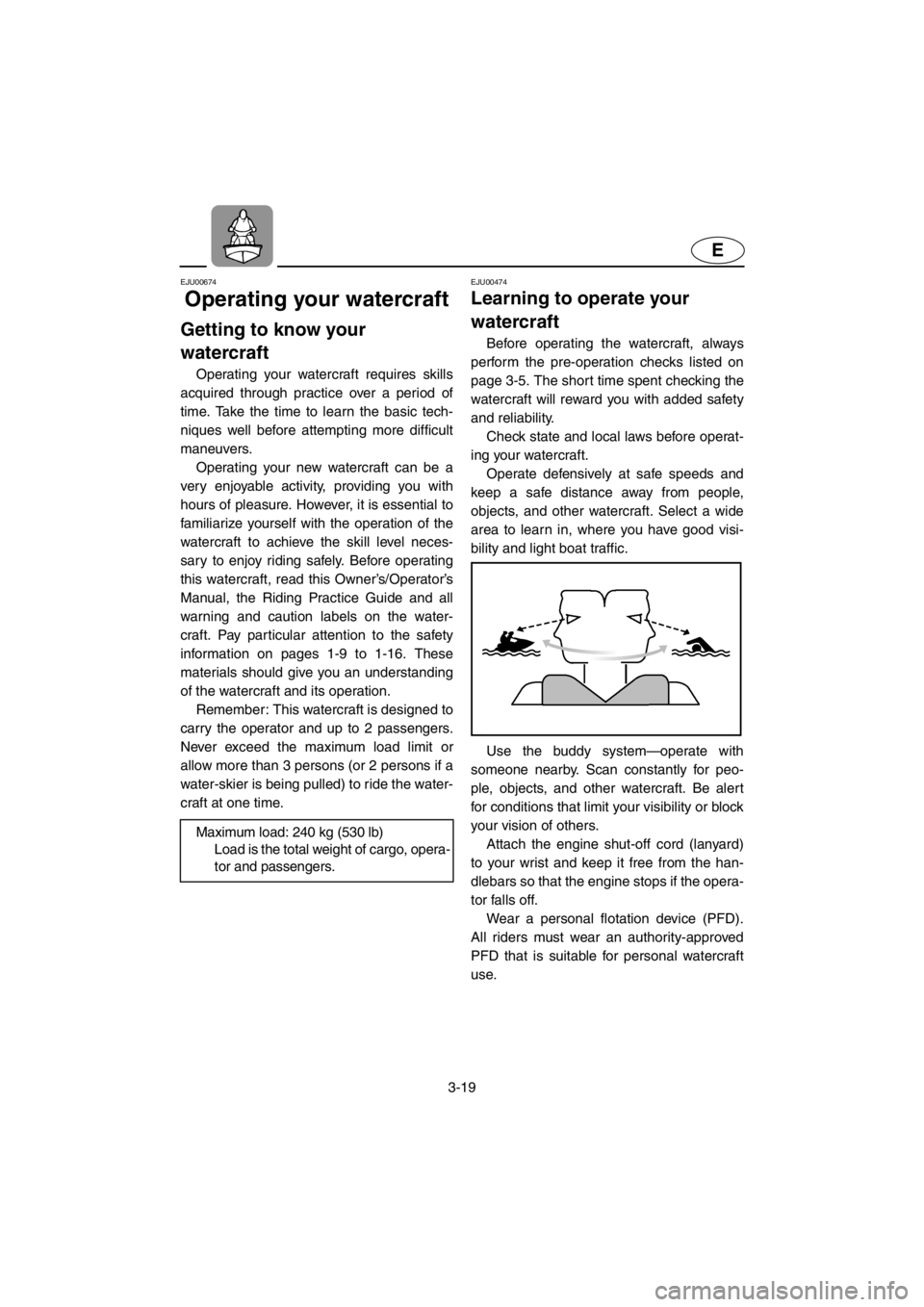
someone nearby. Scan constantly for peo-
ple, objects, and other watercraft. Be alert
for conditions that limit your visibility or block
your vision of others.
Attach the engine shut-off cord (lanyard)
to your wrist and keep it free from the han-
dlebars so that the engine stops if the opera-
tor falls off.
Wear a personal flotation device (PFD).
All riders must wear an authority-approved
PFD that is suitable for personal watercraft
use. Maximum load: 240 kg (530 lb)
Load is the total weight of cargo, opera-
tor and passengers.
E_F0M-72-3.fm Page 19 Thursday, July 27, 2000 9:52 AM
Page 61 of 111

3-20
E
Wear protective clothing. Severe internal
injuries can occur if water is forced into body
cavities as result of falling into the water or
being near the jet thrust nozzle. Normal
swimwear does not adequately protect
against forceful water entry into rectum and
vagina. All riders must wear a wetsuit bot-
tom or clothing that provides equivalent pro-
tection.
Such clothing includes thick, tightly
woven, sturdy and snug-fitting apparel such
as denim, but does not include spandex or
similar fabrics like those used in bicycle
shorts. A full wetsuit can also protect against
hypothermia (subnormal body temperature)
and abrasions.
Footwear and gloves are recommended.
Eye protection is recommended to keep
wind, water, and glare from the sun out of
your eyes while you operate your watercraft.
Restraining straps for eyewear are made
which are designed to float should your eye-
wear fall in the water.
You should grip the handlebars firmly and
keep both feet on the floor of the footwell. Do
not attempt to ride with passengers until
your operating skills are fully developed.
EJU00736
Riding watercraft with
passengers
When 2 or 3 persons (including the oper-
ator) are on board, the watercraft handles
differently, and is not as easy to maneuver,
so operating it requires a higher degree of
skill. Before attempting to operate the water-
craft with passengers on board, the operator
must practice operating the watercraft alone
enough to be able to acquire the necessary
skills.The passengers must always wear an
authority-approved PFD and wetsuit bottom
or equivalent.
WARNING
Do not apply throttle when anyone is at
rear of watercraft. Turn engine off or keep
engine at idle. Water and/or debris exit-
ing the jet thrust nozzle can cause severe
injury. Passengers should not attempt to
board the watercraft if the operator is
applying throttle.
Do not give a ride to children whose feet
cannot reach the floor of the footwell. Pas-
sengers should hold on firmly to the person
in front of them or to the side grips and keep
both feet in the footwell.
WARNING
When passengers are on board, make
sure that they are holding on firmly and
have feet in the footwell before you start
to accelerate.
When pulling a skier, the spotter should
face to the rear while holding the handgrip
with one hand and the finger grip with the
other hand. The spotter should always sit
astride the seat with his or her feet placed
firmly on the footrest for proper balance. Fol-
low state laws regarding skiing such as
skier-down flags, rearward-facing spotter,
and other requirements.
E_F0M-72-3.fm Page 20 Thursday, July 27, 2000 9:52 AM
Page 62 of 111
3-21
E
EJU00484
Starting the watercraft
WARNING
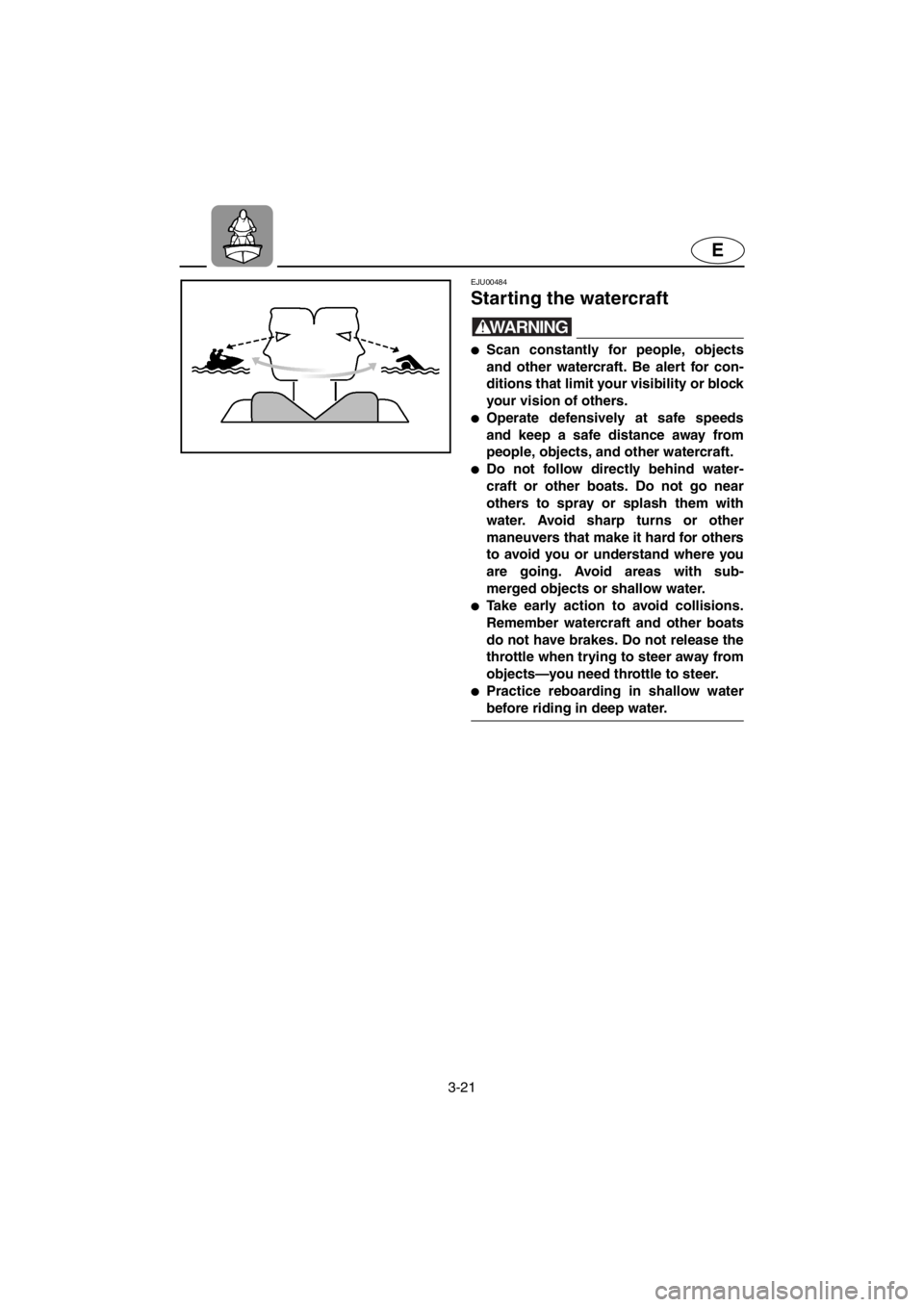
●Scan constantly for people, objects
and other watercraft. Be alert for con-
ditions that limit your visibility or block
your vision of others.
●Operate defensively at safe speeds
and keep a safe distance away from
people, objects, and other watercraft.
●Do not follow directly behind water-
craft or other boats. Do not go near
others to spray or splash them with
water. Avoid sharp turns or other
maneuvers that make it hard for others
to avoid you or understand where you
are going. Avoid areas with sub-
merged objects or shallow water.
●Take early action to avoid collisions.
Remember watercraft and other boats
do not have brakes. Do not release the
throttle when trying to steer away from
objects—you need throttle to steer.
●Practice reboarding in shallow water
before riding in deep water.
E_F0M-72-3.fm Page 21 Thursday, July 27, 2000 9:52 AM
Page 64 of 111
3-23
E
EJU00490a
Boarding and starting in deep
water
WARNING
●Operator and passenger should prac-
tice getting on board in shallow water
before riding in deep water. Boarding
in deep water requires more skill.
●The fatigue and exposure that could
result after unsuccessful attempts to
get back on the watercraft may
increase the risk of injuries and drown-
ing.
Boarding alone
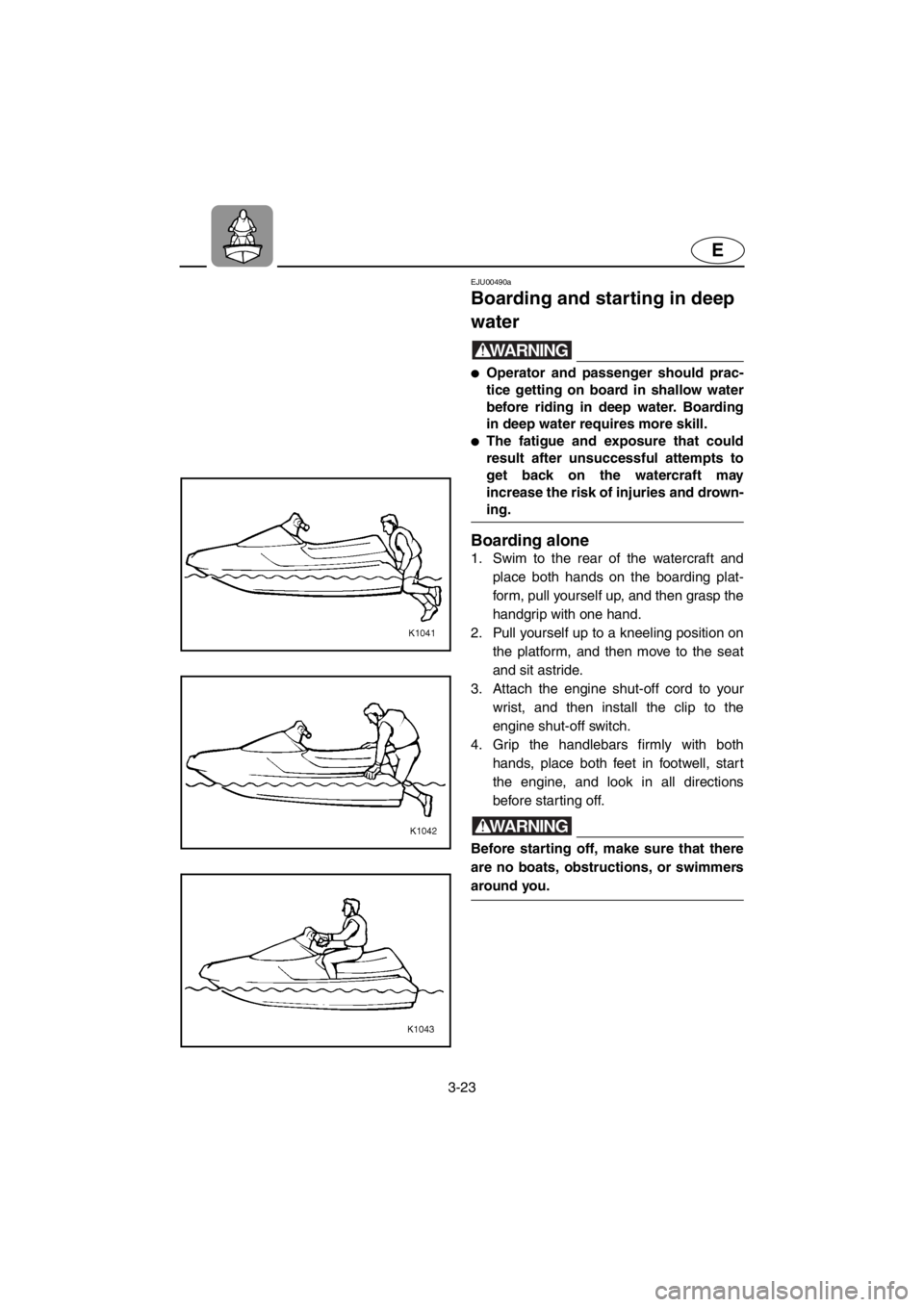
1. Swim to the rear of the watercraft and
place both hands on the boarding plat-
form, pull yourself up, and then grasp the
handgrip with one hand.
2. Pull yourself up to a kneeling position on
the platform, and then move to the seat
and sit astride.
3. Attach the engine shut-off cord to your
wrist, and then install the clip to the
engine shut-off switch.
4. Grip the handlebars firmly with both
hands, place both feet in footwell, start
the engine, and look in all directions
before starting off.
WARNING
Before starting off, make sure that there
are no boats, obstructions, or swimmers
around you.
E_F0M-72-3.fm Page 23 Thursday, July 27, 2000 9:52 AM
Page 65 of 111
3-24
E
EJU00737a
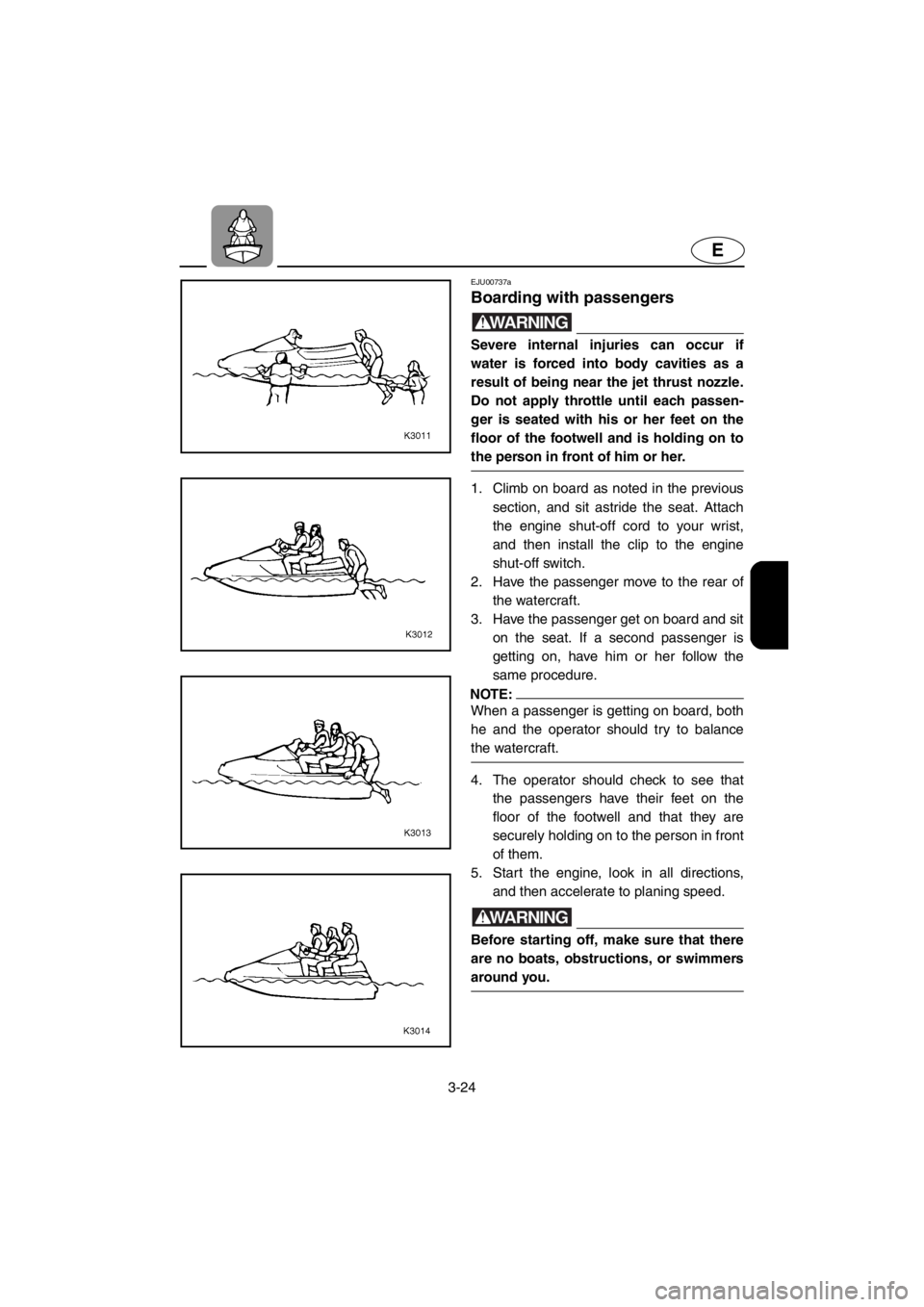
Boarding with passengers
WARNING
Severe internal injuries can occur if
water is forced into body cavities as a
result of being near the jet thrust nozzle.
Do not apply throttle until each passen-
ger is seated with his or her feet on the
floor of the footwell and is holding on to
the person in front of him or her.
1. Climb on board as noted in the previous
section, and sit astride the seat. Attach
the engine shut-off cord to your wrist,
and then install the clip to the engine
shut-off switch.
2. Have the passenger move to the rear of
the watercraft.
3. Have the passenger get on board and sit
on the seat. If a second passenger is
getting on, have him or her follow the
same procedure.
NOTE:
When a passenger is getting on board, both
he and the operator should try to balance
the watercraft.
4. The operator should check to see that
the passengers have their feet on the
floor of the footwell and that they are
securely holding on to the person in front
of them.
5. Start the engine, look in all directions,
and then accelerate to planing speed.
WARNING
Before starting off, make sure that there
are no boats, obstructions, or swimmers
around you.
E_F0M-72-3.fm Page 24 Thursday, July 27, 2000 9:52 AM
Page 66 of 111

3-25
E
NOTE:
The heavier the total weight of the operator
and passengers, the more difficult it will be
to balance the watercraft. Do not operate the
watercraft when the total weight exceeds
240 kg (530 lb) including any cargo. If it is
difficult to balance the vehicle at a standstill,
proceed as follows:
1. The passenger must steady the water-
craft while the operator is boarding. The
operator pulls himself up onto the plat-
form into a seating position, then bal-
ances the vehicle.
2. Attach the lanyard to your left wrist, then
install the clip on the lanyard to the
engine shut-off switch. Start the engine
and keep it at idle.
3. The passenger pulls himself up on the
platform, kneels down, then crawls onto
the seat as the watercraft accelerates.
4. The watercraft can now be accelerated
to planing speed, then the operator can
reduce the throttle to the desired running
speed.
EJU00677a
Capsized watercraft
If the watercraft capsizes, follow the pro-
cedures below carefully to prevent damage
or injury.
WARNING
IMPROPER UPRIGHTING CAN CAUSE
INJURY:
●Shut engine off, and be sure engine
shut-off cord is removed from the
engine shut-off switch.
●Do not put hand in intake grate.
●Watch so you are not hit by the water-
craft as it comes over.
E_F0M-72-3.fm Page 25 Thursday, July 27, 2000 9:52 AM
Page 69 of 111

3-28
E
WARNING
●Do not release the throttle when trying
to steer away from objects—you need
throttle to steer. A collision could
result in severe injury or death.
●When operating at higher speeds,
make gradual turns or slow down
before turning. Sharp high-speed turns
may cause the watercraft to slide side-
ways or spin, throwing the operator
and passengers overboard which
could cause an injury.
E_F0M-72-3.fm Page 28 Thursday, July 27, 2000 9:52 AM
Page 70 of 111
3-29
E
EJU00621
Stopping the watercraft
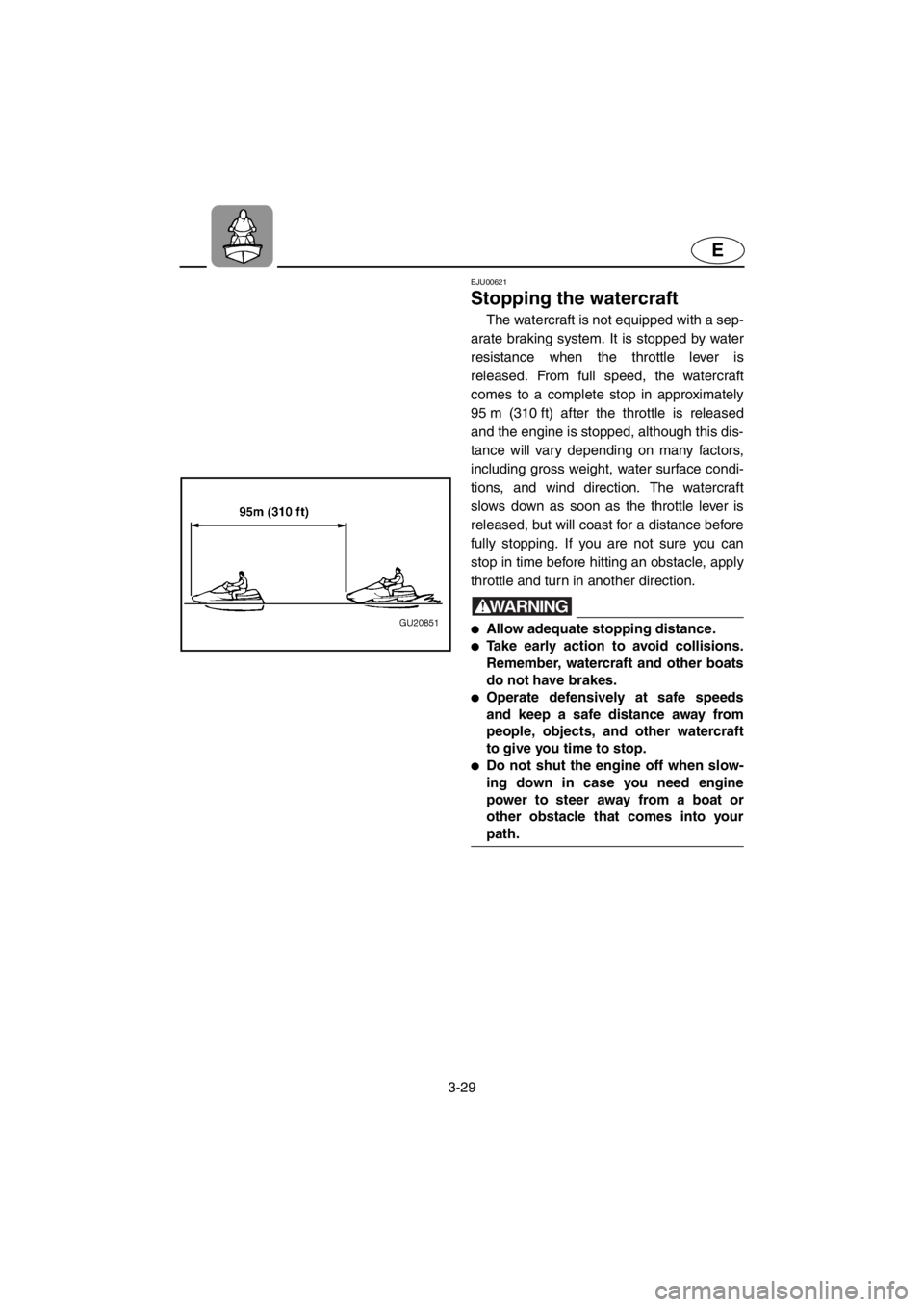
The watercraft is not equipped with a sep-
arate braking system. It is stopped by water
resistance when the throttle lever is
released. From full speed, the watercraft
comes to a complete stop in approximately
95 m (310 ft) after the throttle is released
and the engine is stopped, although this dis-
tance will vary depending on many factors,
including gross weight, water surface condi-
tions, and wind direction. The watercraft
slows down as soon as the throttle lever is
released, but will coast for a distance before
fully stopping. If you are not sure you can
stop in time before hitting an obstacle, apply
throttle and turn in another direction.
WARNING
●Allow adequate stopping distance.
●Take early action to avoid collisions.
Remember, watercraft and other boats
do not have brakes.
●Operate defensively at safe speeds
and keep a safe distance away from
people, objects, and other watercraft
to give you time to stop.
●Do not shut the engine off when slow-
ing down in case you need engine
power to steer away from a boat or
other obstacle that comes into your
path.
E_F0M-72-3.fm Page 29 Thursday, July 27, 2000 9:52 AM
Page 74 of 111
3-33
E
EJU00679
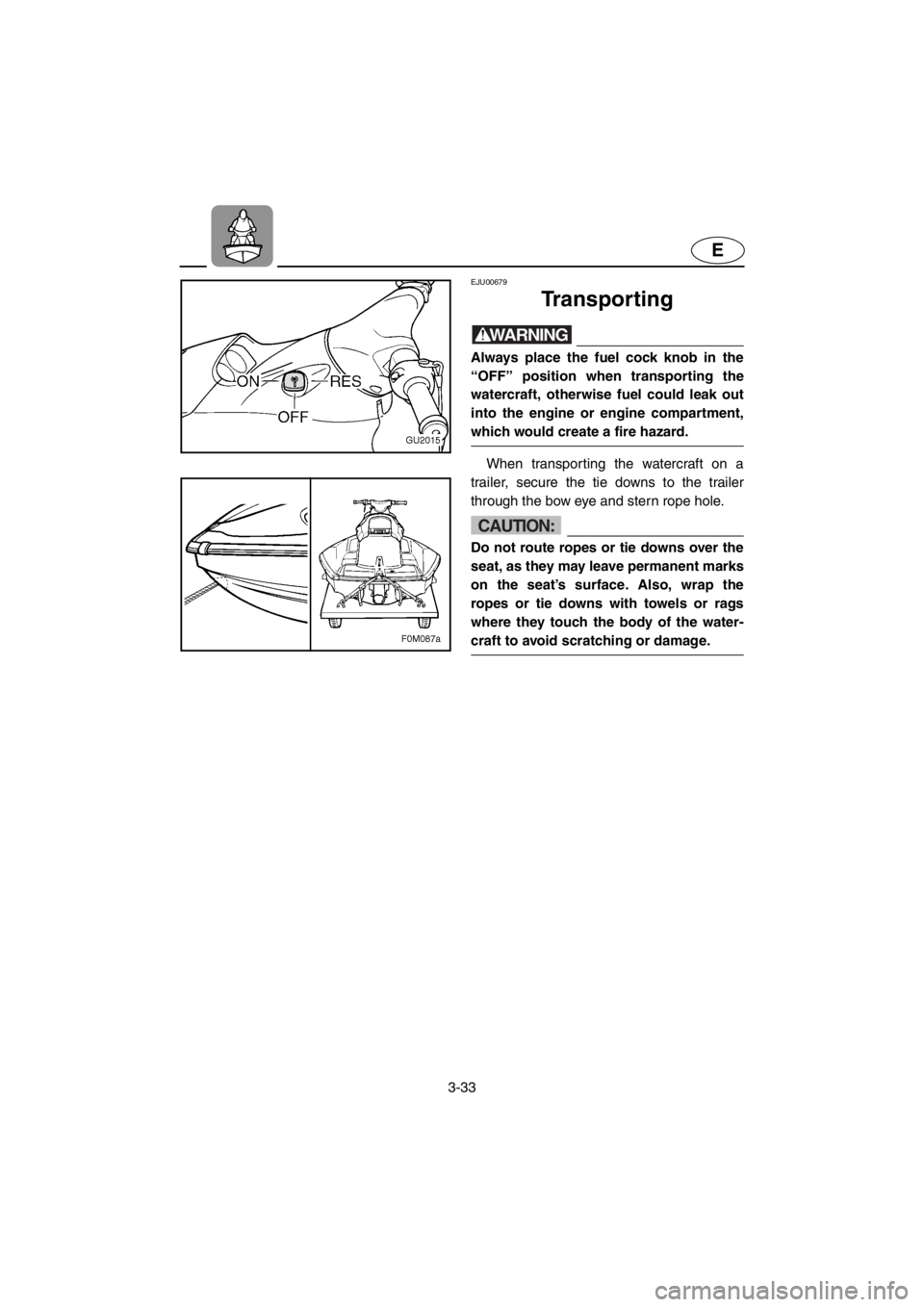
Transporting
WARNING
Always place the fuel cock knob in the
“OFF” position when transporting the
watercraft, otherwise fuel could leak out
into the engine or engine compartment,
which would create a fire hazard.
When transporting the watercraft on a
trailer, secure the tie downs to the trailer
through the bow eye and stern rope hole.
CAUTION:
Do not route ropes or tie downs over the
seat, as they may leave permanent marks
on the seat’s surface. Also, wrap the
ropes or tie downs with towels or rags
where they touch the body of the water-
craft to avoid scratching or damage.
E_F0M-72-3.fm Page 33 Thursday, July 27, 2000 9:52 AM