water pump YAMAHA XL 700 2001 Owners Manual
[x] Cancel search | Manufacturer: YAMAHA, Model Year: 2001, Model line: XL 700, Model: YAMAHA XL 700 2001Pages: 111, PDF Size: 12.05 MB
Page 21 of 111
1-14
E
EJU00315a
Watercraft characteristics
●Jet thrust turns the watercraft. Releasing
the throttle completely produces only min-
imum thrust. If you are traveling at speeds
above trolling, you will have rapidly
decreasing ability to steer without throttle.
You may still have some turning ability
immediately after releasing the throttle,
but once the engine slows down, the
watercraft will no longer respond to han-
dlebar input until you open the throttle
again or you reach a trolling speed. Prac-
tice turning in an open area without
obstructions until you have a good feel for
this maneuver.
●This watercraft is water-jet propelled. The
jet pump is directly connected to the
engine. This means that jet thrust will pro-
duce some movement whenever the
engine is running. There is no “neutral”
position.
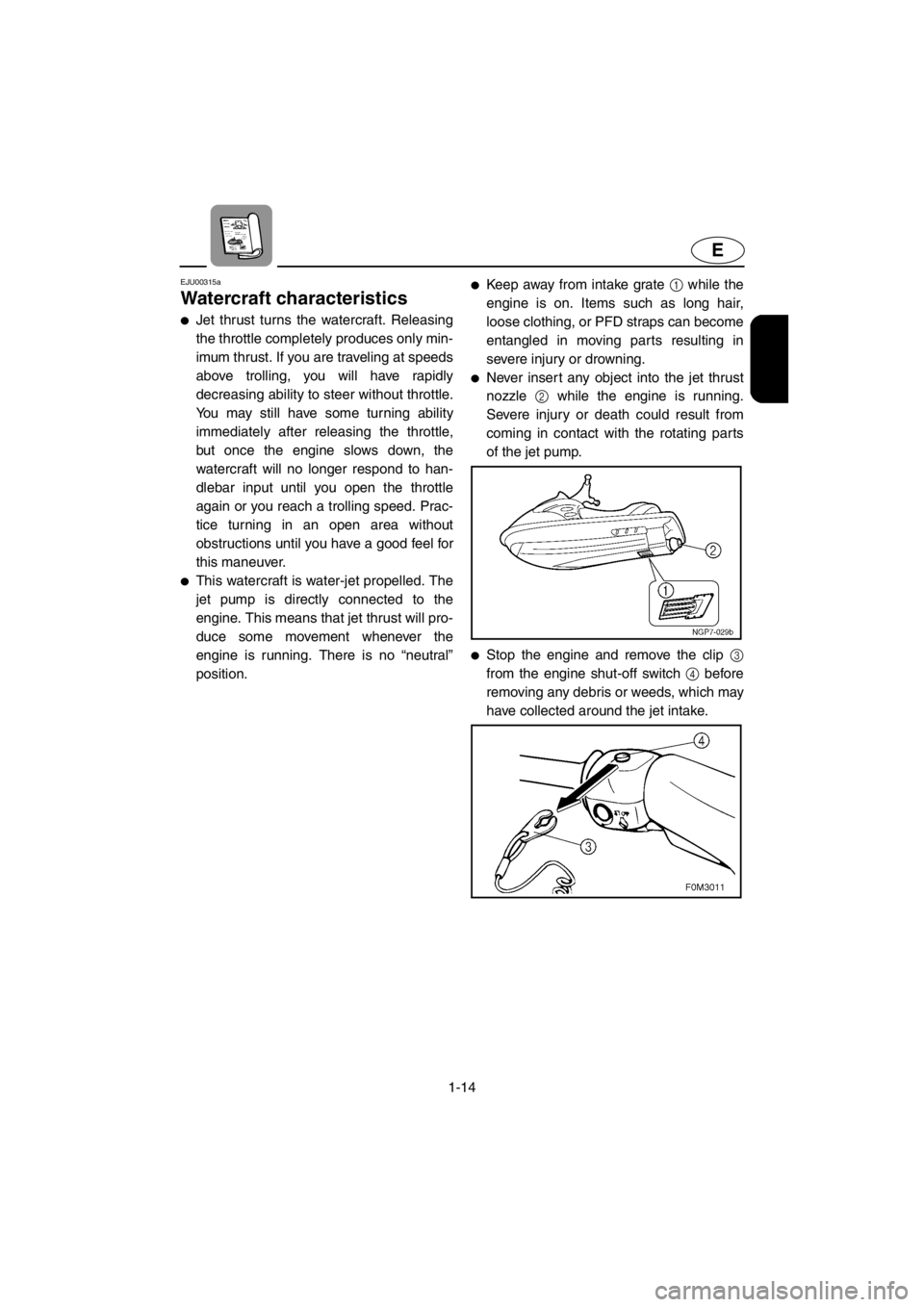
●Keep away from intake grate 1 while the
engine is on. Items such as long hair,
loose clothing, or PFD straps can become
entangled in moving parts resulting in
severe injury or drowning.
●Never insert any object into the jet thrust
nozzle 2 while the engine is running.
Severe injury or death could result from
coming in contact with the rotating parts
of the jet pump.
●Stop the engine and remove the clip 3
from the engine shut-off switch 4 before
removing any debris or weeds, which may
have collected around the jet intake.
E_F0M-72-1.fm Page 14 Thursday, July 27, 2000 10:40 AM
Page 26 of 111
2-1
E
EJU00327
Location of main components
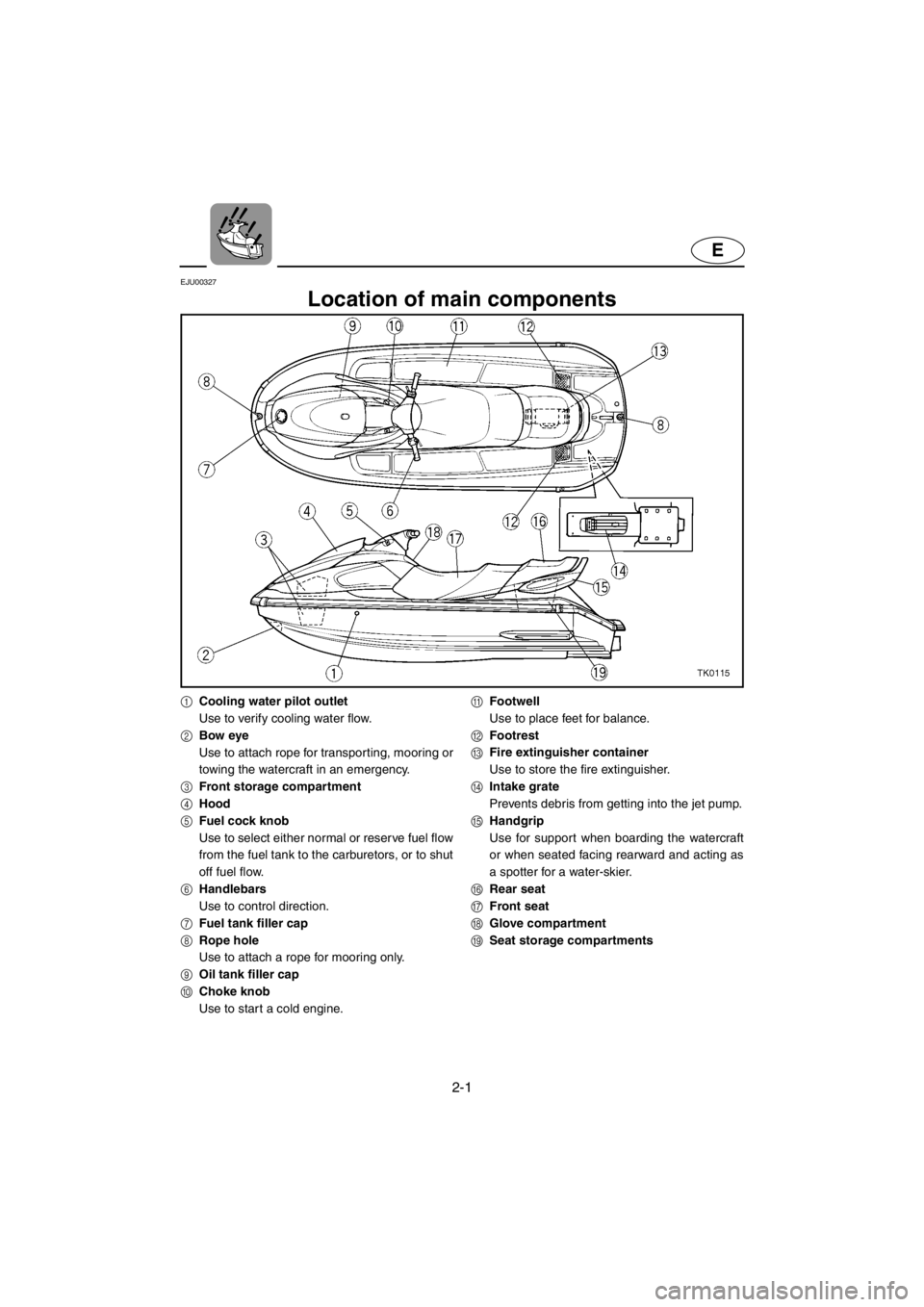
1Cooling water pilot outlet
Use to verify cooling water flow.
2Bow eye
Use to attach rope for transporting, mooring or
towing the watercraft in an emergency.
3Front storage compartment
4Hood
5Fuel cock knob
Use to select either normal or reserve fuel flow
from the fuel tank to the carburetors, or to shut
off fuel flow.
6Handlebars
Use to control direction.
7Fuel tank filler cap
8Rope hole
Use to attach a rope for mooring only.
9Oil tank filler cap
0Choke knob
Use to start a cold engine.AFootwell
Use to place feet for balance.
BFootrest
CFire extinguisher container
Use to store the fire extinguisher.
DIntake grate
Prevents debris from getting into the jet pump.
EHandgrip
Use for suppor t when boarding the watercraft
or when seated facing rearward and acting as
a spotter for a water-skier.
FRear seat
GFront seat
HGlove compartment
ISeat storage compartments
E_F0M-72-2.fm Page 1 Thursday, July 27, 2000 9:50 AM
Page 36 of 111
2-11
E
EJU00366
Engine overheat warning
system
This model is equipped with an engine
overheat warning system.
If the engine starts to overheat, the
engine speed will be limited to about
3,000 r/min.
When this occurs, check for water dis-
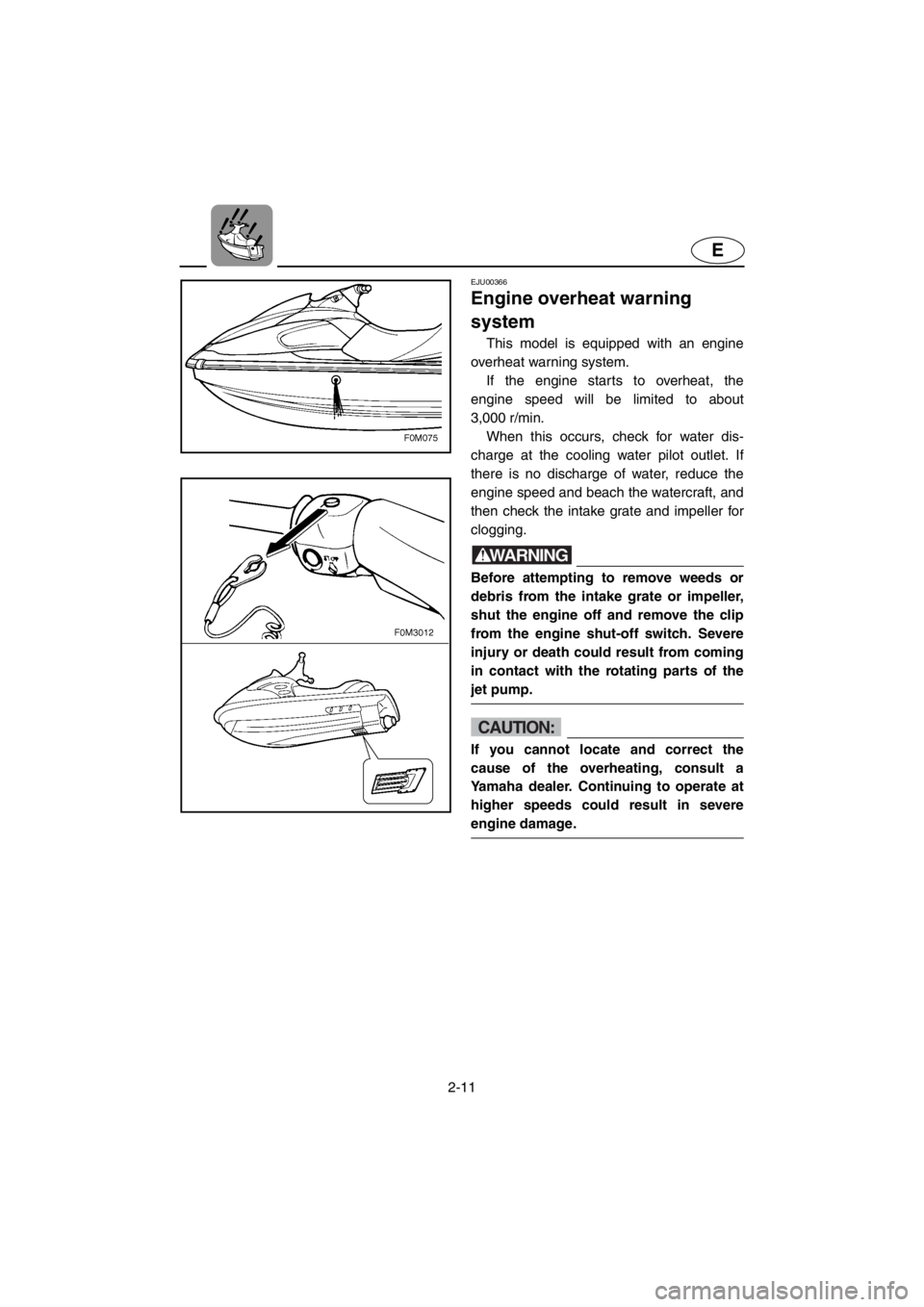
charge at the cooling water pilot outlet. If
there is no discharge of water, reduce the
engine speed and beach the watercraft, and
then check the intake grate and impeller for
clogging.
WARNING
Before attempting to remove weeds or
debris from the intake grate or impeller,
shut the engine off and remove the clip
from the engine shut-off switch. Severe
injury or death could result from coming
in contact with the rotating parts of the
jet pump.
CAUTION:
If you cannot locate and correct the
cause of the overheating, consult a
Yamaha dealer. Continuing to operate at
higher speeds could result in severe
engine damage.
E_F0M-72-2.fm Page 11 Thursday, July 27, 2000 9:50 AM
Page 52 of 111
3-11
E
EJU00451a
Jet unit
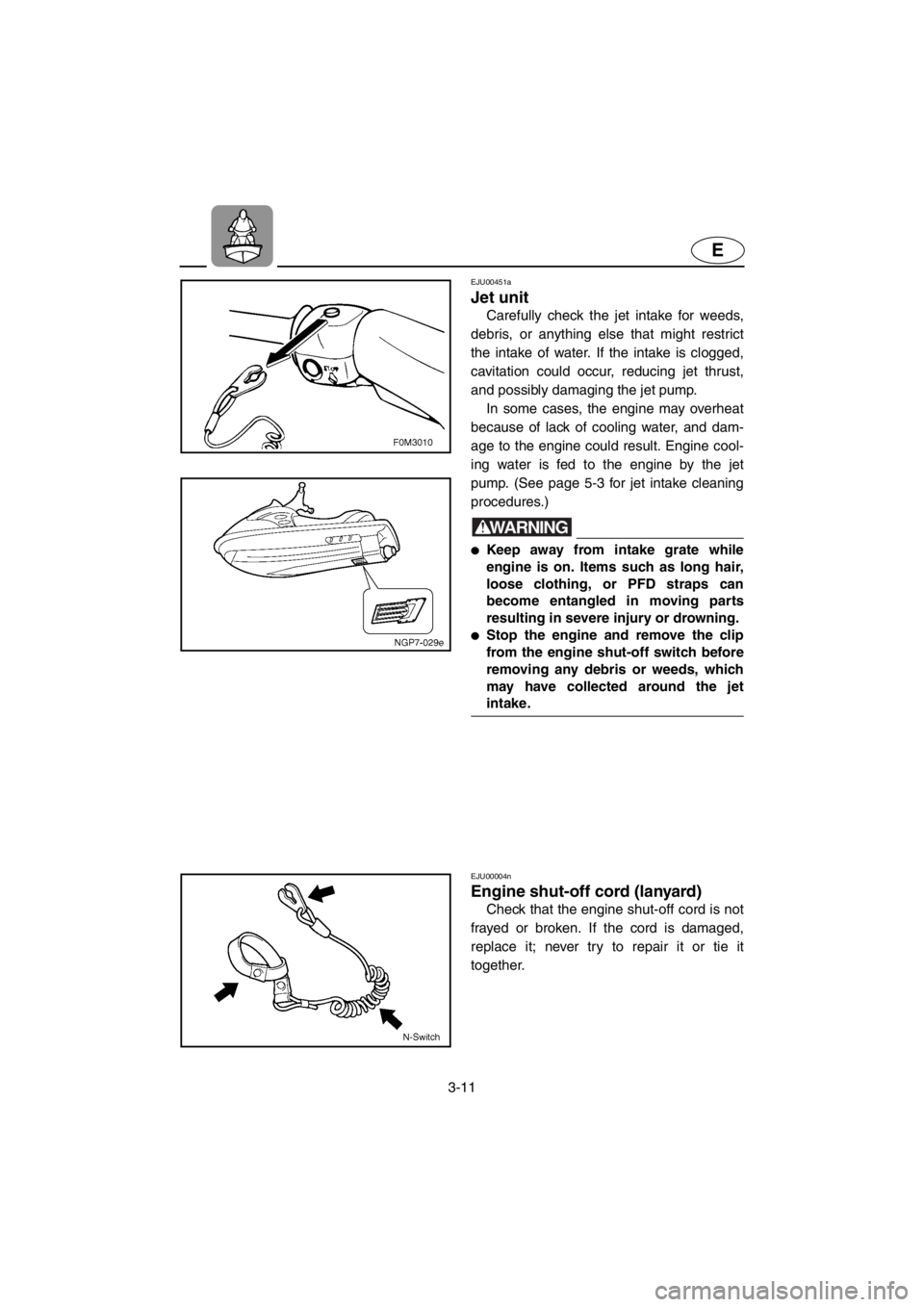
Carefully check the jet intake for weeds,
debris, or anything else that might restrict
the intake of water. If the intake is clogged,
cavitation could occur, reducing jet thrust,
and possibly damaging the jet pump.
In some cases, the engine may overheat
because of lack of cooling water, and dam-
age to the engine could result. Engine cool-
ing water is fed to the engine by the jet
pump. (See page 5-3 for jet intake cleaning
procedures.)
WARNING
●Keep away from intake grate while
engine is on. Items such as long hair,
loose clothing, or PFD straps can
become entangled in moving parts
resulting in severe injury or drowning.
●Stop the engine and remove the clip
from the engine shut-off switch before
removing any debris or weeds, which
may have collected around the jet
intake.
EJU00004n
Engine shut-off cord (lanyard)
Check that the engine shut-off cord is not
frayed or broken. If the cord is damaged,
replace it; never try to repair it or tie it
together.
E_F0M-72-3.fm Page 11 Thursday, July 27, 2000 9:52 AM
Page 58 of 111
3-17
E
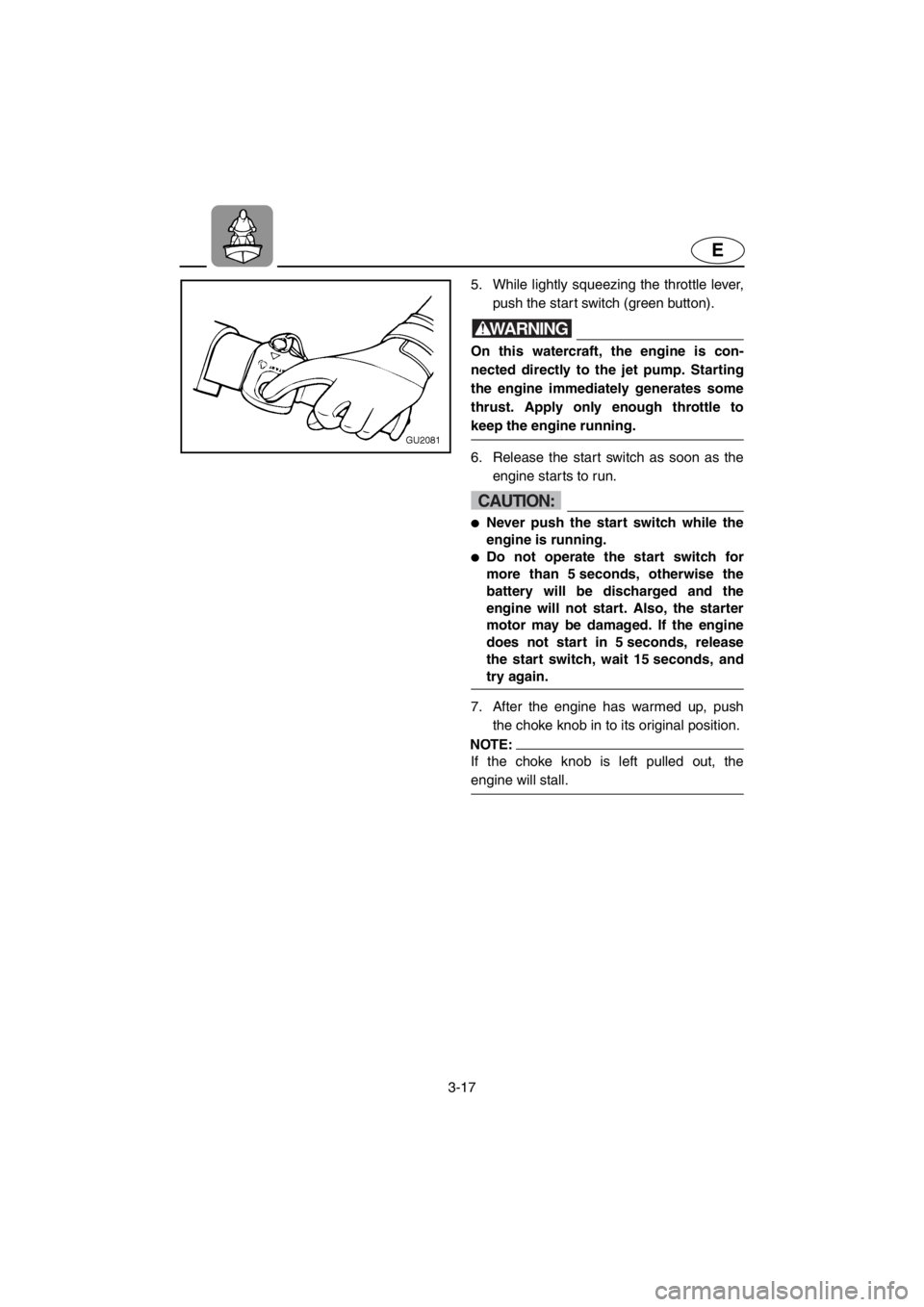
5. While lightly squeezing the throttle lever,
push the start switch (green button).
WARNING
On this watercraft, the engine is con-
nected directly to the jet pump. Starting
the engine immediately generates some
thrust. Apply only enough throttle to
keep the engine running.
6. Release the start switch as soon as the
engine starts to run.
CAUTION:
●Never push the start switch while the
engine is running.
●Do not operate the start switch for
more than 5 seconds, otherwise the
battery will be discharged and the
engine will not start. Also, the starter
motor may be damaged. If the engine
does not start in 5 seconds, release
the start switch, wait 15 seconds, and
try again.
7. After the engine has warmed up, push
the choke knob in to its original position.
NOTE:
If the choke knob is left pulled out, the
engine will stall.
E_F0M-72-3.fm Page 17 Thursday, July 27, 2000 9:52 AM
Page 68 of 111
3-27
E
A
B
C
D
EJU00499
Turning the watercraft
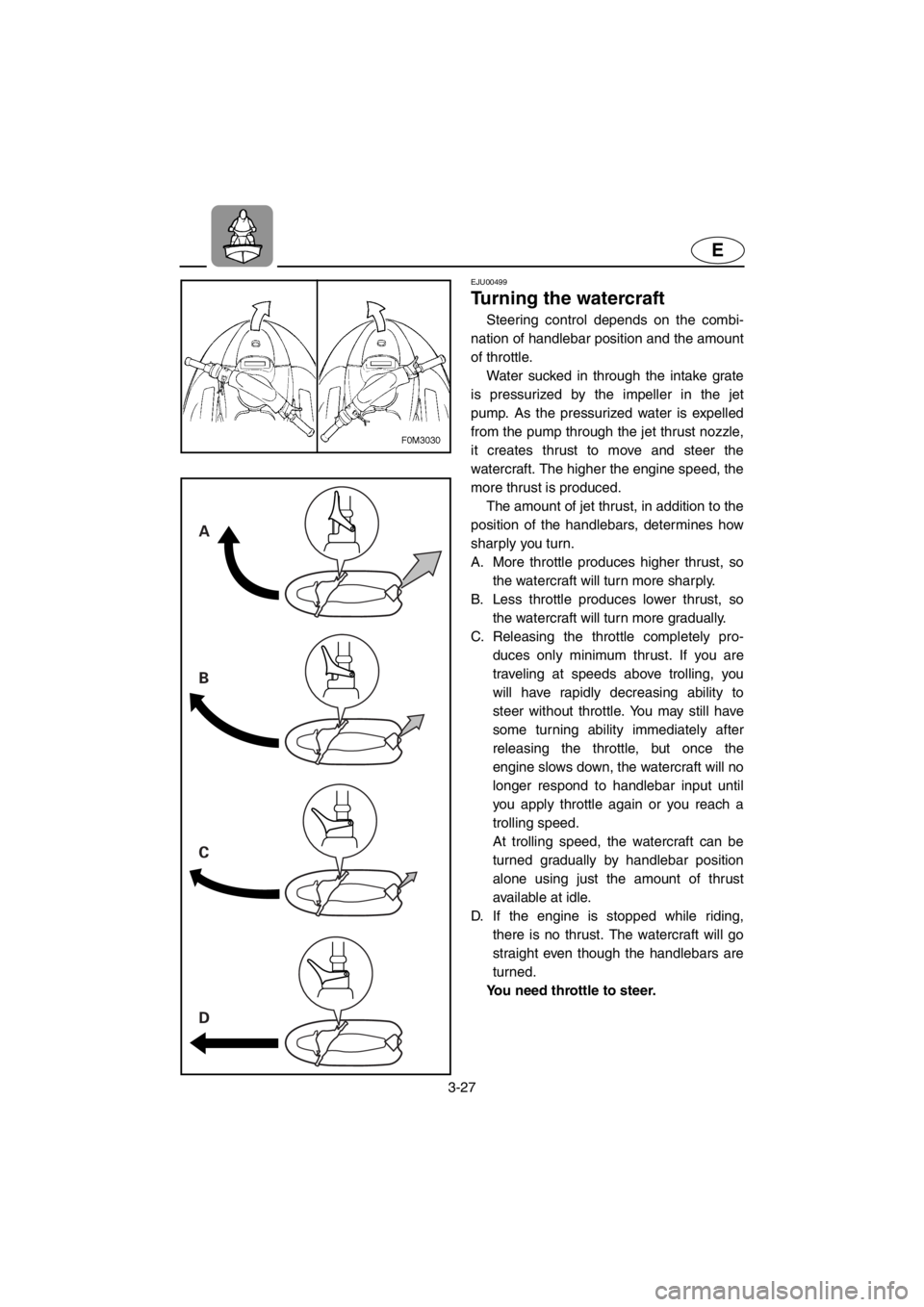
Steering control depends on the combi-
nation of handlebar position and the amount
of throttle.
Water sucked in through the intake grate
is pressurized by the impeller in the jet
pump. As the pressurized water is expelled
from the pump through the jet thrust nozzle,
it creates thrust to move and steer the
watercraft. The higher the engine speed, the
more thrust is produced.
The amount of jet thrust, in addition to the
position of the handlebars, determines how
sharply you turn.
A. More throttle produces higher thrust, so
the watercraft will turn more sharply.
B. Less throttle produces lower thrust, so
the watercraft will turn more gradually.
C. Releasing the throttle completely pro-
duces only minimum thrust. If you are
traveling at speeds above trolling, you
will have rapidly decreasing ability to
steer without throttle. You may still have
some turning ability immediately after
releasing the throttle, but once the
engine slows down, the watercraft will no
longer respond to handlebar input until
you apply throttle again or you reach a
trolling speed.
At trolling speed, the watercraft can be
turned gradually by handlebar position
alone using just the amount of thrust
available at idle.
D. If the engine is stopped while riding,
there is no thrust. The watercraft will go
straight even though the handlebars are
turned.
You need throttle to steer.
E_F0M-72-3.fm Page 27 Thursday, July 27, 2000 9:52 AM
Page 75 of 111
E
4
EJU00515
MAINTENANCE AND
CARE
Storage....................................................... 4-1
Flushing the cooling system ................... 4-1
Lubrication............................................... 4-3
Fuel system............................................. 4-4
Battery ..................................................... 4-4
Cleaning the watercraft........................... 4-5
Maintenance and adjustments............... 4-6
Owner’s/Operator’s Manual and tool
kit ............................................................. 4-7
Periodic maintenance chart .................... 4-8
Inspecting the fuel system ...................... 4-9
Inspecting the oil injection system........ 4-11
Inspecting the steering cable................ 4-12
Inspecting and adjusting the throttle
cable ...................................................... 4-12
Cleaning and adjusting the spark
plugs ...................................................... 4-13
Lubrication points .................................. 4-14
Adjusting the choke cable..................... 4-16
Inspecting the battery ........................... 4-17
Adjusting the carburetor ....................... 4-19
Replacing the fuse ................................ 4-20
Bleeding the oil injection pump............. 4-20
Specifications......................................... 4-21
E_F0M-72-4TOC.fm Page 1 Thursday, July 27, 2000 9:53 AM
Page 84 of 111
4-9
E
EJU00537
Inspecting the fuel system
WARNING
Gasoline and its vapors are highly flam-
mable and explosive.
Check the fuel system for leaks, cracks,
or malfunctions. If any problem is found, do
the necessary repair or replacement as
required. If repair is necessary, consult a
Yamaha dealer.
Check:
●Carburetor for leakage.
●Fuel pump for malfunction or leakage.
●Fuel tank for water or dirt.
●Fuel tank for damage, cracks or leakage.
●Fuel hose joint for leakage.
●Fuel hose for cracks or other damage.
●Fuel filter for leakage.
●Fuel cock for leakage.
●Air vent check valve for leakage.
●Fuel tank filler cap for damage.
WARNING
Failure to check for and repair any fuel
leakage may result in fire or explosion.
E_F0M-72-4.fm Page 9 Thursday, July 27, 2000 9:53 AM
Page 86 of 111
4-11
E
EJU00544
Inspecting the oil injection
system
Check the oil injection system for leakage,
cracks, or malfunctions. If necessary, have a
Yamaha dealer repair the oil injection sys-
tem.
Check:
●Oil tank for damage, cracks or leakage.
●Oil tank for water or dirt.
●Oil hose and joint for damage or cracks.
●Oil filter for dirt.
●Oil pump for leakage.
Oil tank
Check the oil tank for leakage or water in
the tank. If water is found in the oil injection
system or if the oil tank needs to be cleaned
have a Yamaha dealer service the water-
craft.
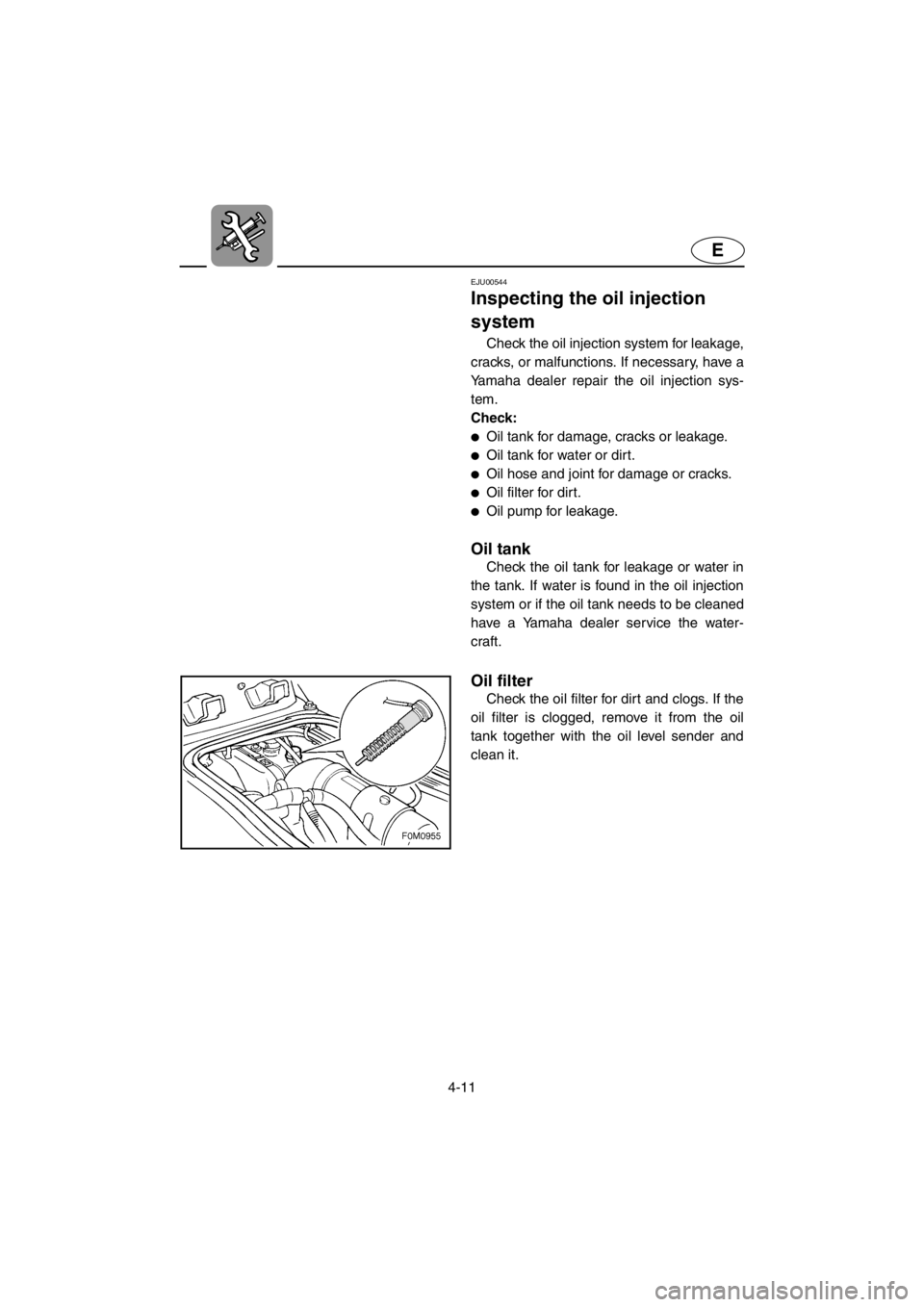
Oil filter
Check the oil filter for dirt and clogs. If the
oil filter is clogged, remove it from the oil
tank together with the oil level sender and
clean it.
E_F0M-72-4.fm Page 11 Thursday, July 27, 2000 9:53 AM
Page 96 of 111

4-21
E
EJU00588
Specifications
MODEL
ITEMUnit XL700
WATERCRAFT CAPACITY
Maximum people on board Number of people 3
Maximum load capacity kg (lb) 240 (530)
DIMENSIONS
Length mm (in) 3,150 (124.0)
Width mm (in) 1,250 (49.2)
Height mm (in) 1,100 (43.3)
Dry weight kg (lb) 245 (540)
PERFORMANCE
Maximum output kW (PS) @ r/min 58.8 (80)@6,250
Maximum fuel consumption L/h (US gal/h, Imp gal/h) 34.0 (9.0, 7.5)
Cruising range at full throttle hr. 1.5
Trolling speed r/min 1,250–1,350
ENGINE
Engine type 2-stroke
Number of cylinders 2
Engine displacement
cm
3 (cu in)701 (42.78)
Bore & stroke mm (in) 81.0 ×
68.0 (3.19 ×
2.68)
Compression ratio 7.2
Lubrication system Oil injection
Cooling system Water-cooled
Starting system Electric starter
Ignition system C.D.I.
Spark plug BR8HS
Spark plug gap mm (in) 0.6–0.7 (0.024–0.028)
Battery capacity V-AH 12-19
Charging system Flywheel magneto
DRIVE UNIT
Propulsion system Jet pump
Jet pump type Axial flow, single stage
Impeller rotation Counter clockwise (Rear view)
Transmission Direct drive from engine
Jet thrust nozzle angle Degree 24 + 24
FUEL AND OIL
Recommended fuel Regular unleaded gasoline
Minimum octane rating PON
RON86
90
Recommended engine oil YAMALUBE 2-W, or an equivalent NMMA-
certified TC-W3 marine oil
Fuel tank capacity
Total L (US gal, Imp gal) 50 (13.2,11)
Reserve L (US gal, Imp gal) 12 (3.17, 2.64)
Oil tank capacity L (US gal, Imp gal) 3.8 (1.00, 0.84)
E_F0M-72-4.fm Page 21 Thursday, July 27, 2000 9:53 AM