oil YAMAHA XL 700 2004 Owner's Manual
[x] Cancel search | Manufacturer: YAMAHA, Model Year: 2004, Model line: XL 700, Model: YAMAHA XL 700 2004Pages: 120, PDF Size: 9.4 MB
Page 107 of 120
5-2
E
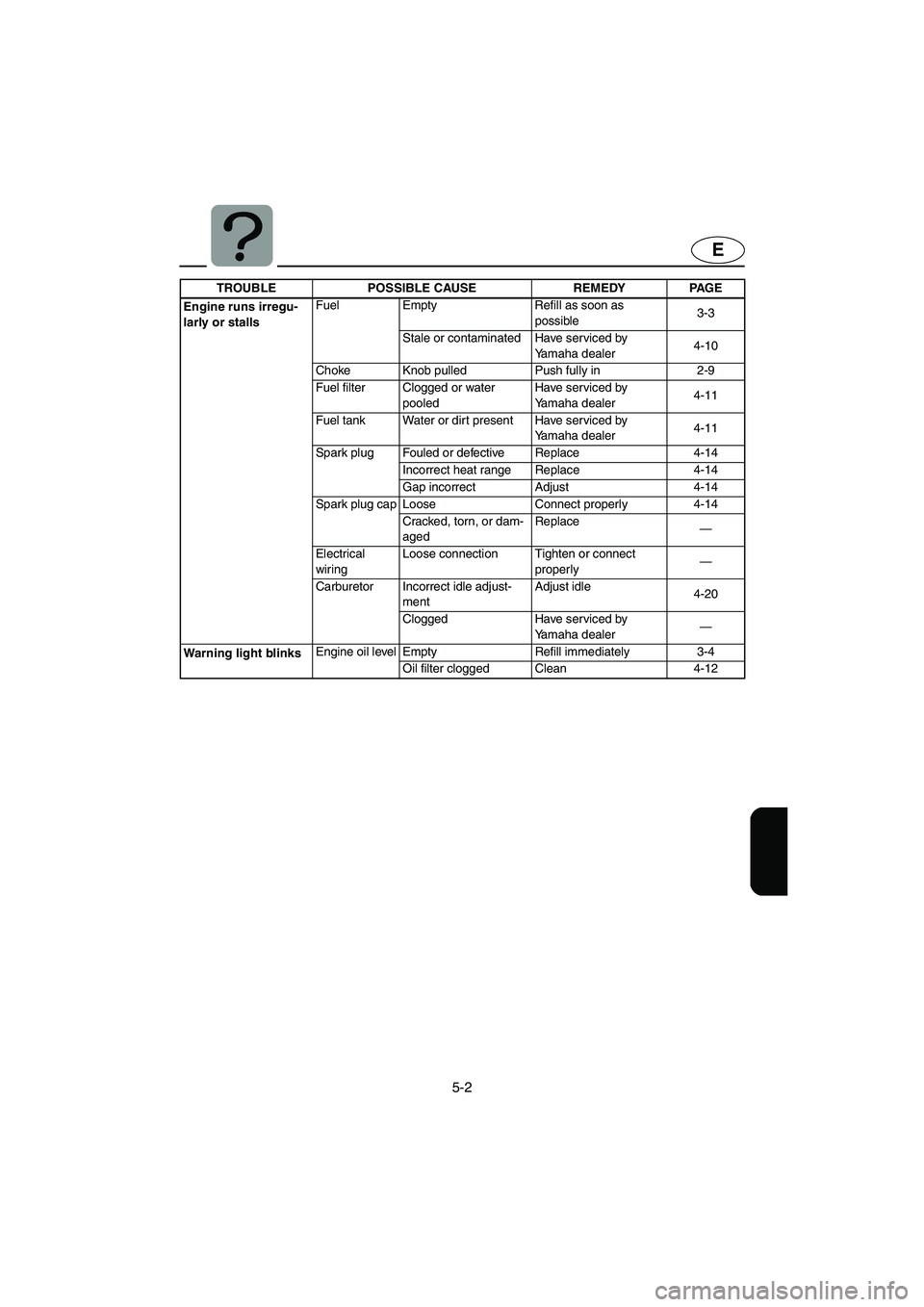
Engine runs irregu-
larly or stallsFuel Empty Refill as soon as
possible3-3
Stale or contaminated Have serviced by
Yamaha dealer4-10
Choke Knob pulled Push fully in 2-9
Fuel filter Clogged or water
pooledHave serviced by
Yamaha dealer4-11
Fuel tank Water or dirt present Have serviced by
Yamaha dealer4-11
Spark plug Fouled or defective Replace 4-14
Incorrect heat range Replace 4-14
Gap incorrect Adjust 4-14
Spark plug cap Loose Connect properly 4-14
Cracked, torn, or dam-
agedReplace
—
Electrical
wiringLoose connection Tighten or connect
properly—
Carburetor Incorrect idle adjust-
mentAdjust idle
4-20
Clogged Have serviced by
Yamaha dealer—
Warning light blinksEngine oil level Empty Refill immediately 3-4
Oil filter clogged Clean 4-12 TROUBLE POSSIBLE CAUSE REMEDY PAGE
UF0M75.book Page 2 Thursday, May 29, 2003 9:53 AM
Page 110 of 120
5-5
E
2. Remove any weeds or debris from
around the drive shaft, impeller, pump
housing, and jet thrust nozzle.
If debris is difficult to remove, consult
your Yamaha dealer.
CAUTION:@ Always avoid operating your watercraft in
areas where weed growth is thick. If trav-
eling in weeded areas is unavoidable,
operate the engine alternately at partial
throttle and full throttle. Weeds tend to
accumulate more at a steady speed and
at trolling speed. If weeds clog the intake
or impeller area and cause cavitation, fol-
low the cleaning procedure above.
@
EJU01844
Jumping the battery
If the watercraft battery has run down, the
engine can be started using a 12-volt bat-
tery and jumper cables.
WARNING@ Battery electrolyte is poisonous and dan-
gerous, causing severe burns, etc. Elec-
trolyte contains sulfuric acid. Avoid
contact with skin, eyes or clothing.
Antidotes
External: Flush with water.
Internal: Drink large quantities of water
or milk. Follow with milk of magnesia,
beaten egg or vegetable oil. Call physi-
cian immediately.
Eyes: Flush with water for 15 minutes
and get prompt medical attention.
Batteries produce explosive gases. Keep
sparks, flame, cigarettes, etc. well away.
If using or charging the battery in an
enclosed space, make sure that it is well
ventilated. Always shield your eyes when
working near batteries.
KEEP OUT OF THE REACH OF CHILDREN.
@
UF0M75.book Page 5 Thursday, May 29, 2003 9:53 AM
Page 116 of 120
6-1
E
EJU01125
Index
2-stroke engine oil ................................... 3-2
A
Adjusting the carburetor ........................ 4-20
Adjusting the choke cable ..................... 4-17
Adjusting the trolling speed ................... 4-20
Approval label of Emission control
certificate ................................................. 1-2
B
Battery .............................................. 3-9, 4-5
Beaching the watercraft ........................ 3-32
Bilge ........................................................ 3-8
Bleeding the oil injection pump ............. 4-21
Boarding alone ...................................... 3-24
Boarding and starting in deep water ..... 3-24
Boarding with passengers ..................... 3-25
C
Capsized watercraft .............................. 3-27
Choke knob ............................................. 2-9
Cleaning and adjusting the spark
plugs...................................................... 4-14
Cleaning the jet intake and impeller ........ 5-4
Cleaning the watercraft ........................... 4-6
Connecting the jumper cables................. 5-6
Cooling water pilot outlet .............. 2-11, 3-13
Cruising limitations ................................ 1-10
D
Docking the watercraft .......................... 3-32
E
Emergency procedures ........................... 5-4
Emission control information
(For Canada only) ................................... 1-2
Engine break-in ..................................... 3-14
Engine compartment ............................... 3-6
Engine overheat warning system .......... 2-13
Engine serial number .............................. 1-1
Engine shut-off cord (lanyard) ............... 3-12
Engine shut-off switch ............................. 2-9
Engine stop switch .................................. 2-9
Enjoy your watercraft responsibly ......... 1-17F
Filling the fuel tank .................................. 3-3
Filling the oil tank .................................... 3-4
Finger grip ............................................. 2-12
Fire extinguisher .................................... 3-10
Flushing the cooling system .................... 4-1
Front seat ................................................ 2-5
Front storage compartment ................... 2-15
Fuel and oil.............................................. 3-1
Fuel and oil systems ............................... 3-7
Fuel cock knob ........................................ 2-8
Fuel filter ............................................... 4-11
Fuel system ............................................. 4-4
Fuel tank ............................................... 4-11
Fuel tank filler cap ................................... 2-7
G
Gasohol ................................................... 3-2
Gasoline .................................................. 3-1
Getting to know your watercraft ............ 3-20
Glove compartment ............................... 2-16
H
Handgrip ................................................ 2-12
Hazard information ................................ 1-14
Hood........................................................ 2-6
Hull and deck .......................................... 3-6
Hull Identification Number (HIN).............. 1-1
I
Identification numbers ............................. 1-1
Important labels ....................................... 1-3
Inspecting and adjusting the throttle
cable...................................................... 4-13
Inspecting the battery ............................ 4-18
Inspecting the fuel system ..................... 4-10
Inspecting the jet thrust nozzle angle .... 4-13
Inspecting the oil injection system ......... 4-12
J
Jet unit................................................... 3-12
Jumping the battery ................................. 5-5
L
Label location .......................................... 1-3
Learning to operate your watercraft ...... 3-20
Leaving the watercraft ........................... 3-19
UF0M75.book Page 1 Thursday, May 29, 2003 9:53 AM
Page 117 of 120
6-2
E
Limitations on who may operate the
watercraft ................................................ 1-9
Location of main components ................. 2-1
Lubrication............................................... 4-3
Lubrication points .................................. 4-15
M
Maintenance and adjustments ................ 4-7
Manufactured date label.......................... 1-2
O
Oil filter .................................................. 4-12
Oil level warning lamp ........................... 2-14
Oil tank .................................................. 4-12
Oil tank filler cap...................................... 2-7
Operating your watercraft...................... 3-20
Operation .............................................. 3-14
Operation of controls and other
functions .................................................. 2-4
Operation requirements ........................ 1-11
Other labels ............................................. 1-7
Owner’s/Operator’s Manual and
tool kit ...................................................... 4-8
P
Periodic maintenance chart..................... 4-9
Post-operation checks........................... 3-34
Pre-operation check list........................... 3-5
Pre-operation check points ..................... 3-6
Pre-operation checks .............................. 3-5
Primary Identification (PRI-ID)
number .................................................... 1-1
R
Rear seat................................................. 2-4
Recommended equipment .................... 1-13
Replacing the fuse ................................ 4-21
Riding watercraft with passengers ........ 3-21
Rough water operation .......................... 3-33
S
Safe boating rules ................................. 1-17
Safety information ................................... 1-9
Seat storage compartment .................... 2-16
Specifications ........................................ 4-22
Starting and boarding in shallow
water ..................................................... 3-23
Starting from a dock .............................. 3-23Starting the engine ................................ 3-16
Starting the watercraft ........................... 3-22
Start switch............................................ 2-10
Steering system ...........................2-11, 3-11
Stern drain plug ....................................... 3-8
Stopping the engine .............................. 3-19
Stopping the watercraft ......................... 3-31
Storage.................................................... 4-1
Storage compartments .......................... 2-15
Submerged watercraft ............................. 5-8
Switches ................................................ 3-13
T
Throttle .................................................. 3-11
Throttle lever ......................................... 2-10
Towing the watercraft .............................. 5-7
Transporting .......................................... 3-36
Troubleshooting ...................................... 5-1
Troubleshooting chart ............................. 5-1
Turning the watercraft ........................... 3-29
W
Warning labels ........................................ 1-4
Watercraft characteristics ...................... 1-14
Water separator ...................................... 3-7
Water-skiing .......................................... 1-15
UF0M75.book Page 2 Thursday, May 29, 2003 9:53 AM