battery YAMAHA XL 800 2001 User Guide
[x] Cancel search | Manufacturer: YAMAHA, Model Year: 2001, Model line: XL 800, Model: YAMAHA XL 800 2001Pages: 131, PDF Size: 16.51 MB
Page 97 of 131
4-4
E
EJU00946
Fuel system
Draining the fuel system prevents buildup
of varnishes and other harmful deposits that
result when gasoline sits for a prolonged
period of time.
WARNING@Gasoline is highly flammable and explo-
sive. A fire or explosion can cause
severe injury or death. Shut the engine
off. Refuel in well-ventilated areas away
from flames or sparks. Do not smoke.
Avoid spilling gasoline. Wipe up spilled
gasoline immediately.
@
To drain the fuel system:
1. Place the fuel cock knob in the “OFF”
position.
2. Drain the fuel tank using a siphon.
EJU00530
Battery
When the watercraft is not to be used for
a month or more, remove the battery and
store it in a cool, dark place. Clean the bat-
tery casing using fresh water. Clean the bat-
tery terminals. Apply dielectric grease or
petroleum jelly to the battery terminals and
to all exposed battery leads.
If the battery is to be stored for a longer
period, check the specific gravity of the elec-
trolyte at least once a month and charge the
battery if necessary.
Specific gravity: 1.28 at 20 °C (68 °F)
E_F0P71-4.fm Page 4 Tuesday, July 18, 2000 7:17 PM
Page 101 of 131
4-8
E
EJU00536
Periodic maintenance chart
The following chart gives general guidelines for periodic maintenance. However, depend-
ing on your operating conditions maintenance may need to be performed more frequently.
(
●) This mark indicates maintenance that you may do yourself.
(
❍) This mark indicates work to be done by a Yamaha dealer.
*1: Grease capacity: 33.0–35.0 cm3 (1.11–1.18 oz)
*2: Grease capacity: 6.0–8.0 cm3 (0.20–0.27 oz)
MAINTENANCE INTERVAL INITIALTHEREAFTER
EVERYPA G E
10
hours50
hours100
hours100
hours200
hours
ITEM
3
months6
months6
months12
months
Spark plug Inspect, clean, adjust●●●●
4-14
Lubrication points Lubricate●●
4-15
Intermediate housing Lubricate❍
*1●
*2●
*2 4-18
Fuel system Inspect❍❍
4-9
Fuel filter Check, replace❍❍
4-10
Fuel tank Clean❍
4-10
Oil injection system Inspect, clean❍❍
4-11
Trolling speed Adjust●●
4-21
Carburetor throttle shaft Inspect❍❍❍
—
Cooling water passages Flush
●
(after
ever y
use)4-1
Bilge strainer Clean●●●
—
Impeller Inspect●●●
—
Steering cable Inspect●●
4-12
Steering master Inspect❍❍❍
—
QSTS mechanism Inspect●●
4-13
Shift cable and mechanism Inspect, adjust●●
4-12
Throttle cable Inspect, adjust●●
4-12
Choke cable Inspect, adjust●●
4-18
Stern drain plugs Inspect, replace●
3-7
Battery Inspect
●(inspect
fluid level
before
ever y
use)
4-19
Rubber coupling Inspect❍
—
Nuts and bolts Tighten❍❍❍
—
E_F0P71-4.fm Page 8 Tuesday, July 18, 2000 7:17 PM
Page 112 of 131
4-19
E
EJU00572
Inspecting the battery
Check the level of the battery electrolyte
and make sure the leads are secure.
WARNING
Battery electrolyte is poisonous and dan-
gerous, causing severe burns, etc. Elec-
trolyte contains sulfuric acid. Avoid
contact with skin, eyes or clothing.
Antidotes
External: Flush with water.
Internal: Drink large quantities of water
or milk. Follow with milk of magnesia,
beaten egg or vegetable oil. Call physi-
cian immediately.
Eyes: Flush with water for 15 minutes
and get prompt medical attention.
Batteries produce explosive gases. Keep
sparks, flame, cigarettes, etc., well away.
If using or charging the battery in an
enclosed space, make sure that it is well
ventilated. Always shield your eyes when
working near batteries.
KEEP OUT OF THE REACH OF CHIL-
DREN.
CAUTION:
Be careful not to place the battery on its
side.
Make sure to remove the battery from the
battery compartment when adding bat-
tery electrolyte or charging the battery.
When checking the battery, make sure
the breather hose is connected to the
battery and not obstructed.
E_F0P71-4.fm Page 19 Tuesday, July 18, 2000 7:17 PM
Page 113 of 131
4-20
E
To replenish the battery:
1. Make sure that the electrolyte level is
between the upper 1 and lower 2 level
marks.
2. Refill the battery with distilled water if
necessary.
CAUTION:
Normal tap water contains minerals that
are harmful to a battery. Use only dis-
tilled water for replenishing the battery.
To charge the battery:
1. Remove the caps from the battery cells.
If the level is low, add distilled water if
necessary.
2. Connect the battery to a charger. Set the
charging rate at 1.9 A, and then charge
the battery for 10 hours.
WARNING
●The battery gives off explosive gases.
When charging the battery, keep it well
away from sparks and open flames.
●When using a battery charger, connect
the battery to the charger before you
turn the charger on. This will prevent
sparking at the terminals, which could
ignite battery gases.
Specific gravity: 1.28 at 20 °C (68 °F)
To connect the battery terminals:
1. Make sure that the connections are correct
when you insert the battery in the watercraft.
2. Make sure that the breather hose is
properly connected and that it is not
damaged or obstructed.
3. Make sure that the battery is securely
held in place.
1Positive (+): Red lead
2Negative (–): Black lead
3Breather hose
E_F0P71-4.fm Page 20 Tuesday, July 18, 2000 7:17 PM
Page 116 of 131
4-23
E
EJU00588
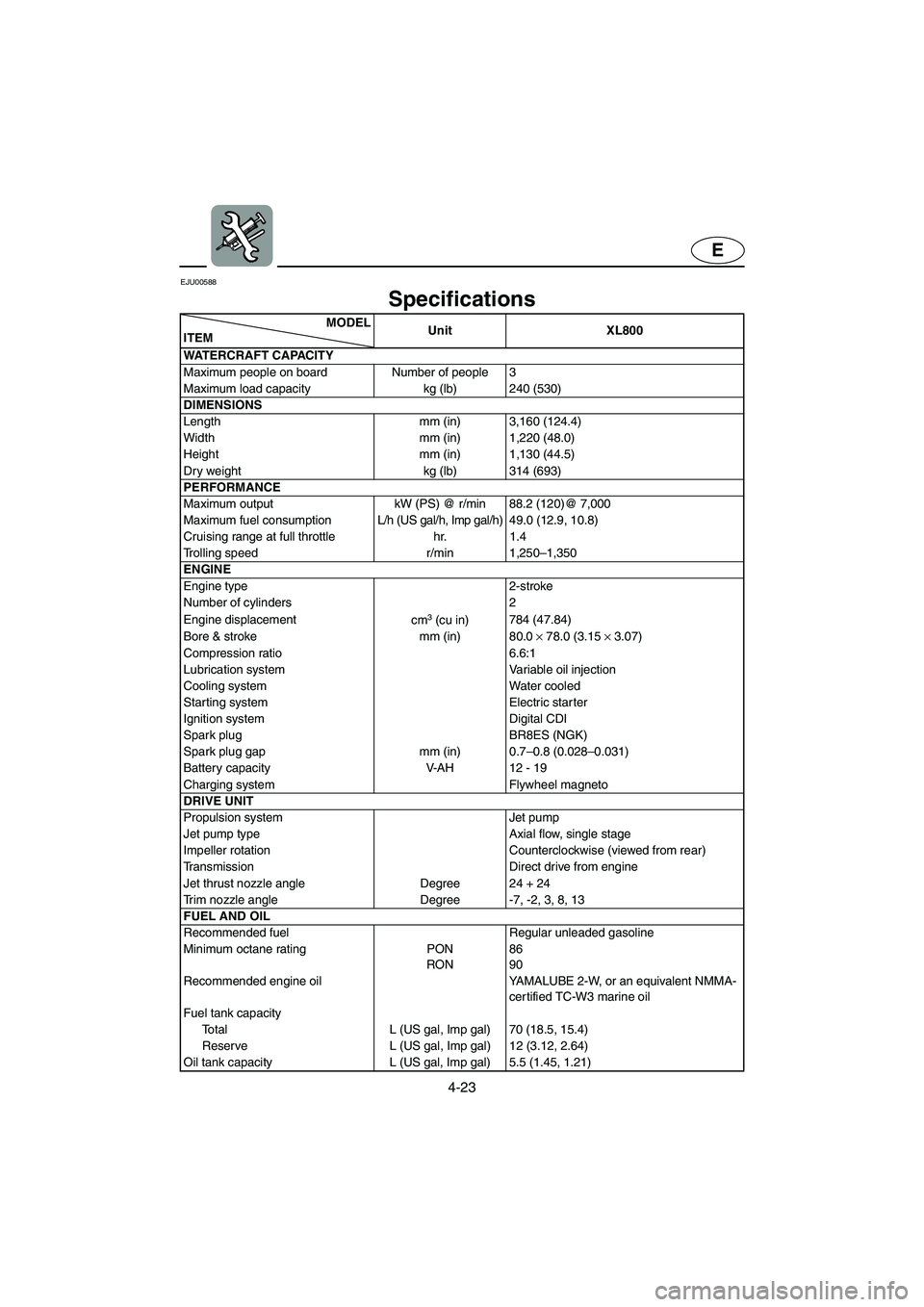
Specifications
MODEL
ITEMUnit XL800
WATERCRAFT CAPACITY
Maximum people on board Number of people 3
Maximum load capacity kg (lb) 240 (530)
DIMENSIONS
Length mm (in) 3,160 (124.4)
Width mm (in) 1,220 (48.0)
Height mm (in) 1,130 (44.5)
Dry weight kg (lb) 314 (693)
PERFORMANCE
Maximum output kW (PS) @ r/min 88.2 (120)@ 7,000
Maximum fuel consumption L/h (US gal/h, Imp gal/h) 49.0 (12.9, 10.8)
Cruising range at full throttle hr. 1.4
Trolling speed r/min 1,250–1,350
ENGINE
Engine type 2-stroke
Number of cylinders 2
Engine displacement
cm
3 (cu in)784 (47.84)
Bore & stroke mm (in) 80.0 × 78.0 (3.15 × 3.07)
Compression ratio 6.6:1
Lubrication system Variable oil injection
Cooling system Water cooled
Starting system Electric starter
Ignition system Digital CDI
Spark plug BR8ES (NGK)
Spark plug gap mm (in) 0.7–0.8 (0.028–0.031)
Battery capacity V-AH 12 - 19
Charging system Flywheel magneto
DRIVE UNIT
Propulsion system Jet pump
Jet pump type Axial flow, single stage
Impeller rotation Counterclockwise (viewed from rear)
Transmission Direct drive from engine
Jet thrust nozzle angle Degree 24 + 24
Trim nozzle angle Degree -7, -2, 3, 8, 13
FUEL AND OIL
Recommended fuel Regular unleaded gasoline
Minimum octane rating PON
RON86
90
Recommended engine oil YAMALUBE 2-W, or an equivalent NMMA-
certified TC-W3 marine oil
Fuel tank capacity
Total L (US gal, Imp gal) 70 (18.5, 15.4)
Reserve L (US gal, Imp gal) 12 (3.12, 2.64)
Oil tank capacity L (US gal, Imp gal) 5.5 (1.45, 1.21)
E_F0P71-4.fm Page 23 Tuesday, July 18, 2000 7:17 PM
Page 117 of 131
E
5
EJU00594
TROUBLESHOOTING
AND EMERGENCY
PROCEDURES
Troubleshooting....................................... 5-1
Troubleshooting chart ............................. 5-1
Emergency procedures........................... 5-4
Cleaning the jet intake and impeller ....... 5-4
Jumping the battery ................................ 5-5
Towing the watercraft ............................. 5-7
Submerged watercraft ............................ 5-8
E_F0P71-5TOC.fm Page 1 Tuesday, July 18, 2000 7:18 PM
Page 118 of 131
5-1
E
EJU00595
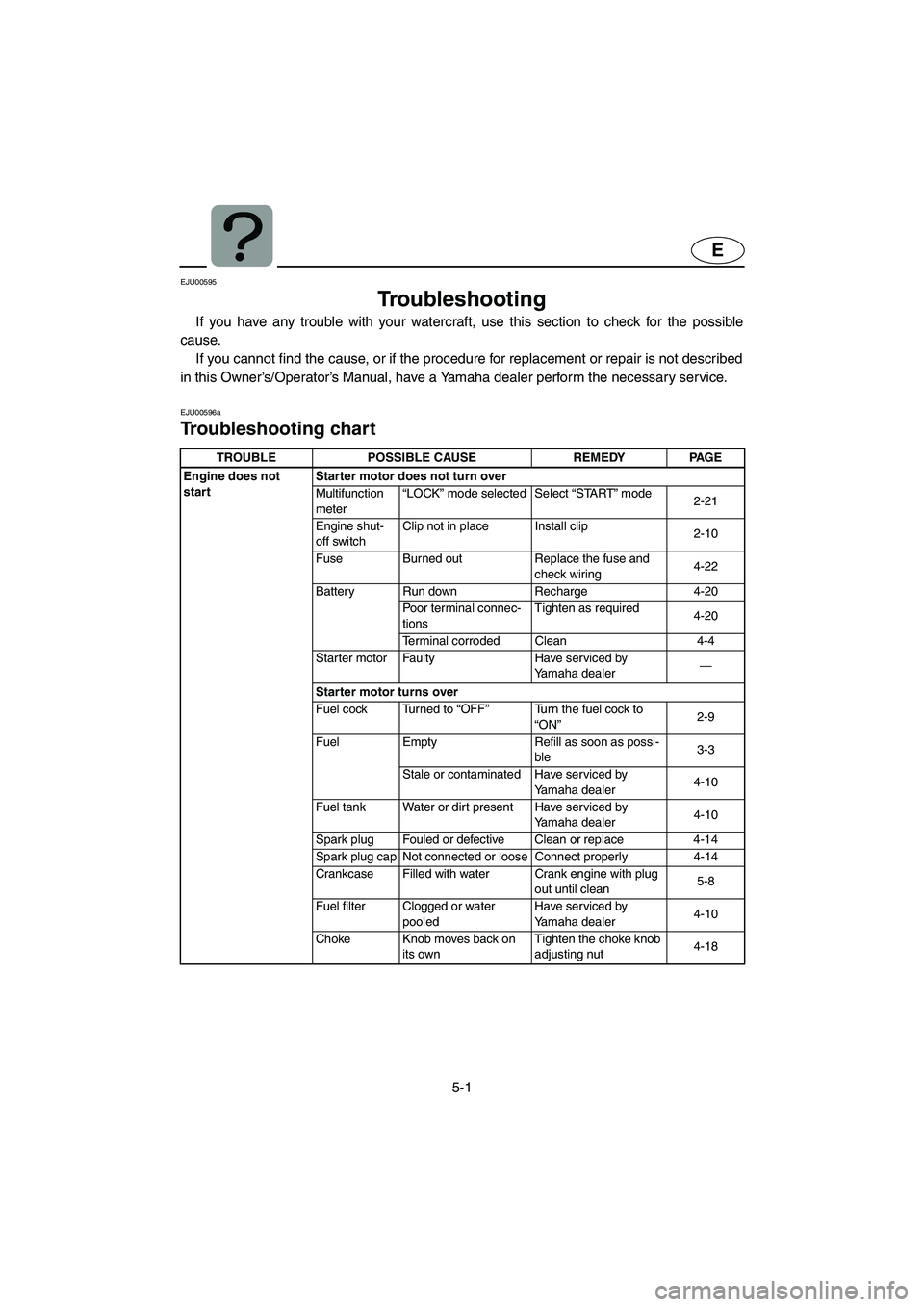
Troubleshooting
If you have any trouble with your watercraft, use this section to check for the possible
cause.
If you cannot find the cause, or if the procedure for replacement or repair is not described
in this Owner’s/Operator’s Manual, have a Yamaha dealer perform the necessary service.
EJU00596a
Troubleshooting chart
TROUBLE POSSIBLE CAUSE REMEDY PAGE
Engine does not
startStarter motor does not turn over
Multifunction
meter“LOCK” mode selected Select “START” mode
2-21
Engine shut-
off switchClip not in place Install clip
2-10
Fuse Burned out Replace the fuse and
check wiring4-22
Battery Run down Recharge 4-20
Poor terminal connec-
tionsTighten as required
4-20
Terminal corroded Clean 4-4
Starter motor Faulty Have serviced by
Yamaha dealer—
Starter motor turns over
Fuel cock Turned to “OFF” Turn the fuel cock to
“ON”2-9
Fuel Empty Refill as soon as possi-
ble3-3
Stale or contaminated Have serviced by
Yamaha dealer4-10
Fuel tank Water or dirt present Have serviced by
Yamaha dealer4-10
Spark plug Fouled or defective Clean or replace 4-14
Spark plug cap Not connected or loose Connect properly 4-14
Crankcase Filled with water Crank engine with plug
out until clean5-8
Fuel filter Clogged or water
pooledHave serviced by
Yamaha dealer4-10
Choke Knob moves back on
its ownTighten the choke knob
adjusting nut4-18
E_F0P71-5.fm Page 1 Tuesday, July 18, 2000 7:19 PM
Page 119 of 131
5-2
E
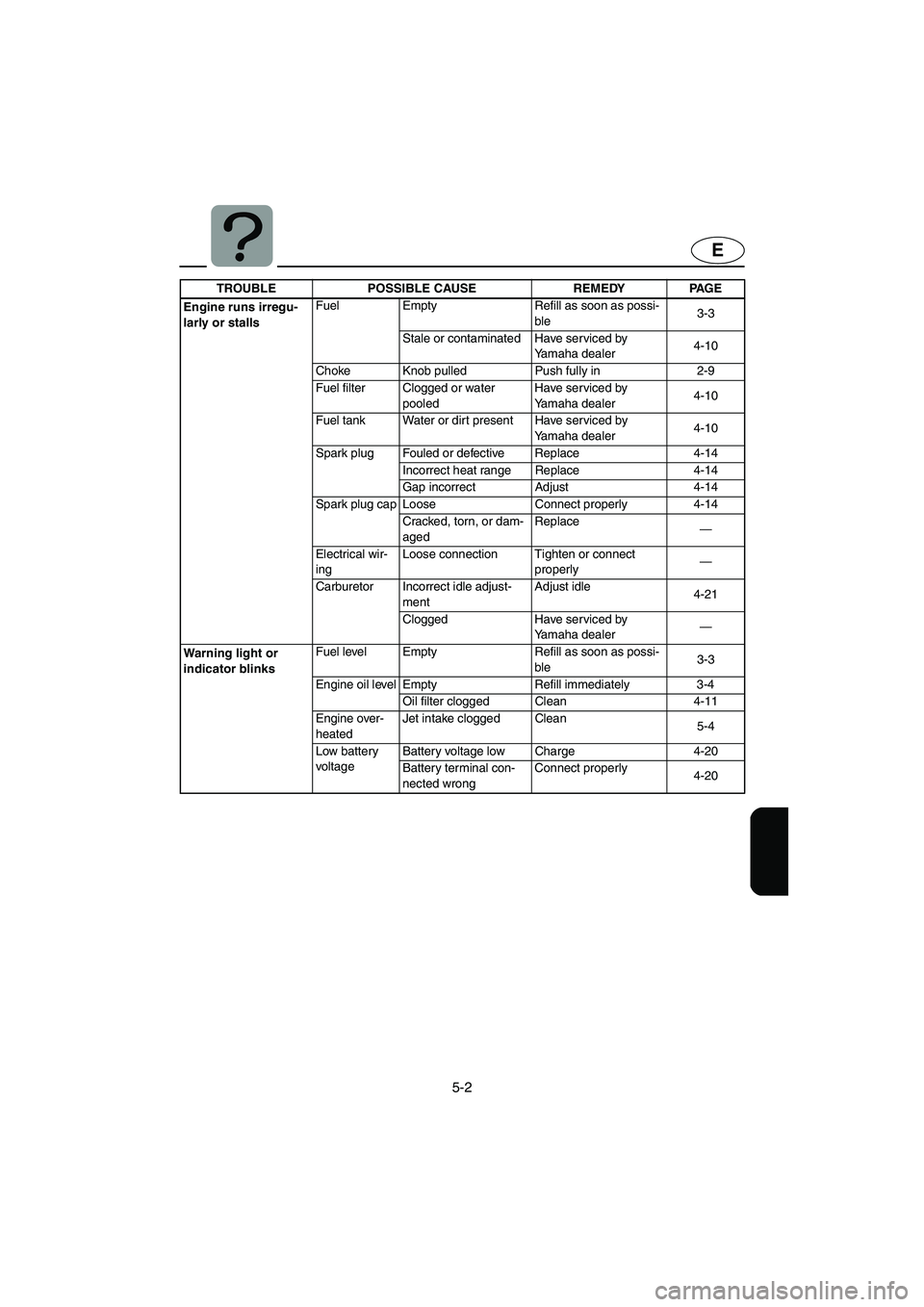
Engine runs irregu-
larly or stallsFuel Empty Refill as soon as possi-
ble3-3
Stale or contaminated Have serviced by
Yamaha dealer4-10
Choke Knob pulled Push fully in 2-9
Fuel filter Clogged or water
pooledHave serviced by
Yamaha dealer4-10
Fuel tank Water or dirt present Have serviced by
Yamaha dealer4-10
Spark plug Fouled or defective Replace 4-14
Incorrect heat range Replace 4-14
Gap incorrect Adjust 4-14
Spark plug cap Loose Connect properly 4-14
Cracked, torn, or dam-
agedReplace
—
Electrical wir-
ingLoose connection Tighten or connect
properly—
Carburetor Incorrect idle adjust-
mentAdjust idle
4-21
Clogged Have serviced by
Yamaha dealer—
Warning light or
indicator blinksFuel level Empty Refill as soon as possi-
ble3-3
Engine oil level Empty Refill immediately 3-4
Oil filter clogged Clean 4-11
Engine over-
heatedJet intake clogged Clean
5-4
Low battery
voltageBattery voltage low Charge 4-20
Battery terminal con-
nected wrongConnect properly
4-20 TROUBLE POSSIBLE CAUSE REMEDY PAGE
E_F0P71-5.fm Page 2 Tuesday, July 18, 2000 7:19 PM
Page 122 of 131
5-5
E
2. Remove any weeds or debris from
around the drive shaft, impeller, pump
housing, and jet thrust nozzle.
If debris is difficult to remove, consult
your Yamaha dealer.
CAUTION:
Always avoid operating your watercraft in
areas where weed growth is thick. If trav-
eling in weeded areas is unavoidable,
operate the engine alternately at partial
throttle and full throttle. Weeds tend to
accumulate more at a steady speed and
at trolling speed. If weeds clog the intake
or impeller area and cause cavitation, fol-
low the cleaning procedure above.
EJU00599
Jumping the battery
If the watercraft battery has run down, the
engine can be started using a 12-volt bat-
tery and jumper cables.
WARNING
Battery electrolyte is poisonous and dan-
gerous, causing severe burns, etc. Elec-
trolyte contains sulfuric acid. Avoid
contact with skin, eyes or clothing.
Antidotes
External: Flush with water.
Internal: Drink large quantities of water
or milk. Follow with milk of magnesia,
beaten egg or vegetable oil. Call physi-
cian immediately.
Eyes: Flush with water for 15 minutes
and get prompt medical attention.
Batteries give off explosive gases. Keep
sparks, flame, cigarettes, etc. well away.
If using or charging the battery in an
enclosed area, make sure that it is well
ventilated. Always shield your eyes when
working near batteries.
KEEP OUT OF THE REACH OF CHILDREN.
E_F0P71-5.fm Page 5 Tuesday, July 18, 2000 7:19 PM
Page 123 of 131
5-6
E
EJU00600
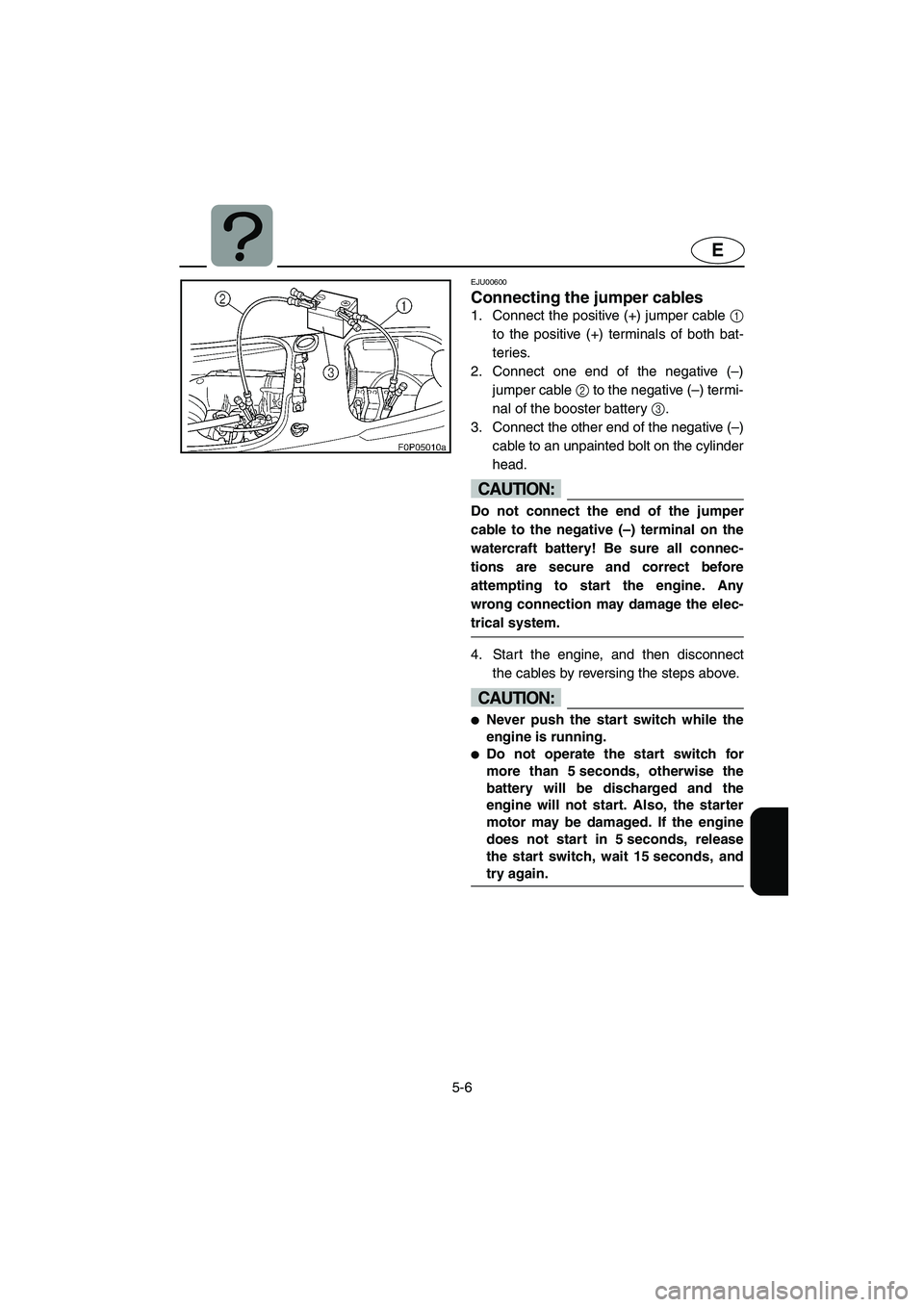
Connecting the jumper cables
1. Connect the positive (+) jumper cable 1
to the positive (+) terminals of both bat-
teries.
2. Connect one end of the negative (–)
jumper cable 2 to the negative (–) termi-
nal of the booster battery 3.
3. Connect the other end of the negative (–)
cable to an unpainted bolt on the cylinder
head.
CAUTION:
Do not connect the end of the jumper
cable to the negative (–) terminal on the
watercraft battery! Be sure all connec-
tions are secure and correct before
attempting to start the engine. Any
wrong connection may damage the elec-
trical system.
4. Start the engine, and then disconnect
the cables by reversing the steps above.
CAUTION:
●Never push the start switch while the
engine is running.
●Do not operate the start switch for
more than 5 seconds, otherwise the
battery will be discharged and the
engine will not start. Also, the starter
motor may be damaged. If the engine
does not start in 5 seconds, release
the start switch, wait 15 seconds, and
try again.
E_F0P71-5.fm Page 6 Tuesday, July 18, 2000 7:19 PM