fuel YAMAHA XL 800 2001 Owners Manual
[x] Cancel search | Manufacturer: YAMAHA, Model Year: 2001, Model line: XL 800, Model: YAMAHA XL 800 2001Pages: 131, PDF Size: 16.51 MB
Page 20 of 131
1-13
E
●Do not attempt to modify this watercraft!
Modifications to your watercraft may
reduce safety and reliability, and render
the watercraft unsafe or illegal for use.
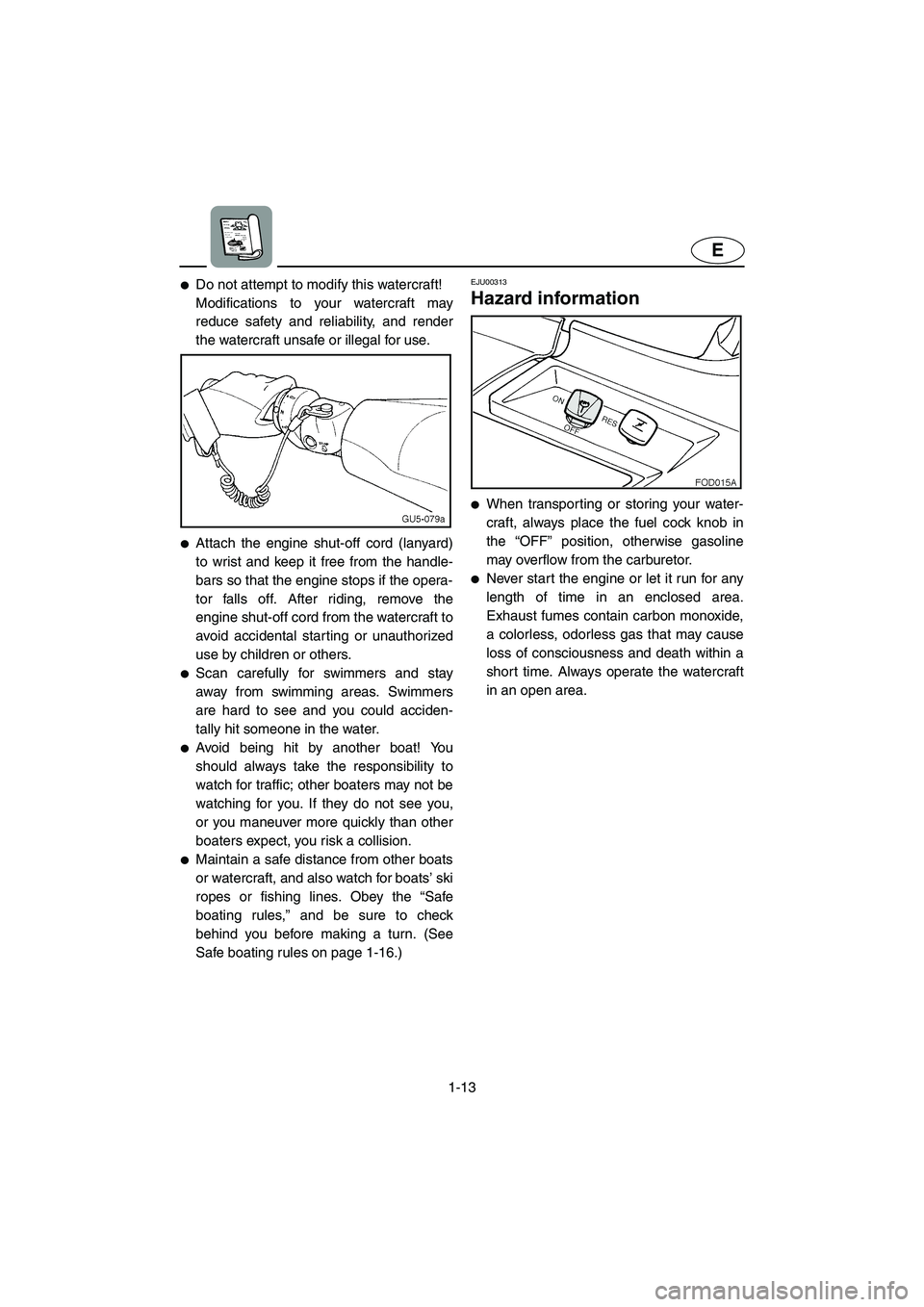
●Attach the engine shut-off cord (lanyard)
to wrist and keep it free from the handle-
bars so that the engine stops if the opera-
tor falls off. After riding, remove the
engine shut-off cord from the watercraft to
avoid accidental starting or unauthorized
use by children or others.
●Scan carefully for swimmers and stay
away from swimming areas. Swimmers
are hard to see and you could acciden-
tally hit someone in the water.
●Avoid being hit by another boat! You
should always take the responsibility to
watch for traffic; other boaters may not be
watching for you. If they do not see you,
or you maneuver more quickly than other
boaters expect, you risk a collision.
●Maintain a safe distance from other boats
or watercraft, and also watch for boats’ ski
ropes or fishing lines. Obey the “Safe
boating rules,” and be sure to check
behind you before making a turn. (See
Safe boating rules on page 1-16.)
EJU00313
Hazard information
●When transporting or storing your water-
craft, always place the fuel cock knob in
the “OFF” position, otherwise gasoline
may overflow from the carburetor.
●Never start the engine or let it run for any
length of time in an enclosed area.
Exhaust fumes contain carbon monoxide,
a colorless, odorless gas that may cause
loss of consciousness and death within a
short time. Always operate the watercraft
in an open area.
E_F0P71-1.fm Page 13 Tuesday, July 18, 2000 7:10 PM
Page 24 of 131
1-17
E
EJU00322
Enjoy your watercraft
responsibly
You share the areas you enjoy when
riding your watercraft with others and with
nature. So your enjoyment includes a
responsibility to treat these other people,
and the lands, waters, and wildlife with
respect and courtesy.
Whenever and wherever you ride, think of
yourself as the guest of those around you.
Remember, for example, that the sound of
your watercraft may be music to you, but it
could be just noise to others. And the excit-
ing splash of your wake can make waves
others won’t enjoy. Avoid riding close to
shoreline homes and waterfowl nesting
areas or other wildlife areas, and keep a
respectful distance from fishermen, other
boats, swimmers, and populated beaches.
When travel in areas like these is unavoid-
able, ride slowly and obey all laws.
Remember that pollution can be harmful
to the environment. Do not refuel or add oil
where a spill could cause damage to nature.
Remove your watercraft from the water and
move it away from the shoreline before refu-
eling. And keep your surroundings pleasant
for the people and wildlife that share the
waterways: don’t litter!
When you ride responsibly, with respect
and courtesy for others, you help ensure
that our waterways stay open for the enjoy-
ment of a variety of recreational opportuni-
ties.
E_F0P71-1.fm Page 17 Tuesday, July 18, 2000 7:10 PM
Page 25 of 131
E
2
EJU00326
FEATURES AND
FUNCTIONS
Location of main components............... 2-1
Operation of controls and other
functions.................................................... 2-5
Rear seat................................................. 2-5
Front seat ................................................ 2-6
Hood ........................................................ 2-7
Fuel tank filler cap ................................... 2-8
Oil tank filler cap...................................... 2-8
Fuel cock knob........................................ 2-9
Engine stop switch ................................ 2-10
Engine shut-off switch........................... 2-10
Choke knob ........................................... 2-10
Throttle lever ......................................... 2-11
Start switch............................................ 2-11
Cooling water pilot outlet ...................... 2-12
Steering system .................................... 2-12
Tilt lever ................................................. 2-13
Shift lever .............................................. 2-14
Quick Shift Trim System (QSTS)
selector .................................................. 2-15
Engine overheat warning system ......... 2-17
Handgrip................................................ 2-18
Multifunction meter................................ 2-19
PADLOC (Programmable digital locking
ignition) .................................................. 2-20
Tachometer ........................................... 2-22
Speedometer ........................................ 2-23
Fuel meter ............................................. 2-23
Engine oil meter .................................... 2-24
Clock ..................................................... 2-24
Hour meter ............................................ 2-25
Trip timer ............................................... 2-25
Tripmeter ............................................... 2-26
Fuel warning indicator........................... 2-26
Oil warning indicator ............................. 2-27
Engine overheat warning indicator....... 2-27
Battery warning indicator ...................... 2-28
Storage compartments ......................... 2-29
E_F0P71-2TOC.fm Page 1 Tuesday, July 18, 2000 7:12 PM
Page 26 of 131
2-1
E
EJU00327
Location of main components
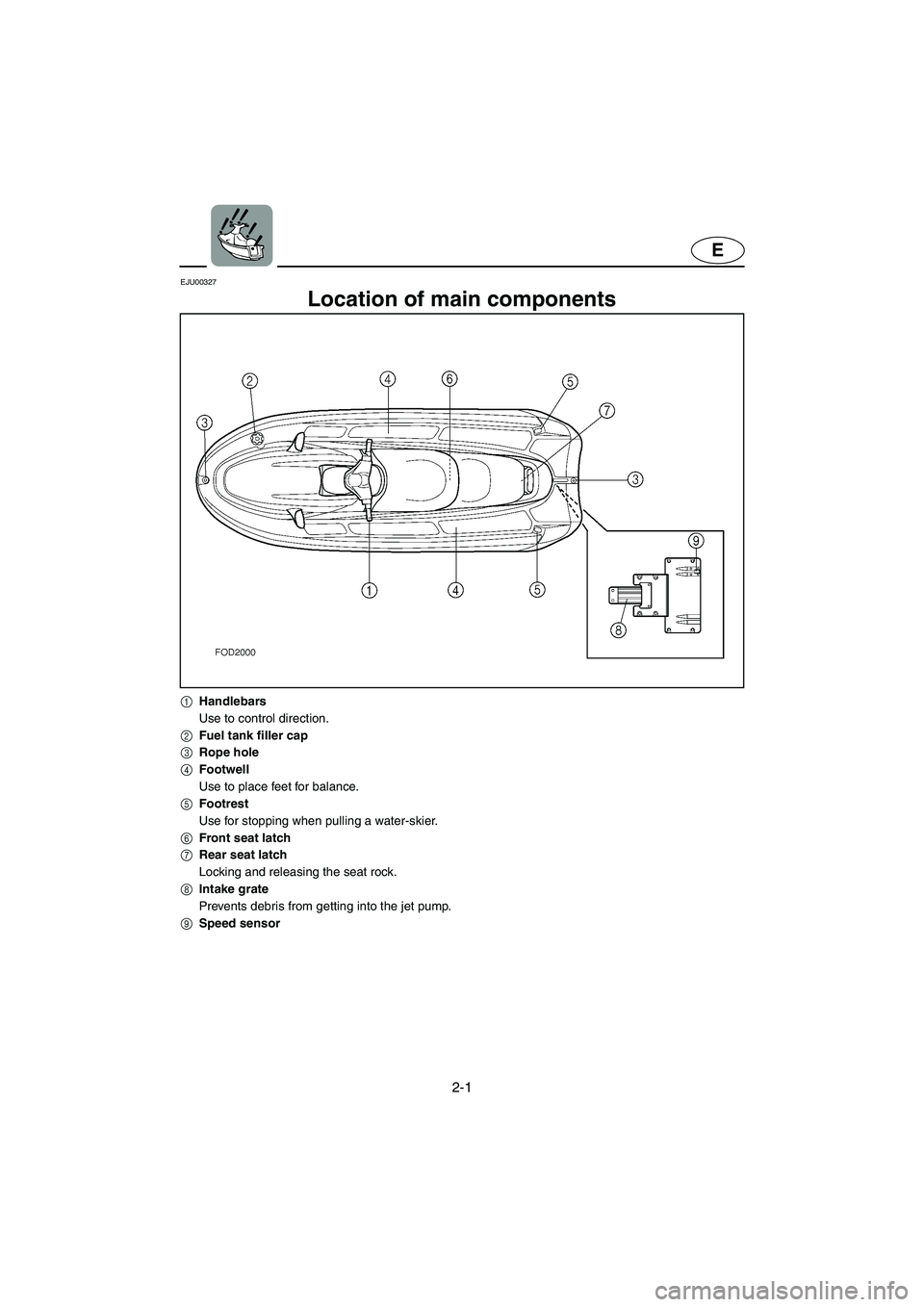
1Handlebars
Use to control direction.
2Fuel tank filler cap
3Rope hole
4Footwell
Use to place feet for balance.
5Footrest
Use for stopping when pulling a water-skier.
6Front seat latch
7Rear seat latch
Locking and releasing the seat rock.
8Intake grate
Prevents debris from getting into the jet pump.
9Speed sensor
E_F0P71-2.fm Page 1 Tuesday, July 18, 2000 8:20 PM
Page 27 of 131
2-2
E
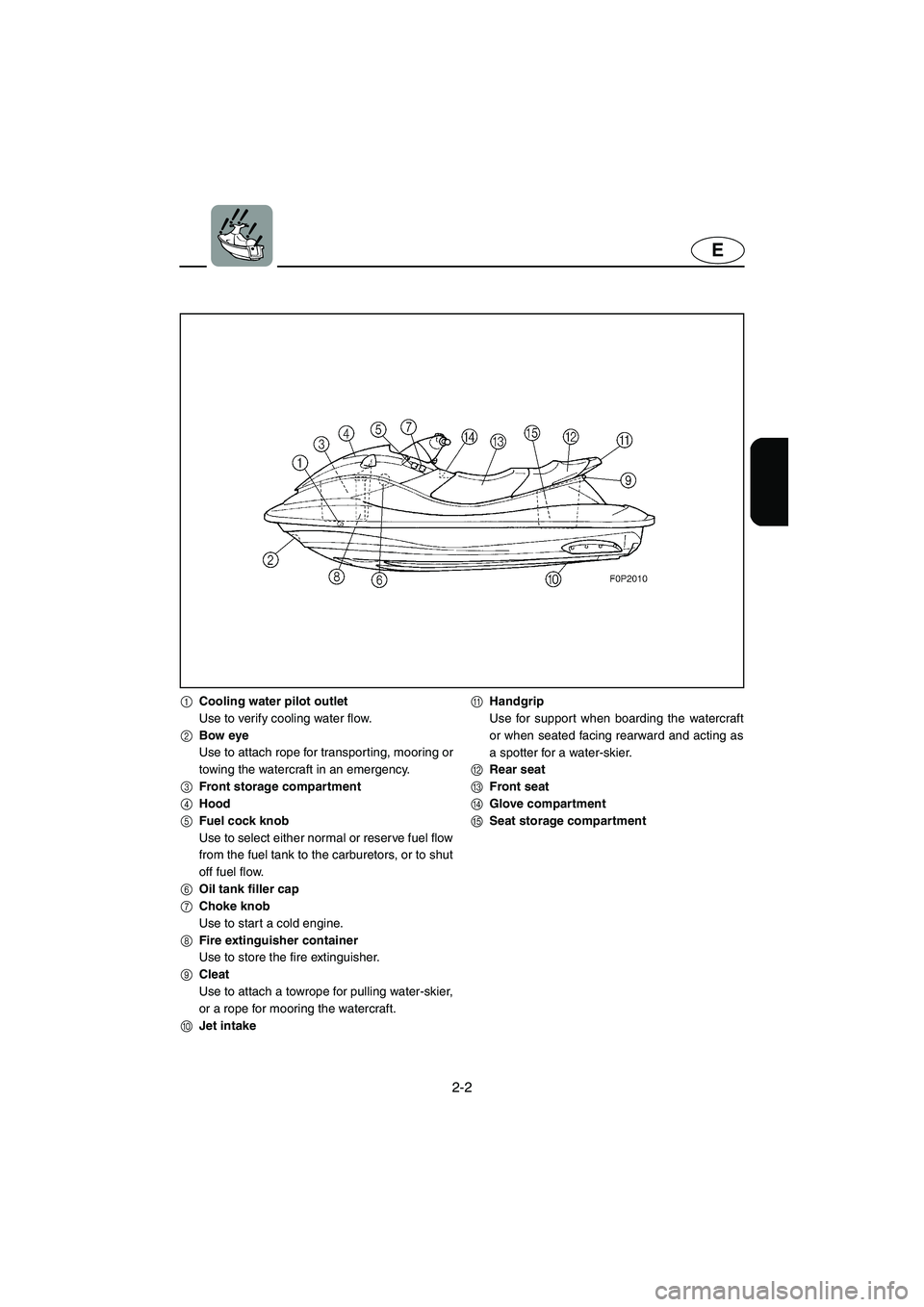
1Cooling water pilot outlet
Use to verify cooling water flow.
2Bow eye
Use to attach rope for transporting, mooring or
towing the watercraft in an emergency.
3Front storage compartment
4Hood
5Fuel cock knob
Use to select either normal or reserve fuel flow
from the fuel tank to the carburetors, or to shut
off fuel flow.
6Oil tank filler cap
7Choke knob
Use to start a cold engine.
8Fire extinguisher container
Use to store the fire extinguisher.
9Cleat
Use to attach a towrope for pulling water-skier,
or a rope for mooring the watercraft.
0Jet intakeAHandgrip
Use for support when boarding the watercraft
or when seated facing rearward and acting as
a spotter for a water-skier.
BRear seat
CFront seat
DGlove compartment
ESeat storage compartment
E_F0P71-2.fm Page 2 Tuesday, July 18, 2000 8:20 PM
Page 29 of 131
2-4
E
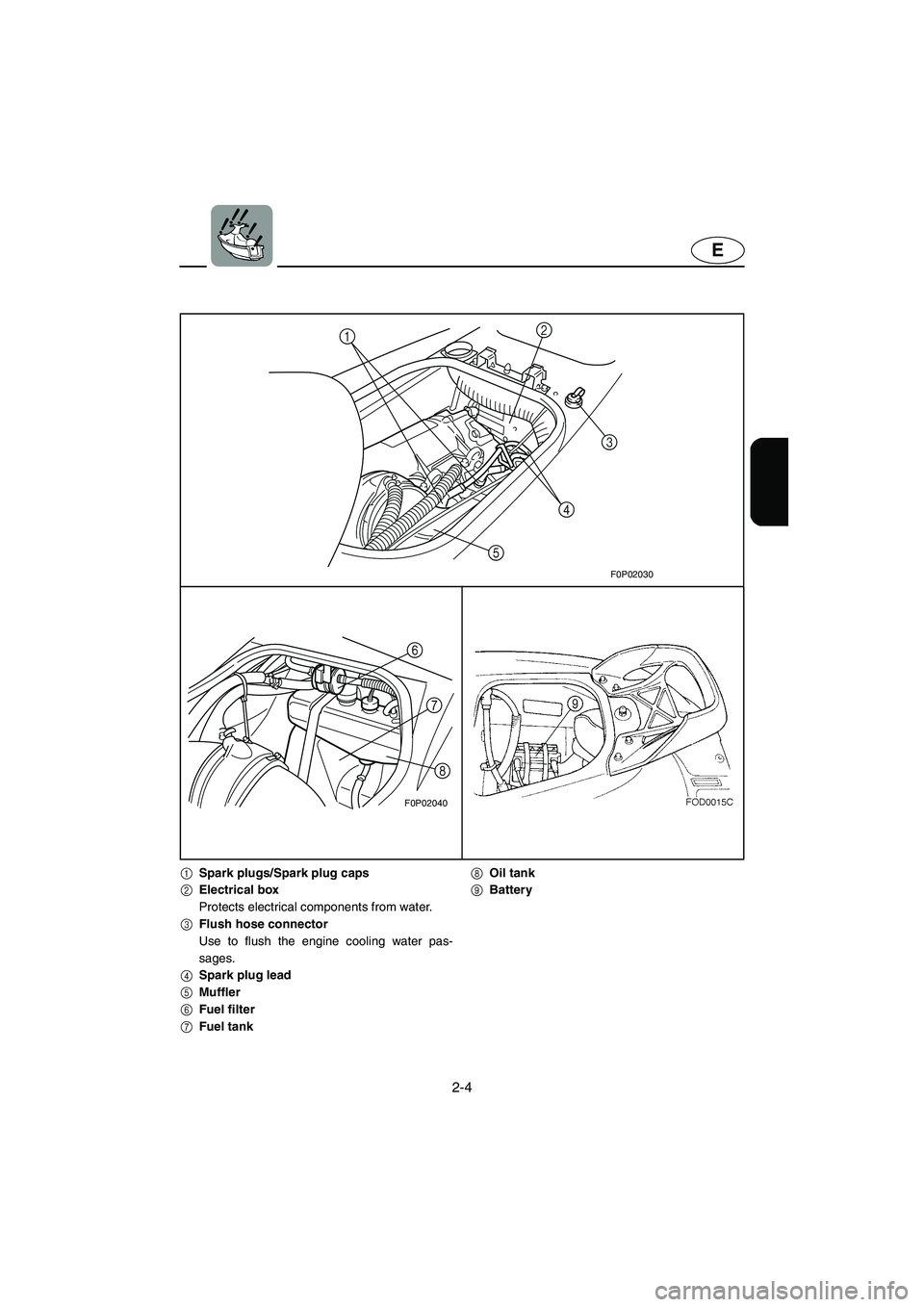
1Spark plugs/Spark plug caps
2Electrical box
Protects electrical components from water.
3Flush hose connector
Use to flush the engine cooling water pas-
sages.
4Spark plug lead
5Muffler
6Fuel filter
7Fuel tank8Oil tank
9Battery
543 1
2
F0P02030
6
8 7
F0P02040
E_F0P71-2.fm Page 4 Tuesday, July 18, 2000 8:20 PM
Page 33 of 131
2-8
E
EJU00347
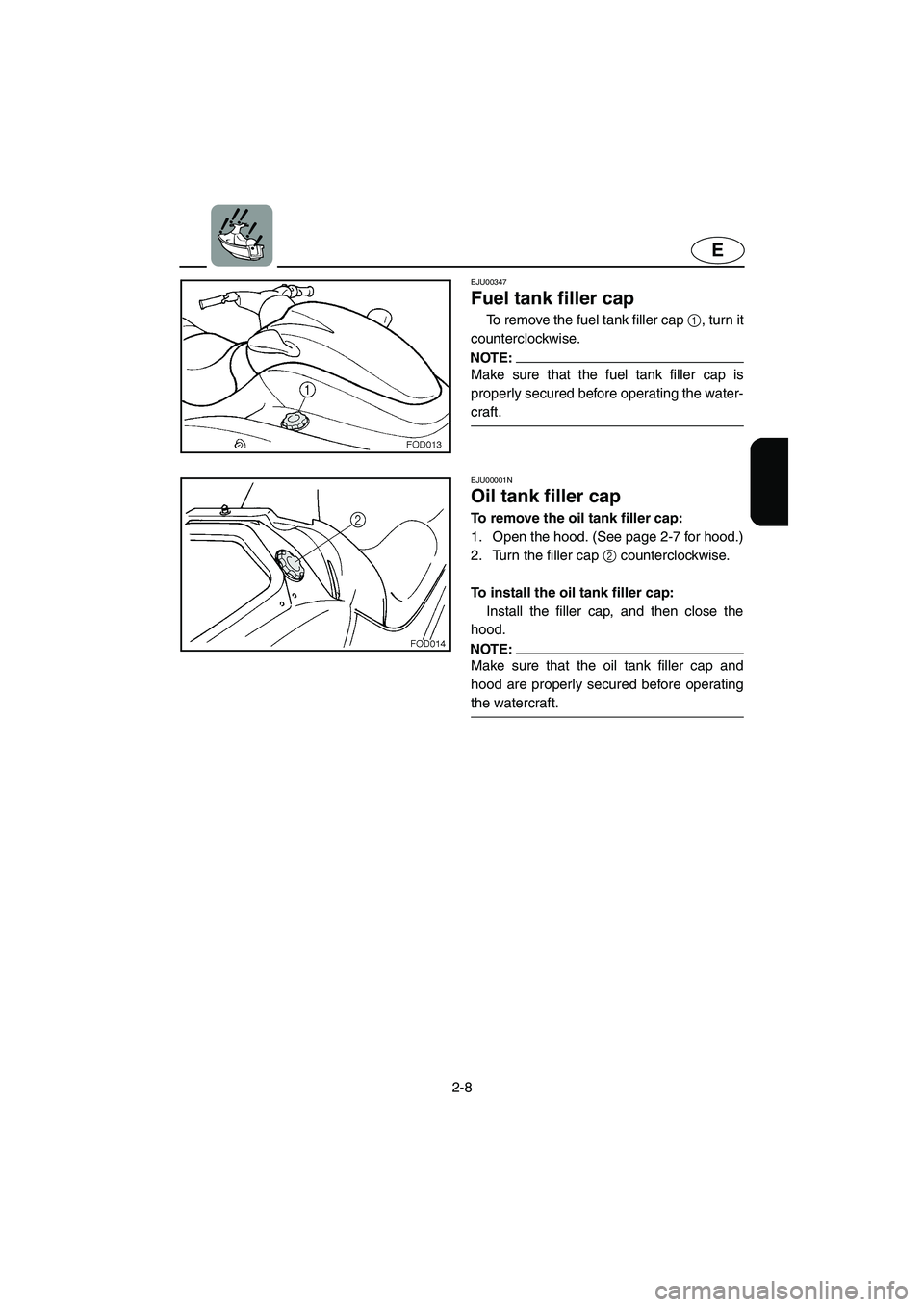
Fuel tank filler cap
To remove the fuel tank filler cap 1, turn it
counterclockwise.
NOTE:
Make sure that the fuel tank filler cap is
properly secured before operating the water-
craft.
EJU00001N
Oil tank filler cap
To remove the oil tank filler cap:
1. Open the hood. (See page 2-7 for hood.)
2. Turn the filler cap 2 counterclockwise.
To install the oil tank filler cap:
Install the filler cap, and then close the
hood.
NOTE:
Make sure that the oil tank filler cap and
hood are properly secured before operating
the watercraft.
E_F0P71-2.fm Page 8 Tuesday, July 18, 2000 8:20 PM
Page 34 of 131
2-9
E
EJU00704
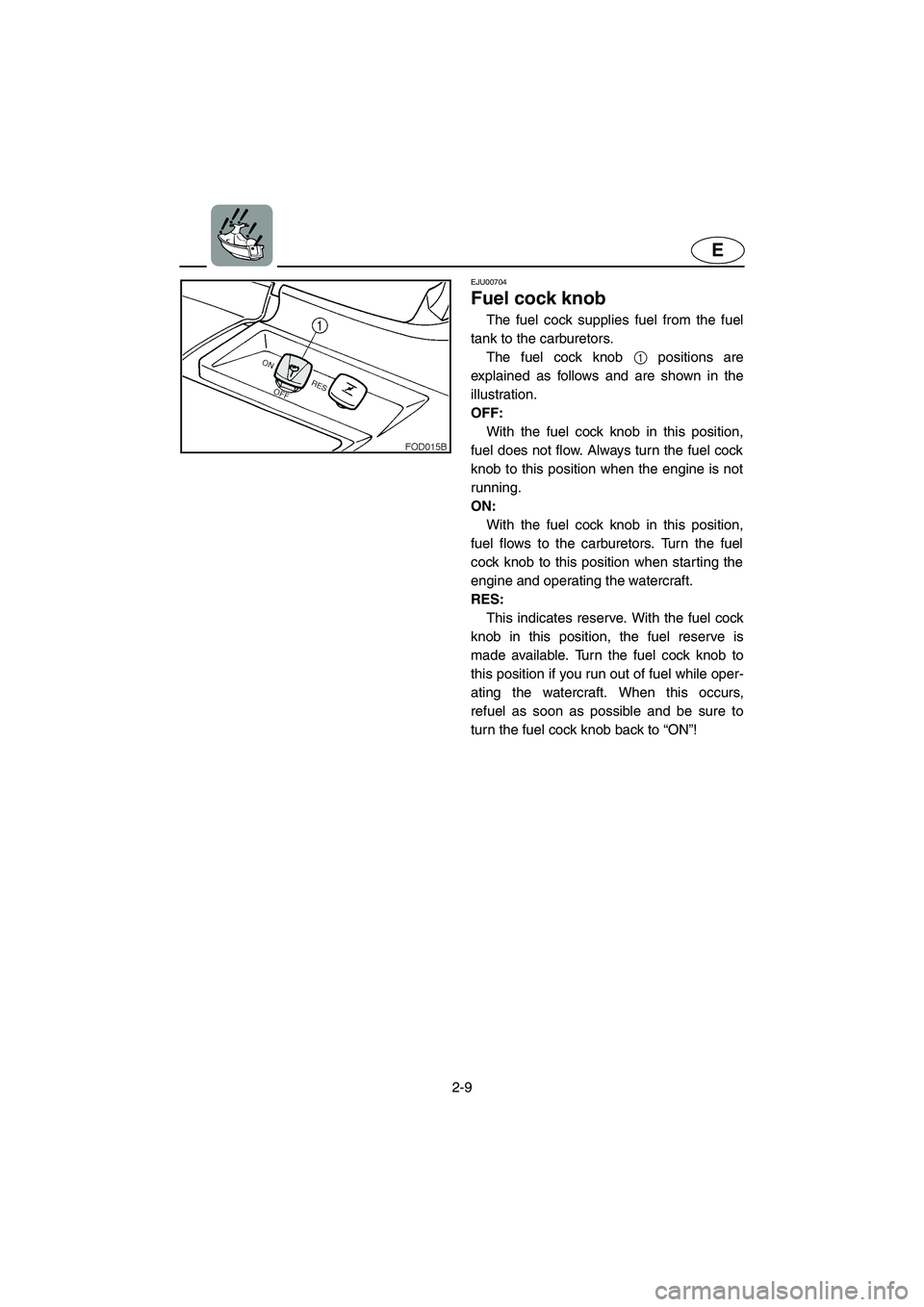
Fuel cock knob
The fuel cock supplies fuel from the fuel
tank to the carburetors.
The fuel cock knob 1 positions are
explained as follows and are shown in the
illustration.
OFF:
With the fuel cock knob in this position,
fuel does not flow. Always turn the fuel cock
knob to this position when the engine is not
running.
ON:
With the fuel cock knob in this position,
fuel flows to the carburetors. Turn the fuel
cock knob to this position when starting the
engine and operating the watercraft.
RES:
This indicates reserve. With the fuel cock
knob in this position, the fuel reserve is
made available. Tur n the fuel cock knob to
this position if you run out of fuel while oper-
ating the watercraft. When this occurs,
refuel as soon as possible and be sure to
turn the fuel cock knob back to “ON”!
E_F0P71-2.fm Page 9 Tuesday, July 18, 2000 8:20 PM
Page 35 of 131
2-10
E
EJU00705
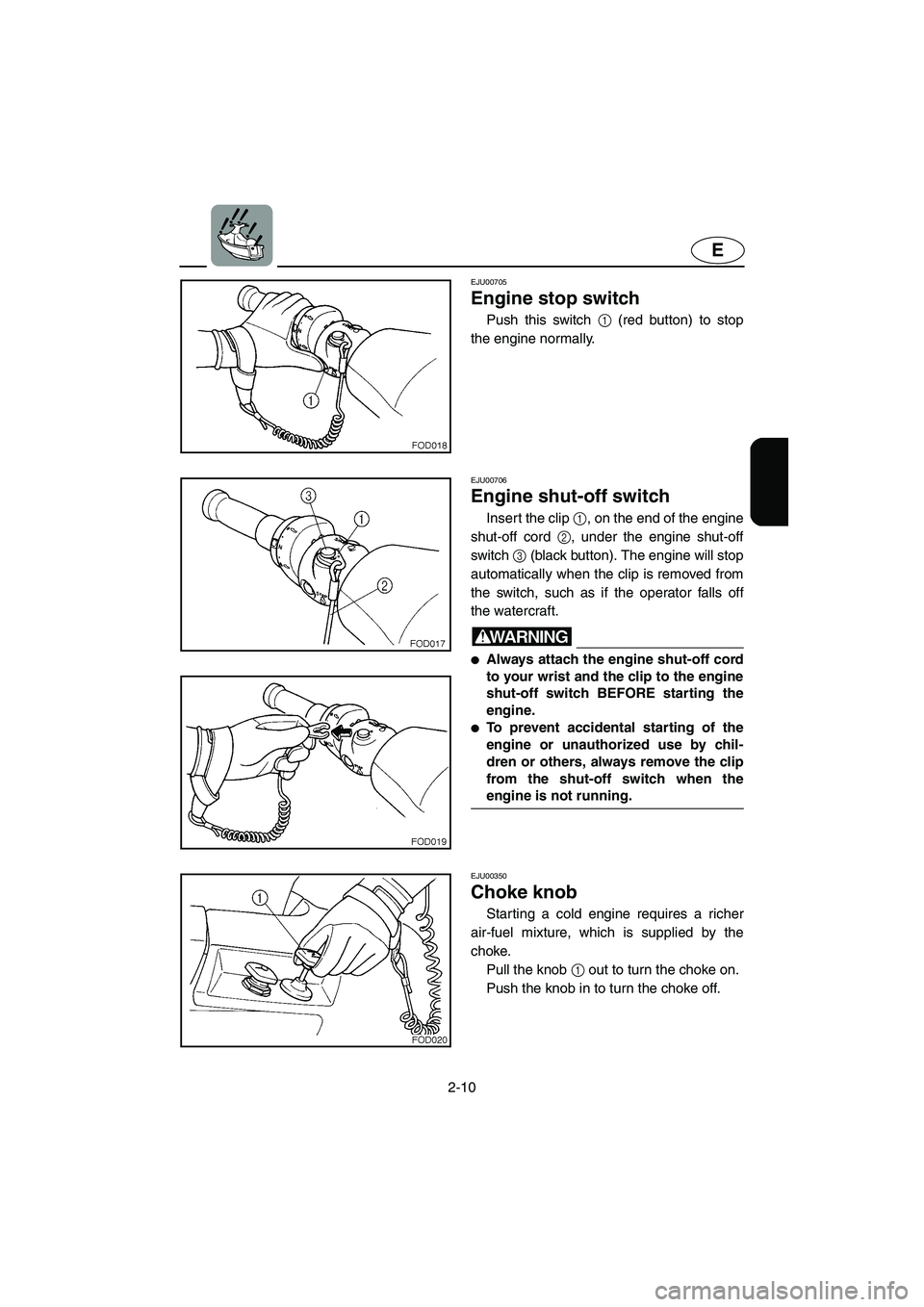
Engine stop switch
Push this switch 1 (red button) to stop
the engine normally.
EJU00706
Engine shut-off switch
Insert the clip 1, on the end of the engine
shut-off cord 2, under the engine shut-off
switch 3 (black button). The engine will stop
automatically when the clip is removed from
the switch, such as if the operator falls off
the watercraft.
WARNING
●Always attach the engine shut-off cord
to your wrist and the clip to the engine
shut-off switch BEFORE starting the
engine.
●To prevent accidental starting of the
engine or unauthorized use by chil-
dren or others, always remove the clip
from the shut-off switch when the
engine is not running.
EJU00350
Choke knob
Starting a cold engine requires a richer
air-fuel mixture, which is supplied by the
choke.
Pull the knob 1 out to turn the choke on.
Push the knob in to turn the choke off.
E_F0P71-2.fm Page 10 Tuesday, July 18, 2000 8:20 PM
Page 41 of 131
2-16
E
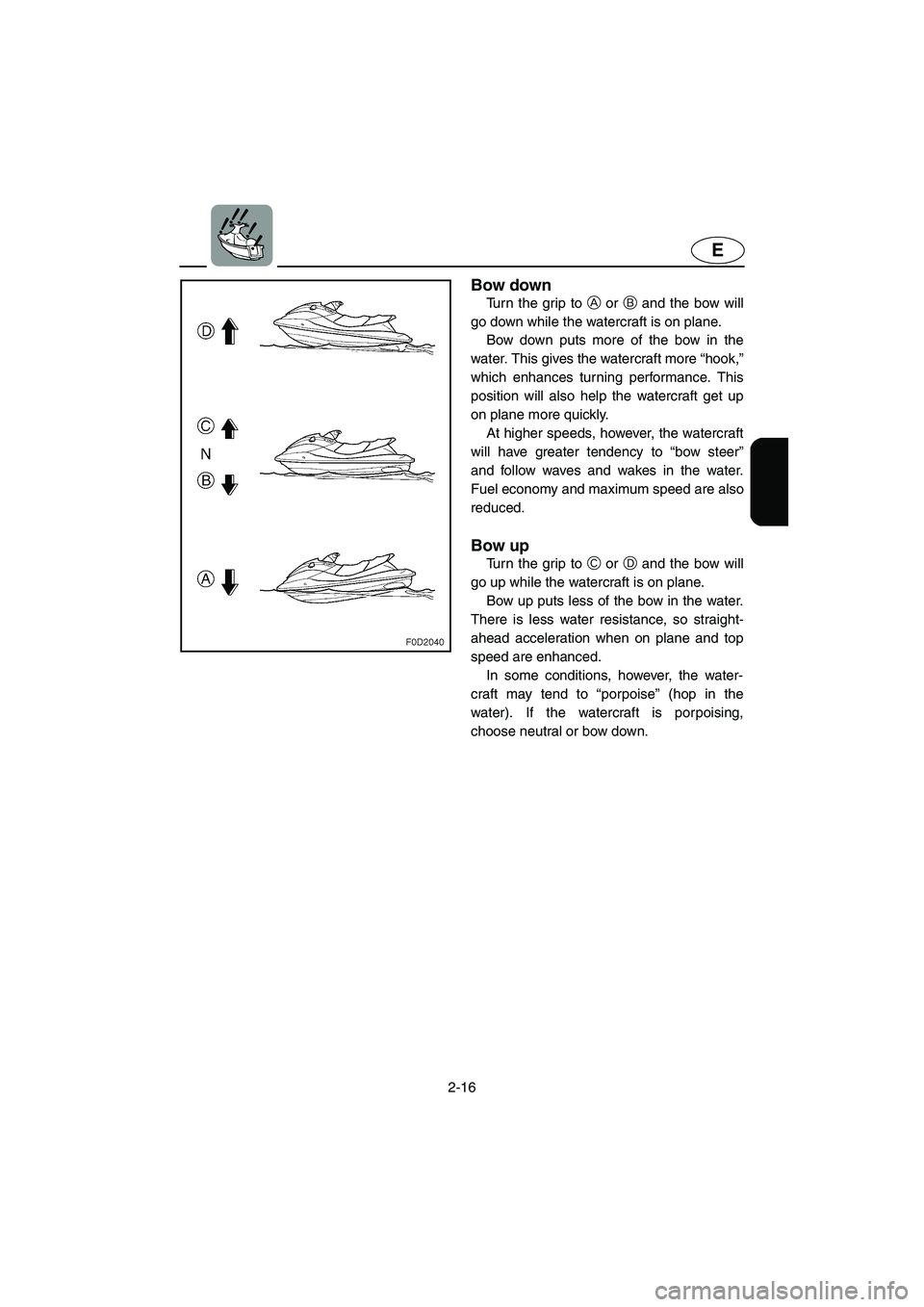
Bow down
Turn the grip to A or B and the bow will
go down while the watercraft is on plane.
Bow down puts more of the bow in the
water. This gives the watercraft more “hook,”
which enhances turning performance. This
position will also help the watercraft get up
on plane more quickly.
At higher speeds, however, the watercraft
will have greater tendency to “bow steer”
and follow waves and wakes in the water.
Fuel economy and maximum speed are also
reduced.
Bow up
Turn the grip to C or D and the bow will
go up while the watercraft is on plane.
Bow up puts less of the bow in the water.
There is less water resistance, so straight-
ahead acceleration when on plane and top
speed are enhanced.
In some conditions, however, the water-
craft may tend to “porpoise” (hop in the
water). If the watercraft is porpoising,
choose neutral or bow down.
E_F0P71-2.fm Page 16 Tuesday, July 18, 2000 8:20 PM