fuel consumption YAMAHA XMAX 125 2014 Owners Manual
[x] Cancel search | Manufacturer: YAMAHA, Model Year: 2014, Model line: XMAX 125, Model: YAMAHA XMAX 125 2014Pages: 94, PDF Size: 8.21 MB
Page 6 of 94

TABLE OF CONTENTSSAFETY INFORMATION.................. 1-1
Further safe-riding points ............... 1-5
DESCRIPTION.................................. 2-1
Left view ......................................... 2-1
Right view ....................................... 2-2
Controls and instruments ............... 2-3
INSTRUMENT AND CONTROL
FUNCTIONS...................................... 3-1
Immobilizer system......................... 3-1
Main switch/steering lock............... 3-2
Indicator lights and warning
lights............................................ 3-3
Multi-function meter unit ................ 3-5
Anti-theft alarm (optional) ............. 3-13
Handlebar switches ...................... 3-14
Front brake lever .......................... 3-15
Rear brake lever ........................... 3-15
ABS (for ABS models) .................. 3-16
Fuel tank cap ................................ 3-17
Fuel ............................................... 3-17
Catalytic converters...................... 3-19
Seat .............................................. 3-19
Storage compartments................. 3-20
Adjusting the shock absorber
assemblies ................................ 3-21
Sidestand ..................................... 3-22
Ignition circuit cut-off system ....... 3-23FOR YOUR SAFETY –
PRE-OPERATION CHECKS............. 4-1
OPERATION AND IMPORTANT
RIDING POINTS................................ 5-1
Starting the engine .......................... 5-1
Starting off ...................................... 5-2
Acceleration and deceleration ........ 5-3
Braking ............................................ 5-3
Tips for reducing fuel
consumption ................................ 5-4
Engine break-in ............................... 5-4
Parking ............................................ 5-5
PERIODIC MAINTENANCE AND
ADJUSTMENT................................... 6-1
Owner’s tool kit ............................... 6-2
Periodic maintenance chart for the
emission control system .............. 6-3
General maintenance and
lubrication chart ........................... 6-4
Removing and installing panels ...... 6-8
Checking the spark plug ............... 6-10
Engine oil....................................... 6-12
Final transmission oil..................... 6-14
Coolant.......................................... 6-15
Air filter and V-belt case air filter
elements and check hoses ........ 6-16
Checking the throttle grip free
play ............................................ 6-18
Valve clearance ............................. 6-18Tires .............................................. 6-18
Cast wheels .................................. 6-20
Checking the front and rear brake
lever free play ............................ 6-21
Checking the front and rear brake
pads .......................................... 6-21
Checking the brake fluid level ...... 6-22
Changing the brake fluid .............. 6-24
Checking and lubricating the
cables ........................................ 6-24
Checking and lubricating the
throttle grip and cable ............... 6-24
Lubricating the front and rear
brake levers ............................... 6-25
Checking and lubricating the
centerstand and sidestand........ 6-25
Checking the front fork ................. 6-26
Checking the steering................... 6-27
Checking the wheel bearings ....... 6-27
Battery .......................................... 6-27
Replacing the fuses ...................... 6-29
Replacing a headlight bulb ........... 6-30
Tail/brake light .............................. 6-31
Front turn signal light .................... 6-31
Replacing a rear turn signal light
bulb ........................................... 6-31
Replacing the license plate light
bulb ........................................... 6-32
Auxiliary light ................................ 6-33
Troubleshooting............................ 6-33
Troubleshooting charts................. 6-34U2DME1E0.book Page 1 Wednesday, October 23, 2013 1:37 PM
Page 22 of 94
INSTRUMENT AND CONTROL FUNCTIONS
3-6
3The multi-function meter unit is
equipped with the following:
a speedometer
a tachometer
a fuel meter
a clock
an odometer and tripmeter display
a multi-function display
a coolant temperature meter
TIPBe sure to turn the key to “ON” be-
fore using the “Select”, “Reset”,
“TRIP” and “INFO” buttons.
When the key is turned to “ON”, all
display segments of the multi-
function meter unit will momen-
tarily appear in order to test the
electrical circuit. The speedome-
ter and odometer will then perform
a display check and a welcome
message will scroll across the
multi-function display.
For the UK, traveling speed, dis-
tance traveled, and fuel consump-
tion measurements can be
displayed in kilometer or mileage
based units. To switch between
miles and kilometers; hold the“SELECT” switch pushed, turn the
main switch to “ON”, and keep the
“SELECT” switch pushed for an
additional 8 seconds.
For other countries, traveling
speed, distance traveled and fuel
consumption measurements are
displayed in kilometer base units.
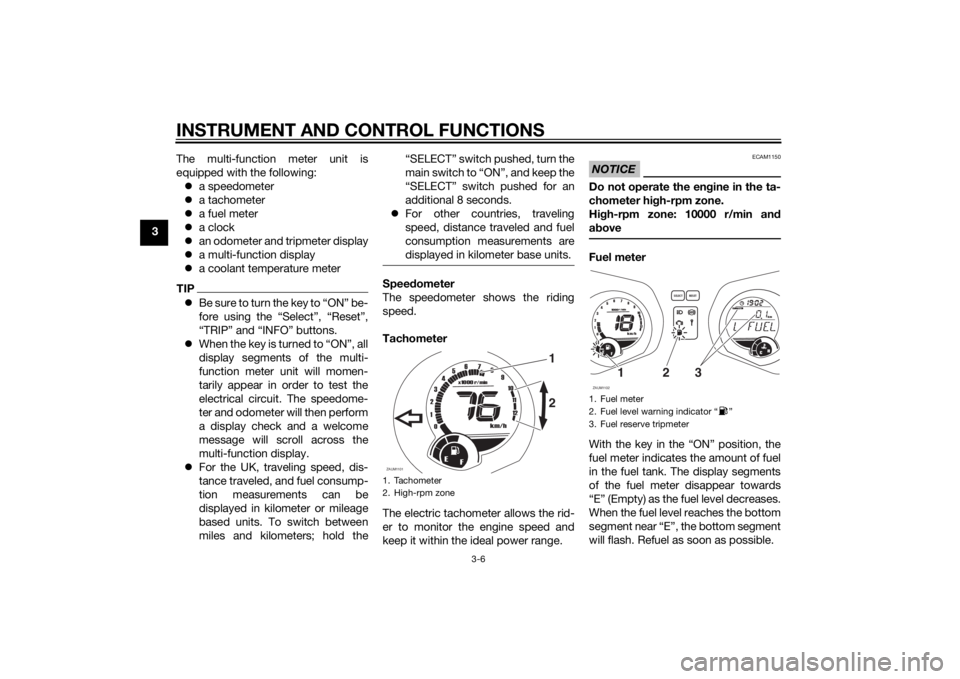
Speedometer
The speedometer shows the riding
speed.
Tachometer
The electric tachometer allows the rid-
er to monitor the engine speed and
keep it within the ideal power range.
NOTICE
ECAM1150
Do not operate the engine in the ta-
chometer high-rpm zone.
High-rpm zone: 10000 r/min and
aboveFuel meter
With the key in the “ON” position, the
fuel meter indicates the amount of fuel
in the fuel tank. The display segments
of the fuel meter disappear towards
“E” (Empty) as the fuel level decreases.
When the fuel level reaches the bottom
segment near “E”, the bottom segment
will flash. Refuel as soon as possible.
1. Tachometer
2. High-rpm zoneZAUM1101
1
98
7
6
54321
11 10
12
0
1000
r/min
x
km/h
E
F
2
1. Fuel meter
2. Fuel level warning indicator Ž
3. Fuel reserve tripmeterZAUM1102
987654321
11 10
12
0
1000r/minkm/h
E
F
CHkm
T
ripOdo
SELECT
RESET
F
3
1
2
U2DME1E0.book Page 6 Wednesday, October 23, 2013 1:37 PM
Page 26 of 94
INSTRUMENT AND CONTROL FUNCTIONS
3-10
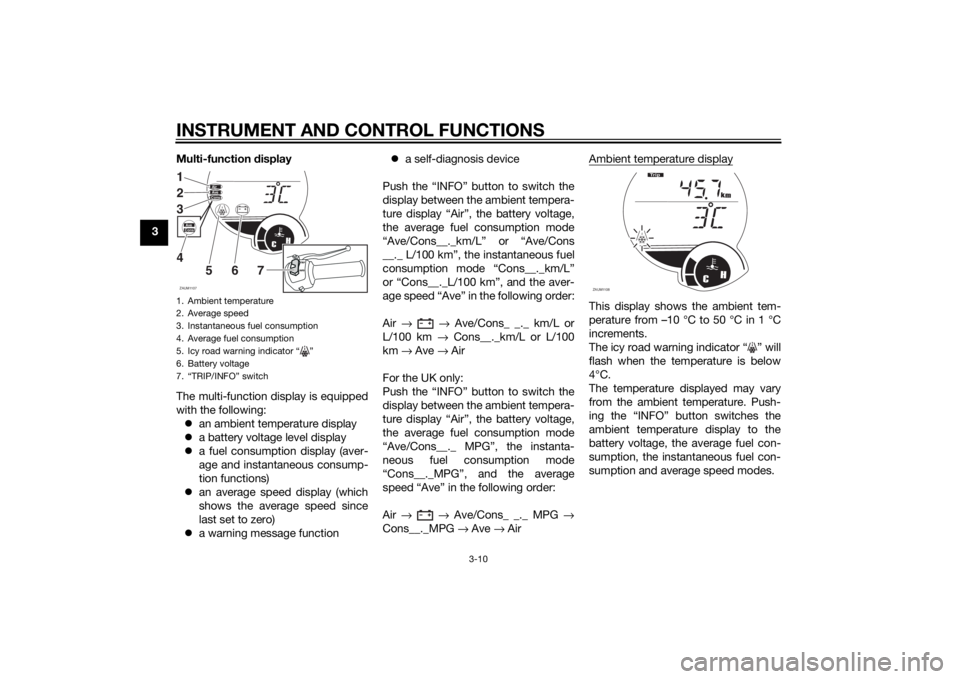
3Multi-function display
The multi-function display is equipped
with the following:
an ambient temperature display
a battery voltage level display
a fuel consumption display (aver-
age and instantaneous consump-
tion functions)
an average speed display (which
shows the average speed since
last set to zero)
a warning message functiona self-diagnosis device
Push the “INFO” button to switch the
display between the ambient tempera-
ture display “Air”, the battery voltage,
the average fuel consumption mode
“Ave/Cons__._km/L” or “Ave/Cons
__._ L/100 km”, the instantaneous fuel
consumption mode “Cons__._km/L”
or “Cons__._L/100 km”, and the aver-
age speed “Ave” in the following order:
Air → → Ave/Cons_ _._ km/L or
L/100 km → Cons__._km/L or L/100
km → Ave → Air
For the UK only:
Push the “INFO” button to switch the
display between the ambient tempera-
ture display “Air”, the battery voltage,
the average fuel consumption mode
“Ave/Cons__._ MPG”, the instanta-
neous fuel consumption mode
“Cons__._MPG”, and the average
speed “Ave” in the following order:
Air → → Ave/Cons_ _._ MPG →
Cons__._MPG → Ave → AirAmbient temperature display
This display shows the ambient tem-
perature from –10 °C to 50 °C in 1 °C
increments.
The icy road warning indicator “ ” will
flash when the temperature is below
4°C.
The temperature displayed may vary
from the ambient temperature. Push-
ing the “INFO” button switches the
ambient temperature display to the
battery voltage, the average fuel con-
sumption, the instantaneous fuel con-
sumption and average speed modes.
1. Ambient temperature
2. Average speed
3. Instantaneous fuel consumption
4. Average fuel consumption
5. Icy road warning indicator “ ”
6. Battery voltage
7. “TRIP/INFO” switchZAUM1107
CH
AirAveCons
1
2
3
4
5
6
7
INFOTRIP
AveCons
ZAUM1108
CH
km
Tr i p
U2DME1E0.book Page 10 Wednesday, October 23, 2013 1:37 PM
Page 27 of 94
INSTRUMENT AND CONTROL FUNCTIONS
3-11
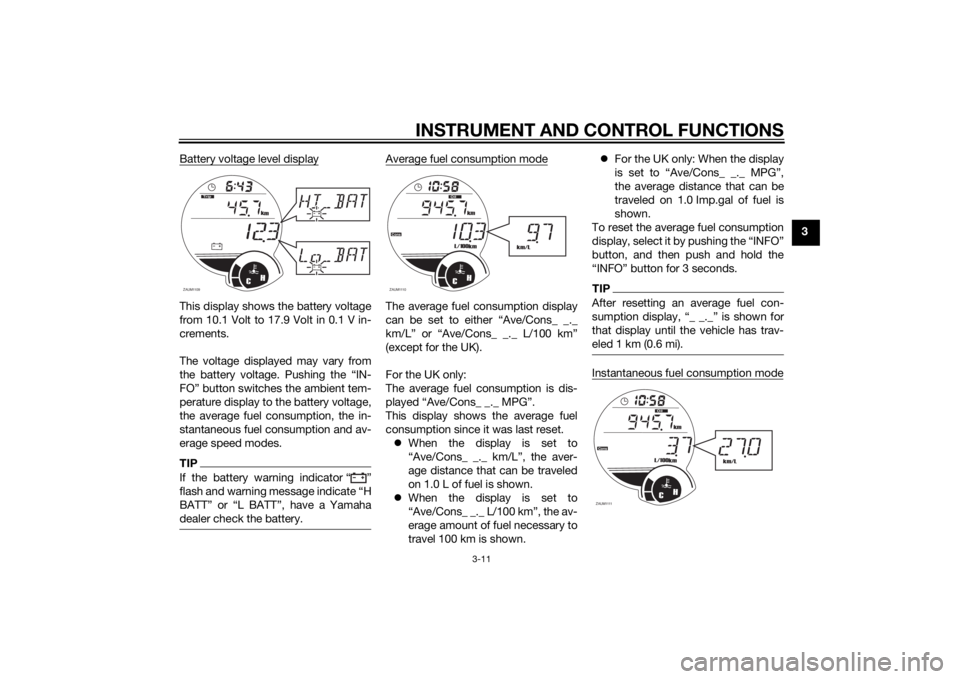
3 Battery voltage level display
This display shows the battery voltage
from 10.1 Volt to 17.9 Volt in 0.1 V in-
crements.
The voltage displayed may vary from
the battery voltage. Pushing the “IN-
FO” button switches the ambient tem-
perature display to the battery voltage,
the average fuel consumption, the in-
stantaneous fuel consumption and av-
erage speed modes.TIPIf the battery warning indicator Ž
dealer check the battery.
Average fuel consumption modeThe average fuel consumption display
(except for the UK).
For the UK only:
The average fuel consumption is dis-
This display shows the average fuel
consumption since it was last reset.
When the display is set to
“Ave/Cons_ _._ km/L”, the aver-
age distance that can be traveled
on 1.0 L of fuel is shown.
When the display is set to
“Ave/Cons_ _._ L/100 km”, the av-
erage amount of fuel necessary to
travel 100 km is shown.For the UK only: When the display
is set to “Ave/Cons_ _._ MPG”,
the average distance that can be
traveled on 1.0 Imp.gal of fuel is
shown.
To reset the average fuel consumption
display, select it by pushing the “INFO”
button, and then push and hold the
“INFO” button for 3 seconds.
TIPAfter resetting an average fuel con-
that display until the vehicle has trav-
eled 1 km (0.6 mi).Instantaneous fuel consumption mode
ZAUM1109
CH
km
T
rip
ZAUM1110
CH
km
L/100km
Cons
Oil
km/L
ZAUM1111
CH
km
L/100km
Cons
Oil
km/L
U2DME1E0.book Page 11 Wednesday, October 23, 2013 1:37 PM
Page 28 of 94
INSTRUMENT AND CONTROL FUNCTIONS
3-12
3The instantaneous fuel consumption
display can be set to either “km/L” or
“L/100 km” (except for the UK).
For the UK only:
The instantaneous fuel consumption is
displayed “MPG”.
When the display is set to “km/L”,
the distance that can be traveled
on 1.0 L of fuel under the current
riding conditions is shown.
When the display is set to “L/100
km”, the amount of fuel necessary
to travel 100 km under the current
riding conditions is shown.
For the UK only: The distance that
can be traveled on 1.0 Imp.gal of
fuel under the current riding condi-
tions is shown.
To switch between the instantaneous
fuel consumption displays, push the
“INFO” button for less than one sec-
ond when one of the displays is shown
(except for the UK).
TIPIf traveling at speeds under 10 km/h
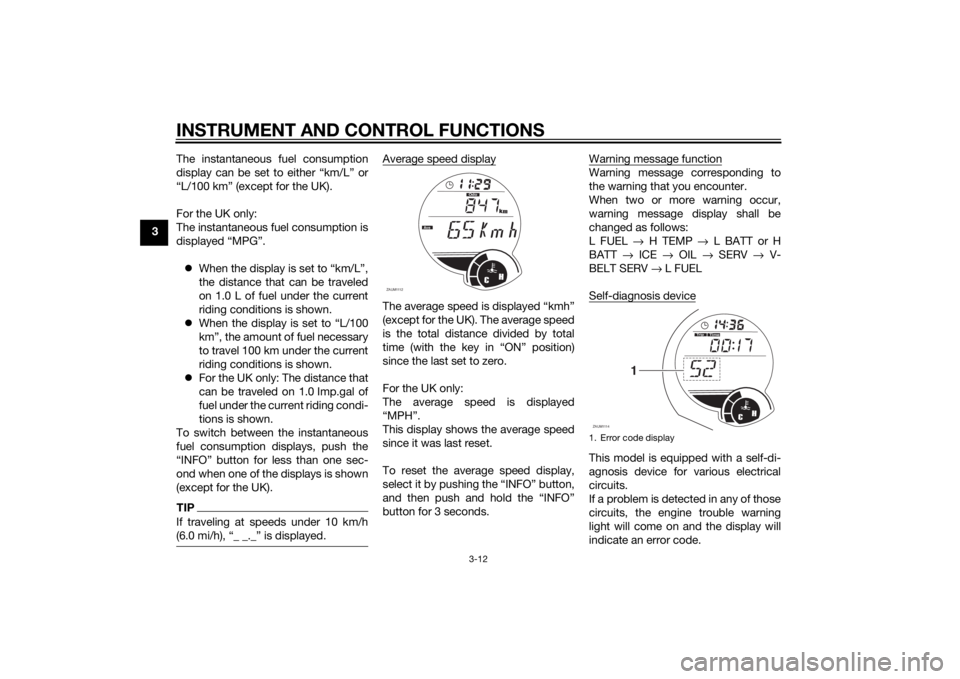
Average speed display
(except for the UK). The average speed
is the total distance divided by total
since the last set to zero.
For the UK only:
The average speed is displayed
This display shows the average speed
since it was last reset.
To reset the average speed display,
button for 3 seconds.Warning message function
Warning message corresponding to
the warning that you encounter.
When two or more warning occur,
warning message display shall be
changed as follows:
L FUEL → H TEMP → L BATT or H
BATT → ICE → OIL → SERV → V-
BELT SERV → L FUEL
Self-diagnosis deviceThis model is equipped with a self-di-
agnosis device for various electrical
circuits.
If a problem is detected in any of those
circuits, the engine trouble warning
light will come on and the display will
indicate an error code.
ZAUM1112
CH
km
Odo
Ave
Cons
V- B e lt
F
1. Error code displayZAUM1114
T
rip
CH
Time
1
U2DME1E0.book Page 12 Wednesday, October 23, 2013 1:37 PM
Page 46 of 94
OPERATION AND IMPORTANT RIDING POINTS
5-4
5
EAU16821
Tips for reducing fuel con-
sumptionFuel consumption depends largely on
your riding style. Consider the follow-
ing tips to reduce fuel consumption:
Avoid high engine speeds during
acceleration.
Avoid high engine speeds with no
load on the engine.
Turn the engine off instead of let-
ting it idle for an extended length
of time (e.g., in traffic jams, at traf-
fic lights or at railroad crossings).
EAU16831
Engine break-inThere is never a more important period
in the life of your engine than the period
between 0 and 1000 km (600 mi). For
this reason, you should read the fol-
lowing material carefully.
Since the engine is brand new, do not
put an excessive load on it for the first
1000 km (600 mi). The various parts in
the engine wear and polish themselves
to the correct operating clearances.
During this period, prolonged full-throt-
tle operation or any condition that
might result in engine overheating
must be avoided.
EAUS1841
0–500 km (0–300 mi)
Avoid prolonged operation above 5000
r/min.
500–1000 km (300–600 mi)
Avoid prolonged operation above 7500
r/min. NOTICE: After 1000 km (600
mi) of operation, be sure to replace
the engine oil, final transmission oil
and the oil filter element.
[ECA12932]
1000 km (600 mi) and beyond
The vehicle can now be operated nor-
mally.NOTICE
ECA10311
Keep the engine speed out of
the tachometer red zone.
If any engine trouble should oc-
cur during the engine break-in
period, immediately have a
Yamaha dealer check the vehi-
cle.
U2DME1E0.book Page 4 Wednesday, October 23, 2013 1:37 PM
Page 91 of 94

10-1
10
INDEX
AABS (for ABS models) .......................... 3-16
ABS warning light (for ABS models) ....... 3-4
Acceleration and deceleration ................ 5-3
Air filter and V-belt case air filter
elements ............................................. 6-16
Anti-theft alarm (optional) ..................... 3-13
Auxiliary light ........................................ 6-33BBattery .................................................. 6-27
Brake fluid, changing............................ 6-24
Brake fluid level, checking.................... 6-22
Brake lever, front .................................. 3-15
Brake lever, rear ................................... 3-15
Brake levers, lubricating ....................... 6-25
Braking ................................................... 5-3CCables, checking and lubricating ......... 6-24
Care ........................................................ 7-1
Catalytic converters.............................. 3-19
Centerstand and sidestand, checking
and lubricating ................................... 6-25
Coolant ................................................. 6-15DDimmer switch...................................... 3-14EEngine break-in ...................................... 5-4
Engine oil .............................................. 6-12
Engine trouble warning light ................... 3-4FFinal transmission oil ............................ 6-14
Front and rear brake lever free play,
checking ............................................. 6-21
Front and rear brake pads, checking ... 6-21Front fork, checking ............................. 6-26
Front turn signal light ........................... 6-31
Fuel ...................................................... 3-17
Fuel consumption, tips for reducing ...... 5-4
Fuel level warning light........................... 3-4
Fuel tank cap........................................ 3-17
Fuses, replacing ................................... 6-29
HHandlebar switches ............................. 3-14
Hazard switch ...................................... 3-14
Headlight bulb, replacing ..................... 6-30
High beam indicator light ....................... 3-4
Horn switch .......................................... 3-14IIdentification numbers ........................... 9-1
Ignition circuit cut-off system .............. 3-23
Immobilizer system ................................ 3-1
Immobilizer system indicator light ......... 3-5
Indicator lights and warning lights ......... 3-3LLicense plate light bulb, replacing ....... 6-32MMain switch/steering lock ...................... 3-2
Maintenance and lubrication, periodic... 6-4
Maintenance, emission control
system ................................................. 6-3
Matte color, caution ............................... 7-1
Model label............................................. 9-1
Multi-function meter unit ........................ 3-5PPanels, removing and installing ............. 6-8
Parking ................................................... 5-5
Part locations ......................................... 2-1
Pass switch .......................................... 3-14
SSafe-riding points ................................... 1-5
Safety information................................... 1-1
Seat....................................................... 3-19
Shock absorber assemblies,
adjusting ............................................. 3-21
Sidestand.............................................. 3-22
Spark plug, checking ............................ 6-10
Specifications ......................................... 8-1
Starting off .............................................. 5-2
Starting the engine ................................. 5-1
Start switch ........................................... 3-14
Steering, checking ................................ 6-27
Storage ................................................... 7-4
Storage compartments ......................... 3-20TTail/brake light ...................................... 6-31
Throttle grip and cable, checking and
lubricating ........................................... 6-24
Throttle grip free play, checking ........... 6-18
Tires ...................................................... 6-18
Tool kit .................................................... 6-2
Troubleshooting .................................... 6-33
Troubleshooting charts ......................... 6-34
Turn signal indicator lights...................... 3-3
Turn signal light bulb (rear),
replacing ............................................. 6-31
Turn signal switch ................................. 3-14VValve clearance..................................... 6-18
Vehicle identification number ................. 9-1WWheel bearings, checking .................... 6-27
Wheels .................................................. 6-20
U2DME1E0.book Page 1 Wednesday, October 23, 2013 1:37 PM