maintenance YAMAHA XMAX 125 2016 Owner's Guide
[x] Cancel search | Manufacturer: YAMAHA, Model Year: 2016, Model line: XMAX 125, Model: YAMAHA XMAX 125 2016Pages: 96, PDF Size: 8.11 MB
Page 74 of 96
Periodic maintenance and adjustment
6-27
6
EAU23292
Checking the wheel bearings
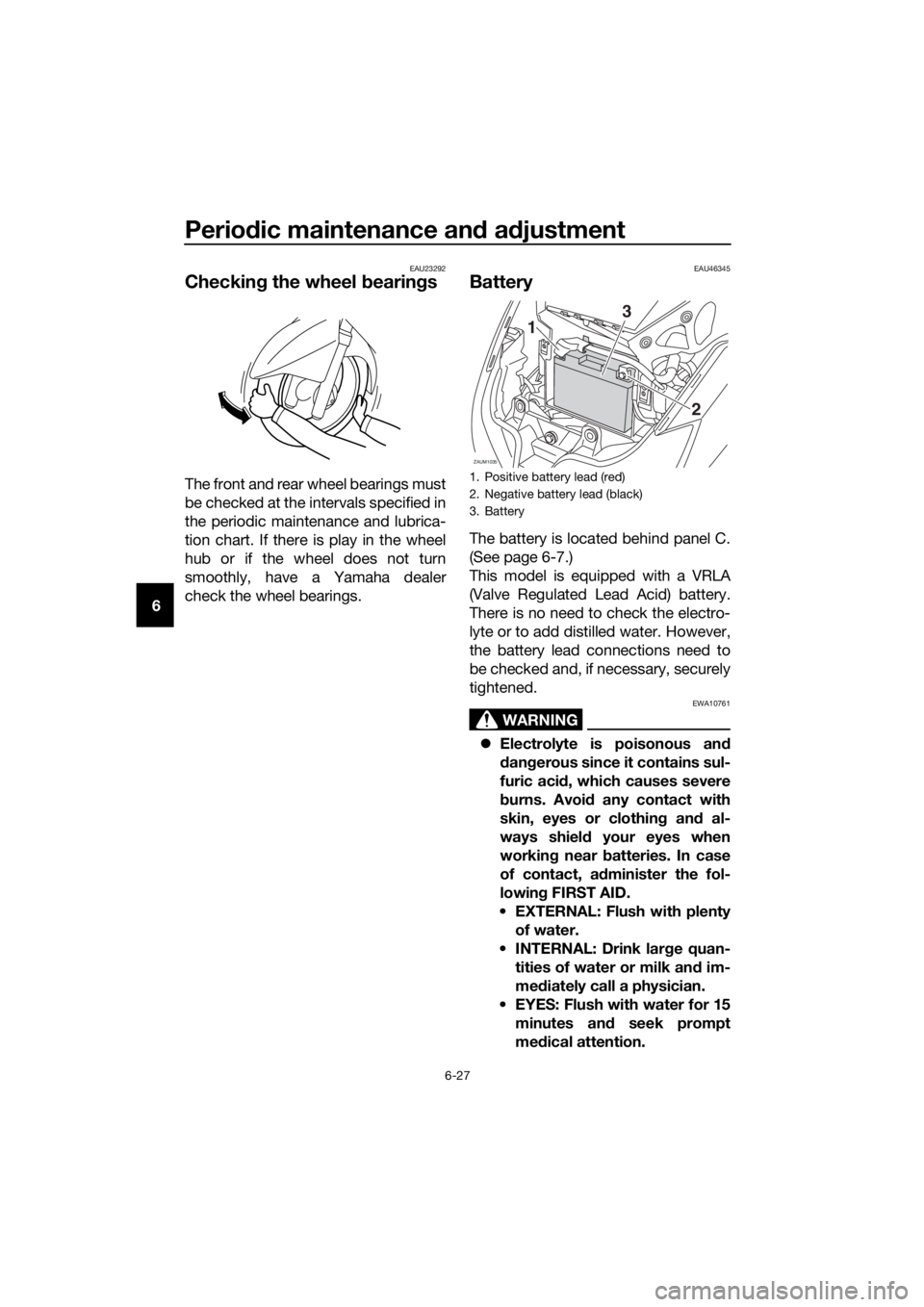
The front and rear wheel bearings must
be checked at the intervals specified in
the periodic maintenance and lubrica-
tion chart. If there is play in the wheel
hub or if the wheel does not turn
smoothly, have a Yamaha dealer
check the wheel bearings.
EAU46345
Battery
The battery is located behind panel C.
(See page 6-7.)
This model is equipped with a VRLA
(Valve Regulated Lead Acid) battery.
There is no need to check the electro-
lyte or to add distilled water. However,
the battery lead connections need to
be checked and, if necessary, securely
tightened.
WARNING
EWA10761
Electrolyte is poisonous and
dangerous since it contains sul-
furic acid, which causes severe
burns. Avoid any contact with
skin, eyes or clothing and al-
ways shield your eyes when
working near batteries. In case
of contact, administer the fol-
lowing FIRST AID.
EXTERNAL: Flush with plenty
of water.
INTERNAL: Drink large quan-
tities of water or milk and im-
mediately call a physician.
EYES: Flush with water for 15
minutes and seek prompt
medical attention.
1. Positive battery lead (red)
2. Negative battery lead (black)
3. Battery
ZAUM1035
2
1
3
U2DME2E0.book Page 27 Tuesday, June 30, 2015 11:38 AM
Page 75 of 96
Periodic maintenance and adjustment
6-28
6 Batteries produce explosive hy-
drogen gas. Therefore, keep
sparks, flames, cigarettes, etc.,
away from the battery and pro-
vide sufficient ventilation when
charging it in an enclosed
space.
KEEP THIS AND ALL BATTER-
IES OUT OF THE REACH OF
CHILDREN.
To charge the battery
Have a Yamaha dealer charge the bat-
tery as soon as possible if it seems to
have discharged. Keep in mind that the
battery tends to discharge more quick-
ly if the vehicle is equipped with op-
tional electrical accessories.
NOTICE
ECA16522
To charge a VRLA (Valve Regulated
Lead Acid) battery, a special (con-
stant-voltage) battery charger is re-
quired. Using a conventional battery
charger will damage the battery.
To store the battery
1. If the vehicle will not be used for
more than one month, remove the
battery, fully charge it, and then
place it in a cool, dry place.
NOTICE: When removing the
battery, be sure the key is
turned to “OFF”, then discon-
nect the negative lead before
disconnecting the positive lead.
[ECA16303]
2. If the battery will be stored for
more than two months, check it at
least once a month and fully
charge it if necessary.3. Fully charge the battery before in-
stallation. NOTICE: When install-
ing the battery, be sure the key
is turned to “OFF”, then connect
the positive lead before con-
necting the negative lead.
[ECA16841]
NOTICE
ECA16531
Always keep the battery charged.
Storing a discharged battery can
cause permanent battery damage.
U2DME2E0.book Page 28 Tuesday, June 30, 2015 11:38 AM
Page 76 of 96
Periodic maintenance and adjustment
6-29
6
EAUM3093
Replacing the fuses
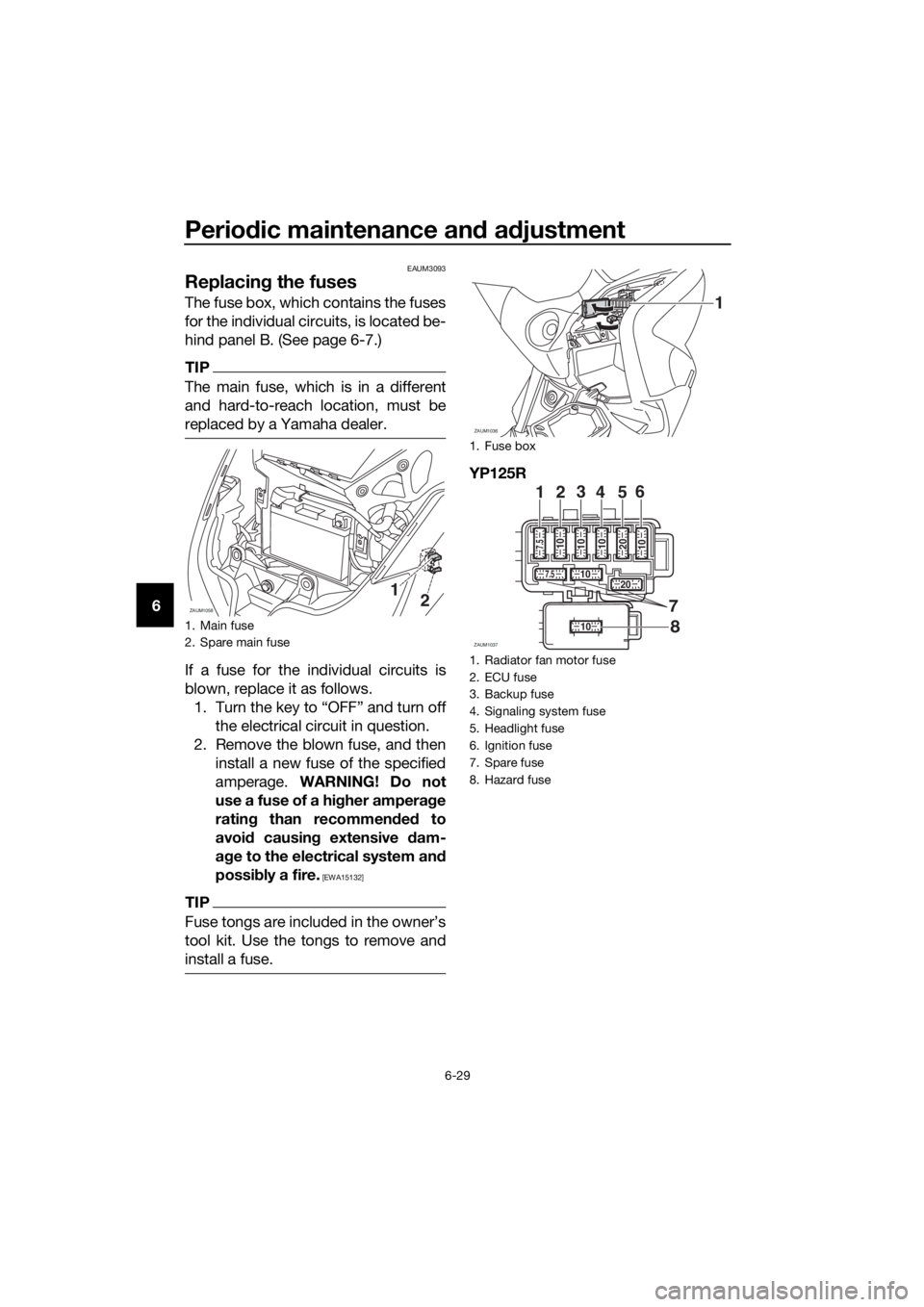
The fuse box, which contains the fuses
for the individual circuits, is located be-
hind panel B. (See page 6-7.)
TIP
The main fuse, which is in a different
and hard-to-reach location, must be
replaced by a Yamaha dealer.
If a fuse for the individual circuits is
blown, replace it as follows.
1.
the electrical circuit in question.
2. Remove the blown fuse, and then
install a new fuse of the specified
amperage. WARNING! Do not
use a fuse of a higher amperage
rating than recommended to
avoid causing extensive dam-
age to the electrical system and
possibly a fire.
[EWA15132]
TIP
tool kit. Use the tongs to remove and
install a fuse.
YP125R
1. Main fuse
2. Spare main fuse
ZAUM1058112
1. Fuse box
1. Radiator fan motor fuse
2. ECU fuse
3. Backup fuse
4. Signaling system fuse
5. Headlight fuse
6. Ignition fuse
7. Spare fuse
8. Hazard fuse
ZAUM1036
1
ZAUM1037
7
123456
20 10
10
20
1010 10107.5
7.5
U2DME2E0.book Page 29 Tuesday, June 30, 2015 11:38 AM
Page 77 of 96
Periodic maintenance and adjustment
6-30
6 YP125RA
3. Turn the key to “ON” and turn on
the electrical circuit in question to
check if the device operates.4. If the fuse immediately blows
again, have a Yamaha dealer
check the electrical system.
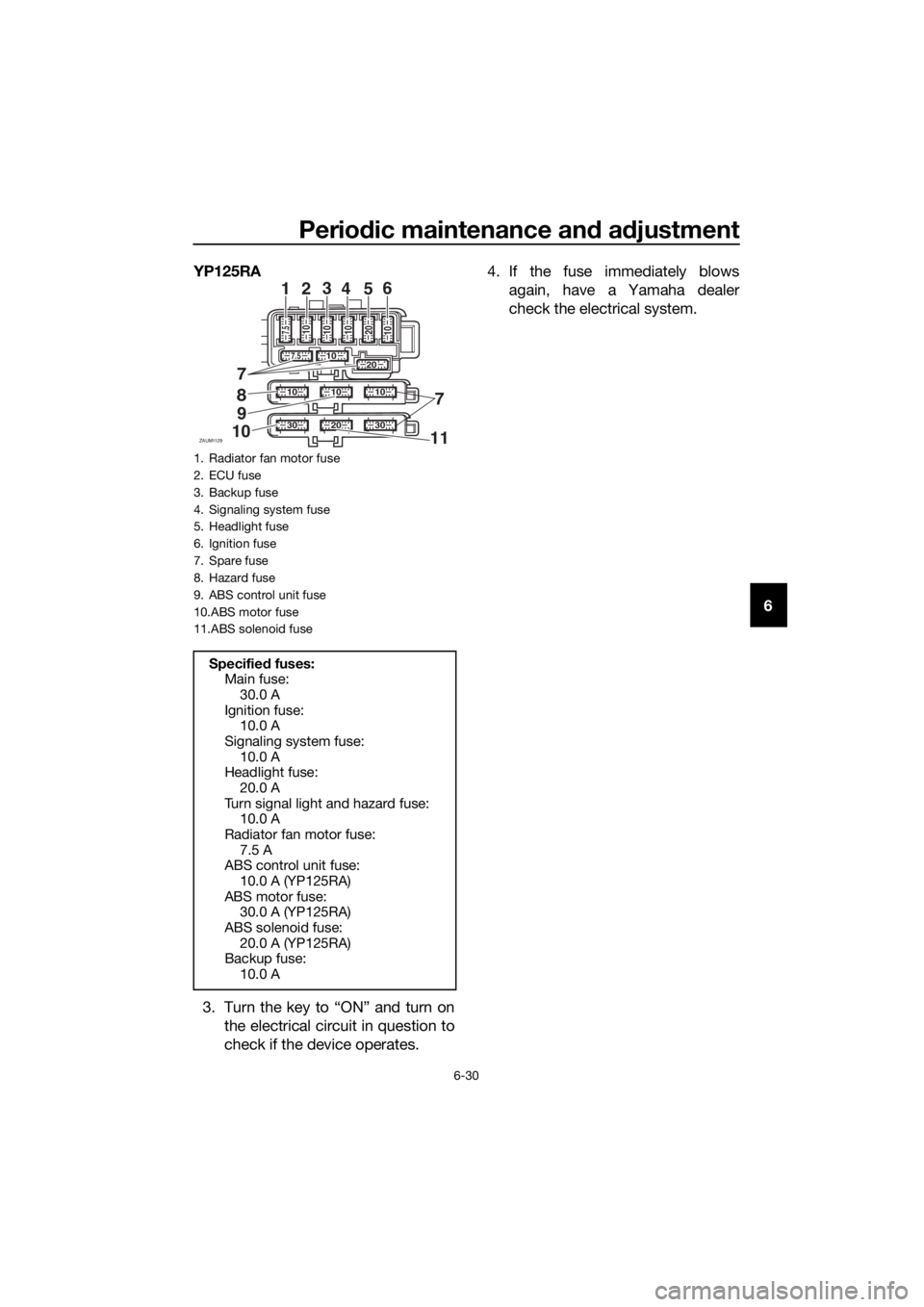
1. Radiator fan motor fuse
2. ECU fuse
3. Backup fuse
4. Signaling system fuse
5. Headlight fuse
6. Ignition fuse
7. Spare fuse
8. Hazard fuse
9. ABS control unit fuse
10.ABS motor fuse
11.ABS solenoid fuse
Specified fuses:
Main fuse:
30.0 A
Ignition fuse:
10.0 A
Signaling system fuse:
10.0 A
Headlight fuse:
20.0 A
Turn signal light and hazard fuse:
10.0 A
Radiator fan motor fuse:
7.5 A
ABS control unit fuse:
10.0 A (YP125RA)
ABS motor fuse:
30.0 A (YP125RA)
ABS solenoid fuse:
20.0 A (YP125RA)
Backup fuse:
10.0 A
ZAUM1129
101010
203030
7
7
11
123
4
56
20 10
20
1010 10107.5
7.5
9
10
U2DME2E0.book Page 30 Tuesday, June 30, 2015 11:38 AM
Page 78 of 96
Periodic maintenance and adjustment
6-31
6
EAU34242
Replacing a headlight bulb
This model is equipped with halogen
bulb headlights. If a headlight bulb
burns out, have a Yamaha dealer re-
place it and, if necessary, adjust the
headlight beam.
EAUM3680
Auxiliary lights
This vehicle is equipped with two aux-
iliary lights. Depending on the model,
the auxiliary lights may be bulb-type or
LED-type.
If an auxiliary light does not come on,
have a Yamaha dealer check the elec-
trical circuit and replace the light if nec-
essary.
U2DME2E0.book Page 31 Tuesday, June 30, 2015 11:38 AM
Page 79 of 96
Periodic maintenance and adjustment
6-32
6
EAU24182
Tail/brake light
This model is equipped with an LED-
type tail/brake light.
If the tail/brake light does not come on,
have a Yamaha dealer check it.
EAU39881
Front turn signal light
If a front turn signal light does not
come on, have a Yamaha dealer check
its electrical circuit or replace the bulb.
U2DME2E0.book Page 32 Tuesday, June 30, 2015 11:38 AM
Page 80 of 96
Periodic maintenance and adjustment
6-33
6
EAUM3062
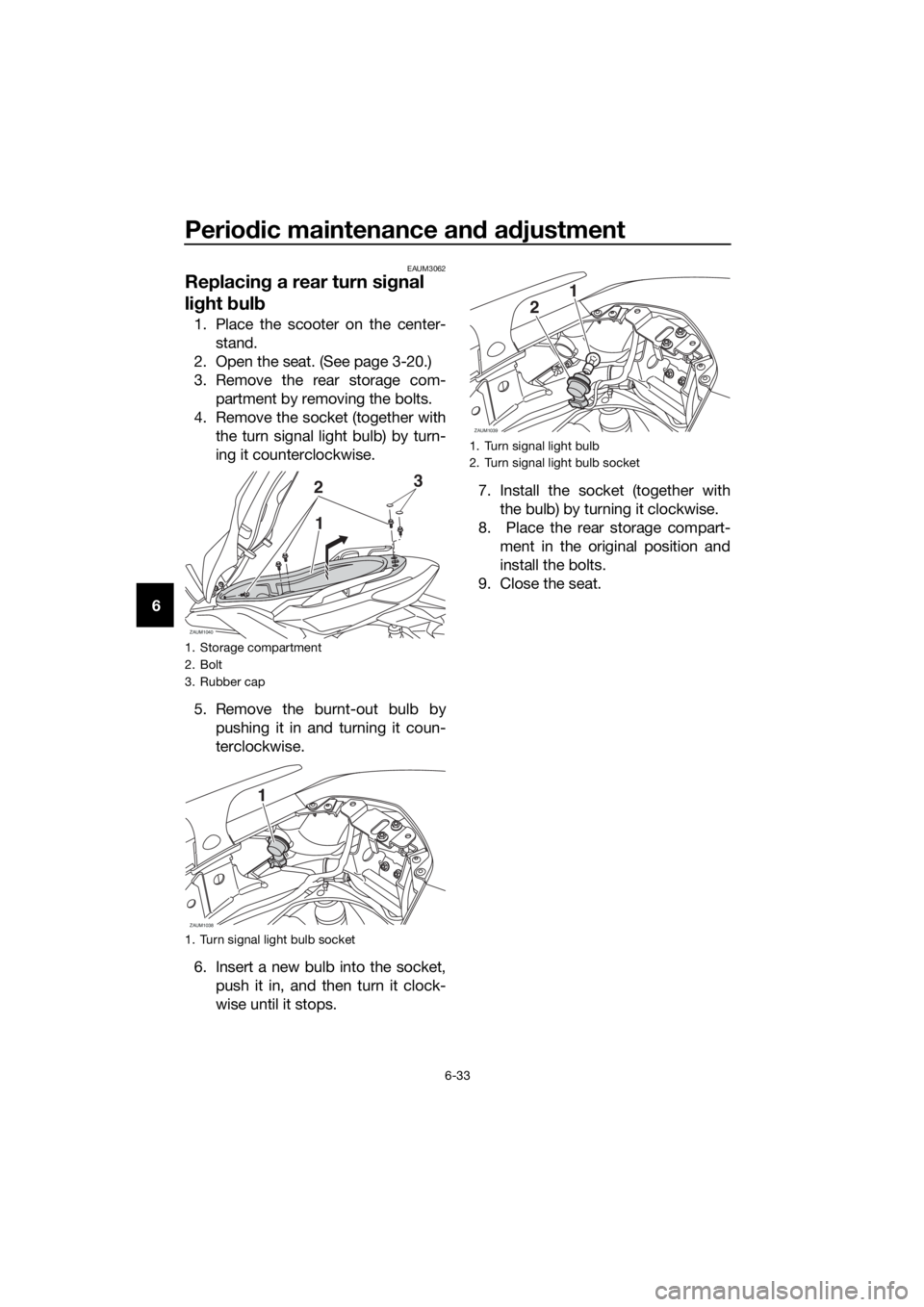
Replacing a rear turn signal
light bulb
1. Place the scooter on the center-
stand.
2. Open the seat. (See page 3-20.)
3. Remove the rear storage com-
partment by removing the bolts.
4. Remove the socket (together with
the turn signal light bulb) by turn-
ing it counterclockwise.
5. Remove the burnt-out bulb by
pushing it in and turning it coun-
terclockwise.
6. Insert a new bulb into the socket,
push it in, and then turn it clock-
wise until it stops.7. Install the socket (together with
the bulb) by turning it clockwise.
8. Place the rear storage compart-
ment in the original position and
install the bolts.
9. Close the seat.
1. Storage compartment
2. Bolt
3. Rubber cap
1. Turn signal light bulb socket
ZAUM1040
23
1
ZAUM1038
1
1. Turn signal light bulb
2. Turn signal light bulb socket
ZAUM1039
1
2
U2DME2E0.book Page 33 Tuesday, June 30, 2015 11:38 AM
Page 81 of 96
Periodic maintenance and adjustment
6-34
6
EAUM2203
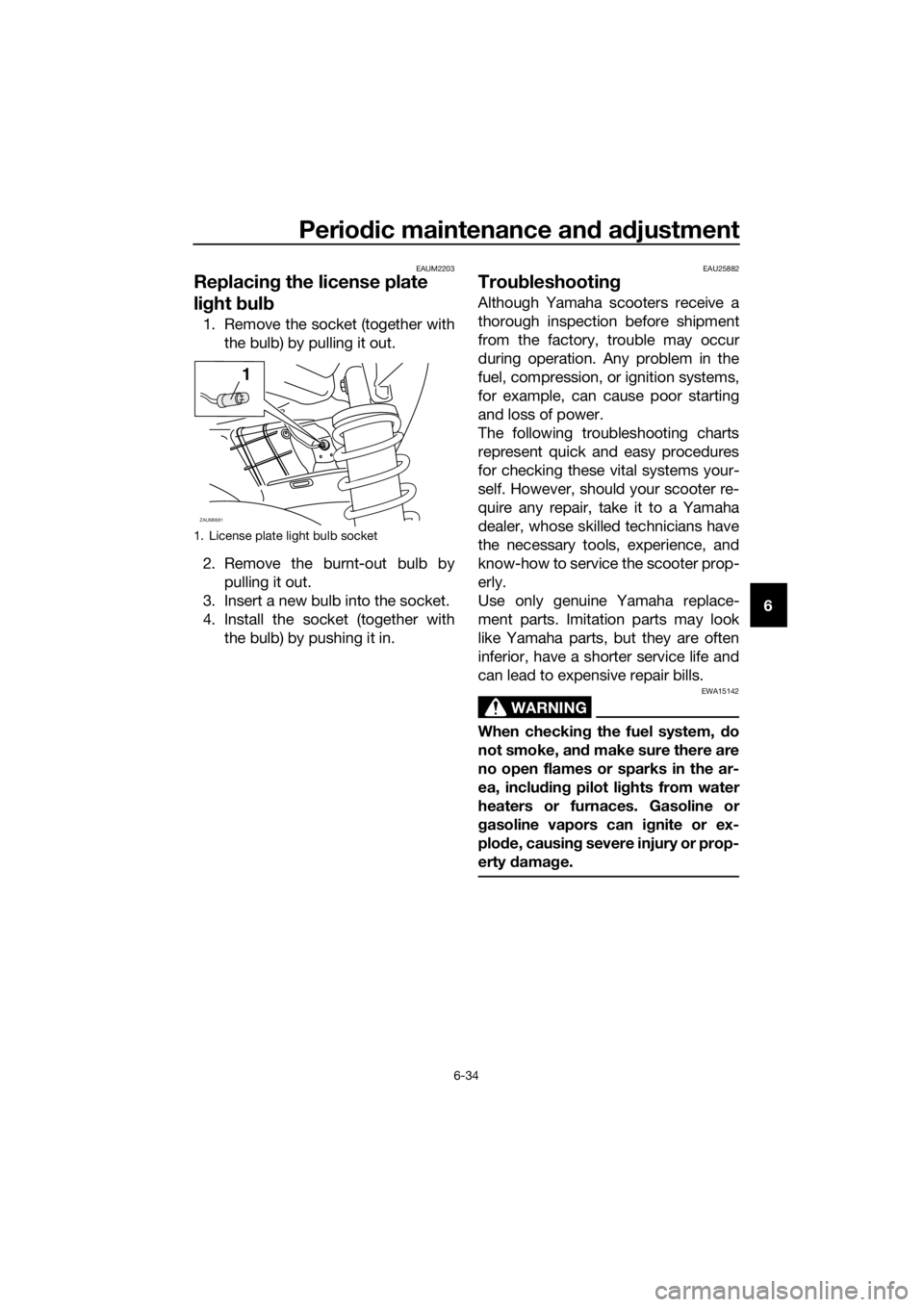
Replacing the license plate
light bulb
1. Remove the socket (together with
the bulb) by pulling it out.
2. Remove the burnt-out bulb by
pulling it out.
3. Insert a new bulb into the socket.
4. Install the socket (together with
the bulb) by pushing it in.
EAU25882
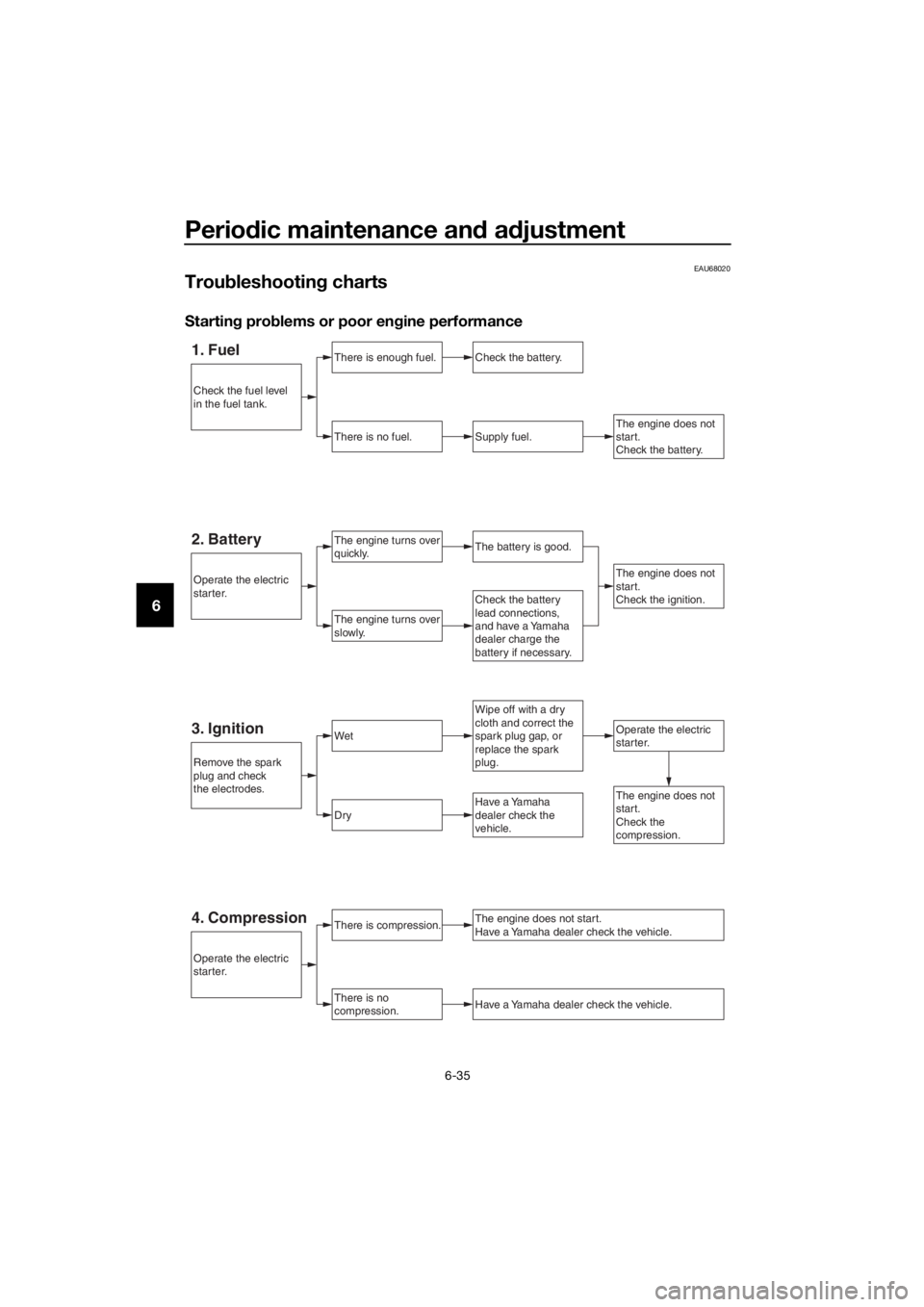
Troubleshooting
Although Yamaha scooters receive a
thorough inspection before shipment
from the factory, trouble may occur
during operation. Any problem in the
fuel, compression, or ignition systems,
for example, can cause poor starting
and loss of power.
The following troubleshooting charts
represent quick and easy procedures
for checking these vital systems your-
self. However, should your scooter re-
quire any repair, take it to a Yamaha
dealer, whose skilled technicians have
the necessary tools, experience, and
know-how to service the scooter prop-
erly.
Use only genuine Yamaha replace-
ment parts. Imitation parts may look
like Yamaha parts, but they are often
inferior, have a shorter service life and
can lead to expensive repair bills.
WARNING
EWA15142
When checking the fuel system, do
not smoke, and make sure there are
no open flames or sparks in the ar-
ea, including pilot lights from water
heaters or furnaces. Gasoline or
gasoline vapors can ignite or ex-
plode, causing severe injury or prop-
erty damage.
1. License plate light bulb socket
ZAUM0681
1
U2DME2E0.book Page 34 Tuesday, June 30, 2015 11:38 AM
Page 82 of 96
Periodic maintenance and adjustment
6-35
6
EAU68020
Troubleshooting charts
Starting problems or poor engine performance
1. FuelThere is enough fuel.
There is no fuel.
Check the battery.
Supply fuel.
The engine turns over
quickly.
The engine turns over
slowly.
Operate the electric
starter.
The engine does not
start.
Check the battery.
Wipe off with a dry
cloth and correct the
spark plug gap, or
replace the spark
plug.
Check the battery
lead connections,
and have a Yamaha
dealer charge the
battery if necessary.
2. BatteryThe battery is good.
The engine does not
start.
Check the ignition.
3. IgnitionWet
Dry
There is compression.
There is no
compression.
The engine does not start.
Have a Yamaha dealer check the vehicle.
Have a Yamaha dealer check the vehicle.
The engine does not
start.
Check the
compression.Have a Yamaha
dealer check the
vehicle.
Remove the spark
plug and check
the electrodes.
Operate the electric
starter.
Operate the electric
starter.
Check the fuel level
in the fuel tank.
4. Compression
U2DME2E0.book Page 35 Tuesday, June 30, 2015 11:38 AM
Page 83 of 96

Periodic maintenance and adjustment
6-36
6 Engine overheating
WARNING
EWAT1041
Do not remove the radiator cap when the engine and radiator are hot.
Scalding hot fluid and steam may be blown out under pressure, which
could cause serious injury. Be sure to wait until the engine has cooled.
Place a thick rag, like a towel, over the radiator cap, and then slowly ro-
tate the cap counterclockwise to the detent to allow any residual pres-
sure to escape. When the hissing sound has stopped, press down on the
cap while turning it counterclockwise, and then remove the cap.
TIP
If coolant is not available, tap water can be temporarily used instead, provided
that it is changed to the recommended coolant as soon as possible.
Wait until the engine
has cooled.
Check the coolant
level in the reservoir
and radiator.Add coolant.
(See TIP.)
The coolant level is
OK.
There is no leakage.
There is leakage.
The coolant level is
low.
Check the cooling
system for leakage.
Have a Yamaha
dealer check and
repair the cooling
system.
Start the engine. If the engine overheats again,
have a Yamaha dealer check and repair the cooling
system.
U2DME2E0.book Page 36 Tuesday, June 30, 2015 11:38 AM