light YAMAHA XMAX 125 2017 Owner's Manual
[x] Cancel search | Manufacturer: YAMAHA, Model Year: 2017, Model line: XMAX 125, Model: YAMAHA XMAX 125 2017Pages: 96, PDF Size: 8.13 MB
Page 55 of 96
Periodic maintenance and adjustment
6-9
6
EAUM3360
Checking the spark plug
The spark plug is an important engine
component, which is easy to check.
Since heat and deposits will cause any
spark plug to slowly erode, the spark
plug should be removed and checked
in accordance with the periodic main-
tenance and lubrication chart. In addi-
tion, the condition of the spark plug
can reveal the condition of the engine.
To remove the spark plug
1. Place the vehicle on the center-
stand
2. Open the seat. (See page 3-19.)
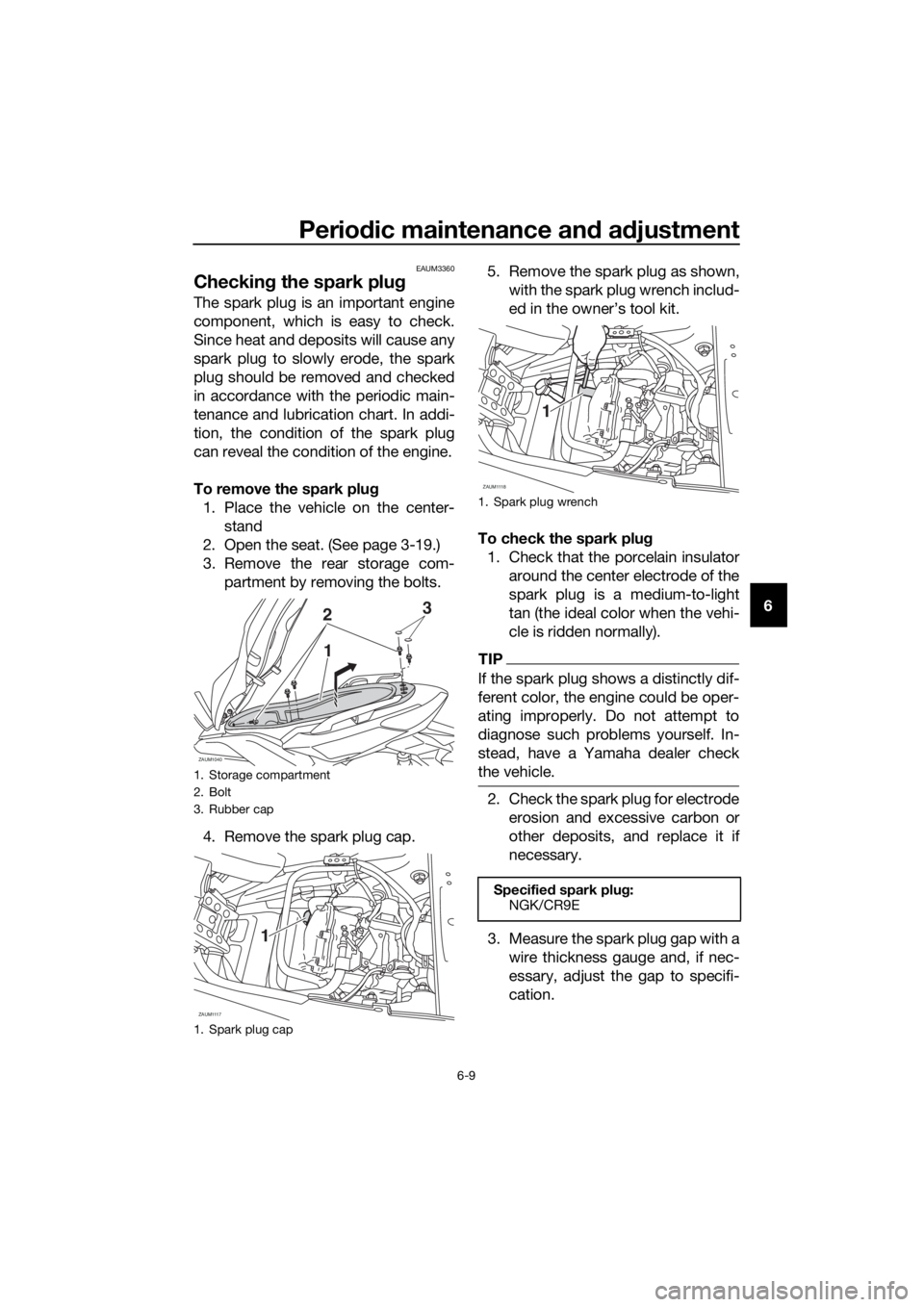
3. Remove the rear storage com-
partment by removing the bolts.
4. Remove the spark plug cap.5. Remove the spark plug as shown,
with the spark plug wrench includ-
ed in the owner’s tool kit.
To check the spark plug
1. Check that the porcelain insulator
around the center electrode of the
spark plug is a medium-to-light
tan (the ideal color when the vehi-
cle is ridden normally).
TIP
If the spark plug shows a distinctly dif-
ferent color, the engine could be oper-
ating improperly. Do not attempt to
diagnose such problems yourself. In-
stead, have a Yamaha dealer check
the vehicle.
2. Check the spark plug for electrode
erosion and excessive carbon or
other deposits, and replace it if
necessary.
3. Measure the spark plug gap with a
wire thickness gauge and, if nec-
essary, adjust the gap to specifi-
cation.
1. Storage compartment
2. Bolt
3. Rubber cap
1. Spark plug cap
ZAUM1040
23
1
ZAUM1117
1
1. Spark plug wrench
Specified spark plug:
NGK/CR9E
ZAUM1118
1
U2DME3E0.book Page 9 Friday, June 10, 2016 2:25 PM
Page 56 of 96
Periodic maintenance and adjustment
6-10
6To install the spark plug
1. Clean the surface of the spark
plug gasket and its mating sur-
face, and then wipe off any grime
from the spark plug threads.
2. Install the spark plug with the
spark plug wrench, and then tight-
en it to the specified torque.
TIP
If a torque wrench is not available
when installing a spark plug, a good
estimate of the correct torque is 1/4…
1/2 turn past finger tight. However, the
spark plug should be tightened to the
specified torque as soon as possible.
3. Install the spark plug cap.
4. Place the rear storage compart-
ment in the original position and
install the bolts.
5. Close the seat.
EAUM3332
Engine oil
The engine oil level should be checked
before each ride. In addition, the oil
must be changed at the intervals spec-
ified in the periodic maintenance and
lubrication chart and when the service
indicator light comes on.
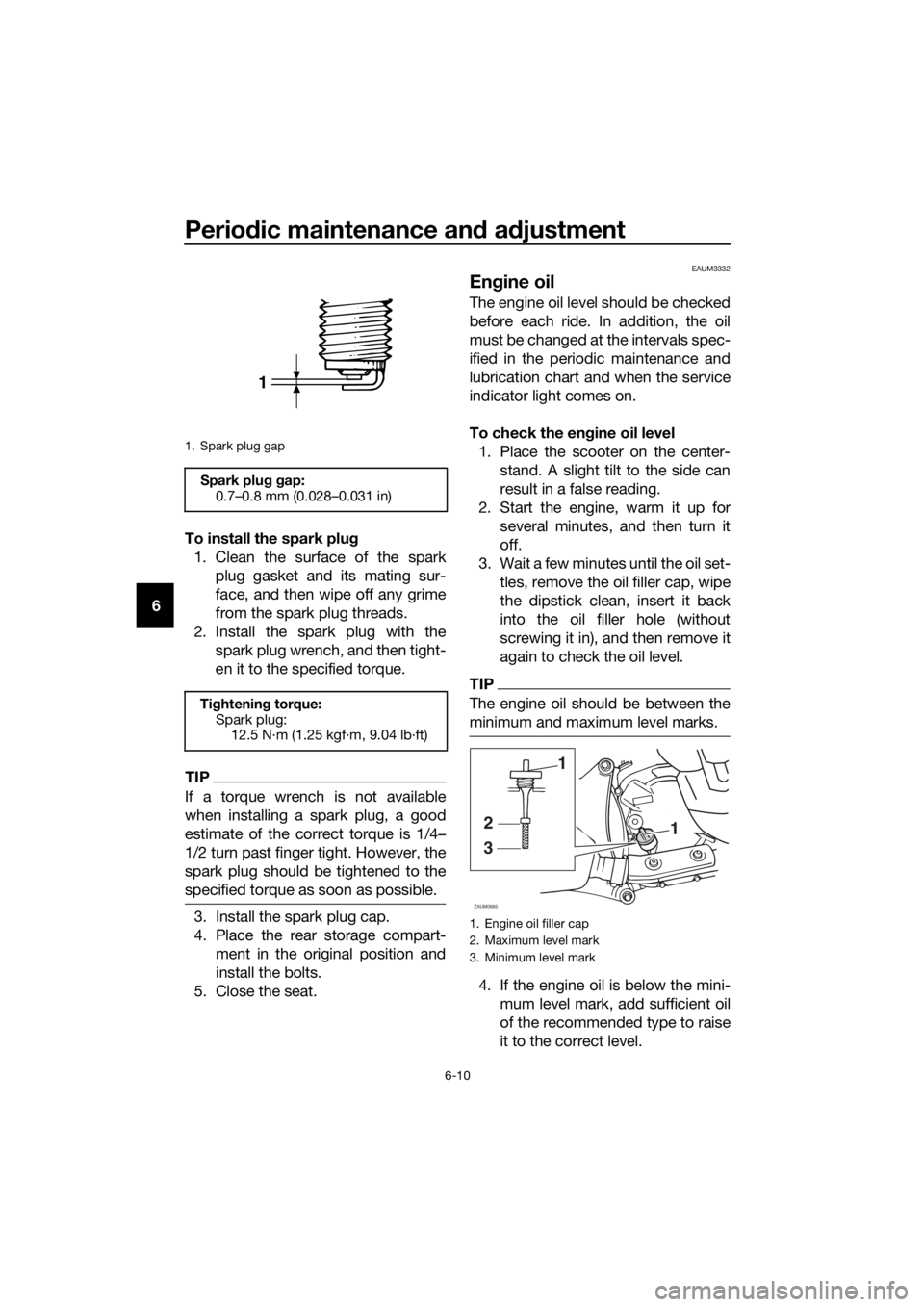
To check the engine oil level
1. Place the scooter on the center-
stand. A slight tilt to the side can
result in a false reading.
2. Start the engine, warm it up for
several minutes, and then turn it
off.
3. Wait a few minutes until the oil set-
tles, remove the oil filler cap, wipe
the dipstick clean, insert it back
into the oil filler hole (without
screwing it in), and then remove it
again to check the oil level.
TIP
The engine oil should be between the
minimum and maximum level marks.
4. If the engine oil is below the mini-
mum level mark, add sufficient oil
of the recommended type to raise
it to the correct level.
1. Spark plug gap
Spark plug gap:
0.7–0.8 mm (0.028–0.031 in)
Tightening torque:
Spark plug:
12.5 N·m (1.25 kgf·m, 9.04 lb·ft)
1
1. Engine oil filler cap
2. Maximum level mark
3. Minimum level mark
1
3
2
1
ZAUM0685
U2DME3E0.book Page 10 Friday, June 10, 2016 2:25 PM
Page 60 of 96
Periodic maintenance and adjustment
6-14
6
EAU20071
Coolant
The coolant level should be checked
before each ride. In addition, the cool-
ant must be changed at the intervals
specified in the periodic maintenance
and lubrication chart.
EAUM3045To check the coolant level
1. Place the vehicle on a level sur-
face and hold it in an upright posi-
tion.
2. Open the front storage compart-
ment A. (See page 3-20.)
TIP
The coolant level must be
checked on a cold engine since
the level varies with engine tem-
perature.
Make sure that the vehicle is posi-
tioned straight up when checking
the coolant level. A slight tilt to the
side can result in a false reading.
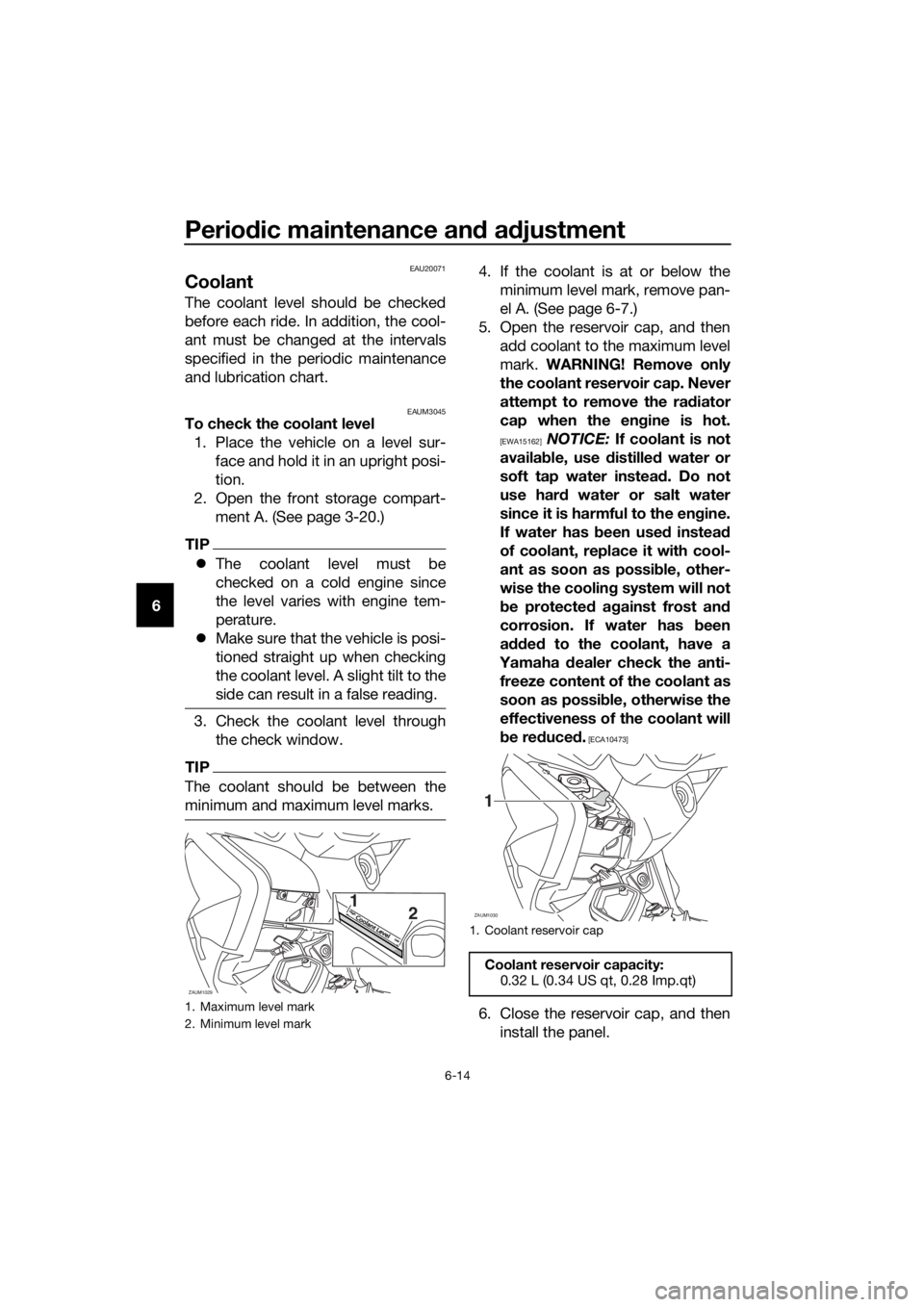
3. Check the coolant level through
the check window.
TIP
The coolant should be between the
minimum and maximum level marks.
4. If the coolant is at or below the
minimum level mark, remove pan-
el A. (See page 6-7.)
5. Open the reservoir cap, and then
add coolant to the maximum level
mark. WARNING! Remove only
the coolant reservoir cap. Never
attempt to remove the radiator
cap when the engine is hot.
[EWA15162] NOTICE: If coolant is not
available, use distilled water or
soft tap water instead. Do not
use hard water or salt water
since it is harmful to the engine.
If water has been used instead
of coolant, replace it with cool-
ant as soon as possible, other-
wise the cooling system will not
be protected against frost and
corrosion. If water has been
added to the coolant, have a
Yamaha dealer check the anti-
freeze content of the coolant as
soon as possible, otherwise the
effectiveness of the coolant will
be reduced.
[ECA10473]
6. Close the reservoir cap, and then
install the panel.1. Maximum level mark
2. Minimum level mark
ZAUM1029
2 1Coolant LevelCoolant L
evelH
ighH
igh
LowLo
w1. Coolant reservoir cap
Coolant reservoir capacity:
0.32 L (0.34 US qt, 0.28 Imp.qt)
ZAUM1030
1
U2DME3E0.book Page 14 Friday, June 10, 2016 2:25 PM
Page 75 of 96
Periodic maintenance and adjustment
6-29
6
EAUM3093
Replacing the fuses
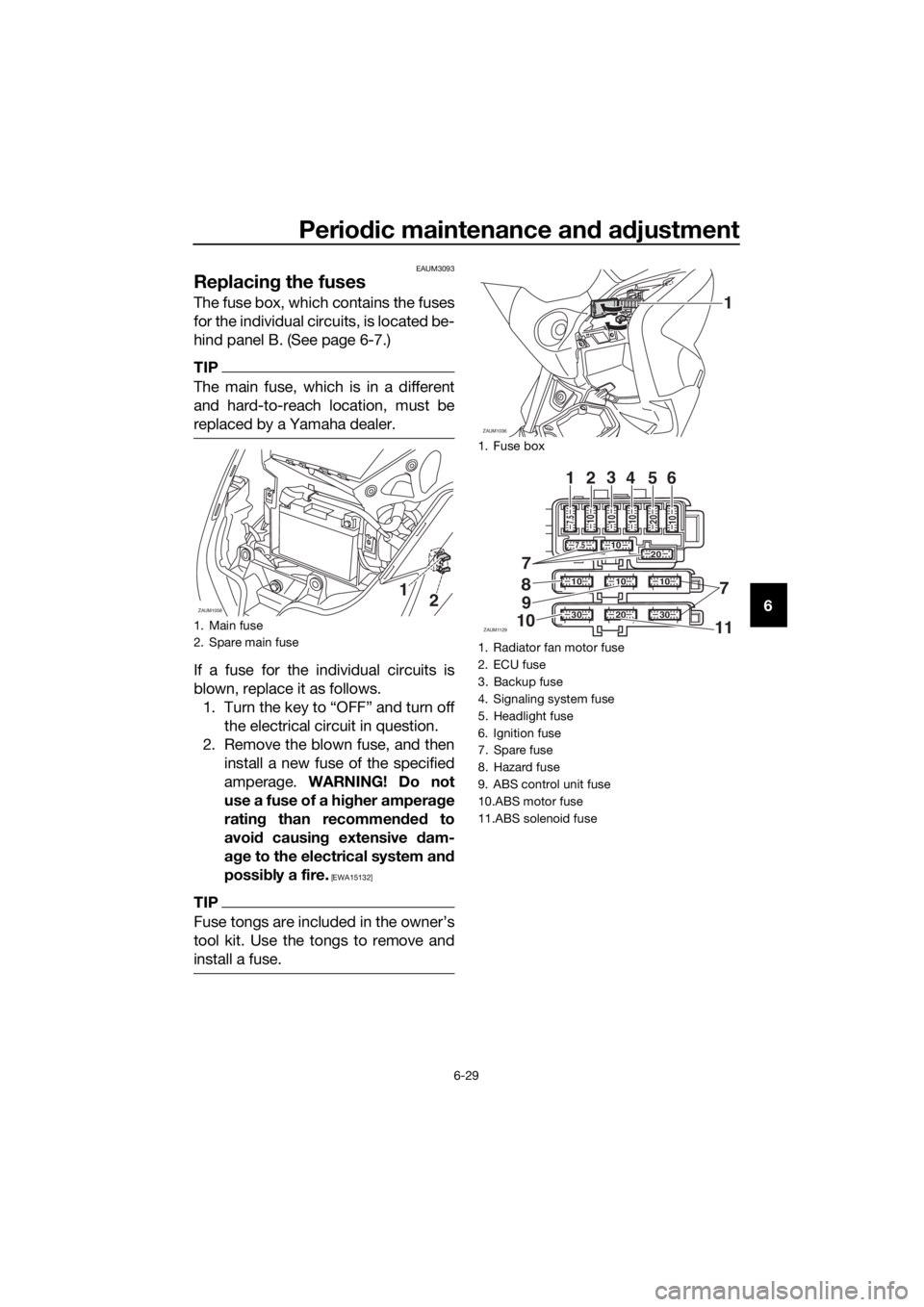
The fuse box, which contains the fuses
for the individual circuits, is located be-
hind panel B. (See page 6-7.)
TIP
The main fuse, which is in a different
and hard-to-reach location, must be
replaced by a Yamaha dealer.
If a fuse for the individual circuits is
blown, replace it as follows.
1.
the electrical circuit in question.
2. Remove the blown fuse, and then
install a new fuse of the specified
amperage. WARNING! Do not
use a fuse of a higher amperage
rating than recommended to
avoid causing extensive dam-
age to the electrical system and
possibly a fire.
[EWA15132]
TIP
tool kit. Use the tongs to remove and
install a fuse.
1. Main fuse
2. Spare main fuse
ZAUM1058112
1. Fuse box
1. Radiator fan motor fuse
2. ECU fuse
3. Backup fuse
4. Signaling system fuse
5. Headlight fuse
6. Ignition fuse
7. Spare fuse
8. Hazard fuse
9. ABS control unit fuse
10.ABS motor fuse
11.ABS solenoid fuse
ZAUM1036
1
ZAUM1129
101010
203030
7
7
11
123
4
56
20 10
20
1010 10107.5
7.5
9
10
U2DME3E0.book Page 29 Friday, June 10, 2016 2:25 PM
Page 76 of 96

Periodic maintenance and adjustment
6-30
6
3. Turn the key to “ON” and turn on
the electrical circuit in question to
check if the device operates.
4. If the fuse immediately blows
again, have a Yamaha dealer
check the electrical system.
EAU34242
Replacing a headlight bulb
This model is equipped with halogen
bulb headlights. If a headlight bulb
burns out, have a Yamaha dealer re-
place it and, if necessary, adjust the
headlight beam.
Specified fuses:
Main fuse:
30.0 A
Ignition fuse:
10.0 A
Signaling system fuse:
10.0 A
Headlight fuse:
20.0 A
Turn signal light and hazard fuse:
10.0 A
Radiator fan motor fuse:
7.5 A
ABS control unit fuse:
10.0 A
ABS motor fuse:
30.0 A
ABS solenoid fuse:
20.0 A
Backup fuse:
10.0 A
U2DME3E0.book Page 30 Friday, June 10, 2016 2:25 PM
Page 77 of 96

Periodic maintenance and adjustment
6-31
6
EAUM3860
Auxiliary light bulbs
If an auxiliary light does not come on,
have a Yamaha dealer check the elec-
trical circuit or replace the bulb.
EAU24182
Tail/brake light
This model is equipped with an LED-
type tail/brake light.
If the tail/brake light does not come on,
have a Yamaha dealer check it.
U2DME3E0.book Page 31 Friday, June 10, 2016 2:25 PM
Page 78 of 96
Periodic maintenance and adjustment
6-32
6
EAU39881
Front turn signal light
If a front turn signal light does not
come on, have a Yamaha dealer check
its electrical circuit or replace the bulb.
EAUM3062
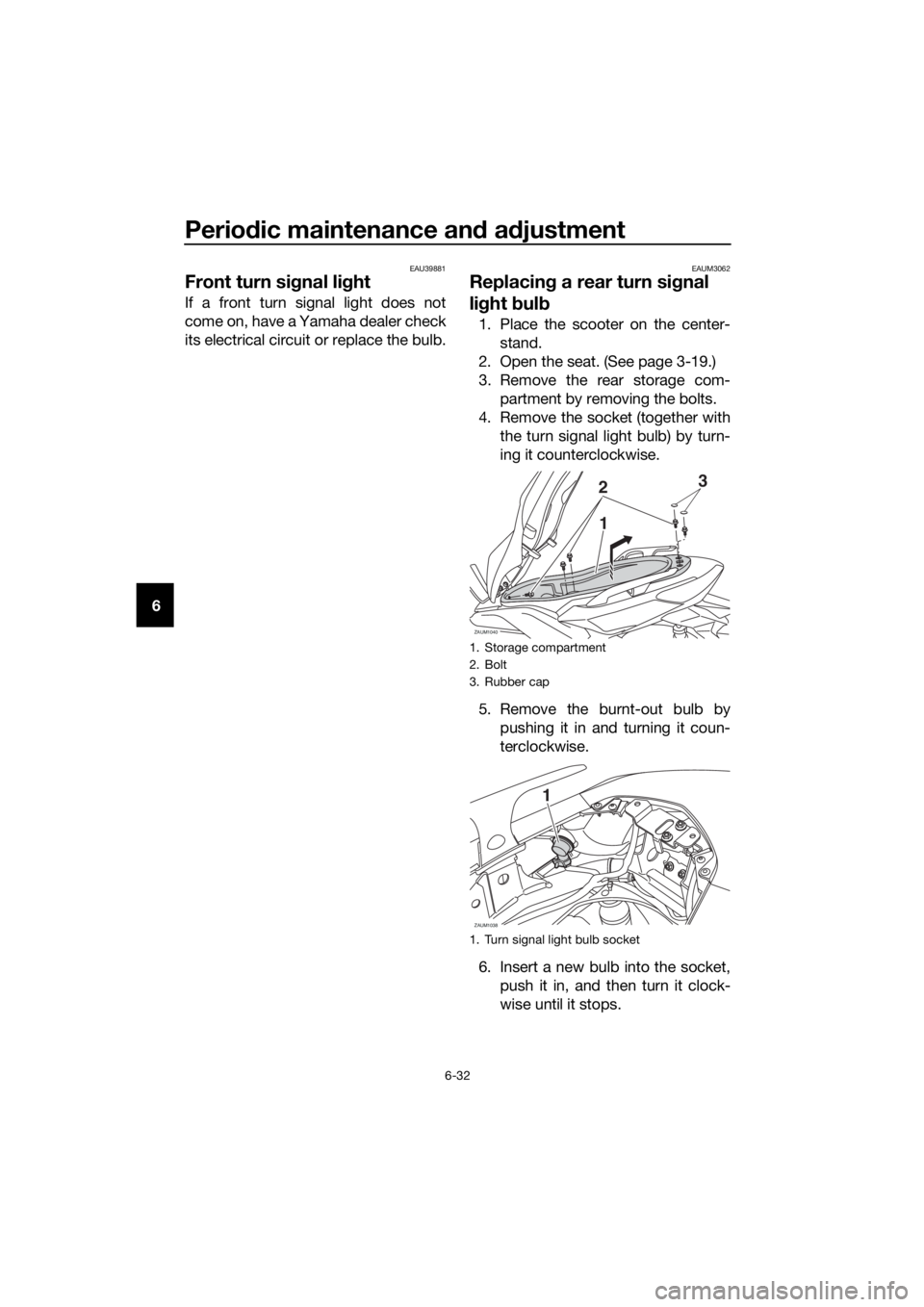
Replacing a rear turn signal
light bulb
1. Place the scooter on the center-
stand.
2. Open the seat. (See page 3-19.)
3. Remove the rear storage com-
partment by removing the bolts.
4. Remove the socket (together with
the turn signal light bulb) by turn-
ing it counterclockwise.
5. Remove the burnt-out bulb by
pushing it in and turning it coun-
terclockwise.
6. Insert a new bulb into the socket,
push it in, and then turn it clock-
wise until it stops.
1. Storage compartment
2. Bolt
3. Rubber cap
1. Turn signal light bulb socket
ZAUM1040
23
1
ZAUM1038
1
U2DME3E0.book Page 32 Friday, June 10, 2016 2:25 PM
Page 79 of 96
Periodic maintenance and adjustment
6-33
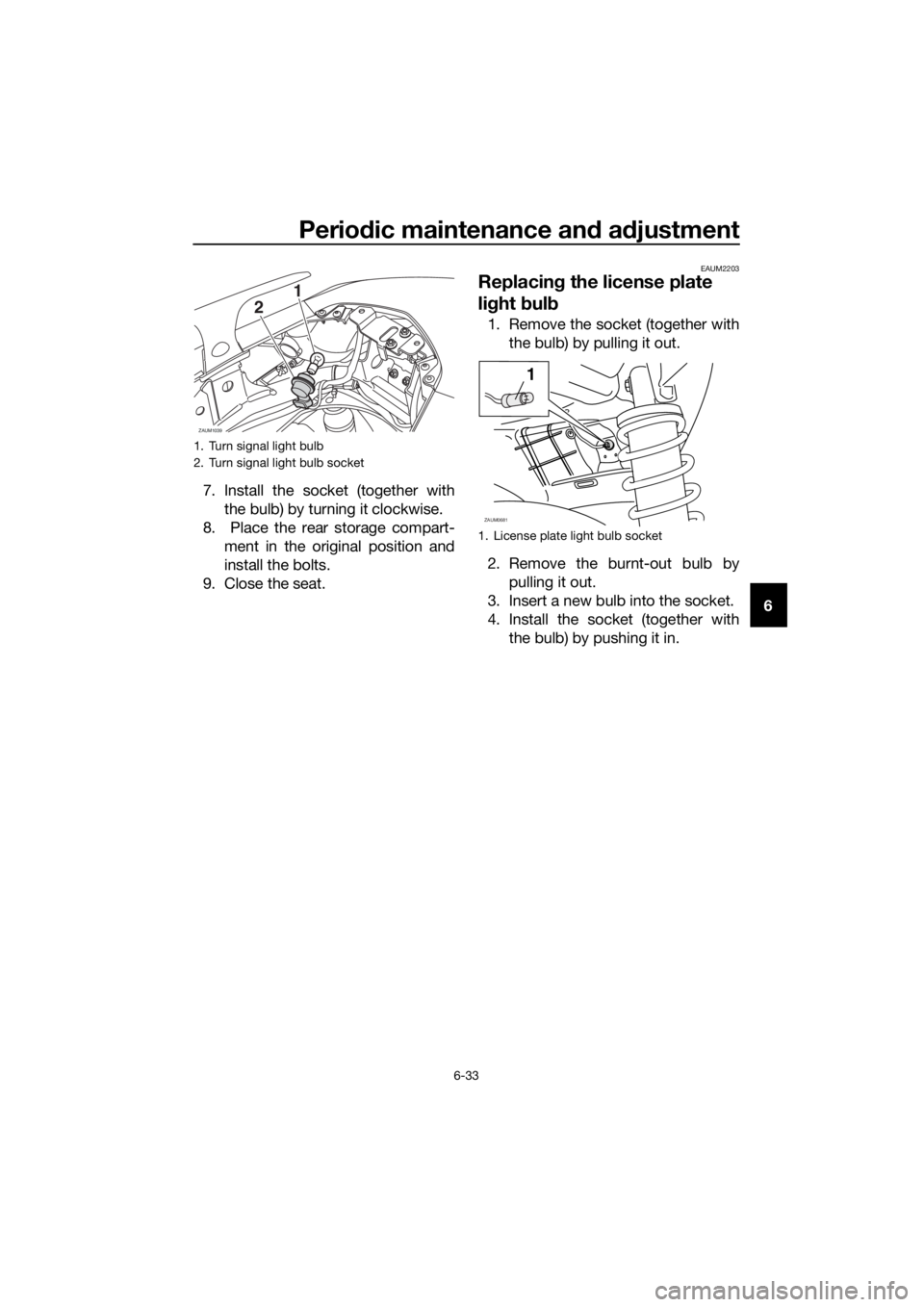
6 7. Install the socket (together with
the bulb) by turning it clockwise.
8. Place the rear storage compart-
ment in the original position and
install the bolts.
9. Close the seat.
EAUM2203
Replacing the license plate
light bulb
1. Remove the socket (together with
the bulb) by pulling it out.
2. Remove the burnt-out bulb by
pulling it out.
3. Insert a new bulb into the socket.
4. Install the socket (together with
the bulb) by pushing it in.
1. Turn signal light bulb
2. Turn signal light bulb socket
ZAUM1039
1
2
1. License plate light bulb socket
ZAUM0681
1
U2DME3E0.book Page 33 Friday, June 10, 2016 2:25 PM
Page 80 of 96
Periodic maintenance and adjustment
6-34
6
EAU25882
Troubleshooting
Although Yamaha scooters receive a
thorough inspection before shipment
from the factory, trouble may occur
during operation. Any problem in the
fuel, compression, or ignition systems,
for example, can cause poor starting
and loss of power.
The following troubleshooting charts
represent quick and easy procedures
for checking these vital systems your-
self. However, should your scooter re-
quire any repair, take it to a Yamaha
dealer, whose skilled technicians have
the necessary tools, experience, and
know-how to service the scooter prop-
erly.
Use only genuine Yamaha replace-
ment parts. Imitation parts may look
like Yamaha parts, but they are often
inferior, have a shorter service life and
can lead to expensive repair bills.
WARNING
EWA15142
When checking the fuel system, do
not smoke, and make sure there are
no open flames or sparks in the ar-
ea, including pilot lights from water
heaters or furnaces. Gasoline or
gasoline vapors can ignite or ex-
plode, causing severe injury or prop-
erty damage.
U2DME3E0.book Page 34 Friday, June 10, 2016 2:25 PM
Page 84 of 96

Scooter care and storage
7-2
7structed. Also, thoroughly rinse
the area off with water, immedi-
ately dry it, and then apply a cor-
rosion protection spray.
Improper cleaning can damage
plastic parts (such as cowlings,
panels, windshields, headlight
lenses, meter lenses, etc.) and
the mufflers. Use only a soft,
clean cloth or sponge with wa-
ter to clean plastic. However, if
the plastic parts cannot be thor-
oughly cleaned with water, di-
luted mild detergent with water
may be used. Be sure to rinse
off any detergent residue using
plenty of water, as it is harmful
to plastic parts.
Do not use any harsh chemical
products on plastic parts. Be
sure to avoid using cloths or
sponges which have been in
contact with strong or abrasive
cleaning products, solvent or
thinner, fuel (gasoline), rust re-
movers or inhibitors, brake fluid,
antifreeze or electrolyte.
Do not use high-pressure wash-
ers or steam-jet cleaners since
they cause water seepage and
deterioration in the following ar-
eas: seals (of wheel and swing-
arm bearings, fork and brakes),
electric components (couplers,
connectors, instruments,
switches and lights), breather
hoses and vents.
For scooters equipped with a
windshield: Do not use strong
cleaners or hard sponges as
they will cause dulling or
scratching. Some cleaningcompounds for plastic may
leave scratches on the wind-
shield. Test the product on a
small hidden part of the wind-
shield to make sure that it does
not leave any marks. If the wind-
shield is scratched, use a quality
plastic polishing compound
af-
ter washing.
After normal use
Remove dirt with warm water, a mild
detergent, and a soft, clean sponge,
and then rinse thoroughly with clean
water. Use a toothbrush or bottlebrush
for hard-to-reach areas. Stubborn dirt
and insects will come off more easily if
the area is covered with a wet cloth for
a few minutes before cleaning.
After riding in the rain, near the sea or
on salt-sprayed roads
Since sea salt or salt sprayed on the
roads during winter are extremely cor-
rosive in combination with water, carry
out the following steps after each ride
in the rain, near the sea or on salt-
sprayed roads.
TIP
Salt sprayed on roads in the winter
may remain well into spring.
1. Clean the scooter with cold water
and a mild detergent after the en-
gine has cooled down. NOTICE:
Do not use warm water since it
increases the corrosive action
of the salt.
[ECA10792]
2. Apply a corrosion protection spray
on all metal, including chrome-
and nickel-plated, surfaces to pre-
vent corrosion.
U2DME3E0.book Page 2 Friday, June 10, 2016 2:25 PM