light YAMAHA XMAX 125 2018 Owner's Manual
[x] Cancel search | Manufacturer: YAMAHA, Model Year: 2018, Model line: XMAX 125, Model: YAMAHA XMAX 125 2018Pages: 114, PDF Size: 8.24 MB
Page 59 of 114
Operation and important riding points
6-2
6
EAU78231
Starting the engine
NOTICE
ECA10251
See page 6-5 for engine break-in in-
structions prior to operating the ve-
hicle for the first time.
In order for the ignition circuit cut-off
system to enable starting, the side-
stand must be up. (See page 4-27.)
1. Turn the main switch on and make
sure that the stop/run/start switch
is set to “ ”.
The following warning lights and
indicator lights should come on for
a few seconds, then go off.
Engine trouble warning light
Traction control system indi-
cator light
Smart key system indicator
light
TIP
The ABS warning light should come on
and stay on until the vehicle reaches a
traveling speed of 10 km/h (6 mi/h) or
higher.
NOTICE
ECA22510
If a warning or indicator light does
not work as described above, see
page 4-1 for the corresponding
warning and indicator light circuit
check.
2. Close the throttle.
3. While applying the front or rear
brake, push the “ ” side of the
stop/run/start switch. Release it
when the engine starts.
TIP
If the engine does not start, release the
start switch after 5 seconds. Before
pressing the start switch again, wait 10
seconds to allow battery voltage to re-
store.
NOTICE
ECA11043
For maximum engine life, never ac-
celerate hard when the engine is
cold!
UBL2E0E0.book Page 2 Friday, June 23, 2017 9:30 AM
Page 62 of 114
Operation and important riding points
6-5
6
EAU16821
Tips for reducing fuel con-
sumption
Fuel consumption depends largely on
your riding style. Consider the follow-
ing tips to reduce fuel consumption:
Avoid high engine speeds during
acceleration.
Avoid high engine speeds with no
load on the engine.
Turn the engine off instead of let-
ting it idle for an extended length
of time (e.g., in traffic jams, at traf-
fic lights or at railroad crossings).
EAU16831
Engine break-in
There is never a more important period
in the life of your engine than the period
between 0 and 1000 km (600 mi). For
this reason, you should read the fol-
lowing material carefully.
Since the engine is brand new, do not
put an excessive load on it for the first
1000 km (600 mi). The various parts in
the engine wear and polish themselves
to the correct operating clearances.
During this period, prolonged full-throt-
tle operation or any condition that
might result in engine overheating
must be avoided.
EAUS1841
0–500 km (0–300 mi)
Avoid prolonged operation above 5000
r/min.
500–1000 km (300–600 mi)
Avoid prolonged operation above 7500
r/min. NOTICE: After 1000 km (600
mi) of operation, be sure to replace
the engine oil, final transmission oil
and the oil filter element.
[ECA12932]
1000 km (600 mi) and beyond
The vehicle can now be operated nor-
mally.
NOTICE
ECA10311
Keep the engine speed out of
the tachometer red zone.
If any engine trouble should oc-
cur during the engine break-in
period, immediately have a
Yamaha dealer check the vehi-
cle.
UBL2E0E0.book Page 5 Friday, June 23, 2017 9:30 AM
Page 69 of 114
Periodic maintenance and adjustment
7-6
7
EAU72790
TIP
Engine air filter and V-belt air filter
• This model’s engine air filter is equipped with a disposable oil-coated pa-
per element, which must not be cleaned with compressed air to avoid
damaging it.
• The engine air filter element needs to be replaced and the V-belt air filter
element needs to be serviced more frequently when riding in unusually wet
or dusty areas.
Hydraulic brake service
• After disassembling the brake master cylinders and calipers, always
change the fluid. Regularly check the brake fluid levels and fill the reser-
voirs as required.
• Every two years replace the internal components of the brake master cyl-
inders and calipers, and change the brake fluid.
• Replace the brake hoses every four years and if cracked or damaged.
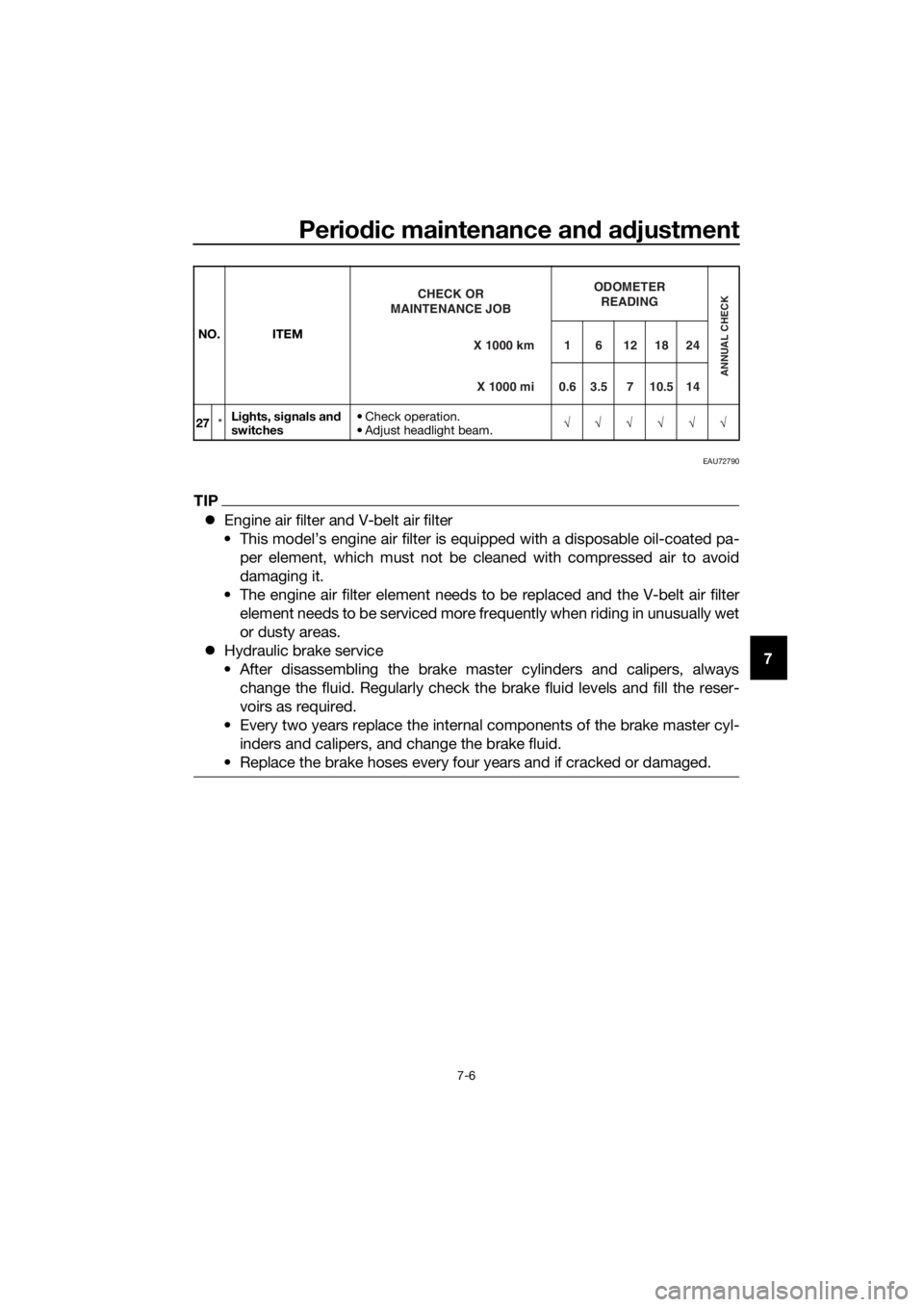
27*Lights, signals and
switches• Check operation.
• Adjust headlight beam.√√√√√√ NO. ITEM
X 1000 km CHECK OR
MAINTENANCE JOB
X 1000 mi
ODOMETER
READING
ANNUAL CHECK
16121824
0.63.5710.514
UBL2E0E0.book Page 6 Friday, June 23, 2017 9:30 AM
Page 71 of 114
Periodic maintenance and adjustment
7-8
7
EAU19623
Checking the spark plug
The spark plug is an important engine
component, which should be checked
periodically, preferably by a Yamaha
dealer. Since heat and deposits will
cause any spark plug to slowly erode,
it should be removed and checked in
accordance with the periodic mainte-
nance and lubrication chart. In addi-
tion, the condition of the spark plug
can reveal the condition of the engine.
The porcelain insulator around the
center electrode of the spark plug
should be a medium-to-light tan (the
ideal color when the vehicle is ridden
normally). If the spark plug shows a
distinctly different color, the engine
could be operating improperly. Do not
attempt to diagnose such problems
yourself. Instead, have a Yamaha deal-
er check the vehicle.
If the spark plug shows signs of elec-
trode erosion and excessive carbon or
other deposits, it should be replaced.
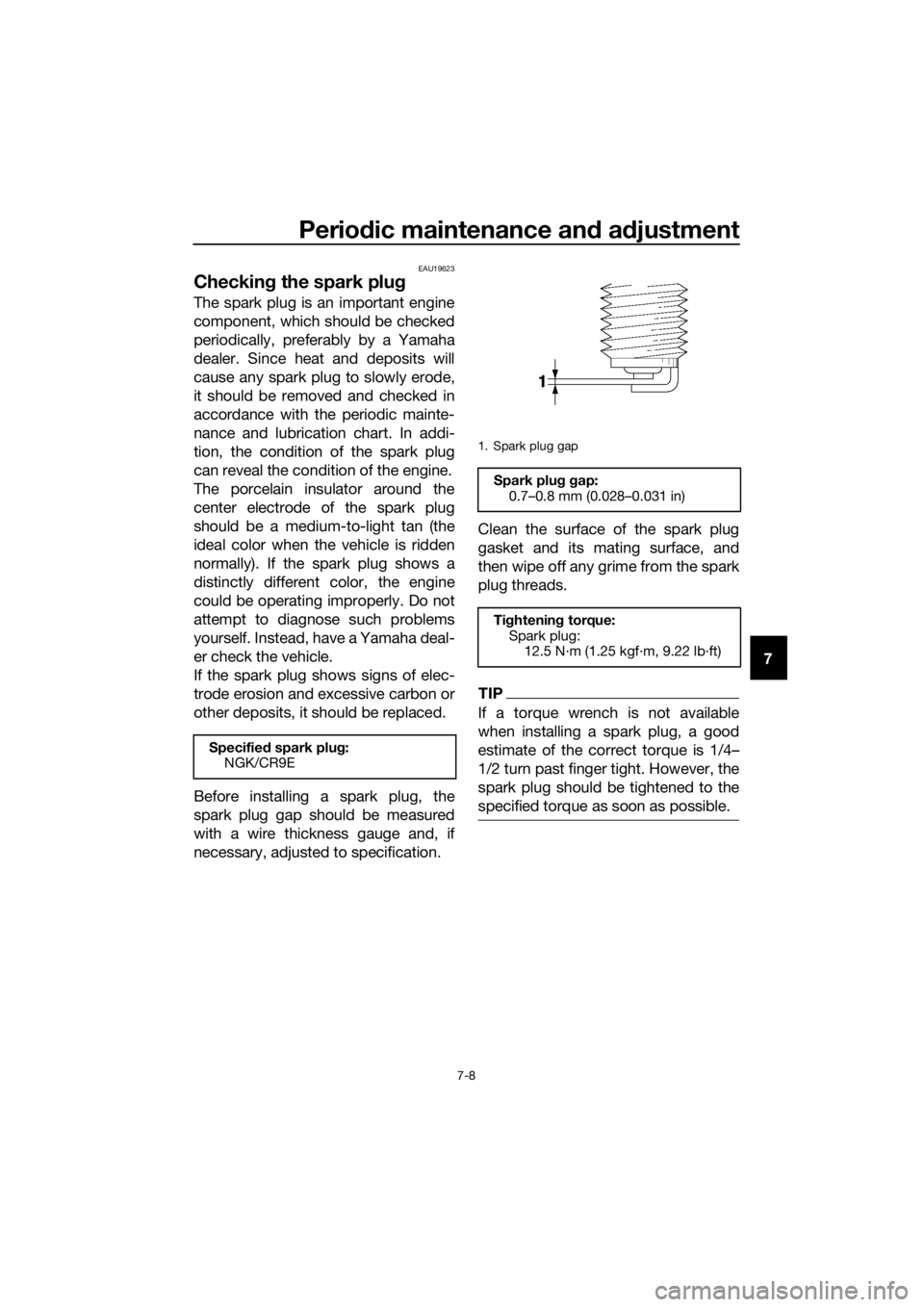
Before installing a spark plug, the
spark plug gap should be measured
with a wire thickness gauge and, if
necessary, adjusted to specification.Clean the surface of the spark plug
gasket and its mating surface, and
then wipe off any grime from the spark
plug threads.
TIP
If a torque wrench is not available
when installing a spark plug, a good
estimate of the correct torque is 1/4…
1/2 turn past finger tight. However, the
spark plug should be tightened to the
specified torque as soon as possible.
Specified spark plug:
NGK/CR9E
1. Spark plug gap
Spark plug gap:
0.7–0.8 mm (0.028–0.031 in)
Tightening torque:
Spark plug:
12.5 N·m (1.25 kgf·m, 9.22 lb·ft)
UBL2E0E0.book Page 8 Friday, June 23, 2017 9:30 AM
Page 72 of 114
Periodic maintenance and adjustment
7-9
7
EAUM3332
Engine oil
The engine oil level should be checked
before each ride. In addition, the oil
must be changed at the intervals spec-
ified in the periodic maintenance and
lubrication chart and when the service
indicator light comes on.
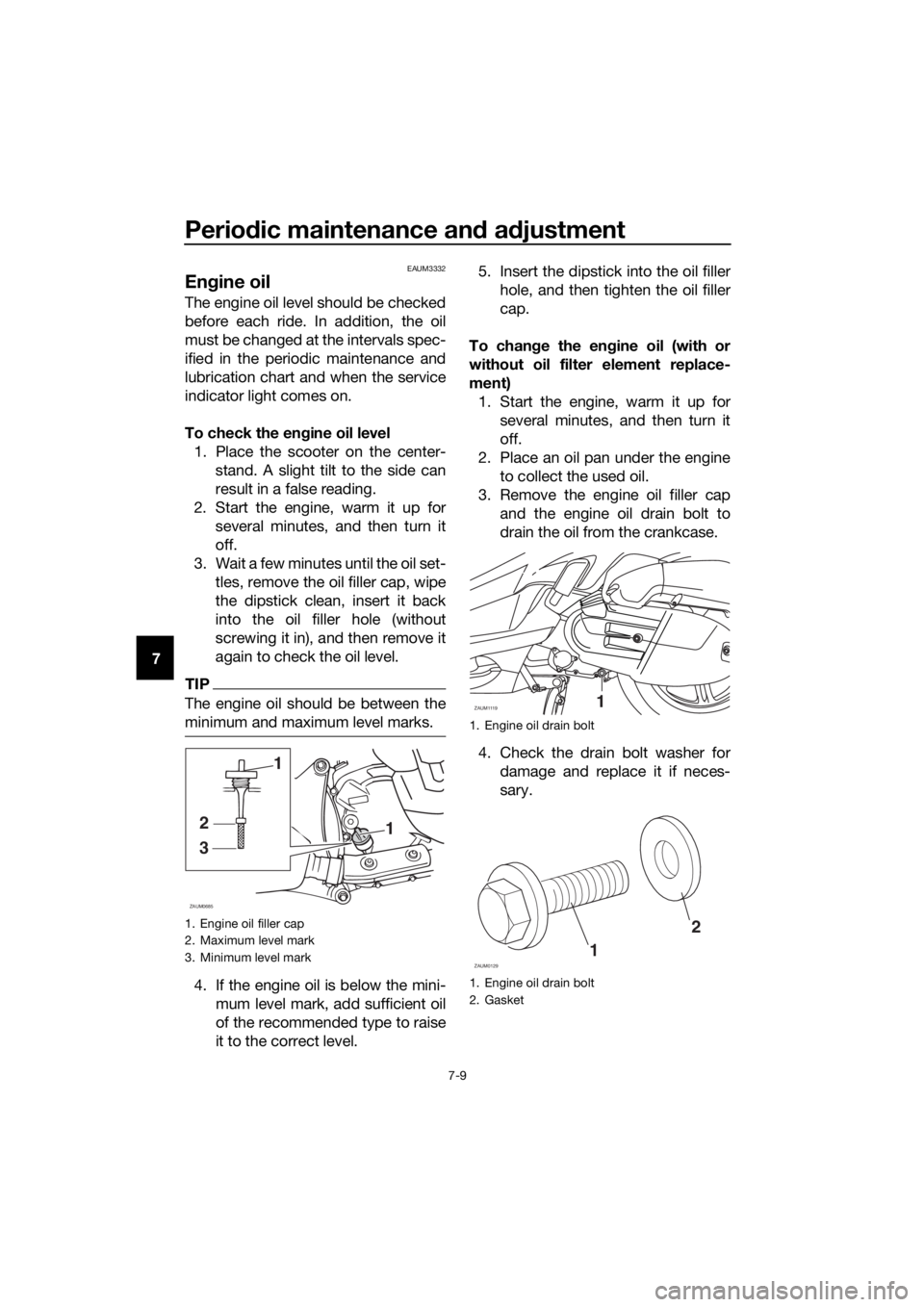
To check the engine oil level
1. Place the scooter on the center-
stand. A slight tilt to the side can
result in a false reading.
2. Start the engine, warm it up for
several minutes, and then turn it
off.
3. Wait a few minutes until the oil set-
tles, remove the oil filler cap, wipe
the dipstick clean, insert it back
into the oil filler hole (without
screwing it in), and then remove it
again to check the oil level.
TIP
The engine oil should be between the
minimum and maximum level marks.
4. If the engine oil is below the mini-
mum level mark, add sufficient oil
of the recommended type to raise
it to the correct level.5. Insert the dipstick into the oil filler
hole, and then tighten the oil filler
cap.
To change the engine oil (with or
without oil filter element replace-
ment)
1. Start the engine, warm it up for
several minutes, and then turn it
off.
2. Place an oil pan under the engine
to collect the used oil.
3. Remove the engine oil filler cap
and the engine oil drain bolt to
drain the oil from the crankcase.
4. Check the drain bolt washer for
damage and replace it if neces-
sary.
1. Engine oil filler cap
2. Maximum level mark
3. Minimum level mark
1
3
2
1
ZAUM0685
1. Engine oil drain bolt
1. Engine oil drain bolt
2. Gasket
ZAUM11191
1
2
ZAUM0129
UBL2E0E0.book Page 9 Friday, June 23, 2017 9:30 AM
Page 75 of 114
Periodic maintenance and adjustment
7-12
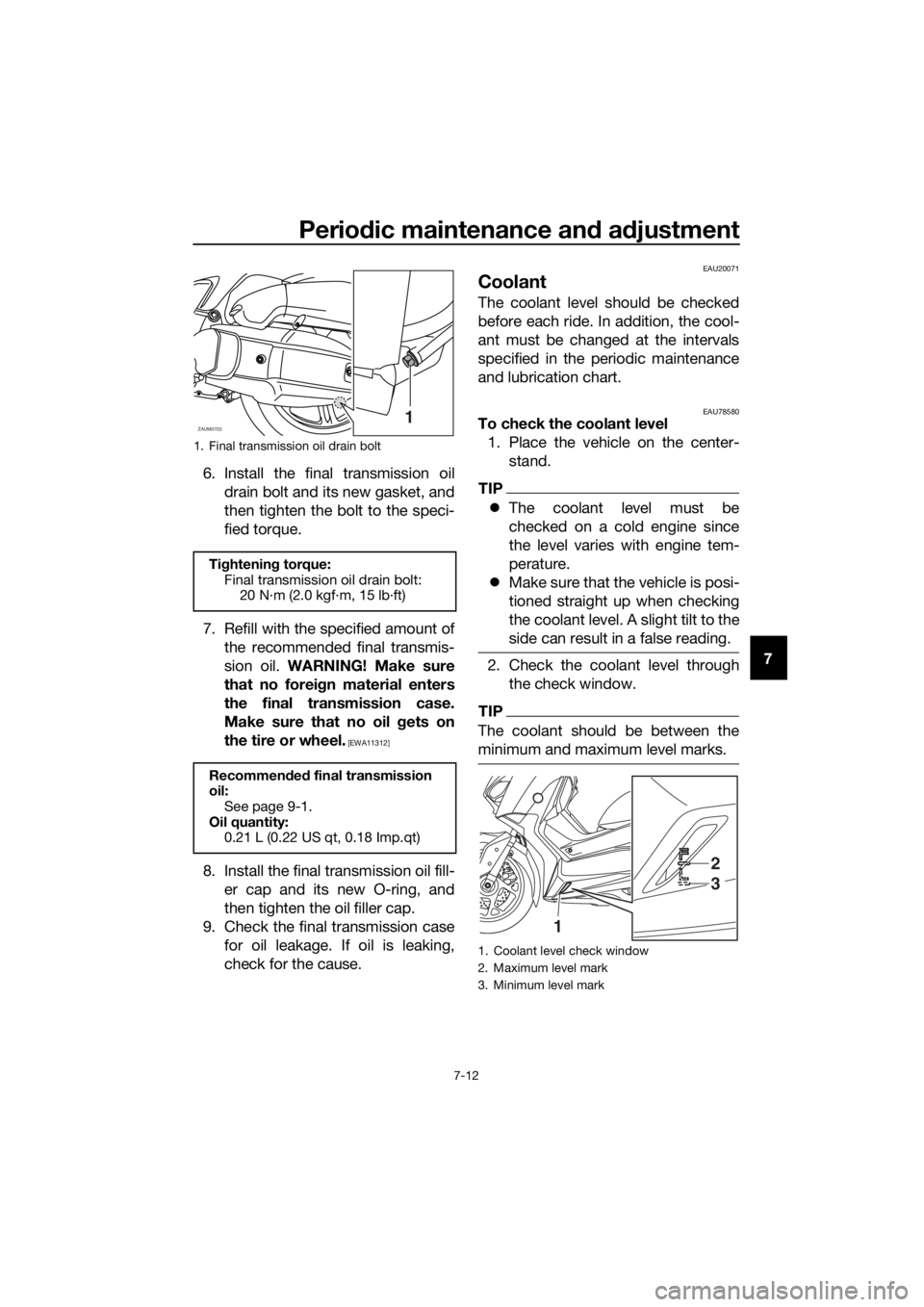
7 6. Install the final transmission oil
drain bolt and its new gasket, and
then tighten the bolt to the speci-
fied torque.
7. Refill with the specified amount of
the recommended final transmis-
sion oil. WARNING! Make sure
that no foreign material enters
the final transmission case.
Make sure that no oil gets on
the tire or wheel.
[EWA11312]
8. Install the final transmission oil fill-
er cap and its new O-ring, and
then tighten the oil filler cap.
9. Check the final transmission case
for oil leakage. If oil is leaking,
check for the cause.
EAU20071
Coolant
The coolant level should be checked
before each ride. In addition, the cool-
ant must be changed at the intervals
specified in the periodic maintenance
and lubrication chart.
EAU78580To check the coolant level
1. Place the vehicle on the center-
stand.
TIP
The coolant level must be
checked on a cold engine since
the level varies with engine tem-
perature.
Make sure that the vehicle is posi-
tioned straight up when checking
the coolant level. A slight tilt to the
side can result in a false reading.
2. Check the coolant level through
the check window.
TIP
The coolant should be between the
minimum and maximum level marks.
1. Final transmission oil drain bolt
Tightening torque:
Final transmission oil drain bolt:
20 N·m (2.0 kgf·m, 15 lb·ft)
Recommended final transmission
oil:
See page 9-1.
Oil quantity:
0.21 L (0.22 US qt, 0.18 Imp.qt)
ZAUM07031
1. Coolant level check window
2. Maximum level mark
3. Minimum level mark
1
2
3
UBL2E0E0.book Page 12 Friday, June 23, 2017 9:30 AM
Page 91 of 114
Periodic maintenance and adjustment
7-28
7
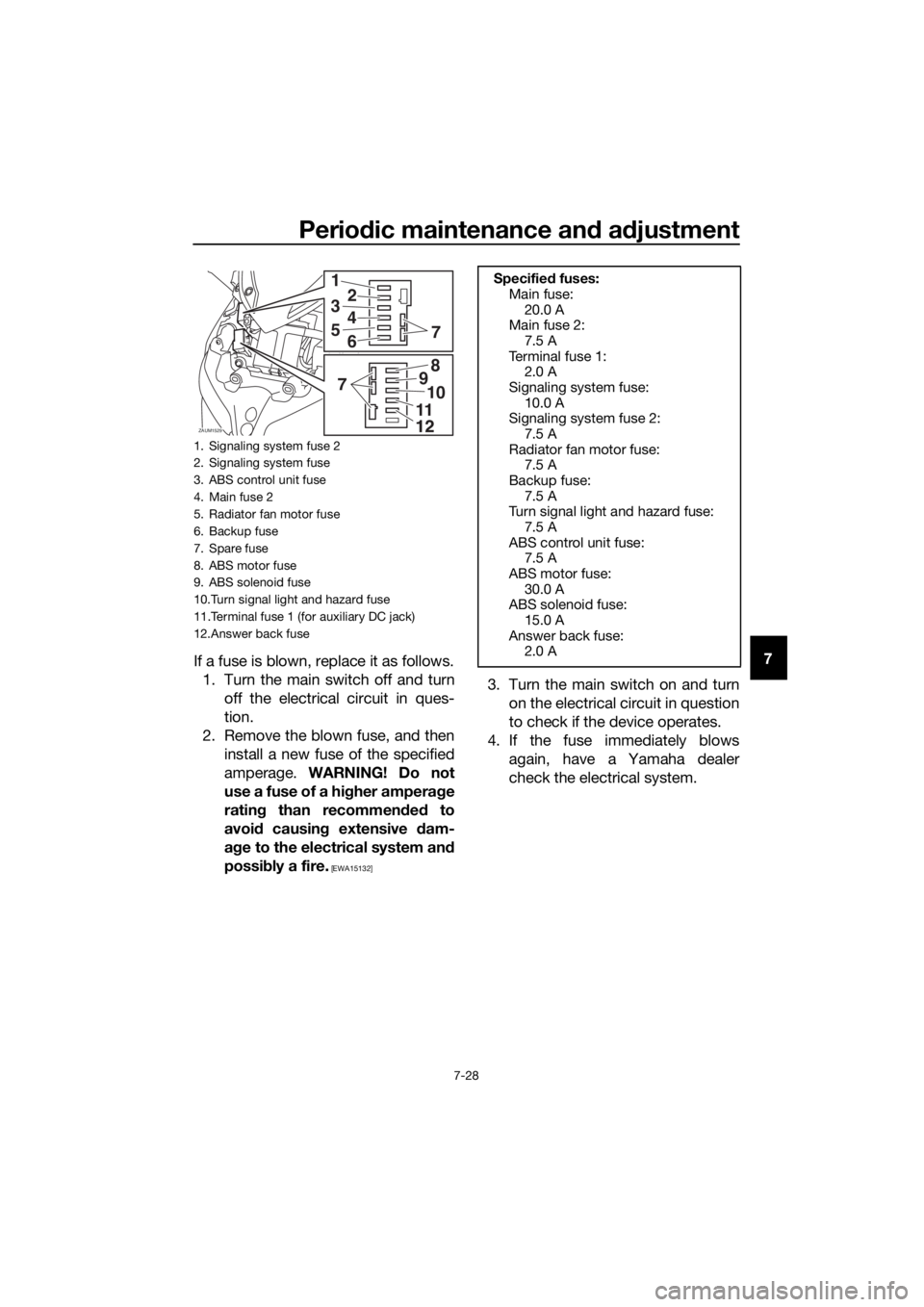
If a fuse is blown, replace it as follows.
1. Turn the main switch off and turn
off the electrical circuit in ques-
tion.
2. Remove the blown fuse, and then
install a new fuse of the specified
amperage. WARNING! Do not
use a fuse of a higher amperage
rating than recommended to
avoid causing extensive dam-
age to the electrical system and
possibly a fire.
[EWA15132]
3. Turn the main switch on and turn
on the electrical circuit in question
to check if the device operates.
4. If the fuse immediately blows
again, have a Yamaha dealer
check the electrical system.
1. Signaling system fuse 2
2. Signaling system fuse
3. ABS control unit fuse
4. Main fuse 2
5. Radiator fan motor fuse
6. Backup fuse
7. Spare fuse
8. ABS motor fuse
9. ABS solenoid fuse
10.Turn signal light and hazard fuse
11.Terminal fuse 1 (for auxiliary DC jack)
12.Answer back fuse
ZAUM1529
1234567
8910
11
7
Specified fuses:
Main fuse:
20.0 A
Main fuse 2:
7.5 A
Terminal fuse 1:
2.0 A
Signaling system fuse:
10.0 A
Signaling system fuse 2:
7.5 A
Radiator fan motor fuse:
7.5 A
Backup fuse:
7.5 A
Turn signal light and hazard fuse:
7.5 A
ABS control unit fuse:
7.5 A
ABS motor fuse:
30.0 A
ABS solenoid fuse:
15.0 A
Answer back fuse:
2.0 A
UBL2E0E0.book Page 28 Friday, June 23, 2017 9:30 AM
Page 92 of 114
Periodic maintenance and adjustment
7-29
7
EAU64070
Headlights
This model is equipped with LED-type
headlights.
If a headlight does not come on, have
a Yamaha dealer check its electrical
circuit.
NOTICE
ECA16581
Do not affix any type of tinted film or
stickers to the headlight lens.
EAU54502
Auxiliary lights
This model is equipped with LED-type
auxiliary lights.
If an auxiliary light does not come on,
have a Yamaha dealer check it.
UBL2E0E0.book Page 29 Friday, June 23, 2017 9:30 AM
Page 93 of 114

Periodic maintenance and adjustment
7-30
7
EAU70540
Brake/tail light
This model is equipped with an LED-
type brake/tail light.
If the brake/tail light does not come on,
have a Yamaha dealer check it.
EAU39881
Front turn signal light
If a front turn signal light does not
come on, have a Yamaha dealer check
its electrical circuit or replace the bulb.
UBL2E0E0.book Page 30 Friday, June 23, 2017 9:30 AM
Page 94 of 114
Periodic maintenance and adjustment
7-31
7
EAUT1331
Rear turn signal light bulb
If a rear turn signal light does not come
on, have a Yamaha dealer check the
electrical circuit or replace the bulb.
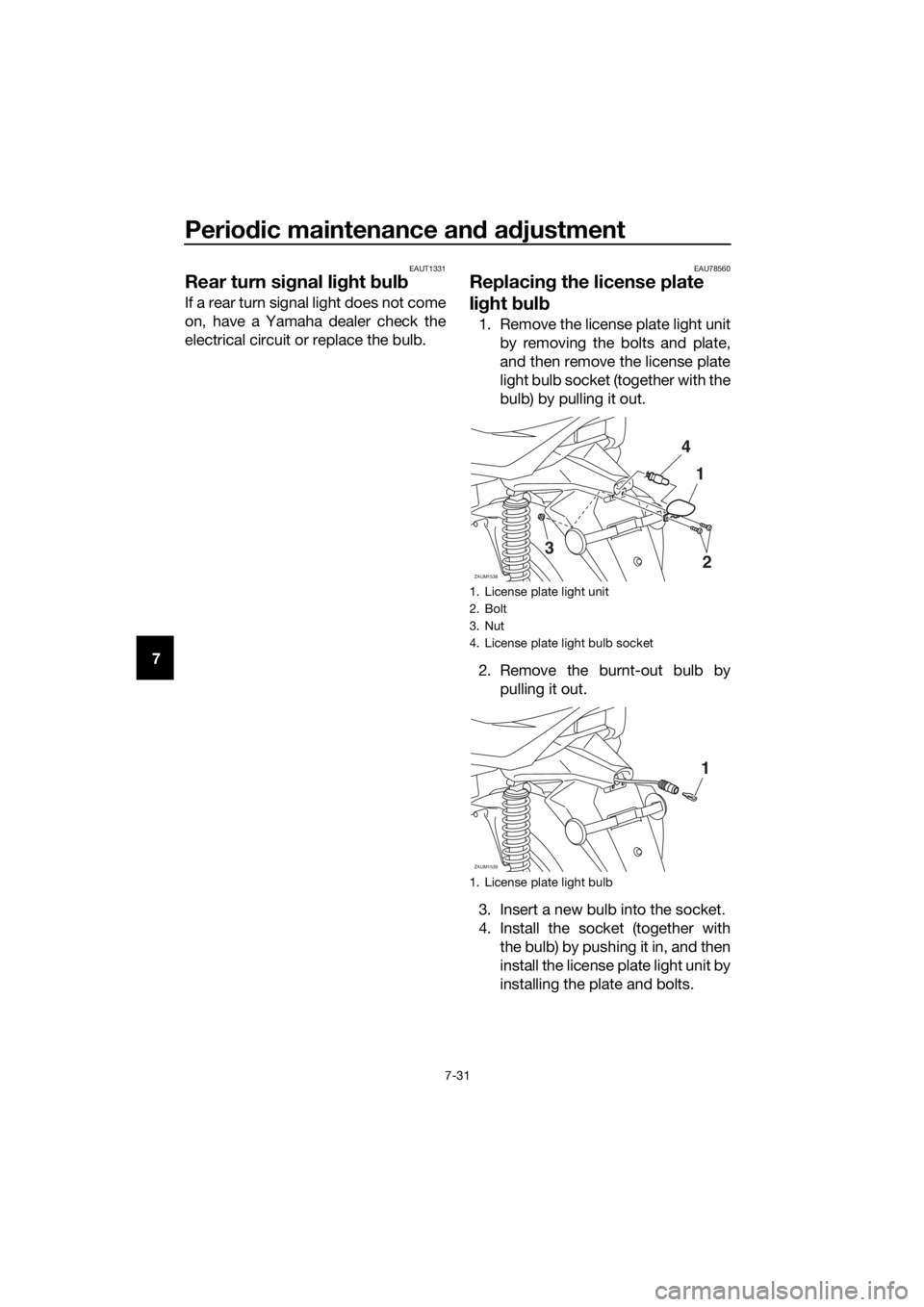
EAU78560
Replacing the license plate
light bulb
1. Remove the license plate light unit
by removing the bolts and plate,
and then remove the license plate
light bulb socket (together with the
bulb) by pulling it out.
2. Remove the burnt-out bulb by
pulling it out.
3. Insert a new bulb into the socket.
4. Install the socket (together with
the bulb) by pushing it in, and then
install the license plate light unit by
installing the plate and bolts.
1. License plate light unit
2. Bolt
3. Nut
4. License plate light bulb socket
1. License plate light bulb
ZAUM1538
1 4
3
2
ZAUM1539
1
UBL2E0E0.book Page 31 Friday, June 23, 2017 9:30 AM